
Reports
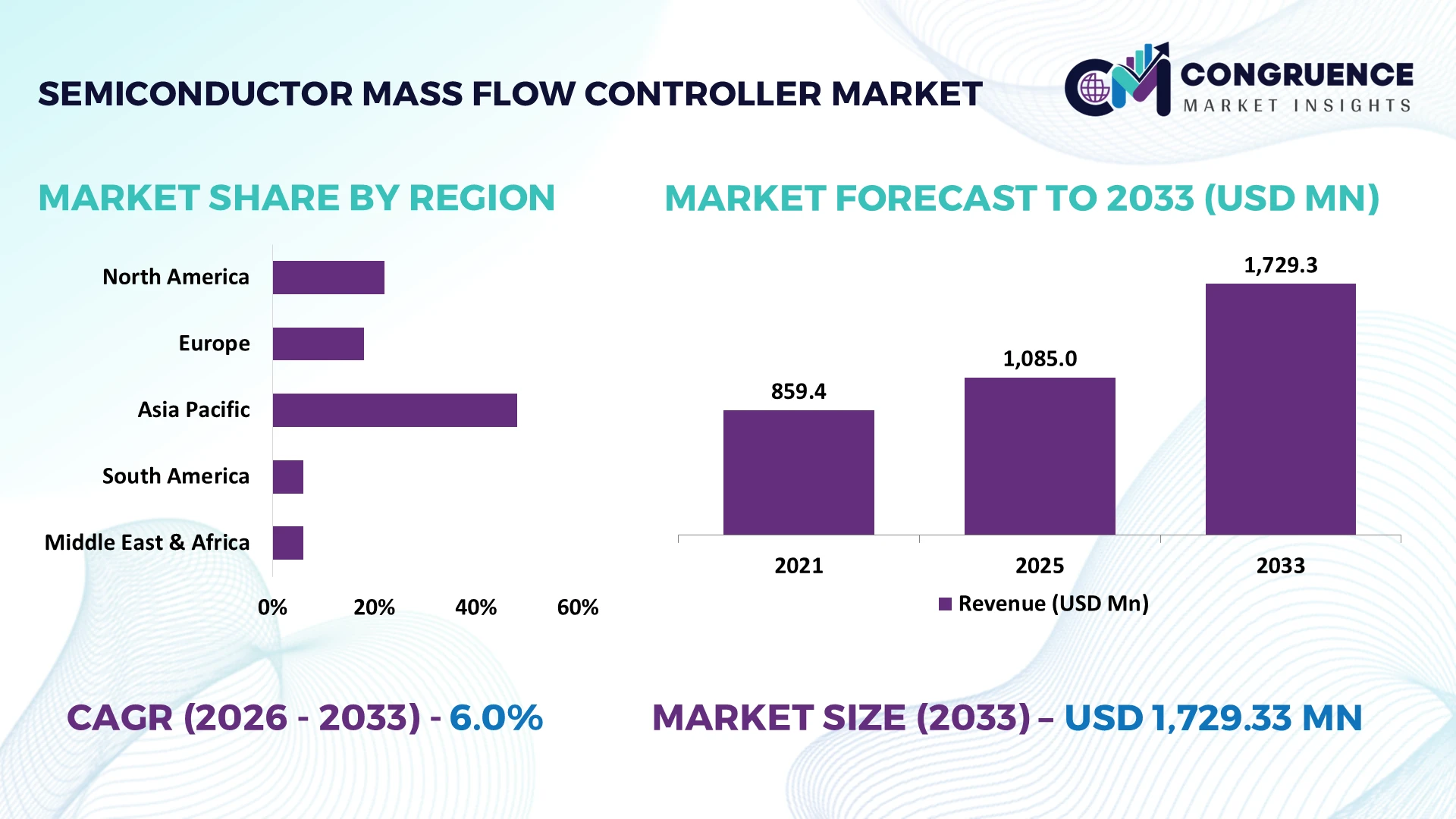
The Global Semiconductor Mass Flow Controller Market was valued at USD 1,085.0 Million in 2025 and is anticipated to reach a value of USD 1,729.3 Million by 2033 expanding at a CAGR of 6.0% between 2026 and 2033. Growth is driven by increasing adoption of atomic layer deposition (ALD), advanced chemical vapor deposition (CVD), plasma etching, and high-precision gas delivery systems requiring faster response times and sub-percent flow accuracy.
Taiwan holds a strategically important position in semiconductor manufacturing, supported by TSMC's advanced fabrication ecosystem and continuous investments in leading-edge production. Taiwan's semiconductor equipment billings reached USD 31.5 billion in 2025, increasing 90% year over year, while China recorded USD 49.3 billion in equipment billings. The US CHIPS Act is also accelerating domestic fab development and reshaping equipment procurement priorities. These developments reinforce demand for precision gas-flow instrumentation across major manufacturing hubs.
Manufacturers should prioritize localized technical support, advanced digital controllers, and qualification partnerships with semiconductor equipment OEMs to strengthen competitive positioning.
Market Size & Growth: The market advances from USD 1,085.0 million in 2025 to USD 1,729.3 million by 2033, supported by precision gas delivery requirements in advanced semiconductor fabrication.
Top Growth Drivers: Advanced-node manufacturing expansion, rising ALD/CVD adoption, and increasing demand for high-accuracy gas-flow regulation are the 3 principal growth drivers.
Short-Term Forecast: By 2028, faster-response feedback control, improved calibration, and digital monitoring will strengthen gas-switching performance and reduce process instability.
Emerging Technologies: Digital thermal controllers, pressure-based mass flow measurement, and model-based feedback systems are advancing precision, response time, and process repeatability.
Regional Leaders: Asia-Pacific benefits from Taiwan's advanced foundries and China's manufacturing scale; North America gains from US fab investment; Europe strengthens specialized semiconductor equipment production.
Consumer/End-User Trends: Semiconductor OEMs increasingly prioritize repeatability, low-flow accuracy, high-purity gas compatibility, and tool-level integration over standalone instrument pricing.
Pilot/Case Example: A 2025 research study demonstrated an estimated-output feedback approach for semiconductor gas-flow control, addressing transient overshoot, sensor noise, and steady-state error in ALD and etching processes.
Competitive Landscape: MKS Instruments, HORIBA, Fujikin, Azbil, and Bronkhorst compete through precision measurement, semiconductor-grade product qualification, and global technical support.
Regulatory & ESG Impact: The US CHIPS Act and semiconductor supply-chain diversification initiatives are encouraging domestic production investment, while accurate gas metering supports process efficiency and reduced material wastage.
Investment & Funding: Taiwan recorded USD 31.5 billion in semiconductor equipment billings in 2025, up 90% year over year, reinforcing demand for advanced process-control components.
Innovation & Future Outlook: Next-generation controllers will emphasize predictive calibration, faster feedback loops, digital diagnostics, and integration with automated gas delivery systems.
Demand for semiconductor mass flow controllers is concentrated in wafer fabrication, specialty gas delivery, deposition, etching, diffusion, and ion implantation. Digital multi-gas controllers, pressure-insensitive measurement, and faster feedback algorithms are improving process stability and reducing gas-flow deviations. With semiconductor manufacturing involving approximately 500 gas-related processes, manufacturers are increasingly prioritizing calibration traceability, repeatability, and rapid gas switching. This trend is strengthening the importance of integrated flow-control solutions in advanced fabrication equipment.
Semiconductor mass flow controllers are becoming strategically important because gas-flow precision directly influences wafer uniformity, deposition consistency, etching accuracy, and manufacturing yield. As fabrication moves toward more complex process architectures, equipment manufacturers increasingly treat flow controllers as critical process-control components rather than interchangeable instrumentation. The US CHIPS Act, which established USD 39 billion in manufacturing incentives, further reinforces the strategic importance of domestic semiconductor equipment and component supply chains.
Technology differentiation is shifting toward digital feedback, pressure-insensitive measurement, and faster transient response. Conventional thermal controllers face response delays during rapid gas switching, whereas model-based feedback approaches improve transient control while addressing sensor noise and steady-state errors. Taiwan and South Korea remain important advanced-node manufacturing centres, while the United States is expanding domestic fabrication capabilities.
Over the next 2–3 years, suppliers will prioritize semiconductor-grade qualification, multi-gas compatibility, predictive diagnostics, and local calibration services. For example, integrating faster-response controllers into ALD and plasma etching equipment improves gas-switching control. Manufacturers are responding through OEM partnerships, regional service expansion, and investment in digital instrumentation. Competitive advantage will increasingly depend on qualification reliability, process integration, and lifecycle support rather than purchase price alone.
The increasing complexity of ALD, CVD, and plasma etching processes is strengthening demand for high-precision mass flow controllers. Semiconductor manufacturing involves approximately 500 gas-related processes, making repeatable gas measurement essential for maintaining wafer quality and process consistency. Taiwan's semiconductor equipment billings increased 90% to USD 31.5 billion in 2025, reflecting substantial investment in advanced fabrication equipment. Rapid gas switching and tighter process tolerances are also accelerating digital feedback adoption. Suppliers are responding through multi-gas controller development, faster sensor architectures, and direct partnerships with equipment OEMs. A key strategic advantage lies in supplying qualified controllers that reduce process variability across multiple chambers rather than competing exclusively on instrument pricing.
Semiconductor-grade mass flow controllers face substantial qualification requirements because even minor measurement deviations can affect deposition uniformity and etching consistency. Specialized sensor components, precision valves, calibration infrastructure, and gas-compatible materials increase manufacturing and servicing costs. The concentration of advanced semiconductor equipment investment also exposes suppliers to regional procurement disruptions: China recorded USD 49.3 billion in equipment billings in 2025, while Taiwan recorded USD 31.5 billion. Export controls and geopolitical restrictions complicate sourcing and customer qualification across borders. Suppliers are mitigating these pressures through regional service networks, alternative component sourcing, long-term procurement agreements, and localized calibration facilities. The non-obvious constraint is that replacing an instrument is not simply a purchasing decision; requalification can create additional operational costs for fab operators.
Digital mass flow controllers offer opportunities through faster feedback, pressure-insensitive measurement, multi-gas compatibility, and improved calibration management. A 2025 research study introduced estimated-output feedback for semiconductor gas control, addressing transient overshoot and sensor-noise limitations in ALD and etching applications. Taiwan's 90% annual increase in semiconductor equipment billings also highlights the opportunity for suppliers to integrate controllers into expanding advanced-node production lines. Manufacturers can differentiate through predictive diagnostics, integrated flow verification, and reduced spare-parts requirements. Japan offers opportunities in precision instrumentation partnerships, while India presents an emerging opportunity through semiconductor manufacturing ecosystem development. Strategic investment in software-enabled calibration and OEM integration will strengthen supplier relationships and create recurring service opportunities.
Maintaining consistent flow performance across different gases, pressure conditions, chamber configurations, and manufacturing environments remains a significant execution challenge. Semiconductor tools require repeatable calibration, low measurement uncertainty, rapid response, and compatibility with demanding process conditions. The 2025 research on feedback-based gas control highlights the technical trade-off between faster response, sensor noise, and flow stability. Meanwhile, the concentration of equipment investment in Asia-Pacific, which represented 69% of projected 2024–2030 semiconductor equipment spending in PwC's analysis, increases the importance of dependable regional engineering support. Manufacturers must address interoperability, calibration traceability, cybersecurity in connected instruments, and skilled technical staffing through R&D investment and equipment partnerships. Long-term competitiveness will depend on maintaining measurement reliability throughout the controller's operating lifecycle.
Digital Calibration and Diagnostics: Semiconductor fabs are increasingly adopting digitally connected controllers with automated calibration records, real-time diagnostics, and communication protocols such as EtherCAT and PROFINET. Digital integration is reducing manual verification requirements and improving equipment traceability across production lines. As fabs pursue higher equipment availability and tighter process control, suppliers are expanding software-enabled product portfolios and remote-monitoring capabilities. The shift also makes calibration data a competitive differentiator during OEM qualification.
Advanced Gas Delivery Architectures: Multi-gas delivery systems are becoming more sophisticated as advanced deposition and etching processes require precise control across changing gas compositions. ALD and plasma processing are increasing the importance of rapid set-point transitions, low-flow measurement, and stable pressure compensation. Equipment manufacturers are responding with compact valve assemblies and integrated flow-control modules, reducing installation complexity and improving chamber-level process consistency.
Regional Fab Capacity Rebalancing: Semiconductor equipment investment is increasingly concentrated in China, Taiwan, and South Korea, which collectively accounted for 79% of global equipment billings in 2025. Taiwan's billings increased 90%, while South Korea recorded 26% growth. This investment concentration is changing procurement schedules for gas delivery equipment and increasing demand for locally available spare controllers. Suppliers are expanding regional inventories, technical service teams, and fab-level qualification support to reduce delivery interruptions.
Higher Precision in Gas Switching: Advanced fabrication is increasing the need for rapid-response controllers, particularly in ALD, plasma etching, and specialty-gas delivery. Pressure-based systems are gaining relevance alongside established thermal controllers, while Coriolis designs address specialized high-precision applications. The transition toward smaller process nodes and increasingly complex gas recipes is encouraging manufacturers to redesign sensing architectures, improve valve response, and strengthen controller compatibility with automated gas panels. The non-obvious shift is that response consistency across repeated gas pulses is becoming as important as nominal measurement accuracy.
The market is segmented into Thermal Mass Flow Controllers, Pressure-Based Mass Flow Controllers, Coriolis Mass Flow Controllers, and Other Specialized Controllers. Thermal MFCs dominate with an estimated 54.3% share in 2025, supported by established semiconductor tool integration, broad gas compatibility, and competitive manufacturing costs. Pressure-based controllers account for approximately 29.7%, benefiting from their suitability for corrosive gases and rapid-response applications. Coriolis controllers represent approximately 16.0% and are gaining adoption in applications requiring direct mass measurement and specialized precursor handling.
Thermal systems retain their advantage in standardized CVD and etching installations, whereas pressure-based and Coriolis technologies address increasingly demanding process conditions. Coriolis solutions represent the emerging growth opportunity as specialty chemistries and liquid precursor applications expand. Manufacturers are prioritizing sensor miniaturization, improved calibration stability, and application-specific product development. Consequently, investment is shifting toward differentiated sensing capabilities rather than replacing established thermal installations across entire fabs.
The market is segmented into Semiconductor Processing Furnaces, PVD & CVD Equipment, Etching Equipment, and Others. Semiconductor processing furnaces represent the leading application, accounting for approximately 42% of market demand, supported by continuous gas-flow requirements during thermal processing, oxidation, and diffusion operations. PVD and CVD equipment maintain substantial demand because precise precursor delivery directly influences thin-film thickness and uniformity. Etching equipment represents an important emerging application, benefiting from increasingly complex plasma processes and tighter gas-flow tolerances.
Established furnace installations benefit from standardized controller configurations, while advanced etching applications increasingly require rapid response and repeatable gas delivery. Etching is an attractive growth area as manufacturers transition toward more complex device architectures and smaller process geometries. Suppliers are responding through application-specific calibration, faster-response pressure controllers, and direct integration with process equipment OEMs. This shift is strengthening demand for specialized controllers rather than interchangeable standard instruments.
The market is segmented into Integrated Device Manufacturers (IDMs), Semiconductor Foundries, and Others. IDMs represent the leading end-user category, accounting for an estimated 58.3% share in 2025, reflecting their extensive control over fabrication infrastructure, process engineering, and equipment procurement. Semiconductor foundries account for approximately 34.7%, supported by outsourced wafer production, advanced-node capacity expansion, and increasing customer requirements for manufacturing consistency. Other end-users contribute approximately 7.0%, including specialized semiconductor manufacturing and related production facilities.
IDMs maintain purchasing concentration through large installed equipment bases and recurring replacement requirements, whereas foundries are strengthening procurement through new-fab commissioning and capacity upgrades. Foundries represent an important emerging demand opportunity as Taiwan, South Korea, and the United States expand manufacturing infrastructure. Suppliers are adapting through long-term OEM agreements, customized gas-panel integration, volume-based procurement arrangements, and localized maintenance support. Competitive positioning increasingly depends on securing qualification across multiple fabrication facilities rather than relying on individual equipment sales.
Asia-Pacific accounted for the largest market share at 48.0% in 2025 however, North America is expected to register the fastest growth, expanding at a CAGR of 7.1% between 2026 and 2033.

North America accounted for an estimated 22.0% market share in 2025, supported by advanced wafer fabrication, semiconductor equipment manufacturing, and increasing investment in domestic chip production. The United States represents the principal demand centre, with Arizona, Texas, and New York strengthening their positions as semiconductor manufacturing hubs. The CHIPS and Science Act allocated USD 39 billion in manufacturing incentives, accelerating fabrication investments and creating opportunities for semiconductor-grade gas delivery equipment. Increasing adoption of advanced logic, memory, and specialty semiconductor processes is reinforcing demand for accurate gas metering, automated calibration, and integrated flow-control systems. Equipment suppliers are strengthening local engineering support, expanding OEM relationships, and prioritizing qualification programs to improve supply reliability and customer retention.
United States Market Outlook: The United States leads regional demand through its advanced semiconductor ecosystem, established equipment manufacturers, and expanding fabrication infrastructure. Arizona's semiconductor investment pipeline, Texas manufacturing expansion, and New York's research and development capabilities are strengthening domestic procurement opportunities. The US CHIPS incentive framework is supporting new fabrication projects, increasing requirements for precision gas panels, process instrumentation, and qualified mass flow controllers.
Europe accounted for an estimated 18.0% market share in 2025, supported by specialized semiconductor manufacturing, automotive electronics, industrial automation, and precision equipment engineering. Germany, France, the Netherlands, and Ireland remain important semiconductor production and technology centres. However, equipment spending declined 41% to USD 2.9 billion in 2025, reflecting weaker automotive and industrial semiconductor investment. The European Chips Act targets mobilization of more than EUR 43 billion in public and private investment, supporting manufacturing resilience and advanced semiconductor capabilities. This creates opportunities for high-purity gas delivery, precision flow measurement, and automated process instrumentation. Suppliers are emphasizing energy-efficient equipment, local technical support, and partnerships with European fabrication and equipment manufacturers.
Germany Market Outlook: Germany leads European industrial semiconductor demand through automotive electronics, power semiconductors, sensor manufacturing, and established equipment engineering. Dresden's semiconductor cluster is particularly important, with investments supporting advanced fabrication and specialized production capacity. Infineon, GlobalFoundries, and other manufacturers strengthen demand for reliable gas delivery systems across wafer processing operations. Suppliers benefit from partnerships with equipment integrators and manufacturers serving automotive-grade semiconductor applications, where process consistency and traceable calibration are essential.
Asia-Pacific dominated the global market with an estimated 48.0% share in 2025, supported by concentrated wafer fabrication capacity, semiconductor equipment procurement, and established specialty-gas supply networks. China, Taiwan, South Korea, and Japan collectively form the region's principal manufacturing ecosystem. According to SEMI, China, Taiwan, and South Korea accounted for 79% of worldwide semiconductor equipment spending in 2025. Taiwan's equipment billings increased 90% to USD 31.5 billion, while South Korea recorded 26% growth. These developments are strengthening procurement of advanced gas delivery components, thermal controllers, and digitally integrated instrumentation. Suppliers are expanding local inventories, application engineering, and qualification partnerships to serve high-volume fabs.
China Market Outlook: China represents a major manufacturing and procurement centre, supported by domestic semiconductor capacity expansion, mature-node production, memory manufacturing, and localized equipment development. Semiconductor equipment billings reached USD 49.3 billion in 2025, maintaining China's position as the largest equipment purchasing market. Domestic fabrication expansion and supply-chain localization are strengthening opportunities for mass flow controller manufacturers that can deliver reliable precision instrumentation, competitive pricing, and localized technical services.
South America accounted for an estimated 6.0% market share in 2025, with Brazil representing the principal regional opportunity. Demand is supported by electronics assembly, industrial automation, research laboratories, specialty chemicals, and gradual development of semiconductor-related manufacturing infrastructure. Unlike Taiwan and South Korea, the region has limited advanced wafer fabrication capacity and depends heavily on imported semiconductor equipment and precision instrumentation. Brazil's semiconductor policy initiatives and industrial development programs are encouraging domestic production capabilities and technology partnerships. This creates opportunities for suppliers offering compact controllers, cost-efficient thermal measurement systems, and dependable aftermarket support. Import dependence, currency fluctuations, and limited specialized calibration infrastructure remain constraints. Companies are prioritizing distributor partnerships, localized servicing, and selective customer acquisition rather than large-scale manufacturing investments.
Brazil Market Outlook: Brazil leads South American semiconductor-related demand through its electronics manufacturing base, automotive industry, industrial automation, and government-supported semiconductor development initiatives. The country's PADIS semiconductor incentive framework supports investment in semiconductor manufacturing and related production activities. Its established electronics clusters, particularly in São Paulo and Manaus, provide opportunities for mass flow controller suppliers serving specialty production and industrial process applications. Manufacturers with local distribution, calibration support, and partnerships with equipment integrators are positioned to capture incremental demand.
The Middle East & Africa accounted for an estimated 6.0% market share in 2025, reflecting an emerging semiconductor manufacturing and precision instrumentation market. Israel represents an established semiconductor technology centre, while the United Arab Emirates and Saudi Arabia are pursuing broader technology diversification and advanced manufacturing initiatives. Demand is concentrated in semiconductor research, electronics manufacturing, specialty industrial processing, and laboratory infrastructure. Regional technology investment and economic diversification programs are creating opportunities for advanced gas monitoring and flow-control systems. However, limited local wafer fabrication capacity, dependence on imported components, and specialized maintenance requirements constrain adoption. Suppliers are targeting research institutions, industrial technology clusters, and semiconductor ecosystem partnerships through distributor networks and application-specific equipment solutions.
Israel Market Outlook: Israel holds the strongest established semiconductor technology position in the region through its chip design, research, and manufacturing ecosystem. Intel's fabrication operations and the presence of multinational semiconductor technology companies support demand for precision process instrumentation. The country's advanced engineering workforce and research infrastructure create opportunities for high-accuracy thermal and pressure-based controllers. Suppliers can strengthen market access through partnerships with fabrication facilities, equipment manufacturers, and specialized process engineering companies.
The Global Semiconductor Mass Flow Controller Market features competition between established precision-instrumentation leaders MKS Instruments, HORIBA, Fujikin, Brooks Instrument, and Azbil, alongside regional suppliers such as Sevenstar and KOFLOC. The top five semiconductor-focused suppliers collectively command an estimated 58% share, although published estimates vary by application coverage. MKS and Brooks compete through broad product portfolios and digital integration, while HORIBA and Fujikin emphasize semiconductor-grade accuracy, gas compatibility, and established OEM relationships. Technology differentiation influences approximately 40% of purchasing priorities, while pricing and supply-chain reliability remain important in standardized installations. Established suppliers benefit from qualification cycles extending 18–36 months, creating substantial switching barriers. Companies are strengthening competitive positions through regional manufacturing, OEM partnerships, sensor innovation, and specialized calibration services. The competitive shift favours pressure-based measurement, faster-response digital controllers, and localized supply capabilities. Winning requires validated process performance, dependable delivery, application-specific engineering, and long-term fab qualification rather than price competition alone.
MKS Instruments, Inc.
HORIBA Ltd.
Fujikin Incorporated
Brooks Instrument
Azbil Corporation
Bronkhorst High-Tech B.V.
Pivotal Systems Corporation
Beijing Sevenstar Flow Co., Ltd.
Hitachi High-Tech Corporation
KOFLOC Corporation
Sensirion AG
Parker Hannifin Corporation
Alicat Scientific, Inc.
Teledyne Hastings Instruments
Digital thermal mass flow controllers, pressure-based measurement, and Coriolis sensing are reshaping semiconductor gas delivery. Digital controllers integrate communication protocols, automated diagnostics, and programmable calibration, improving process visibility compared with conventional analog instruments. Azbil's F4Q achieves 1% measurement accuracy across 15–100% of its control range. Fujikin's FCS technology specifies response times of 0.5 milliseconds or less, strengthening transient control during demanding etching and deposition operations.
Miniaturized controller architectures are another important development. HORIBA's DZ-107 provides approximately 7 times the full-scale flow capability of previous models, reaching 20 SLM within a 10 mm-wide design. Compared with conventional lower-capacity configurations, this improves gas-panel integration flexibility and supports higher-flow applications. EtherCAT connectivity also strengthens synchronization with automated process equipment. Established suppliers with qualified semiconductor portfolios benefit most from these upgrades because existing OEM relationships accelerate equipment integration.
Between 2026 and 2028, predictive diagnostics, in-situ verification, advanced sensor compensation, and multi-gas calibration will become increasingly important. Estimated-output feedback research addresses the trade-off between response speed and measurement noise, while self-calibration developments target reduced maintenance interruptions. Although public fab-wide adoption percentages remain undisclosed, digital integration is increasingly visible in new product launches. Suppliers investing now in software-enabled control, compact architectures, and application-specific qualification will strengthen their competitive position in advanced fabrication equipment.
October 2024 — Azbil Corporation received SICE's New Product Development Award for its F4Q digital mass flow controller, achieving 1% measurement accuracy across 15–100% of its control range, strengthening precision and usability in semiconductor process-gas applications. Source: azbil.com.
March 2024 — Brooks Instrument introduced the GF120xHT high-temperature thermal mass flow controller for semiconductor precursors. Its flow module operates between 45°C and 150°C, supporting precise delivery of heated solid and liquid precursors in advanced semiconductor manufacturing. Source: brooksinstrument.com.
January 2025 — HORIBA STEC launched its DZ-107 ultra-thin mass flow controller, increasing full-scale flow approximately sevenfold to 20 SLM while maintaining a 10 mm width. The product supports higher-flow etching, CVD, and ALD applications. Source: horiba.com.
June 2026 — MKS Inc. announced a USD 25 million Guangzhou manufacturing expansion, adding approximately 323,000 square feet and targeting doubled production capacity by Q4 2027. The investment strengthens regional manufacturing responsiveness for semiconductor and advanced-packaging customers. Source: investor.mks.com.
The Global Semiconductor Mass Flow Controller Market Report examines industry structure, competitive positioning, technological innovation, and manufacturing demand across 2026–2033. The study covers four product categories: thermal, pressure-based, Coriolis, and specialized controllers. Application analysis includes semiconductor processing furnaces, PVD and CVD equipment, etching equipment, and other semiconductor manufacturing processes. End-user coverage evaluates integrated device manufacturers, semiconductor foundries, and other manufacturing participants.
Geographical assessment encompasses North America, Europe, Asia-Pacific, South America, and the Middle East & Africa, with country-level analysis of major semiconductor production hubs. The report evaluates digital flow control, advanced sensing, automated calibration, multi-gas compatibility, and precision gas delivery. Competitive profiling covers 14 influential industry participants, supporting supplier benchmarking, investment planning, market-entry assessment, expansion priorities, technology selection, and long-term competitive positioning.
| Report Attribute / Metric | Details |
|---|---|
| Market Revenue (2025) | USD 1,085.0 Million |
| Market Revenue (2033) | USD 1,729.3 Million |
| CAGR (2026–2033) | 6.0% |
| Base Year | 2025 |
| Forecast Period | 2026–2033 |
| Historic Period | 2021–2025 |
| Segments Covered |
By Type
By Application
By End-User
|
| Key Report Deliverables | Revenue Forecast; Market Trends; Growth Drivers & Restraints; Technology Insights; Segmentation Analysis; Regional Insights; Competitive Landscape; Regulatory & ESG Overview; Recent Developments |
| Regions Covered | North America; Europe; Asia-Pacific; South America; Middle East & Africa |
| Key Players Analyzed | MKS Instruments, Inc.; HORIBA Ltd.; Fujikin Incorporated; Brooks Instrument; Azbil Corporation; Bronkhorst High-Tech B.V.; Pivotal Systems Corporation; Beijing Sevenstar Flow Co., Ltd.; Hitachi High-Tech Corporation; KOFLOC Corporation; Sensirion AG; Parker Hannifin Corporation; Alicat Scientific, Inc.; Teledyne Hastings Instruments |
| Customization & Pricing | Available on Request (10% Customization Free) |




