
Reports
The Global Semiconductor Grade Silicon Market was valued at USD 16,832.3 Million in 2025 and is anticipated to reach a value of USD 34,790.2 Million by 2033 expanding at a CAGR of 9.5% between 2026 and 2033. Growth is being driven by rapid expansion of advanced wafer fabrication capacity, AI processor demand, and government-backed semiconductor manufacturing programs requiring ultra-high-purity silicon feedstock.
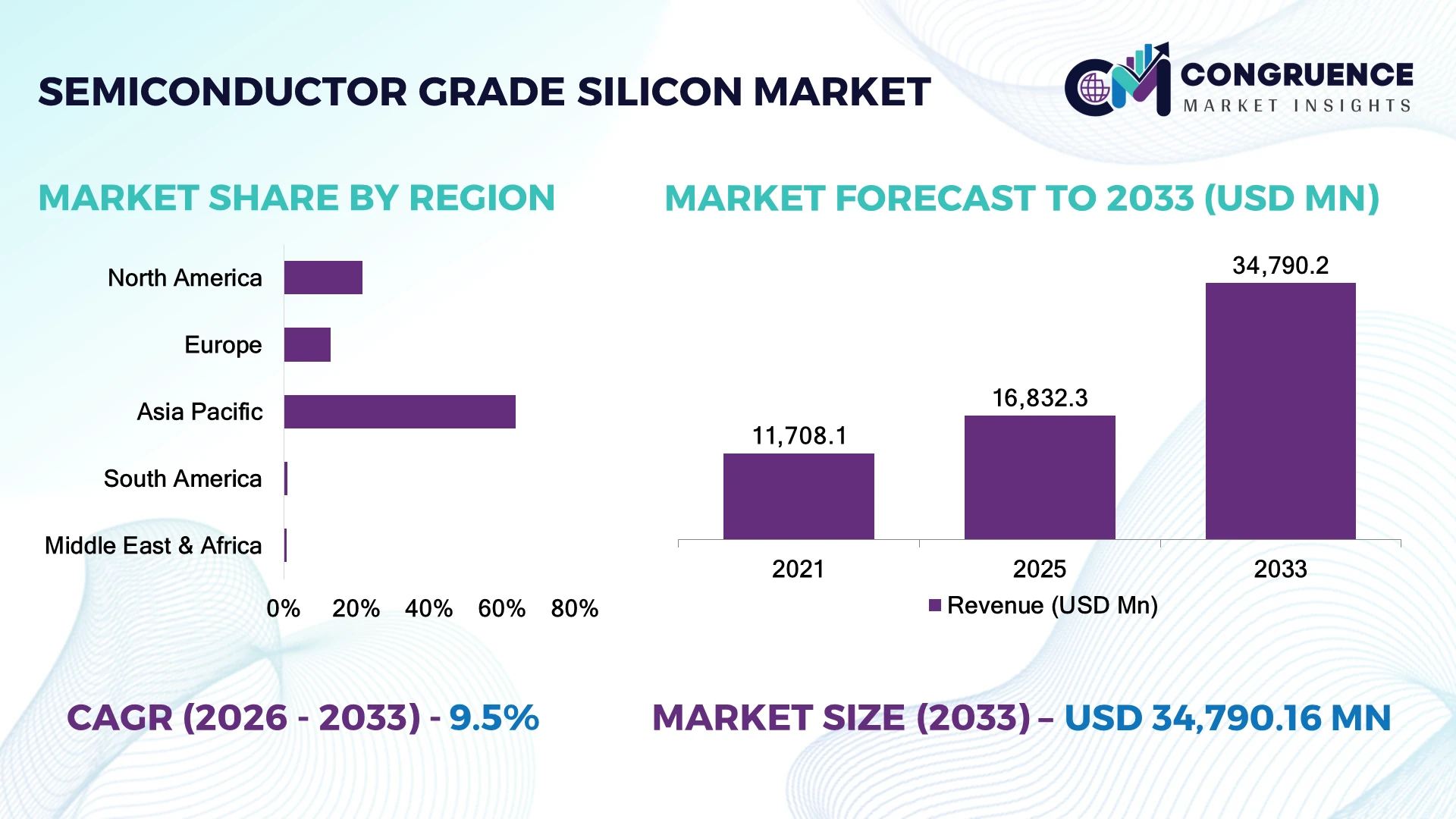
China remains the dominant production and consumption hub, accounting for approximately 34% of global semiconductor-grade silicon processing capacity, supported by multi-billion-dollar fab investments and vertically integrated supply chains. Japan maintains leadership in ultra-high-purity silicon refinement with more than 45% of premium electronic-grade material output, while South Korea focuses on advanced memory manufacturing. Ongoing geopolitical technology restrictions have accelerated domestic capacity expansion and supply-chain localization across major semiconductor economies.
Strategic advantage increasingly depends on securing high-purity silicon supply through regional manufacturing integration and long-term upstream partnerships.
Market Size & Growth: USD 16,832.3 million (2025) to USD 34,790.2 million (2033) at 9.5% CAGR, driven by advanced semiconductor fabrication expansion.
Top Growth Drivers: AI chips (+31%), 300 mm wafer demand (+24%), government fab investments (+28%).
Short-Term Forecast: By 2028, production yield improves 15% through process automation and purity optimization.
Emerging Technologies: AI process control, advanced crystal growth, digital quality inspection accelerate manufacturing precision.
Regional Leaders: Asia-Pacific exceeds USD 20 billion; North America surpasses USD 6 billion; Europe approaches USD 4.5 billion through strategic capacity expansion.
Consumer/End-User Trends: Over 63% of demand originates from logic and memory semiconductor manufacturers.
Pilot/Case Example: 2026 smart crystal-growth deployment improves wafer uniformity by 18%.
Competitive Landscape: Top five suppliers control approximately 67% of global supply through technology leadership.
Regulatory & ESG Impact: Energy optimization reduces manufacturing electricity intensity by nearly 12%.
Investment & Funding: More than USD 45 billion supports silicon capacity expansion and new wafer ecosystems.
Innovation & Future Outlook: High-purity feedstock and larger-diameter wafers strengthen next-generation semiconductor competitiveness.
Semiconductor grade silicon demand is increasingly concentrated in AI processors, high-bandwidth memory, automotive electronics, and advanced power devices. Continuous improvements in crystal growth technology and ultra-high-purity refining have enhanced wafer consistency by nearly 20%. Supply-chain localization initiatives and strategic material security programs are accelerating regional investments, setting the foundation for the market's evolving competitive landscape.
Semiconductor grade silicon has become a strategic material underpinning global semiconductor competitiveness as governments and manufacturers strengthen domestic chip ecosystems. Supply-chain restructuring, export-control policies, and national semiconductor initiatives are accelerating investment in upstream silicon purification, crystal growth, and wafer manufacturing. Companies capable of ensuring secure high-purity material availability are gaining long-term advantages in advanced logic, memory, automotive, and AI semiconductor production.
Modern continuous crystal-growth technologies improve defect control by approximately 22% compared with conventional production methods while reducing material losses by nearly 15%. Asia-Pacific leads manufacturing scale through integrated supply networks, whereas North America emphasizes technology innovation, advanced wafer capacity, and resilient domestic sourcing. More than 70% of new leading-edge fabrication projects prioritize regional material security alongside manufacturing efficiency.
Manufacturers are expanding strategic partnerships with wafer producers, investing in next-generation purification technologies, and increasing vertically integrated production capacity. For example, integrated silicon producers are aligning upstream refining with downstream wafer manufacturing to shorten qualification cycles and improve supply stability. Between 2026 and 2028, digital process monitoring and AI-assisted quality control will strengthen production consistency, making operational resilience, material purity, and ecosystem collaboration decisive factors for long-term competitive positioning.
Accelerating investments in advanced semiconductor fabrication are strengthening demand for ultra-high-purity semiconductor grade silicon across logic, memory, and power device manufacturing. Approximately 68% of new wafer fabrication projects are designed around 300 mm production platforms, while AI-driven chip demand has increased high-purity silicon consumption by nearly 26%. The United States, supported by domestic semiconductor manufacturing incentives, continues expanding fabrication capacity to reduce import dependence. This structural shift is increasing long-term procurement contracts for electronic-grade silicon. Producers are responding through purification capacity expansion, strategic partnerships with wafer manufacturers, and investments in next-generation crystal growth technologies. A critical operational advantage now depends on consistently delivering ultra-low-defect silicon that improves wafer yield and supports leading-edge semiconductor production.
Manufacturing semiconductor grade silicon requires energy-intensive purification, crystal growth, and contamination control, exposing producers to electricity price volatility and high operating costs. Nearly 35% of total production expenditure is associated with energy consumption, while high-purity processing materials contribute approximately 18% of manufacturing costs. Germany and Japan continue facing elevated industrial electricity prices, reducing cost competitiveness for domestic producers. These structural constraints pressure profitability and complicate long-term capacity expansion decisions. Companies are mitigating risk through renewable energy procurement, localized refining facilities, multi-year supply agreements, and process optimization technologies that reduce power consumption while maintaining stringent purity specifications for semiconductor applications.
Next-generation AI processors, advanced packaging, and silicon photonics are creating new demand for premium semiconductor grade silicon with tighter impurity control and enhanced crystal uniformity. Approximately 42% of advanced chip development programs now require higher-purity feedstock, while digital manufacturing platforms improve process efficiency by nearly 19%. South Korea is expanding investment in AI semiconductor manufacturing ecosystems, accelerating adoption of precision silicon materials. Manufacturers are strengthening R&D collaboration with wafer producers, expanding automated purification systems, and developing advanced crystal engineering technologies. A distinctive opportunity lies in supplying customized silicon grades optimized for heterogeneous integration, enabling higher device performance while reducing downstream fabrication complexity.
Maintaining consistent ultra-high purity while expanding production remains a significant execution challenge for semiconductor grade silicon manufacturers. Approximately 24% of capacity expansion projects experience extended qualification cycles because of stringent contamination control requirements, while automated quality validation increases commissioning complexity by nearly 17%. Japan's advanced semiconductor ecosystem continues demanding tighter impurity thresholds for next-generation wafers, raising manufacturing precision requirements across the supply chain. Companies must strengthen digital process control, analytical metrology, workforce expertise, and collaborative development with wafer manufacturers to sustain production quality. Long-term competitiveness will increasingly depend on scalable precision manufacturing rather than production volume alone.
AI Chip Supply Alignment: Around 47% of new semiconductor-grade silicon production is being allocated toward AI accelerator and advanced computing applications. Rising demand for high-performance chips is encouraging manufacturers to prioritize premium-purity output, expand long-term supply agreements, and automate quality inspection to improve production efficiency and delivery reliability.
Digital Crystal Growth Optimization: Nearly 39% of leading producers have integrated AI-assisted crystal growth monitoring, reducing process variation by approximately 16% while improving ingot consistency. Japan's focus on advanced semiconductor materials has accelerated deployment of intelligent manufacturing systems, enabling faster qualification and stronger operational control across production facilities.
Localized Material Ecosystems: Approximately 36% of recently announced silicon capacity investments emphasize regional supply-chain integration rather than export dependence. Government-backed semiconductor manufacturing initiatives are encouraging producers to establish localized refining, wafer processing, and logistics partnerships, reducing procurement risks while shortening customer delivery cycles by nearly 18%.
Advanced Purification Process Innovation: More than 41% of premium manufacturing lines now utilize enhanced purification and contamination-control technologies that improve usable silicon yield by roughly 14%. Companies are investing in automated metrology, predictive maintenance, and closed-loop production systems to strengthen quality consistency, reduce material losses, and support next-generation semiconductor manufacturing requirements.
Electronic Grade Silicon accounted for approximately 72% of the global semiconductor grade silicon market in 2025, maintaining leadership through its ultra-high purity, low defect density, and compatibility with advanced integrated circuit manufacturing. Demand remains concentrated in 300 mm wafer production, AI processors, and advanced memory fabrication, where impurity control directly influences wafer yield and device reliability. Companies continue expanding purification capacity and investing in next-generation crystal growth technologies to meet increasingly stringent semiconductor specifications.
Solar Grade Silicon is projected to be the fastest-growing segment as manufacturers increasingly leverage process improvements and selective purification technologies for high-efficiency photovoltaic applications. While Electronic Grade Silicon remains the benchmark for logic and memory devices, Solar Grade Silicon continues strengthening its position through cost optimization and large-scale production. Approximately 68% of new purification investments are directed toward electronic-grade output, while more than 24% target flexible production capabilities that can support multiple high-purity silicon applications. Investment priorities increasingly favor advanced refining technologies that improve production efficiency and long-term supply resilience.
According to SEMI's 2025 industry outlook, global 300 mm semiconductor wafer capacity expansion continues to drive sustained investment in ultra-high-purity electronic-grade silicon production, reinforcing its strategic importance across advanced semiconductor manufacturing.
Integrated Circuits represented approximately 61% of global semiconductor grade silicon demand in 2025, driven by expanding production of AI processors, advanced logic chips, memory devices, and high-performance computing hardware. The segment benefits from stringent purity requirements, continuous node migration, and increasing wafer complexity, making electronic-grade silicon indispensable for achieving consistent manufacturing yields. Leading suppliers continue prioritizing long-term agreements with wafer manufacturers while expanding purification and crystal growth capacity.
Power Semiconductor Devices are expected to register the fastest growth as electric vehicles, renewable energy systems, and industrial electrification accelerate deployment of silicon-based power components. MEMS sensors and discrete semiconductor devices continue supporting stable demand across automotive, industrial automation, and consumer electronics. Approximately 29% of newly commissioned wafer capacity is dedicated to power semiconductor production, while automated material inspection improves silicon qualification efficiency by nearly 18%. Manufacturers are strengthening vertical integration, digital quality control, and customized silicon solutions to address increasingly diversified application requirements.
Industry assessments published during 2026 indicate that AI accelerators and automotive power electronics remain the fastest-expanding wafer-consuming applications, increasing procurement of premium semiconductor-grade silicon across global fabrication facilities.
Integrated Device Manufacturers (IDMs) accounted for approximately 48% of semiconductor grade silicon consumption in 2025, supported by vertically integrated manufacturing, high wafer throughput, and direct control over advanced fabrication processes. Their continuous investment in leading-edge logic, memory, and automotive semiconductor production sustains consistent procurement of premium-purity silicon. Major suppliers increasingly customize material specifications and establish long-term strategic supply agreements to ensure uninterrupted production.
Pure-Play Foundries represent the fastest-growing end-user segment as outsourced chip manufacturing expands with AI, automotive electronics, and high-performance computing demand. Fabless semiconductor companies continue increasing indirect consumption through foundry partnerships, while research institutes and specialty manufacturers remain important for advanced material development and pilot-scale innovation. Approximately 55% of newly announced advanced fabrication investments are associated with foundry expansion, while customized silicon qualification programs have increased by nearly 22%. Producers are responding through collaborative R&D, localized manufacturing, and application-specific silicon development to strengthen long-term customer relationships.
According to SEMI's 2026 industry capacity assessment, advanced foundry expansion remains the largest driver of incremental high-purity silicon demand as new wafer fabrication facilities continue entering production across major semiconductor manufacturing hubs.
Asia-Pacific accounted for the largest market share at 63.8% in 2025 however, North America is expected to register the fastest growth, expanding at a CAGR of 10.3% between 2026 and 2033.
Advanced Domestic Chip Manufacturing Strengthens Material Security
North America is reinforcing its position through accelerated semiconductor manufacturing investments, localized material sourcing, and advanced wafer fabrication expansion. The region accounted for approximately 21.6% of global semiconductor grade silicon demand in 2025, supported by large-scale investments in logic, AI, and defense-related semiconductor production. More than 65% of recently announced leading-edge fabrication projects emphasize regional sourcing of ultra-high-purity silicon to strengthen supply resilience. Increasing automation across purification and wafer production is improving material qualification efficiency while reducing production variability. Strategic collaboration between silicon suppliers, wafer manufacturers, and semiconductor producers continues expanding the regional ecosystem, positioning North America as a technology-driven market focused on secure upstream integration rather than manufacturing scale alone.
United States Market Outlook: The United States leads regional demand through rapid expansion of advanced semiconductor fabrication supported by domestic manufacturing incentives and strategic technology investments. AI processors, high-performance computing, and defense electronics remain key demand drivers. More than 70% of new leading-edge fabrication investments prioritize secure domestic sourcing of semiconductor materials, encouraging suppliers to establish localized purification, crystal-growth, and wafer-processing capabilities while strengthening long-term supply partnerships.
High-Purity Manufacturing Drives Strategic Autonomy
Europe continues strengthening semiconductor material capabilities through industrial modernization, technology sovereignty initiatives, and advanced manufacturing investments. The region contributes approximately 12.8% of global semiconductor grade silicon demand, supported by automotive electronics, industrial automation, and power semiconductor production. Increasing investment in regional semiconductor ecosystems has encouraged expansion of electronic-grade silicon refinement and wafer manufacturing infrastructure. Producers are focusing on process efficiency, sustainable manufacturing, and advanced quality control while collaborating closely with downstream semiconductor manufacturers to improve long-term supply resilience and technological independence.
Germany Market Outlook: Germany serves as Europe's primary semiconductor manufacturing hub, supported by advanced industrial infrastructure, automotive semiconductor leadership, and precision engineering capabilities. Expansion of domestic wafer fabrication and electronic materials production continues strengthening demand for premium semiconductor-grade silicon. Automation-driven manufacturing and collaborative research initiatives improve material qualification efficiency while reinforcing Germany's position within Europe's evolving semiconductor supply chain.
Manufacturing Scale Anchors Global Leadership
Asia-Pacific dominates the semiconductor grade silicon market through integrated supply chains, extensive wafer fabrication capacity, and strong upstream material production. The region represents approximately 63.8% of global consumption, supported by leading semiconductor manufacturing clusters across China, Japan, South Korea, and Taiwan. More than 75% of global 300 mm wafer production capacity operates within Asia-Pacific, reinforcing demand for ultra-high-purity silicon. Continuous investment in crystal growth technologies, purification facilities, and vertically integrated manufacturing strengthens operational efficiency while enabling rapid commercialization of next-generation semiconductor technologies.
China Market Outlook: China remains the largest regional market through extensive investment in semiconductor self-sufficiency, purification facilities, and integrated wafer manufacturing. Domestic producers continue expanding electronic-grade silicon capacity alongside advanced fabrication projects. Approximately one-third of global semiconductor-grade silicon processing capacity is concentrated within China, supported by government-backed industrial policies and increasing collaboration between upstream material suppliers and downstream semiconductor manufacturers.
Industrial Modernization Supports Emerging Demand
South America remains an emerging market where semiconductor grade silicon demand is closely linked to industrial electronics, renewable energy infrastructure, and growing electronics manufacturing capabilities. Although regional production remains limited, investments in technology manufacturing and industrial automation continue expanding demand for imported high-purity silicon materials. Electronics assembly, automotive manufacturing, and research initiatives are gradually strengthening the regional semiconductor ecosystem. Companies are prioritizing strategic import partnerships and specialized distribution networks to improve material availability while preparing for future industrial expansion.
Brazil Market Outlook: Brazil represents the region's largest semiconductor market through its diversified electronics manufacturing base and expanding industrial automation sector. Government support for technology development and increasing investment in semiconductor research are encouraging greater utilization of advanced electronic materials. Strong demand from automotive electronics and industrial control systems continues improving long-term opportunities for semiconductor-grade silicon suppliers serving the domestic manufacturing ecosystem.
Technology Investment Expands Future Manufacturing Base
The Middle East & Africa market is evolving through strategic investments in technology infrastructure, electronics manufacturing, and industrial diversification programs. Demand remains concentrated in advanced research, telecommunications equipment, and industrial electronics, while government initiatives encourage higher participation in semiconductor value chains. Technology parks, innovation hubs, and digital industrial strategies are gradually improving regional capabilities for advanced materials handling and semiconductor ecosystem development. Companies increasingly view the region as a long-term strategic investment destination rather than an immediate production center.
Saudi Arabia Market Outlook: Saudi Arabia is emerging as the region's most significant growth market through industrial diversification initiatives, technology investments, and advanced manufacturing programs under Vision 2030. Expansion of research infrastructure, electronics manufacturing capabilities, and digital industrial projects is increasing demand for semiconductor materials. Strategic international partnerships and investments in high-technology industries continue strengthening the country's long-term position within the evolving semiconductor supply chain.
The semiconductor grade silicon market is led by Wacker Chemie, Hemlock Semiconductor, Tokuyama, Shin-Etsu Chemical, and REC Silicon, competing against regional refiners and emerging Chinese material suppliers for advanced-node semiconductor contracts. The top five producers collectively control nearly 74% of global electronic-grade silicon supply. Competition centers on purity above 99.999999999%, production yield, and long-term supply reliability, with premium suppliers achieving approximately 18% lower impurity variation and 22% faster customer qualification than smaller competitors. Global leaders are expanding purification capacity, integrating upstream polysilicon operations, and signing multi-year agreements with wafer manufacturers, while regional suppliers compete through localized production and shorter delivery cycles. The competitive shift increasingly favors vertically integrated producers with secure energy access and proprietary purification technologies as governments prioritize supply-chain resilience. High capital intensity, lengthy customer certification, and stringent quality requirements remain the primary entry barriers. Winning requires unmatched material purity, dependable capacity expansion, strategic customer partnerships, and resilient localized supply chains.
Wacker Chemie AG
Hemlock Semiconductor
Shin-Etsu Chemical Co., Ltd.
Tokuyama Corporation
REC Silicon ASA
OCI Holdings
Mitsubishi Materials Corporation
Elkem ASA
GCL Technology Holdings Limited
Hoshine Silicon Industry Co., Ltd.
Fujian Cangyuan Technologies Co., Ltd.
Asia Silicon Co., Ltd.
Advanced purification technologies remain the foundation of semiconductor grade silicon production, with enhanced Siemens processes, fluidized bed reactor optimization, and AI-enabled process control improving impurity consistency by nearly 20% while reducing energy consumption by approximately 14%. Around 68% of new electronic-grade silicon facilities now deploy automated inline monitoring and digital quality analytics, enabling tighter control over boron, phosphorus, and metallic contaminants. These capabilities strengthen wafer yield and reduce downstream manufacturing variability for advanced logic and memory devices.
Emerging technologies focus on next-generation crystal growth, digital twin process optimization, and predictive manufacturing platforms. Automated crystal pulling systems deliver approximately 16% higher production consistency than conventional manual control, while machine-learning algorithms shorten process optimization cycles by nearly 25%. Suppliers supporting 300 mm and future advanced wafer platforms gain competitive advantage because leading semiconductor manufacturers increasingly prioritize stable material performance over raw production volume.
Between 2026 and 2028, advanced metrology, real-time impurity detection, and integrated manufacturing execution systems will accelerate adoption across premium silicon production. More than 55% of planned capacity additions are expected to incorporate autonomous process control from commissioning. Companies investing in vertically integrated purification, crystal growth, and digital manufacturing infrastructure will improve qualification speed, strengthen supply resilience, and secure preferred supplier status for AI processors, high-bandwidth memory, automotive semiconductors, and next-generation power electronics.
April 2024 Shin-Etsu Chemical announced construction of a fourth semiconductor lithography materials production base in Gunma, Japan, with first-phase investment of approximately ¥83 billion to strengthen advanced semiconductor material supply. This expands long-term ecosystem support for chip manufacturing. Source: Shin-Etsu Chemical
October 2024 Hemlock Semiconductor secured a proposed US$325 million U.S. government award to expand semiconductor-grade polysilicon manufacturing in Michigan, reinforcing domestic supply-chain resilience and supporting leading-edge chip production capacity. Source: Reuters
October 2024 SEMI projected global silicon wafer shipments would rebound by 10% during 2025 following a temporary market correction, reflecting strengthening demand from AI infrastructure and advanced semiconductor packaging applications. Source: SEMI
February 2025 SEMI reported worldwide silicon wafer shipments began recovering during the second half of 2024 despite a 2.7% annual shipment decline, indicating improving fab utilization driven by AI and high-bandwidth memory demand. Source: SEMI
This report provides a comprehensive assessment of the semiconductor grade silicon market across electronic-grade and other purity classifications, covering applications including integrated circuits, discrete semiconductors, photovoltaic-related semiconductor manufacturing, MEMS devices, and advanced packaging technologies. It evaluates demand across semiconductor manufacturers, wafer producers, integrated device manufacturers, and foundries while examining regional dynamics across North America, Europe, Asia-Pacific, South America, and the Middle East & Africa. The analysis incorporates manufacturing technologies, purification methods, crystal growth processes, and supply-chain developments influencing more than 70% of industry deployment patterns.
The report delivers strategic intelligence on technology adoption, competitive positioning, production localization, material qualification trends, and emerging investments between 2026 and 2033. It highlights deployment shifts, capacity expansion strategies, company benchmarking, operational performance indicators, and evolving customer requirements to support investment planning, expansion decisions, procurement strategies, partnership evaluation, and long-term competitive positioning across the global semiconductor materials value chain.
| Report Attribute/Metric | Report Details |
|---|---|
|
Market Revenue in 2025 |
USD 16,832.3 Million |
|
Market Revenue in 2033 |
USD 34,790.2 Million |
|
CAGR (2026 - 2033) |
9.5% |
|
Base Year |
2025 |
|
Forecast Period |
2026 - 2033 |
|
Historic Period |
2021 - 2025 |
|
Segments Covered |
By Type
By Application
By End-User
|
|
Key Report Deliverable |
Revenue Forecast, Growth Trends, Market Dynamics, Segmental Overview, Regional and Country-wise Analysis, Competition Landscape |
|
Region Covered |
North America, Europe, Asia-Pacific, South America, Middle East, Africa |
|
Key Players Analyzed |
Wacker Chemie AG, Hemlock Semiconductor, Shin-Etsu Chemical Co., Ltd., Tokuyama Corporation, REC Silicon ASA, OCI Holdings, Mitsubishi Materials Corporation, Elkem ASA, GCL Technology Holdings Limited, Hoshine Silicon Industry Co., Ltd., Fujian Cangyuan Technologies Co., Ltd., Asia Silicon Co., Ltd. |
|
Customization & Pricing |
Available on Request (10% Customization is Free) |




