
Reports
The Global Semiconductor Equipment Predictive Maintenance Market was valued at USD 1,591.8 Million in 2025 and is anticipated to reach a value of USD 6,936.2 Million by 2033 expanding at a CAGR of 20.2% between 2026 and 2033. Growth is driven by AI-enabled equipment health monitoring, rising utilization of advanced wafer fabrication tools, and increasing investment in digital twin-based predictive maintenance across semiconductor fabs.
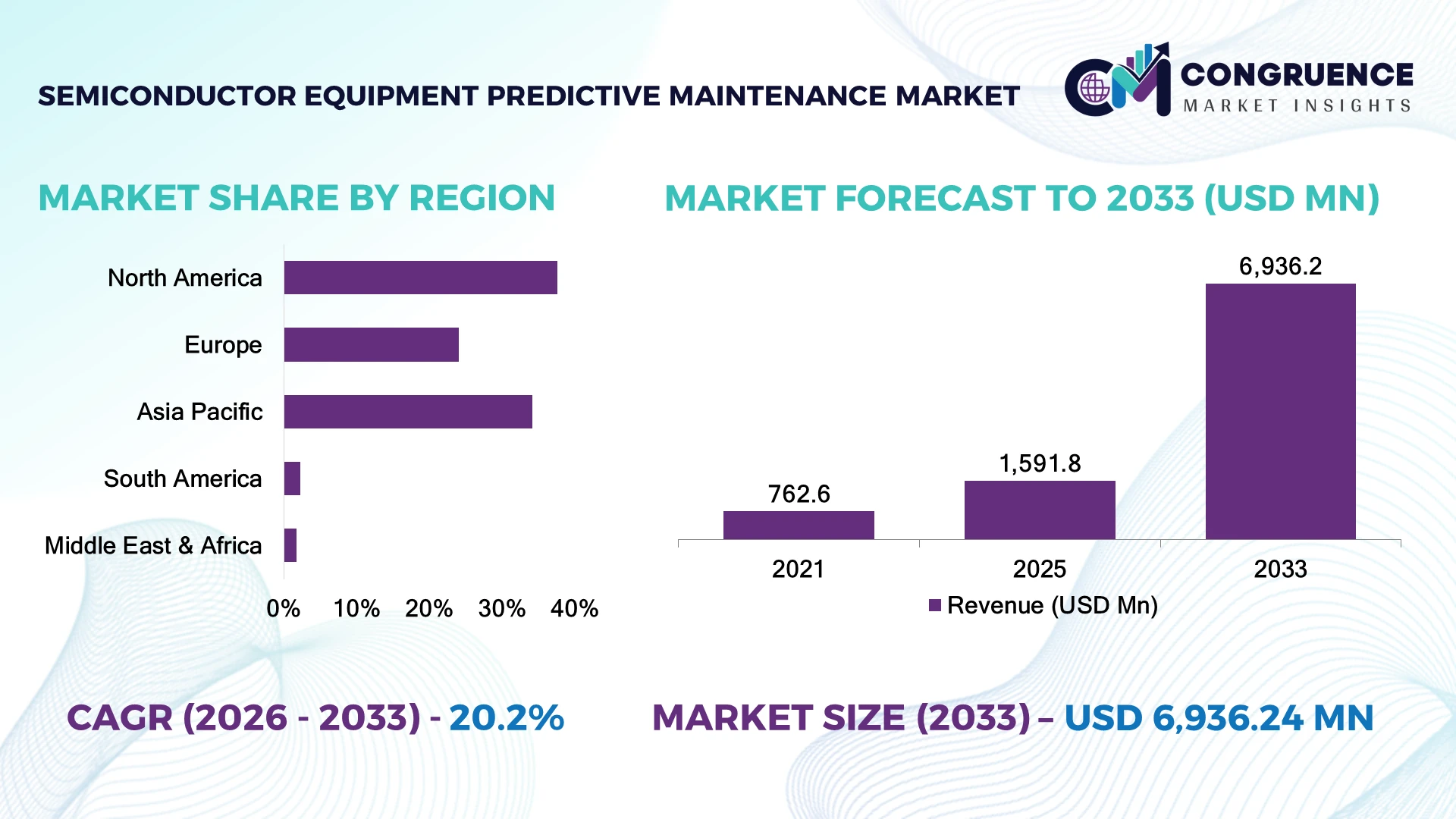
The United States leads the market with approximately 31% global adoption, supported by large-scale investments in advanced semiconductor manufacturing, AI infrastructure, and equipment analytics platforms. More than 70% of leading domestic wafer fabs have deployed predictive maintenance systems for critical process equipment, compared with nearly 58% in Japan. Amid ongoing semiconductor supply-chain realignment and the CHIPS Act implementation, manufacturers are accelerating intelligent maintenance capabilities to improve equipment availability and production resilience.
Strategic investment in predictive maintenance platforms is becoming essential for maximizing fab utilization, reducing unplanned downtime, and sustaining competitive semiconductor manufacturing capacity.
Market Size & Growth: USD 1,591.8 million in 2025 to USD 6,936.2 million by 2033 at 20.2% CAGR, driven by AI-enabled fab automation.
Top Growth Drivers: AI analytics 38%, digital twins 31%, sensor deployment 29% accelerate predictive maintenance adoption.
Short-Term Forecast: By 2028, unplanned equipment downtime declines by nearly 35% across advanced semiconductor fabs.
Emerging Technologies: Machine learning, edge AI, digital twins, and industrial IoT reshape predictive maintenance workflows.
Regional Leaders: North America, Asia-Pacific, and Europe lead adoption through advanced wafer fabrication expansion.
Consumer/End-User Trends: Over 65% of leading fabs prioritize predictive maintenance for lithography and etching equipment.
Pilot/Case Example: 2026 AI maintenance deployment improves equipment uptime by approximately 22% in high-volume production.
Competitive Landscape: Top providers collectively hold around 46% share through analytics, automation, and software integration.
Regulatory & ESG Impact: Energy optimization lowers maintenance-related power consumption by nearly 15% across smart fabs.
Investment & Funding: Multi-billion-dollar fab expansion programs accelerate predictive maintenance platform deployment worldwide.
Innovation & Future Outlook: Autonomous maintenance and generative AI diagnostics strengthen global semiconductor manufacturing resilience.
The Semiconductor Equipment Predictive Maintenance Market is expanding through demand for intelligent equipment monitoring across wafer fabrication, advanced packaging, and semiconductor testing facilities. AI-powered anomaly detection and digital twin technologies improve maintenance precision, reducing unexpected failures by approximately 30%. Ongoing semiconductor supply-chain diversification is encouraging manufacturers to modernize asset management platforms, creating a stronger foundation for the strategic outlook discussed below.
Semiconductor equipment predictive maintenance has become a strategic manufacturing capability because advanced fabs cannot afford unexpected equipment failures that disrupt high-value production. Expanding domestic semiconductor manufacturing initiatives, supply-chain diversification, and increasing process complexity are accelerating adoption of AI-driven maintenance platforms. Equipment availability has become a competitive differentiator as leading manufacturers prioritize continuous production and yield optimization.
Compared with conventional preventive maintenance, AI-based predictive maintenance reduces unexpected downtime by approximately 30% while lowering maintenance costs by nearly 20% through condition-based interventions. Asia-Pacific leads deployment across high-volume wafer fabrication facilities, whereas North America emphasizes advanced analytics, digital twins, and enterprise-wide integration with manufacturing execution systems. Industry adoption is expected to exceed 75% among newly commissioned advanced fabs within the next two to three years as automation maturity increases.
A practical example involves predictive monitoring of lithography and plasma etching equipment using vibration, temperature, and process data to schedule maintenance before performance degradation affects yields. Equipment manufacturers and semiconductor producers are expanding strategic partnerships, cloud analytics investments, and AI software integration. Organizations that combine predictive intelligence with automated maintenance workflows will secure higher equipment utilization, stronger operational resilience, and long-term manufacturing competitiveness.
Semiconductor manufacturers are prioritizing predictive maintenance as advanced process nodes increase equipment complexity and downtime costs. More than 72% of leading wafer fabrication facilities now deploy AI-enabled equipment monitoring for lithography, etching, and deposition tools, while predictive analytics reduces unexpected failures by nearly 30% and improves equipment utilization by approximately 18%. The United States continues expanding advanced fabrication capacity under semiconductor manufacturing incentives, increasing investment in digital maintenance infrastructure. Higher process precision requirements are driving fabs to replace calendar-based servicing with condition-based maintenance. In response, equipment suppliers are expanding AI software portfolios, strengthening sensor partnerships, and integrating digital twin capabilities into next-generation process equipment. The strategic advantage now lies in maximizing tool availability without compromising process stability or wafer yield.
Many semiconductor fabs continue operating mixed generations of manufacturing equipment, limiting seamless deployment of predictive maintenance platforms. Nearly 45% of legacy tools lack standardized connectivity interfaces, while integrating proprietary control systems can increase implementation costs by approximately 20%. Export control restrictions affecting advanced semiconductor technologies further complicate software compatibility and equipment upgrades across multinational manufacturing networks. These constraints delay enterprise-wide analytics, reduce predictive accuracy, and increase maintenance complexity. Manufacturers are addressing these limitations by deploying middleware platforms, localizing software development, negotiating long-term technology agreements, and adopting vendor-neutral industrial communication standards. Establishing interoperable digital infrastructure has become a critical operational priority for achieving scalable predictive maintenance across heterogeneous fabrication environments.
Digital twin technology combined with edge AI creates significant opportunities for predictive maintenance beyond traditional equipment monitoring. Virtual equipment models can improve fault prediction accuracy by approximately 28%, while intelligent maintenance scheduling reduces spare-part inventory requirements by nearly 15%. South Korea is accelerating smart semiconductor manufacturing through advanced digital factory initiatives that encourage deeper integration of AI-driven asset optimization. Equipment manufacturers are investing in cloud-connected diagnostics, autonomous maintenance algorithms, and collaborative ecosystems linking suppliers, fabs, and software developers. A non-obvious opportunity lies in cross-fab learning models, where anonymized operational data improves predictive performance across multiple production sites without exposing proprietary process information, creating stronger long-term competitive differentiation.
Transitioning from predictive alerts to autonomous maintenance execution remains a significant operational challenge. More than 60% of semiconductor manufacturers still require manual engineering validation before maintenance actions are approved, while AI model retraining demands increase by approximately 25% as equipment configurations evolve. Taiwan's advanced fabrication facilities face growing pressure to maintain model accuracy across increasingly complex process technologies and diverse equipment fleets. Inconsistent sensor quality, cybersecurity requirements, and shortages of AI-literate maintenance engineers complicate enterprise-wide deployment. Companies must strengthen data governance, invest in workforce upskilling, standardize industrial AI architectures, and collaborate with equipment vendors to deliver reliable autonomous maintenance systems that sustain production quality and operational competitiveness.
AI-powered failure prediction AI models are identifying equipment anomalies up to 35% earlier than conventional monitoring while reducing false maintenance alerts by nearly 20%. Advanced wafer fabs increasingly combine process data, vibration sensing, and equipment logs into unified analytics platforms. Semiconductor manufacturers are expanding partnerships with industrial AI providers to improve maintenance precision as advanced-node production becomes increasingly sensitive to equipment variability.
Digital twin deployment expands Digital twin adoption has exceeded 55% across newly commissioned high-volume semiconductor facilities, enabling approximately 25% faster root-cause analysis and nearly 18% lower maintenance planning time. Growing investments in smart manufacturing infrastructure encourage equipment suppliers to embed simulation capabilities directly into critical process tools, improving maintenance decision quality without interrupting production schedules.
Edge analytics at equipment Edge computing processes nearly 70% of equipment health data locally, reducing diagnostic response times by approximately 40%. As data volumes increase across advanced fabs, manufacturers are deploying decentralized analytics architectures that minimize network latency while strengthening operational resilience. Equipment vendors continue integrating embedded AI processors directly within semiconductor manufacturing systems.
Predictive maintenance ecosystems Semiconductor manufacturers are replacing isolated maintenance applications with integrated enterprise ecosystems connecting equipment suppliers, MES platforms, ERP software, and spare-parts management. Shared operational intelligence improves maintenance productivity by approximately 22% while reducing emergency service interventions by nearly 17%. Companies are restructuring supplier relationships around continuous performance optimization rather than traditional reactive maintenance contracts, strengthening long-term manufacturing efficiency.
Cloud-based predictive maintenance platforms accounted for approximately 61% of the market in 2025, leading because they enable centralized monitoring across multiple fabs, continuous AI model updates, and scalable integration with manufacturing execution systems (MES), enterprise resource planning (ERP), and digital twins. Their ability to aggregate high-volume equipment data lowers infrastructure costs while improving maintenance responsiveness. On-premises solutions remain essential for highly secure semiconductor environments requiring low-latency processing and strict data governance. Hybrid deployment is emerging as the fastest-growing segment, with adoption projected to exceed 24% of new installations by 2028 as manufacturers combine cloud analytics with localized edge computing to balance security and performance.
Investment priorities increasingly favor hybrid architectures that support both centralized analytics and real-time shop-floor decision-making. Around 68% of new predictive maintenance implementations now incorporate cloud-native AI capabilities, while nearly 35% integrate edge processing for mission-critical production tools. Equipment suppliers are expanding platform interoperability, forming software partnerships, and embedding predictive analytics into semiconductor manufacturing ecosystems to strengthen long-term customer retention.
According to SEMI industry findings published during 2025–2026, advanced semiconductor manufacturers increasingly prioritize hybrid digital infrastructure that combines secure on-premises equipment control with cloud-based predictive analytics for enterprise-wide asset optimization.
Wafer fabrication represented approximately 47% of the market in 2025, driven by the high operational value of lithography, deposition, etching, and metrology equipment where unplanned downtime directly impacts yield and production throughput. Predictive maintenance minimizes unexpected tool failures while supporting process consistency across advanced manufacturing nodes. Assembly and packaging is the fastest-growing application as heterogeneous integration and advanced packaging technologies increase equipment complexity. Testing and inspection continue expanding through AI-assisted diagnostics, while supporting facility utilities increasingly adopt predictive maintenance to improve operational continuity and reduce energy-intensive equipment failures.
Manufacturers are integrating predictive analytics across complete production workflows rather than isolated equipment categories. Nearly 64% of newly deployed maintenance platforms now support cross-process equipment monitoring, while predictive maintenance improves maintenance scheduling efficiency by approximately 27%. Equipment vendors continue expanding automation capabilities, strengthening digital twin integration, and collaborating with semiconductor fabs to deliver application-specific predictive maintenance solutions across the entire production lifecycle.
Industry analysis released by SEMI during 2025–2026 indicates that wafer fabrication facilities remain the primary adopters of AI-enabled equipment monitoring because process tool availability has become a critical determinant of manufacturing efficiency and yield stability.
Integrated Device Manufacturers (IDMs) accounted for approximately 42% of market demand in 2025, supported by extensive ownership of high-value semiconductor production assets, vertically integrated operations, and continuous investment in equipment optimization. Foundries represent the fastest-growing end-user segment as advanced-node manufacturing requires predictive maintenance to maximize equipment utilization and minimize production interruptions. Outsourced Semiconductor Assembly and Test (OSAT) providers are steadily increasing adoption to improve packaging equipment efficiency, while research institutes and specialty semiconductor manufacturers continue deploying predictive maintenance for precision process control and pilot manufacturing environments.
Companies are tailoring AI platforms, service agreements, and digital maintenance ecosystems to the operational priorities of each customer group. Nearly 70% of advanced fabs now integrate predictive maintenance into enterprise manufacturing workflows, while around 33% of OSAT facilities have accelerated deployments to support advanced packaging expansion. Strategic partnerships between software developers, equipment manufacturers, and semiconductor producers continue strengthening customer-specific predictive maintenance capabilities.
A 2025 enterprise assessment by SEMI highlighted that leading semiconductor manufacturers increasingly classify predictive maintenance as a core operational capability supporting higher equipment availability, stronger yield performance, and more resilient fab operations.
North America accounted for the largest market share at 37.6% in 2025 however, Asia-Pacific is expected to register the fastest growth, expanding at a CAGR of 22.8% between 2026 and 2033.

Integrated AI-driven fab maintenance accelerates operational resilience
North America maintains market leadership through its concentration of advanced semiconductor fabs, equipment manufacturers, AI software developers, and digital industrial infrastructure. Leading manufacturers increasingly deploy predictive maintenance across lithography, etching, deposition, and metrology tools to maximize equipment utilization and improve production continuity. More than 70% of advanced semiconductor facilities across the region have incorporated AI-enabled asset monitoring into manufacturing workflows. The region also benefits from semiconductor capacity expansion supported by public and private investment, encouraging wider deployment of intelligent maintenance platforms. Cloud-edge integration, digital twins, and equipment-level analytics continue improving maintenance planning while reducing unscheduled production interruptions. Strategic collaborations between semiconductor manufacturers, equipment OEMs, and industrial software providers are strengthening predictive maintenance ecosystems throughout North America's fabrication network.
United States Market Outlook: The United States dominates regional demand through advanced semiconductor manufacturing, strong AI software capabilities, and extensive investment in domestic fab expansion. New fabrication facilities supported by national semiconductor initiatives increasingly integrate predictive maintenance from commissioning stages rather than retrofitting later. Around 75% of newly announced leading-edge fabs include digital asset management platforms as part of their operational architecture, enabling manufacturers to improve equipment availability, optimize maintenance scheduling, and enhance long-term production efficiency.
Digital manufacturing modernization reshapes semiconductor operations
Europe continues expanding predictive maintenance adoption through advanced industrial automation, Industry 4.0 initiatives, and growing semiconductor production modernization. Regional manufacturers increasingly integrate predictive analytics into precision manufacturing equipment to improve asset utilization while supporting stricter quality standards. Around 58% of semiconductor equipment modernization projects now incorporate AI-enabled maintenance capabilities. Public investment supporting semiconductor resilience has accelerated digital transformation across fabrication facilities, while equipment suppliers continue integrating condition monitoring and machine learning into service offerings. Partnerships between industrial software developers, semiconductor equipment manufacturers, and research organizations are strengthening predictive maintenance deployment across Europe's expanding semiconductor ecosystem.
Germany Market Outlook: Germany leads the regional market through its advanced industrial automation expertise, semiconductor equipment engineering capabilities, and strong manufacturing technology base. Domestic semiconductor production facilities increasingly combine predictive maintenance with industrial IoT platforms to improve operational consistency. More than 60% of large semiconductor manufacturing modernization projects incorporate predictive analytics, allowing manufacturers to reduce maintenance complexity while supporting highly automated production environments.
Manufacturing scale drives intelligent maintenance adoption
Asia-Pacific is becoming the fastest-expanding regional market as semiconductor manufacturing capacity, advanced packaging investment, and AI-enabled factory automation continue accelerating across major production hubs. The region accounts for more than 65% of global semiconductor manufacturing capacity, creating substantial demand for predictive maintenance across production equipment. Manufacturers increasingly deploy real-time equipment analytics, digital twins, and edge AI to maximize tool utilization and production throughput. Government-supported semiconductor expansion programs and large-scale fab construction further strengthen deployment of intelligent maintenance systems. Equipment suppliers are embedding predictive monitoring directly into next-generation manufacturing platforms to improve operational reliability.
China Market Outlook: China leads regional deployment through continuous investment in semiconductor manufacturing capacity, industrial digitalization, and domestic equipment development. Newly commissioned fabrication facilities increasingly integrate predictive maintenance into production control systems from initial deployment. Approximately 68% of large semiconductor manufacturing projects now include intelligent equipment monitoring platforms, enabling higher equipment utilization, improved maintenance planning, and greater manufacturing independence across strategic semiconductor supply chains.
Industrial digitalization supports emerging adoption
South America remains an emerging market where predictive maintenance adoption is concentrated among semiconductor packaging, electronics manufacturing, and industrial automation facilities. Demand is gradually increasing as manufacturers seek greater equipment availability while controlling maintenance costs. Nearly 30% of large electronics manufacturing facilities have begun deploying predictive asset monitoring across critical production equipment. Investment remains constrained by limited semiconductor manufacturing infrastructure and dependence on imported equipment technologies. However, partnerships between automation providers, industrial software companies, and manufacturing enterprises continue supporting digital maintenance adoption. Operational priorities increasingly focus on extending equipment life rather than expanding large-scale fabrication capacity.
Brazil Market Outlook: Brazil represents the region's largest opportunity through its electronics manufacturing base, industrial automation initiatives, and growing investment in digital manufacturing. Large manufacturing enterprises increasingly implement predictive maintenance across high-value production assets to improve operational efficiency. Approximately one-third of advanced electronics manufacturing facilities have adopted AI-assisted equipment monitoring, supporting improved maintenance planning while strengthening industrial productivity across domestic manufacturing operations.
Industrial diversification strengthens digital infrastructure
The Middle East & Africa market is gradually adopting predictive maintenance through industrial modernization, smart manufacturing initiatives, and technology-driven economic diversification. Demand is strongest within semiconductor research, electronics assembly, and advanced industrial manufacturing facilities integrating intelligent asset management. Governments continue expanding digital infrastructure that supports AI-based industrial applications. Around 28% of newly developed advanced manufacturing facilities incorporate predictive maintenance capabilities within broader digital factory programs. Technology partnerships between industrial automation providers and regional manufacturing organizations are improving implementation expertise while supporting long-term operational modernization across emerging semiconductor ecosystems.
United Arab Emirates Market Outlook: The United Arab Emirates leads regional adoption through advanced manufacturing investment, smart industry initiatives, and strong digital infrastructure. Industrial technology parks increasingly deploy predictive maintenance across automated production systems to improve operational performance. More than 35% of newly established high-technology manufacturing facilities integrate AI-enabled equipment monitoring, positioning the country as a regional hub for intelligent industrial operations and advanced manufacturing innovation.
Competition centers on Applied Materials, Lam Research, KLA, ASML, and Siemens against specialized predictive maintenance software providers such as C3 AI, IBM, and SparkCognition, while semiconductor equipment OEMs increasingly compete by embedding proprietary AI diagnostics directly into tools. The top five participants collectively command approximately 63% of market activity through integrated equipment-service ecosystems. Technology leadership outweighs price, with AI-enabled predictive accuracy improving maintenance efficiency by 20–30% and reducing unplanned downtime by nearly 35%. Companies compete through digital service expansion, cloud-edge analytics, equipment intelligence platforms, strategic software partnerships, and vertically integrated lifecycle support. The competitive shift favors embedded intelligence over standalone maintenance software as fabs demand unified equipment management. High entry barriers stem from proprietary equipment data, semiconductor process expertise, and access to installed tool fleets. Winning requires combining AI algorithms, equipment-specific knowledge, secure data integration, and global field-service capabilities that consistently improve fab productivity while minimizing operational disruption.
Applied Materials, Inc.
Lam Research Corporation
KLA Corporation
ASML Holding N.V.
Tokyo Electron Limited
Hitachi High-Tech Corporation
SCREEN Semiconductor Solutions Co., Ltd.
Onto Innovation Inc.
Siemens AG
IBM Corporation
C3 AI, Inc.
ABB Ltd.
Schneider Electric SE
Emerson Electric Co.
Artificial intelligence, machine learning, industrial IoT, and digital twins form the technology foundation of modern semiconductor equipment predictive maintenance. AI-based anomaly detection improves fault prediction accuracy by approximately 22%, while high-frequency sensor networks increase equipment visibility by nearly 30%. More than 65% of advanced semiconductor fabs are deploying cloud-edge hybrid monitoring platforms that combine real-time equipment telemetry with centralized analytics. Equipment OEMs increasingly embed predictive intelligence directly into lithography, etch, deposition, and metrology platforms, creating continuous diagnostics rather than periodic maintenance.
Compared with conventional preventive maintenance, AI-driven predictive maintenance reduces unexpected equipment downtime by nearly 35% while improving maintenance resource utilization by approximately 25%. Companies controlling both equipment and analytics platforms gain stronger competitive advantages because proprietary process data continuously refines prediction models. Automated root-cause analysis, explainable AI, and physics-informed machine learning are replacing static threshold-based monitoring across advanced fabrication environments.
Between 2026 and 2028, autonomous equipment intelligence, self-optimizing maintenance workflows, and federated AI models will become strategic differentiators. Semiconductor manufacturers investing in integrated digital maintenance ecosystems will improve tool availability, accelerate production scheduling, reduce spare-parts inventories, and strengthen operational resilience as next-generation AI chip manufacturing increases equipment complexity.
May 2026 Lam Research introduced its Equipment Intelligence® portfolio to expand autonomous fab capabilities, integrating AI, sensors, and automation to improve predictive maintenance, faster troubleshooting, and equipment productivity across semiconductor manufacturing. Source: Lam Research Newsroom
May 2026 Lam Research highlighted sensor-driven intelligence for smart fabs, enabling predictive maintenance through real-time contextual equipment data that improves decision-making and strengthens operational resilience across increasingly complex semiconductor production environments. Source: Lam Research Newsroom
June 2026 ASML reported broader deployment of AI-assisted predictive maintenance and diagnostic tools within customer support operations, with approximately 95% of service issues resolved locally through predictive analytics, improving equipment uptime and maintenance planning. Source: ASML Annual Report
February 2026 Applied Materials reported stronger AI-driven equipment demand, with SEMI forecasting global semiconductor equipment sales increasing 9% during 2026, reinforcing investment in intelligent equipment service capabilities and predictive maintenance technologies. Source: Reuters
The report provides comprehensive analysis of predictive maintenance technologies deployed across semiconductor manufacturing equipment, covering software platforms, cloud and on-premises deployment models, AI-driven diagnostics, digital twins, industrial IoT, and advanced analytics. It evaluates applications spanning lithography, deposition, etching, metrology, inspection, and wafer handling systems across integrated device manufacturers, foundries, OSAT providers, and semiconductor equipment OEMs. Regional assessment covers North America, Europe, Asia-Pacific, South America, and the Middle East & Africa, while examining adoption patterns exceeding 65% among advanced fabrication facilities and evolving equipment intelligence strategies.
The study profiles leading technology providers, equipment manufacturers, and industrial software companies while assessing competitive positioning, deployment maturity, and digital transformation priorities. It delivers strategic insights into automation integration, predictive accuracy improvements, maintenance optimization, equipment lifecycle management, and semiconductor manufacturing resilience. The report supports investment planning, technology selection, expansion strategy, partnership evaluation, and long-term competitive decision-making across the global semiconductor equipment predictive maintenance ecosystem between 2026 and 2033.
| Report Attribute/Metric | Report Details |
|---|---|
|
Market Revenue in 2025 |
USD 1,591.8 Million |
|
Market Revenue in 2033 |
USD 6,936.2 Million |
|
CAGR (2026 - 2033) |
20.2% |
|
Base Year |
2025 |
|
Forecast Period |
2026 - 2033 |
|
Historic Period |
2021 - 2025 |
|
Segments Covered |
By Type
By Application
By End-User
|
|
Key Report Deliverable |
Revenue Forecast, Growth Trends, Market Dynamics, Segmental Overview, Regional and Country-wise Analysis, Competition Landscape |
|
Region Covered |
North America, Europe, Asia-Pacific, South America, Middle East, Africa |
|
Key Players Analyzed |
Applied Materials, Inc., Lam Research Corporation, KLA Corporation, ASML Holding N.V., Tokyo Electron Limited, Hitachi High-Tech Corporation, SCREEN Semiconductor Solutions Co., Ltd., Onto Innovation Inc., Siemens AG, IBM Corporation, C3 AI, Inc., ABB Ltd., Schneider Electric SE, Emerson Electric Co. |
|
Customization & Pricing |
Available on Request (10% Customization is Free) |




