
Reports
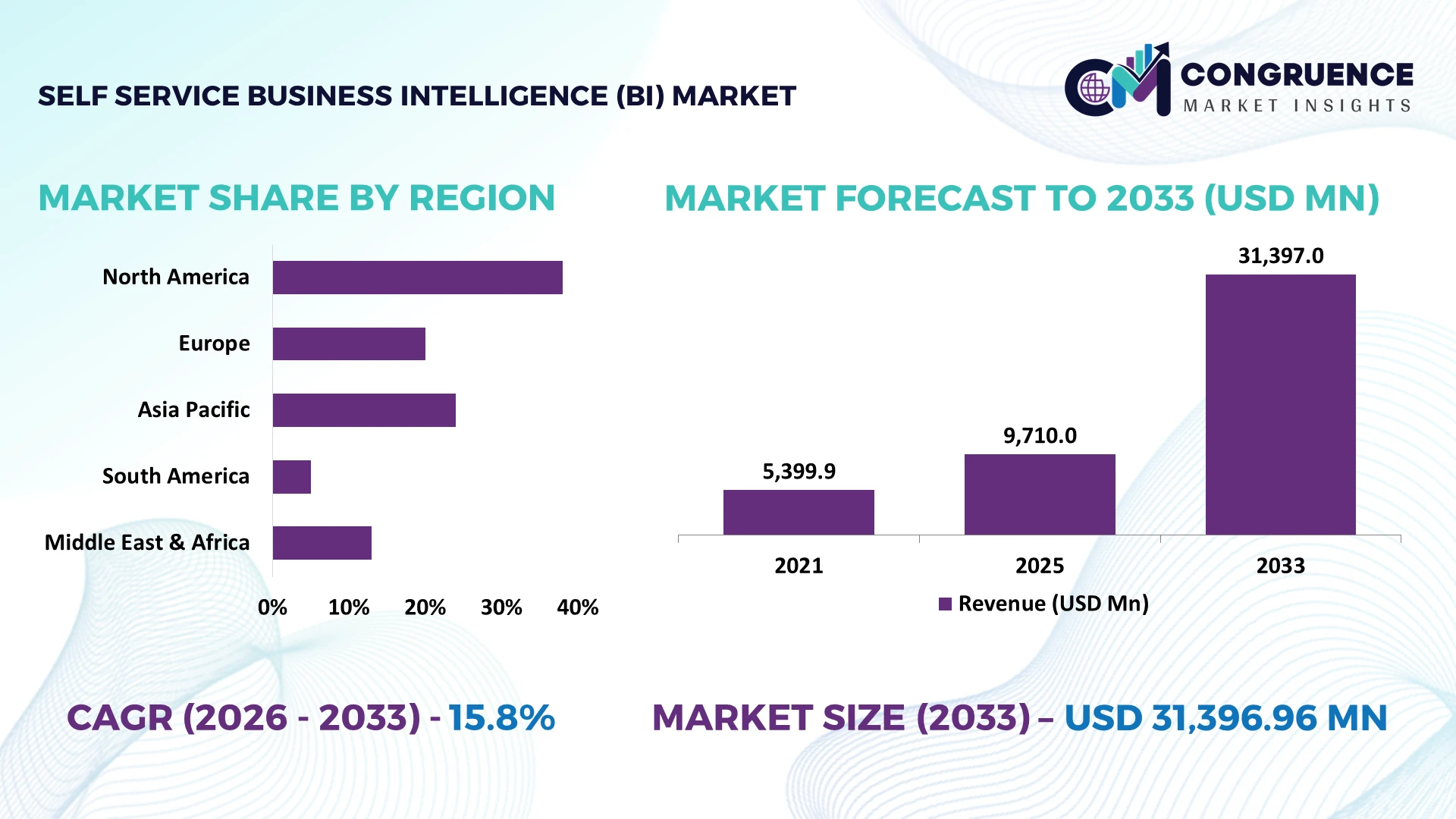
The Global Self-service Business Intelligence (BI) Market was valued at USD 9710 Million in 2025 and is anticipated to reach a value of USD 31396.96 Million by 2033 expanding at a CAGR of 15.8% between 2026 and 2033. Growth is driven by generative-AI analytics, natural-language querying, cloud data platforms, semantic modeling, embedded analytics, and enterprises shifting dashboard creation from centralized IT teams to business users.
The United States represents approximately 38% of global self-service BI demand, supported by extensive cloud infrastructure and deployment across banking, retail, healthcare, technology, and professional services. Roughly 78% of organizations use AI in at least one business function, strengthening demand for conversational analytics and automated insight generation. Microsoft, Salesforce, Google, and cloud-data ecosystems reinforce domestic deployment. Compared with Germany, U.S. adoption is more cloud-intensive, while Germany’s GDPR environment increases emphasis on governed datasets, access controls, and data residency across decentralized analytics programs.
Strategically, vendors combining governed semantic layers, generative AI, cloud interoperability, and intuitive natural-language analytics are positioned to capture enterprise-wide BI consolidation.
Market Size & Growth: USD 9,710 million in 2025 advances to USD 31,396.96 million by 2033 at 15.8% CAGR, driven by generative-AI analytics.
Top Growth Drivers: AI adoption reaches 78%, cloud usage exceeds 90%, and data-driven decision programs engage more than 70% of large enterprises.
Short-Term Forecast: By 2028, AI-assisted analytics workflows are positioned to reduce repetitive dashboard-development effort by approximately 30%.
Emerging Technologies: Generative AI, natural-language querying, and automated insight generation are reshaping BI as enterprise AI usage reaches 78%.
Regional Leaders: By 2033, North America approaches USD 11.6 billion, Europe USD 8.2 billion, and Asia-Pacific USD 8.5 billion as cloud analytics expands.
Consumer/End-User Trends: Approximately 70% of enterprises are expanding analytics access beyond specialist data teams toward operational business users.
Pilot/Case Example: In 2024, Klarna’s AI assistant handled two-thirds of customer-service conversations, demonstrating how enterprise AI can operationalize high-volume business data.
Competitive Landscape: Microsoft holds an estimated 20%+ positioning in enterprise BI, competing with Salesforce, Qlik, Google, and Oracle across analytics ecosystems.
Regulatory & ESG Impact: The EU AI Act introduces governance obligations across 27 member states, increasing requirements for traceable AI-assisted analytics and controlled enterprise data use.
Investment & Funding: Generative-AI investment exceeded USD 30 billion globally in 2024, accelerating partnerships between analytics, cloud, data-platform, and foundation-model providers.
Innovation & Future Outlook: Agentic analytics can automate 30%+ of selected data-preparation and reporting workflows, shifting BI from dashboard consumption toward continuous decision support.
The Self-service Business Intelligence (BI) Market is moving from manually assembled dashboards toward conversational, AI-assisted decision environments where business users interrogate governed enterprise data directly. Demand is concentrated across banking, retail, healthcare, manufacturing, technology, and professional services, where rapid operational decisions depend on accessible analytics. With approximately 78% of organizations using AI in at least one business function, vendors are integrating natural-language querying, automated visualization, semantic models, and AI-generated explanations. Europe’s AI governance requirements simultaneously elevate traceability and data controls, making governed self-service analytics central to the market’s strategic evolution.
Self-service BI is becoming strategic infrastructure as enterprises distribute analytical decision-making beyond centralized data teams. With roughly 78% of organizations using AI in at least one business function and cloud adoption exceeding 90%, governed analytics increasingly determines how quickly managers convert operational data into decisions. The EU AI Act adds another structural shift, pushing enterprises toward traceable semantic models, controlled datasets, and auditable AI-generated insights.
Generative BI combines natural-language querying, automated visualization, and contextual explanations, reducing selected dashboard-development and exploratory-analysis workloads by approximately 30% compared with legacy analyst-led reporting. U.S. enterprises emphasize cloud-scale analytics and AI copilots, while German deployments prioritize governance, privacy, and controlled data access. Through 2026–2028, conversational interfaces and agentic analytics will increasingly automate query generation, anomaly identification, and recurring management reporting.
A retail manager can query governed sales, inventory, and promotion data conversationally and receive visualized variance analysis without submitting an IT reporting request. Vendors are investing in semantic layers, AI assistants, cloud-data partnerships, and embedded analytics. Competitive advantage will increasingly depend on delivering trusted answers at business-user speed without weakening enterprise data governance.
Generative AI is shifting BI consumption from specialist-built dashboards toward conversational analysis accessible to operational employees. Approximately 78% of organizations use AI in at least one business function, cloud adoption exceeds 90%, and more than 70% of large enterprises are broadening data-driven decision programs. U.S. banking, retail, healthcare, and technology organizations increasingly embed natural-language querying and automated visualization into daily workflows, reducing dependence on centralized analytics teams. This transition shortens the path from business question to actionable insight while expanding BI usage across departments. Microsoft, Salesforce, Google, and specialist analytics vendors are investing in copilots, semantic models, automated data preparation, and cloud integrations. A critical operational shift is that interface simplicity now matters less than semantic accuracy: business users require governed answers, not merely easier dashboard creation.
Self-service analytics remains structurally constrained by fragmented enterprise data, inconsistent definitions, legacy systems, and governance requirements. Approximately 80% of enterprise data is unstructured, while more than 60% of organizations report data-quality challenges affecting analytics initiatives; cloud environments also span multiple platforms for over 75% of large enterprises. Germany illustrates the constraint because GDPR obligations require organizations to control access, processing purpose, and sensitive information while decentralizing analytics. Poorly governed self-service deployment creates conflicting KPI definitions, duplicated datasets, and unreliable management reporting, increasing reconciliation work instead of eliminating it. Vendors are responding with semantic layers, data catalogs, lineage tracking, role-based controls, and integration partnerships. The strategic restraint is therefore not visualization capability but whether organizations can establish a trusted data foundation before analytical access expands across thousands of users.
Agentic BI creates an opportunity to move analytics beyond answering questions toward monitoring conditions, investigating anomalies, and initiating predefined actions. With approximately 78% of organizations already using AI, more than 90% using cloud services, and selected AI-assisted analytical workflows reducing manual effort by around 30%, the foundation for autonomous analytics is forming rapidly. India offers substantial potential through expanding digital banking, IT services, e-commerce, and cloud-based enterprise operations. Between 2026 and 2028, analytics agents will increasingly monitor KPIs, identify causal relationships, prepare management summaries, and trigger workflow actions through enterprise applications. Vendors are investing in reasoning models, governed semantic layers, API ecosystems, and partnerships with cloud-data platforms. The non-obvious opportunity is persistent analytics: value shifts from employees repeatedly opening dashboards toward software continuously watching operational metrics on their behalf.
The central execution challenge is maintaining accuracy, security, and accountability as AI-generated analytics reaches larger employee populations. Approximately 78% of organizations use AI, over 75% of large enterprises operate multi-cloud environments, and cybersecurity workforce shortages affect roughly 70% of organizations, increasing governance complexity across distributed data estates. The EU AI Act intensifies pressure on companies deploying AI-supported decision systems to maintain appropriate transparency, oversight, and risk controls. Generative BI can produce convincing but incorrect interpretations when semantic context, permissions, or source data are incomplete, creating operational exposure in finance, procurement, and regulated workflows. Vendors must strengthen grounding, lineage, permission-aware retrieval, model monitoring, and human validation while partnering with governance platforms. Long-term competitiveness depends on scaling analytical autonomy without allowing faster insight generation to outrun data quality and organizational accountability.
Semantic Layers Become Governance Backbone: Enterprises are standardizing business definitions before expanding self-service access, as more than 60% report data-quality challenges and over 75% of large organizations operate multi-cloud estates. Central semantic models now align finance, sales, and operational KPIs across BI interfaces. Vendors are strengthening lineage, catalogs, permission inheritance, and metric stores, reducing duplicated reporting logic by an estimated 20–30% and improving consistency across decentralized analytics teams.
Embedded Analytics Moves Into Workflows: Organizations increasingly place analytics inside CRM, ERP, service, and operational applications instead of requiring users to open separate BI environments. With cloud adoption exceeding 90% and SaaS usage expanding across enterprise functions, contextual dashboards and alerts shorten decision cycles. BI providers are scaling APIs, software-development kits, and application partnerships, allowing companies to deliver insights at the point of action while reducing dashboard switching and repetitive data exports.
Mobile BI Gains Operational Depth: Mobile analytics is evolving from executive dashboard viewing toward interactive frontline decision support. Smartphone penetration exceeds 85% in several advanced digital economies, while distributed work arrangements keep mobile access operationally relevant. Retail, field services, logistics, and manufacturing teams increasingly consume alerts, drill-down metrics, and location-sensitive KPIs through mobile interfaces. Vendors are improving responsive visualization, offline functionality, push alerts, and biometric authentication to accelerate decisions outside traditional desktop environments.
AI Governance Reshapes Product Design: Europe’s AI Act and expanding enterprise governance programs are forcing BI providers to make generated insights more traceable. Approximately 78% of organizations use AI in at least one function, increasing scrutiny of model outputs and underlying datasets. Vendors are embedding lineage, citations, permission-aware retrieval, and administrative controls into AI-assisted analytics. The non-obvious shift is procurement-related: explainability is becoming a product-selection criterion alongside visualization performance and usability.
Cloud-Based BI accounts for approximately 43% of type-level demand, supported by elastic computing, browser-based access, simplified upgrades, and direct integration with cloud data platforms. More than 90% of enterprises use cloud services, while multi-cloud deployment exceeds 75% among large organizations, strengthening demand for analytics independent of on-premise infrastructure. On-Premise BI remains strategically relevant for highly controlled environments requiring localized data management. Embedded BI is gaining adoption as enterprises integrate analytics directly into operational software, while Mobile BI supports executives and frontline users requiring location-independent access.
Augmented BI is the fastest-growing type as AI-generated summaries, natural-language querying, automated visualization, and anomaly detection reduce dependence on specialist analysts. Approximately 78% of organizations already use AI in at least one business function, creating an established adoption base. Vendors are prioritizing AI copilots, semantic models, embedded interfaces, and cloud-data partnerships. Investment priorities are consequently moving from standalone visualization toward platforms combining governed cloud analytics with automated analytical assistance.
Data Visualization represents approximately 30% of application demand because dashboards, interactive charts, and visual exploration remain the primary interface through which nontechnical employees consume enterprise analytics. Dashboarding maintains strong adoption for recurring KPI monitoring, while Reporting remains essential for standardized financial, regulatory, and operational outputs. Ad Hoc Analysis serves managers requiring rapid investigation beyond predefined reports. More than 70% of large enterprises are broadening data-driven decision programs, strengthening demand for interfaces that translate complex datasets into accessible business metrics.
Predictive Analytics is the fastest-growing application as AI integration shifts self-service BI from historical interpretation toward forecasting and recommended action. With approximately 78% of organizations using AI and cloud adoption exceeding 90%, enterprises increasingly expose forecasting models through user-friendly BI interfaces. Vendors are embedding automated forecasting, anomaly detection, scenario analysis, and natural-language explanations while integrating dashboards with operational applications. Investment is shifting toward analytics environments where visualization initiates investigation rather than representing the final analytical output.
Financial Services accounts for approximately 28% of end-user demand, reflecting extensive deployment across risk management, profitability analysis, customer intelligence, fraud monitoring, compliance, and branch performance. Banks require governed access to high-volume transactional information while enabling managers to investigate performance without repeated analyst intervention. Retail uses self-service BI for merchandising, inventory, pricing, and customer analysis, while Manufacturing emphasizes production efficiency, quality, procurement, and supply-chain visibility. IT and Telecom deployments concentrate on network performance, customer retention, service operations, and infrastructure utilization.
Healthcare is the fastest-growing end-user as organizations digitize clinical, administrative, financial, and operational workflows. More than 95% of U.S. hospitals use certified electronic health record technology, creating substantial structured data availability for analytics. BI providers are responding with healthcare-specific data models, role-based governance, cloud integrations, and embedded operational dashboards. Competitive positioning increasingly depends on industry templates and governed semantic models rather than generic visualization functionality, particularly where regulated data must reach nontechnical decision-makers safely.
North America accounted for the largest market share at 38.4% in 2025 however, Asia-Pacific is expected to register the fastest growth, expanding at a CAGR of 18.7% between 2026 and 2033.
AI-Native Analytics Reshapes Enterprise Decisions
North America represents approximately 38.4% of global self-service BI demand, supported by mature cloud infrastructure, extensive enterprise data estates, and rapid deployment of generative analytics. U.S. organizations are moving beyond static visualization toward conversational querying, automated summaries, semantic modeling, and embedded decision intelligence. Approximately 78% of organizations use AI in at least one business function, creating a substantial installed base for AI-assisted BI. Financial services, retail, healthcare, technology, and professional services concentrate deployment because operational teams require direct access to governed data. Canada contributes through banking, telecommunications, government, and healthcare digitization. Major vendors are integrating BI copilots with cloud warehouses, productivity applications, and enterprise data platforms. The operational shift reduces dependence on specialist analysts for recurring queries while increasing investment in semantic consistency, lineage, and permission-aware analytics.
United States Market Outlook: The United States remains the primary technology and deployment center through its concentration of hyperscalers, analytics vendors, financial institutions, retailers, and software enterprises. Cloud usage exceeds 90% among enterprises, enabling rapid distribution of browser-based analytics. Organizations increasingly connect BI platforms with cloud data warehouses, CRM systems, productivity suites, and AI models, strengthening demand for governed conversational analytics.
Governance Becomes Core Analytics Architecture
Europe accounts for approximately 26.3% of global self-service BI demand, led by Germany, the United Kingdom, France, the Netherlands, and Italy. Enterprise adoption increasingly combines decentralized analytics with centralized governance as GDPR and the EU AI Act elevate requirements around data access, transparency, and AI-supported decision processes. Financial institutions, manufacturers, retailers, healthcare organizations, and public agencies are deploying semantic layers, lineage controls, role-based permissions, and cloud analytics to reconcile accessibility with regulatory accountability. The EU AI Act applies across 27 member states, creating a measurable governance trigger for analytics platforms incorporating generative AI. Vendors are expanding European cloud availability, localized data controls, governance functionality, and partnerships with enterprise software providers. Procurement increasingly favors platforms capable of documenting how metrics and AI-generated interpretations connect to authorized underlying data.
Germany Market Outlook: Germany combines advanced manufacturing, financial services, enterprise software, and stringent data-governance requirements, creating demand for controlled self-service analytics. Industrial organizations increasingly connect production, procurement, quality, and supply-chain datasets through governed BI environments. GDPR and emerging AI governance reinforce deployment of lineage, permission management, and traceable semantic models rather than unrestricted departmental analytics.
Digital Scale Expands Analytics Participation
Asia-Pacific represents approximately 25.1% of global self-service BI demand, supported by rapid cloud adoption, digital commerce, financial technology, manufacturing digitization, and expanding enterprise data infrastructure. India, China, Japan, Australia, Singapore, and South Korea concentrate deployment, although adoption patterns differ materially. India’s technology-services and digital-payment ecosystems support high-volume operational analytics, while Japan emphasizes enterprise modernization and manufacturing intelligence. Multi-cloud usage exceeds 75% among large enterprises, increasing demand for BI layers capable of querying distributed datasets without duplicating information. Providers are expanding cloud regions, language capabilities, mobile analytics, AI assistants, and partnerships with local system integrators. Embedded BI is gaining importance as banks, retailers, telecommunications providers, and software companies place analytics directly inside customer and employee workflows, reducing reliance on separate specialist reporting environments.
India Market Outlook: India provides a strong deployment environment through its IT-services workforce, digital banking scale, telecommunications sector, e-commerce ecosystem, and expanding cloud infrastructure. Organizations increasingly deploy self-service dashboards for customer analytics, service delivery, workforce utilization, and financial operations. India’s digital public infrastructure also reinforces data-intensive operating models, encouraging enterprises to invest in scalable cloud analytics and governed business-user access.
Digital Commerce Broadens Analytics Demand
South America accounts for approximately 5.8% of global self-service BI demand, with Brazil providing the largest deployment base and Colombia, Chile, and Argentina contributing through banking, retail, telecommunications, and digital services. Cloud migration is allowing enterprises to bypass infrastructure-heavy on-premise analytics while extending dashboards to distributed business teams. Brazil’s Pix instant-payment system processes transactions at national scale, increasing the operational importance of real-time financial, customer, fraud, and service-performance analytics. Retailers and banks increasingly integrate BI with cloud databases and operational applications rather than maintaining isolated reporting repositories. Smaller organizations still face data-engineering skills gaps, inconsistent data quality, and constrained technology budgets. Vendors are responding through cloud subscriptions, Portuguese and Spanish interfaces, local integration partners, embedded analytics, and packaged dashboards designed to shorten implementation cycles.
Brazil Market Outlook: Brazil combines a large banking system, sophisticated digital payments, nationwide retail networks, and expanding cloud infrastructure. Pix has made real-time transaction monitoring operationally important for financial institutions and merchants. Enterprises increasingly require accessible analytics spanning payments, customer behavior, inventory, and branch performance, creating opportunities for cloud BI platforms offering localized integration and governance capabilities.
Cloud Modernization Accelerates Data-Led Operations
Middle East & Africa represents approximately 4.4% of global self-service BI demand, with the UAE, Saudi Arabia, Israel, and South Africa concentrating enterprise adoption. Gulf digital-transformation programs are modernizing government services, banking, aviation, healthcare, energy, and telecommunications, producing larger operational datasets requiring accessible analytics. Saudi Arabia and the UAE are expanding cloud infrastructure and AI programs, encouraging enterprises to move reporting workloads from isolated departmental systems toward governed cloud platforms. Vendors are responding with regional data-center capacity, Arabic-language functionality, system-integrator partnerships, and industry-specific analytics. African deployment remains uneven because cloud availability, analytics skills, and enterprise digitization vary substantially by country. This disparity strengthens demand for managed cloud BI that minimizes internal infrastructure requirements while providing standardized dashboards, mobile access, and centralized governance.
Saudi Arabia Market Outlook: Saudi Arabia offers strong enterprise analytics potential through digital-government modernization, financial-sector transformation, healthcare digitization, energy operations, and Vision 2030 initiatives. Organizations increasingly consolidate operational information into cloud data platforms and management dashboards. Government-backed AI and data programs strengthen demand for Arabic-capable, governed analytics that can serve executive, operational, and departmental users across large institutions.
Microsoft, Salesforce, Qlik, Google, and Oracle compete for self-service BI workloads through cloud ecosystems, AI-assisted analytics, semantic modeling, and embedded intelligence. The top five collectively represent approximately 58% of market activity, creating a platform tier alongside specialists such as ThoughtSpot and Domo. Microsoft leverages Power BI integration with Microsoft 365 and Azure; Salesforce competes through Tableau and CRM-connected analytics; Qlik emphasizes data integration and governed discovery. AI-assisted analysis can reduce selected reporting workloads by roughly 30%, cloud deployment lowers infrastructure administration by 20–25%, and embedded analytics can shorten application-switching workflows by approximately 15%. Players are expanding generative-AI copilots, cloud-data partnerships, industry templates, and consumption-based deployment while integrating governance into semantic layers. Competition is shifting from dashboard functionality toward conversational and agentic analytics. Trusted data models, ecosystem integration, enterprise distribution, and governance create entry barriers. Winning requires AI-generated insights, intuitive self-service workflows, interoperable data access, and scalable governance across business functions.
Microsoft
Salesforce
Qlik
Oracle
SAP
IBM
SAS Institute
ThoughtSpot
Domo
MicroStrategy
Zoho Corporation
Sisense
TIBCO Software
Current self-service BI combines cloud analytics, governed semantic layers, natural-language querying, and embedded AI copilots. Cloud-native platforms can reduce infrastructure administration by approximately 25%, while automated data preparation lowers analyst workloads by roughly 30%. With 78% of organizations using AI in at least one business function, conversational analytics is moving from experimentation into enterprise reporting, visualization, and decision workflows.
Emerging technology centers on augmented analytics, vector-enabled retrieval, real-time intelligence, and automated semantic modeling. Compared with legacy dashboard development requiring manual queries and visualization assembly, generative BI can shorten selected report-building workflows by about 40%. Embedded analytics also reduces application switching by approximately 15% by placing governed insights inside CRM, ERP, and operational software. Financial services, retailers, and technology enterprises benefit most from faster decentralized analysis.
Disruptive development through 2026–2028 will center on agentic analytics that monitors metrics, investigates anomalies, explains causal relationships, and initiates approved workflow actions. AI agents integrated with governed data products can reduce recurring analytical intervention by 30% while expanding continuous decision support. Vendors combining trusted semantic layers, permission-aware retrieval, real-time data, and workflow automation gain competitive advantage. Enterprises should prioritize these capabilities now because analytical differentiation is shifting from dashboard availability toward autonomous, governed decision execution.
May 2024 Microsoft made Copilot for Power BI generally available within Fabric, enabling natural-language report generation and summaries for customers. The release shifted generative AI from preview into production analytics, reducing technical barriers for business users across enterprise reporting workflows. Source: InfoWorld
April 2025 Salesforce announced Tableau Next, introducing agentic analytics built on its platform with an AI-powered semantic layer and Agentforce integration. Deloitte, IBM, and Box backed the launch, strengthening enterprise adoption of contextual, action-oriented analytics directly within operational business workflows. Source: Salesforce
December 2025 Qlik introduced a private-preview agentic experience in Qlik Cloud, combining structured analytics, unstructured documents, specialized agents, and large-language-model reasoning. Qlik Answers became the unified conversational interface, expanding governed multi-step enterprise analysis while preserving citations and engine-backed analytical calculations. Source: Qlik
July 2026 Microsoft expanded Power BI through its monthly update, adding capabilities across reporting, modeling, mobile, embedded analytics, organizational-app APIs, and web-based TMDL view. The release broadened self-service model management and application distribution, strengthening enterprise analytics administration across deployment environments. Source: Microsoft Learn
The report evaluates Cloud-Based BI, On-Premise BI, Embedded BI, Mobile BI, and Augmented BI across Data Visualization, Ad Hoc Analysis, Dashboarding, Reporting, and Predictive Analytics. End-user coverage includes Financial Services, Healthcare, Retail, Manufacturing, and IT and Telecom. Regional analysis spans North America, Europe, Asia-Pacific, South America, and Middle East & Africa, with North America representing approximately 38.4% of 2025 market activity.
Technology coverage examines generative AI, conversational querying, agentic analytics, semantic layers, automated data preparation, predictive modeling, embedded intelligence, and real-time analytics. The report tracks cloud migration, governed self-service deployment, mobile consumption, AI-assisted workflows, and emerging autonomous decision intelligence. Competitive and country-level analysis supports investment planning, technology partnerships, geographic expansion, product positioning, and enterprise analytics strategy between 2026 and 2033.
| Report Attribute/Metric | Report Details |
|---|---|
Market Revenue in 2025 | USD 9710 Million |
Market Revenue in 2033 | USD 31396.96 Million |
CAGR (2026 - 2033) | 15.8% |
Base Year | 2025 |
Forecast Period | 2026 - 2033 |
Historic Period | 2021 - 2025 |
Segments Covered | By Type
By Application
By End-User
|
Key Report Deliverable | Revenue Forecast, Growth Trends, Market Dynamics, Segmental Overview, Regional and Country-wise Analysis, Competition Landscape |
Region Covered | North America, Europe, Asia-Pacific, South America, Middle East, Africa |
Key Players Analyzed | Microsoft, Salesforce, Qlik, Google, Oracle, SAP, IBM, SAS Institute, ThoughtSpot, Domo, MicroStrategy, Zoho Corporation, Sisense, TIBCO Software |
Customization & Pricing | Available on Request (10% Customization is Free) |




