
Reports
The Global Selective Soldering Equipment Market was valued at USD 175.0 Million in 2025 and is anticipated to reach a value of USD 262.5 Million by 2033 expanding at a CAGR of 5.2% between 2026 and 2033. Growth is propelled by the shift toward high-mix, low-volume PCB assembly and the necessity for thermal isolation of sensitive components in automotive and medical electronics.
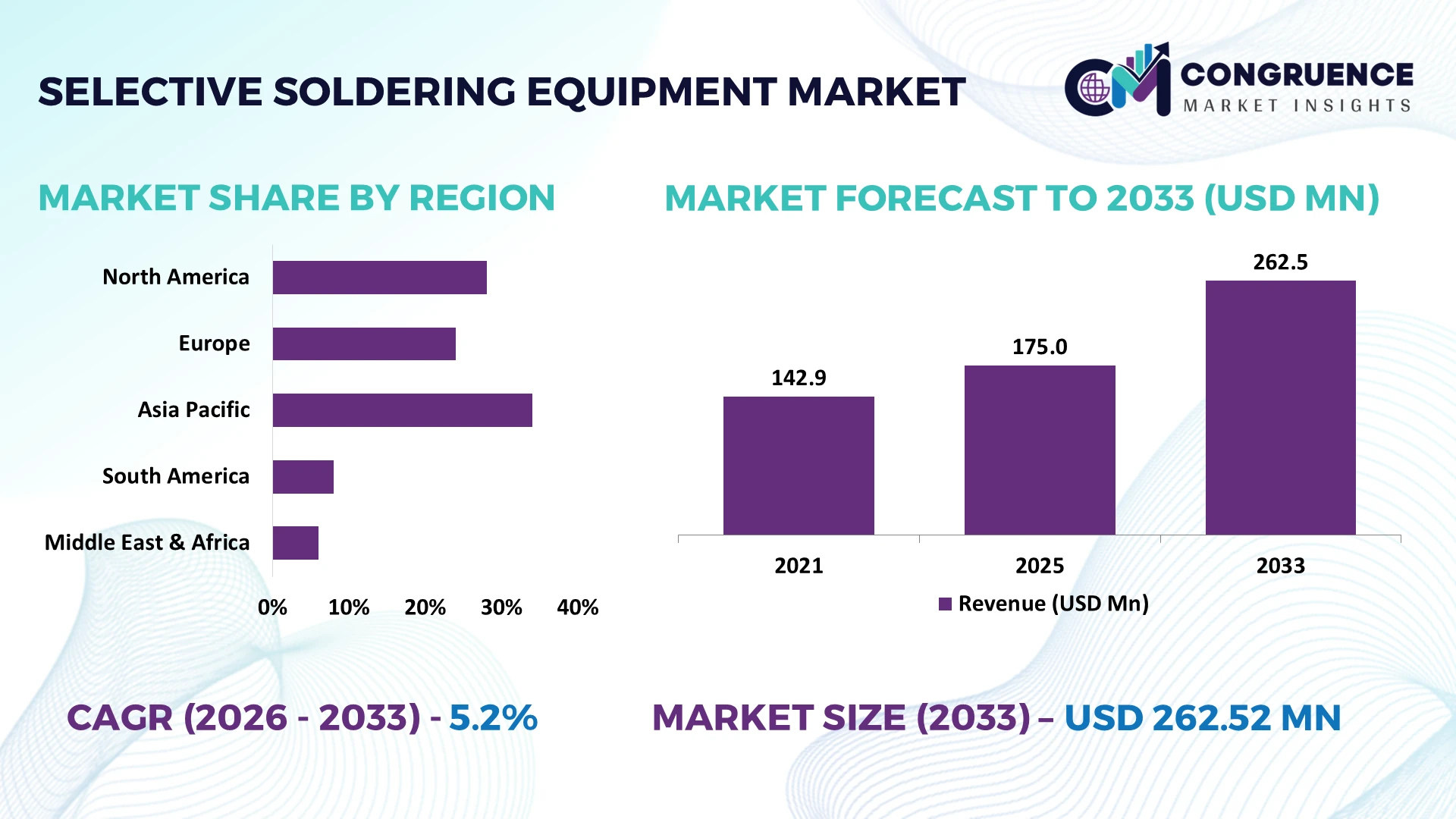
China commands approximately 38% of global consumption, supported by aggressive domestic semiconductor equipment investment and a dense EMS cluster across Shenzhen and Suzhou, while Germany retains technological leadership with over 22% of high-precision units deployed in automotive ECU manufacturing. Adoption of parallel processing selective soldering platforms in China outpaces Western Europe by a factor of 1.8, driven by smartphone and EV power module production cycles.
Strategic implication, equipment vendors must localize application engineering in Asia while defending premium pricing through nozzle and thermal control IP.
Market Size & Growth: The market stands at USD 175.0 Million in 2025, reaching USD 262.5 Million by 2033, with parallel processing architecture eliminating line complexity as a primary growth driver.
Top Growth Drivers: Automotive electronics miniaturization (34% of new selective soldering capacity), medical device hermetic sealing demand (19% of high-precision orders), and supply chain regionalization (27% of new line installations in Southeast Asia).
Short-Term Forecast: By 2028, automated nozzle changing and matrix preheating reduce setup time by 40% and unplanned maintenance by 28% across high-mix production floors.
Emerging Technologies: Digital twin solder profiling, dual-pot parallel processing for dual-alloy runs, and IPC CFX-certified traceability integration are reshaping equipment specifications.
Regional Leaders: China at USD 66.5 Million (38% share), Germany at USD 38.5 Million with 22% high-precision penetration, and the United States at USD 31.5 Million driven by defense and aerospace rework.
Consumer/End-User Trends: 67% of EMS providers now require selective soldering equipment with integrated THT-AOI, up from 41% in 2023, reflecting zero-defect mandates.
Pilot/Case Example: In 2026, a German automotive Tier-1 supplier deployed parallel-processing selective soldering and achieved 22% throughput gain without additional floor space.
Competitive Landscape: Kurtz Ersa leads with approximately 24% share; Pillarhouse, SEHO Systems, ITW EAE, and Nordson Select constitute the next tier.
Regulatory & ESG Impact: EU RoHS enforcement and UL 61010 certification requirements add 12–18% to equipment validation costs for regulated buyers.
Investment & Funding: Over USD 340 Million in announced capacity expansions across Germany, Japan, and China during 2026–2027, focused on certified manufacturing lines.
Innovation & Future Outlook: Next-generation platforms prioritize zero-defect traceability and nitrogen consumption reduction of 30%, with strategic shifts toward software-defined soldering recipes.
The Selective Soldering Equipment Market is witnessing concentrated demand from automotive power electronics and medical device assembly, where thermal isolation of through-hole components remains non-negotiable. Recent product innovations include parallel dual-lane processing and automated nozzle cleaning systems that reduce operator intervention by 35%. A notable operational shift is the integration of IPC CFX connectivity for real-time solder joint traceability, now specified in 29% of new tenders from European OEMs. This traceability imperative directly informs the strategic pathways examined below.
Selective soldering has moved from a niche complement to wave soldering into a strategic enabler of high-mix, regulated electronics production. Supply-chain restructuring across North America and Europe, coupled with the CHIPS-adjacent push for domestic electronics capacity, has elevated equipment selection from a procurement decision to a capability differentiator. Manufacturers that control thermal profiling and flux deposition precision can qualify for automotive and medical contracts that reject legacy wave processes on thermal stress grounds.
A direct technology comparison illustrates the shift: parallel-processing selective platforms reduce per-board cycle time by 22% compared with sequential single-nozzle systems, while nitrogen consumption drops 30% when matrix-controlled preheating replaces blanket convection. Regionally, Germany’s installed base emphasizes high-precision, low-volume medical and automotive applications, whereas China’s capacity expansion prioritizes throughput and cost-per-joint for consumer and EV power modules. Over the next 24–36 months, adoption indicators point to shorter replacement cycles—from seven years to approximately six—as closed-loop fluxing and thermal profiling make older machines commercially uncompetitive in regulated segments.
A practical deployment example is Kurtz Ersa’s VERSAFLOW FIVE, which processes two PCBs independently within a single machine, allowing a contract manufacturer to run a high-mix automotive batch alongside a medical order without cross-contamination risk or line duplication. Companies are responding by reallocating capital from floor-space expansion toward software and validation capabilities, and by forming application-engineering partnerships with equipment vendors rather than relying on distributor support. The strategic conclusion is unambiguous: selective soldering competence now functions as a qualification gate for high-value electronics contracts, and firms that treat it as a commodity purchase will find themselves structurally excluded from the most defensible segments of the market.
Automotive electronics account for 34% of new selective soldering capacity additions, driven by the thermal sensitivity of ADAS sensors and 800V power module interconnects that cannot survive wave solder immersion. In Germany and China, Tier-1 suppliers are specifying selective platforms with closed-loop thermal profiling to meet IATF 16949 traceability requirements, pushing equipment vendors to integrate recipe management and CFX connectivity. Kurtz Ersa’s introduction of automatic solder nozzle changing directly responds to this demand, reducing setup variability that previously disqualified selective soldering from high-volume automotive runs. The operational insight is that automotive qualification cycles now favor vendors who can demonstrate process capability data, not merely machine specifications.
Building a certified manufacturing line for selective soldering equipment takes 12–18 months, constraining suppliers’ ability to respond to demand surges in regulated segments. Input cost volatility for high-purity alloys and semiconductor controllers adds further margin pressure, with lead times for customized machines extending by 3–6 months during component shortages. In the United States and EU, buyers require UL 61010 and ISO 13485-aligned quality systems, effectively narrowing the qualified supplier pool. Companies are responding by pre-qualifying second-source component suppliers and holding strategic inventory of controller boards, but the structural constraint persists: capacity cannot be flexed quickly without compromising certification integrity.
Dual-pot selective systems enable processing of different alloys or nozzle configurations without line stoppage, addressing the 41% of EMS providers that now run high-mix batches with alloy diversity. Apollo Seiko’s dual-pot inline platform and Kurtz Ersa’s parallel-processing architecture demonstrate that throughput gains of 22% are achievable without additional floor space. The non-obvious opportunity lies in medical device manufacturing, where hermetic sealing and biocompatible alloy requirements command premium pricing but have been underserved by general-purpose platforms. Companies investing in application-specific recipe libraries for implantable and diagnostic device assembly can capture margin that commodity consumer-electronics vendors cannot access.
The integration of IPC CFX and digital twin profiling demands operator competency that most EMS floors lack; 29% of European tenders now require documented soldering recipe validation, yet fewer than half of surveyed contract manufacturers have dedicated process engineers for selective soldering. In China, rapid capacity expansion has outpaced training, with 18% of new installations reporting initial yield variability exceeding acceptable thresholds. The long-term risk is regulatory: if traceability data integrity cannot be maintained across shifts and machine reconfigurations, automotive and medical customers will rescind qualification. Companies must solve this through embedded simulation training and vendor-supported recipe lock protocols, treating workforce development as infrastructure rather than overhead.
Local-for-Local Production Shift Kurtz Ersa launched the VERSAFLOW ONE in March 2025, manufactured at its Zhuhai plant, marking a decisive local-for-local strategy for the Chinese market. This cuts delivery lead times by an estimated 30–40% versus German-imported units and shields pricing from tariff volatility. Competitors are accelerating similar China-based assembly to defend share in the 38% consumption pool.
Dual-Lane Parallel Throughput Parallel dual-lane architectures now appear in 29% of new high-mix tenders, enabling simultaneous processing of two non-mirror PCB panels. Pillarhouse’s Fusion Pro platform accommodates twin solder baths with independent pitch adjustment, effectively doubling output per square meter of floor space. EMS providers in Mexico and Southeast Asia are prioritizing this configuration to absorb labor cost pressure without headcount expansion.
Lead-Free/Leaded Segregation Federal Electronics installed dual Pillarhouse Jade systems at its Hermosillo facility in October 2025—one dedicated to leaded, one to lead-free alloys—to serve high-reliability customers without cross-contamination risk. This segregation model is spreading across North American EMS sites as medical and defense contracts tighten alloy traceability requirements.
Recipe-Driven Traceability IPC CFX integration now features in 34% of European automotive tenders, up from 19% in 2023, with recipe lock protocols becoming a qualification gate rather than a differentiator. Non-obvious insight: the bottleneck is not machine capability but operator data discipline—18% of Chinese installations report yield drift attributable to manual recipe override. Vendors are responding with role-based access controls embedded at the firmware level.
Offline selective soldering systems command approximately 60% of unit share, retaining dominance through lower capital outlay and suitability for small-batch rework across Chinese and Southeast Asian EMS clusters. Their scalability ceiling is now visible: manual board loading limits throughput to roughly 40–60 boards per hour in high-mix runs. Inline systems represent the fastest-growing configuration, expanding at nearly double the offline rate as automotive and medical buyers demand conveyor-integrated processing with recipe recall across shifts. German Tier-1 suppliers report 22% higher line utilization after transitioning from offline to inline configurations, particularly where IATF 16949 documentation requires continuous board-level traceability.
Remaining niche types—including laser selective platforms—hold under 8% combined share, confined to fine-pitch applications where thermal budgets prohibit contact soldering. Vendors are reallocating R&D toward inline modularity, with Kurtz Ersa and Pillarhouse both introducing compact inline platforms in 2025 to capture mid-volume buyers migrating from offline workflows.
Automotive electronics represents the leading application at approximately 31% of selective soldering demand, driven by the thermal isolation requirements of ADAS sensor modules, 800V power interconnects, and ECU through-hole connectors that cannot survive wave solder immersion. Demand is concentrated in Germany and China, where EV platform ramps and IATF 16949 traceability mandates make selective soldering a qualification prerequisite rather than a process preference. Telecommunication infrastructure follows as a mature but stable application, holding roughly 24% share, with 5G base station power amplifiers requiring selective rework of through-hole connectors on densely populated boards.
The fastest-growing application is medical devices, expanding at a pace exceeding the overall market by 1.6×, as hermetic sealing and biocompatible alloy requirements push OEMs away from manual soldering and toward programmable, recipe-locked platforms. Aerospace and defense remain operationally critical but volume-constrained, with qualification cycles extending 12–18 months and favoring incumbent vendors already on approved supplier lists. Companies are responding by building application-specific recipe libraries for medical implantables and automotive power modules, shifting investment from general-purpose platform development toward verticalized process knowledge.
Contract electronics manufacturers (EMS) constitute the leading end-user group at approximately 44% of selective soldering equipment demand, reflecting their role as the volume aggregation point for high-mix automotive, medical, and industrial production across Mexico, China, and Southeast Asia. EMS providers prioritize throughput per square meter and recipe flexibility, driving adoption of dual-lane parallel platforms that maximize utilization without floor-space expansion. Automotive OEMs and Tier-1 suppliers represent the fastest-growing direct buyer segment, increasingly specifying selective soldering equipment at the platform design stage rather than delegating process selection to EMS partners. This shift is narrowing the qualified vendor pool: 29% of European automotive tenders now name specific equipment platforms in RFQs, effectively locking out general-purpose alternatives.
Medical device OEMs exhibit the highest per-unit specification intensity, requiring ISO 13485-aligned validation documentation that adds 12–18% to equipment acquisition cost but commands premium pricing for qualified vendors. Industrial and instrumentation buyers remain cost-sensitive and favor offline configurations, while aerospace and defense end-users sustain long qualification cycles with low volume but high margin. Companies are responding by assigning dedicated application engineering teams to EMS accounts while developing design-in partnerships with automotive Tier-1s to capture specification influence earlier in the procurement cycle.
Asia-Pacific accounted for the largest market share at 34% in 2025 however, North America is expected to register the fastest growth, expanding at a CAGR of 7.4% between 2026 and 2033.
North America represents approximately 28% of global selective soldering demand, concentrated in US medical device clusters across Massachusetts, California, and North Carolina, alongside defense electronics rework facilities in Texas and Arizona. Regional demand is specification-driven rather than volume-driven: buyers prioritize IPC CFX traceability and ISO 13485-aligned validation documentation, which adds 12–18% to acquisition cost but supports premium pricing for qualified vendors. Mexico’s EMS corridor, particularly Hermosillo and Guadalajara, absorbs mid-volume automotive and industrial production, with Federal Electronics’ 2025 dual-line Pillarhouse installation illustrating the lead/lead-free segregation model spreading across the region. Replacement cycles in regulated US segments have compressed from seven years to approximately six as closed-loop thermal profiling becomes a qualification baseline.
United States Market Outlook: The United States functions as the region’s demand anchor, with medical device and aerospace electronics buyers specifying selective soldering platforms at the design stage rather than delegating process selection to EMS partners. Domestic production capacity remains limited, with significant inbound shipments of German and Japanese high-precision models serving FDA-regulated assembly lines. Investment momentum centers on application engineering partnerships rather than greenfield equipment manufacturing, with vendors localizing recipe development and validation support near Boston and Raleigh clusters.
Europe holds approximately 24% of global selective soldering demand, with Germany accounting for the largest single-country share and simultaneously serving as the continent’s production powerhouse—German manufacturing capacity represents an estimated 25–30% of global selective soldering equipment output. EU GMP Annex 15 qualification requirements and IATF 16949 traceability mandates make Europe the most specification-intensive regional market, where equipment validation documentation carries weight comparable to machine performance. Automotive Tier-1 suppliers in Bavaria and Baden-Württemberg specify dual-pot and parallel-processing platforms to handle 800V power module interconnects alongside ADAS sensor assemblies. Kurtz Ersa’s Wertheim operations anchor the regional supply chain, though component lead-time extensions of 3–6 months during shortages have pushed buyers toward pre-qualified second-source arrangements.
Germany Market Outlook: Germany’s selective soldering position rests on dual strength as both producer and demand center, with domestic automotive electronics and medical device manufacturers requiring equipment that meets IATF 16949 and ISO 13485 simultaneously. German vendors export high-precision platforms to North America and China while defending domestic share against Asian price competition. The country’s application engineering depth—particularly in nozzle design and thermal profiling for fine-pitch connectors—remains a defensible advantage that Chinese manufacturers have not replicated at scale.
Asia-Pacific commands approximately 34% of global selective soldering demand, with China alone representing 38% of worldwide consumption as established in earlier analysis, though regional share distribution reflects Japan, South Korea, and Southeast Asia’s combined contribution. China’s EMS cluster density across Shenzhen, Suzhou, and Zhuhai supports high-volume consumer electronics and EV power module production, where throughput per square meter governs equipment selection. Japan retains high-precision production capability and exports to Southeast Asian contract manufacturers and South Korean biopharma facilities. Kurtz Ersa’s March 2025 launch of the VERSAFLOW ONE, manufactured at its Zhuhai plant, signals the localization strategy now required to compete on delivery speed and tariff exposure in the region’s price-sensitive mid-tier.
China Market Outlook: China’s selective soldering demand is bifurcating: domestic vendors increasingly supply mid-range offline platforms for consumer electronics rework, while high-end automotive and medical buyers continue importing German and Japanese inline systems for regulated applications. The Zhuhai manufacturing localization by Kurtz Ersa cuts delivery lead times by an estimated 30–40% versus German imports, directly addressing the speed advantage that domestic competitors previously held. Investment momentum favors vendors who combine local assembly with application engineering presence in Shenzhen and Suzhou.
South America represents approximately 8% of global selective soldering demand, with Brazil accounting for the majority of regional consumption concentrated in São Paulo and Manaus free-trade-zone electronics assembly. Regional demand is primarily import-dependent, with 70–80% of installations relying on foreign equipment routed through distribution hubs that add integration and calibration value. Infrastructure limitations—including customs clearance variability and limited local application engineering—constrain deployment speed for regulated automotive and medical buyers. However, Brazilian EMS providers serving domestic automotive and telecom markets are investing in inline selective soldering to replace manual rework, driven by quality mandates from OEM customers rather than cost reduction alone.
Brazil Market Outlook: Brazil’s selective soldering adoption is accelerating from a low base as domestic automotive assembly and telecom infrastructure projects require through-hole soldering quality that manual processes cannot consistently deliver. São Paulo’s EMS cluster concentrates deployment activity, with buyers favoring offline configurations that accommodate variable production volumes and reduce capital exposure. The Manaus free-trade zone presents a distinct opportunity for consumer electronics rework, though logistics complexity and import duty structures favor vendors offering integrated service and spare-parts support locally.
The Middle East & Africa region holds approximately 6% of global selective soldering demand, with Gulf Cooperation Council states—particularly the UAE and Saudi Arabia—accounting for the majority of regional deployment concentrated in defense electronics maintenance and telecommunications infrastructure assembly. Regional buyers are almost entirely import-dependent, with equipment routed through UAE distribution hubs serving downstream markets. Demand is project-based rather than continuous-flow, with defense modernization programs and 5G infrastructure rollouts creating episodic procurement cycles. South Africa contributes a smaller but technically sophisticated segment through its defense and industrial electronics sectors, though currency volatility and procurement lead times constrain replacement cycles.
Saudi Arabia Market Outlook: Saudi Arabia’s selective soldering demand is anchored in defense electronics sustainment and telecommunications infrastructure localization under Vision 2030 industrial development priorities. Domestic electronics manufacturing remains nascent, but military maintenance depots and telecom equipment assembly operations require high-reliability soldering capability that cannot be sourced locally. Import-dependent procurement favors vendors offering extended service contracts and on-site application support, with equipment selection often bundled into broader defense offset agreements rather than standalone capital purchases.
Kurtz Ersa leads with roughly 24% share, competing against Pillarhouse, SEHO Systems, ITW EAE, and Nordson Select as the top five, which together command approximately 58% of the market. Competition bifurcates: German and Japanese vendors (Kurtz Ersa, SEHO, Apollo Seiko) defend premium pricing through thermal control IP and automated nozzle changing, while Chinese and regional suppliers compete on cost and delivery speed for mid-tier offline demand. Technology differentiation drives roughly 34% of automotive tender decisions, while supply-chain localization influences 27% of Chinese procurement choices. Kurtz Ersa’s Zhuhai production of the VERSAFLOW ONE directly contests domestic pricing pressure. Consolidation pressure is rising as application engineering depth—not machine specifications—becomes the qualification gate. Entry barriers center on 12–18 month certification cycles and recipe traceability integration. Winning requires localized application engineering paired with validated process data; equipment alone no longer secures contracts.
Kurtz Ersa
Pillarhouse International
SEHO Systems
ITW EAE
Nordson Select
Apollo Seiko
SASinno Americas
Japan Unix
Ace Korea
Shenzhen JT Automation Equipment
Beijing Torch
Sumitomo Precision Products
Parallel dual-lane processing has moved from differentiation to baseline expectation in high-mix tenders, with Kurtz Ersa’s VERSAFLOW FIVE processing two PCBs independently or synchronously without prior synchronization, delivering double-digit output gains in asynchronous mode. Nordson’s SELECT Synchro claims 20–40% throughput improvement over sequential single-nozzle systems through patented synchronous motion and continuous transport. Adoption signal: 29% of new high-mix European tenders now specify parallel architecture as a requirement rather than a preference.
Automated nozzle management is the emerging technology reshaping operating economics. Kurtz Ersa’s automatic solder nozzle changer and SEHO’s PowerSelective-HD cluster preheating reduce setup variability and energy consumption, while Apollo Seiko’s EF 3040A patented direct drive motor cuts maintenance time by reducing dross and sludge accumulation. The competitive angle favors vendors with deep application engineering: German and Japanese suppliers capture premium pricing from automotive Tier-1s requiring IATF 16949-documented process capability.
Between 2026 and 2028, software-defined recipe traceability will determine qualification outcomes. IPC CFX integration appears in 34% of European automotive tenders, and vendors embedding role-based recipe lock protocols at firmware level will defend share against cost-focused entrants. Acting now matters: replacement cycles have compressed from seven years to approximately six as closed-loop thermal profiling renders legacy sequential platforms commercially uncompetitive in regulated segments.
October 2025 – SASinno Americas launched the Ultra Series offline selective soldering machines (Ultra-i1 and Ultra-i2), featuring automatic nozzle cleaning and dual-zone preheating, targeting high-mix production with reduced changeover downtime. Source: circuitnet.com
November 2025 – Kurtz Ersa debuted the VERSAFLOW FIVE at Productronica, incorporating VERSAFLEX 2.0 and automatic nozzle changer, enabling simultaneous processing of two 320mm PCBs and delivering double-digit percentage output increases. Source: kurtzersa.com
March 2025 – Pillarhouse showcased the Fusion Pro at APEX 2025, a high-speed platform configured with twin adjustable flux heads and twin adjacent solder baths for simultaneous processing of two non-mirror PCBs up to 254mm × 508mm each. Source: pillarhouse.co.uk
November 2025 – Apollo Seiko received the 2025 Global Technology Award for the EF 3040A All-in-One selective soldering machine, recognized for its patented direct drive motor reducing dross and maintenance time while supporting 6.5 kg solder pot extended runs. Source: circuitnet.com
The report delivers granular coverage of the selective soldering equipment market across offline, inline, and laser platform types, segmented by application (automotive electronics, telecommunications, medical devices, aerospace and defense, industrial instrumentation) and end-user (EMS providers, automotive OEMs and Tier-1s, medical device OEMs, industrial buyers). Regional analysis spans Asia-Pacific, North America, Europe, South America, and the Middle East & Africa, with country-level demand concentration and deployment patterns quantified where operationally relevant.
Quantitative indicators include segment distribution—offline systems holding approximately 60% of unit share, automotive electronics representing 31% of application demand, and EMS providers constituting 44% of end-user volume—alongside adoption metrics such as 34% of European automotive tenders specifying IPC CFX traceability. The report supports investment planning through competitive positioning analysis of the top five players commanding roughly 58% combined share, and expansion strategy through localized production signals including Kurtz Ersa’s Zhuhai manufacturing. Strategic direction between 2026 and 2033 is framed around parallel-processing adoption, recipe-locked traceability, and application engineering depth as qualification gates for high-value contracts.
| Report Attribute / Metric | Details |
|---|---|
| Market Revenue (2025) | USD 175.0 Million |
| Market Revenue (2033) | USD 262.5 Million |
| CAGR (2026–2033) | 5.2% |
| Base Year | 2025 |
| Forecast Period | 2026–2033 |
| Historic Period | 2021–2025 |
| Segments Covered |
By Type
By Application
By End-User
|
| Key Deliverables | Revenue Forecast; Market Trends; Growth Drivers & Restraints; Technology Insights; Segmentation Analysis; Regional Insights; Competitive Landscape; Regulatory & ESG Overview; Recent Developments |
| Regions Covered | North America; Europe; Asia-Pacific; South America; Middle East & Africa |
| Companies Profiled | Kurtz Ersa; Pillarhouse International; SEHO Systems; ITW EAE; Nordson Select; Apollo Seiko; SASinno Americas; Japan Unix; Ace Korea; Shenzhen JT Automation Equipment; Beijing Torch; Sumitomo Precision Products |
| Customization & Pricing | Available on Request (10% Customization Free) |




