
Reports
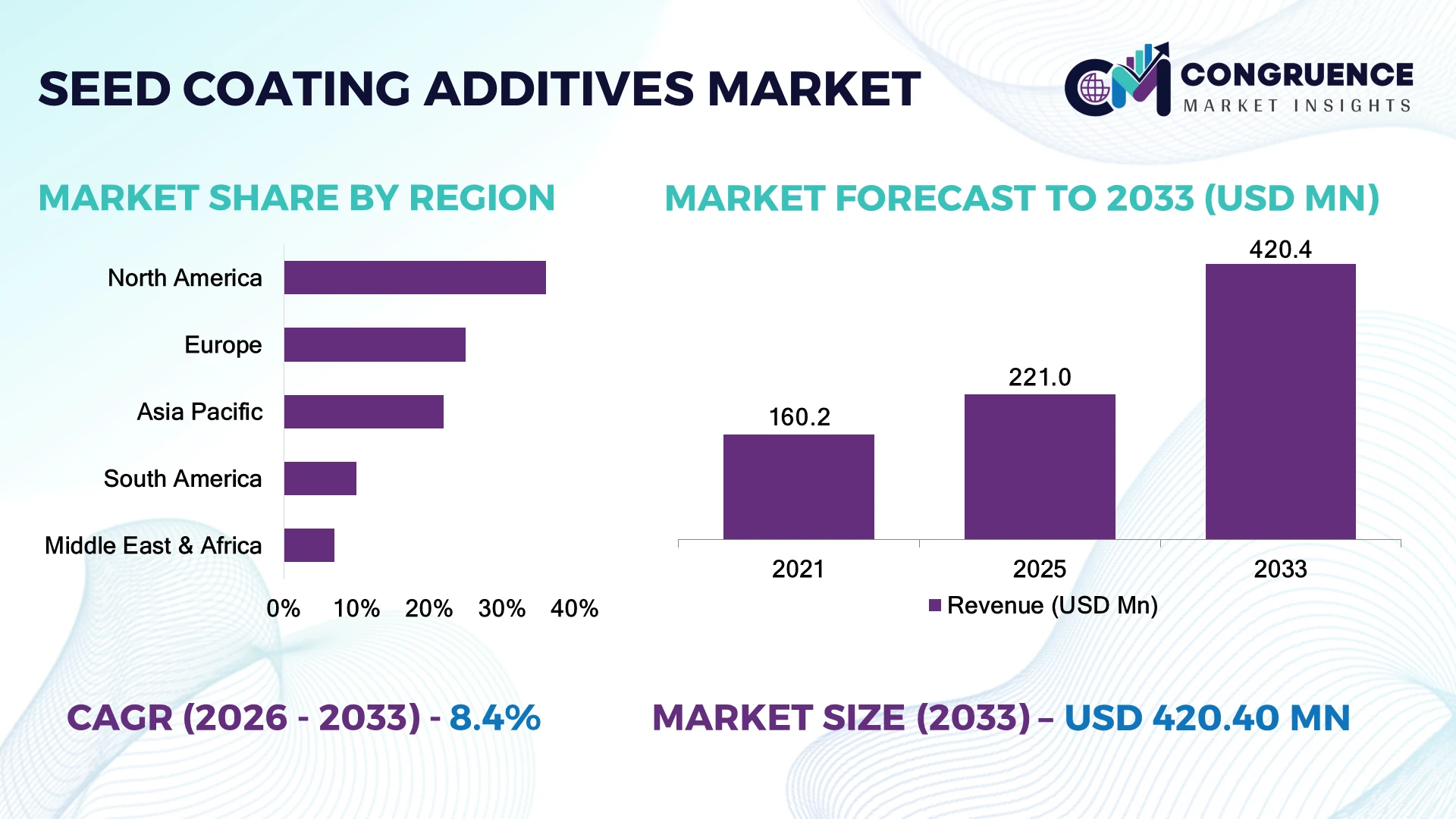
The Global Seed Coating Additives Market was valued at USD 221.0 Million in 2025 and is anticipated to reach a value of USD 420.4 Million by 2033 expanding at a CAGR of 8.37% between 2026 and 2033. Growth is driven by increasing adoption of biological seed treatments, advanced polymer coatings, and precision agriculture practices that improve germination consistency and crop protection efficiency.
The United States dominates the market with nearly 32% share, supported by large-scale corn and soybean production, advanced seed technology investments, and over 70% adoption of treated seeds across major row-crop farms. China follows with approximately 22% share, driven by government-backed agricultural modernization programs and rising biotech seed adoption. Compared with India, where coated seed penetration remains below 45%, the U.S. benefits from stronger mechanized farming infrastructure and integrated seed technology ecosystems.
Strategic expansion into emerging agricultural economies will define competitive positioning for additive manufacturers.
Market Size & Growth: USD 221.0 Million in 2025 to USD 420.4 Million by 2033 at 8.37% CAGR, driven by advanced biological coatings and precision farming adoption.
Top Growth Drivers: Biological additives (+35% adoption), polymer-based coatings (+28% usage), and sustainable seed treatment solutions (+25% demand).
Short-Term Forecast: By 2028, automated coating systems improve seed treatment efficiency by 20% and reduce additive wastage by 15%.
Emerging Technologies: AI-enabled coating optimization, biodegradable polymers, and microbial-based additives are reshaping advanced seed treatment processes.
Regional Leaders: North America reaches USD 145 Million with high precision farming adoption; Asia Pacific reaches USD 120 Million through hybrid seed expansion; Europe reaches USD 85 Million through sustainable agriculture policies.
Consumer/End-User Trends: Commercial seed producers report over 60% preference for multifunctional coatings combining nutrients, polymers, and biological agents.
Pilot/Case Example: 2024 smart seed coating trials in the U.S. demonstrated up to 18% improvement in early crop establishment rates.
Competitive Landscape: Market leaders including BASF, Bayer, Corteva Agriscience, Croda International, and Sensient Technologies collectively account for a significant share, with leading players holding approximately 15–20% individual influence.
Regulatory & ESG Impact: European sustainability regulations are accelerating biodegradable additive adoption by nearly 30% among premium seed suppliers.
Investment & Funding: More than USD 500 Million has been directed toward agricultural biotechnology partnerships, coating innovation, and sustainable input development.
Innovation & Future Outlook: Next-generation microbial coatings, nano-enabled additives, and digital seed treatment platforms are shifting competition toward high-performance agricultural solutions.
Seed Coating Additives are becoming essential components in modern agriculture as farmers increasingly prioritize improved seed performance, reduced chemical dependency, and higher crop establishment reliability. Innovations in biodegradable polymers, microbial formulations, and nutrient-enhanced coatings are expanding applications across cereals, oilseeds, and specialty crops. Approximately 40% of commercial seed producers are actively evaluating sustainable additive alternatives as regulatory pressure increases in markets such as the European Union. Supply-chain localization and partnerships between biotechnology firms and seed companies are accelerating product development, creating a transition toward more efficient and environmentally responsible seed treatment systems.
The Seed Coating Additives Market is becoming strategically important as agricultural companies compete to improve crop productivity, reduce input losses, and support sustainable farming systems. The shift toward climate-resilient agriculture and stricter chemical-use regulations is accelerating investment in biological additives, biodegradable polymers, and precision coating technologies. Global seed suppliers are restructuring supply chains to secure specialized additive formulations and regional manufacturing capabilities.
Advanced automated coating platforms demonstrate measurable advantages over conventional systems, improving additive distribution accuracy by nearly 25% while reducing material waste by approximately 15%. The United States and Germany are leading innovation through biotechnology integration, whereas India and Brazil are expanding adoption through large-scale commercial farming programs. Emerging markets are focusing on affordable coating solutions suited for diverse crop conditions.
Over the next 2–3 years, companies are prioritizing partnerships between seed producers, biotechnology firms, and agricultural technology providers. For example, integrated seed treatment facilities in North America are combining microbial additives with digital monitoring systems to enhance planting outcomes. Strategic investments in sustainable formulations, localized production, and advanced application technologies will determine long-term competitive advantage in this evolving agricultural ecosystem.
The transition toward sustainable agriculture is accelerating adoption of advanced seed coating additives, with biological formulations increasing by more than 30% in commercial seed programs. Rising demand for improved germination and reduced chemical dependency is encouraging companies to develop microbial-based polymers and nutrient delivery systems. The European Union’s environmental policies are pushing seed suppliers toward lower-impact formulations, while the United States continues expanding precision agriculture adoption across major crop regions. Companies including BASF, Bayer, and Corteva are investing in R&D partnerships to develop multifunctional coatings. The strategic advantage lies in improving crop establishment while reducing input inefficiencies across large-scale farming operations.
Cost fluctuations in specialty polymers, biological ingredients, and coating chemicals remain key limitations for manufacturers. Prices of agricultural input materials have experienced volatility exceeding 20% in recent supply cycles due to energy costs and international logistics disruptions. Countries dependent on imported specialty chemicals face additional procurement challenges, particularly in emerging agricultural markets. Limited local manufacturing capacity in regions such as India restricts rapid scalability of premium additive solutions. Companies are responding through supplier diversification, regional production facilities, and long-term raw material agreements. The ability to stabilize input costs while maintaining formulation quality remains a critical operational priority.
The rising adoption of regenerative agriculture creates opportunities for bio-based seed coating additives, with sustainable formulations expected to capture more than 35% of new product development pipelines. Digital agriculture platforms are enabling data-driven optimization of coating thickness, nutrient release, and seed performance monitoring. Brazil and India represent significant expansion opportunities due to increasing commercial seed adoption and government-supported agricultural modernization initiatives. Companies are investing in microbial technologies, biodegradable polymers, and customized crop-specific solutions. A major strategic opportunity lies in combining coating additives with precision farming data systems to deliver measurable yield improvement and resource efficiency.
Scaling innovative seed coating technologies across global agricultural markets remains challenging due to differences in farming practices, infrastructure availability, and regulatory requirements. Approximately 40% of smallholder farming regions still face limited access to advanced seed treatment technologies. Variability in climate conditions and crop types requires customized formulations, increasing development complexity and operational costs. Countries such as India and parts of Southeast Asia require affordable solutions compatible with fragmented farming structures. Companies must address these barriers through localized production, farmer education programs, technology partnerships, and adaptable coating platforms to maintain consistent performance across diverse agricultural environments.
Biological Additive Integration Growth Seed companies are rapidly shifting toward microbial and bio-based additives, with adoption increasing by nearly 30% among premium seed producers and biological formulations representing over 25% of new product launches. Regulatory pressure on chemical inputs in Europe and sustainability targets from agricultural enterprises are accelerating this transition. Companies are expanding biotechnology partnerships and investing in microbial coating platforms to improve crop establishment, nutrient efficiency, and environmental compliance.
Smart Coating Process Automation Automated seed coating systems are gaining traction as producers seek higher precision, with advanced equipment improving additive application accuracy by approximately 20% and reducing coating material losses by 15%. Large seed processors in the United States and Brazil are upgrading facilities with sensor-based monitoring and automated mixing technologies. Manufacturers are responding through integrated coating solutions that combine formulation control, digital tracking, and scalable production workflows.
Sustainable Polymer Development Shift Demand for biodegradable coating materials is increasing as companies replace conventional polymers with environmentally responsible alternatives, with sustainable formulations gaining more than 35% attention in new product development pipelines. European environmental standards and supply-chain sustainability commitments are influencing procurement decisions. Chemical manufacturers are restructuring portfolios through bio-polymer research, regional manufacturing expansion, and collaborations with seed technology companies.
Customized Crop Coating Solutions Agricultural enterprises are moving toward crop-specific additive formulations, with customized treatments improving seed performance consistency by 18–25% in commercial trials. Unlike traditional universal coatings, tailored solutions address climate variability, soil conditions, and crop-specific nutrient requirements. Companies are increasing investments in precision agriculture partnerships and localized formulation centers, creating a less visible but important shift toward decentralized seed treatment innovation.
Polymer-based additives dominate the Seed Coating Additives Market, accounting for approximately 42% of adoption due to superior binding capability, controlled release performance, and compatibility with multiple active ingredients. Their scalability across cereals, oilseeds, and commercial seed operations makes them the preferred choice among large seed producers. Biological additives represent the fastest-growing segment, expanding as growers seek sustainable solutions with improved soil compatibility and reduced chemical dependency. Adoption of bio-based formulations has increased by nearly 30%, while colorants and other functional additives continue supporting seed identification, handling efficiency, and branding requirements. The market is witnessing a shift from conventional coating materials toward multifunctional additive systems combining polymers, nutrients, and biological agents. Companies are increasing R&D investments in biodegradable polymers and hybrid formulations to address sustainability requirements. Traditional additives maintain strong industrial relevance due to cost advantages, but emerging biological solutions are attracting higher investment attention as agricultural companies prioritize environmental performance and precision application.
Crop protection applications represent the leading segment, capturing nearly 45% market share due to widespread use of additives that enhance fungicide, insecticide, and biological treatment performance. Large-scale agricultural producers prioritize coated seeds to improve early plant protection and reduce input losses. Nutrient enhancement applications are emerging as the fastest-growing area, supported by demand for micronutrient delivery systems that improve early-stage crop development. Adoption of nutrient-based coatings has increased by approximately 25% as farmers seek higher input efficiency. Other applications, including seed identification and handling improvement, continue supporting operational workflows across commercial seed processing facilities. Companies are expanding integrated solutions that combine protection, nutrition, and performance-enhancing additives within single coating systems. The shift toward multifunctional applications is changing procurement strategies, with seed producers increasingly selecting suppliers offering complete treatment ecosystems rather than individual additive products.
Commercial seed producers represent the dominant end-user segment, accounting for approximately 50% of demand due to large-scale processing requirements, quality control standards, and consistent seed performance expectations. These companies rely heavily on advanced coating additives to differentiate seed products and improve farmer outcomes. Agricultural cooperatives and farming enterprises are emerging as fast-growing users, with adoption increasing by nearly 28% as mechanized farming expands and growers seek improved planting efficiency. Research institutes and other specialized users maintain strategic importance by supporting formulation testing, innovation trials, and next-generation additive development. Large enterprises are increasingly forming partnerships with additive manufacturers to customize formulations according to crop type, geography, and farming conditions. The competitive focus is shifting from basic additive supply toward integrated solutions involving technical support, application optimization, and long-term collaboration models.
North America accounted for the largest market share at 36% in 2025 however, Asia-Pacific is expected to register the fastest growth, expanding at a CAGR of 9.21% between 2026 and 2033.
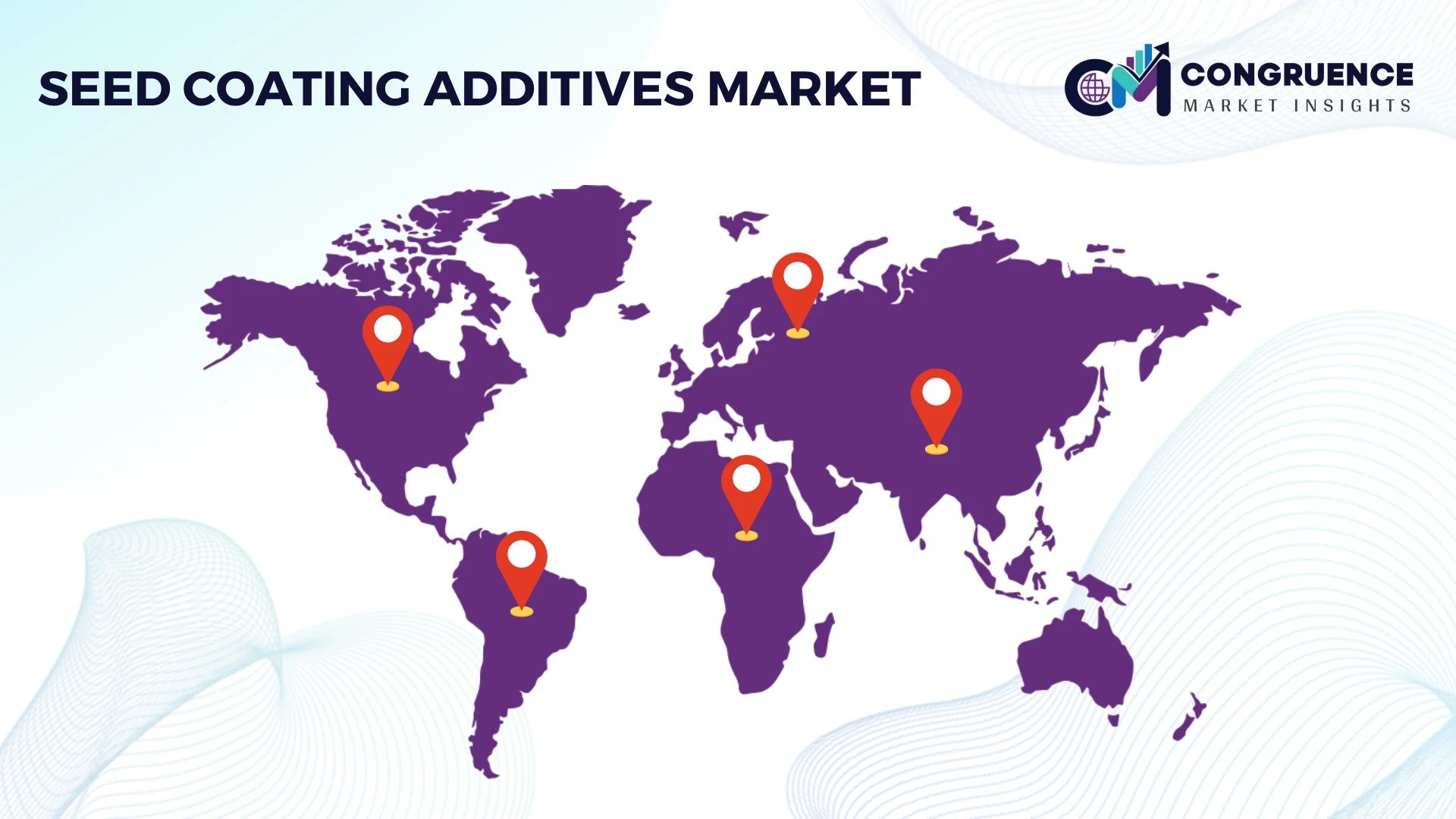
North America leads the Seed Coating Additives Market due to its mature commercial seed industry, advanced agricultural infrastructure, and high adoption of precision farming technologies. The region contributes nearly 36% of global demand, supported by extensive corn, soybean, and wheat cultivation across the United States and Canada. More than 70% of commercial row-crop seeds in the U.S. utilize treated seed technologies, creating strong demand for polymers, biological additives, and nutrient-enhanced coatings. Seed companies are expanding automated treatment facilities and developing customized formulations through biotechnology partnerships. The region’s strong research ecosystem and integration of digital agriculture platforms continue improving coating accuracy, reducing input waste, and accelerating adoption of next-generation additive solutions.
United States Market Outlook: The United States remains the dominant country within North America due to its large-scale agricultural operations, advanced seed processing infrastructure, and strong presence of global seed technology companies. Over 90 million acres of corn and soybean cultivation support extensive use of coated seeds. Companies are increasingly investing in biological additives, automated coating equipment, and precision treatment systems to improve crop establishment and operational efficiency.
Europe represents a highly developed market for Seed Coating Additives, supported by strict sustainability policies, advanced agricultural research, and increasing demand for environmentally responsible formulations. The region accounts for approximately 25% of global adoption, with countries such as Germany, France, and the Netherlands driving technology development. Regulatory initiatives focused on reducing chemical inputs are accelerating the transition toward biodegradable polymers and biological additives. Nearly 35% of new seed treatment innovations in Europe emphasize sustainable formulations and reduced environmental impact. Agricultural companies are forming partnerships with biotechnology firms to develop multifunctional coatings that combine nutrients, microbial agents, and protective compounds. Strong laboratory infrastructure and precision farming adoption continue supporting premium additive deployment.
Germany Market Outlook: Germany serves as Europe’s innovation hub for sustainable agricultural technologies, supported by advanced chemical manufacturing capabilities and strong research networks. The country’s agricultural sector increasingly prioritizes biological seed treatments and environmentally compliant formulations. More than 60% of large commercial farms use advanced crop management technologies, creating demand for efficient seed enhancement solutions and automated application systems.
Asia-Pacific is the fastest-expanding market for Seed Coating Additives due to rising food security requirements, increasing hybrid seed usage, and modernization of agricultural practices. The region contributes approximately 22% of global demand, with China, India, Japan, and Australia representing major adoption centers. China’s agricultural modernization programs and India’s expanding commercial seed industry are accelerating demand for polymer coatings, biological additives, and nutrient delivery solutions. Hybrid seed adoption has increased by more than 25% across major crop categories, supporting additive consumption. Companies are establishing local production facilities and distribution partnerships to improve accessibility and reduce dependence on imported formulations. The region’s manufacturing capabilities also support cost-efficient additive production.
China Market Outlook: China dominates Asia-Pacific due to its large agricultural production base, extensive seed industry, and government-supported modernization initiatives. The country produces more than 130 million tons of major grain crops annually, creating significant demand for efficient seed technologies. Domestic companies are expanding biotechnology capabilities and investing in advanced coating solutions to improve productivity and reduce agricultural input losses.
South America is gaining importance in the Seed Coating Additives Market due to expanding commercial agriculture, rising export-oriented crop production, and increasing adoption of improved seed technologies. The region contributes nearly 10% of global demand, driven primarily by Brazil and Argentina’s soybean, corn, and wheat sectors. Large agricultural enterprises are adopting coated seeds to improve planting consistency and protect crops during early growth stages. Brazil’s precision agriculture adoption has increased by more than 30% in commercial farming operations, encouraging demand for advanced additives. However, infrastructure differences between farming regions continue affecting distribution efficiency. Companies are responding through localized production, regional partnerships, and customized formulations designed for tropical and large-scale farming environments.
Brazil Market Outlook: Brazil represents the leading South American market due to its position as a global soybean and corn production hub. The country cultivates more than 40 million hectares of soybean farmland, creating strong demand for seed treatment technologies. Agricultural companies are investing in local additive manufacturing, biological solutions, and integrated seed treatment services to support export-driven farming operations.
The Middle East & Africa market is developing through agricultural modernization initiatives, water-efficient farming programs, and increasing investment in food security infrastructure. The region contributes approximately 7% of global demand, with adoption concentrated in South Africa, Egypt, Saudi Arabia, and the United Arab Emirates. Governments are supporting advanced farming technologies to improve productivity under challenging climate conditions. Controlled agriculture projects and commercial farming investments are increasing demand for coated seeds that improve germination and resource efficiency. Adoption of precision agriculture solutions has grown by nearly 20% across advanced farming projects, encouraging technology providers to expand partnerships. Companies are focusing on climate-adapted additives, localized supply chains, and specialized formulations.
South Africa Market Outlook: South Africa leads the regional market due to its established commercial farming sector and advanced agricultural supply chains. The country’s maize production exceeds 10 million tons annually, supporting demand for seed enhancement technologies. Agricultural companies are adopting biological additives and precision treatment systems to improve crop resilience, reduce input inefficiencies, and strengthen sustainable farming practices.
The Seed Coating Additives Market is characterized by competition between global agricultural input leaders such as BASF, Bayer, Corteva Agriscience, and Syngenta, specialized additive manufacturers including Croda International and Michelman, and regional suppliers focused on cost-efficient formulations. The top five companies collectively influence approximately 45% of the market through integrated seed treatment portfolios, advanced R&D capabilities, and global distribution networks. Competition is driven by sustainable formulation technology, biological additive performance, customization, and supply reliability, with advanced coating solutions improving application efficiency by 15–25%. Leading companies are expanding through biotechnology partnerships, regional production facilities, and vertically integrated seed treatment platforms. The competitive landscape is shifting toward biodegradable polymers, microbial additives, and precision coating technologies. High regulatory expertise, formulation capabilities, and established agricultural partnerships create significant entry barriers. Companies that combine innovation speed, scalable manufacturing, and crop-specific solutions will secure stronger competitive positions in the evolving seed treatment ecosystem.
Bayer AG
Corteva Agriscience
Syngenta Group
Croda International Plc
Clariant AG
Michelman Inc.
Sensient Technologies Corporation
Incotec Group BV
Germains Seed Technology
Chromatech Incorporated
Precision Laboratories LLC
BrettYoung Seeds Limited
Loveland Products Inc.
The Seed Coating Additives Market is advancing through biological seed treatments, biodegradable polymers, and precision coating technologies. Microbial additives are gaining adoption as agricultural companies reduce chemical dependency, with biological formulations seeing nearly 30% higher adoption among premium seed producers. Advanced polymer technologies improve coating uniformity by approximately 20% compared with traditional coating materials, supporting better seed flow, handling, and treatment consistency.
Automation and digital monitoring systems are transforming commercial seed processing by enabling real-time control of additive application, coating thickness, and quality performance. Automated coating platforms reduce material losses by nearly 15% compared with conventional processes while improving production throughput for large seed processors. Companies investing in smart coating systems gain operational advantages through improved efficiency, reduced waste, and consistent product quality.
Between 2026 and 2028, AI-enabled formulation optimization, nano-enhanced nutrient delivery, and sustainable biodegradable coatings will become important competitive differentiators. Global seed companies and additive manufacturers are strengthening partnerships to develop customized crop-specific solutions. Early technology adoption will help companies improve sustainability compliance, accelerate product innovation, and strengthen their position in advanced agricultural input markets.
November 2025 – BASF SE announced the registration of Integral® Pro for sunflower seed treatment in France, expanding its biological seed treatment portfolio under BASF Agricultural Solutions. The Bacillus-based solution supports sustainable crop protection, with field evaluations conducted across Europe from 2022–2024 demonstrating strong disease-control performance. The development strengthens BASF’s biological seed treatment strategy and expands EU market access from the 2026 planting season. Source: www.agriculture.basf.com
May 2026 – BASF SE commissioned its new BioHub fermentation plant in Ludwigshafen, Germany, representing a high double-digit million-euro investment to increase production flexibility for biological and biotechnology-based agricultural solutions. The facility supports manufacturing of biological fungicides and seed treatment products, improving supply chain resilience and strengthening BASF’s sustainable agriculture portfolio. Source: www.basf.com
November 2025 – Syngenta Group introduced Victrato® seed treatment in the United States after EPA registration for soybean and cotton applications. The Seedcare innovation provides nematode and disease protection through a single active ingredient platform and prepares growers for the 2026 planting season. The launch expands Syngenta’s premium seed treatment portfolio and strengthens its biological and crop protection integration strategy. Source: www.syngenta-us.com
January 2025 – Corteva Agriscience highlighted advancements in seed treatment formulation development through its “Building a Better Seed Treatment” initiative, focusing on optimized combinations of fungicides, insecticides, inoculants, polymers, nematicides, biologicals, and biostimulants. Corteva emphasized extensive product screening and testing processes to improve treatment performance and farmer outcomes, reinforcing its integrated seed technology approach.
The Seed Coating Additives Market Report provides comprehensive coverage of additive technologies, application areas, end-user segments, and regional market dynamics across North America, Europe, Asia-Pacific, South America, and Middle East & Africa. The report evaluates polymer additives, biological formulations, nutrient-based additives, crop protection coatings, commercial seed producers, agricultural enterprises, and research organizations.
The study analyzes emerging technologies including biodegradable coating materials, microbial seed treatments, automated coating systems, and precision agriculture integration. It covers competitive strategies of more than 10 leading market participants, sustainability-driven product development, regional manufacturing trends, and evolving agricultural input requirements. The report supports investment planning, market expansion strategies, partnership decisions, and competitive positioning by identifying technology shifts, adoption patterns, operational opportunities, and future development pathways from 2026 to 2033.
| Report Attribute / Metric | Details |
|---|---|
| Market Revenue (2025) | USD 221.0 Million |
| Market Revenue (2033) | USD 420.4 Million |
| CAGR (2026–2033) | 8.37% |
| Base Year | 2025 |
| Forecast Period | 2026–2033 |
| Historic Period | 2021–2025 |
| Segments Covered |
By Type
By Application
By End-User
|
| Key Deliverables | Revenue Forecast; Market Trends; Growth Drivers & Restraints; Technology Insights; Segmentation Analysis; Regional Insights; Competitive Landscape; Regulatory & ESG Overview; Recent Developments |
| Regions Covered | North America; Europe; Asia-Pacific; South America; Middle East & Africa |
| Companies Profiled | BASF SE; Bayer AG; Corteva Agriscience; Syngenta Group; Croda International Plc; Clariant AG; Michelman Inc.; Sensient Technologies Corporation; Incotec Group BV; Germains Seed Technology; Chromatech Incorporated; Precision Laboratories LLC; BrettYoung Seeds Limited; Loveland Products Inc. |
| Customization & Pricing | Available on Request (10% Customization Free) |




