
Reports
The Global Secure Document Management System Market was valued at USD 8,234.6 Million in 2025 and is anticipated to reach a value of USD 23,989.0 Million by 2033 expanding at a CAGR of 14.3% between 2026 and 2033. Accelerating enterprise digital transformation, stricter data privacy regulations, AI-enabled document automation, and rising cybersecurity investments are driving large-scale deployment of secure document management platforms across regulated industries.
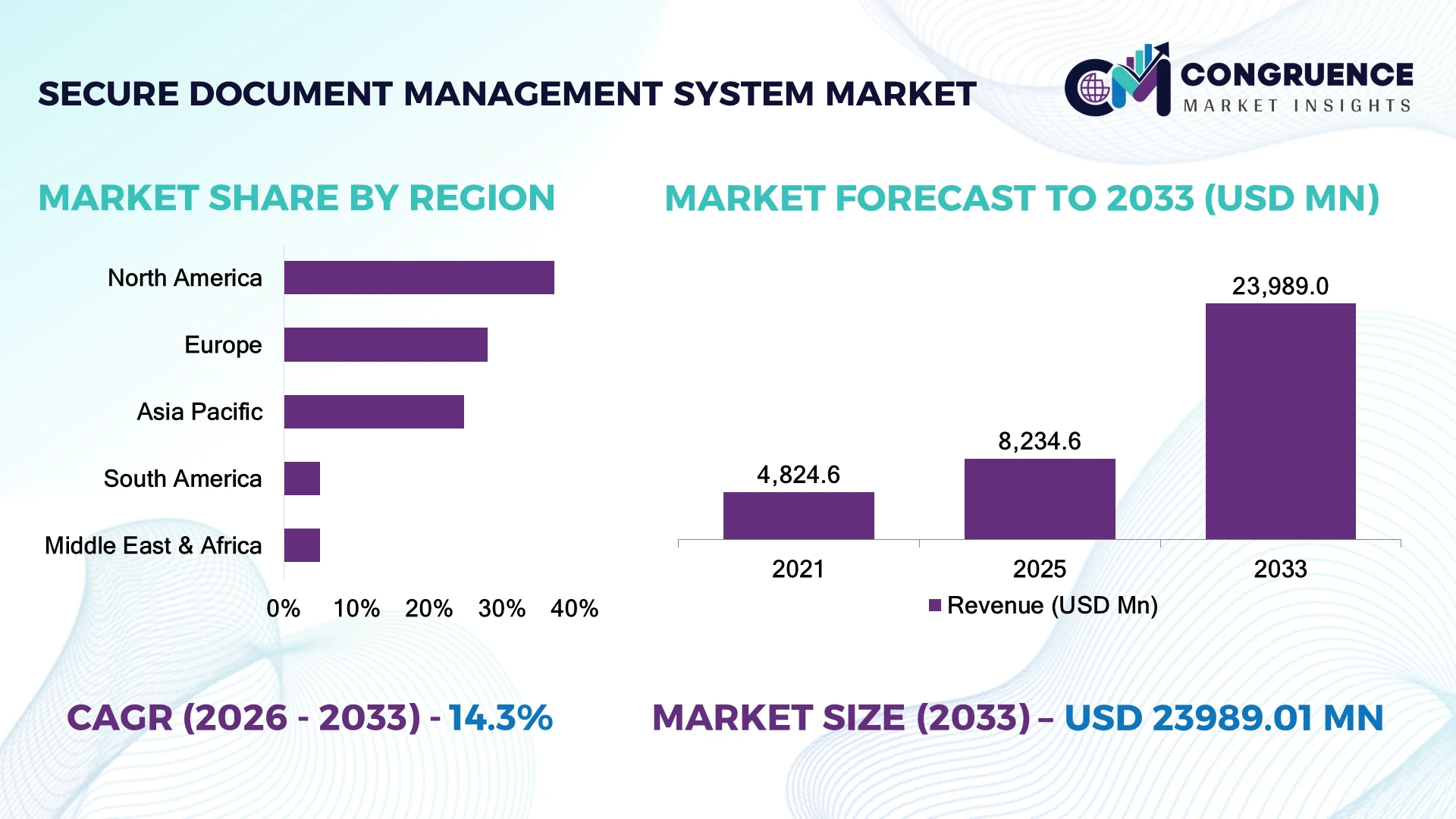
The United States dominates the market with approximately 34% global share, supported by extensive adoption across BFSI, healthcare, government, legal, and enterprise IT sectors. More than 72% of large enterprises have integrated cloud-based document governance with identity and access management, compared with nearly 56% in Germany. Following expanding cybersecurity regulations and geopolitical concerns over digital infrastructure resilience, organizations continue increasing investments in zero-trust document security, encryption, and compliance automation.
Organizations investing in intelligent document governance today are strengthening regulatory readiness while creating long-term operational advantages through secure digital workflows.
Market Size & Growth: USD 8,234.6 Million (2025) to USD 23,989.0 Million (2033), CAGR 14.3%, driven by AI-enabled compliance automation.
Top Growth Drivers: AI document processing (+41%), cloud migration (+38%), cybersecurity investment (+35%).
Short-Term Forecast: By 2028, document retrieval time declines nearly 45% through intelligent indexing.
Emerging Technologies: Generative AI, zero-trust architecture, blockchain verification strengthen document security.
Regional Leaders: North America, Europe, and Asia-Pacific lead deployment through compliance-focused digital transformation.
Consumer/End-User Trends: Around 69% of enterprises prioritize secure remote document collaboration.
Pilot/Case Example: 2026 enterprise deployment reduced document approval cycles by approximately 40%.
Competitive Landscape: Top vendors collectively account for nearly 48% market share through integrated cloud ecosystems.
Regulatory & ESG Impact: Digital documentation lowers paper usage by nearly 60% while strengthening audit readiness.
Investment & Funding: Enterprise content management investments exceed USD 3 billion through platform modernization initiatives.
Innovation & Future Outlook: AI-powered classification, intelligent search, and automated governance redefine enterprise document security.
The Secure Document Management System Market is witnessing increasing demand from financial institutions, healthcare providers, government agencies, legal firms, and manufacturing enterprises requiring secure digital collaboration. AI-assisted document classification improves processing efficiency by nearly 42%, while expanding privacy regulations encourage migration toward encrypted cloud repositories and zero-trust architectures. These operational shifts establish the foundation for the market's evolving strategic direction.
Secure document management has become a strategic enterprise capability as organizations transition from fragmented file repositories to centralized, compliance-driven information ecosystems. Rising cybersecurity threats, expanding digital operations, and increasingly stringent privacy regulations are accelerating enterprise investment in secure content governance. Zero-trust security models and sovereign cloud strategies are reshaping procurement priorities, particularly across regulated industries where document integrity directly influences operational continuity and regulatory compliance.
AI-enabled document management platforms process, classify, and retrieve enterprise records approximately 45% faster than conventional rule-based systems while reducing manual indexing efforts by nearly 50%. North America leads large-scale enterprise deployment through mature cloud infrastructure, whereas Asia-Pacific demonstrates stronger implementation momentum among digital-first enterprises modernizing business operations. Over the next two to three years, intelligent automation, secure collaboration, and policy-driven governance will become standard procurement requirements rather than premium capabilities.
A multinational financial institution implementing AI-driven document lifecycle automation reduced contract processing time by nearly 38% while strengthening audit readiness across multiple jurisdictions. Vendors continue expanding through cloud partnerships, cybersecurity integration, and industry-specific compliance solutions. Organizations capable of combining intelligent automation, resilient security, and regulatory governance will establish durable competitive advantages as enterprise document ecosystems become increasingly mission-critical.
Expanding regulatory obligations and enterprise-wide digital transformation are making secure document management a strategic technology investment. More than 72% of large organizations now prioritize centralized document governance, while AI-powered document classification reduces manual processing by nearly 45% and retrieval time by approximately 40%. The enforcement of stricter privacy regulations across the European Union and growing cybersecurity mandates in the United States have accelerated adoption of encrypted document repositories and zero-trust access controls. This shift improves compliance, reduces audit complexity, and strengthens operational resilience. Technology vendors are responding through AI integration, cloud-native platform expansion, strategic cybersecurity partnerships, and industry-specific compliance modules. A key competitive advantage now lies in combining intelligent automation with policy-driven document governance rather than conventional storage capabilities.
Many enterprises continue operating fragmented legacy content repositories that complicate migration to secure document management systems. Nearly 48% of medium-sized organizations still maintain hybrid document environments, while integration costs can increase deployment budgets by 20–30% when multiple enterprise applications require synchronization. Highly regulated industries also face interoperability challenges between legacy ERP, CRM, and records management platforms. These constraints delay implementation, reduce operational efficiency, and increase administrative complexity. Organizations in Japan and Germany are addressing these issues through phased migration strategies, standardized APIs, long-term technology contracts, and hybrid deployment architectures that minimize operational disruption. Vendors increasingly prioritize interoperability frameworks and migration automation to reduce deployment complexity while preserving business continuity.
AI-driven knowledge management, automated compliance workflows, and intelligent document lifecycle management are creating significant expansion opportunities. Enterprises implementing intelligent document processing achieve approximately 35% faster contract execution and nearly 30% lower document handling costs through workflow automation. Sovereign cloud infrastructure, confidential computing, and generative AI assistants are reshaping secure information management, particularly across financial services, healthcare, and government sectors. Organizations in Singapore and the United Arab Emirates continue accelerating digital government initiatives that require highly secure document ecosystems. Software providers are investing in advanced analytics, multilingual AI models, ecosystem partnerships, and low-code workflow platforms to address growing enterprise demand. The strongest opportunity increasingly lies in transforming document repositories into intelligent decision-support systems.
Maintaining secure document ecosystems has become increasingly challenging as cyber threats evolve faster than enterprise security architectures. Approximately 61% of organizations identify ransomware and insider access risks as primary concerns, while cloud misconfigurations contribute to nearly 27% of enterprise security incidents involving sensitive documents. Expanding cross-border collaboration further complicates identity management, encryption policies, and regulatory alignment across jurisdictions. These challenges affect deployment consistency, compliance assurance, and long-term platform scalability. Vendors are strengthening investments in behavioral analytics, continuous authentication, quantum-resistant encryption research, and unified security operations to improve resilience. Sustainable market leadership will depend on balancing seamless user access with adaptive cybersecurity capabilities that continuously respond to emerging digital threats.
AI-Powered Document Intelligence AI-driven document classification and semantic search are transforming enterprise workflows. Automated indexing improves processing efficiency by approximately 42% while reducing manual validation by nearly 35%. Organizations increasingly deploy generative AI assistants for document summarization and retrieval, prompting software providers to expand AI investments and strengthen enterprise governance capabilities.
Zero-Trust Security Expansion Zero-trust document access is becoming standard across regulated industries as cyber threats intensify. Around 68% of large enterprises are implementing identity-centric access controls, reducing unauthorized document exposure by nearly 30%. Vendors are integrating continuous authentication, encryption, and privileged access management to support secure hybrid work environments and stricter compliance obligations.
Cloud-Native Workflow Modernization Organizations continue replacing fragmented on-premise repositories with cloud-native document ecosystems supporting real-time collaboration. Cloud deployments now account for nearly 65% of new enterprise implementations, reducing infrastructure administration by approximately 28%. Software vendors are expanding regional cloud infrastructure and strategic partnerships to improve scalability, resilience, and data sovereignty compliance.
Industry-Specific Compliance Platforms Financial institutions, healthcare providers, and government agencies increasingly demand sector-specific document governance capabilities rather than generic content management solutions. Compliance-focused platforms improve audit preparation by nearly 40% while shortening document approval cycles by approximately 25%. Vendors are accelerating vertical product development, workflow customization, and regulatory automation to strengthen differentiation in highly regulated enterprise environments.
Cloud-based secure document management systems account for approximately 57% of the global market, driven by scalability, centralized security management, lower infrastructure costs, and seamless integration with enterprise collaboration platforms. Their ability to support remote workforces, automated backup, AI-enabled search, and regulatory compliance makes them the preferred deployment model for large organizations. On-premises systems continue serving defense, government, and highly regulated industries where strict data sovereignty requirements remain critical. Vendors are expanding cloud-native capabilities, strengthening encryption frameworks, and embedding AI-driven document intelligence to improve enterprise productivity and compliance.
Hybrid deployment represents the fastest-growing segment as enterprises balance cloud flexibility with sensitive on-premises data retention. Nearly 46% of large enterprises now operate hybrid document environments, while cloud-first implementations reduce document administration effort by around 35%. Companies are investing in zero-trust security architectures, multi-cloud interoperability, and strategic cloud partnerships to simplify migration. Investment priorities are increasingly shifting toward platforms that provide unified governance across distributed document ecosystems while maintaining regulatory control and operational resilience.
According to AIIM enterprise research published during 2025, most large organizations now operate hybrid information management environments combining cloud and on-premises repositories to improve compliance, resilience, and business continuity.
Compliance & Records Management leads the market with an estimated 34% share as enterprises prioritize regulatory reporting, audit readiness, document retention, and secure information governance. Financial institutions, healthcare providers, and public agencies continue investing in automated compliance workflows that reduce manual oversight while strengthening regulatory adherence. Document Storage & Retrieval remains a mature application with consistent enterprise demand, whereas Document Capture & Imaging supports large-scale digitization initiatives across paper-intensive industries. Vendors continue enhancing AI-based indexing, automated metadata extraction, and policy-driven retention management to improve operational efficiency.
Workflow Automation & Collaboration is the fastest-growing application as organizations modernize enterprise operations through intelligent document routing and digital approvals. AI-enabled workflow platforms reduce approval cycles by nearly 40%, while integrated collaboration tools improve cross-functional productivity by approximately 30%. Companies are expanding low-code workflow capabilities, integrating electronic signatures, and embedding intelligent process automation. Demand continues strengthening where secure collaboration, compliance automation, and enterprise-wide document visibility have become operationally critical for digital business transformation.
A 2026 enterprise digital workplace assessment by IDC found that intelligent workflow automation remains among the fastest-growing enterprise priorities for improving document-centric operational efficiency and compliance.
BFSI represents the largest end-user segment with approximately 29% market share owing to high document volumes, stringent regulatory obligations, fraud prevention requirements, and continuous audit activity. Banks and financial institutions require secure repositories, encrypted document exchange, and automated retention policies across customer onboarding, lending, and compliance operations. Government and Legal Services remain established users because of statutory documentation requirements, while Manufacturing and IT & Telecom increasingly adopt secure document platforms to streamline engineering records, supplier documentation, and digital collaboration. Vendors continue delivering sector-specific compliance modules, customized workflows, and strategic technology partnerships to strengthen customer retention.
Healthcare is emerging as the fastest-growing end-user segment as hospitals, diagnostic networks, and life sciences organizations digitize patient records and strengthen privacy compliance. Nearly 68% of healthcare providers are expanding secure digital document initiatives, while AI-assisted document processing reduces administrative workload by approximately 33%. Providers increasingly prioritize encrypted cloud repositories, automated consent management, and secure interoperability. Software companies are responding through healthcare-focused compliance frameworks, AI integration, and cybersecurity partnerships that address evolving regulatory requirements and future enterprise demand.
A 2025 healthcare information management assessment reported that healthcare organizations continue accelerating secure digital document adoption to strengthen regulatory compliance, interoperability, and patient information governance.
North America accounted for the largest market share at 37.2% in 2025 however, Asia-Pacific is expected to register the fastest growth, expanding at a CAGR of 16.1% between 2026 and 2033.
Enterprise Cybersecurity and AI Integration Drive Platform Modernization
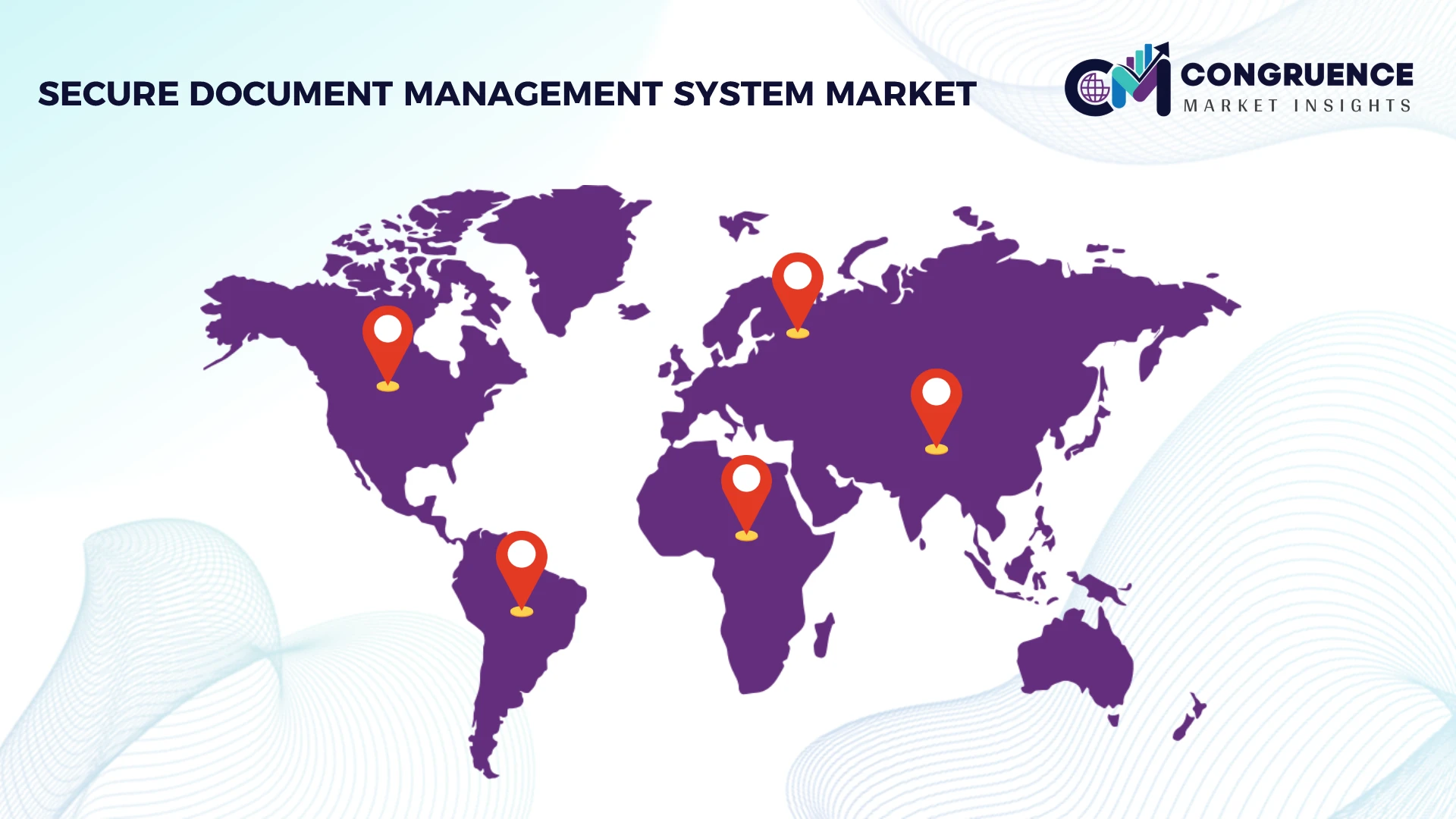
North America leads the Secure Document Management System market through widespread enterprise cloud adoption, mature cybersecurity infrastructure, and stringent regulatory compliance requirements across BFSI, healthcare, government, and legal sectors. The region contributes over 37% of global deployments, with organizations increasingly adopting AI-powered document classification, zero-trust access controls, and encrypted collaboration platforms. Nearly 74% of large enterprises have integrated secure document management into broader digital workplace initiatives. Cloud providers, cybersecurity vendors, and enterprise software companies continue expanding strategic alliances to deliver unified governance, identity management, and compliance automation. Growing investments in sovereign cloud infrastructure and secure digital workflows are further strengthening enterprise resilience while supporting high-volume document processing across regulated industries.
United States Market Outlook: The United States remains the largest national market owing to advanced enterprise IT infrastructure, high cybersecurity spending, and rigorous compliance frameworks across financial services, healthcare, and government agencies. More than 72% of Fortune 1000 organizations utilize enterprise-grade secure document management integrated with identity and access management platforms. Vendors continue expanding AI-enabled automation, secure cloud collaboration, and industry-specific compliance solutions to support evolving digital governance requirements.
Regulatory Compliance Accelerates Intelligent Information Governance
Europe maintains a strong market position through strict privacy legislation, cross-border digital governance initiatives, and enterprise modernization programs. Financial services, healthcare, manufacturing, and public administration continue investing in secure document ecosystems supporting encrypted collaboration and automated retention management. Nearly 63% of enterprise software procurements now include advanced compliance management capabilities. Technology providers are strengthening regional cloud infrastructure, confidential computing capabilities, and AI-assisted records management while expanding partnerships with cybersecurity specialists to improve regulatory readiness and secure digital operations.
Germany Market Outlook: Germany leads the regional market through its advanced industrial economy, strong enterprise software ecosystem, and extensive manufacturing digitization. Large organizations continue modernizing engineering documentation, compliance archives, and supply-chain records using secure cloud platforms. Nearly 60% of large manufacturing enterprises have expanded intelligent document governance solutions integrated with ERP and workflow automation, supporting operational efficiency and regulatory compliance.
Digital Transformation Expands Enterprise Cloud Deployment
Asia-Pacific is the fastest-growing regional market as governments and enterprises accelerate digital transformation, cloud adoption, and paperless administration initiatives. Rapid expansion of banking, healthcare, manufacturing, and technology sectors is driving demand for secure enterprise content platforms. Approximately 58% of new enterprise document management deployments in the region are cloud-native, reflecting strong investment in scalable digital infrastructure. Software vendors continue expanding regional data centers, AI capabilities, and managed security services while strengthening partnerships with domestic cloud providers to support regulatory compliance and localized data governance.
China Market Outlook: China leads regional deployment through extensive enterprise digitization, expanding cloud infrastructure, and large-scale government digital administration programs. Banking, manufacturing, healthcare, and public-sector organizations continue replacing legacy document repositories with intelligent cloud-based systems. More than 65% of large enterprises have accelerated secure digital document initiatives, encouraging vendors to expand localized AI capabilities and enterprise-grade cybersecurity services.
Financial Modernization Strengthens Digital Document Adoption
South America is experiencing steady growth as financial institutions, government agencies, and healthcare organizations modernize document-intensive operations. Increasing adoption of cloud computing and electronic records management is supporting secure enterprise collaboration despite infrastructure disparities across several economies. Around 44% of new enterprise software investments now include secure document management capabilities. Technology providers are expanding regional partner ecosystems, managed cloud services, and compliance consulting while balancing deployment flexibility with evolving cybersecurity requirements and regulatory frameworks.
Brazil Market Outlook: Brazil represents the region's largest market through expanding digital banking, government digitization, and enterprise cloud migration. Organizations continue investing in encrypted document repositories, workflow automation, and secure collaboration platforms to improve operational efficiency. Strong adoption among financial institutions and public-sector organizations is encouraging software vendors to establish localized cloud infrastructure and compliance-focused implementation services.
Digital Government Programs Accelerate Secure Information Infrastructure
The Middle East & Africa market is expanding as governments and regulated industries prioritize secure digital services, cloud modernization, and enterprise cybersecurity. Banking, healthcare, energy, and public-sector organizations increasingly deploy secure document management systems to strengthen operational transparency and compliance. Nearly 47% of digital transformation initiatives across Gulf economies now include enterprise content governance capabilities. Global technology providers are expanding regional cloud availability, cybersecurity partnerships, and managed compliance services to support secure digital infrastructure and business continuity.
Saudi Arabia Market Outlook: Saudi Arabia leads regional demand through large-scale digital government initiatives, financial sector modernization, and Vision 2030 technology investments. Enterprises are implementing secure document platforms to support electronic records management, digital workflows, and regulatory compliance across government and commercial sectors. Continued investment in cloud infrastructure and cybersecurity ecosystems is strengthening enterprise adoption while encouraging international software vendors to expand local implementation and support capabilities.
The Secure Document Management System market is led by Microsoft, OpenText, Hyland, M-Files, and Box, with the top five vendors collectively controlling approximately 54% of global market share. Global enterprise platforms compete against agile cloud-native providers, while AI-focused innovators challenge traditional ECM vendors through intelligent automation and metadata-driven workflows. Competition centers on AI-powered document processing, cybersecurity, regulatory compliance, deployment speed, and ecosystem integration, with AI reducing document retrieval time by nearly 45% and automated classification improving processing efficiency by over 60%. Vendors increasingly differentiate through Microsoft 365 integration, zero-trust security, industry-specific solutions, and sovereign cloud capabilities. Strategic partnerships, embedded AI assistants, and platform consolidation are replacing standalone document repositories with unified information governance ecosystems. The primary entry barrier remains enterprise trust, compliance certification, and large-scale migration capability. Winning requires delivering secure AI-enabled content intelligence, seamless enterprise integration, rapid deployment, and measurable compliance automation across highly regulated industries.
Microsoft Corporation
OpenText Corporation
Hyland Software, Inc.
M-Files Corporation
Box, Inc.
DocuWare GmbH
Laserfiche
Xerox Holdings Corporation
Adobe Inc.
IBM Corporation
Kyocera Document Solutions Inc.
Newgen Software Technologies Limited
Zoho Corporation
Revver (eFileCabinet)
Artificial intelligence has become the core technology transforming secure document management platforms. AI-driven document classification, intelligent metadata extraction, optical character recognition, and natural language search reduce manual processing by approximately 60% while improving retrieval accuracy by nearly 45%. Around 68% of new enterprise deployments now include AI-assisted document indexing integrated with enterprise workflow platforms. Organizations benefit from faster compliance audits, stronger governance, and significantly lower administrative effort across regulated industries.
Cloud-native architectures, zero-trust security, confidential computing, blockchain-backed audit trails, and API-first integration are replacing legacy on-premises repositories. Modern cloud platforms reduce infrastructure management costs by nearly 35% compared with conventional document management environments while enabling secure collaboration across distributed workforces. Organizations adopting unified content governance with identity management, data loss prevention, and automated retention policies achieve stronger operational resilience. Large enterprises integrating document intelligence with ERP, CRM, and productivity ecosystems gain the greatest competitive advantage through connected information workflows.
Between 2026 and 2028, generative AI copilots, autonomous document agents, vector search, and retrieval-augmented generation will redefine enterprise content management. Intelligent policy enforcement, contextual security analytics, and AI-driven workflow orchestration will become standard enterprise capabilities. Vendors investing in trusted AI governance, industry-specific automation, and secure cloud ecosystems will strengthen competitive positioning as organizations prioritize compliant, scalable, and intelligent document operations.
July 2025 Microsoft and M-Files announced a strategic partnership enabling M-Files to natively store enterprise content within Microsoft 365 using SharePoint Embedded, unlocking Microsoft 365 Copilot experiences and improving enterprise document governance for AI-powered workflows. Source: m-files.com
March 2026 M-Files introduced enhanced Microsoft 365 Copilot and Copilot Agent Builder experiences, enabling trusted AI-powered document retrieval through context-enriched enterprise content, strengthening productivity and accelerating intelligent knowledge management across regulated organizations. Source: m-files.com
March 2026 Microsoft announced new AI capabilities for SharePoint, introducing expanded agentic content management, AI-assisted publishing, and intelligent document organization to improve enterprise knowledge discovery and operational efficiency across Microsoft 365 environments. Source: techcommunity.microsoft.com
September 2025 Microsoft added AI in SharePoint to the Microsoft 365 roadmap, introducing automated metadata enrichment, compliance improvements, and Copilot-ready content management for enterprise document repositories, strengthening intelligent governance capabilities. Source: Microsoft 365 Roadmap.
This report provides comprehensive analysis of the Secure Document Management System market across deployment models, enterprise sizes, applications, end-user industries, and major global regions. It evaluates cloud, on-premises, and hybrid platforms together with AI-powered document intelligence, workflow automation, cybersecurity, records governance, and enterprise content management technologies. The assessment covers adoption patterns across BFSI, healthcare, government, manufacturing, legal services, education, and other regulated sectors, where cloud deployments now represent more than 55% of new enterprise implementations.
The study examines competitive positioning of leading technology providers, regional deployment trends, enterprise digital transformation strategies, and evolving compliance requirements between 2026 and 2033. It delivers strategic insights into technology innovation, investment priorities, AI integration, platform modernization, and ecosystem partnerships while helping stakeholders evaluate expansion opportunities, product differentiation, operational risks, customer adoption patterns, and long-term competitive strategies across mature and emerging markets.
| Report Attribute/Metric | Report Details |
|---|---|
|
Market Revenue in 2025 |
USD 8,234.6 Million |
|
Market Revenue in 2033 |
USD 23,989.0 Million |
|
CAGR (2026 - 2033) |
14.3% |
|
Base Year |
2025 |
|
Forecast Period |
2026 - 2033 |
|
Historic Period |
2021 - 2025 |
|
Segments Covered |
By Type
By Application
By End-User
|
|
Key Report Deliverable |
Revenue Forecast, Growth Trends, Market Dynamics, Segmental Overview, Regional and Country-wise Analysis, Competition Landscape |
|
Region Covered |
North America, Europe, Asia-Pacific, South America, Middle East, Africa |
|
Key Players Analyzed |
Microsoft Corporation, OpenText Corporation, Hyland Software, Inc., M-Files Corporation, Box, Inc., DocuWare GmbH, Laserfiche, Xerox Holdings Corporation, Adobe Inc., IBM Corporation, Kyocera Document Solutions Inc., Newgen Software Technologies Limited, Zoho Corporation, Revver (eFileCabinet) |
|
Customization & Pricing |
Available on Request (10% Customization is Free) |




