
Reports
The Global Secure Digital Card Market was valued at USD 9900 Million in 2025 and is anticipated to reach a value of USD 14078.7 Million by 2033 expanding at a CAGR of 4.5% between 2026 and 2033. AI-driven device proliferation and industrial-grade encrypted storage demand across surveillance, automotive, and healthcare verticals are the principal structural growth drivers.
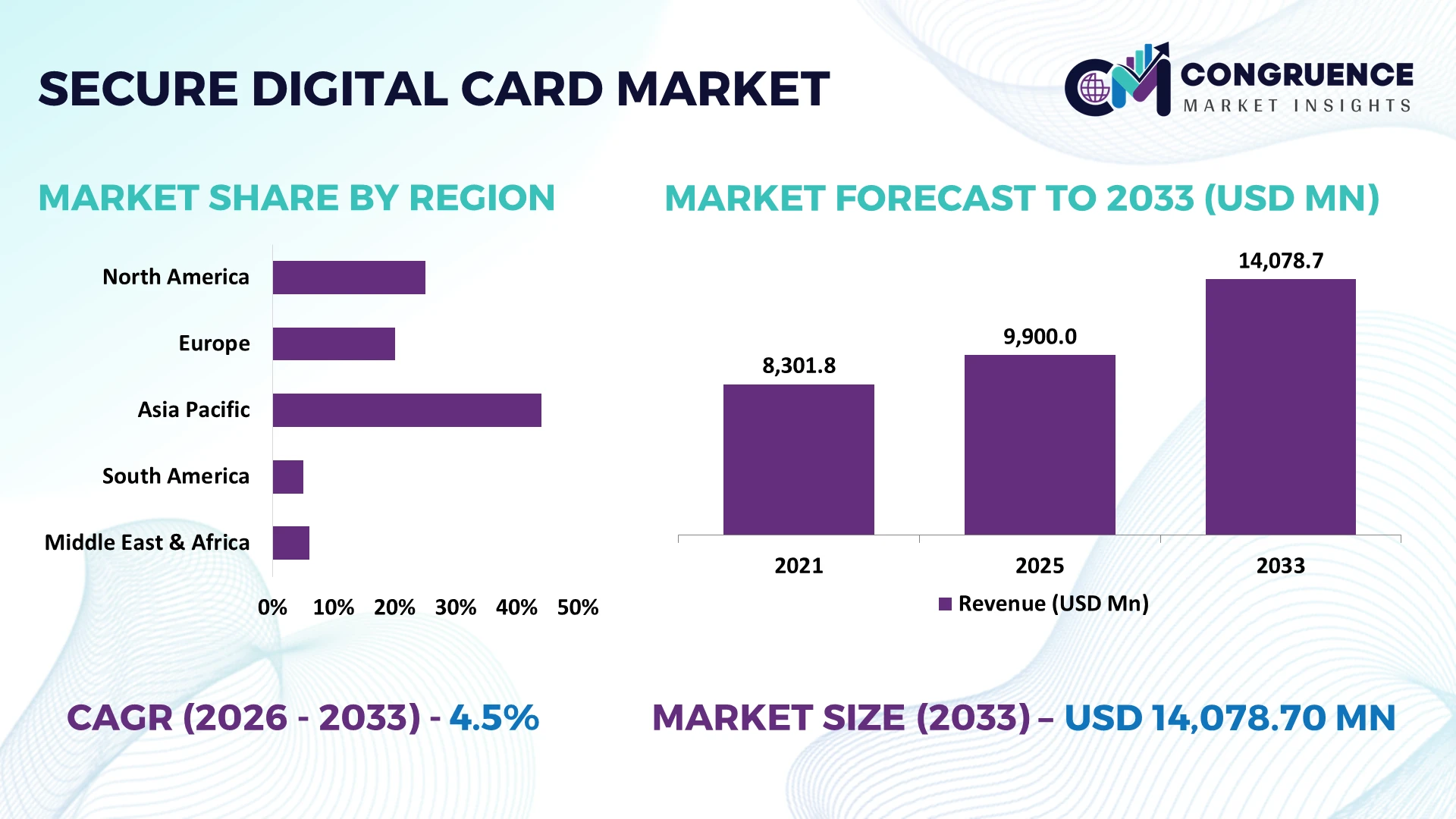
Asia-Pacific commands 48% of global spending, equivalent to USD 4.56 billion, anchored by China's semiconductor manufacturing base, Japan's automotive data-logging ecosystem, and South Korea's NAND flash leadership; the region's MicroSD card shipments grew 12% sequentially in Q3 2025, with 64GB capacity capturing 31% share in India alone. India's consumer storage device shipments surged 44% year-over-year in Q3 2025, driven by 75% USB flash drive dominance and professional MicroSD demand from drone, action camera, and surveillance applications. By contrast, North America's public sector prioritizes FIPS-validated encryption and write-endurance specifications for body-worn cameras and medical imaging devices, commanding premium pricing that offsets lower unit volumes.
Portfolio allocation must pivot toward high-endurance, security-certified industrial SD cards and away from commodity consumer memory, where price competition compresses margins and Chinese suppliers aggressively target mid-tier applications.
Market Size & Growth: Valued at USD 9900 Million in 2025, projected to USD 14078.7 Million by 2033 at 4.5% CAGR, driven by industrial encryption mandates and AI edge-device storage requirements.
Top Growth Drivers: Surveillance infrastructure expansion (48% APAC spending share), automotive data logging adoption, and biometric authentication integration (6.82% payment card adoption).
Short-Term Forecast: By 2027, FIPS-validated SD card procurement for US public safety grows 22%, with write-endurance specifications displacing capacity as the primary procurement criterion.
Emerging Technologies: Smart microSD secure elements enabling NFC payments independent of mobile network operators, post-quantum cryptography migration for EMV chip specifications, and AI-integrated edge storage controllers.
Regional Leaders: Asia-Pacific at USD 4.56 billion and 48% global share, North America prioritizing defense-grade encryption, and Europe deploying tamper-evident cards for police body cameras and railway event recorders.
Consumer/End-User Trends: 32GB remains the preferred flash drive capacity at 39% share, while 64GB MicroSD cards capture 31% of India's professional segment.
Pilot/Case Example: 2025 India consumer storage shipments grew 44% year-over-year, with SanDisk commanding 54% flash drive and 37% MicroSD share, validating branded premium positioning.
Competitive Landscape: SanDisk leads with 54% India flash drive share; Samsung, Western Digital, Micron, Kingston, and Transcend compete across NAND supply and industrial certification.
Regulatory & ESG Impact: GDPR and ISO 27701 mandate encryption for removable media containing personal data, with UK Legal Aid Agency enforcing 28-day secure disposal windows for unencrypted SD cards.
Investment & Funding: US Commerce Department tightened memory equipment export controls from 18nm to 25nm and imposed strict reviews on 128-layer+ NAND equipment, directly constraining Chinese manufacturer capacity expansion.
Innovation & Future Outlook: Post-quantum cryptography integration, agentic payment specifications for card-based authentication, and supply-chain de-sinicization pressure reshaping NAND sourcing strategies.
Demand concentrates in industrial-grade encrypted storage for surveillance, automotive event recorders, and portable medical imaging, where write endurance and FIPS validation outrank capacity and price. Product innovation centers on smart microSD secure elements enabling NFC payments without mobile network operator intermediation, alongside post-quantum cryptography migration for EMV chip specifications. The emerging trend is procurement bifurcation: North American public sector prioritizes 22% higher-specification cards with physical write-protect switches, while Asia-Pacific volume growth flows toward 64GB professional MicroSD at 31% share. Supply-chain context: US export controls on 128-layer+ NAND equipment and Senate pressure on Apple to avoid Chinese memory suppliers are restructuring global NAND sourcing toward South Korean and US fabrication. These dynamics favor suppliers with certified industrial portfolios and geographically diversified manufacturing footprints, a strategic imperative examined in the following competitive positioning analysis.
The Secure Digital Card Market is becoming strategically important as removable storage evolves from basic memory expansion into a performance-critical component of digital imaging, gaming, and industrial data infrastructure. The transition toward PCIe-based SD Express interfaces is reshaping product development, controller integration, and semiconductor procurement strategies. Manufacturers increasingly prioritize application-specific performance certification and dependable NAND flash sourcing to differentiate premium products from conventional storage cards. This shift strengthens investment in advanced packaging, thermal management, and high-density memory architectures.
SD Express technology delivers significant performance advantages over conventional UHS-I interfaces. Samsung's microSD Express technology achieves read speeds approaching 800 MB/s compared with approximately 200 MB/s for premium UHS-I products, representing a 300% speed improvement. South Korea emphasizes NAND innovation and advanced memory integration, while China concentrates on electronics assembly and large-scale distribution. Japan contributes specialized flash engineering and industrial storage technologies, supporting distinct regional manufacturing advantages.
Between 2026 and 2028, product development will emphasize microSD Express commercialization, higher-capacity NAND configurations, and improved random-access performance. Nintendo Switch 2's exclusive microSD Express requirement for expandable game storage demonstrates the commercial influence of device-level compatibility standards. Samsung and Sandisk are strengthening application-specific storage portfolios through faster controllers and certified memory products. Competitive advantage increasingly depends on performance validation, ecosystem partnerships, and reliable semiconductor supply.
Increasing demand for uninterrupted high-resolution video capture is strengthening the commercial importance of performance-certified secure digital cards. The SD Association's V90 classification guarantees minimum sustained writing performance of 90 MB/s, representing a 200% improvement over the 30 MB/s minimum required for V30 products. Similarly, V60 cards provide 100% greater guaranteed sustained throughput than V30 alternatives, supporting demanding professional recording workflows. Japanese camera manufacturers increasingly incorporate advanced video recording capabilities that require reliable continuous data transfer. This technology transition is encouraging storage manufacturers to optimize NAND controllers, expand high-endurance flash portfolios, and strengthen compatibility testing with camera producers. Suppliers delivering certified recording stability gain stronger access to professional imaging and specialized audiovisual equipment markets.
Concentrated NAND flash manufacturing and fragmented host-device compatibility constrain secure digital card production flexibility. Conventional UHS-I interfaces offer theoretical transfer speeds of 104 MB/s, whereas UHS-II supports 312 MB/s, creating substantial performance differences across existing device ecosystems. SD Express products also require compatible host interfaces to deliver their advanced performance capabilities. Nintendo Switch 2 supports microSD Express storage expansion up to 2TB, while conventional microSD cards cannot perform equivalent game-storage functions. These interoperability requirements complicate inventory planning and increase product qualification costs. Semiconductor production concentration in South Korea, Japan, and China further exposes manufacturers to procurement disruptions. Companies are responding through diversified NAND procurement, multigeneration product portfolios, and long-term component supply agreements to protect manufacturing continuity.
Application-oriented flash storage presents substantial opportunities as secure digital cards increasingly support software execution rather than simple file retention. The A2 Application Performance Class specifies 4,000 random read operations per second, representing approximately 167% higher minimum performance than the 1,500 operations required under A1. Its minimum random write performance reaches 2,000 operations per second, quadrupling the A1 requirement. These capabilities strengthen opportunities in embedded computing, portable gaming, and application-intensive consumer electronics. Taiwan's semiconductor controller ecosystem provides an important development base for optimizing flash translation layers and random-access performance. Manufacturers are investing in firmware engineering, host-device qualification, and advanced controller architectures to capture premium storage applications. Products combining responsive application loading with efficient flash management offer stronger differentiation than capacity-focused alternatives.
Maintaining consistent performance across diverse operating environments presents a major long-term engineering challenge for secure digital card manufacturers. SD Express Speed Classes E150, E300, E450, and E600 establish sustained performance tiers ranging from 150 MB/s to 600 MB/s, requiring increasingly sophisticated controller optimization and thermal management. The highest classification demands 300% greater sustained throughput than E150, intensifying validation requirements for compact storage designs. Industrial applications introduce additional demands involving continuous write cycles, power interruption protection, and predictable data retention. German automotive and industrial electronics manufacturers increasingly require storage qualification aligned with equipment operating conditions. Memory suppliers must strengthen endurance testing, firmware validation, and device-level integration partnerships to maintain deployment reliability. Consistent performance under demanding workloads is becoming a decisive competitive requirement beyond advertised peak transfer speeds.
Industrial-Grade Migration Accelerates: Automotive and surveillance procurement is shifting toward high-endurance cards rated for 10,000+ write cycles, with industrial SD card demand growing at 5.7% annually through 2030. China's smart-city surveillance expansion and EV data-logging mandates drive 8–10% annual growth in industrial-grade capacity. Manufacturers are responding by securing long-term NAND allocation contracts and investing in wide-temperature certification.
UHS-II and SD Express Adoption Widens: Professional imaging and gaming consoles are migrating to UHS-II and SD Express standards, which deliver transfer speeds exceeding legacy UHS-I by 300%. Japan's professional camera segment and South Korea's handheld gaming devices lead adoption. Card makers are restructuring product lines toward higher-margin advanced-interface models while phasing out Class 2/4/6/10 commodity SKUs.
Online Channel Displaces Retail Distribution: Online channels now command 65.26% of SD card distribution, driven by competitive pricing and convenience in markets including India and Brazil. This shift compresses traditional retail margins and forces distributors toward direct-to-consumer logistics. Brands are investing in e-commerce fulfillment infrastructure and regional warehousing to reduce delivery latency.
Post-Quantum Security Certifications Reshape Procurement: Government and defense procurement in the United States increasingly mandates hardware-encrypted SD cards with tamper-evident construction, with the U.S. market projected at USD 2.02 billion in 2026. This regulatory pull is creating a bifurcated market where security-certified cards command 30–80% price premiums over consumer equivalents.
SDHC represents an established leading segment of the Secure Digital Card Market, accounting for approximately 38.2% of market share in 2025. Its dominance reflects established device compatibility, affordable manufacturing, and widespread utilization in conventional digital storage applications. Supporting capacities above 2GB and up to 32GB, SDHC maintains commercial relevance in cost-sensitive electronics and replacement markets. SDXC represents the strongest established high-capacity growth category, supporting storage configurations above 32GB and up to 2TB. Manufacturers are strengthening SDXC portfolios through improved NAND density, faster interfaces, and optimized controller firmware to capture premium storage demand.
SDUC represents an emerging high-capacity technology frontier, extending standardized storage capabilities beyond 2TB to 128TB. SDS and Standard Capacity cards continue serving legacy equipment requiring smaller storage configurations, while High-Capacity Cards address broader consumer and professional requirements. The shift toward advanced capacity standards is encouraging manufacturers to prioritize higher-density memory production, interface certification, and differentiated durability features. Companies maintaining compatibility across established and emerging product generations gain stronger distribution flexibility and reduce inventory transition risks.
Smartphones represent a leading application within the broader removable memory card industry, accounting for approximately 38.4% of market demand in 2025. Their established installed base and demand for affordable storage expansion support continued microSD utilization, particularly across budget and midrange Android devices. Digital Cameras represent another substantial application, supported by professional photography, high-resolution recording, and removable media workflows. Gaming Consoles constitute a rapidly advancing application as hardware manufacturers introduce stricter storage compatibility requirements and faster game-loading architectures. Nintendo Switch 2's microSD Express requirement is accelerating the transition toward application-certified flash storage.
Tablets maintain demand for portable media expansion and document storage, while Dash Cameras increasingly prioritize continuous recording endurance. Surveillance Systems require dependable local storage for event capture and operational continuity, whereas Industrial Data Storage emphasizes extended service life and controlled firmware behavior. Manufacturers are responding through device-specific compatibility programs, improved endurance ratings, and differentiated storage capacities. Competitive priorities are shifting from universal memory expansion toward products engineered for distinct performance, reliability, and utilization requirements.
Consumer Electronics represents the leading end-user segment of the Secure Digital Card Market, accounting for approximately 71.4% of broader flash memory card demand in 2025. Extensive adoption across portable electronic devices, storage upgrades, and accessory purchasing supports its dominant position. Photography maintains strong requirements for sustained recording performance and data protection, particularly among professional imaging users. Gaming is gaining importance through dedicated high-speed storage standards and expanding digital software libraries. Manufacturers are strengthening certified product portfolios and retail partnerships to address differentiated consumer purchasing requirements.
Industrial Automation represents an important emerging high-value segment as connected machinery and embedded controllers increasingly require dependable local data retention. Automotive applications emphasize durable storage for vehicle monitoring and recording, while Security & Surveillance prioritizes continuous writing endurance and predictable replacement cycles. Healthcare applications require controlled data handling and device-specific storage qualification. Manufacturers are responding through customized firmware, industrial temperature ratings, and long-term product availability programs. This segmentation shift supports premium pricing for validated reliability, while consumer-oriented manufacturers retain competitive advantages through production scale and established distribution networks.
Asia-Pacific accounted for the largest market share at 39.80% in 2025 however, Asia-Pacific is expected to register the fastest growth between 2026 and 2033, supported by semiconductor manufacturing expansion, electronics production, and increasing adoption of high-capacity removable storage.

Premium Flash Storage Adoption and Advanced Device Integration
North America accounted for approximately 29% of global Secure Digital Card Market demand in 2025, reflecting substantial consumption across professional imaging, gaming, security equipment, and industrial computing. The United States leads advanced storage commercialization through established technology retailers, semiconductor design capabilities, and sophisticated device integration. Increasing deployment of high-resolution recording equipment is strengthening demand for certified SDXC and high-endurance microSD products. PCIe-based removable storage is also reshaping compatibility requirements across gaming and portable computing systems. The region benefits from an established ecosystem of memory card manufacturers, hardware developers, and specialized distribution partners. Sandisk's product expansion into microSD Express technology reflects the commercial importance of faster interfaces and application-specific certification. Manufacturers are strengthening OEM partnerships, expanding premium storage portfolios, and emphasizing reliability testing to differentiate products beyond basic capacity specifications.
United States Market Outlook: The United States maintains a leading position in advanced removable storage commercialization through technology development, consumer electronics distribution, and specialized memory solutions. Sandisk's microSD Express products provide read speeds approaching 880 MB/s, supporting faster application loading and data transfer in compatible hardware. Domestic gaming platforms, professional production studios, and industrial equipment manufacturers create opportunities for certified storage products, optimized controller firmware, and high-performance device integration.
Industrial Storage Reliability and Professional Imaging Demand
Europe represented approximately 19.5% of global Secure Digital Card Market demand in 2025, supported by professional imaging equipment, automotive electronics, industrial automation, and connected surveillance infrastructure. Germany, France, and the United Kingdom anchor regional demand through established electronics distribution networks and specialized industrial equipment manufacturing. European industrial customers increasingly emphasize predictable flash memory endurance, operating temperature tolerance, and long-term component availability. Professional imaging demand also remains substantial, with digital camera shipments to Europe reaching approximately 2.12 million units in 2025, reflecting a 6.2% annual increase. Regulatory attention to electronic product durability and resource efficiency is strengthening interest in reliable storage components. Manufacturers are responding through industrial-grade memory portfolios, extended qualification procedures, and specialized distribution partnerships. Companies providing consistent firmware support and lifecycle management gain advantages in equipment procurement and maintenance-intensive applications.
Germany Market Outlook: Germany represents a strategically important industrial storage market through its automotive engineering, factory automation, and embedded electronics sectors. Industrial storage suppliers serving German manufacturers emphasize extended operating temperature specifications, with specialized cards commonly supporting environments from minus 40°C to 85°C. Established engineering and equipment certification practices encourage adoption of validated memory components, creating opportunities for high-endurance storage, customized firmware, and long-term supply agreements.
Semiconductor Production Leadership and Storage Technology Commercialization
Asia-Pacific maintains the strongest position in the Secure Digital Card Market through concentrated NAND flash manufacturing, electronics assembly, and extensive consumer device production. China, South Korea, Japan, and Taiwan contribute complementary capabilities spanning semiconductor fabrication, memory controller design, packaging, and finished storage products. South Korean manufacturers emphasize advanced V-NAND integration, while Japanese companies maintain substantial expertise in flash memory development and professional imaging applications. China's extensive electronics manufacturing ecosystem supports large-scale device integration and regional distribution. Camera shipments to China reached approximately 2.27 million units in 2025, increasing 16.3% compared with the previous year. The expansion of high-resolution imaging, portable gaming, and embedded electronics is strengthening demand for differentiated storage capabilities. Manufacturers are investing in higher-density memory architectures, advanced interface controllers, and localized assembly operations to improve product availability and manufacturing efficiency.
South Korea Market Outlook: South Korea represents a leading technology development center through Samsung Electronics and SK hynix's advanced semiconductor manufacturing capabilities. Samsung's eighth-generation V-NAND technology supports high-density flash integration, while its PRO Plus microSD portfolio offers read speeds reaching 180 MB/s. Domestic expertise in semiconductor process technology, controller development, and memory qualification supports differentiated storage products. Integrated manufacturing capabilities strengthen performance optimization and commercial responsiveness across premium consumer and embedded storage applications.
Consumer Electronics Distribution and Local Manufacturing Expansion
South America represents an important emerging market for secure digital cards, supported by expanding consumer electronics distribution, surveillance installations, and portable device adoption. Brazil anchors regional demand through its electronics manufacturing infrastructure, established retail networks, and Manaus industrial production cluster. Argentina, Chile, and Colombia contribute demand from digital photography, automotive recording equipment, and small-scale industrial applications. Brazil's electrical and electronics industry operated at approximately 78% installed capacity utilization in 2025, reflecting an established manufacturing base for device integration and accessory distribution. However, dependence on imported NAND flash and finished memory products exposes distributors to currency fluctuations and international procurement conditions. Manufacturers are strengthening authorized distribution agreements, improving inventory planning, and expanding affordable SDHC and SDXC portfolios. Local assembly capabilities and dependable product authentication are becoming important competitive factors in price-sensitive markets.
Brazil Market Outlook: Brazil's Manaus Industrial Pole provides an established electronics manufacturing platform supporting consumer device assembly and associated storage accessory demand. Mobile phone production in Manaus reached approximately 2.79 million units during the first quarter of 2026, increasing 4.02% annually. Tax incentives, established electronics manufacturers, and domestic retail infrastructure strengthen market accessibility. Storage suppliers can capitalize on these capabilities through local distribution partnerships, certified product availability, and industrial procurement relationships.
Digital Infrastructure Expansion and Surveillance Storage Integration
The Middle East and Africa Secure Digital Card Market is being shaped by digital infrastructure investment, expanding surveillance networks, and increasing deployment of connected electronic equipment. Saudi Arabia and the United Arab Emirates emphasize smart infrastructure, advanced monitoring technologies, and industrial digitization, while South Africa and Egypt provide established electronics distribution and security installation networks. Public security modernization is strengthening demand for dependable recording equipment, although cloud-connected systems and centralized video storage influence removable memory requirements. South Africa's Gauteng province reported 960 installed CCTV cameras across strategic locations by May 2026, illustrating continued investment in electronic monitoring infrastructure. Storage manufacturers are adapting through high-endurance product portfolios, distributor partnerships, and equipment compatibility certification. Market access increasingly depends on dependable aftermarket support, resistance to counterfeit products, and reliable performance under demanding environmental conditions.
South Africa Market Outlook: South Africa represents a significant market for surveillance-oriented and industrial removable storage through its established security technology ecosystem. Cape Town's municipal CCTV network exceeded 1,200 cameras in 2026, with surveillance infrastructure upgrades supporting wider monitoring coverage. Demand concentrates on durable storage for recording equipment, security installations, and industrial electronic devices. Manufacturers offering validated endurance ratings, dependable supply agreements, and technical support gain competitive advantages across institutional procurement and commercial distribution channels.
The Secure Digital Card Market is moderately concentrated, with Sandisk, Samsung Electronics, Kingston Technology, Lexar, and Transcend Information collectively holding approximately 50.1% share in 2025. Sandisk leads with 23.1%, competing against Samsung's 12.0% share through retail distribution, NAND partnerships, and premium storage certification. Kingston's 7.4% position reflects broad channel coverage, while Lexar targets professional imaging and Transcend emphasizes industrial reliability. SD Express cards approaching 880 MB/s challenge conventional UHS-I products operating near 200 MB/s, offering approximately 340% higher peak read performance. Manufacturers compete through controller optimization, qualified endurance ratings, OEM agreements, and differentiated capacity offerings. Sandisk's independent corporate structure and manufacturing collaboration with Kioxia strengthen flash supply coordination, while Samsung leverages vertically integrated semiconductor capabilities. NAND procurement volatility, counterfeit prevention, and stringent device compatibility create barriers for smaller brands. Sustained competitiveness requires certified performance, dependable component sourcing, disciplined pricing, and application-specific product development across consumer and industrial storage channels.
Western Digital (SanDisk)
Samsung Electronics
Kingston Technology
Micron Technology
Kioxia
Lexar
Transcend Information
Sony
PNY Technologies
ADATA Technology
Panasonic
Nextorage
Current Secure Digital Card technologies emphasize high-density 3D NAND, advanced controllers, and performance-certified interfaces. Samsung's eighth-generation V-NAND enables 1TB microSD configurations, while modern 28nm controllers improve energy efficiency compared with earlier 55nm designs. UHS-I products deliver read speeds reaching 200 MB/s, supporting established imaging and consumer electronics applications. Manufacturers integrating advanced error correction and intelligent wear management benefit from improved reliability, manufacturing differentiation, and longer storage lifecycles.
Emerging SD Express technology combines PCIe connectivity with NVMe protocols, transforming removable memory performance. Lexar's microSD Express cards achieve 900 MB/s read speeds, representing a 350% improvement over 200 MB/s conventional products. Host Memory Buffer integration and dynamic thermal management improve application responsiveness and sustained operation. Nintendo Switch 2 deployment establishes commercial adoption of Express-compatible storage, encouraging Samsung, Sandisk, and ADATA to expand certified product portfolios and strengthen hardware compatibility partnerships.
Disruptive developments include SDUC architectures, automated flash health monitoring, and AI-assisted storage management. SDUC specifications extend addressable capacity to 128TB, supporting future industrial and data-intensive applications. Between 2026 and 2028, controller innovation, automated endurance diagnostics, and advanced NAND packaging will increasingly determine product competitiveness. Vertically integrated manufacturers gain procurement and engineering advantages, while specialized suppliers compete through firmware customization.
November 2025: Samsung launched the P9 Express microSD Express card with 800 MB/s sequential read speeds—4x faster than UHS-I—optimized for Nintendo Switch 2 and available in 256GB/512GB capacities, establishing SD Express as the new gaming storage standard .
July 2025: Kioxia commenced sample shipments of 9th generation BiCS FLASH 512Gb TLC devices featuring 61% write performance improvement and 36% better write power efficiency, accelerating high-performance NAND availability for next-generation SD card controllers .
May 2026: WD advanced post-quantum cryptography hard drives with ML-DSA-87 secure boot to production storage infrastructure, signaling that quantum-resistant security is transitioning from theoretical planning to deployed hardware for long-lifecycle data protection .
November 2025: Sandisk reported fiscal Q1 2026 results with $1.44 billion cash position following its February 2025 separation from Western Digital, demonstrating operational independence and financial resilience as a standalone flash memory company .
The Secure Digital Card Market Report examines industry developments, product segmentation, manufacturing capabilities, and competitive positioning between 2026 and 2033. Type coverage includes SDS, SDHC, SDXC, SDUC, Standard Capacity, and High-Capacity Cards. Application analysis evaluates Digital Cameras, Smartphones, Tablets, Gaming Consoles, Dash Cameras, Surveillance Systems, and Industrial Data Storage. End-user assessment covers Consumer Electronics, Photography, Automotive, Gaming, Security & Surveillance, Industrial Automation, and Healthcare, highlighting differentiated storage requirements and procurement priorities.
Regional analysis encompasses North America, Europe, Asia-Pacific, South America, and the Middle East & Africa. The report profiles 14 leading manufacturers and evaluates NAND technology, SD Express interfaces, controller innovation, and endurance optimization. Performance indicators include transfer speeds approaching 900 MB/s and emerging storage capacities exceeding 2TB. Strategic insights support manufacturing investment, product development, geographic expansion, competitive benchmarking, and long-term supply-chain planning.
| Report Attribute/Metric | Report Details |
|---|---|
Market Revenue in 2025 | USD 9900 Million |
Market Revenue in 2033 | USD 14078.7 Million |
CAGR (2026 - 2033) | 4.5% |
Base Year | 2025 |
Forecast Period | 2026 - 2033 |
Historic Period | 2021 - 2025 |
Segments Covered | By Type
By Application
By End-User
|
Key Report Deliverable | Revenue Forecast, Growth Trends, Market Dynamics, Segmental Overview, Regional and Country-wise Analysis, Competition Landscape |
Region Covered | North America, Europe, Asia-Pacific, South America, Middle East, Africa |
Key Players Analyzed | Western Digital (SanDisk), Samsung Electronics, Kingston Technology, Micron Technology, Kioxia, Lexar, Transcend Information, Sony, PNY Technologies, ADATA Technology, Panasonic, Nextorage |
Customization & Pricing | Available on Request (10% Customization is Free) |




