
Reports
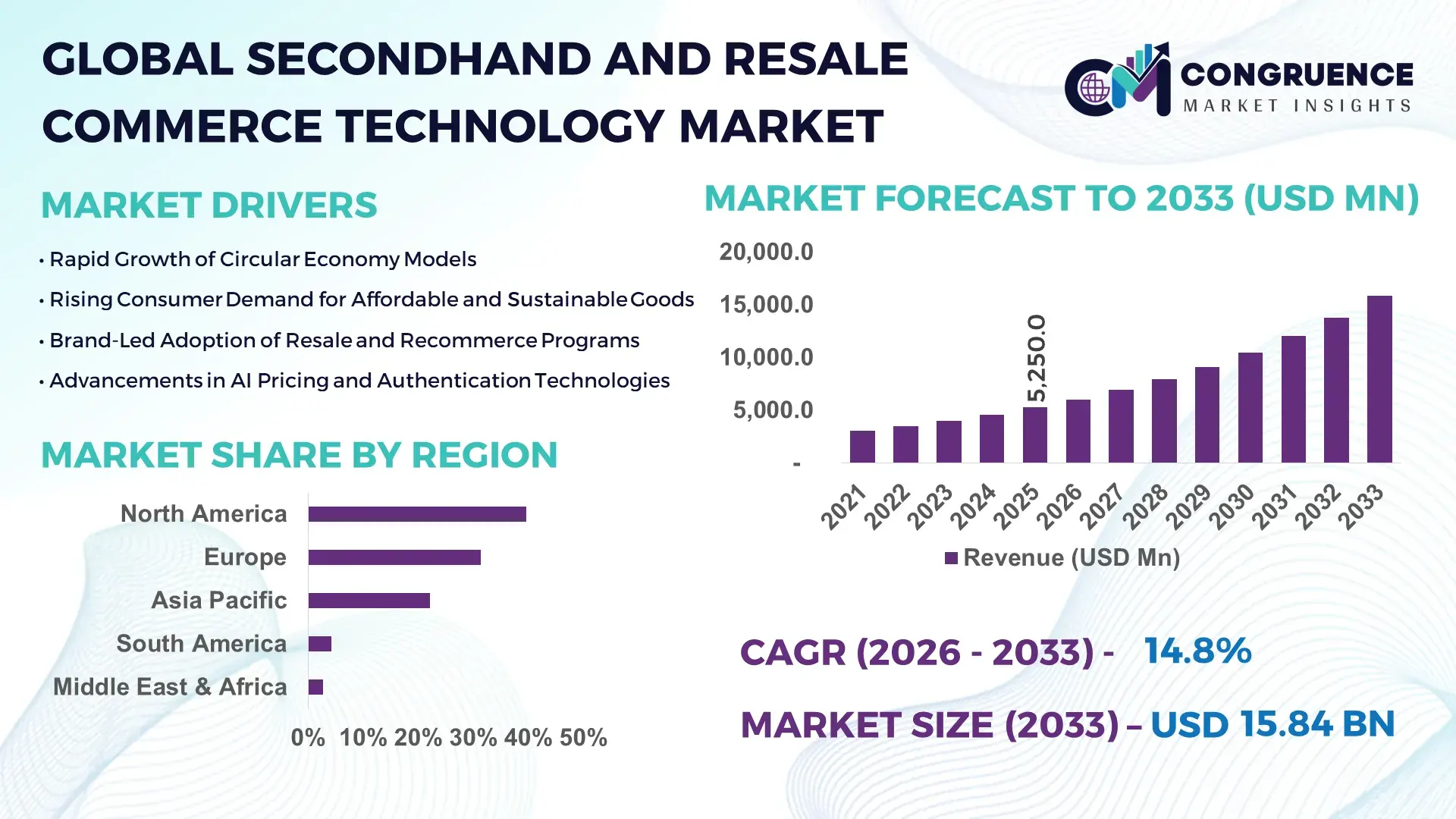
The Global Secondhand and Resale Commerce Technology Market was valued at USD 5,250.0 Million in 2025 and is anticipated to reach a value of USD 15,837.8 Million by 2033 expanding at a CAGR of 14.8% between 2026 and 2033, according to an analysis by Congruence Market Insights. This expansion is primarily supported by rising digital recommerce adoption, sustainability-driven purchasing behavior, and platform-level automation improving resale efficiency and pricing accuracy.
The United States represents the most influential country within the global Secondhand and Resale Commerce Technology Market, driven by its advanced digital infrastructure, high platform penetration, and large-scale investment in recommerce innovation. Over 78% of U.S.-based resale platforms deploy AI-powered pricing, demand forecasting, and fraud detection tools, significantly improving inventory turnover rates. Annual investments in recommerce technology platforms exceeded USD 1.6 billion in 2024, spanning apparel, electronics, furniture, and luxury goods. More than 62 million U.S. consumers actively use secondhand digital marketplaces, with mobile-based resale transactions accounting for nearly 68% of total platform activity. Advanced integrations such as automated authentication, blockchain-backed product history, and warehouse robotics are increasingly deployed, supporting scalable operations and high transaction volumes across national fulfillment networks.
Market Size & Growth: Valued at USD 5.25 billion in 2025 and projected to reach USD 15.84 billion by 2033, driven by platform automation and sustainability-led consumption.
Top Growth Drivers: Digital resale adoption (42%), AI-driven pricing efficiency gains (31%), circular economy participation increase (27%).
Short-Term Forecast: By 2028, platform-level automation is expected to reduce inventory holding time by 35%.
Emerging Technologies: AI-based dynamic pricing engines, blockchain-enabled product authentication, and automated reverse logistics systems.
Regional Leaders: North America (USD 5.9 billion by 2033; mobile-first adoption), Europe (USD 4.6 billion; regulatory-aligned platforms), Asia Pacific (USD 3.8 billion; social-commerce-driven resale).
Consumer/End-User Trends: Apparel and consumer electronics account for over 55% of total platform transactions, with Gen Z representing 46% of active users.
Pilot or Case Example: In 2024, a U.S.-based apparel resale pilot achieved a 29% reduction in return processing time using AI-based grading.
Competitive Landscape: Market leader holds ~18% share, followed by eBay, ThredUp, The RealReal, Vestiaire Collective, and Poshmark.
Regulatory & ESG Impact: Extended producer responsibility (EPR) frameworks are accelerating resale platform partnerships across Europe and North America.
Investment & Funding Patterns: Over USD 4.2 billion invested globally since 2022, with rising venture interest in AI-enabled resale SaaS models.
Innovation & Future Outlook: Integration of generative AI, predictive demand engines, and cross-platform resale APIs will shape next-generation marketplaces.
The Secondhand and Resale Commerce Technology Market spans apparel, electronics, luxury goods, furniture, and automotive parts, with apparel contributing approximately 38% of platform activity. AI-based grading, automated fulfillment, and blockchain authentication are reshaping operational efficiency, while sustainability regulations and cost-conscious consumer behavior continue to influence regional adoption patterns, particularly in North America and Europe.
The Secondhand and Resale Commerce Technology Market is increasingly positioned as a strategic enabler of circular economy models, operational resilience, and compliance-led digital commerce transformation. Enterprises are integrating advanced resale platforms to extend product lifecycles, optimize inventory recovery, and align with sustainability mandates. AI-driven pricing algorithms now deliver 28% faster sell-through rates compared to manual pricing standards, while automated condition grading delivers a 34% accuracy improvement compared to legacy inspection processes.
From a regional standpoint, North America dominates in transaction volume, supported by mature digital infrastructure, while Europe leads in adoption, with approximately 61% of large retailers integrating resale technology into their omnichannel strategies. In Asia Pacific, social commerce integrations are accelerating platform engagement, particularly among mobile-first users.
By 2028, AI-enabled demand forecasting and automated reverse logistics are expected to cut resale fulfillment costs by 30%, improving profitability for platform operators and brand-owned resale programs. Compliance and ESG considerations are also shaping strategy, with firms committing to 40% product recirculation targets by 2030, driven by regulatory frameworks such as digital product passports and extended producer responsibility mandates.
A micro-scenario illustrates this shift: in 2024, a U.S.-based electronics resale platform achieved a 22% reduction in refurbishment cycle time through AI-led defect classification and automated warehouse routing. Looking ahead, the Secondhand and Resale Commerce Technology Market will serve as a core pillar for sustainable growth, regulatory alignment, and digitally resilient commerce ecosystems worldwide.
The Secondhand and Resale Commerce Technology Market is shaped by the convergence of digital commerce infrastructure, sustainability-driven consumer behavior, and enterprise-level circular economy strategies. Platforms are evolving from basic peer-to-peer resale models into sophisticated technology ecosystems integrating AI, automation, and data analytics. Increased product returns, overstock optimization, and regulatory pressure on waste reduction are driving enterprise participation across apparel, electronics, and luxury goods. At the same time, interoperability with logistics providers, payment gateways, and authentication services is becoming a critical operational requirement. Market dynamics are also influenced by mobile commerce penetration, cross-border resale capabilities, and the standardization of product condition grading, all of which impact scalability and platform competitiveness.
Circular economy adoption is a primary growth driver, as retailers and brands seek to recover value from returned, unsold, or end-of-life products. Over 65% of global fashion and electronics brands have launched or piloted resale programs, relying on technology platforms for pricing, authentication, and fulfillment. Automated resale solutions improve asset recovery rates by 25–30%, while AI-driven demand matching reduces markdown dependency. Governments and corporate ESG commitments are further accelerating adoption, with resale platforms increasingly embedded into core retail and supply chain strategies.
A major restraint is the lack of standardized product condition, grading, and data taxonomy across resale platforms. Variability in quality assessment leads to consumer trust gaps and higher dispute rates, with some platforms reporting return ratios exceeding 18% for electronics and luxury goods. Integration challenges with legacy ERP and inventory systems further slow enterprise adoption, increasing implementation timelines and operational complexity, particularly for multinational retailers managing cross-border resale flows.
AI-led automation presents significant opportunities by enabling scalable, high-volume resale operations. Computer vision-based grading systems can process products 3× faster than manual inspection, while predictive pricing engines improve sell-through probability by over 20%. White-label resale SaaS solutions are gaining traction among mid-sized retailers, opening new revenue pathways for platform providers and expanding adoption beyond early-market leaders.
Reverse logistics remains a critical challenge due to fragmented return flows and high transportation costs. In some regions, reverse logistics expenses account for 35–40% of resale operational costs, impacting profitability. Limited refurbishment infrastructure and inconsistent cross-border regulations further complicate scalability, particularly for electronics and bulky goods, requiring continued investment in automation and regional fulfillment hubs.
AI-Driven Automated Product Grading and Pricing: AI-based grading and pricing tools are transforming platform efficiency, with over 58% of leading resale platforms now using computer vision for condition assessment. These systems reduce manual inspection time by 45% and improve pricing accuracy by 32%, enabling faster listings and higher buyer confidence across apparel and electronics categories.
Expansion of Brand-Owned Resale Platforms: More than 41% of global apparel and electronics brands now operate proprietary resale platforms. These initiatives improve customer lifetime value by 27% while increasing product recirculation rates. Integrated CRM and loyalty features are driving repeat engagement, particularly among Gen Z and millennial consumers.
Blockchain-Enabled Authentication and Traceability: Blockchain adoption is increasing, with 29% of luxury resale platforms using distributed ledgers for authentication and ownership tracking. These solutions reduce counterfeit disputes by 38% and enhance compliance with emerging digital product passport regulations, particularly in Europe.
Rise in Modular and Prefabricated Platform Architecture: Modular platform architectures are reshaping deployment strategies, with 55% of new resale technology projects reporting cost and deployment time reductions. Pre-configured AI modules, API-driven logistics integration, and cloud-native architectures are accelerating rollout timelines by 40%, supporting rapid geographic expansion and scalability.
The Secondhand and Resale Commerce Technology Market is segmented based on type, application, and end-user, reflecting the layered structure of digital recommerce ecosystems. By type, the market spans end-to-end resale platforms, analytics and pricing engines, authentication and traceability solutions, and logistics orchestration tools, each addressing distinct operational requirements. Application-wise, adoption is concentrated across apparel, consumer electronics, luxury goods, furniture, and automotive parts, with usage intensity varying based on return rates, refurbishment complexity, and consumer trust requirements. From an end-user perspective, large retailers and brand-owned resale programs account for the majority of deployments, while SMEs, marketplaces, and logistics providers increasingly adopt modular resale technologies. The segmentation highlights a shift toward integrated, AI-enabled solutions that unify pricing, authentication, and reverse logistics, enabling scalable and compliant secondhand commerce operations across global markets.
The market by type includes end-to-end resale commerce platforms, AI-driven pricing and analytics engines, authentication and traceability solutions, reverse logistics and refurbishment software, and supporting API and integration layers. End-to-end resale commerce platforms currently lead the segment, accounting for approximately 38% of total adoption, as enterprises prefer unified systems that manage listing, pricing, payments, and fulfillment within a single architecture. AI-driven pricing and analytics tools follow closely at 27%, driven by their ability to improve sell-through rates and reduce inventory aging.
Authentication and traceability solutions represent a smaller but critical segment, holding around 18% share, particularly in luxury goods and electronics, where trust and compliance are paramount. Reverse logistics and refurbishment management tools, along with integration APIs, collectively account for the remaining 17%, serving niche but operationally essential functions.
Among these, AI-based authentication and traceability tools are the fastest-growing type, expanding at an estimated 18.6% CAGR, supported by regulatory pressure for product transparency and increasing counterfeit risks. Their growth is driven by blockchain integration, computer vision-based verification, and automated condition grading.
In 2025, an industry-led pilot demonstrated that AI-powered authentication systems reduced counterfeit dispute rates by 36% across a global luxury resale platform serving over 8 million active users.
By application, apparel resale platforms dominate, accounting for nearly 41% of overall market adoption, due to high product turnover, standardized grading frameworks, and strong consumer acceptance of secondhand fashion. Consumer electronics follow with 26% share, supported by structured refurbishment processes and strong secondary demand for smartphones, laptops, and gaming devices. Luxury goods applications account for 19%, where authentication and traceability technologies are central to value preservation.
Furniture, home goods, and automotive parts together represent the remaining 14%, serving region-specific and category-driven resale ecosystems. While apparel leads, luxury and electronics applications are growing fastest, with luxury resale technology adoption expanding at an estimated 17.2% CAGR, driven by digital authentication, digital product passports, and cross-border resale demand.
Consumer adoption trends further support this shift. In 2025, over 44% of Gen Z consumers globally reported purchasing secondhand apparel through digital platforms, while 39% of electronics buyers indicated a preference for certified refurbished products. Additionally, more than 46% of enterprises piloted resale integrations within existing e-commerce systems to manage returns and excess inventory more efficiently.
In 2025, a multi-country pilot showed that automated electronics refurbishment platforms reduced device turnaround time by 28%, enabling faster redeployment into secondary markets.
From an end-user perspective, large retailers and brand-owned resale programs represent the leading segment, accounting for approximately 47% of total market adoption. These organizations deploy resale commerce technology to manage returns, extend product lifecycles, and meet ESG commitments through structured recommerce initiatives. Online marketplaces and platform operators follow with 31% share, leveraging scalable, multi-vendor resale infrastructure.
Small and medium-sized enterprises, logistics providers, and refurbishers collectively contribute the remaining 22%, increasingly adopting modular and white-label resale solutions. While large retailers lead in absolute adoption, SMEs are the fastest-growing end-user segment, expanding at an estimated 19.1% CAGR, driven by lower entry costs, SaaS-based platforms, and plug-and-play integrations.
Adoption data highlights this trend: in 2025, over 36% of SMEs in retail and electronics reported active use of resale technology platforms, while 52% of logistics providers integrated reverse logistics software to support recommerce operations. Consumer-facing impact is also notable, with more than 60% of frequent secondhand buyers indicating higher trust in brands offering certified resale programs.
In 2025, a national retail association initiative enabled over 400 mid-sized retailers to deploy white-label resale platforms, improving inventory recovery rates by 24% within the first year.
North America accounted for the largest market share at 39.6% in 2025; however, Asia-Pacific is expected to register the fastest growth, expanding at a CAGR of 17.9% between 2026 and 2033.

North America’s leadership is supported by high enterprise adoption of resale platforms, with over 64% of large retailers operating in-house or partner-based recommerce systems. Europe followed closely with a 31.4% share, driven by regulatory mandates and sustainability frameworks accelerating technology deployment. Asia-Pacific represented 22.1% of the global market in 2025, supported by rapid growth in mobile commerce users, exceeding 2.7 billion smartphone users, and strong penetration of social resale platforms. South America and the Middle East & Africa collectively accounted for the remaining 6.9%, where adoption is rising due to cost-sensitive consumers and expanding digital infrastructure. Regional differences in consumer behavior, regulatory pressure, and platform maturity continue to shape deployment intensity and technology priorities across markets.
North America holds approximately 39.6% of the global Secondhand and Resale Commerce Technology Market, reflecting early technology adoption and mature digital commerce infrastructure. Key industries driving demand include apparel, consumer electronics, luxury goods, and refurbished medical devices, with apparel and electronics together accounting for over 58% of regional platform usage. Regulatory developments around extended producer responsibility and waste reduction policies at state and federal levels are accelerating enterprise adoption. Technological advancements such as AI-based pricing engines, automated authentication, and warehouse robotics are widely deployed, with more than 72% of large resale platforms integrating machine learning tools. Local players such as ThredUp and The RealReal are expanding proprietary resale-as-a-service models for brands, improving inventory recovery efficiency by over 25%. Regional consumer behavior shows higher participation among millennials and Gen Z, with 61% of U.S. consumers reporting at least one digital secondhand purchase annually.
Europe accounts for nearly 31.4% of global market share, supported by strong regulatory alignment and sustainability initiatives. Key markets include Germany, the UK, and France, which together represent over 67% of regional deployments. Regulatory bodies enforcing circular economy action plans and digital product transparency requirements are pushing enterprises toward advanced resale technology. Adoption of blockchain-based traceability, AI-powered condition grading, and compliance-focused data management tools is widespread, with 54% of European platforms using digital product identification systems. Local players such as Vestiaire Collective are investing heavily in authentication automation, reducing manual verification workloads by 30%. Consumer behavior across Europe reflects higher trust expectations, with over 70% of buyers preferring resale platforms that provide transparent product history and condition disclosure.
Asia-Pacific represents the third-largest regional market by volume, holding 22.1% share in 2025, with China, India, and Japan as the top consuming countries. The region benefits from rapid e-commerce expansion, high mobile penetration, and dense logistics networks supporting cross-border resale. Infrastructure investments in cloud computing and digital payments have enabled scalable resale platforms, while innovation hubs in Shenzhen, Bangalore, and Tokyo drive AI and automation adoption. Local players such as Xianyu (Idle Fish) in China process millions of listings daily using algorithmic pricing and recommendation systems. Consumer behavior is distinctly mobile-driven, with over 68% of secondhand transactions conducted via smartphones, and strong engagement in social and livestream-based resale formats.
South America holds approximately 4.2% of global market share, led by Brazil and Argentina, which together account for more than 70% of regional activity. Growth is supported by expanding e-commerce infrastructure and rising demand for affordable consumer goods. Government-led digital trade facilitation programs and import cost controls are indirectly boosting domestic resale platforms. Local players in Brazil are integrating AI-based pricing tools to manage inflation-driven demand volatility. Consumer behavior in the region shows high sensitivity to pricing, with nearly 59% of users citing cost savings as the primary driver for adopting digital resale platforms, particularly in electronics and apparel.
The Middle East & Africa region accounts for approximately 2.7% of the global market, with key growth countries including the UAE and South Africa. Demand is influenced by retail diversification, construction sector overstock management, and rising digital entrepreneurship. Technological modernization initiatives, including national digital economy strategies, are encouraging platform adoption. Local regulations supporting e-commerce licensing and cross-border trade are improving market accessibility. In the UAE, resale platforms increasingly focus on luxury goods, while African markets show growing activity in refurbished electronics. Consumer behavior varies widely, with urban centers showing over 40% digital resale awareness, compared to lower penetration in rural areas.
United States – 28.4% Market Share: Strong enterprise adoption, advanced digital infrastructure, and large-scale investment in resale platform automation.
China – 14.6% Market Share: High-volume mobile commerce usage and integration of social and AI-driven resale technologies across consumer categories.
The competitive environment in the Secondhand and Resale Commerce Technology Market is notably fragmented, with dozens of active competitors ranging from dedicated resale platforms to integrated marketplace providers. The market features both legacy e-commerce giants and specialized recommerce innovators, with the combined share of the top 5 companies (eBay, ThredUp, Poshmark, Vestiaire Collective, and Vinted) estimated at approximately 42–45% of total platform technology adoption globally, reflecting significant competition beyond the largest players. Competition is shaped by technological differentiation, such as AI-enabled authentication, automated pricing, reverse logistics orchestration, and data analytics.
Key players are engaging in strategic initiatives, including cross-market partnerships (e.g., luxury resale integrations into major e-commerce sites) and product launches like automated product listing and pricing tools. Innovation trends influencing competition include AI-powered seller tools, computer vision-based authentication systems, and integrated trade-in/refurbishment services that streamline the resale experience for both sellers and buyers. The number of specialized resale tech providers continues to grow, with over 60 distinct platforms and tech firms actively deploying new solutions. This competitive landscape incentivizes continuous innovation, rapid feature rollouts, and ecosystem expansion to capture diverse end-user demands across apparel, electronics, luxury goods, and other categories.
Vestiaire Collective
Vinted
Depop
Back Market
The RealReal
Mercari
OfferUp
Swappa
Grailed
Facebook Marketplace
Craigslist
Carvana
Vroom
The Secondhand and Resale Commerce Technology Market is being reshaped by a suite of both established and emerging technologies that are enhancing trust, efficiency, and user engagement across platforms. AI-powered tools are now central to operations, automating tasks such as product listing generation, pricing optimization, and personalized search. For example, several resale platforms have introduced AI-generated product descriptions and attribute suggestions, significantly reducing manual listing effort and improving seller conversion. Computer vision and machine learning models are widely used for authentication and counterfeiting detection, achieving verification accuracies above 98% and enhancing buyer trust in luxury and high-value pre-owned goods. Vision-language and zero-shot retrieval models are increasingly integrated for visual search and discovery, with experimental deployments showing double-digit increases in engagement metrics through improved product relevance and shopping experience.
Blockchain and distributed ledger technologies are beginning to support traceability and provenance, especially pertinent in luxury resale segments where history and authenticity are key buyer considerations. Reverse logistics and refurbishment orchestration systems are also advancing, with platforms integrating smart inventory routing and predictive refurbishment schedules to reduce turnaround times and operational costs. Mobile and social commerce technologies, including in-app payments, livestream commerce, and social sharing enhancements, are driving adoption in mobile-first markets, enabling more dynamic community interactions and direct user-to-user commerce flows. Data analytics and shopper behavior platforms further enable resale marketplaces to personalize recommendations, forecast demand patterns, and optimize cross-inventory utilization, contributing to enhanced platform stickiness and repeat usage.
• In June 2025, Poshmark launched its Smart List AI tool, enabling sellers to generate automated product listings—complete with details like brand, style, and color—by analyzing uploaded photos, streamlining secondhand listing creation processes. Source: www.theverge.com
• In mid-2025, Back Market entered a new growth phase, projecting over €3 billion in gross merchandise value (GMV) for 2025 and expanding its repair platform across France, Germany, and Spain to integrate trade-in and refurbishment services. Source: www.backmarket.com
• In June 2025, Rebag partnered with Amazon’s Luxury Stores, offering nearly 30,000 authenticated pre-owned luxury items on Amazon’s platform and significantly broadening its customer reach in authenticated resale. Source: www.nypost.com
• In early 2025, Marks & Spencer launched its first resale service via eBay, with searches for its pre-loved items rising over 525% in the past year, coupled with a take-back program encouraging circular fashion participation. Source: www.marieclaire.co.uk
The scope of the Secondhand and Resale Commerce Technology Market Report encompasses a comprehensive examination of the overarching technology ecosystem enabling recommerce activities across global regions and end-user industries. It covers market segmentation by technology types such as AI-driven listing and pricing tools, authentication and traceability systems, logistics and refurbishment orchestration platforms, and integrated payment and customer engagement solutions. The report further explores application contexts including apparel, consumer electronics, luxury goods, furniture, and automotive parts, detailing how technology adaptations differ by category and user interaction complexity.
Geographically, the report analyzes regional dynamics across North America, Europe, Asia-Pacific, South America, and the Middle East & Africa, offering insights into adoption patterns, infrastructure readiness, regulatory influences, and consumer behavior trends specific to each region’s resale ecosystem. It profiles emerging niches like social commerce-enabled resale, mobile-first marketplace dynamics, and brand-owned resale integrations, illustrating how innovative channels are expanding market participation. Key technology focus areas include machine learning for visual search and authentication, blockchain for provenance, automated reverse logistics systems, and integrated omnichannel resale platform architectures that support cross-platform interoperability. The report is designed for decision-makers, technology vendors, investors, and enterprise leaders seeking a detailed landscape of competitive positioning, technology trends, and actionable insights to guide strategic planning, investment decisions, and operational enhancements in the rapidly evolving global recommerce technology space.
| Report Attribute / Metric | Details |
|---|---|
| Market Revenue (2025) | USD 5,250.0 Million |
| Market Revenue (2033) | USD 15,837.8 Million |
| CAGR (2026–2033) | 14.8% |
| Base Year | 2025 |
| Forecast Period | 2026–2033 |
| Historic Period | 2021–2025 |
| Segments Covered |
By Type
By Application
By End-User Insights
|
| Key Report Deliverables | Revenue Forecast, Market Trends, Growth Drivers & Restraints, Technology Insights, Segmentation Analysis, Regional Insights, Competitive Landscape, Regulatory & ESG Overview, Recent Developments |
| Regions Covered | North America, Europe, Asia-Pacific, South America, Middle East & Africa |
| Key Players Analyzed | eBay, ThredUp, Poshmark, Vestiaire Collective, Vinted, Depop, Back Market, The RealReal, Mercari,OfferUp, Swappa, Grailed, Facebook Marketplace, Craigslist, Carvana, Vroom |
| Customization & Pricing | Available on Request (10% Customization Free) |




