
Reports
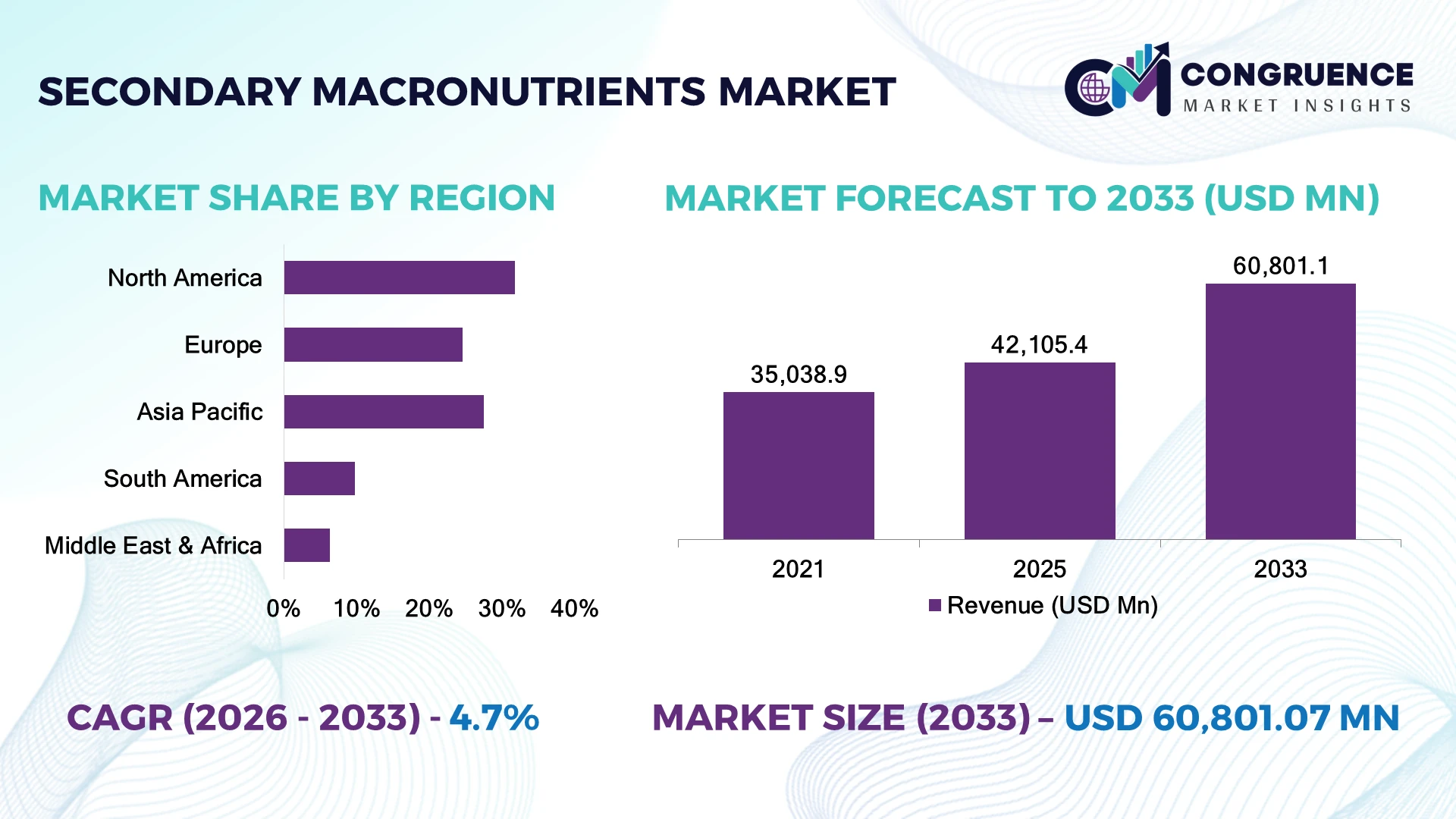
The Global Secondary Macronutrients Market was valued at USD 42,105.4 Million in 2025 and is anticipated to reach a value of USD 60,801.1 Million by 2033 expanding at a CAGR of 4.7% between 2026 and 2033. Growth is being driven by soil nutrient depletion, rising sulfur demand in high-yield crops, precision fertilization, and increasing use of calcium- and magnesium-based inputs to correct nutrient imbalances.
China remains a dominant secondary macronutrient market, supported by its large fertilizer manufacturing base and intensive grain production, while India is accelerating adoption through balanced-nutrition programs; China accounts for more than 20% of global fertilizer consumption, while sulfur-deficiency management is increasingly integrated into commercial agronomy. Supply-chain realignment following the Russia-Ukraine conflict is also reshaping fertilizer sourcing.
Strategically, suppliers with localized production, sulfur-calcium integration, and precision application capabilities are best positioned to capture premium demand.
Market Size & Growth: USD 42.1 billion in 2025 to USD 60.8 billion by 2033 at a 4.7% CAGR, supported by soil nutrient correction and precision fertilization.
Top Growth Drivers: Soil nutrient depletion 32%, sulfur deficiency 24%, and precision nutrient management 19% are the strongest demand catalysts.
Short-Term Forecast: By 2028, precision application can reduce nutrient wastage by 8–12% while improving nutrient-use efficiency by approximately 10%.
Emerging Technologies: Variable-rate spreading, fertigation, soil sensors, and satellite mapping are increasing data-led secondary nutrient placement, with precision practices approaching 20% adoption across advanced commercial farming systems.
Regional Leaders: Asia-Pacific is projected at approximately USD 26 billion by 2033, North America at USD 14 billion, and Europe at USD 11 billion, with digital nutrient management expanding fastest in developed agricultural systems.
Consumer/End-User Trends: Commercial farms and intensive horticulture account for more than 60% of organized secondary-nutrient demand, driven by higher-value crops and soil-testing programs.
Pilot/Case Example: 2025 precision-fertilizer programs demonstrated approximately 8–15% reductions in unnecessary nutrient application, strengthening the business case for variable-rate calcium, magnesium, and sulfur placement.
Competitive Landscape: Leading suppliers include Nutrien, Yara International, ICL Group, The Mosaic Company, and K+S, with the leading player estimated near 8% share and competition centered on formulation breadth and distribution.
Regulatory & ESG Impact: Nutrient-management policies increasingly prioritize efficiency, with optimized application strategies targeting 10–20% reductions in nutrient losses while supporting soil-health objectives.
Investment & Funding: More than USD 1 billion in recent fertilizer capacity, processing, and distribution investments is shifting toward localized production, specialty formulations, and supply-chain resilience.
Innovation & Future Outlook: Next-generation products will combine sulfur, calcium, and magnesium with micronutrient blends, controlled-release technologies, and digital agronomy, shifting competition from volume supply toward nutrient-performance solutions.
The Secondary Macronutrients Market is increasingly concentrated around sulfur, calcium, and magnesium applications in cereals, oilseeds, horticulture, and intensive farming. Sulfur-enriched fertilizers and blended formulations are gaining traction as soil testing identifies nutrient imbalances earlier. Approximately 20% of advanced commercial farming operations now incorporate some form of precision nutrient management, while fertilizer producers are redesigning portfolios around localized formulations and more efficient application.
Secondary macronutrients are becoming strategically important because fertilizer economics are shifting from bulk nutrient volume toward crop-specific nutrient efficiency. Sulfur, calcium, and magnesium increasingly influence yield quality, nutrient uptake, and soil conditioning, making formulation capability a competitive differentiator. Producers are responding by expanding specialty fertilizer portfolios and integrating secondary nutrients into NPK blends rather than selling them as standalone inputs.
Digital agronomy is accelerating this transition. Variable-rate application combined with soil mapping can improve nutrient-placement efficiency by roughly 10–15% compared with uniform application, while reducing unnecessary application by approximately 8–12%. North American farms lead adoption of precision systems, whereas India and China are emphasizing scalable blended fertilizers and localized soil-correction programs.
Over the next 2–3 years, manufacturers will prioritize granular blends, soluble formulations, fertigation-compatible products, and controlled-release technologies. A practical deployment model combines soil testing, satellite field mapping, and variable-rate spreading to target sulfur-deficient zones instead of treating entire fields uniformly. Companies are consequently directing investment toward regional blending plants, agronomy partnerships, and digital advisory platforms. Competitive advantage will increasingly depend on converting nutrient chemistry into measurable field-level efficiency, not simply expanding fertilizer volumes.
Soil nutrient imbalance is accelerating demand for sulfur, calcium, and magnesium formulations, particularly where intensive cropping removes secondary nutrients faster than replenishment. Sulfur-deficiency correction programs are expanding by roughly 8–10%, while precision nutrient application can improve nutrient-use efficiency by 10–15%. In India, soil-testing and balanced-fertilization initiatives are pushing growers toward crop-specific secondary nutrient blends rather than uniform fertilizer programs. Supply-chain restructuring following disruptions in European fertilizer availability is also encouraging localized blending. Manufacturers are responding with sulfur-enriched NPK products, soluble calcium-magnesium formulations, and agronomy partnerships. The strategic shift is significant: suppliers that combine formulation capability with field-level nutrient diagnostics can capture higher-value demand while reducing unnecessary application volumes.
Secondary macronutrient production remains exposed to raw-material, energy, and freight volatility, particularly for sulfur and magnesium compounds. Feedstock and energy costs can represent 15–25% of specialty fertilizer manufacturing expenses, while imported mineral inputs expose some Asian and African markets to logistics disruptions. India and Southeast Asian buyers remain sensitive to delivered-cost movements because imported inputs can add 8–12% to landed fertilizer costs during supply-chain stress. Regulatory differences in fertilizer registration also slow commercialization of new formulations. Producers are reducing exposure through regional blending facilities, multi-source procurement, longer-term mineral contracts, and greater use of locally available calcium and magnesium materials. The operational priority is controlling input variability before expanding specialty-product capacity.
The strongest opportunity lies in combining secondary nutrients with precision-delivery technologies and crop-specific formulations. Controlled-release and water-soluble products can reduce application losses by approximately 10–15%, while fertigation-compatible calcium and magnesium solutions are gaining traction in high-value horticulture. In India, protected cultivation and intensive vegetable production create demand for formulations capable of precise nutrient dosing, with fertigation adoption increasing steadily across commercial farms. Manufacturers are investing in soluble blends, coated granules, and digital nutrient recommendations. A less obvious opportunity is integrating sulfur into existing nitrogen-phosphorus-potassium products, allowing suppliers to upgrade established distribution channels without building entirely new demand categories. Partnerships with irrigation-equipment providers and agronomy platforms can accelerate commercialization.
The next execution barrier is integrating secondary nutrient recommendations into fragmented farm-management systems. Soil-test interpretation, satellite mapping, variable-rate equipment, and fertilizer prescriptions often operate through disconnected workflows, creating 10–15% variability between recommended and applied nutrient quantities. Adoption is strongest among large commercial farms, while smaller producers frequently lack calibrated spreading equipment and agronomic data. India and Brazil face additional implementation complexity from fragmented farm structures and uneven access to precision machinery. Manufacturers must therefore invest in interoperable advisory platforms, distributor training, demonstration farms, and equipment partnerships. The non-obvious competitive risk is not product availability but application accuracy: suppliers that cannot translate formulation performance into consistent field execution will struggle to retain premium positioning.
Sulfur-Enriched Blends Gain Ground Sulfur is increasingly integrated into NPK formulations as soil testing identifies deficiencies earlier. Blended products can represent 10–20% higher formulation value than basic nutrient products, while sulfur-focused programs are expanding roughly 8–10%. Producers are reformulating established grades to capture demand without rebuilding distribution networks.
Precision Spreading Becomes Standardized Variable-rate spreading and field mapping are moving into commercial fertilizer workflows, improving nutrient-use efficiency by approximately 10–15% and reducing unnecessary application by 8–12%. Equipment manufacturers and fertilizer suppliers are partnering around calibrated application systems, particularly across large farms in the United States and Australia.
Soluble Products Expand Horticulture Fertigation-compatible calcium and magnesium formulations are gaining traction in protected cultivation, where dosing precision can reduce nutrient waste by 10% or more. India and China are expanding controlled-environment agriculture, prompting manufacturers to prioritize soluble concentrates, rapid-dissolution grades, and crop-specific nutrient programs.
Localized Blending Reshapes Supply Chains Fertilizer producers are increasing regional blending and storage capacity as freight volatility and geopolitical disruptions expose dependence on imported inputs. Localized operations can reduce delivered logistics costs by 5–10% and shorten replenishment cycles. Companies are responding through multi-source procurement, regional warehouses, and flexible formulation platforms that adjust to feedstock availability.
Sulfur Leads on Broad-Acre Economics
Sulfur remains the leading type, accounting for approximately 48% of the global Secondary Macronutrients Market in 2025. Its dominance reflects broad use across cereals, oilseeds, and pulses, together with strong compatibility with conventional fertilizer programs and relatively competitive raw-material economics. Calcium follows at roughly 28%, while magnesium represents about 24%, maintaining strategic relevance in horticulture, greenhouse cultivation, and crops requiring tighter nutrient balancing. Sulfur's established position is reinforced by its role in protein synthesis and nitrogen-use efficiency, making it difficult to displace in large-scale field applications. Companies are expanding sulfur-enriched blends and improving granulation consistency to protect volume-based demand.
Calcium is emerging as the fastest-growing type as soil acidification, crop-quality requirements, and protected cultivation increase the need for targeted supplementation. Soluble calcium formulations are gaining importance where fertigation and precision nutrient delivery are established, while magnesium remains concentrated in high-value horticultural production. The shift is moving investment from commodity-only portfolios toward differentiated, crop-specific formulations and higher-solubility products.
Industry-backed insight: Industry market analysis places sulfur at approximately 47.9% of the global secondary macronutrients market in 2025, while calcium is identified as the fastest-growing nutrient type, reflecting stronger demand for soil correction and crop-quality applications.
Soil Application Retains Scale Advantage
Soil application is the leading application, representing approximately 77% of the global Secondary Macronutrients Market in 2025. Its concentration reflects compatibility with broad-acre farming, established spreading infrastructure, and the ability to correct nutrient deficiencies directly within the root zone. Conventional soil treatment remains particularly important for sulfur and calcium because growers can integrate these nutrients into existing fertilizer passes without major equipment changes. Foliar application retains a strategic role where rapid deficiency correction is required, while fertigation is gaining traction in controlled-environment agriculture. Companies are responding by developing more soluble formulations, improving nutrient dispersion, and integrating secondary nutrients into multi-nutrient programs.
Fertigation is the fastest-growing application as greenhouse production, drip irrigation, and precision nutrient management expand. Adoption is shifting from uniform field treatment toward dosage-controlled delivery, reducing unnecessary nutrient application and improving operational consistency. Soil application remains mature and volume-driven, whereas fertigation is increasingly value-driven, particularly in fruit, vegetable, and greenhouse production. Suppliers are therefore prioritizing liquid formulations, dosing compatibility, and irrigation-system integration, making application precision a growing competitive differentiator.
Industry-backed insight: Global market analysis indicates that soil application represented approximately 76.5% of the secondary macronutrients market in 2025, while fertigation is emerging as the fastest-growing application as precision delivery expands in intensive cultivation systems.
Field Crop Producers Anchor Demand
Field crop producers represent the leading end-user group, accounting for approximately 45% of global Secondary Macronutrients Market demand. Their dominance comes from the scale of wheat, corn, rice, soybean, and other broad-acre cultivation, where nutrient programs must operate efficiently across large land areas. Large farms prioritize granular products, blended fertilizers, and established spreading systems because operational simplicity directly affects application economics. Horticultural producers hold a smaller base but are becoming the fastest-growing end-user group, supported by higher-value crops, controlled environments, and tighter nutrient-management requirements.
Horticulture is shifting purchasing behavior toward soluble calcium and magnesium products, fertigation-compatible blends, and crop-specific formulations, with adoption intensity in controlled cultivation estimated to be roughly 15–20% higher than conventional field systems in targeted applications. Field agriculture remains focused on cost per hectare and supply reliability, while horticultural buyers emphasize nutrient precision, crop quality, and response speed. Companies are consequently tailoring product portfolios by crop economics, establishing agronomy partnerships, and expanding liquid-fertilizer capabilities to capture higher-value demand.
Industry-backed insight: Agricultural market analysis estimates field crops accounted for approximately 44.8% of secondary macronutrient demand in 2025, while horticultural crops are positioned as the faster-expanding end-user segment as controlled cultivation increases the value of precise nutrient delivery.
North America accounted for the largest market share at 31.8% in 2025 however, Asia-Pacific is expected to register the fastest growth, expanding at a CAGR of 5.4% between 2026 and 2033.
Precision nutrient management is shifting demand toward higher-value formulations
North America remains the largest market, supported by mechanized broad-acre farming, established fertilizer distribution networks, and strong adoption of soil-testing programs. The region represented approximately 31.8% of global demand in 2025, with the United States accounting for the majority through extensive corn, soybean, wheat, and specialty-crop cultivation. Approximately 34% of commercial nutrient programs increasingly incorporate secondary nutrients where soil diagnostics identify sulfur, calcium, or magnesium deficiencies. Producers are moving from commodity nutrient purchasing toward blended, crop-specific formulations, while manufacturers are expanding granulation, coating, and controlled-release capabilities. Investment is increasingly directed toward precision application compatibility and regional production resilience, particularly as North American agriculture continues adjusting procurement strategies following global fertilizer supply disruptions.
United States Market Outlook: The United States dominates North American demand because of its large-scale row-crop infrastructure, sophisticated fertilizer logistics, and high mechanization intensity. Corn and soybean production create substantial sulfur and magnesium requirements, while soil variability supports targeted calcium applications. More than 70% of major commercial farms use some form of soil or nutrient testing, strengthening demand for diagnostic-led formulations. Manufacturers are prioritizing distributor partnerships and agronomic support to increase product penetration beyond conventional fertilizer programs.
Regulatory precision is accelerating nutrient-efficiency formulations
Europe is moving toward more efficient secondary-nutrient application as environmental regulation, soil-health programs, and fertilizer optimization reshape purchasing criteria. The region accounted for approximately 24.6% of global demand in 2025, with Germany, France, Italy, Spain, and the United Kingdom representing major consumption centers. Nutrient-management programs increasingly emphasize application efficiency rather than volume, encouraging calcium, magnesium, and sulfur products with higher nutrient-use efficiency. Approximately 29% of European fertilizer-management programs increasingly incorporate soil diagnostics or precision nutrient planning. Manufacturers are responding through low-dust granules, stabilized formulations, and blended products designed to reduce unnecessary field passes while meeting increasingly stringent environmental requirements.
Germany Market Outlook: Germany holds a strategically important position because of its advanced agricultural machinery base, structured fertilizer distribution, and strong emphasis on nutrient efficiency. Its intensive cereal, oilseed, and horticultural production supports demand for sulfur and magnesium alongside calcium-based soil amendments. Precision agriculture adoption across commercial farms is estimated at more than 30%, strengthening demand for application-specific nutrient recommendations. Producers and suppliers are increasingly linking nutrient products with digital soil mapping and variable-rate application to improve input utilization.
Intensive cultivation is driving precision nutrient adoption
Asia-Pacific combines the largest agricultural production base with rapidly improving nutrient-management practices, making it the fastest-expanding demand center for secondary macronutrients. China and India dominate consumption, while Japan, South Korea, Australia, and Southeast Asian markets add demand through horticulture and commercial farming. The region represented approximately 27.5% of global demand in 2025, with intensive rice, wheat, vegetable, fruit, and plantation cultivation creating recurring nutrient-balancing requirements. Approximately 22% of commercial nutrient programs in advanced agricultural markets increasingly use precision or crop-specific application methods. Suppliers are expanding local blending capacity, farmer advisory networks, and soluble formulations to address fragmented farm structures and improve product accessibility.
China Market Outlook: China is strategically significant because of its enormous cultivated area, intensive fertilizer consumption, and expanding focus on soil-health management. High-value horticulture and greenhouse cultivation are increasing demand for soluble calcium and magnesium products, while sulfur remains relevant across cereal and oilseed systems. Precision agriculture adoption has surpassed 25% across targeted commercial farming applications, creating opportunities for nutrient products integrated with soil diagnostics and variable-rate systems. Domestic manufacturers are strengthening formulation capabilities and regional distribution to capture localized nutrient deficiencies.
Export agriculture is strengthening nutrient-balancing requirements
South America is becoming increasingly important as Brazil and Argentina intensify high-yield soybean, corn, wheat, sugarcane, and specialty-crop production. The region represented approximately 9.8% of global secondary macronutrient demand in 2025, with Brazil generating the strongest commercial opportunity because of its extensive cultivated area and dependence on imported agricultural inputs. Around 30% of major Brazilian crop programs increasingly incorporate sulfur or other secondary nutrients where soil analysis identifies deficiencies. Strong export-oriented agriculture supports premium nutrient formulations, but logistics costs and imported-input exposure remain operational constraints. Suppliers are responding by expanding local blending, distributor networks, and integrated nutrient packages that reduce dependence on individual imported products.
Brazil Market Outlook: Brazil represents the region's strongest market opportunity because its soybean, corn, sugarcane, and cotton industries operate at large commercial scale and require increasingly precise nutrient management. More than 60 million hectares are dedicated to major grain and oilseed production, creating substantial recurring demand for soil amendments and balanced fertilizer blends. Tropical soil conditions also increase the importance of nutrient correction. Manufacturers are strengthening domestic blending and agronomic partnerships to improve supply reliability and support customized sulfur, calcium, and magnesium formulations.
Water efficiency is reshaping nutrient delivery economics
Middle East & Africa presents a structurally diverse market, with demand concentrated around irrigated agriculture, horticulture, commercial plantations, and nutrient-intensive farming projects. Approximately 6.3% of global secondary macronutrient demand originated from the region in 2025, with Saudi Arabia, the United Arab Emirates, Egypt, South Africa, and Morocco representing key demand centers. Water scarcity is accelerating fertigation and controlled nutrient delivery, particularly in greenhouse and high-value horticultural production. More than 35% of advanced protected-cultivation operations in major Gulf agricultural projects use integrated irrigation and nutrient-delivery systems. Companies are therefore emphasizing highly soluble calcium and magnesium formulations, localized distribution, and technical partnerships rather than relying solely on conventional granular products.
Saudi Arabia Market Outlook: Saudi Arabia is strategically significant because agricultural modernization is increasingly linked with water-efficient production systems, greenhouse cultivation, and controlled-environment agriculture. Large-scale agricultural projects are shifting toward fertigation and precision irrigation, creating stronger demand for soluble secondary nutrients that can be integrated directly into irrigation systems. Controlled cultivation accounts for a growing share of commercial horticultural investment, while water-efficiency requirements reinforce nutrient-dosing precision. Suppliers are positioning through customized formulations, technical agronomy support, and partnerships with protected-cultivation operators to capture higher-value nutrient demand.
Global leaders Nutrien, Yara International, ICL Group, Mosaic, and K+S compete against regional specialists such as Coromandel and Haifa, with diversified producers competing against specialty-nutrient innovators. The top five players collectively control an estimated 35% of global value, leaving room for regional suppliers. Competition centers on price, formulation performance, supply security, and agronomic support; roughly 30% of purchasing decisions emphasize customized nutrient blends, while 20% prioritize reliable local availability. Nutrien and Yara leverage integrated distribution and agronomy networks, whereas ICL emphasizes specialty formulations and controlled-release technologies. Coromandel is strengthening backward integration, while regional producers compete through localized blends and faster access. The competitive shift is moving from commodity volume toward nutrient-use efficiency, traceability, and crop-specific formulation. Entry barriers remain high because scale, raw-material access, compliance, and distributor relationships require capital. Winning requires secured inputs, differentiated formulations, agronomic data, and local distribution capable of converting nutrient science into measurable farm-level economics.
Nutrien Ltd.
Yara International ASA
The Mosaic Company
ICL Group Ltd.
K+S Aktiengesellschaft
CF Industries Holdings, Inc.
OCP Group
EuroChem Group AG
Coromandel International Limited
Haifa Group
Koch Fertilizer, LLC
Deepak Fertilisers and Petrochemicals Corporation Limited
Sociedad Química y Minera de Chile S.A.
Tessenderlo Group
Precision nutrient-management platforms are becoming central to secondary macronutrient deployment, combining soil mapping, crop diagnostics, variable-rate application, and digital agronomy. Sensor-guided programs can reduce unnecessary nutrient application by approximately 10–15%, while improving placement efficiency by 8–12%. Adoption is strongest among large commercial farms using digital field-management systems, pushing suppliers toward data-linked calcium, magnesium, and sulfur recommendations rather than standalone commodity products.
Controlled-release coatings, water-soluble formulations, and fertigation-compatible products represent the next technology layer. Compared with conventional granular application, controlled-release systems can improve nutrient-use efficiency by up to 15%, while soluble formulations can reduce application losses by roughly 8–10% when integrated with precision irrigation. ICL and specialty-nutrient producers benefit most because differentiated formulations support premium positioning, recurring agronomic services, and crop-specific product portfolios.
From 2026 to 2028, AI-assisted nutrient recommendations, automated dosing, remote sensing, and biological-nutrient integration will increasingly connect field diagnostics with product selection. Digital adoption across commercial agriculture is moving beyond monitoring toward automated decision support, strengthening operational consistency. Companies combining formulation science with agronomic data will gain an advantage through lower input waste, faster response to deficiencies, and stronger customer retention.
March 2025 Coromandel International commissioned a second bentonite-sulfur plant at Visakhapatnam, doubling sulfur-fertilizer capacity to 50,000 MT. The expansion strengthens Indian supply security, supports crop-specific formulations, and reduces dependence on external sulfur-fertilizer availability for domestic agriculture markets nationwide. Source: coromandel.biz
February 2026 Nutrien reported 49% of its potash ore tonnes were mined using automation in 2025. The productivity shift strengthens its low-cost operating position and supports targeted 2026 investment in mine automation, network optimization, and proprietary crop-nutrition products. Source: nutrien.com
April 2025 Bayer Crop Science highlighted calcium, magnesium, and sulfur as greenhouse vegetable nutrients. The guidance reinforces demand for crop-specific nutrient programs and strengthens the commercial case for precision formulations in controlled environments, where balance supports plant performance. Source: vegetables.bayer.com
September 2025 Bunge reported its regenerative agriculture program expanded to four U.S. facilities and enrolled approximately 60,000 acres. The program integrates nutrient management with digital verification, strengthening demand for traceable fertilizer strategies across soybean and corn supply chains. Source: bunge.com
The Secondary Macronutrients Market Report evaluates calcium, magnesium, and sulfur across major crop categories, application methods, formulations, and end-use farming systems. Coverage spans cereals and grains, oilseeds and pulses, fruits and vegetables, turf and ornamentals, alongside solid and liquid delivery formats. The analysis distinguishes established broad-acre applications from higher-value fertigation, specialty-crop, and precision-nutrition use cases.
Regional assessment covers North America, Europe, Asia-Pacific, South America, and Middle East & Africa, with country-level analysis of production intensity, nutrient deficiencies, fertilizer infrastructure, and adoption patterns. The report also evaluates controlled-release formulations, soluble products, soil diagnostics, precision application, digital agronomy, and nutrient-use-efficiency technologies. Competitive analysis covering 10–14 major participants supports investment planning, localization, portfolio expansion, supply-chain decisions, and competitive positioning through 2026–2033.
| Report Attribute/Metric | Report Details |
|---|---|
|
Market Revenue in 2025 |
USD 42,105.4 Million |
|
Market Revenue in 2033 |
USD 60,801.1 Million |
|
CAGR (2026 - 2033) |
4.7% |
|
Base Year |
2025 |
|
Forecast Period |
2026 - 2033 |
|
Historic Period |
2021 - 2025 |
|
Segments Covered |
By Type
By Application
By End-User
\ |
|
Key Report Deliverable |
Revenue Forecast, Growth Trends, Market Dynamics, Segmental Overview, Regional and Country-wise Analysis, Competition Landscape |
|
Region Covered |
North America, Europe, Asia-Pacific, South America, Middle East, Africa |
|
Key Players Analyzed |
Nutrien Ltd., Yara International ASA, The Mosaic Company, ICL Group Ltd., K+S Aktiengesellschaft, CF Industries Holdings, Inc., OCP Group, EuroChem Group AG, Coromandel International Limited, Haifa Group, Koch Fertilizer, LLC, Deepak Fertilisers and Petrochemicals Corporation Limited, Sociedad Química y Minera de Chile S.A., Tessenderlo Group |
|
Customization & Pricing |
Available on Request (10% Customization is Free) |




