
Reports
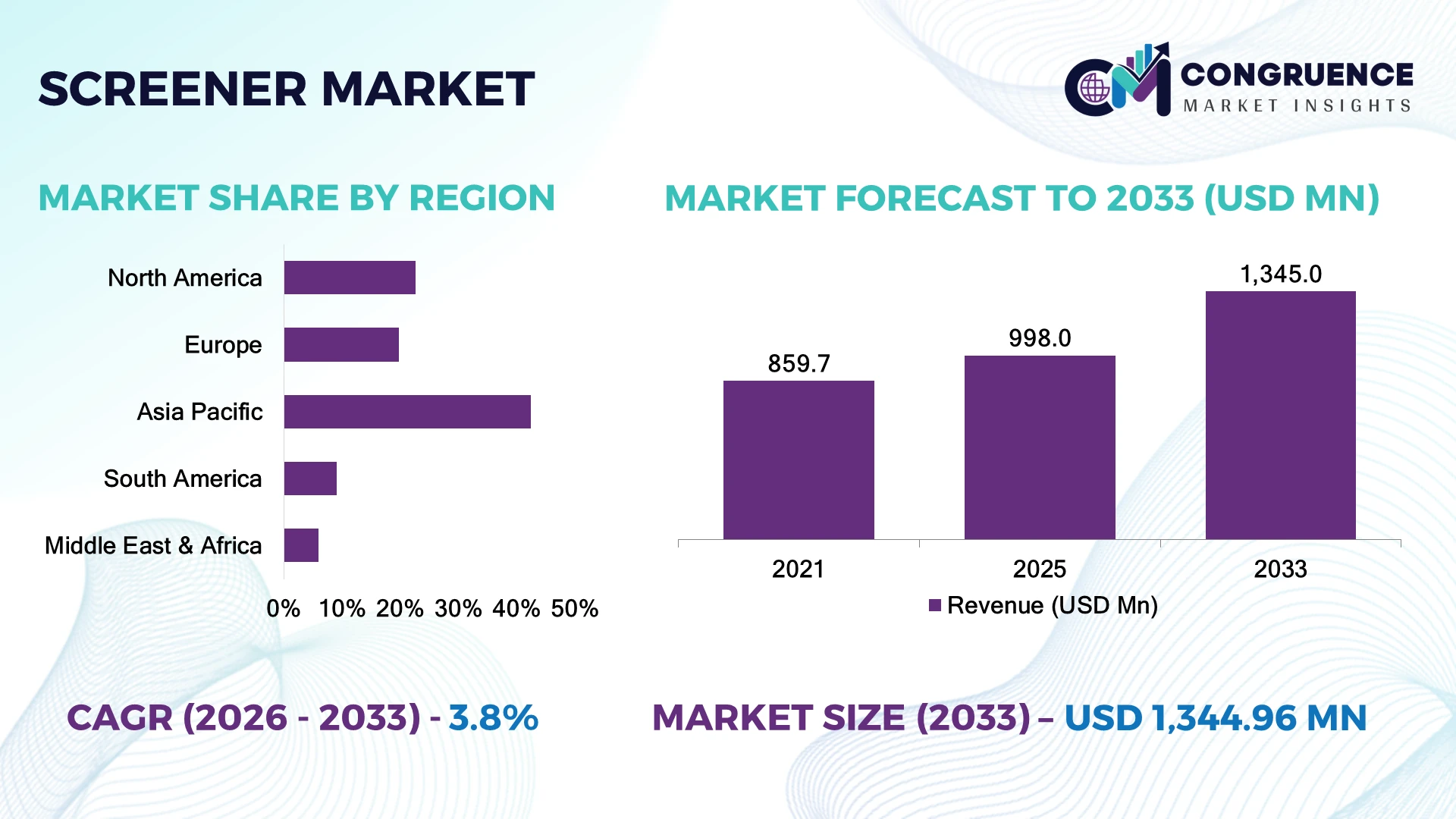
The Global Screener Market was valued at USD 998.0 Million in 2025 and is anticipated to reach a value of USD 1,345.0 Million by 2033 expanding at a CAGR of 3.8% between 2026 and 2033. Growth is driven by automation-led material separation, higher screening accuracy, and replacement of labor-intensive conventional screening equipment across mining, aggregates, recycling, and construction.
China held a dominant position with an estimated 29% market share in 2025, supported by large-scale mining, aggregates, and infrastructure activity, while India accounted for approximately 9%, driven by road construction and mineral processing investments. China’s automated screening adoption is estimated at nearly 38%, compared with about 24% in India. Geopolitical supply-chain realignment is accelerating localized equipment sourcing and component manufacturing.
Strategically, manufacturers should prioritize automated screening platforms and localized service networks in high-volume industrial markets.
Market Size & Growth: Market value reaches USD 1,345.0 Million by 2033 from USD 998.0 Million in 2025, at a 3.8% CAGR, supported by automated material separation and equipment modernization.
Top Growth Drivers: Automation contributes 38%, recycling adoption 31%, and infrastructure modernization 27% to major purchasing priorities.
Short-Term Forecast: By 2028, automated screening deployment is positioned to increase approximately 15%, while material-handling efficiency improves by nearly 12%.
Emerging Technologies: AI-assisted sorting, sensor-based screening, and advanced wear-resistant materials are reshaping equipment design, with predictive monitoring reducing unplanned stoppages by about 10%.
Regional Leaders: Asia-Pacific reaches approximately USD 560 Million, North America USD 355 Million, and Europe USD 285 Million by 2033, with digital controls and automated screening leading adoption.
Consumer/End-User Trends: Mining and aggregates users increasingly prioritize automated systems, with approximately 42% of large operators adopting remote monitoring capabilities.
Pilot/Case Example: A 2024 automated aggregate-screening deployment achieved approximately 14% higher throughput and 9% lower manual intervention, strengthening the business case for connected equipment.
Competitive Landscape: Leading manufacturers collectively command approximately 35% of the market, with Metso, Sandvik, Terex, Astec Industries, and McCloskey International competing through equipment efficiency, customization, service coverage, and product innovation.
Regulatory & ESG Impact: Recycling and emissions-control requirements are increasing demand for energy-efficient equipment, while approximately 18% lower energy consumption is targeted through optimized drive systems.
Investment & Funding: More than USD 1.2 Billion in cumulative industrial investment is supporting equipment modernization, manufacturing expansion, automation partnerships, and localized supply chains.
Innovation & Future Outlook: Next-generation electric drives, AI-enabled monitoring, modular screening decks, and predictive maintenance are shifting competition toward lifecycle efficiency rather than equipment price alone.
The Screener Market is increasingly concentrated around high-throughput mining, aggregates, construction, recycling, and waste-processing applications. Advanced screening systems are gaining traction where automated particle classification, modular deck configurations, and remote diagnostics improve operational consistency. Approximately 42% of large operators now prioritize connected monitoring capabilities, while supply-chain localization following geopolitical disruptions is encouraging regional component sourcing and service expansion, creating a stronger basis for strategic investment decisions.
The Screener Market is becoming strategically important because screening performance directly influences throughput, product quality, equipment utilization, and downstream processing costs. Mining operators in China, Australia, and India are increasing automation to stabilize production while infrastructure modernization expands demand for high-capacity aggregate processing. Over the next three years, connected screening installations are positioned to rise by roughly 15%, strengthening the role of digital equipment in operational planning.
Technology is creating a measurable advantage over legacy systems. Sensor-enabled screening and automated monitoring can improve material-handling efficiency by approximately 12% while reducing manual intervention by around 9%. North America emphasizes connected equipment and lifecycle services, whereas China prioritizes high-volume deployment and manufacturing scale. Europe is placing greater emphasis on energy efficiency and recycling integration.
A practical deployment model combines modular screening equipment with remote diagnostics, predictive maintenance, and centralized fleet monitoring. Manufacturers are responding through localized production, technology partnerships, aftermarket expansion, and integrated automation packages. The strategic priority is shifting from selling individual machines toward delivering measurable throughput, uptime, energy efficiency, and lifecycle performance.
Automation is becoming the primary structural driver as mining and aggregates operators seek consistent throughput with fewer manual interventions. Connected screening systems can improve processing efficiency by approximately 12%, while predictive monitoring can reduce unexpected stoppages by nearly 10%. China’s large mining and infrastructure operations are accelerating deployment of sensor-enabled equipment, while India is increasing investment in automated aggregate plants. Supply-chain restructuring is also encouraging manufacturers to localize controls, components, and aftermarket support. Companies are responding with AI-assisted monitoring, modular screening decks, remote diagnostics, and equipment-as-a-service models. The non-obvious advantage is lifecycle optimization: screening manufacturers that combine equipment with operational data can influence replacement cycles and secure higher-value aftermarket relationships.
Screening equipment remains exposed to volatility in steel, bearings, motors, electrical controls, and wear-resistant components. Raw-material and component costs can account for roughly 30%–40% of equipment manufacturing expenditure, while imported components can extend procurement cycles by 15%–20% during supply disruptions. India and Southeast Asian manufacturers face particular pressure where specialized components remain dependent on overseas suppliers. Geopolitical trade restrictions and logistics bottlenecks further complicate inventory planning. These conditions compress margins and delay equipment deployment for cost-sensitive operators. Manufacturers are reducing exposure through dual sourcing, localized fabrication, longer-term procurement contracts, and standardized component platforms. The strategic pressure point is not equipment availability alone but the ability to guarantee parts continuity throughout the machine lifecycle.
AI-assisted classification, sensor fusion, and predictive maintenance create an opportunity to move screening from standalone machinery toward intelligent processing infrastructure. Automated monitoring can deliver approximately 10%–15% higher equipment utilization, while optimized drive systems can reduce energy consumption by nearly 18%. Australia and India offer attractive deployment opportunities as mining modernization and infrastructure expansion increase demand for higher-throughput equipment. Recycling is another underpenetrated application, particularly where automated separation improves material recovery. Manufacturers are positioning through software partnerships, sensor integration, modular platforms, and digital aftermarket services. A distinctive opportunity lies in retrofitting existing screening fleets with monitoring systems rather than replacing complete machines, allowing operators to obtain measurable efficiency gains with substantially lower capital disruption.
The next challenge is integrating advanced screening equipment with existing crushing, conveying, sorting, and plant-control infrastructure. Approximately 25% of industrial operators still operate mixed fleets containing legacy and digitally enabled machinery, increasing interoperability complexity. Workforce capability is another constraint, with digitally controlled plants requiring technicians skilled in automation, sensors, diagnostics, and industrial software. Cybersecurity exposure also rises as connected equipment becomes integrated with centralized operational networks, requiring stronger access controls and system monitoring. Companies must invest in standardized communication protocols, technician training, cybersecurity architecture, and modular control systems. The operational priority is deployment consistency: advanced screening technology delivers limited value when plant-level integration, maintenance capability, and data infrastructure cannot support continuous utilization.
AI-Enabled Screening Control: AI-assisted monitoring is moving from pilot installations toward continuous plant operation, with connected systems targeting 10–15% higher equipment utilization and roughly 10% fewer unplanned stoppages. Mining operators in Australia and China are integrating sensor data with plant controls to adjust screening parameters faster. Equipment manufacturers are responding with predictive-maintenance platforms and remote diagnostics, shifting aftermarket competition toward uptime guarantees rather than replacement-part availability alone.
Mobile Equipment Deployment: Mobile and modular screeners are gaining traction as contractors seek faster relocation between quarry faces and construction sites. Mobile configurations can reduce setup requirements by approximately 20–30% and improve equipment utilization by around 15% across multi-site operations. India’s expanding infrastructure projects are strengthening this deployment model, while manufacturers are scaling tracked units, hybrid powertrains, and modular screening decks. The non-obvious shift is greater preference for fleet flexibility over maximum fixed-plant capacity.
Recycling-Led Workflow Changes: Recycling facilities are increasing automated screening as material recovery and circular-economy requirements tighten. Advanced screening configurations can improve material separation efficiency by approximately 12–18% while reducing manual sorting requirements by nearly 15%. Construction-and-demolition waste processors are increasingly pairing trommel and vibrating systems with conveyors and optical sorting. Companies are responding through integrated recycling lines and partnerships with waste-management operators, making screening accuracy increasingly important for recovered-material quality and resale value.
Localized Supply Chain Strategies: Equipment producers are restructuring procurement as geopolitical disruptions and component shortages expose dependence on imported motors, controls, bearings, and wear components. Local sourcing programs are targeting 15–20% shorter component lead times and approximately 10% lower logistics exposure. Manufacturers in India and China are expanding regional fabrication and service capabilities, while global suppliers are establishing dual-source procurement networks. This is changing purchasing decisions from lowest equipment price toward guaranteed parts availability and localized lifecycle support.
Vibrating screens remain the leading type, accounting for approximately 51.5% of the global screening-machine market in 2025. Their dominance reflects high throughput, adaptable deck configurations, and reliable separation across mining, aggregates, and recycling. Trommel screens represented about 16.2%, while gyratory screens accounted for approximately 14.4%, maintaining relevance where sticky, irregular, or specialized feed materials require alternative screening mechanics. Companies continue investing in vibrating-screen optimization because standardized components and broad aftermarket availability lower lifecycle complexity.
Trommel screens represent the fastest-growing type, supported by expanding waste-processing and material-recovery applications. Their rotating configuration improves handling of irregular feed and can reduce maintenance intervention by roughly 10–15% in suitable workflows. Vibrating systems remain the preferred choice for high-volume mineral processing, while trommels gain share in recycling and organic-material separation. Manufacturers are responding through modular drums, wear-resistant liners, and hybrid configurations, shifting investment toward application-specific equipment rather than one-size-fits-all screening platforms.
Mining and minerals represented approximately 45.5% of global screening-machine demand in 2025, reflecting the high-volume, abrasive operating conditions of mineral-processing plants. Aggregates and construction followed at about 27.6%, supported by roadbuilding and infrastructure activity. Mining operations prioritize throughput, particle-size consistency, and wear resistance, while construction users increasingly favor mobile systems that can move between project locations. Manufacturers are therefore strengthening heavy-duty product portfolios and expanding field-service coverage around major mining and quarrying hubs.
Recycling and waste management is the fastest-changing application, representing approximately 5.0% of the broader screening-machine mix while recording stronger adoption momentum than mature mineral-processing uses. Automated separation can increase usable-material recovery by approximately 12–18% and reduce manual sorting requirements by around 15%. Food and pharmaceuticals, at roughly 12.0%, continue emphasizing precision classification, while chemicals account for approximately 9.9% and favor controlled particle separation. Companies are expanding modular screening solutions and integrated processing lines as recycling regulations and material-recovery targets reshape plant investment.
Mining and quarrying companies represent the dominant end-user group, accounting for approximately 45% of screening-machine demand because their operations require continuous high-volume separation, abrasive-material handling, and strict particle-size control. Construction and infrastructure contractors represent roughly 28%, with purchasing increasingly centered on mobile and modular systems that can follow project locations. Municipal waste-management authorities account for approximately 12%, while other industrial users contribute the remaining demand. Manufacturers are responding with heavier-duty designs, customized screening decks, and stronger field-service networks.
Municipal waste-management authorities form the fastest-growing end-user group as recycling infrastructure expands and material-recovery requirements become more stringent. Automated screening can reduce manual sorting needs by nearly 15% and improve recoverable-material separation by approximately 12–18%. Mining buyers remain focused on uptime and wear life, whereas municipalities prioritize throughput, recovery efficiency, and environmental compliance. Companies are targeting this shift through partnerships with recycling operators, compact equipment configurations, service contracts, and integrated sorting systems. The competitive advantage is moving toward lifecycle support and measurable recovery performance rather than equipment specifications alone.
Asia-Pacific accounted for the largest market share at 42.4% in 2025 however, Asia-Pacific is expected to register the fastest growth, expanding at a CAGR of 8.4% between 2026 and 2033.
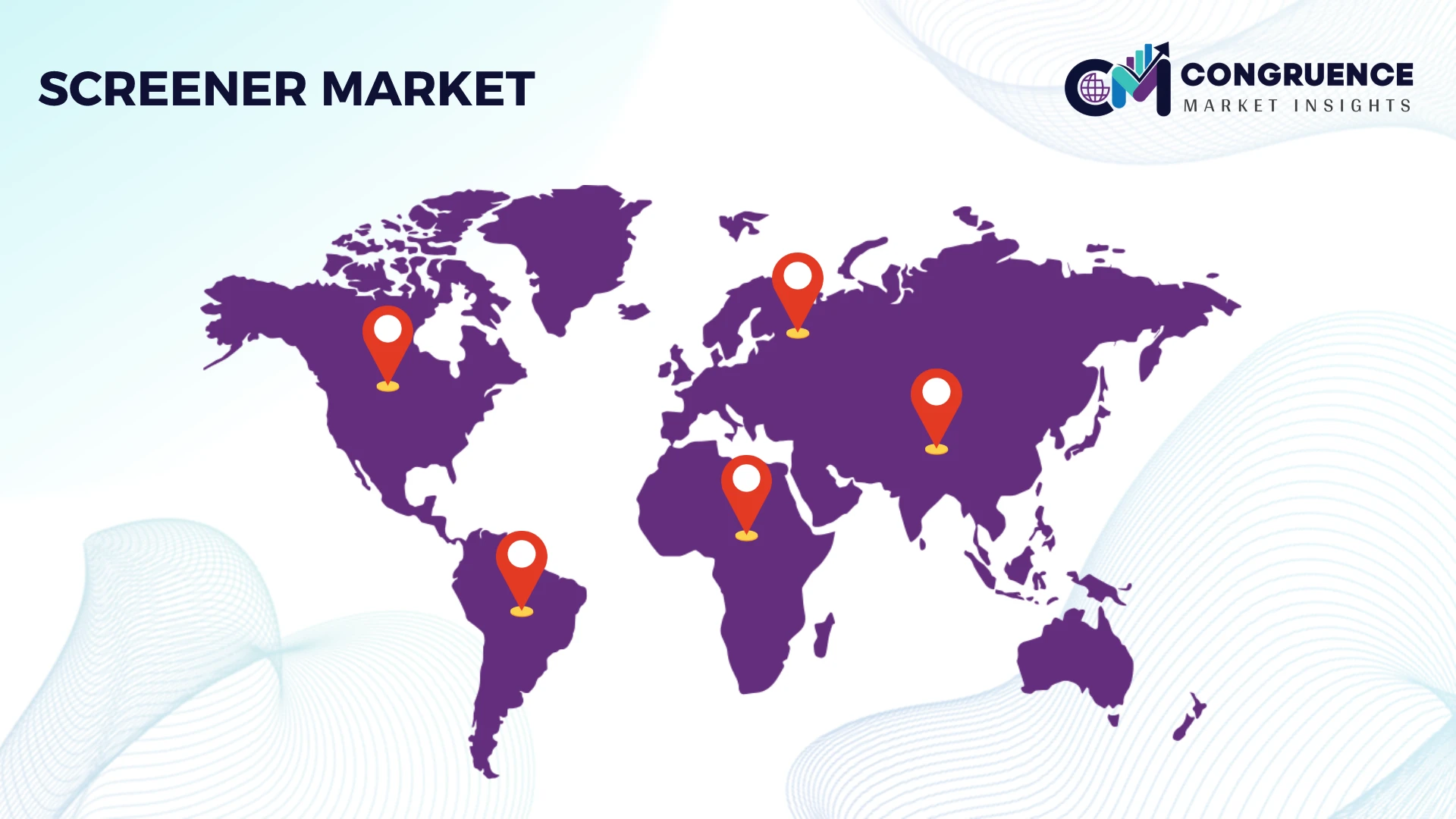
North America represents approximately 22.7% of global screener demand, supported by established aggregates, mining, recycling, and construction operations. The United States concentrates most regional deployment, with operators increasingly replacing aging stationary equipment with mobile, sensor-enabled systems. Infrastructure modernization and stricter dust, waste, and material-handling requirements are accelerating equipment upgrades. Automated monitoring is improving equipment utilization by roughly 10%–12%, while localized service networks reduce maintenance response times. Manufacturers are strengthening U.S. production, aftermarket coverage, and digital-monitoring partnerships to protect installed-base relationships. The key shift is toward lifecycle efficiency rather than first-cost purchasing, particularly among large quarry and mining operators.
United States Market Outlook: The United States remains the region’s most strategically significant market because of its large crushed-stone, sand-and-gravel, mining, and recycling base. Continued infrastructure spending supports replacement and expansion of screening fleets, while domestic manufacturing and established dealer networks improve equipment availability. Mobile screening and automated monitoring are gaining traction among contractors seeking faster deployment and higher utilization across multiple projects.
Europe contributes approximately 19.8% of global screening-system demand, with mature quarrying, construction, mining, and recycling industries sustaining replacement activity. Germany, France, Italy, and the United Kingdom are important deployment markets, while recycling infrastructure is increasingly influencing equipment specifications. Energy-efficient drives, dust suppression, low-noise operation, and automated material classification are becoming stronger purchasing criteria. Equipment modernization can reduce energy consumption by approximately 10%–18% in suitable operating configurations. Manufacturers are responding with electric and hybrid systems, modular screening platforms, and integrated recycling solutions. Regulatory pressure around waste recovery and environmental performance is shifting purchasing decisions toward measurable operating efficiency, creating stronger opportunities for suppliers with low-energy designs and comprehensive service packages.
Germany Market Outlook: Germany holds a strategically important position because of its advanced industrial machinery base, dense recycling infrastructure, and strong engineering ecosystem. The country’s screening-equipment market was estimated at approximately USD 0.39 billion in 2025, supported by automated screening adoption and investment in recycling facilities. Manufacturers benefit from demand for precision separation, energy-efficient drives, and durable equipment suited to high-utilization industrial environments.
Asia-Pacific held approximately 42.4% of the global screening-machine market in 2025, establishing the region as the dominant deployment center. China accounts for the largest country-level demand, while India is accelerating through road construction, mineral processing, quarrying, and urban infrastructure programs. Australia and Indonesia add substantial mining-driven demand. Regional buyers increasingly favor mobile systems, high-capacity vibrating equipment, and locally supported components. Equipment localization is reducing procurement lead times, while automation adoption is improving operational monitoring and fleet utilization. Manufacturers are expanding regional assembly, distributor networks, and technology partnerships to capture project-driven demand. The strategic advantage is scale: high equipment volumes allow suppliers to combine localized manufacturing with standardized platforms, reducing costs while maintaining application-specific configurations.
China Market Outlook: China is the region’s largest screening-equipment market, supported by extensive mining, aggregates production, industrial processing, and infrastructure construction. Domestic manufacturers increasingly integrate automation and digital controls into screening systems, strengthening price competitiveness while improving operational visibility. China’s large installed base also creates substantial aftermarket demand for screen media, wear components, retrofit controls, and maintenance services.
South America represents approximately 9.1% of global crushing and screening-system demand, with Brazil accounting for the largest share of regional activity. Mining, aggregates, cement, and infrastructure projects determine equipment purchasing cycles, creating strong demand for heavy-duty vibrating screens and mobile processing systems. Brazil’s iron-ore and aggregates operations require high-capacity equipment capable of continuous operation under abrasive conditions. Chile and Peru add mining-led demand, while infrastructure limitations and project financing can lengthen procurement cycles. Manufacturers are therefore emphasizing localized dealers, parts inventories, equipment leasing, and service partnerships. Mobile screening is gaining relevance because contractors can redeploy equipment across geographically dispersed projects, improving utilization by approximately 10%–15%. The strategic priority is service availability, as remote mine locations make downtime materially more expensive than equipment acquisition costs.
Brazil Market Outlook: Brazil is the most strategically significant South American market because of its large mining, aggregates, and construction base. Iron-ore production and quarrying activity support continuous demand for high-throughput screening systems, while infrastructure projects create additional requirements for mobile equipment. Suppliers with regional parts inventories and field-service capabilities are better positioned to address Brazil’s geographically dispersed operating sites and reduce equipment downtime.
The Middle East & Africa market accounts for roughly 6.0% of global crushing and screening-system demand, with activity concentrated around Saudi Arabia, the United Arab Emirates, South Africa, and major African mining markets. Quarrying, aggregates, gold, copper, iron ore, and infrastructure development are strengthening demand for robust screening equipment. Gulf construction programs favor mobile and high-capacity systems capable of rapid site deployment, while African mining operations prioritize durability and local maintenance support. Equipment suppliers are expanding distributor partnerships and regional parts inventories to reduce service delays. Hybrid and electric equipment is also gaining attention as operators seek lower fuel consumption and improved emissions performance. The strategic opportunity is strongest where infrastructure megaprojects and resource extraction overlap, creating sustained requirements for screening capacity rather than short-duration equipment purchases.
Saudi Arabia Market Outlook: Saudi Arabia is strategically important because large-scale infrastructure, quarrying, construction-material production, and economic-diversification projects are expanding demand for screening equipment. Buyers increasingly favor mobile and high-throughput systems that can support multiple construction sites and aggregate-processing operations. Suppliers with local partnerships, rapid parts availability, and equipment suited to hot, dusty operating environments hold a strong competitive advantage in the country.
Metso, Sandvik, Terex Finlay, Astec, and McCloskey compete as global OEMs, while regional manufacturers compete primarily on cost, customization, and service responsiveness. The top five players collectively command approximately 35% of the market, indicating a moderately fragmented structure. Competition centers on technology, with advanced screening systems improving throughput by up to 20%, while localized sourcing can reduce lead times by 15%–20%. Global OEMs are expanding through regional manufacturing, dealer partnerships, and integrated crushing-screening portfolios. Metso is strengthening China and African operations, Astec is widening Australian and European distribution, while McCloskey is expanding Indian dealer coverage. The competitive shift is moving from equipment price toward lifecycle productivity, automation, energy efficiency, and parts availability. High engineering requirements, installed-base relationships, dealer networks, and aftermarket capabilities remain major entry barriers. Winning requires differentiated screening technology, rapid service coverage, application-specific customization, and reliable component supply rather than low acquisition cost alone.
Metso Corporation
Sandvik AB
Terex Corporation
Astec Industries, Inc.
McCloskey International
KLEEMANN GmbH
thyssenkrupp AG
Haver & Boecker
FLSmidth
Weir Group PLC
Doppstadt
MEKA Global
TEMA ISENMANN
Anaconda Equipment
Advanced screening technology is shifting toward variable-motion decks, sensor-assisted monitoring, hybrid power, and predictive maintenance. Variable-frequency and elliptical-motion systems improve material flow while reducing blinding, with newer designs delivering throughput gains of up to 20% over conventional configurations. Connected monitoring can improve equipment utilization by approximately 10%–15%, giving operators faster visibility into vibration, loading, wear, and maintenance conditions. Adoption is strongest among large mining, aggregates, and recycling operators managing high-utilization fleets.
The key technology comparison is between conventional fixed-motion screens and adaptive screening systems. Adaptive motion can deliver approximately 20% higher throughput within the same footprint, reducing the need for plant expansion and lowering associated infrastructure requirements. Hybrid-electric systems are also gaining relevance where operators need lower fuel dependency and flexible grid or engine operation. Manufacturers benefit by differentiating equipment through measurable productivity rather than mechanical specifications alone.
Between 2026 and 2028, AI-assisted diagnostics, advanced screen media, remote monitoring, electrification, and integrated plant-control systems will increasingly converge. Digital connectivity is expected to expand across roughly 30%–40% of new high-end deployments as operators prioritize uptime and lifecycle economics. Technology leaders with integrated equipment, software, service, and aftermarket ecosystems will capture the strongest competitive advantage, while cost-focused manufacturers face increasing pressure to modernize their platforms.
June 2026 Metso launched ELL Series screens, delivering up to 20% higher throughput within the same footprint. The variable elliptical motion improves material movement and separation, helping European quarries increase output without plant expansion. Source: metso.com
April 2026 Terex Finlay launched TRAC Vibration Analysis for screening equipment, expanding digital monitoring capabilities. The system supports vibration analysis and equipment diagnostics, helping operators identify performance issues earlier and strengthen maintenance planning across mobile screening fleets. Source: terex.com
April 2026 Astec expanded European screening innovation with eight new solutions at Hillhead, including Vari-Frequency and Multi-Frequency screens. The portfolio expansion strengthens productivity-focused equipment deployment while broadening its European dealer-supported screening offering. Source: astecindustries.com
October 2025 McCloskey appointed Prime Equipment & Supply as an authorized Indian dealer, covering seven northeastern states. The partnership expands sales, service, and parts support, strengthening McCloskey’s local presence and accelerating access to mobile screening equipment. Source: mccloskeyinternational.com
The Screener Market Report covers screening equipment across major types, including vibrating screens, trommel screens, gyratory screens, and other specialized configurations. Application coverage includes mining and minerals, aggregates and construction, recycling and waste management, food and pharmaceuticals, chemicals, and related processing environments. End-user analysis evaluates mining and quarrying companies, construction and infrastructure contractors, municipal waste-management authorities, and other industrial buyers.
The report provides regional assessment across North America, Europe, Asia-Pacific, South America, and the Middle East & Africa, with country-level analysis emphasizing industrial deployment and investment patterns. Coverage also examines mobile and modular screening, automation, sensor-based monitoring, variable-motion technology, hybrid electrification, predictive maintenance, and advanced screening media. Strategic analysis evaluates competitive positioning, supply-chain localization, aftermarket opportunities, technology adoption, and deployment priorities, supporting investment planning, geographic expansion, partnership decisions, product development, and competitive strategy through 2033.
| Report Attribute / Metric Details | Details |
|---|---|
| Market Revenue (2025) | USD 998.0 Million |
| Market Revenue (2033) | USD 1,345.0 Million |
| CAGR (2026–2033) | 3.8% |
| Base Year | 2025 |
| Forecast Period | 2026–2033 |
| Historic Period | 2021–2025 |
| Segments Covered |
By Type
By Application
By End-User
|
| Key Deliverables | Revenue Forecast; Market Trends; Growth Drivers & Restraints; Technology Insights; Segmentation Analysis; Regional Insights; Competitive Landscape; Regulatory & ESG Overview; Recent Developments |
| Regions Covered | North America; Europe; Asia-Pacific; South America; Middle East & Africa |
| Companies Profiled | Metso Corporation; Sandvik AB; Terex Corporation; Astec Industries, Inc.; McCloskey International; KLEEMANN GmbH; thyssenkrupp AG; Haver & Boecker; FLSmidth; Weir Group PLC; Doppstadt; MEKA Global; TEMA ISENMANN; Anaconda Equipment |
| Customization & Pricing | Available on Request (10% Customization Free) |




