
Reports
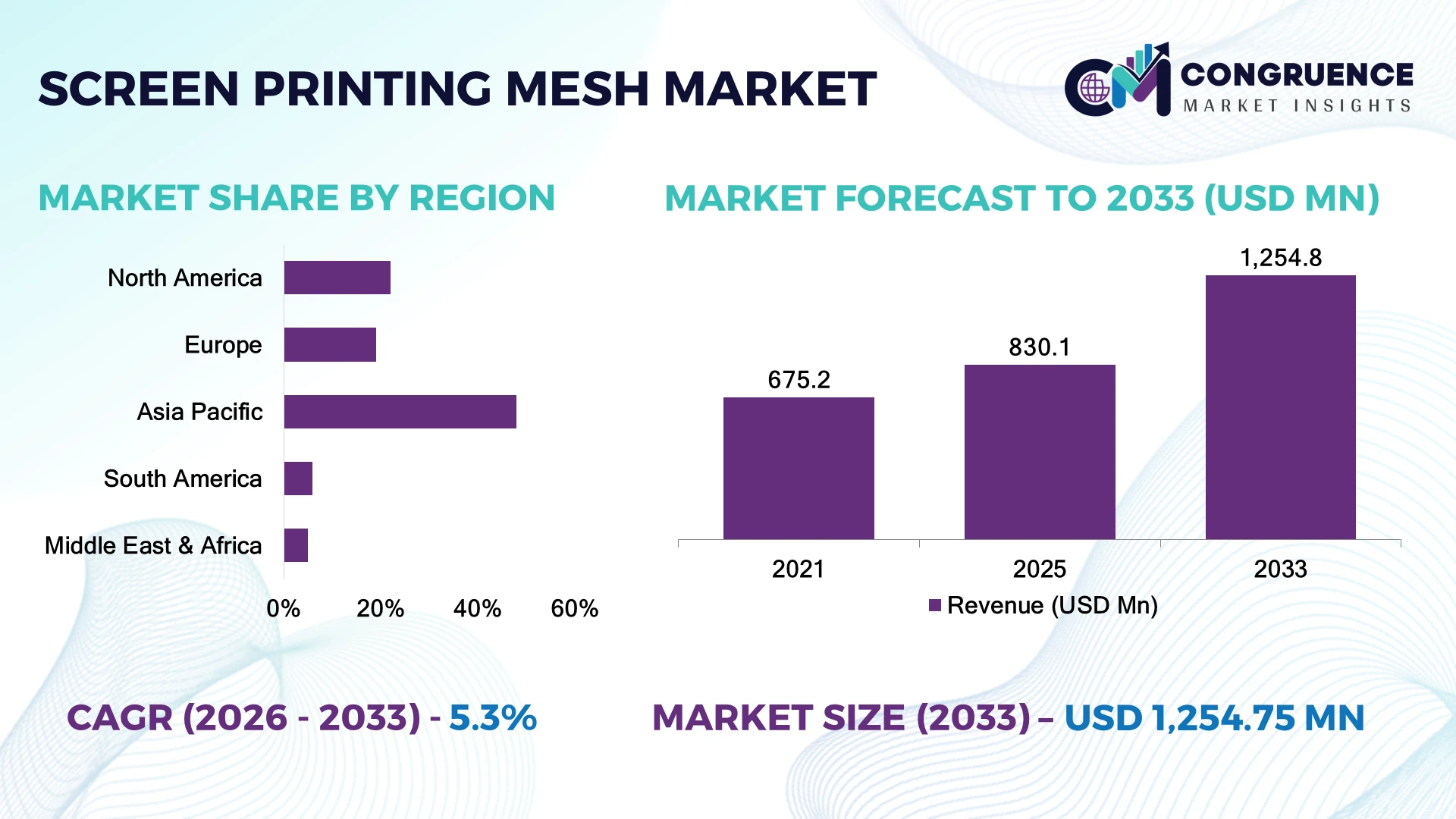
The Global Screen Printing Mesh Market was valued at USD 830.1 Million in 2025 and is anticipated to reach a value of USD 1,254.8 Million by 2033 expanding at a CAGR of 5.3% between 2026 and 2033. Growth is being driven by finer mesh adoption in electronics, photovoltaic metallization, high-resolution textile printing, and automated screen-production workflows.
China remains the dominant manufacturing hub, contributing an estimated 35%–40% of global screen-mesh production capacity, supported by extensive textile, electronics, packaging, and photovoltaic manufacturing. Japan emphasizes premium precision mesh, while China competes more aggressively on scale and cost. In 2025, ultra-fine solar printing screens reached openings near 17 micrometers, strengthening material-efficiency gains.
Strategically, suppliers with precision weaving, stable tension control, and localized production capacity are best positioned to capture high-value industrial applications.
Market Size & Growth: USD 830.1 million in 2025 to USD 1,254.8 million by 2033 at 5.3% CAGR, driven by precision electronics and photovoltaic printing.
Top Growth Drivers: Electronics printing 28%, textile printing 24%, photovoltaic applications 19%.
Short-Term Forecast: By 2028, automated screen preparation can reduce setup time 15%–20% and material waste 8%–12%.
Emerging Technologies: Ultra-fine mesh, computer-to-screen systems, automated tension control and AI-assisted inspection are improving registration and consistency.
Regional Leaders: Asia-Pacific estimated near USD 690 million by 2033; North America near USD 280 million; Europe near USD 240 million, with precision-printing adoption strengthening.
Consumer/End-User Trends: High-resolution industrial printing applications account for an estimated 35%+ of premium mesh demand.
Pilot/Case Example: 2025 photovoltaic research achieved 17-micrometer screen openings, supporting finer metallization and reduced silver consumption.
Competitive Landscape: NBC Meshtec leads the premium precision segment alongside SAATI, Nippon Tokushu Fabric, Asada Mesh and Maishi.
Regulatory & ESG Impact: Water-based and lower-chemical workflows can reduce screen-processing chemical consumption by approximately 10%–20%.
Investment & Funding: Manufacturers are prioritizing automated weaving, precision coating and regional converting capacity, with investments increasingly linked to electronics and solar supply chains.
Innovation & Future Outlook: 2026–2028 priorities center on ultra-fine mesh, digital screen imaging, automated inspection and higher-tension synthetic materials.
Screen printing mesh demand is concentrating on polyester and precision synthetic meshes for textiles, electronics, packaging, glass, ceramics, and photovoltaic applications. Polyester represents roughly 39% of market demand in current industry estimates, while ultra-fine mesh is gaining importance where line resolution and controlled ink deposition determine product performance. The 2025 shift toward finer solar metallization is pushing mesh producers toward tighter tolerances, improved dimensional stability, and lower-defect manufacturing.
Screen printing mesh is becoming strategically important because mesh geometry directly determines deposition accuracy, material consumption, throughput, and print repeatability. This is particularly significant in electronics and photovoltaic manufacturing, where micron-level pattern control influences yield. The shift toward finer conductive lines is encouraging manufacturers to invest in precision weaving, advanced coatings, automated tensioning, and computer-to-screen workflows rather than competing solely on mesh price.
Technology differentiation is becoming measurable. Ultra-fine screens can support openings around 17 micrometers, compared with substantially coarser conventional configurations, enabling tighter metallization patterns and more controlled material deposition. In textile printing, established screen processes retain an advantage in high-volume production, while electronics and solar applications increasingly reward precision-oriented mesh suppliers. Asia-Pacific remains manufacturing-intensive, whereas Japan and Europe emphasize high-specification materials and process consistency.
During 2026–2028, adoption of automated inspection, digital screen imaging, optimized thread geometries, and higher-tension synthetic meshes will strengthen productivity and reduce setup variation. Suppliers are therefore expanding precision capacity and partnering with printing-equipment and materials companies. The strategic advantage will shift toward manufacturers that combine consistent mesh performance, application engineering, rapid customization, and reliable supply.
The shift toward finer-resolution printing is strengthening demand for high-tension polyester and stainless-steel screen printing mesh across electronics, photovoltaics, and functional graphics. Electronics and photovoltaic applications together represent an estimated 30%–35% of premium mesh consumption, while automated screen preparation can improve registration consistency by 10%–15%. China’s expansion of solar-cell manufacturing and continued electronics capacity additions are accelerating demand for tighter mesh tolerances. Manufacturers are responding with ultra-fine weaving, improved calendaring, and automated tension-control systems. The strategic shift is significant: suppliers achieving tighter aperture uniformity can command premium pricing while reducing replacement frequency and print defects for high-volume industrial customers.
Polyester resin, stainless-steel wire, energy, and specialty coating costs remain structural constraints, particularly for precision mesh requiring narrow dimensional tolerances. Raw-material and processing costs can account for roughly 45%–60% of manufacturing expenditure, while premium ultra-fine mesh can carry 20%–35% higher production costs than conventional grades. Asian manufacturers also face freight and inventory volatility when serving European and North American converters. These pressures directly compress margins where buyers negotiate primarily on unit price. Producers are mitigating exposure through multi-country sourcing, longer-term polymer and wire contracts, localized finishing, and higher automation. The non-obvious pressure point is yield: a small increase in weaving defects can disproportionately raise cost per saleable mesh panel.
The strongest opportunity is the migration toward ultra-fine mesh for photovoltaic metallization, printed electronics, semiconductor packaging, and precision glass applications. Mesh openings below 20 micrometers can support finer conductive patterns, while automated inspection can reduce quality-related rejection by an estimated 15%–20%. India, Vietnam, and Southeast Asia offer additional opportunities as electronics and photovoltaic supply chains diversify beyond established Chinese production clusters. Manufacturers are investing in advanced weaving equipment, precision coatings, and application-specific mesh geometries rather than expanding commodity capacity alone. The emerging strategic advantage lies in engineering services: suppliers that jointly optimize mesh, emulsion, ink, and squeegee parameters can capture higher-margin contracts and deepen customer integration.
Screen printing mesh performance increasingly depends on integration with digital imaging, automated tensioning, ink rheology, and high-speed printing systems, creating execution complexity for suppliers serving diverse equipment platforms. Advanced industrial lines can require tension stability within approximately 5% of specified operating levels, while dimensional variation above 10% can increase registration corrections and production interruptions. Skilled technicians remain important for mesh selection, stretching, coating, and process calibration, particularly in precision electronics applications. Companies are addressing this challenge through automated tension measurement, machine-vision inspection, standardized application protocols, and partnerships with printing-equipment manufacturers. Long-term competitiveness will depend less on mesh availability and more on maintaining repeatable performance across different substrates, inks, temperatures, and production speeds.
Ultra-Fine Mesh Gains Ground — Photovoltaic and printed-electronics producers are shifting toward mesh openings below 20 micrometers, with precision applications representing an estimated 30%–35% of premium demand. The transition improves line definition and material deposition control, encouraging manufacturers to expand fine-wire weaving and tighter aperture inspection.
Automation Reshapes Quality Control — Automated tension measurement, machine vision, and digital screen preparation are increasingly integrated into production workflows, improving registration consistency by approximately 10%–15% and reducing manual inspection requirements by 15%–20%. Suppliers are upgrading converting lines as labor availability and quality-control requirements tighten.
Synthetic Mesh Improves Process Stability — High-tension polyester and engineered synthetic meshes are gaining preference where dimensional stability and repeatability outweigh basic material cost. Premium synthetic grades can deliver 8%–12% longer usable cycles in demanding applications, prompting producers to develop coated and application-specific mesh structures.
Supply Chains Move Closer — Electronics and solar manufacturing diversification is increasing demand for localized mesh converting and finishing, particularly across India and Southeast Asia. Regional processing can reduce replenishment lead times by 15%–25%, encouraging suppliers to establish local inventory, technical support, and application-engineering partnerships rather than relying exclusively on centralized exports.
Polyester Mesh Leadership and Precision-Mesh Expansion
Polyester screen printing mesh is the leading type, accounting for an estimated 58%–62% of global demand because of its cost efficiency, broad mesh-count availability, chemical resistance, and suitability for high-volume textile and packaging workflows. Nylon mesh represents approximately 15%–18% of demand and remains relevant where elasticity, conformability, and impact tolerance are prioritized. Polyester therefore retains the strongest position in mature applications, while nylon serves specialized production requirements. Manufacturers are improving monofilament consistency, dimensional stability, and tension retention to defend polyester’s cost advantage while developing application-specific grades.
Stainless steel mesh is the fastest-growing type, with an estimated 18%–22% share, driven by photovoltaic metallization, PCB fabrication, touch interfaces, and functional-ink printing. Its low elongation and high tensile strength support finer patterns and repeatable deposition. Premium stainless-steel grades command higher prices, but customers increasingly prioritize process stability and longer service life. Companies are expanding fine-wire weaving, precision coating, and technical partnerships, shifting investment toward higher-value industrial mesh rather than commodity capacity.
Industry-backed insight: In 2025–2026, finer photovoltaic and electronics patterns increasingly favored stainless-steel mesh because its high tensile strength supports tighter dimensional control and precision conductive printing.
Textile Printing Leadership Meets Electronics Precision
Textile printing remains the leading application, representing an estimated 42%–46% of global screen printing mesh demand due to established flat-screen and rotary-screen workflows, high production volumes, and recurring mesh replacement. Packaging and industrial graphics collectively account for approximately 25%–30%, supported by durable labels, decorative finishes, and specialty substrates. Mature textile applications remain cost-focused, favoring polyester mesh, whereas industrial customers increasingly evaluate aperture uniformity, tension retention, and print repeatability. Suppliers are responding with customized mesh counts, faster preparation workflows, and application-specific surface treatments.
Electronics and photovoltaic printing represent the fastest-growing application cluster, with combined demand estimated at 20%–24%. PCB fabrication, membrane switches, touch interfaces, and solar metallization require finer apertures and controlled paste deposition than conventional textile printing. Photovoltaic manufacturing is accelerating adoption of stainless-steel and ultra-fine mesh, while glass and ceramic printing remain specialized niches. Companies are expanding precision production and integrating mesh engineering with printing equipment, inks, and screen-preparation processes. The business implication is a shift from volume-led purchasing toward performance-led procurement.
Industry-backed insight: During 2025–2026, photovoltaic metallization increasingly emphasized fine-line screen printing and tighter mesh tolerances, strengthening demand for precision mesh configurations capable of controlled conductive-paste deposition.
Industrial Precision Buyers Gain Strategic Weight
Commercial and textile printers remain the dominant end-user group, accounting for approximately 48%–52% of global demand because of large production volumes, recurring screen replacement, and established polyester-based workflows. Their procurement remains highly price-sensitive, with availability and replacement economics influencing purchasing decisions. Industrial manufacturers display a different buying pattern, prioritizing tension stability, aperture consistency, and defect reduction. This divergence is pushing suppliers to maintain competitive commodity grades while developing premium mesh portfolios for specification-driven customers. Approximately 22%–26% of demand is now associated with higher-precision industrial applications, strengthening the value of technical customization.
Electronics and photovoltaic manufacturers form the fastest-growing end-user group, supported by increasingly demanding conductive, dielectric, and metallization printing requirements. Their purchasing decisions emphasize repeatability and process yield rather than minimum unit cost. Automotive, glass, ceramic, and packaging producers maintain specialized requirements, creating opportunities for application-specific mesh development. Suppliers are responding through localized inventories, technical support, co-development programs, and partnerships with printing-equipment manufacturers. The strategic shift favors companies capable of translating mesh specifications into measurable production improvements across different substrates, inks, and printing speeds.
Industry-backed insight: 2025–2026 industrial printing assessments continued to identify stainless-steel mesh as a preferred solution for PCB, solar-cell, and functional-ink applications where high tensile strength and low elongation support dimensional accuracy.
Asia-Pacific accounted for the largest market share at 48% in 2025 however, North America is expected to register the fastest growth, expanding at a CAGR of 6.1% between 2026 and 2033.
Precision Electronics and Domestic Solar Manufacturing Reshape Demand
North America represents approximately 22% of global screen printing mesh demand, supported by electronics, automotive components, specialty packaging, glass decoration, and photovoltaic manufacturing. The United States dominates regional consumption, with precision stainless-steel and high-tension polyester mesh increasingly preferred for functional printing and high-resolution applications. Domestic photovoltaic manufacturing investment is strengthening demand for fine-mesh screens, while reshoring initiatives are reducing reliance on imported production inputs. U.S. photovoltaic manufacturing capital expenditure is projected to reach approximately USD 7 billion in 2027, reinforcing the region’s requirement for precision metallization tooling. Suppliers are responding through localized inventory, technical support, and partnerships with electronics and solar manufacturers. The key business shift is toward application-engineered mesh rather than commodity grades.
United States Market Outlook: The United States remains the region’s most strategically significant market because of its advanced electronics ecosystem, expanding solar manufacturing base, and high-value industrial printing requirements. Domestic photovoltaic capacity expansion is increasing demand for fine stainless-steel mesh capable of tighter metallization patterns. More than 90% of projected 2027 U.S. crystalline-silicon photovoltaic manufacturing capital expenditure is expected to target the silicon value chain, strengthening the need for precision production inputs and localized technical support.
Precision Engineering and Sustainable Screen Processing
Europe accounts for an estimated 19% of global screen printing mesh demand, with Germany, Italy, France, and the United Kingdom supporting strong industrial printing, electronics, automotive, packaging, and specialty-glass applications. Demand is shifting toward high-tension stainless-steel and engineered polyester mesh as manufacturers pursue finer conductive patterns and tighter registration. European research and industrial development is advancing digitally structured fine-mesh screens, with laser systems demonstrating openings as small as 2 micrometers for photovoltaic and semiconductor applications. Suppliers are therefore prioritizing precision weaving, digital screen preparation, and chemical-reduction technologies. The region’s competitive advantage increasingly rests on engineering performance rather than low-cost production.
Germany Market Outlook: Germany leads European demand through its concentration of industrial automation, automotive electronics, photovoltaic technology, machinery, and precision manufacturing. Its advanced equipment ecosystem supports rapid integration of fine-mesh screens with automated imaging and inspection systems. Recent European development programs have demonstrated laser structuring of fine-mesh screens at approximately 2-micrometer opening widths, creating opportunities for suppliers serving semiconductor, optoelectronics, and high-efficiency solar applications.
Manufacturing Scale Drives High-Volume Mesh Consumption
Asia-Pacific holds the largest position with approximately 48% of global screen printing mesh demand, supported by China, Japan, South Korea, India, Taiwan, and Southeast Asia. China combines extensive textile and packaging production with major electronics and photovoltaic manufacturing capacity, while Japan and South Korea concentrate more heavily on precision applications. The region’s manufacturing concentration creates substantial recurring demand for polyester mesh, alongside increasing stainless-steel consumption for functional printing. China remains the principal production hub, while India and Southeast Asia are expanding as electronics and manufacturing supply chains diversify. Suppliers are increasing local inventories, fine-mesh production, and technical service capabilities to reduce lead times and capture higher-value industrial orders.
China Market Outlook: China remains the most strategically significant country because its textile, electronics, photovoltaic, packaging, and industrial-printing ecosystems generate demand across commodity and precision mesh grades. Its manufacturing scale supports competitive polyester production, while solar-cell and electronics facilities increasingly require stainless-steel fine-mesh configurations. The country’s position across multiple downstream industries enables suppliers to balance high-volume orders with premium precision applications, making localized production and rapid customization important competitive advantages.
Textile and Packaging Demand Supports Regional Expansion
South America represents an estimated 6%–7% of global screen printing mesh demand, with Brazil accounting for the largest share through its textile, packaging, promotional-printing, ceramics, and industrial manufacturing base. Screen printing remains particularly relevant in Brazil’s textile sector, where high-volume production supports recurring polyester-mesh replacement. Demand for specialized mesh is also increasing in packaging and decorative applications, although local conversion and precision-mesh availability remain less developed than in Asia-Pacific. Suppliers are strengthening distributor networks, maintaining regional inventories, and targeting industrial customers with application-specific mesh grades. Brazil’s textile-printing market generated approximately USD 1.7 billion in 2025, reinforcing the commercial importance of screen-based production.
Brazil Market Outlook: Brazil is the region’s strongest market because of its diversified textile and packaging manufacturing base and established screen-printing infrastructure. Screen printing remained the largest printing-technology segment within Brazil’s textile-printing industry in 2025, supporting recurring demand for polyester mesh. Suppliers with domestic distribution, rapid replacement capability, and technical assistance have an advantage because imported precision mesh can create longer replenishment cycles and higher working-capital requirements for printers.
Packaging Localization and Industrial Diversification Reshape Demand
Middle East & Africa contributes approximately 5%–6% of global screen printing mesh demand, with the UAE, Saudi Arabia, South Africa, and Egypt representing the principal consumption centers. Packaging, commercial printing, textiles, glass decoration, and industrial labeling are the strongest applications, while Gulf manufacturing diversification is creating new requirements for localized printing inputs. Dubai is strengthening its packaging-manufacturing infrastructure through a USD 50 million integrated manufacturing and logistics hub scheduled for full operations in 2028, adding up to 30,000 tonnes of annual packaging capacity. Suppliers are positioning through regional warehousing, distributor partnerships, and application support, reducing dependence on long-distance imports and improving fulfillment speed.
United Arab Emirates Market Outlook: The UAE leads the region in advanced printing and packaging infrastructure because of its logistics connectivity, industrial-zone development, and concentration of packaging, hospitality, retail, and consumer-product manufacturing. The planned AED 180 million packaging hub in Dubai will integrate manufacturing, warehousing, robotics-enabled fulfillment, and distribution across more than 678,000 square feet. This strengthens the commercial case for locally stocked screen printing mesh and faster technical servicing for packaging converters.
The market pits Sefar, SAATI, NBC Meshtec, Haver & Boecker, and Asada Mesh against cost-focused Asian suppliers such as MAISHI and producers. The top five players command an estimated 38% share, leaving a fragmented field where premium engineering competes with price-led volume. Technology influences 35% of purchasing decisions in precision electronics and photovoltaic applications, while supply reliability influences about 30%. Customization and rapid delivery increasingly determine contracts, particularly for fine stainless-steel meshes. Sefar and SAATI emphasize engineered polyester, specialty coatings, and technical support; NBC Meshtec competes through metal and synthetic mesh breadth, while Haver & Boecker differentiates with high-strength stainless-steel grades. Asian producers are expanding capacity and distribution to pressure pricing by 8%–12%. Competition is shifting toward finer tolerances, application-specific mesh, and vertically integrated process support. Entry barriers remain high in precision weaving, tension control, quality certification, and customer qualification. Winning requires dependable supply, measurable print performance, and faster customization.
Sefar AG
SAATI S.p.A.
NBC Meshtec Inc.
Asada Mesh Co., Ltd.
Haver & Boecker OHG
BOPP GmbH
Nippon Tokushu Fabric Inc.
MAISHI Wire Mesh Mfg. Co., Ltd.
MITANI MICRO Co., Ltd.
Fratelli Mariani S.p.A.
Weisse & Eschrich GmbH & Co. KG
Hebei Anping Printing Screen Co., Ltd.
Precision polyester, stainless-steel mesh, and engineered surface treatments are defining current screen printing technology. High-modulus, low-elongation polyester improves registration stability, while fine stainless-steel mesh supports photovoltaic and electronics metallization. Haver & Boecker’s high-strength TBC mesh delivers 30% higher strength than standard grades, and SAATI’s 420 t/inch HiLo configuration targets microscopic printed features. These designs typically improve process repeatability by 8%–15% versus conventional mesh in high-precision workflows, strengthening yield and reducing screen replacement.
Computer-to-screen (CTS), automated tension measurement, digital inspection, and AI-assisted press optimization are moving mesh preparation from operator judgment toward parameter-controlled production. CTS adoption can reduce screen-preparation material and operating costs by 10%–20%, while automated inspection cuts setup-related defects by approximately 15%. Sefar, SAATI, and NBC Meshtec benefit from this shift because their engineered meshes integrate more effectively with controlled stencil workflows and production environments.
Between 2026 and 2028, nano-surface treatments, thinner-wire stainless steel, low-elongation polymers, and closed-loop tension monitoring will become more important. Adoption of automated screen preparation is positioned to exceed 40% among large industrial printers, where consistency matters more than lowest unit price. Suppliers that combine mesh engineering with digital process data will capture premium contracts, while commodity producers face margin pressure and shorter qualification cycles.
September 2025 SAATI launched LTS E70B at Printing United, combining precision hardware with AI-driven software for textile screen printing. The launch targets faster setup and controlled quality, strengthening SAATI’s position in automated workflows and premium mesh-linked production systems. Source: saati.com (Saati)
February 2025 Sefar showcased advanced screen-printing mesh and accessories for flexible, organic, and printed electronics at LOPEC in Munich. The company emphasized precision, durability, and production efficiency, reinforcing fine-mesh demand as electronics manufacturers pursue tighter process tolerances commercially. Source: linkedin.com (LinkedIn)
March 2025 NBC Meshtec updated its Asada BS metal mesh specification, delivering 25% higher tensile strength than conventional stainless-steel mesh. The product targets fine-line and thin-deposit MLCC printing, improving dimensional stability and directly supporting higher-precision electronics manufacturing requirements. Source: nbcmeshtec.com (NBC Meshtec)
May 2024 Qcells tested Lumet’s metallization technology, replacing conventional screen-printing steps with patterned silver films. The process targets thinner silver fingers and lower production costs, while Qcells’ USD 2.5 billion Georgia supply-chain investment strengthens U.S. solar manufacturing competitiveness.
The Screen Printing Mesh Market Report evaluates demand across polyester, nylon, and stainless-steel mesh, with analysis of standard, high-tension, fine-detail, and application-engineered grades. Coverage spans textile printing, graphics, packaging, glass and ceramic decoration, electronics, photovoltaic metallization, and other functional-printing applications. The report assesses procurement priorities including mesh count, tensile strength, open area, dimensional stability, service life, and customization.
Regional analysis covers North America, Europe, Asia-Pacific, South America, and Middle East & Africa, with country-level assessment of manufacturing concentration, industrial printing capacity, electronics production, and solar-cell deployment. The study profiles major producers and evaluates competitive positioning, technology adoption, supply-chain localization, and product innovation. It supports investment planning, capacity expansion, distributor strategy, portfolio prioritization, and competitive positioning through 2026–2033, while identifying premium niches where precision mesh commands stronger margins.
| Report Attribute/Metric | Report Details |
|---|---|
|
Market Revenue in 2025 |
USD 830.1 Million |
|
Market Revenue in 2033 |
USD 1,254.8 Million |
|
CAGR (2026 - 2033) |
5.3% |
|
Base Year |
2025 |
|
Forecast Period |
2026 - 2033 |
|
Historic Period |
2021 - 2025 |
|
Segments Covered |
By Type
By Application
By End-User
|
|
Key Report Deliverable |
Revenue Forecast, Growth Trends, Market Dynamics, Segmental Overview, Regional and Country-wise Analysis, Competition Landscape |
|
Region Covered |
North America, Europe, Asia-Pacific, South America, Middle East, Africa |
|
Key Players Analyzed |
Sefar AG, SAATI S.p.A., NBC Meshtec Inc., Asada Mesh Co., Ltd., Haver & Boecker OHG, BOPP GmbH, Nippon Tokushu Fabric Inc., MAISHI Wire Mesh Mfg. Co., Ltd., MITANI MICRO Co., Ltd., Fratelli Mariani S.p.A., Weisse & Eschrich GmbH & Co. KG, Hebei Anping Printing Screen Co., Ltd. |
|
Customization & Pricing |
Available on Request (10% Customization is Free) |




