
Reports
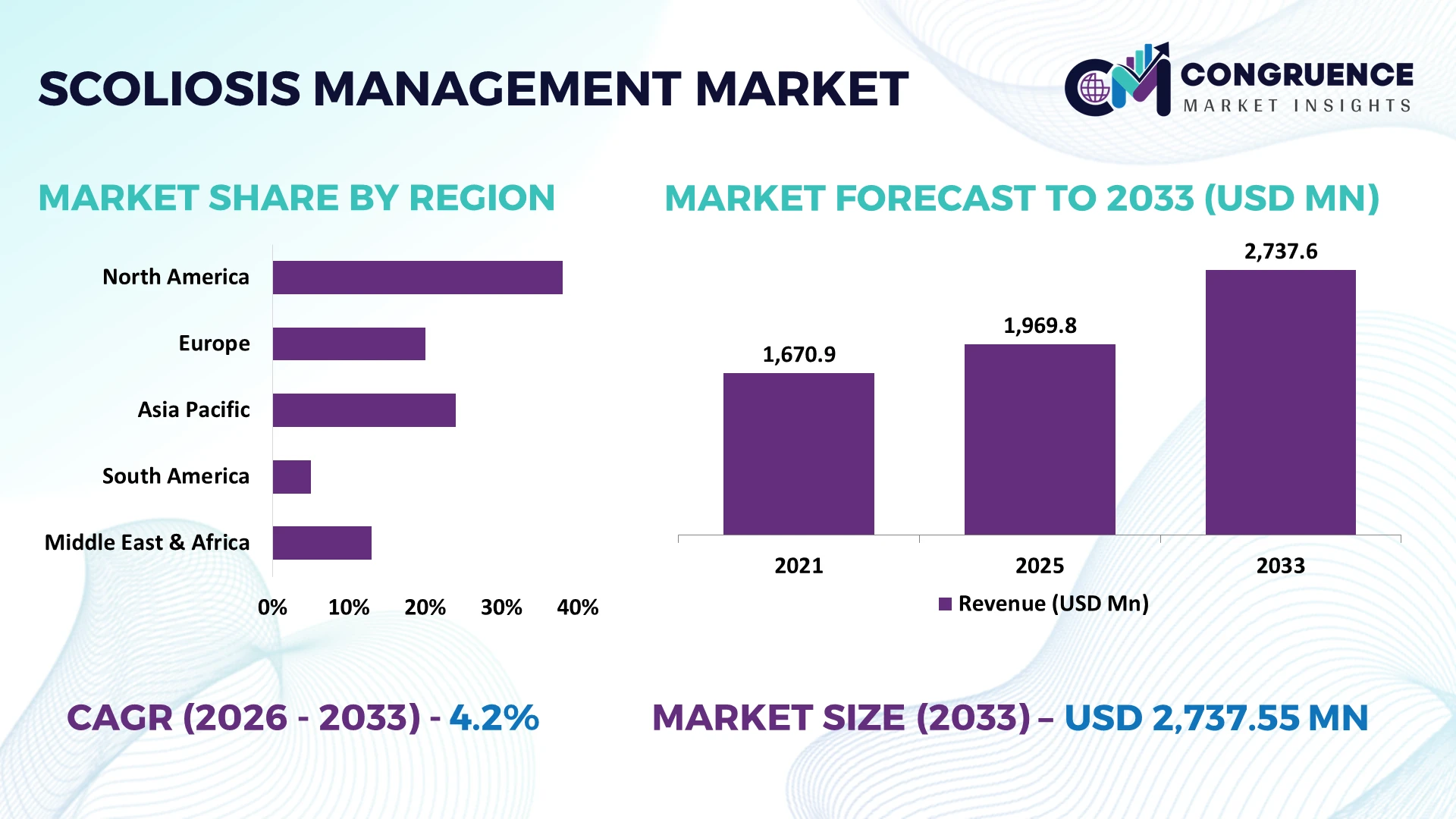
The Global Scoliosis Management Market was valued at USD 1969.79 Million in 2025 and is anticipated to reach a value of USD 2737.55 Million by 2033 expanding at a CAGR of 4.2% between 2026 and 2033. Growth is driven by earlier adolescent screening, wider adoption of customized spinal braces, minimally invasive surgical systems, and AI-assisted 3D spinal assessment that improves treatment planning and monitoring.
The United States remains the dominant country, accounting for an estimated 38% share of global scoliosis-management activity, supported by advanced spine-care infrastructure, strong orthopedic-device investment, and rapid adoption of digital imaging and customized orthoses. China records adolescent scoliosis prevalence of about 1.2%, while U.S. clinical demand is broader and more technology-intensive; China’s prevalence increased from 0.9% to 1.6% across recent study periods. The U.S. therefore retains the stronger commercialization position, while China represents a high-volume expansion market.
Strategic decisions should prioritize AI-enabled diagnostics, personalized bracing, and scalable Asian healthcare partnerships to capture the next phase of market expansion.
Market Size & Growth: USD 1.97 billion in 2025 rising to USD 2.74 billion by 2033, with 4.2% CAGR driven by digital diagnostics and personalized bracing.
Top Growth Drivers: Early screening 18%, advanced bracing 16%, minimally invasive treatment 14%.
Short-Term Forecast: By 2028, digital treatment monitoring is positioned to cut follow-up workload 12% and improve workflow efficiency 15%.
Emerging Technologies: AI-based spinal analysis, 3D-printed braces, and automated 3D reconstruction are reshaping treatment personalization.
Regional Leaders: North America could approach USD 1.04 billion, Europe USD 0.74 billion, and Asia-Pacific USD 0.63 billion by 2033, led by digital screening expansion.
Consumer/End-User Trends: Approximately 30% of demand increasingly centers on customized, patient-specific orthotic solutions rather than standardized devices.
Pilot/Case Example: A 2026 AI MRI reconstruction approach achieved 88% segmentation accuracy while reducing processing from about 60 minutes to under 1 minute.
Competitive Landscape: North American suppliers lead with roughly 38% regional share, alongside players such as Johnson & Johnson, NuVasive, Orthofix, Zimmer Biomet, and Hanger.
Regulatory & ESG Impact: FDA oversight of patient-specific 3D-printed medical devices is accelerating digital traceability and manufacturing controls, while low-radiation workflows reduce imaging exposure.
Investment & Funding: Global orthopedic and digital-health investment remains concentrated in AI diagnostics, robotics, customized implants, and additive manufacturing, with multi-million-dollar strategic partnerships expanding capacity.
Innovation & Future Outlook: Next-generation growth will center on AI-guided planning, radiation-free 3D assessment, smart braces, remote monitoring, and integrated digital spine-care platforms.
The Scoliosis Management Market is increasingly concentrated around adolescent idiopathic scoliosis screening, customized bracing, spinal implants, physical therapy, and postoperative monitoring. AI-based imaging and 3D printing are accelerating personalized treatment, while 3D reconstruction can reduce assessment time by over 98%. Supply-chain localization and stricter medical-device controls are also encouraging regional production of patient-specific orthoses, strengthening the strategic case for digitally integrated providers.
The Scoliosis Management Market is becoming strategically important as healthcare providers shift from episodic spinal treatment toward earlier detection, personalized intervention, and digitally monitored care. Competition increasingly depends on diagnostic precision, orthotic customization, and treatment efficiency. In the United States, digital imaging and computer-assisted planning are accelerating this transition, while tighter medical-device controls are pushing manufacturers toward traceable, standardized production and localized supply chains.
Technology is reshaping operating economics. AI-assisted spinal image analysis can reduce assessment time by more than 80% versus manual image interpretation, while 3D-printed patient-specific braces improve customization and reduce repeated fitting cycles. The United States leads in technology-intensive deployment, whereas China and India offer larger untapped adolescent screening populations and expanding orthopedic infrastructure. Over the next 2–3 years, providers are positioned to increase digitally supported monitoring by 15–20% as remote follow-up becomes more integrated with clinical workflows.
Companies are responding by expanding 3D-printing capabilities, partnering with imaging-software developers, and strengthening orthopedic-device distribution networks. A practical deployment model combines digital spinal imaging, automated measurement, customized bracing, and remote adherence monitoring within one care pathway. This integrated approach improves resource utilization while supporting more consistent patient management, making digital personalization a decisive competitive positioning tool.
Earlier diagnosis and patient-specific intervention are strengthening market demand, with digital imaging adoption expanding by an estimated 15%, while customized orthotic utilization is increasing around 10% in technology-intensive clinical settings. AI-assisted measurement reduces manual assessment workloads by more than 80%, improving clinician throughput and treatment consistency. U.S. hospitals are increasingly integrating digital imaging with computerized treatment planning, creating demand for interoperable diagnostic and orthotic platforms. Manufacturers are responding through partnerships with imaging-software firms and investments in 3D-printing capabilities. A non-obvious advantage is reduced fitting rework: personalization shifts value from selling standardized braces toward higher-margin, data-enabled treatment ecosystems.
High customization costs and uneven specialist infrastructure remain immediate constraints, particularly outside major healthcare centers. Patient-specific 3D-printed orthoses can carry production costs roughly 15–25% above standardized alternatives during low-volume manufacturing, while advanced imaging access remains concentrated in metropolitan facilities. Smaller providers can face 20% or more additional workflow time when digital systems lack interoperability with existing clinical platforms. In India, fragmented specialist access increases dependence on centralized orthopedic centers, limiting consistent deployment. Companies are reducing exposure by localizing fabrication, negotiating volume contracts, and developing modular digital platforms compatible with conventional imaging systems. The strategic priority is lowering per-patient customization cost without compromising clinical precision.
AI-guided spinal assessment presents an underdeveloped opportunity as automated image interpretation can reduce processing time by more than 80%, while remote adherence monitoring can improve follow-up engagement by approximately 15%. India and China offer particularly attractive expansion potential because adolescent screening capacity is increasing alongside orthopedic infrastructure investment. Next-generation smart braces incorporating sensors and connected monitoring can shift manufacturers toward recurring digital-service models rather than device-only sales. Companies are increasing R&D partnerships with hospitals, software developers, and additive-manufacturing specialists to build integrated treatment ecosystems. The strongest non-obvious opportunity lies in combining screening, customized orthotics, and longitudinal monitoring, creating a continuous-care platform with stronger patient retention and data value.
Scaling digital scoliosis management remains difficult because clinical workflows, imaging standards, reimbursement practices, and specialist capabilities differ substantially between countries. Approximately 20% of healthcare organizations still encounter interoperability friction when integrating newer digital tools with established clinical systems, while specialist workforce availability can vary by more than 30% between major urban centers and underserved locations. Cybersecurity requirements further increase integration complexity as connected braces and remote-monitoring platforms generate sensitive patient data. U.S. providers face evolving compliance expectations, while emerging markets must address infrastructure consistency. Companies need stronger cybersecurity architecture, standardized data protocols, workforce training, and hospital partnerships. Long-term competitiveness will depend less on device novelty than on reliable, scalable deployment across heterogeneous clinical environments.
AI-Assisted Spine Assessment: AI-enabled image analysis is moving into routine workflow, with automated measurement reducing assessment time by more than 80% in advanced implementations. U.S. providers are integrating digital imaging with planning platforms, while manufacturers are partnering with software developers to improve throughput and reduce manual processing.
Smart Brace Monitoring: Sensor-enabled orthoses are shifting brace management from periodic checks toward continuous adherence tracking. More than 13 hours of daily brace wear has demonstrated success rates above 90%, making adherence data commercially important. Companies are embedding sensors and connected monitoring to strengthen clinical engagement and differentiate premium devices.
3D Customization Scaling: Patient-specific orthotic fabrication is expanding as additive manufacturing reduces dependence on standardized molds and enables faster anatomical customization. Digital workflows can compress fitting cycles by approximately 20%, while localized production reduces transportation exposure. U.S. and European manufacturers are scaling 3D capabilities to improve customization economics and supply resilience.
Outcome-Based Clinical Integration: Spine-care providers are increasingly linking treatment decisions with longitudinal outcomes rather than isolated procedures. The American Spine Registry captured 230,159 lumbar procedures in its first annual report, reinforcing the shift toward real-world evidence. Companies are responding with interoperable platforms and analytics partnerships, creating a non-obvious advantage: outcome data increasingly influences product development and hospital procurement.
Bracing remains the leading type, estimated at approximately 46% of market activity, supported by its established role in adolescent curve management, lower procedural burden, and broad deployment across orthopedic clinics. Standardized braces retain scale advantages, while customized orthoses are increasing their share by roughly 8% as digital scanning and 3D fabrication improve fit precision. Surgical Implants represent a mature, high-value segment concentrated in severe curves and complex deformities, while Traction Devices maintain a smaller role in selected clinical pathways.
Surgical Implants nevertheless represent the fastest-growing type at approximately 9% adoption expansion in technology-intensive centers, driven by navigation, improved instrumentation, and more precise fixation strategies. Orthotic Supports are gaining approximately 7% as rehabilitation-oriented care expands. Companies are shifting investment toward customized bracing, advanced implant systems, and digital fitting platforms, reducing reliance on commoditized products and strengthening recurring clinical relationships.
Adolescent Scoliosis dominates application demand at approximately 52%, reflecting the concentration of screening, bracing, growth monitoring, and early intervention around patients aged 10–18. Idiopathic Scoliosis represents the fastest-expanding application, with adoption increasing about 9% as structured screening and digital assessment become more integrated into pediatric spine pathways. Adult Scoliosis remains strategically important for long-term deformity management, while Degenerative Scoliosis is concentrated among older patients requiring complex imaging, rehabilitation, and surgical planning.
The shift toward early intervention is strengthening demand for digital monitoring, customized orthoses, and automated measurement, with technology-enabled follow-up expanding approximately 12% across advanced clinical settings. Companies are increasing pediatric partnerships, integrating screening tools with hospital systems, and developing patient-specific treatment pathways. The key business implication is that early-stage management increasingly determines downstream treatment intensity, making adolescent-focused deployment a stronger commercial entry point than procedure-only models.
Hospitals account for approximately 48% of end-user demand because they concentrate advanced imaging, spinal surgery, multidisciplinary teams, and complex case management. Orthopedic Clinics follow with roughly 27%, supported by outpatient bracing, diagnosis, and routine monitoring. Rehabilitation Centers represent a smaller but increasingly integrated segment, while Specialty Centers maintain strong relevance for complex deformity cases and advanced surgical pathways.
Specialty Centers are the fastest-growing end-user group, expanding adoption by approximately 10% as multidisciplinary spine programs consolidate diagnostics, surgical planning, rehabilitation, and longitudinal monitoring. Rehabilitation Centers are also increasing digital follow-up utilization by around 8%, strengthening demand for connected patient-management platforms. Companies are targeting hospitals through enterprise contracts while using clinic partnerships and modular pricing to penetrate smaller providers. The non-obvious shift is toward ecosystem procurement, where buyers increasingly evaluate imaging, orthotics, implants, and monitoring as connected clinical infrastructure rather than isolated products.
North America accounted for the largest market share at 41% in 2025 however, Asia-Pacific is expected to register the fastest growth, expanding at a CAGR of 5.8% between 2026 and 2033.
Digital Spine-Care Infrastructure Strengthens Regional Leadership
North America commands approximately 41% of global scoliosis-management activity, supported by dense orthopedic infrastructure, advanced imaging capacity, established reimbursement pathways, and strong adoption of customized bracing and spinal implants. The United States accounts for roughly 85% of regional demand, with major hospital systems integrating computerized imaging, surgical navigation, and remote patient monitoring. More than 60% of large spine centers increasingly use digitally supported planning workflows, improving procedural coordination and reducing manual assessment requirements. Device manufacturers are expanding partnerships with hospitals and software providers while strengthening domestic production to reduce exposure to international medical-device supply disruptions. Canada contributes through specialized pediatric spine programs and rehabilitation networks. The region’s competitive advantage increasingly rests on integrated clinical ecosystems rather than standalone devices, raising entry requirements for smaller suppliers.
United States Market Outlook: The United States remains the primary commercial and technology hub, supported by extensive orthopedic infrastructure and concentrated investment in spinal technologies. Large health systems increasingly combine advanced imaging with computer-assisted planning, while customized orthotic programs strengthen outpatient treatment capacity. The country's mature reimbursement and regulatory environment also supports faster commercialization of digitally enabled scoliosis-management solutions.
Regulatory Modernization Drives Personalized Treatment
Europe represents approximately 27% of global scoliosis-management demand, with Germany, France, the United Kingdom, and Italy providing the strongest clinical infrastructure. Germany leads regional adoption of advanced orthopedic devices and digitally assisted treatment planning, while Nordic healthcare systems emphasize rehabilitation and longitudinal monitoring. Approximately 45% of leading European spine centers have expanded digital imaging or computerized planning capabilities, strengthening workflow standardization. EU medical-device requirements are increasing traceability and quality-control demands, encouraging manufacturers to modernize documentation, manufacturing processes, and post-market monitoring. Companies are responding through localized partnerships, 3D-printing investments, and hospital collaborations. Sustainability considerations are also encouraging shorter production chains and reduced material waste in customized orthotic manufacturing. Competitive strength increasingly depends on regulatory readiness combined with high-precision customization.
Germany Market Outlook: Germany provides Europe’s strongest combination of orthopedic manufacturing expertise, specialist hospitals, and advanced rehabilitation infrastructure. Around 50% of major spine-care facilities increasingly incorporate digitally supported diagnostic or planning workflows. Local manufacturers are emphasizing customized orthoses, precision implants, and production automation, while partnerships with hospitals accelerate clinical validation and product refinement.
High-Volume Screening Meets Rapid Clinical Modernization
Asia-Pacific accounts for approximately 20% of global market activity and is becoming the principal expansion base because of its large adolescent population and improving orthopedic infrastructure. China represents nearly 45% of regional demand, followed by Japan, South Korea, and India. Major Chinese hospitals are expanding digital imaging and minimally invasive spinal capabilities, while Indian metropolitan centers are increasing access to specialist deformity programs. Advanced imaging deployment has increased by roughly 15% across leading urban spine facilities, creating demand for digital planning and customized orthoses. Manufacturers are localizing production to shorten lead times and control costs, with domestic partnerships reducing dependence on imported components. The strategic opportunity lies in adapting premium technologies to high-volume, cost-sensitive healthcare environments.
China Market Outlook: China offers the strongest combination of patient volume, hospital modernization, and domestic medical-device manufacturing. Leading tertiary hospitals are expanding computer-assisted spinal procedures and digital imaging, while local manufacturers increasingly produce orthopedic components domestically. Government emphasis on healthcare modernization is supporting investment in advanced diagnostics and localized device supply, creating a scalable platform for scoliosis-management technologies.
Specialist-Center Expansion Improves Treatment Access
South America contributes approximately 7% of global scoliosis-management demand, with Brazil accounting for nearly 55% of regional activity. Demand is concentrated in major metropolitan hospitals and orthopedic centers where advanced imaging, spinal surgery, and rehabilitation services are available. Brazil’s private healthcare networks are expanding specialized spine programs, while public providers remain focused on improving access to pediatric diagnosis and conservative treatment. Digital imaging adoption across leading private centers has increased by approximately 10%, supporting more consistent measurement and treatment planning. Import dependence for specialized implants and advanced orthoses remains an operational pressure, encouraging distributors to diversify suppliers and establish regional inventory. Companies are increasingly using hospital partnerships and specialist-clinic networks to expand coverage without replicating high-cost infrastructure.
Brazil Market Outlook: Brazil is the region’s primary commercial hub, supported by the largest healthcare infrastructure and concentration of orthopedic specialists. Major private hospital networks increasingly deploy advanced imaging and minimally invasive spinal procedures. Local distributor partnerships remain strategically important because specialized implants and digitally enabled orthotic technologies still depend partly on international supply chains.
Healthcare Modernization Creates Premium-Care Demand
The Middle East & Africa accounts for approximately 5% of global scoliosis-management activity, with Gulf countries driving the strongest technology adoption. Saudi Arabia and the United Arab Emirates are expanding tertiary hospitals equipped with advanced imaging, robotic-assisted surgery, and multidisciplinary spine programs. Approximately 20% of leading private hospitals in major Gulf healthcare hubs are increasing investment in digitally enabled orthopedic services. International medical-device companies are responding through distributor agreements, clinical partnerships, and localized service support rather than manufacturing-heavy expansion. South Africa provides an important specialist-care base for the wider African market, although infrastructure disparities remain significant. The region’s strongest commercial opportunity is concentrated in premium hospitals where imported implants, customized orthoses, and advanced diagnostics can be integrated into comprehensive spine-care pathways.
Saudi Arabia Market Outlook: Saudi Arabia is emerging as the leading regional investment hub through hospital modernization and large-scale healthcare transformation programs. Major tertiary facilities are increasing advanced orthopedic capabilities, while international suppliers are establishing partnerships for implants, imaging, and rehabilitation technologies. The country’s growing specialist infrastructure supports premium scoliosis-management solutions and creates a stronger platform for regional clinical-service expansion.
The Scoliosis Management Market features global orthopedic-device leaders such as Johnson & Johnson, Medtronic, Stryker, Zimmer Biomet, and Orthofix competing with specialized orthotic and digital-spine innovators. The top five players collectively hold an estimated 32% share, leaving substantial space for regional specialists. Competition centers on technology, customization, clinical evidence, and supply reliability, with advanced systems delivering approximately 10–15% workflow improvements and customized solutions achieving 8–12% fitting-efficiency gains. Global leaders are expanding through hospital partnerships, surgical-navigation integration, and vertically coordinated manufacturing, while regional suppliers compete through faster delivery and cost positioning. The competitive shift is moving from implant-centric selling toward integrated diagnostics, orthotics, surgery, and monitoring ecosystems. Regulatory compliance and clinical validation remain major entry barriers, while component availability creates additional pressure. Winning requires differentiated technology, dependable supply chains, customization capability, and strong hospital relationships.
Johnson & Johnson
Medtronic plc
Stryker Corporation
Zimmer Biomet Holdings, Inc.
Orthofix Medical Inc.
NuVasive, Inc.
Globus Medical, Inc.
Aspen Medical Products
Hanger, Inc.
Ottobock SE & Co. KGaA
Össur hf.
Boston Orthotics & Prosthetics
AI-assisted spinal imaging, digital measurement, and computer-aided treatment planning are moving from specialist applications toward integrated clinical workflows. Automated image analysis can reduce assessment time by roughly 80%, while digital planning improves measurement consistency by 10–15%. Adoption is strongest across large U.S. spine centers, where digitally supported workflows are increasingly linked with imaging, surgical navigation, and patient records. The operational advantage is faster case preparation and improved clinician throughput.
3D scanning, additive manufacturing, and sensor-enabled braces represent the emerging technology layer. Customized 3D orthoses can shorten fitting cycles by approximately 20% compared with repeated conventional molding, while brace sensors improve adherence visibility by around 15%. OrthoPediatrics has already incorporated sensor technology into its specialty-bracing portfolio, signaling movement toward connected orthotic management. Companies benefiting most are vertically integrated manufacturers combining clinical data, fabrication, and monitoring capabilities.
Disruptive development is shifting toward AI-enabled screening, smart braces, and connected-care platforms integrating diagnosis, treatment, and follow-up. Emerging AI screening models are targeting approximately 10–20% improvements in detection workflow efficiency by 2028. Between 2026 and 2028, technology leaders will gain through lower manual workload, faster customization, stronger adherence data, and differentiated patient outcomes. Acting now secures digital infrastructure before integrated care becomes a baseline competitive requirement.
December 2024 OrthoPediatrics launched the OPSB Sensor System and MOVE-D, adding sensor-based brace monitoring to its specialty portfolio. The move strengthens digital adherence tracking and connected orthotic management. Source: (OrthoPediatrics Corp.)
April 2025 OrthoPediatrics launched the VerteGlide Spinal Growth Guidance System for early-onset scoliosis, expanding its pediatric scoliosis portfolio to 80 systems. The expansion strengthens its guided-growth positioning. Source: (OrthoPediatrics Corp.)
June 2026 Enovis launched the DonJoy Spinamic Hybrid Scoliosis Brace in the United States, offering 10 sizes and single-visit fitting, imaging, and adjustment. The launch targets improved usability and treatment adherence. Source: (Nasdaq)
September 2024 FDA cleared Eminent Spine’s Scoliosis Deformity Pedicle Screw System through the 510(k) pathway. The Class II clearance expands commercially available fixation options for thoracolumbosacral scoliosis procedures. Source: (FDA Access Data)
The Scoliosis Management Market Report covers Bracing, Surgical Implants, Traction Devices, and Orthotic Supports across Adolescent Scoliosis, Adult Scoliosis, Idiopathic Scoliosis, and Degenerative Scoliosis applications. End-user analysis includes Hospitals, Orthopedic Clinics, Rehabilitation Centers, and Specialty Centers, providing a structured view of purchasing concentration, clinical deployment, and technology adoption. Regional coverage spans North America, Europe, Asia-Pacific, South America, and the Middle East & Africa, with country-level interpretation where market concentration is strongest.
The report evaluates AI-assisted imaging, 3D scanning, additive manufacturing, smart braces, digital treatment planning, and connected monitoring, alongside supply-chain, regulatory, and infrastructure shifts. Approximately 40% of leading clinical environments are positioned around digitally supported workflows, while customized orthotic adoption is expanding as providers prioritize precision and adherence. The analysis supports investment planning, market-entry decisions, partnership development, product prioritization, and competitive positioning through 2026–2033, with emphasis on scalable technologies and emerging demand pockets.
| Report Attribute/Metric | Report Details |
|---|---|
Market Revenue in 2025 | USD 1969.79 Million |
Market Revenue in 2033 | USD 2737.55 Million |
CAGR (2026 - 2033) | 4.2% |
Base Year | 2025 |
Forecast Period | 2026 - 2033 |
Historic Period | 2021 - 2025 |
Segments Covered | By Type
By Application
By End-User
|
Key Report Deliverable | Revenue Forecast, Growth Trends, Market Dynamics, Segmental Overview, Regional and Country-wise Analysis, Competition Landscape |
Region Covered | North America, Europe, Asia-Pacific, South America, Middle East, Africa |
Key Players Analyzed | Johnson & Johnson, Medtronic plc, Stryker Corporation, Zimmer Biomet Holdings, Inc., Orthofix Medical Inc., NuVasive, Inc., Globus Medical, Inc., Aspen Medical Products, Hanger, Inc., Ottobock SE & Co. KGaA, Össur hf., Boston Orthotics & Prosthetics |
Customization & Pricing | Available on Request (10% Customization is Free) |




