
Reports
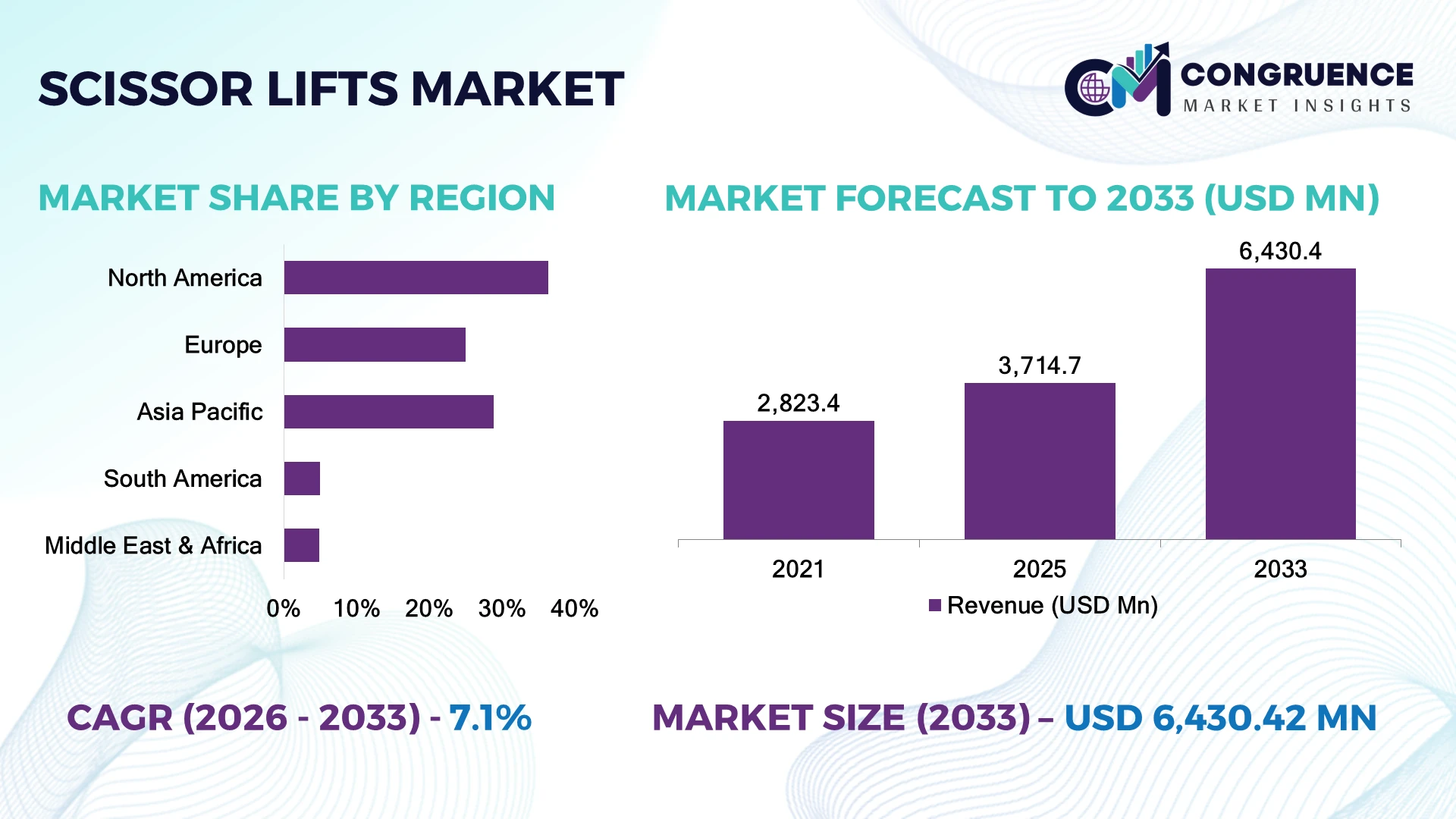
The Global Scissor Lifts Market was valued at USD 3,714.7 Million in 2025 and is anticipated to reach a value of USD 6,430.4 Million by 2033 expanding at a CAGR of 7.1% between 2026 and 2033. Growth is being accelerated by fleet electrification, warehouse automation, infrastructure modernization, and rental-led replacement of aging access equipment.
The U.S. remains the dominant country, accounting for about 82% of North American scissor lift demand and USD 1.34 billion in 2025, supported by construction, infrastructure, warehousing, and mature rental channels; roughly 90–95% of North American slab units enter rental fleets. India is expanding faster from a smaller base as infrastructure spending and industrial modernization increase electric-equipment adoption, while China strengthens manufacturing and export capacity.
Strategic implication: prioritize electric, telematics-enabled fleets and localized service capacity in North America while building scalable distribution in Asia-Pacific.
Market Size & Growth: USD 3.71 billion in 2025 to USD 6.43 billion by 2033 at 7.1% CAGR, driven by electrification, rental replacement, and warehouse expansion.
Top Growth Drivers: Electric adoption 68.7%; rental penetration 90–95%; construction application 48.2%, reinforcing high-growth fleet modernization.
Short-Term Forecast: By 2028, automated fleet monitoring and lithium platforms target 10–15% higher utilization and 20–30% lower maintenance intervention.
Emerging Technologies: Lithium-ion power, AI-enabled telematics, regenerative drive systems, and compact micro-lifts are reshaping productivity, diagnostics, and indoor deployment.
Regional Leaders: North America approaches USD 2.3 billion; Asia-Pacific about USD 1.9 billion; Europe about USD 1.5 billion, with electrification and rental adoption leading regional fleet upgrades.
Consumer/End-User Trends: Construction represents 48.2% of demand, while indoor/slab machines reach 53%, reflecting warehouse, manufacturing, and facility-maintenance usage.
Pilot/Case Example: 2025 Haulotte electric-platform engineering increased working height 25% and loading capacity 50%, demonstrating performance gains alongside powertrain electrification.
Competitive Landscape: JLG leads at about 15% share; Genie, Skyjack, Haulotte, and MEC follow, with the top five near 46%, sustaining a moderately concentrated market.
Regulatory & ESG Impact: Electric models represented roughly 69% of 2024 market revenue, as zero-emission indoor operation and tighter air-quality requirements reshape procurement.
Investment & Funding: More than USD 2 trillion in U.S. construction spending supports equipment renewal, while rental fleets prioritize electric replacements and telematics partnerships.
Innovation & Future Outlook: 2026–2028 competition shifts toward lithium platforms, predictive maintenance, compact designs, and digitally managed fleets, making uptime and lifecycle economics decisive.
The Scissor Lifts Market is concentrating demand around construction, warehousing, industrial maintenance, and indoor fit-outs, where electric platforms combine zero point-of-use emissions with lower noise. Electric models already represent about 69% of market revenue, while rental fleets increasingly favor connected machines. Supply-chain localization and tighter emissions expectations are accelerating procurement decisions toward serviceable, standardized platforms.
Scissor lifts are becoming strategic assets because access-equipment productivity now affects project schedules, labor utilization, safety compliance, and fleet economics. North America’s mature rental ecosystem drives replacement cycles, while Asia-Pacific combines infrastructure expansion with manufacturing localization. This creates a competitive split between premium connected equipment and cost-focused regional platforms, particularly for high-volume construction and industrial maintenance.
Technology is changing the investment equation. Advanced electric architectures can reduce energy consumption by 35–50% versus conventional hydraulic configurations, while lithium-ion systems support faster opportunity charging and higher availability. By 2028, fleet operators are prioritizing telematics, battery-health monitoring, and predictive maintenance to raise utilization rather than simply expanding unit counts across established rental networks.
Deployment is increasingly application-specific: warehouses favor compact slab lifts, while construction projects require rough-terrain capacity. In 2025, North American sales were approximately 95% slab models and 90–95% rental-directed, reinforcing rental partnerships. Companies are directing capital toward electric fleets, regional service hubs, and digital fleet-management alliances. Competitive advantage will come from uptime, lifecycle cost, compliance readiness, and application-fit, with procurement increasingly based on total operating performance.
Electrification is the strongest structural driver, with electric scissor lifts representing roughly 69% of market revenue and indoor applications accounting for more than 50% of deployment. In the U.S., rental operators are accelerating replacement of diesel units as warehouses and construction sites prioritize low-noise, zero-emission equipment. Lithium-ion platforms can reduce charging-related downtime by approximately 20–30% versus conventional battery workflows. Manufacturers are responding with higher-capacity batteries, opportunity-charging systems, and connected fleet controls. The non-obvious advantage is utilization: quieter electric machines expand operating windows inside occupied facilities, allowing rental companies to extract more productive hours from the same fleet.
Battery systems, electronic controllers, hydraulic components, and specialized access-control systems increase acquisition and maintenance costs, particularly for compact electric platforms. Lithium battery packs can represent approximately 20–30% of equipment value, while imported electronic components expose Indian and Southeast Asian assemblers to currency and logistics volatility. Component shortages can extend procurement cycles by 10–20% and delay fleet deployment. Manufacturers are reducing exposure through multi-source procurement, localized assembly, and standardized battery architectures. A key operational constraint is that component commonality directly affects rental-fleet maintenance: platforms using interchangeable controllers, chargers, and batteries can reduce service complexity by roughly 15–25%, making modular design an increasingly important purchasing criterion.
Telematics creates an underdeveloped opportunity to monetize utilization rather than equipment volume. Connected scissor lifts can transmit battery health, operating hours, fault codes, location, and impact events, enabling rental operators to target approximately 10–15% higher fleet utilization and 15–20% faster preventive-maintenance response. In the U.K. and Germany, tighter equipment documentation and workplace-safety requirements strengthen the value of machine-level records. Manufacturers are integrating remote diagnostics, geofencing, and digital service platforms through equipment-software partnerships. The strategic opportunity extends beyond hardware sales: predictive maintenance subscriptions and utilization analytics can create recurring service relationships while helping rental companies identify underperforming assets before committing capital to fleet expansion.
Advanced scissor lifts increasingly combine CAN-bus electronics, lithium battery management, proportional controls, telematics, and hydraulic systems, raising service complexity. Electronic faults can account for roughly 20–30% of unplanned troubleshooting activity on technology-intensive fleets, while technician shortages in markets such as the U.S. can lengthen specialized service response by 10–15%. Manufacturers must expand remote diagnostics, technician certification, and regional parts inventories to protect uptime. Cybersecurity is also becoming relevant as connected machines exchange operational data with fleet platforms. The long-term competitive issue is therefore not machine capability alone but service-system scalability: companies with standardized diagnostics and trained dealer networks will sustain higher availability as connected equipment penetration increases.
Lithium Platforms Reshape Fleet Mix: Lithium-ion scissor lifts are gaining preference as operators target 20–30% lower charging-related downtime and 15–25% longer productive shifts. U.S. rental fleets are prioritizing opportunity charging and maintenance-light electric platforms, while manufacturers are standardizing battery interfaces to simplify multi-brand fleet servicing and accelerate replacement cycles.
Compact Models Enter Data Centers: Data-center construction is increasing demand for narrow electric scissor lifts capable of working around dense equipment layouts. Compact platforms can reduce aisle-clearance requirements by 15–25% and support indoor deployment with near-zero point-of-use emissions. Manufacturers are adapting deck dimensions, turning radii, and non-marking tires for controlled industrial environments.
Telematics Moves Beyond Tracking: Fleet operators are shifting from basic location monitoring toward utilization analytics, fault-code diagnostics, and impact detection. Connected equipment can target 10–15% higher utilization and 15–20% faster maintenance response. Rental companies are integrating machine data with dispatch systems, changing fleet decisions from calendar-based replacement toward condition- and utilization-based asset management.
Rental Fleets Favor Standardization: Supply-chain volatility is pushing major rental operators toward standardized models, interchangeable components, and common charger architectures. Platform commonality can reduce parts complexity by approximately 15–25% and shorten technician training requirements. Manufacturers are responding with modular designs and regional parts hubs, making serviceability an increasingly important differentiator alongside lifting capacity and working height.
Electric scissor lifts represent approximately 63–69% of global market demand, making them the dominant type as warehouses, commercial facilities, and indoor construction sites prioritize zero direct emissions, low noise, and lower maintenance intensity. North American rental fleets are particularly advanced, with scissor-lift electrification reaching about 93%, compared with roughly 84% in European rental fleets. Engine-powered units retain strategic relevance for rough-terrain construction, infrastructure, mining, and applications requiring extended outdoor duty cycles. Hybrid platforms occupy a smaller position but address mixed indoor-outdoor operations where charging access remains inconsistent.
Electric models are also the fastest-shifting type, supported by lithium-ion batteries, faster charging, and increasingly sophisticated battery-management systems. Companies are concentrating product development on compact electric platforms, while retaining diesel configurations for high-load applications. This creates a two-speed investment market: electrification dominates controlled environments, while engine-powered equipment remains essential for rugged jobsites. The business priority is increasingly platform specialization rather than one powertrain replacing another.
The European Rental Association reported that electric scissor lifts represented approximately 84% of European rental-fleet penetration, confirming that rental channels are accelerating electrification faster than many ownership-based fleets.
Construction accounts for approximately 44–48% of global scissor-lift applications, supported by building installation, electrical work, ceiling systems, façade activities, and infrastructure projects requiring stable vertical access. Its scale remains strongest in the U.S., China, India, and major European construction markets. Warehousing and logistics follow at roughly 27%, with automated distribution centers increasingly requiring compact electric platforms for maintenance, inventory access, lighting, and equipment installation. Manufacturing and industrial operations contribute approximately 18%, supported by plant modernization and production-line maintenance.
Warehousing and logistics represent the fastest-changing application as high-bay facilities become more automated and equipment must operate around narrower aisles and densely configured infrastructure. Companies are responding with compact dimensions, non-marking tires, proportional controls, and integrated telematics. Construction remains equipment-intensive, but logistics creates stronger requirements for quiet operation, maneuverability, and continuous indoor availability. This shift is strategically important because future product differentiation increasingly depends on operating environment rather than lifting capacity alone.
The U.S. Energy Information Administration’s 2025 commercial-building outlook highlighted continued warehouse and logistics infrastructure investment, reinforcing demand for compact, electrically powered access equipment in increasingly automated facilities.
Construction companies represent approximately 45–50% of scissor-lift end-user demand, reflecting high equipment utilization across structural installation, mechanical and electrical work, finishing, and infrastructure projects. Rental providers form the fastest-growing buyer group, supported by project-based deployment and pressure to minimize idle capital. In North America, rental penetration for scissor lifts is approximately 90–95%, making rental companies influential in model selection, residual-value expectations, and technology adoption.
Industrial manufacturers and warehousing operators remain important buyers, particularly for recurring maintenance and facility upgrades. Their procurement increasingly favors electric machines with low noise, compact turning radii, and predictable battery performance. Rental operators, by contrast, prioritize durability, standardized components, telematics, and resale economics because one machine can serve multiple customer applications. Manufacturers are therefore segmenting product portfolios rather than pursuing a single universal platform, with dedicated electric ranges for indoor users and higher-capacity rough-terrain models for construction fleets. The investment shift favors lifecycle service, fleet connectivity, and flexible rental partnerships.
The International Powered Access Federation reported continued expansion in powered access equipment utilization and fleet investment during 2025, with rental-led deployment remaining central to equipment availability and replacement decisions.
North America accounted for the largest market share at 36.3% in 2025 however, Asia-Pacific is expected to register the fastest growth, expanding at a CAGR of 7.09% between 2026 and 2033.

North America remains the largest scissor lifts market, contributing about 36.3% of global demand in 2025. The U.S. dominates deployment through rental fleets, commercial construction, logistics, and infrastructure projects; approximately 95% of units sold in 2025 were slab models and up to 90–95% entered rental fleets. Canada adds demand from transportation, energy, and industrial projects. Electrification is accelerating as indoor operators replace diesel equipment, while fleet telematics improves utilization and maintenance planning. The U.S. market benefits from mature dealer networks and established safety-compliance practices, giving manufacturers a strong platform for premium electric and connected equipment.
United States Market Outlook: The U.S. is the region’s primary equipment hub, supported by construction spending, data-center development, warehousing, and a highly developed rental ecosystem. Roughly 90–95% of North American scissor lifts flow through rental channels, strengthening fleet replacement and standardized procurement. Manufacturers are prioritizing lithium-ion platforms, telematics, and compact indoor machines to address labor productivity and increasingly technology-intensive worksites.
Europe represents roughly 28–30% of global scissor-lift demand, with equipment modernization closely tied to workplace-safety requirements, low-emission construction, and industrial automation. Germany leads the region, accounting for about 31% of European demand, followed by the U.K., France, and Italy. Electric and hybrid machines are increasingly favored for indoor projects, while rental operators emphasize compliant, low-noise fleets. Manufacturers are expanding electric portfolios and localized service coverage as European buyers place greater weight on lifecycle emissions and operating efficiency.
Germany Market Outlook: Germany is Europe’s largest country market, supported by automotive plants, engineering facilities, logistics centers, and advanced manufacturing sites. Its approximately 31% share of European demand gives equipment suppliers access to dense industrial users with high utilization requirements. Industry 4.0 adoption also supports connected access equipment, while strict workplace and environmental requirements favor electric machines, digital diagnostics, and service-backed fleet procurement.
Asia-Pacific accounts for approximately 28.8% of global scissor-lift demand and is the fastest-expanding major market as China and India combine construction, logistics, manufacturing, and infrastructure investment. China provides substantial manufacturing depth and increasingly competitive electric equipment, while India is moving from manual access practices toward organized rental and modern aerial platforms. Japan and South Korea remain technology-intensive markets, favoring compact electric machines and advanced controls. Manufacturers are localizing production, parts inventories, and dealer support to shorten delivery cycles and compete on both price and uptime.
China Market Outlook: China is the region’s largest manufacturing base for aerial access equipment, supported by construction, factory modernization, logistics facilities, and a strong domestic equipment ecosystem. Chinese manufacturers supply an estimated 80% of global electric construction machinery, creating a significant platform for cost-competitive electric scissor-lift exports. Suppliers are investing in lithium platforms, automation, and localized component sourcing to strengthen both domestic penetration and overseas competitiveness.
South America represents about 5% of global scissor-lift demand, with Brazil accounting for the largest share of regional activity. Construction, industrial maintenance, automotive production, and logistics projects support deployment, while rental models help contractors limit capital exposure. Brazil’s manufacturing base creates recurring requirements for electric indoor platforms and higher-capacity equipment. Currency volatility and imported components remain operational constraints, encouraging suppliers to hold regional parts inventories and develop local dealer partnerships. The strategic opportunity is strongest where organized rental fleets can improve equipment utilization above fragmented ownership models.
Brazil Market Outlook: Brazil is the principal South American demand center, supported by automotive manufacturing, commercial construction, logistics infrastructure, and industrial maintenance. Large metropolitan projects increasingly favor rental access equipment because contractors need flexible deployment without carrying idle assets. Electric scissor lifts are gaining relevance for indoor facilities, while local service coverage and parts availability remain decisive for fleet uptime. Suppliers that combine financing, rental partnerships, and regional technical support are better positioned to capture fragmented demand.
Middle East & Africa represents approximately 4% of global scissor-lift demand, with Gulf economies concentrating the region’s highest-value activity. Saudi Arabia and the UAE are driving deployment through large construction programs, hospitality developments, logistics facilities, and industrial diversification. GCC countries account for more than 45% of the broader aerial work platform market, creating a concentrated opportunity for suppliers. High temperatures, dust exposure, and long project cycles favor ruggedized machines, while electric platforms increasingly serve enclosed commercial sites. Manufacturers are strengthening distributor networks, spare-parts availability, and application-specific engineering.
Saudi Arabia Market Outlook: Saudi Arabia is the region’s most strategically important construction equipment market, supported by large-scale urban, tourism, transport, and industrial projects. Mega-project execution requires reliable vertical-access fleets with high utilization and rapid service response. Electric scissor lifts are increasingly relevant for enclosed developments, while rough-terrain configurations remain important for major outdoor sites. Suppliers are expanding local distribution, technician coverage, and fleet-support capabilities to secure project accounts and reduce equipment downtime.
JLG, Genie, Skyjack, Haulotte, and Zhejiang Dingli compete as global OEM leaders, while Sinoboom and regional manufacturers compete through cost, localization, and faster delivery. The top five players collectively hold about 25% of market revenue, indicating a fragmented structure despite brand concentration. Competition centers on price, electric-drive efficiency, product availability, and service coverage, with advanced models delivering roughly 20–40% longer duty cycles and electric systems reducing maintenance costs by about 15–25%. In practice, OEMs are expanding electric portfolios, localizing components, strengthening rental partnerships, and integrating telematics into fleet management. The competitive shift is moving from lift capacity toward total cost of ownership, battery performance, uptime, and digital fleet control. Entry barriers remain substantial because safety certification, dealer networks, engineering expertise, and rental-fleet qualification require scale. Cost-focused Asian manufacturers intensify pricing pressure. Winning requires reliable supply, application-specific engineering, strong residual values, and service infrastructure that converts technology into measurable fleet productivity.
JLG Industries, Inc.
Genie
Skyjack
Haulotte Group
Zhejiang Dingli Machinery Co., Ltd.
Hunan Sinoboom Heavy Industry Co., Ltd.
Snorkel
MEC Aerial Work Platforms
Manitou Group
Zoomlion Heavy Industry Science & Technology Co., Ltd.
Niftylift Limited
Aichi Corporation
Scissor lift technology is shifting from conventional hydraulic drive and lead-acid batteries toward AC electric drives, lithium-ion power, regenerative controls, and connected telematics. Lithium systems can cut charging downtime by 20–30%, while AC electric drives improve duty cycles by 15–25%. Adoption is strongest in rental fleets and indoor construction, where zero-emission operation and lower maintenance directly improve utilization.
Machine intelligence is becoming a practical differentiator. Telematics, battery-health monitoring, fault diagnostics, geofencing, and remote access controls can reduce unscheduled service intervention by 10–20% and improve fleet utilization by 10–15%. Compared with legacy hydraulic platforms, modern electric-drive models can deliver more than 40% higher duty-cycle performance in selected applications. Manufacturers benefit by combining equipment sales with digital service and fleet-management ecosystems.
From 2026–2028, compact micro-scissors, high-capacity lithium platforms, automated diagnostics, and rough-terrain electric models will expand deployment beyond conventional indoor applications. Skyjack and Haulotte are extending electric machines into higher working heights, while JLG and Genie continue broad electric portfolios. This integration also supports predictive parts planning and standardized fleet procurement, reducing operational variability for large rental customers across markets.
June 2026 Skyjack launched the SJ6940 RTE, its largest electric rough-terrain scissor, with 12.19-meter platform height, 363-kg capacity, and 35% gradeability. The model extends electric deployment into demanding sites, strengthening productivity and rental versatility across mixed indoor-outdoor applications. Source: skyjack.com
September 2025 Haulotte unveiled the HS21 E and HS21 E PRO, 100% electric rough-terrain scissors reaching 21 meters with 750-kg capacity. Full-height driving and lithium-ion power expand zero-emission deployment for demanding construction, strengthening Haulotte’s position in high-access applications. Source: haulotte.com
August 2024 JLG made lithium-ion batteries optional across scissor models, with five minutes of charging providing 100 feet of driving. Opportunity charging supports longer duty cycles and less downtime, improving electric fleet economics for rental and construction operators. Source: jlg.com
April 2025 Skyjack’s SJ3219 micro won Product of the Year for scissor lifts at the IAPAs. Its brushless AC drive and proportional controls deliver efficiency, controllability, and lower ownership costs, strengthening demand for compact electric access equipment globally. Source: khl.com
The report covers scissor lift types including electric, diesel, hybrid, and rough-terrain configurations, with application analysis across construction, warehousing and logistics, manufacturing, infrastructure, and facility maintenance. End-user coverage includes rental companies, construction contractors, industrial enterprises, logistics operators, and government infrastructure organizations. Regional assessment spans North America, Europe, Asia-Pacific, South America, and Middle East & Africa, with country-level analysis of major deployment centers.
Technology coverage evaluates lithium-ion powertrains, AC electric drives, telematics, predictive diagnostics, compact micro-lifts, automated controls, and connected fleet-management systems. Electric platforms account for roughly two-thirds of current market demand, while rental channels control approximately 90–95% of North American deployment. The report supports investment planning, fleet expansion, product positioning, localization, partnership strategy, and technology prioritization through 2033.
| Report Attribute/Metric | Report Details |
|---|---|
|
Market Revenue in 2025 |
USD 3,714.7 Million |
|
Market Revenue in 2033 |
USD 6,430.4 Million |
|
CAGR (2026 - 2033) |
7.1% |
|
Base Year |
2025 |
|
Forecast Period |
2026 - 2033 |
|
Historic Period |
2021 - 2025 |
|
Segments Covered |
By Type
By Application
By End-User
|
|
Key Report Deliverable |
Revenue Forecast, Growth Trends, Market Dynamics, Segmental Overview, Regional and Country-wise Analysis, Competition Landscape |
|
Region Covered |
North America, Europe, Asia-Pacific, South America, Middle East, Africa |
|
Key Players Analyzed |
JLG Industries, Inc., Genie, Skyjack, Haulotte Group, Zhejiang Dingli Machinery Co., Ltd., Hunan Sinoboom Heavy Industry Co., Ltd., Snorkel, MEC Aerial Work Platforms, Manitou Group, Zoomlion Heavy Industry Science & Technology Co., Ltd., Niftylift Limited, Aichi Corporation |
|
Customization & Pricing |
Available on Request (10% Customization is Free) |




