
Reports
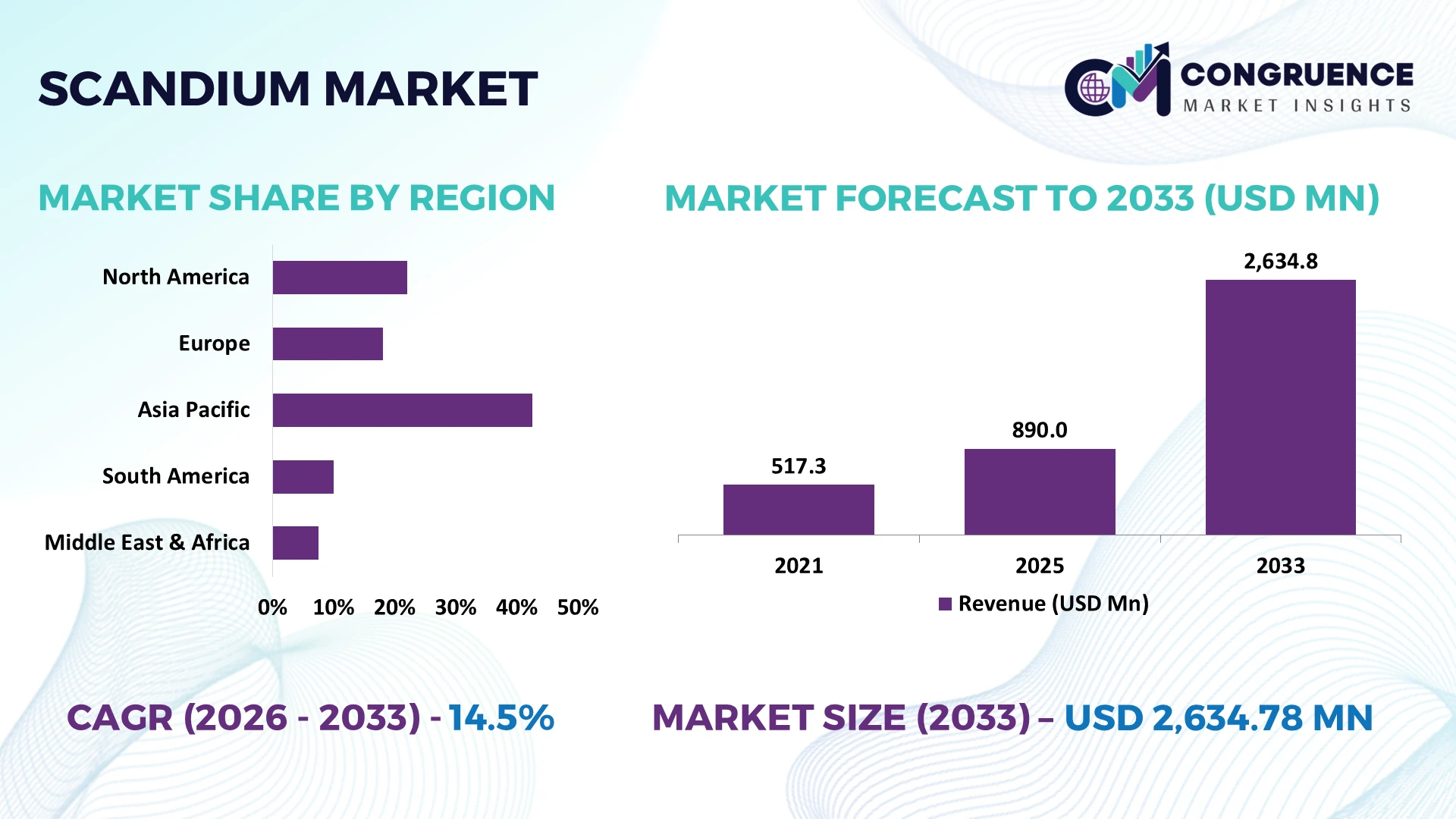
The Global Scandium Market was valued at USD 890.0 Million in 2025 and is anticipated to reach a value of USD 2,634.8 Million by 2033 expanding at a CAGR of 14.53% between 2026 and 2033. Growth is anchored in aerospace aluminum-scandium alloy qualification programs and solid-oxide fuel cell electrolyte scaling, with China’s April 2025 export-licensing regime accelerating Western supply diversification.
China controls 50–60% of global scandium output at 30–50 tonnes annually, with state-backed research targeting 65% recovery from red mud; Japan’s Ene-Farm residential SOFC deployment consumes scandium-stabilized zirconia at commercial scale, while the United States allocated USD 69 million in 2026 for domestic critical-material refining. Australia’s Sunrise Energy Metals secured a USD 400 million conditional Pentagon loan for its 60 tpa Syerston project, exceeding Canada’s Rio Tinto Sorel-Tracy expanded capacity of 9 tpa by a factor of nearly seven.
Strategic implication, supply security, not demand creation, now determines competitive positioning in high-purity scandium.
Market Size & Growth: USD 890.0 Million (2025) to USD 2,634.8 Million (2033); growth driven by SOFC electrolyte demand and aerospace alloy substitution.
Top Growth Drivers: Aerospace alloy adoption (26% annual demand growth), defense hypersonic programs (23%), automotive lightweighting (22%).
Short-Term Forecast: By 2028, Western primary supply additions reduce import dependency by an estimated 15–20% as Syerston and Nyngan advance.
Emerging Technologies: Scandium-stabilized SOFCs for AI data-center power; Al-ScN thin films for 5G RF components; additive manufacturing of aerospace frames.
Regional Leaders: China (50–60% output share, red-mud recovery focus), Japan (Ene-Farm SOFC adoption), United States (USD 69M DOE refining funding).
Consumer/End-User Trends: Aerospace and defense hold 30.8% end-use share; SOFC segment scales with Bloom Energy’s 6N electrolyte production.
Pilot/Case Example: 2026 — Sunrise Energy Metals’ USD 400M Pentagon loan for 60 tpa Syerston project, targeting first production 2028.
Competitive Landscape: Leader Rio Tinto (~9 tpa Quebec capacity); key players include Sumitomo Metal Mining, NioCorp, Scandium International, Australian Mines.
Regulatory & ESG Impact: EU Critical Raw Materials Act targets 25% recycling capacity by 2030; China licensing adds compliance friction for US chipmakers.
Investment & Funding: USD 400M (Sunrise/Pentagon) + USD 29.9M (ElementUSA DPA award) signal sovereign supply-chain capital deployment.
Innovation & Future Outlook: AlScN ferroelectric memory chips attract USD 5M strategic investment from Sunrise; shift toward primary scandium production from byproduct-only model.
Scandium’s demand center is migrating from laboratory-scale oxide sales toward industrialized aerospace master alloys and SOFC electrolyte powders, with aluminum-scandium components delivering 15–20% weight reduction in qualified structural applications. Japan’s residential fuel cell rollout demonstrates operational viability at commercial scale, while China’s export-licensing framework has transformed access—not availability—into the binding constraint for Western manufacturers. Approximately two-thirds of US-imported scandium content originates from Chinese atoms despite Japanese refining labels, exposing a traceability gap that procurement teams now treat as a strategic risk. This access asymmetry frames the competitive dynamics explored below.
Scandium has shifted from a niche alloying additive to a strategic input for aerospace reindustrialization and distributed power generation. China’s licensing controls exposed how a 60–80 tonne annual market can bottleneck multi-billion-dollar SOFC and defense programs, prompting the Pentagon’s Office of Strategic Capital to deploy a USD 400 million conditional loan for Australia’s Syerston project—the agency’s largest mining commitment to date.
Technologically, scandium-stabilized zirconia enables SOFC operation at temperatures roughly 100–150°C lower than yttria-stabilized alternatives, extending stack life and permitting cheaper balance-of-plant materials. Regionally, Australia advances primary supply at 60 tpa nameplate while Canada’s Rio Tinto expands byproduct recovery to 9 tpa from titanium dioxide waste streams, a scale differential reflecting distinct resource strategies rather than competitive displacement . Over the next two to three years, procurement teams should track offtake qualification timelines rather than headline capacity announcements, as Bloom Energy alone consumed an estimated 30–36 tonnes in 2025.
NioCorp’s Elk Creek project illustrates the operational adjustment now underway: the company secured a Defense Production Act award of up to USD 10 million to qualify aluminum-scandium master alloy for defense primes, integrating mining, alloying, and customer qualification under a single financing structure. Competitive positioning in scandium now hinges on securing qualified supply before demand materializes—not on waiting for spot market clarity.
Aerospace demand for aluminum-scandium alloys is growing at 26% annually through 2050, with defense following at 23% and automotive at 22% . NioCorp’s 2025 agreement with defense primes under the Defense Production Act to supply qualified Al-Sc components demonstrates how qualification cycles create durable procurement visibility. The structural shift is from spot oxide purchases to multi-year alloy qualification contracts, compelling producers to integrate downstream alloying capabilities. Companies are responding by acquiring or partnering with alloy developers—Sunrise Energy Metals’ USD 5 million investment in Agni Semiconductor for AlScN chip materials exemplifies this forward integration . The operational insight: qualification timelines, not mining permits, now gate revenue realization for new supply.
With 80 tonnes of annual global output against 6N oxide spot prices swinging between USD 632.95 and 715.23 per kilogram in August 2025, scandium’s byproduct production model ties supply to host-metal economics rather than scandium demand. China’s 50–60% production share means its April 2025 export-licensing regime directly constrains Western availability, with US chipmakers reporting licensing delays by February 2026. The business impact is acute for SOFC manufacturers operating continuous production lines: Bloom Energy’s estimated 30–36 tonne annual consumption exceeded non-Chinese supply by over 20 tonnes in 2025. Companies are mitigating through offtake agreements with Australian and Canadian developers, though no primary producer operates as of mid-2026 .
Recovering scandium from titanium dioxide and red-mud waste streams offers a capital-light path to supply diversification, with China’s 2026 research program targeting 65% scandium recovery from red mud at 99.9% oxide purity. ElementUSA’s USD 29.9 million Defense Production Act award for a Louisiana demonstration facility recovering gallium and scandium from industrial waste validates this approach commercially. The non-obvious opportunity lies in processing economics: waste-stream recovery avoids new mining permits and benefits from existing feedstock logistics. Companies positioning for this include Rio Tinto, whose Sorel-Tracy operation recovers scandium from TiO2 waste with an announced expansion to 9 tpa . Strategic insight: waste-stream recovery could compress Western supply lead times by years compared to greenfield mining projects.
USGS records show approximately 90% of US scandium oxide imports labeled as Japanese-origin, yet Japan mines no scandium; the only verifiable non-Chinese material in that flow is Sumitomo’s 7–8 tonnes of Philippine-origin oxide . This traceability gap creates regulatory and reputational exposure as the EU Critical Raw Materials Act imposes 25% recycling and 10% extraction targets by 2030. For aerospace and defense manufacturers requiring conflict-mineral-style provenance documentation, current supply chains cannot reliably distinguish Chinese atoms from non-Chinese despite contractual assurances. Companies must invest in chain-of-custody systems and direct producer relationships—not rely on country-of-refining labels—to satisfy compliance and customer audit requirements.
Primary Supply Projects Accelerate Australia’s Syerston project secured a USD 400 million Pentagon conditional loan in August 2026, targeting 60 tpa nameplate with first production by 2028; Scandium International’s Nyngan project holds a mining licence for 38.5 tpa capacity and commissioned an updated feasibility study in June 2026. These projects represent a structural shift from byproduct-only supply toward primary production, though financing conditions and customer offtakes remain gating factors.
SOFC Demand Concentrates Procurement Bloom Energy’s 6N scandium oxide-based electrolyte production scaled in 2025, with Japan’s Ene-Farm rollout and US DOE Hydrogen Shot roadmap designating SOFCs as critical for long-duration storage. At approximately 45 kg scandium per MW of SOFC deployment, Bloom’s 2025 consumption of 30–36 tonnes consumed over one-third of global output, forcing large buyers into bilateral contracts that bypass spot markets entirely .
AlScN Semiconductor Niche Emerges Sunrise Energy Metals’ USD 5 million strategic investment in Agni Semiconductor—50% of a USD 10 million seed round—targets aluminum-scandium nitride ferroelectric memory and AI compute-in-memory chips. This represents a non-obvious demand vector: scandium’s semiconductor applications could command premium pricing insulated from aerospace alloy cycles, though volumes remain small relative to SOFC or structural alloys.
Export Controls Reshape Trade Flows China’s April 2025 licensing regime prompted US chipmakers to report scandium access delays by February 2026, with some manufacturers facing shortages affecting 5G infrastructure components. The operational response is bifurcated: large OEMs accelerate dual-sourcing audits, while junior developers prioritize offtake agreements with Western-facing customers to secure financing. The non-obvious consequence: Japan’s role as a refining and relabeling hub may face increased scrutiny as provenance documentation requirements tighten.
Alloys captured the largest demand share at approximately 34.9% in 2025, anchored in aerospace rivets, bicycle frames, and sporting goods where scandium’s grain-refining effect delivers weld-crack resistance and strength-to-weight gains at mature cost structures. Oxide represents the fastest-expanding type, with SOFC electrolyte and semiconductor uptake driving purity requirements toward 99.999%, creating a bifurcated pricing environment where high-purity oxide commands substantial premiums over metallurgical-grade material.
Fluoride and chloride salts serve niche electronic and catalytic applications, while iodide and nitrate volumes remain R&D-scale. Companies are responding by integrating downstream: IBC Advanced Alloys signed a long-term offtake with NioCorp in 2025 for master-alloy billets, reinforcing North American value-chain control . Investment priorities are shifting toward high-purity oxide capacity and master-alloy integration rather than commodity salt production.
Aluminum-scandium alloys hold the leading application position, with aerospace and defense consumption driving demand concentration through airframe and hypersonic platform qualification programs. Solid oxide fuel cells represent the fastest-growing application, where scandium-stabilized zirconia enables operating temperature reduction of roughly 100–150°C versus yttria-stabilized alternatives, extending stack life and permitting cheaper balance-of-plant materials . High-intensity metal halide lamps and lasers constitute mature, stable-volume applications with limited expansion trajectory, while scandium’s role in additive manufacturing remains emerging at below 5 tons annually.
Companies are adapting through application-specific purity strategies: SOFC customers require 6N-grade oxide while alloy customers accept lower-purity master alloys, prompting producers to segment production lines accordingly. Demand is strengthening most sharply in SOFC electrolytes, where Bloom Energy’s commercial scaling has converted scandium from a specialty additive into an operationally critical input .
Aerospace and defense held the leading end-user share at approximately 30.8% in 2025, reflecting demand concentration in aluminum-scandium structural components where operational intensity and qualification cycles create durable procurement relationships . The solid oxide fuel cell end-user segment is expanding fastest, driven by distributed power generation deployments in Japan and the United States where scandium’s temperature-lowering function directly reduces system capital costs.
Ceramics, lighting, and electronics represent established buying groups with stable but limited volume growth, while 3D printing and sporting goods constitute emerging adopters with fragmented demand patterns. Companies are targeting aerospace through defense-prime qualification partnerships—NioCorp’s 2025 Defense Production Act agreement exemplifies this approach—while SOFC-focused producers prioritize bilateral offtakes with system integrators rather than spot market exposure. Future demand is shifting toward energy infrastructure buyers whose procurement decisions hinge on stack lifetime economics rather than material price alone.
Asia-Pacific accounted for the largest market share at 42.5% in 2025 however, Europe is expected to register the fastest growth, expanding at a CAGR of 10.46% between 2026 and 2033.
North America holds approximately 22% of global scandium demand, concentrated in aerospace alloy qualification and SOFC electrolyte procurement. The U.S. Defense Logistics Agency’s September 2025 commitment to procure over 6,000 kilograms of scandium oxide for the National Defense Stockpile from Rio Tinto’s Sorel-Tracy operation established institutional demand visibility unmatched in other regions. Canada contributes production-side relevance through the Sorel-Tracy facility’s 9 tpa capacity expansion, while U.S. refining capacity remains dependent on imported oxide feedstock. Companies are responding by integrating alloy qualification with defense-prime contracts, with NioCorp’s Defense Production Act award enabling master-alloy supply to U.S. aerospace manufacturers.
United States Market Outlook: The United States drives regional demand through defense aerospace programs requiring aluminum-scandium components for hypersonic and tactical airframe applications. The Defense Production Act Title III program allocated USD 29.9 million to ElementUSA for domestic scandium recovery demonstration, signaling policy prioritization of supply-chain autonomy over spot-market procurement efficiency.
Europe accounts for approximately 18% of global scandium consumption, with demand concentrated in SOFC electrolyte manufacturing and automotive lightweighting research. The EU Critical Raw Materials Act’s 2030 benchmarks—10% extraction, 40% processing, and 25% recycling of strategic raw materials—create compliance-driven procurement requirements for scandium users. Germany leads regional SOFC deployment through industrial CHP installations, while the United Kingdom’s Critical Minerals Strategy targets 10% domestic production of aggregate critical-mineral demand by 2035. Companies are responding by embedding provenance documentation into supplier contracts, with European OEMs requiring chain-of-custody verification that distinguishes non-Chinese atoms from relabeled imports.
Germany Market Outlook: Germany’s SOFC deployment for distributed power generation and industrial combined heat and power applications anchors regional scandium demand. The country’s engineering firms are integrating scandium-stabilized zirconia electrolytes into stationary fuel cell systems, with Bosch and Viessmann advancing commercial-scale deployments that require qualified 6N oxide supply contracts.
Asia-Pacific holds 42.5% of global scandium market share, anchored in China’s 50–60% production control and Japan’s SOFC commercialization leadership. China’s April 2025 export-licensing regime transformed regional supply dynamics, with licensing delays affecting U.S. chipmakers by February 2026. Japan’s Ene-Farm residential fuel cell program consumes scandium-stabilized electrolyte at commercial scale, while Australian primary supply projects—Syerston’s 60 tpa and Nyngan’s 38.5 tpa—target Western-facing offtake agreements. Companies are adapting through dual-track strategies: Chinese producers prioritize domestic SOFC and electronics demand, while Australian developers secure Pentagon and DOE financing to bypass Chinese processing entirely.
China Market Outlook: China’s dominance rests on red-mud recovery capacity and export-licensing leverage rather than downstream technology leadership. State-backed research targeting 65% scandium recovery from bauxite residue at 99.9% purity aims to extend production cost advantages, though domestic SOFC manufacturers remain dependent on imported Japanese electrolyte technology.
South America accounts for approximately 10% of global scandium demand, with Brazil representing the primary market for imported oxide and alloy products. The region’s relevance lies in geological potential rather than current production: Brazilian lateritic nickel-cobalt deposits contain scandium mineralization that remains unexploited due to processing infrastructure limitations and capital constraints. Demand centers are limited to ceramics, lighting, and research applications, with aerospace and SOFC adoption negligible. Companies view South America as a long-horizon resource opportunity rather than a near-term supply source, with investment priorities focused on jurisdictions offering established permitting frameworks and export logistics.
Brazil Market Outlook: Brazil’s scandium demand is confined to ceramics and lighting applications, with no domestic production or refining capacity. The country’s mining sector holds latent potential in lateritic deposits, but development requires processing infrastructure investment that current market volumes cannot justify, leaving Brazil dependent on imported material through 2033.
The Middle East & Africa region represents approximately 7.5% of global scandium demand, with South Africa and the United Arab Emirates serving as primary import hubs for ceramics and lighting applications. The region’s strategic relevance is prospective: Gulf states’ investment in industrial diversification and hydrogen infrastructure creates potential SOFC deployment pathways, while South African mining operations hold scandium-bearing residues from platinum and titanium processing. No commercial-scale scandium production exists in the region, and demand remains dependent on imported oxide and master alloy products. Companies are positioning through distribution partnerships rather than capital deployment, treating the region as a secondary market for standardized products.
South Africa Market Outlook: South Africa’s scandium relevance derives from platinum-group metal processing residues that contain recoverable scandium values, though no commercial extraction operates. The country’s mining infrastructure and metallurgical expertise provide a foundation for potential byproduct recovery, contingent on offtake commitments that current demand scale cannot support.
The global scandium market features competition between Rio Tinto, NioCorp Developments, Scandium International Mining, Clean TeQ Water, and emerging Chinese scandium processors. Established producers leverage integrated extraction infrastructure, while development-stage companies compete through resource ownership, processing technology, and prospective supply agreements. The five leading suppliers are estimated to control approximately 65% of commercial supply, although fragmented reporting limits verification. High-purity scandium oxide commands premiums exceeding 20% over lower-grade material, while advanced recovery processes target operating cost reductions of 15–25%. Rio Tinto emphasizes byproduct recovery and supply-chain integration, whereas NioCorp advances domestic mineral processing capabilities. Emerging producers pursue partnerships with aerospace manufacturers and solid oxide fuel cell developers to secure long-term demand. Competition is shifting toward traceable, geographically diversified supply chains as export restrictions and processing complexity intensify procurement risks. Winning requires reliable purification, competitive recovery economics, customer qualification, and scalable production capacity supported by binding offtake commitments.
Rio Tinto
NioCorp Developments Ltd.
Scandium International Mining Corp.
Clean TeQ Water Limited
Australian Mines Limited
Sunrise Energy Metals Limited
Imperial Mining Group Ltd.
Platina Resources Limited
Rusal
Sumitomo Metal Mining Co., Ltd.
Scandium recovery technologies increasingly prioritize selective extraction from industrial byproducts, particularly titanium dioxide residues, nickel laterites, and rare-earth processing streams. Solvent extraction and ion-exchange systems enable targeted scandium separation, reducing dependence on dedicated mining operations. Advanced resin technologies can potentially improve recovery efficiency by 10–20%, depending on feedstock chemistry. Compared with conventional multistage precipitation, integrated hydrometallurgical processing can reduce reagent consumption by approximately 15% under optimized conditions, strengthening production economics and environmental performance.
Emerging technologies include membrane-assisted separation, continuous ion exchange, and automated purification systems. These technologies target 10–25% reductions in processing costs while improving consistency in high-purity scandium oxide production. Commercial adoption remains concentrated in specialized facilities and demonstration projects rather than widespread industrial deployment. Integrated producers benefit from existing infrastructure, established residue streams, and lower incremental capital requirements. Smaller developers increasingly pursue modular processing configurations to reduce upfront investment and accelerate technical validation.
Between 2026 and 2028, technological competition will increasingly center on scalable recovery, digital process monitoring, and aluminum-scandium alloy manufacturing. Additive manufacturing and advanced alloy qualification could expand aerospace applications through improved material performance. Producers securing reliable feedstock, validated purification processes, and downstream customer partnerships will gain procurement advantages as buyers prioritize diversified supply, consistent quality, and predictable delivery schedules.
August 2026 NioCorp Developments signed a memorandum of understanding with Lockheed Martin covering potential purchases of up to 15 tonnes of scandium oxide annually over 10 years. The agreement supports domestic defense supply-chain development and future aluminum-scandium alloy commercialization. Source: niocorp.com.
November 2025 Rio Tinto announced a transaction with Canada Growth Fund involving approximately C$25 million to expand scandium oxide production in Quebec. The investment supports nine tonnes of annual nameplate capacity, strengthening North American supply security and downstream industrial access. Source: riotinto.com.
June 2026 Scandium International Mining initiated an updated feasibility study for its wholly owned Nyngan project in Australia. The project identifies approximately 37,690 kilograms of planned annual scandium oxide production, supporting technical reassessment, project financing discussions, and future commercial development. Source: scandiummining.com.
June 2025 Rio Tinto launched a C$7.6 million ore-sorting demonstration at Lac Tio, supported by C$2.5 million from Quebec. The technology targets separation based on titanium and scandium content, potentially reducing waste transportation, processing costs, and associated industrial emissions. Source: riotinto.com.
The Scandium Market Report evaluates global industry developments from 2026 to 2033, covering scandium oxide, scandium metal, and aluminum-scandium master alloys. Application analysis includes aerospace components, solid oxide fuel cells, additive manufacturing, electronics, and advanced industrial materials. End-user coverage examines aerospace and defense manufacturers, energy technology providers, automotive producers, electronics manufacturers, and research institutions. The study assesses extraction efficiency, purification technologies, alloy processing, and industrial byproduct recovery.
Regional analysis covers North America, Europe, Asia Pacific, South America, and the Middle East & Africa, emphasizing resource availability, processing infrastructure, trade dependencies, and emerging production hubs. Strategic assessment examines commercial producers, development-stage projects, supply agreements, technology partnerships, and regulatory developments. The report supports investment screening, capacity expansion, supplier diversification, competitive benchmarking, and market-entry planning while identifying commercialization opportunities and supply-chain risks through 2033.
h3>Scandium Market Report Summary
| Report Attribute / Metric | Details |
|---|---|
| Market Revenue (2025) | USD 890.0 Million |
| Market Revenue (2033) | USD 2,634.8 Million |
| CAGR (2026–2033) | 14.53% |
| Base Year | 2025 |
| Forecast Period | 2026–2033 |
| Historic Period | 2021–2025 |
| Segments Covered |
By Type
By Application
By End-User
|
| Key Report Deliverables | Revenue Forecast; Market Trends; Growth Drivers & Restraints; Technology Insights; Segmentation Analysis; Regional Insights; Competitive Landscape; Regulatory & ESG Overview; Recent Developments |
| Regions Covered | North America; Europe; Asia-Pacific; South America; Middle East & Africa |
| Key Players Analyzed | Rio Tinto; NioCorp Developments Ltd.; Scandium International Mining Corp.; Clean TeQ Water Limited; Australian Mines Limited; Sunrise Energy Metals Limited; Imperial Mining Group Ltd.; Platina Resources Limited; Rusal; Sumitomo Metal Mining Co., Ltd. |
| Customization & Pricing | Available on Request (10% Customization Free) |




