
Reports
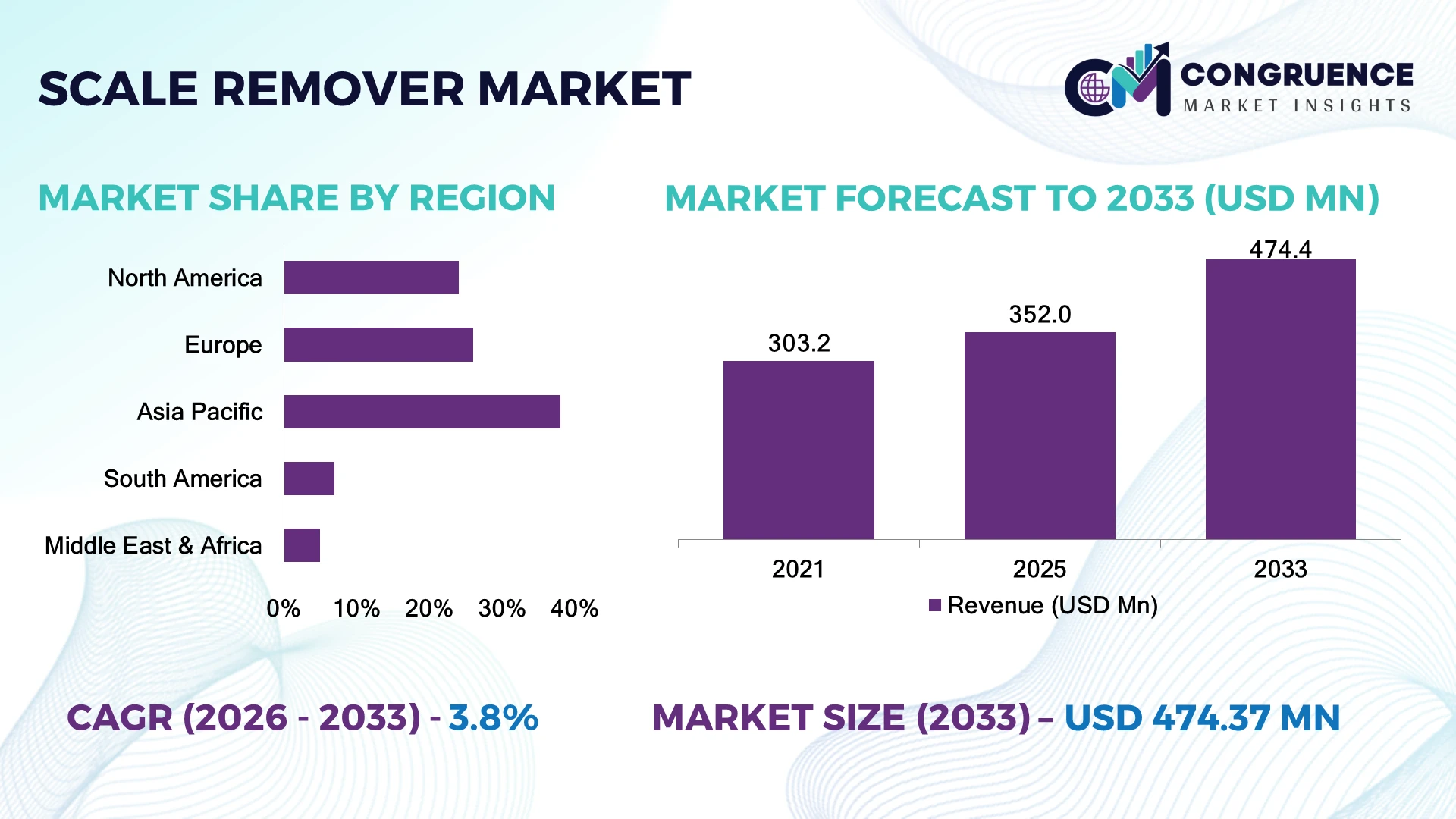
The Global Scale Remover Market was valued at USD 352.0 Million in 2025 and is anticipated to reach a value of USD 474.4 Million by 2033 expanding at a CAGR of 3.8% between 2026 and 2033. Growth is driven by rising adoption of eco-friendly descaling formulations, automated cleaning systems, and water-treatment solutions across household appliances, hospitality, and industrial processing facilities.
China dominates the scale remover landscape, accounting for nearly 28% of global production capacity through its extensive chemical manufacturing base and appliance supply chain ecosystem. The country has invested heavily in specialty chemical plants and advanced formulation facilities, supporting adoption across electronics, food processing, and industrial maintenance sectors. Germany holds approximately 12% share with strong demand from industrial equipment manufacturers, while China’s manufacturing output remains over 2 times higher than Germany’s in chemical processing capacity. The EU’s tightening chemical sustainability regulations are accelerating low-toxicity product development.
Companies prioritizing localized manufacturing and green formulations are positioned to capture future market opportunities.
Market Size & Growth: USD 352.0 Million (2025) to USD 474.4 Million (2033), expanding at 3.8% CAGR, driven by advanced biodegradable descaling formulations and industrial cleaning automation.
Top Growth Drivers: Eco-friendly product adoption (35%), appliance maintenance demand (28%), and industrial water system cleaning requirements (22%) are shaping market expansion.
Short-Term Forecast: By 2028, automated dispensing solutions are reducing chemical wastage by 15% and improving cleaning efficiency by 20% across commercial applications.
Emerging Technologies: AI-enabled maintenance monitoring, enzyme-based cleaners, and low-corrosion chemical formulations are transforming next-generation scale removal solutions.
Regional Leaders: Asia Pacific approaches USD 190 Million with manufacturing expansion, Europe reaches USD 125 Million through sustainability adoption, and North America exceeds USD 100 Million with smart appliance integration.
Consumer/End-User Trends: Over 45% of households in developed markets use specialized descaling products for coffee machines, water heaters, and kitchen appliances.
Pilot/Case Example: A 2024 European hospitality cleaning initiative using optimized descaling chemicals achieved 18% reduction in maintenance downtime.
Competitive Landscape: Leading manufacturers hold approximately 30% combined share, including Reckitt, Henkel, Ecolab, 3M, and Church & Dwight.
Regulatory & ESG Impact: Green chemistry regulations are driving a 25% increase in biodegradable cleaning product launches and reducing hazardous chemical usage.
Investment & Funding: More than USD 500 Million has been directed toward specialty chemical innovation, partnerships, and sustainable cleaning technology expansion.
Innovation & Future Outlook: Next-generation scale removers focus on bio-based ingredients, smart dosing systems, and circular chemical manufacturing models.
Scale remover products are increasingly adopted across residential appliances, commercial kitchens, industrial boilers, and water circulation systems due to rising maintenance requirements. Recent innovations include phosphate-free formulations, concentrated solutions, and automated dosing technologies, with premium eco-friendly products capturing nearly 20% higher consumer preference in developed markets. Supply-chain restructuring in chemical manufacturing and stricter environmental compliance standards are encouraging manufacturers to expand localized production and sustainable formulations.
The Scale Remover Market is becoming strategically important as industries prioritize equipment longevity, water efficiency, and sustainable maintenance practices. Growing pressure from environmental regulations, including chemical restrictions in Europe, is accelerating the transition toward biodegradable and low-toxicity descaling solutions. Manufacturers are restructuring supply chains by expanding regional formulation facilities to reduce dependency on imported chemical intermediates.
Advanced enzyme-based and automated cleaning technologies are improving operational efficiency compared with conventional acid-based cleaners, reducing chemical consumption by nearly 20% while extending equipment maintenance cycles. Japan and Germany are leading adoption through high-efficiency appliance ecosystems, whereas India and Southeast Asian markets are expanding through rising appliance ownership and industrial infrastructure development.
Commercial facilities are deploying automated descaling systems in coffee machines, cooling equipment, and manufacturing lines to reduce manual intervention and maintenance interruptions. Companies are increasing investments in sustainable chemistry research, strategic partnerships, and regional production networks to strengthen competitiveness. Over the next 2–3 years, businesses that combine environmentally compliant formulations with smart maintenance capabilities will secure stronger operational advantages and long-term market relevance.
Demand for environmentally safer scale removers is accelerating as industries replace harsh chemical cleaners with biodegradable formulations. Sustainable product launches have increased by approximately 25%, while commercial users are adopting low-corrosion solutions to reduce equipment damage. Germany, Japan, and the Netherlands are strengthening chemical sustainability standards, pushing manufacturers toward phosphate-free and enzyme-based alternatives. Companies are responding through R&D investments, green chemistry partnerships, and expanded production of concentrated formulations. The strategic advantage lies in reducing lifecycle maintenance costs while meeting stricter environmental requirements across appliance, hospitality, and industrial sectors.
Scale remover manufacturers face cost pressures from fluctuations in organic acids, surfactants, and specialty chemical inputs, with raw material volatility affecting nearly 10–15% of production expenses. Dependence on imported chemical intermediates creates supply-chain exposure, particularly across emerging manufacturing economies. China and India are expanding domestic chemical production, but smaller producers continue facing procurement challenges. Companies are mitigating risks through supplier diversification, long-term contracts, and localized sourcing strategies. The key operational challenge remains maintaining competitive pricing while investing in sustainable formulations and regulatory compliance.
Emerging opportunities are centered on automated cleaning technologies, IoT-enabled maintenance systems, and bio-based descaling chemistry. Smart dosing solutions can reduce chemical consumption by 15–20%, creating value for industrial users seeking efficiency improvements. Demand is expanding in India, Brazil, and Southeast Asia as appliance ownership and water treatment infrastructure improve. Manufacturers are investing in enzyme technologies, digital monitoring platforms, and partnerships with appliance companies to create integrated maintenance solutions. A significant opportunity exists in combining scale removal products with predictive maintenance ecosystems, enabling companies to move from chemical supply toward value-added service models.
Manufacturers face execution challenges in standardizing advanced scale remover technologies across regions with different water hardness levels, regulatory requirements, and consumer preferences. More than 40% of households globally experience varying mineral buildup conditions, requiring customized formulations. Developing markets often lack awareness of premium descaling solutions, limiting adoption of advanced products. Companies must invest in localized testing, consumer education, and distribution partnerships to improve market penetration. Long-term competitiveness depends on balancing formulation flexibility, regulatory compliance, and cost efficiency while maintaining consistent product performance across residential and industrial applications.
Bio-Based Formulation Shift: Manufacturers are accelerating development of biodegradable scale removers as environmental compliance expands, with green cleaning product launches increasing by nearly 25% and low-toxicity formulations gaining over 15% adoption among commercial users. Regulatory pressure in Germany and the European Union is reshaping chemical procurement strategies, encouraging companies to partner with specialty chemical producers and expand sustainable product portfolios.
Automated Cleaning Integration: Industrial users are deploying automated dosing and monitoring systems to improve descaling efficiency, reducing chemical wastage by 15–20% and lowering manual maintenance requirements by approximately 18%. Food processing and hospitality operators are integrating smart cleaning workflows, while companies are forming equipment partnerships to deliver complete maintenance solutions rather than standalone chemical products.
Concentrated Product Innovation: Scale remover suppliers are shifting toward high-concentration formulations that reduce packaging volume by nearly 30% and improve transportation efficiency by 20%. Supply-chain disruptions affecting chemical logistics have accelerated this transition, particularly among manufacturers in China and India, where companies are redesigning formulations to improve storage stability and reduce dependency on frequent raw material shipments.
Predictive Maintenance Adoption: Industrial facilities are combining scale removal with predictive maintenance platforms, enabling up to 25% improvement in equipment monitoring efficiency. A non-obvious trend is the movement from periodic cleaning schedules toward condition-based maintenance models. Companies are investing in digital partnerships and sensor-enabled solutions to capture recurring service opportunities across boilers, cooling systems, and commercial appliances.
Acid-based scale removers dominate the market, accounting for approximately 55% share due to their strong descaling performance, rapid mineral dissolution capability, and widespread use in industrial equipment maintenance. These products remain preferred across boilers, heat exchangers, and heavy-duty applications where operational downtime must be minimized. However, bio-based and enzyme-based scale removers represent the fastest-growing segment, expanding as industries prioritize safer chemistry and regulatory compliance. Adoption of sustainable alternatives has increased by nearly 20% in commercial cleaning applications, while conventional chemical products continue maintaining strong demand due to cost advantages.
Manufacturers are balancing portfolios by improving acid formulations with lower corrosion impact while investing in environmentally friendly alternatives. Neutral and specialized formulations collectively account for nearly 25% of demand, supporting niche applications in electronics, food processing, and sensitive equipment. Companies are increasing R&D spending and forming technology partnerships to capture shifting preferences toward safer and more efficient descaling solutions.
Industrial equipment maintenance represents the leading application segment with approximately 48% market share, supported by extensive use in boilers, cooling systems, manufacturing machinery, and processing equipment. High mineral buildup in industrial systems can reduce heat transfer efficiency by 10–15%, increasing demand for regular descaling programs. Residential appliance cleaning remains a mature segment, while commercial applications in hospitality and food services are expanding rapidly due to increased hygiene requirements.
The fastest-growing application area is commercial and institutional cleaning, where automated descaling systems are gaining adoption through hotels, restaurants, and healthcare facilities. Deployment of automated maintenance programs has improved cleaning consistency by nearly 20% while reducing labor requirements. Companies are responding by developing application-specific formulations and partnering with equipment manufacturers to integrate scale removal solutions into broader maintenance ecosystems.
Industrial facilities account for nearly 50% of scale remover consumption due to extensive requirements from manufacturing plants, power generation units, and processing industries. These users depend on effective descaling solutions to maintain equipment efficiency and prevent production interruptions. Large industrial operators typically purchase bulk formulations and customized cleaning solutions, creating stable demand for specialized suppliers. Commercial establishments represent the fastest-growing end-user category, supported by rising adoption across hospitality, food service, and healthcare facilities. This segment is expanding as businesses focus on hygiene compliance and operational efficiency, with adoption increasing by approximately 18% in automated cleaning environments. Residential users continue contributing through appliance maintenance products, while institutional buyers are shifting toward eco-certified solutions.
Companies are adapting strategies through customized product offerings, subscription-based maintenance programs, and partnerships with facility management providers. The competitive focus is shifting from chemical supply alone toward integrated cleaning solutions that improve equipment performance and reduce operational costs.
Asia-Pacific accounted for the largest market share at 38% in 2025 however, Middle East & Africa is expected to register the fastest growth, expanding at a CAGR of 5.1% between 2026 and 2033.
North America represents approximately 24% of the global scale remover market, supported by strong demand from commercial facilities, food processing units, healthcare infrastructure, and household appliance users. The United States leads regional consumption due to advanced maintenance practices and high appliance penetration. Industrial users are increasingly adopting automated dosing systems, reducing chemical waste by nearly 15% and improving cleaning consistency. Canada is expanding sustainable cleaning adoption through environmentally compliant formulations, while manufacturers are increasing partnerships with equipment suppliers to deliver integrated maintenance solutions. The region’s mature industrial base creates demand for specialized, low-corrosion formulations that improve equipment lifespan and operational efficiency.
United States Market Outlook: The United States remains the largest North American market due to its extensive commercial infrastructure and industrial equipment base. More than 60% of large-scale facility operators implement preventive maintenance programs, increasing demand for professional-grade scale removers. Growth is supported by food processing, hospitality, and water treatment industries adopting advanced cleaning technologies and sustainable chemical solutions.
Europe accounts for nearly 26% of global scale remover demand, driven by strict environmental regulations, industrial modernization, and strong preference for eco-certified cleaning products. Germany, France, and the United Kingdom represent major consumption centers due to advanced manufacturing and commercial infrastructure. The European Union’s chemical sustainability framework is accelerating adoption of phosphate-free and biodegradable formulations, with sustainable product adoption increasing by approximately 20% among institutional users. Manufacturers are investing in localized production facilities and green chemistry research to meet regulatory requirements while maintaining performance standards. Industrial equipment maintenance, hospitality services, and premium household appliances remain key application areas across the region.
Germany Market Outlook: Germany dominates Europe’s scale remover market through its advanced manufacturing ecosystem and industrial equipment concentration. Nearly 30% of regional industrial cleaning demand originates from manufacturing and engineering sectors. The country’s focus on resource efficiency, automation, and environmentally responsible chemicals is encouraging companies to develop specialized formulations for machinery maintenance and commercial applications.
Asia-Pacific holds the largest market position with approximately 38% share, supported by extensive chemical manufacturing capacity, expanding appliance ownership, and industrial infrastructure growth. China, India, Japan, and South Korea are major contributors due to large manufacturing bases and increasing demand from food processing, electronics, and commercial facilities. China accounts for a significant share of regional production capacity, with domestic chemical manufacturers supplying both local and export markets. Appliance maintenance adoption has increased by nearly 25% across urban markets as residential and commercial users prioritize equipment longevity. Companies are expanding regional manufacturing hubs and forming distribution partnerships to capture growing demand.
China Market Outlook: China remains the dominant Asia-Pacific market due to its large-scale chemical production ecosystem and appliance manufacturing strength. The country contributes nearly one-third of global chemical manufacturing capacity, supporting cost-efficient scale remover production. Increasing investments in industrial automation and sustainable chemical processing are encouraging manufacturers to develop advanced descaling solutions for domestic and industrial users.
South America contributes approximately 7% of global scale remover demand, with Brazil and Argentina representing major markets due to industrial processing, commercial facilities, and water management requirements. Manufacturing, mining, food processing, and hospitality sectors are driving adoption as companies focus on reducing equipment downtime caused by mineral buildup. Brazil’s expanding industrial maintenance sector is increasing demand for bulk and specialized formulations, while infrastructure limitations in smaller markets restrict wider deployment. Companies are strengthening local distribution networks and developing cost-efficient products suited for regional water conditions. Sustainable cleaning solutions are gradually gaining traction among large enterprises.
Brazil Market Outlook: Brazil is the leading South American market due to its diversified industrial base and large food processing sector. More than 40% of regional industrial cleaning demand is concentrated in Brazil, supported by manufacturing plants, commercial facilities, and agricultural processing operations. Companies are increasing partnerships with local distributors to improve product availability and technical support.
Middle East & Africa represents approximately 5% of global scale remover demand, supported by water-intensive industries, hospitality infrastructure, and industrial modernization projects. Countries with high mineral content in water supplies are increasing usage of specialized descaling products for cooling systems, desalination facilities, and commercial equipment. The Gulf region is investing heavily in infrastructure development, with facility maintenance programs expanding across hotels, airports, and industrial complexes. Adoption of efficient cleaning technologies has increased by nearly 15% among large commercial operators. Companies are entering partnerships with facility management providers and expanding regional supply chains to address specialized maintenance requirements.
Saudi Arabia Market Outlook: Saudi Arabia is the leading Middle East market due to large-scale infrastructure development, hospitality expansion, and water management investments. The country’s desalination and industrial facilities require consistent equipment maintenance, creating demand for high-performance scale removers. More than 50% of major commercial projects incorporate structured maintenance programs, supporting adoption of specialized cleaning solutions.
The Scale Remover Market features competition between global chemical leaders such as Reckitt, Henkel, Ecolab, and 3M against regional formulators and specialty cleaning suppliers competing through pricing, customization, and distribution strength. The top five companies collectively account for approximately 30% of market share, creating a moderately fragmented structure. Global players emphasize advanced formulations, sustainability, and brand strength, while regional manufacturers compete with 10–15% lower production costs and localized supply chains. Companies are expanding through partnerships with appliance manufacturers, facility management providers, and industrial users. Technology-driven competition is increasing as bio-based formulations and automated dosing solutions gain adoption, improving cleaning efficiency by nearly 20%. Entry barriers include chemical expertise, regulatory compliance, and established distribution networks. The competitive shift is moving toward sustainable chemistry and integrated maintenance solutions, making innovation, supply reliability, and application-specific performance essential for companies seeking long-term market leadership.
Henkel
Ecolab
3M
Church & Dwight
Procter & Gamble
Unilever
Kärcher
Diversey
Zep Inc.
SC Johnson
Bissell
Scale remover technology is shifting from conventional acid-based chemicals toward biodegradable enzymes, advanced surfactants, and low-corrosion formulations. Bio-based cleaners improve environmental performance while reducing equipment damage by nearly 15% compared with traditional solutions. Adoption of sustainable formulations has reached approximately 20–25% among commercial cleaning users, driven by stricter chemical compliance requirements.
Automation and smart maintenance systems are transforming industrial descaling operations through connected dosing equipment and predictive monitoring. Automated systems reduce chemical consumption by 15–20% and improve cleaning consistency by nearly 25% compared with manual processes. Large industrial facilities and hospitality operators are increasingly integrating these technologies to reduce downtime and improve maintenance scheduling.
Between 2026 and 2028, the competitive advantage will shift toward companies combining chemistry innovation with digital capabilities. Manufacturers offering concentrated formulations, IoT-enabled maintenance solutions, and application-specific products will benefit most. Compared with legacy cleaning methods, integrated solutions can deliver 20% higher operational efficiency, creating opportunities for technology-focused suppliers and established chemical companies investing in next-generation product platforms.
April 2025 Reckitt expanded its Lysol cleaning portfolio with Lavender & Cotton Blossom products across sprays, wipes, and cleaners. The launch maintained 99.9% germ-kill performance, strengthening premium household cleaning demand through fragrance-led product innovation. Source: Reckitt official website
January 2025 Kärcher expanded its sustainable professional cleaning portfolio with RM 69N natural industrial cleaner for scrubber dryers. The formulation uses environmentally focused chemistry, supporting greener facility maintenance operations and improving sustainable cleaning adoption. Source: Kärcher official website
March 2025 Ecolab highlighted AI-enabled water management solutions to improve operational efficiency and resource optimization. The initiative supports digital cleaning and maintenance workflows, helping customers advance water savings and sustainable industrial operations. Source: Ecolab official website
October 2025 Henkel introduced Bonderite C-AK DW 805 AERO, a sustainable cleaner manufactured in the U.S. The no-rinse solution reduces water usage and improves aircraft maintenance efficiency, expanding Henkel’s advanced cleaning technology applications. Source: Henkel official website
The Scale Remover Market Report covers comprehensive analysis across product types, including acid-based, bio-based, and specialized formulations, along with applications spanning industrial equipment, residential appliances, commercial cleaning, and institutional maintenance. The study evaluates end-user segments such as industrial facilities, households, hospitality, healthcare, and commercial operators across North America, Europe, Asia-Pacific, South America, and Middle East & Africa.
The report examines technology developments, sustainability trends, competitive strategies, supply-chain dynamics, and emerging opportunities shaping market direction between 2026 and 2033. It provides strategic insights into adoption patterns, regional deployment trends, innovation priorities, and company positioning. The analysis supports investors, manufacturers, and stakeholders in identifying expansion opportunities, partnership potential, operational improvements, and long-term competitive strategies within the evolving scale remover ecosystem.
| Report Attribute / Metric | Details |
|---|---|
| Market Revenue (2025) | USD 352.0 Million |
| Market Revenue (2033) | USD 474.4 Million |
| CAGR (2026–2033) | 3.8% |
| Base Year | 2025 |
| Forecast Period | 2026–2033 |
| Historic Period | 2021–2025 |
| Segments Covered |
By Type
By Application
By End-User
|
| Key Deliverables | Revenue Forecast; Market Trends; Growth Drivers & Restraints; Technology Insights; Segmentation Analysis; Regional Insights; Competitive Landscape; Regulatory & ESG Overview; Recent Developments |
| Regions Covered | North America; Europe; Asia-Pacific; South America; Middle East & Africa |
| Companies Profiled | Reckitt; Henkel AG & Co. KGaA; Ecolab Inc.; 3M Company; Church & Dwight Co., Inc.; Procter & Gamble Company; Unilever PLC; Kärcher Group; Diversey Holdings Ltd.; Zep Inc.; SC Johnson & Son, Inc.; Bissell Inc. |
| Customization & Pricing | Available on Request (10% Customization Free) |




