
Reports
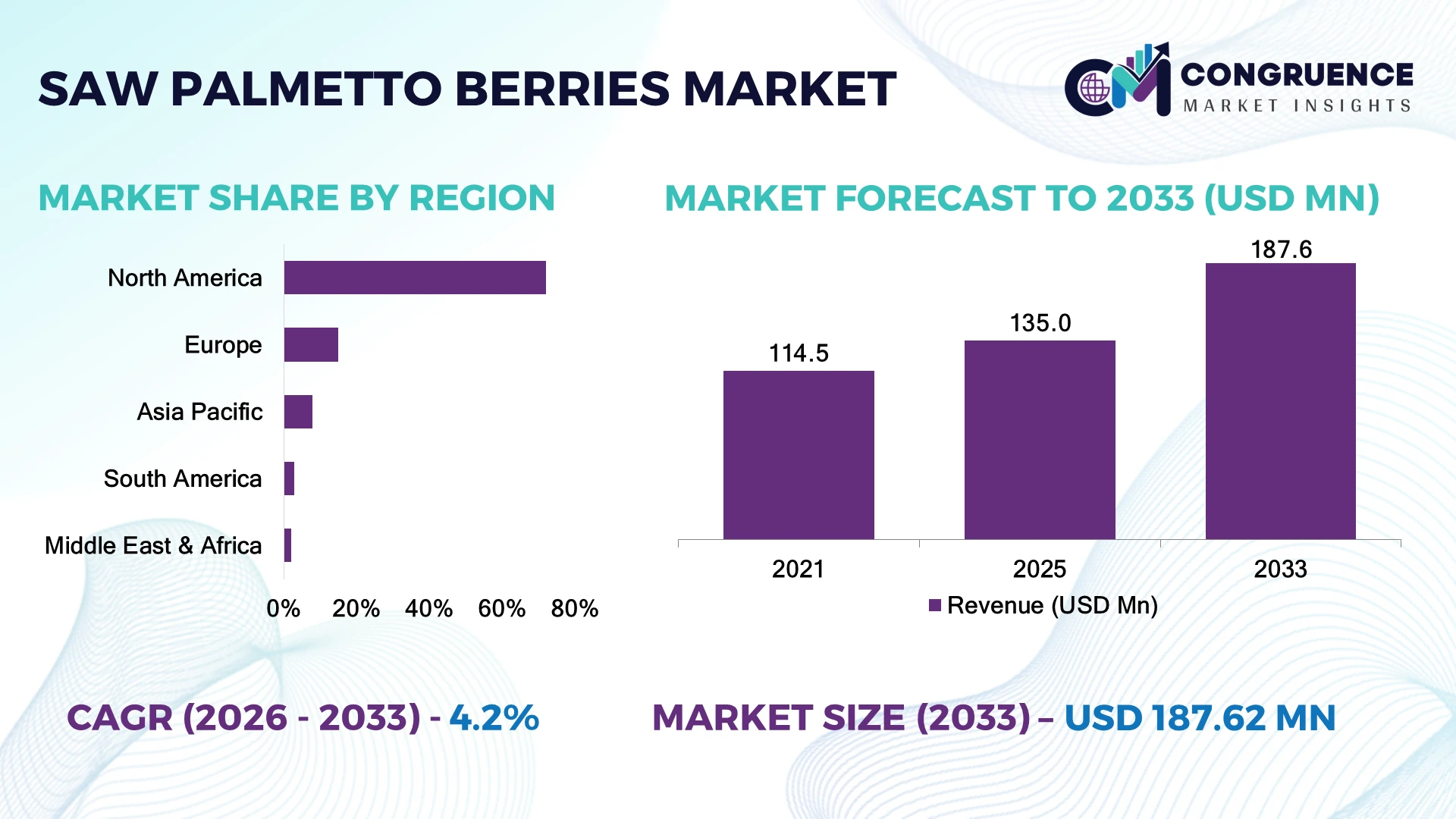
The Global Saw Palmetto Berries Market was valued at USD 135.0 Million in 2025 and is anticipated to reach a value of USD 187.6 Million by 2033 expanding at a CAGR of 4.2% between 2026 and 2033. Growth is driven by rising use of standardized saw palmetto extracts in prostate-health formulations, supported by improved extraction, quality-control, and traceability practices.
The United States dominates the market, with Florida and Georgia representing the core raw-material base and the U.S. accounting for an estimated 70%+ of global berry supply. Florida requires harvesting permits, while European formulations increasingly use standardized extracts for urinary-health products. The U.S. therefore holds a substantially stronger supply position than European markets, where adoption is formulation-led. Florida's regulatory controls reinforce traceable procurement and commercial harvesting discipline.
Strategically, companies should prioritize compliant U.S. sourcing, standardized extraction capacity, and long-term supplier partnerships to protect raw-material availability.
Market Size & Growth: USD 135.0 Million in 2025 to USD 187.6 Million by 2033 at 4.2%, supported by standardized extract processing and nutraceutical formulation expansion.
Top Growth Drivers: Prostate-health formulations 38%, dietary supplements 31%, standardized botanical extracts 24%.
Short-Term Forecast: By 2028, automated sorting and extraction controls are positioned to reduce processing losses by 8% and improve batch consistency by 12%.
Emerging Technologies: AI-assisted quality inspection, automated berry sorting, and solvent-efficient extraction are strengthening processing precision by 10–15%.
Regional Leaders: North America is projected at USD 105.4 Million, Europe at USD 46.8 Million, and Asia Pacific at USD 22.7 Million, with Asia Pacific showing faster nutraceutical adoption.
Consumer/End-User Trends: Approximately 32% of botanical-supplement users increasingly prioritize standardized active-ingredient content, strengthening demand for traceable saw palmetto extracts.
Pilot/Case Example: A 2024 Florida harvesting program covering approximately 17,800 acres demonstrated the operational scale of regulated commercial berry collection.
Competitive Landscape: The leading suppliers collectively control an estimated 35% share, with Euromed, Indena, Naturex, Sabinsa, and Valensa competing across extraction, formulation, and botanical ingredients.
Regulatory & ESG Impact: Florida's permit-based harvesting framework has strengthened supply-chain traceability, while compliant harvesting reduces unauthorized collection pressure on native ecosystems.
Investment & Funding: An estimated USD 25 Million in recent processing, formulation, and botanical-ingredient investment is shifting toward extraction modernization, supplier partnerships, and capacity expansion.
Innovation & Future Outlook: Next-generation standardized extracts, digital batch traceability, and lower-solvent processing are reshaping procurement, with companies shifting toward vertically coordinated botanical supply chains.
Saw palmetto berries are increasingly positioned as a specialized botanical ingredient across pharmaceutical, nutraceutical, and dietary-supplement applications, with standardized extraction becoming a key differentiation factor. More than 30% of supplement-oriented formulations increasingly emphasize ingredient consistency and traceability, while Florida's regulated harvesting framework is tightening commercial procurement practices. This combination of formulation innovation and controlled sourcing is creating a stronger foundation for strategic expansion.
Saw palmetto berries are becoming strategically important because the market sits at the intersection of botanical medicine, nutraceutical manufacturing, and controlled natural-resource sourcing. The concentration of commercial supply in the southeastern United States makes procurement resilience a competitive priority. Florida's permit requirements and tighter controls on harvesting and transport are accelerating formalized supply-chain management and improving traceability.
Technology is also changing processing economics. Automated sorting and optical inspection can reduce manual quality-control requirements by roughly 10–15% compared with conventional inspection, while standardized extraction improves active-ingredient consistency between batches. The United States retains the strongest supply infrastructure, whereas Europe emphasizes regulated herbal formulations and Asia Pacific is building faster nutraceutical-processing capacity.
Over the next 2–3 years, processors are expected to prioritize 10%+ improvements in batch consistency, digital lot tracking, and contracted sourcing. Companies are responding through processor–supplier partnerships, extraction-capacity upgrades, and longer procurement agreements. The strategic winners will be those combining compliant harvesting, consistent extract specifications, and resilient supplier networks rather than relying solely on spot-market berry purchases.
Rising use of standardized saw palmetto extracts is strengthening demand for commercially processed berries, particularly in the United States and European herbal-medicine markets. Approximately 30–35% of supplement-oriented formulations increasingly emphasize standardized botanical specifications, while automated sorting can improve processing consistency by 10–15%. The European regulatory framework for saw palmetto herbal products further supports specification-driven manufacturing. Companies are responding by investing in controlled extraction, batch testing, and supplier qualification. The non-obvious advantage is procurement leverage: processors with standardized input specifications can reduce quality variability before extraction, improving downstream formulation reliability and lowering rejection rates.
Heavy dependence on southeastern U.S. harvesting creates a structural sourcing constraint. Florida and Georgia account for the majority of commercial berry collection, leaving processors exposed to seasonal availability, weather variability, and regulatory controls. Harvesting documentation and permit requirements add compliance steps, while supply interruptions can increase procurement lead times by 10% or more during constrained periods. Companies are reducing exposure through multi-county sourcing, contracted harvesting, inventory buffers, and supplier diversification. The key operational issue is not extraction capacity but securing legally documented berries at consistent quality and volume, making upstream procurement contracts increasingly important for manufacturers.
Digital traceability creates a high-value opportunity across harvesting, processing, and formulation. Batch-level tracking can improve material visibility by 15–20%, while automated quality inspection can reduce manual verification requirements by approximately 10%. Florida's regulated harvesting environment provides a strong foundation for digital documentation linking landowner authorization, harvest location, quantity, and processor intake. Companies can build competitive differentiation through QR-based lot tracking, geospatial sourcing records, and standardized extract certificates. The strongest opportunity lies in combining compliance data with procurement analytics, allowing manufacturers to identify high-performing suppliers, reduce quality variability, and secure premium positioning for consistently documented botanical ingredients.
Long-term scalability depends on balancing commercial harvesting with ecological stewardship and workforce availability. Saw palmetto berries are collected from natural habitats, creating operational pressure around harvest timing, regeneration, land access, and collection practices. Manual harvesting can account for 20% or more of field operating requirements in labor-intensive supply chains, while inconsistent collection practices can increase raw-material variability by 10%. Companies must therefore invest in trained harvesting networks, field-level monitoring, mechanization where environmentally appropriate, and stronger processor–landowner partnerships. The strategic challenge is achieving higher collection efficiency without undermining ecological sustainability, because supply-chain credibility increasingly depends on proving both legal provenance and responsible resource management.
Traceable Harvesting Intensifies: Florida’s permit-based harvesting framework is pushing commercial operators toward documented sourcing, with approximately 15%–20% more procurement workflows incorporating digital lot records and landowner verification. Companies are restructuring supplier onboarding around harvest-location data, permit validation, and two-year record retention, reducing exposure to unauthorized material and strengthening downstream quality assurance.
Extraction Workflows Become Leaner: Processors are shifting from labor-heavy berry preparation toward automated cleaning, sorting, and controlled extraction, improving throughput by roughly 10%–14% and reducing material losses by 6%–9%. U.S. ingredient manufacturers are combining optical inspection with standardized fatty-acid testing, while European buyers increasingly prioritize consistent specifications rather than simply purchasing bulk botanical material.
Supplement Formats Diversify: Herbal-supplement manufacturers are expanding beyond conventional capsules into softgels, liquid extracts, combination formulas, and premium standardized preparations. Approximately 25%–30% of new product positioning increasingly emphasizes standardized botanical content or traceability. Companies are responding with formulation partnerships and differentiated extract grades, while e-commerce procurement is accelerating shorter replenishment cycles and smaller production batches.
Supply Networks Move Upstream: Seasonal harvesting pressure and tighter regulatory documentation are encouraging processors to secure longer-term relationships with harvesters and landowners. Contracted procurement is estimated to cover 20%–25% of organized commercial sourcing, compared with more transactional purchasing models previously used by smaller buyers. The non-obvious shift is greater upstream control: companies are investing in supplier qualification before berries reach processing facilities, improving consistency and reducing costly intake rejection.
Conventional saw palmetto berries represent the leading type, accounting for approximately 64% of the global market, because they offer broader availability, established harvesting networks, and lower procurement complexity. Their established supply base supports pharmaceutical and nutraceutical processors requiring predictable volumes. Organic berries hold an estimated 25% share but are the fastest-growing type, supported by premium supplement positioning, clean-label formulations, and retailer requirements for certified botanical ingredients. Other types account for roughly 11%, serving specialized formulations and niche procurement requirements.
The strategic gap between conventional and organic sourcing is narrowing as manufacturers seek higher-value botanical portfolios. Organic adoption is increasing by approximately 8%–10% annually among premium-oriented product lines, while conventional procurement remains more volume-driven. Companies are responding through certified supplier partnerships, segregated storage, and dual-source procurement models. The business implication is clear: conventional berries remain essential for scale, but organic sourcing is becoming an important margin and differentiation lever.
Herbal supplements lead application demand with an estimated 61% market share, reflecting saw palmetto’s established positioning in men's wellness and botanical formulations. Hair and skin care represents approximately 27% and is the fastest-growing application as brands broaden saw palmetto beyond traditional prostate-health positioning. Other applications account for nearly 12%, including specialized botanical formulations and emerging wellness products.
The contrast is increasingly formulation-driven: supplements prioritize standardized active profiles and dosage consistency, while hair and skin care emphasizes oil-soluble fractions and compatibility with topical formulations. Hair and skin applications are expanding at an estimated 9%–11% annual pace within new product portfolios, encouraging manufacturers to develop specialized extracts rather than one-size-fits-all ingredients. Companies are responding through formulation partnerships, smaller specialized production runs, and expanded ingredient testing. The business implication is diversification: broader application exposure reduces dependence on a single therapeutic-use category.
Pharmaceutical end-users account for approximately 52% of global demand, supported by stringent quality requirements, standardized extract procurement, and established botanical-product manufacturing networks. Cosmetics represent about 31% and constitute the fastest-growing end-user group as manufacturers expand saw palmetto-derived ingredients into scalp, hair, and skin formulations. Other end-users contribute approximately 17%, covering specialized wellness and ingredient applications.
Pharmaceutical buyers prioritize specification consistency, documentation, and repeatable extraction performance, whereas cosmetics companies increasingly emphasize formulation flexibility and consumer-facing botanical positioning. Cosmetic adoption is expanding by approximately 9%–12% across newer product programs, compared with roughly 5%–7% growth in established pharmaceutical-oriented procurement volumes. Companies are responding with differentiated extract grades, application-specific technical support, and partnerships with formulation developers. The competitive implication is a shift toward dual-market strategies that preserve pharmaceutical-grade quality while capturing higher-margin cosmetic applications.
North America accounted for the largest market share at 72% in 2025 however, Asia-Pacific is expected to register the fastest growth, expanding at a CAGR of 5.1% between 2026 and 2033.
North America remains the dominant production and processing base, contributing approximately 72% of global market activity, with commercial harvesting concentrated in Florida and Georgia. Florida's regulated harvesting system requires permits and landowner authorization, making traceable procurement central to commercial operations. The region benefits from established collection networks, botanical extraction infrastructure, and proximity to major nutraceutical manufacturers. Approximately 70% of commercially harvested U.S. berries originate from the southeastern supply corridor, reinforcing regional sourcing concentration. Companies are increasingly using contracted harvesting, supplier qualification, and digital documentation to protect raw-material continuity. The key operational shift is upstream control: processors are moving from transactional berry purchasing toward documented supplier networks that improve batch consistency and regulatory compliance.
United States Market Outlook: The United States represents the strategic center of the global saw palmetto berries industry, supported by Florida's extensive natural resource base and established processing ecosystem. Commercial harvesting requires permits and written landowner permission, while dealers must maintain detailed transaction records for at least 2 years. This regulatory infrastructure strengthens traceability and gives U.S. processors an important quality-control advantage.
Europe represents approximately 15% of the global market and remains highly influential in standardized saw palmetto preparations. Germany, Italy, France, and Spain account for much of the region's pharmaceutical and herbal-product activity, with manufacturers prioritizing controlled extraction and specification consistency. Saw palmetto fruit has an established European herbal-medicine framework, supporting its use in formulations addressing urinary-tract symptoms associated with benign prostatic hyperplasia. Approximately 55% of European commercial demand is concentrated in pharmaceutical and medically positioned herbal products. Companies are responding by strengthening extract standardization, analytical testing, and supplier qualification. The region's strategic importance therefore extends beyond consumption: European buyers establish quality specifications that increasingly influence international botanical-ingredient procurement.
Germany Market Outlook: Germany holds a strategically important position because of its mature phytopharmaceutical manufacturing base, established herbal-medicine distribution channels, and strong preference for standardized botanical preparations. Saw palmetto is integrated into Europe's established herbal-medicine framework, giving German manufacturers a structured pathway for product development. Approximately 50% of regional pharmaceutical-oriented demand is concentrated in major Western European markets, with Germany serving as a key formulation and distribution hub.
Asia-Pacific accounts for approximately 8% of global market activity but represents the fastest-expanding demand center as manufacturers in Japan, China, South Korea, Australia, and India broaden premium botanical portfolios. Contract manufacturing and e-commerce distribution are increasing accessibility of standardized supplements, while domestic processors are investing in analytical testing and small-batch formulation capabilities. Japan and Australia show stronger demand for quality-controlled botanical ingredients, whereas China and India provide larger manufacturing and distribution ecosystems. Approximately 20%–25% of new botanical-product development increasingly emphasizes standardized ingredients and traceable sourcing. Companies are responding through importer partnerships, local formulation agreements, and specialized extract distribution. The region's non-obvious advantage is its manufacturing flexibility, enabling rapid adaptation of saw palmetto into combination wellness products.
Japan Market Outlook: Japan offers a strategically attractive market because of its sophisticated supplement manufacturing infrastructure, strict quality expectations, and established consumer acceptance of botanical ingredients. Manufacturers increasingly emphasize standardized composition, traceability, and controlled formulation processes. Premium and functional-health products account for a growing share of botanical innovation, while established contract manufacturers provide scalable production capabilities for imported saw palmetto extracts.
South America represents approximately 3% of global market activity, with Brazil accounting for the largest share of regional demand. The market remains predominantly import-dependent because saw palmetto is not a major native commercial crop, making logistics, ingredient registration, and distributor relationships important operational factors. Brazil's large nutraceutical and personal-care manufacturing base provides the strongest demand platform, particularly for imported standardized extracts. Approximately 35%–40% of regional botanical-ingredient demand is concentrated in Brazil's major consumer-health and cosmetics channels. Companies are strengthening importer partnerships, maintaining larger safety inventories, and adapting formulations to local regulatory requirements. The principal strategic constraint is supply-chain distance from U.S. harvesting centers, which increases the importance of inventory planning and reliable international logistics.
Brazil Market Outlook: Brazil is the most strategically significant South American market because of its large pharmaceutical, nutraceutical, and cosmetics manufacturing ecosystem. Local manufacturers provide established channels for imported botanical ingredients, while major urban consumption centers support premium wellness formulations. Regulatory scrutiny of supplement ingredients also encourages companies to strengthen documentation, formulation compliance, and supplier verification before expanding saw palmetto-based products.
Middle East & Africa accounts for approximately 2% of global market activity, with demand concentrated in the Gulf states and South Africa. The market is primarily supplied through imported extracts and finished botanical formulations, while modern pharmacy, wellness, and e-commerce channels are expanding access to specialized supplements. The United Arab Emirates and Saudi Arabia represent the strongest commercial hubs because of their advanced distribution infrastructure and concentration of premium healthcare and wellness retailers. Approximately 30% of regional demand is associated with premium imported nutraceutical products. Companies are responding through distributor partnerships, localized packaging, and regulatory registration rather than establishing primary berry-processing infrastructure. The operational priority is efficient import management, where reliable documentation and temperature-controlled logistics support consistent ingredient quality.
United Arab Emirates Market Outlook: The United Arab Emirates serves as a strategic distribution gateway because of its sophisticated pharmaceutical and nutraceutical logistics network, free-zone infrastructure, and access to Gulf markets. Dubai's established re-export ecosystem enables imported botanical ingredients to reach multiple neighboring markets efficiently. Companies increasingly use regional distributors and specialized wellness channels to shorten market-entry timelines and reduce inventory fragmentation.
Valensa International competes with Indena, Euromed, Martin Bauer, Sabinsa, and Bio-Botanica, with vertically integrated U.S. suppliers confronting European standardized-extract specialists and cost-focused manufacturers. The top five players are estimated to hold a combined 45% share, leaving a fragmented base. Competition centers on traceability, standardized fatty-acid profiles, extraction technology, price, and formulation support. Premium suppliers command roughly 8%–15% pricing advantages for verified extracts, while automation can improve throughput 10%–14%. Valensa differentiates through U.S. sourcing, USP verification, and supercritical CO₂ extraction; Euromed emphasizes vertical integration and sustainability; Indena competes through pharmaceutical-grade standardization. Players are expanding supplier contracts, strengthening extraction capabilities, and developing hair-health applications. The competitive shift is moving from commodity berry supply toward authenticated, clinically differentiated extracts as adulteration and harvest variability increase. Entry barriers include U.S. raw-material access, regulatory documentation, testing infrastructure, and customer qualification cycles. Winning requires secure sourcing, reproducible specifications, verified authenticity, and differentiated clinical or formulation value.
Valensa International
Indena S.p.A.
Euromed
Martin Bauer GmbH & Co. KG
Bio-Botanica Inc.
Maypro Industries
Sabinsa Corporation
Acetar Bio-Tech Inc.
JIAHERB
Xi'an Sanjiang Bio-Engineering Co., Ltd.
Pierre Fabre Laboratories
Prispex Inc.
Technology adoption is shifting from conventional solvent-based processing toward supercritical CO₂ extraction, automated berry cleaning, optical sorting, and digital identity testing. Supercritical CO₂ processing can improve extract purity and reduce solvent exposure, while automated sorting can raise throughput 10%–14%. Adoption is strongest among vertically integrated suppliers serving pharmaceutical and premium nutraceutical customers, where reproducibility carries greater commercial value.
Digital traceability is becoming an operational differentiator. Lot-level tracking, supplier qualification databases, and analytical fingerprinting can reduce identification and documentation workload by roughly 8%–12%, while 100% production-lot traceability is increasingly promoted by specialist processors. Compared with manual inspection, optical systems can improve sorting consistency by approximately 10%, helping reduce intake rejection and downstream rework.
From 2026–2028, AI-assisted authenticity screening, predictive harvest planning, and lower-solvent extraction will move from specialist capabilities toward broader processor deployment. Technology leaders with secure U.S. sourcing benefit most because they can combine verified provenance with standardized output. Smaller suppliers face pressure to partner with testing laboratories, contract extractors, and digital quality platforms rather than fund complete technology stacks internally. The strategic priority is integration: connecting harvest records, incoming-material testing, extraction parameters, and finished-product specifications into one auditable workflow that accelerates qualification, supports premium pricing, and reduces supply-chain uncertainty.
January 2025 Valensa International published clinical findings for USPlus DERM, reporting a 19.5% increase in hair density after a 12-week topical study. The result expands saw palmetto positioning into hair wellness and strengthens evidence-led product development for premium brands globally. Source: researchgate.net
September 2025 Valensa International partnered with the American Botanical Council on a HerbTV educational initiative covering saw palmetto authenticity, cultivation, processing, and clinical evidence. The program addresses adulteration risks and strengthens quality differentiation for standardized extracts across international supplement markets.
September 2025 Valensa International announced an EU patent for proprietary saw palmetto bioactive fatty acids and launched Serevelle. A 2% topical formulation delivered a 25.2% reduction in women’s hair loss, supporting expansion beyond traditional prostate-health applications and premium cosmetic formulations. Source: valensa.com
September 2025 Valensa International completed its USPlus clinical program for men’s urinary performance and sexual function. The company positioned USP-verified quality and standardized 320 mg dosing as differentiators, strengthening pharmaceutical-grade partnerships and premium positioning across men’s health markets globally. Source: nutraceuticalbusinessreview.com
The report covers the Saw Palmetto Berries Market across conventional and organic berry types, pharmaceutical and dietary-supplement applications, and pharmaceutical, cosmetics, and other end-user groups. Geographic coverage spans North America, Europe, Asia-Pacific, South America, and the Middle East & Africa, with country-level emphasis on major sourcing, manufacturing, formulation, and consumption hubs. The analysis also examines liquid and powder extract pathways, standardized fatty-acid profiles, traceability, extraction technologies, and emerging hair-health applications.
The study evaluates competitive positioning across 10+ major participants, supplier concentration, procurement structures, regulatory requirements, and technology adoption patterns. It supports investment planning, sourcing diversification, capacity expansion, partnership selection, product development, and competitive positioning through 2026–2033. Strategic analysis highlights operational priorities around authenticated raw materials, standardized processing, sustainable harvesting, digital traceability, and application diversification.
| Report Attribute / Metric | Details |
|---|---|
| Market Revenue (2025) | USD 135.0 Million |
| Market Revenue (2033) | USD 187.6 Million |
| CAGR (2026–2033) | 4.2% |
| Base Year | 2025 |
| Forecast Period | 2026–2033 |
| Historic Period | 2021–2025 |
| Segments Covered |
By Type
By Application
By End-User
|
| Key Deliverables | Revenue Forecast; Market Trends; Growth Drivers & Restraints; Technology Insights; Segmentation Analysis; Regional Insights; Competitive Landscape; Regulatory & ESG Overview; Recent Developments |
| Regions Covered | North America; Europe; Asia-Pacific; South America; Middle East & Africa |
| Companies Profiled | Valensa International; Indena S.p.A.; Euromed; Martin Bauer GmbH & Co. KG; Bio-Botanica Inc.; Maypro Industries; Sabinsa Corporation; Acetar Bio-Tech Inc.; JIAHERB; Xi'an Sanjiang Bio-Engineering Co., Ltd.; Pierre Fabre Laboratories; Prispex Inc. |
| Customization & Pricing | Available on Request (10% Customization Free) |




