
Reports
The Global Satellite Manufacturing Market was valued at USD 12600 Million in 2025 and is anticipated to reach a value of USD 39355.46 Million by 2033 expanding at a CAGR of 15.3% between 2026 and 2033. Growth is accelerating through large-scale low Earth orbit constellation deployment, defense modernization programs, advanced satellite miniaturization, and AI-enabled onboard processing that improves mission flexibility and manufacturing efficiency.
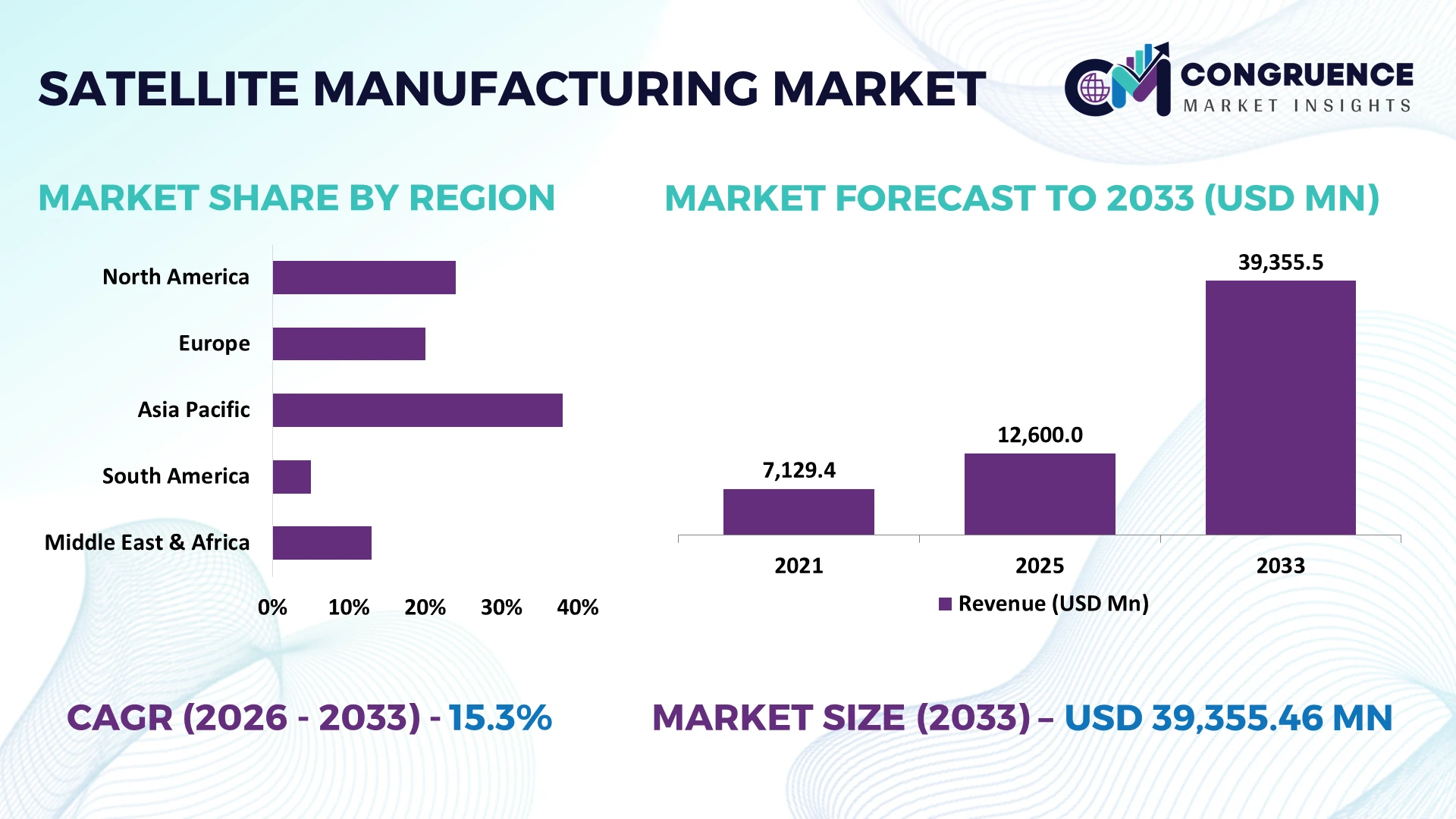
The United States remains the dominant satellite manufacturing hub, accounting for approximately 42% of global production capacity, supported by defense spending, commercial launch ecosystems, and sustained public-private investments exceeding USD 18 billion across strategic space programs. China follows with nearly 24% manufacturing capacity, expanding domestic production through vertically integrated aerospace industries and increasing deployment of high-throughput satellites by more than 20% in 2026 amid intensified global competition and evolving space security priorities.
Organizations prioritizing scalable manufacturing, resilient component supply chains, and advanced digital production capabilities will secure stronger positioning across the next generation of commercial and sovereign space programs.
Market Size & Growth: USD 12,600 million in 2025, reaching USD 39,355.46 million by 2033 at a 15.3% CAGR, driven by expanding LEO constellations, defense satellite procurement, and automated manufacturing.
Top Growth Drivers: LEO constellation deployment (+32%), defense space investment (+18%), and satellite miniaturization adoption (+26%) continue accelerating global demand.
Short-Term Forecast: By 2028, digital manufacturing reduces production cycles by 24% while AI-assisted engineering improves assembly efficiency by 19%.
Emerging Technologies: AI-driven design, additive manufacturing, and advanced composite materials improve structural performance by 17% while reducing production waste by 15%.
Regional Leaders: North America exceeds USD 15.8 billion, Asia-Pacific reaches USD 10.9 billion, and Europe approaches USD 8.2 billion, supported by regional manufacturing expansion and sovereign space initiatives.
Consumer/End-User Trends: More than 68% of new satellite orders originate from broadband, Earth observation, defense, and secure communications programs demanding faster deployment.
Pilot/Case Example: In 2026, automated satellite integration programs shortened assembly timelines by 22% while improving production consistency across high-volume manufacturing lines.
Competitive Landscape: The top five manufacturers collectively control approximately 48% of the global market, supported by integrated production capabilities and long-term government contracts.
Regulatory & ESG Impact: Sustainable manufacturing initiatives lower production waste by 14%, while evolving space sustainability requirements strengthen responsible satellite lifecycle management.
Investment & Funding: More than USD 21 billion in public and private investments supports advanced production facilities, strategic partnerships, and resilient global supply chain expansion.
Innovation & Future Outlook: Software-defined satellites, modular architectures, and digital twins accelerate next-generation manufacturing, strengthening competitiveness through flexible, high-volume production strategies.
Growing demand for broadband connectivity, Earth observation, secure defense communications, and climate monitoring continues reshaping the Satellite Manufacturing Market. AI-assisted engineering, modular satellite platforms, and advanced composite materials improve manufacturing productivity by nearly 20%, while supply-chain localization strengthens production resilience amid evolving geopolitical priorities and export compliance requirements. These developments establish a strong foundation for the strategic market analysis that follows.
The Satellite Manufacturing Market has become strategically important as governments, commercial operators, and defense organizations prioritize resilient space infrastructure, sovereign production capabilities, and secure communications. Supply-chain restructuring since recent geopolitical disruptions has accelerated localization of critical electronic components and propulsion systems, while digital manufacturing platforms shorten engineering cycles and strengthen production flexibility. This transition is reshaping competitive positioning as manufacturers increasingly integrate vertically to improve delivery reliability and reduce dependence on imported subsystems.
Modern digital twin platforms combined with AI-assisted engineering reduce design validation time by nearly 30% compared with conventional engineering workflows while lowering prototype iterations by approximately 20%. The United States continues to lead large-scale satellite production through integrated aerospace ecosystems, whereas India is expanding cost-efficient manufacturing supported by domestic launch capabilities and growing private-sector participation. Over the next two to three years, automated assembly is expected to exceed 45% adoption across advanced manufacturing facilities, improving production consistency while supporting higher satellite deployment rates.
A practical example is the deployment of modular production lines that allow manufacturers to assemble multiple satellite variants using standardized subsystems, reducing integration complexity and accelerating order fulfillment. Companies are expanding strategic partnerships with semiconductor suppliers, launch providers, and software developers while increasing investment in automated testing infrastructure. Organizations that combine scalable manufacturing, resilient supply networks, and rapid product customization will strengthen competitive advantage and secure long-term leadership across commercial and sovereign space programs.
Large-scale deployment of low Earth orbit satellite constellations is transforming production priorities, requiring manufacturers to deliver higher volumes with shorter lead times. Automated production lines improve assembly efficiency by approximately 24%, while standardized satellite platforms reduce manufacturing time by nearly 18%. More than 60% of newly commissioned commercial satellites now emphasize compact architectures and software-defined functionality. The United States continues expanding defense-oriented satellite procurement, while India is strengthening domestic manufacturing through private aerospace participation and industrial policy support. In response, companies are investing in digital factories, forming long-term supplier partnerships, and expanding modular production capacity to improve throughput, reduce integration costs, and strengthen resilience against component shortages.
Dependence on radiation-hardened semiconductors, advanced sensors, and specialized propulsion components continues to constrain manufacturing scalability. Delivery timelines for selected space-grade electronics remain around 25% longer than standard industrial components, while procurement costs for qualified subsystems have increased by approximately 15% because of limited supplier availability. Export control requirements further complicate cross-border sourcing for strategic technologies. Manufacturers in Japan and Europe are responding by qualifying alternative suppliers, expanding localized component production, and securing multi-year procurement agreements. These initiatives improve operational continuity, yet supplier concentration remains a structural limitation affecting production planning, inventory management, and contract execution across high-value satellite programs.
Artificial intelligence, digital engineering, and modular satellite architectures are creating substantial operational opportunities beyond conventional manufacturing expansion. AI-enabled quality inspection improves defect detection accuracy by approximately 28%, while additive manufacturing reduces selected structural component weight by nearly 20%. India is rapidly emerging as a competitive engineering and subsystem development hub through expanding private investment and supportive space-sector reforms. Companies are establishing collaborative research ecosystems with launch providers, software developers, and advanced materials specialists to accelerate product development. The growing adoption of software-defined satellites also enables post-launch functionality upgrades, creating differentiated service models and long-term customer value while improving manufacturing flexibility.
Sustaining high-volume satellite production requires greater manufacturing standardization without compromising cybersecurity, quality assurance, or mission reliability. Digital manufacturing environments increase operational efficiency but also expand cyber exposure, with industrial cybersecurity investments rising by approximately 22% across aerospace production facilities. Workforce shortages in specialized satellite systems engineering remain close to 18% in several advanced manufacturing economies, slowing production scale-up. The United States and Germany are increasing investment in workforce development, secure digital infrastructure, and automated verification systems to address these constraints. Manufacturers that integrate secure digital operations, advanced workforce capabilities, and interoperable production standards will achieve stronger deployment consistency and maintain long-term competitive differentiation.
AI-Enabled Production Workflows AI-assisted engineering and digital manufacturing platforms are reshaping satellite production by reducing design validation time by nearly 30% and improving first-pass manufacturing quality by around 18%. Growing labor shortages in specialized aerospace engineering are accelerating automation adoption, prompting manufacturers in the United States and Japan to expand AI-integrated assembly, predictive quality control, and digital collaboration across global supplier networks.
Localized Supply Chain Strategies Manufacturers are restructuring procurement as export controls and critical component constraints continue influencing production planning. Approximately 35% of leading satellite producers have expanded localized sourcing, while inventory buffers for radiation-hardened electronics have increased by nearly 20%. Companies are establishing regional supplier partnerships, dual-sourcing strategies, and long-term semiconductor agreements to strengthen delivery reliability and reduce operational disruption.
Software-Defined Satellite Integration Demand for software-defined payloads is transforming manufacturing priorities, with configurable onboard systems increasing by approximately 25% across new commercial programs. Modular electronics simplify future upgrades while reducing redesign requirements by nearly 15%. Satellite manufacturers are expanding partnerships with software developers and avionics specialists to deliver adaptable platforms capable of supporting evolving communication, navigation, and defense missions.
Advanced Materials and Digital Testing Lightweight composite structures and automated environmental testing are improving manufacturing efficiency and operational performance. Composite integration reduces structural mass by approximately 18%, while automated qualification systems shorten testing cycles by nearly 22%. European manufacturers are increasing investment in digital qualification laboratories and advanced material partnerships to accelerate certification, improve production consistency, and strengthen competitiveness in high-volume satellite manufacturing.
Nanosatellites represent the leading segment with an estimated 41% share, supported by lower production costs, shorter manufacturing cycles, and strong deployment across commercial communications and Earth observation programs. Their standardized architecture enables rapid integration and constellation scalability, making them the preferred choice for high-volume missions. Microsatellites continue serving applications requiring higher payload capacity without significantly increasing launch costs, while large satellites retain strategic importance for complex defense, navigation, and telecommunications missions requiring long operational lifespans.
Minisatellites are the fastest-growing segment as operators seek greater payload flexibility and enhanced onboard processing while maintaining cost efficiency. Adoption has increased by approximately 23% across advanced imaging and secure communications programs, while modular manufacturing has reduced subsystem integration time by nearly 17%. Manufacturers are expanding dedicated production lines, strengthening subsystem partnerships, and investing in adaptable satellite platforms that support multiple mission profiles. This shift is directing investment toward scalable manufacturing capabilities while maintaining specialized production for larger strategic spacecraft.
Communication remains the largest application segment, accounting for approximately 46% of satellite manufacturing demand as broadband connectivity, mobility services, and secure enterprise networks continue expanding globally. Large communication constellations require standardized production methods and rapid deployment schedules, encouraging manufacturers to optimize throughput and digital integration. Defense & Intelligence represents the fastest-growing application, with procurement activity increasing by approximately 21% as governments strengthen resilient communications and space-based surveillance capabilities.
Earth Observation continues expanding through climate monitoring, agriculture, and industrial analytics, while Navigation satellites remain essential for transportation and critical infrastructure services. Scientific Research maintains a specialized but strategically valuable position through technology demonstration and advanced exploration missions. Manufacturers are increasing automation, strengthening payload integration capabilities, and collaborating with mission operators to shorten development timelines. Higher subsystem standardization has improved production efficiency by approximately 19%, enabling companies to respond more effectively to diverse mission requirements while strengthening operational flexibility.
Government agencies remain the dominant end-user group with an estimated 44% market share, supported by sustained investment in national security, civil space infrastructure, weather monitoring, and strategic communications. Large procurement programs, long-term development cycles, and sovereign manufacturing priorities continue concentrating demand within public-sector organizations. Commercial Operators represent the fastest-growing end-user segment, with satellite fleet expansion increasing by approximately 24% as broadband connectivity and private space services accelerate worldwide.
Defense Organizations continue strengthening demand for secure communication and intelligence satellites, while Research Institutions support specialized scientific missions and technology validation programs. Manufacturers are responding by offering modular spacecraft, customized payload integration, and long-term service agreements tailored to mission-specific requirements. More than 55% of new commercial procurement programs now prioritize flexible satellite architectures, encouraging companies to build stronger technology partnerships and develop configurable production ecosystems that improve delivery speed and operational responsiveness.
North America accounted for the largest market share at 41.8% in 2025 however, Asia-Pacific is expected to register the fastest growth, expanding at a 17.1% CAGR between 2026 and 2033.

Integrated Defense and Commercial Space Leadership
North America remains the global center of satellite manufacturing through its mature aerospace ecosystem, vertically integrated supply chains, and strong government-commercial collaboration. The region contributes nearly 42% of global satellite production, supported by high deployment rates across communication, Earth observation, and national security missions. Advanced digital engineering, automated assembly, and software-defined payload integration continue reducing production lead times by approximately 22%. Public-private partnerships are expanding manufacturing capacity while specialized semiconductor and propulsion investments strengthen supply resilience. Enterprise demand for high-throughput satellites and proliferated low Earth orbit constellations continues driving factory modernization, with manufacturers prioritizing scalable production platforms capable of supporting both defense and commercial missions.
United States Market Outlook: The United States maintains the world's strongest satellite manufacturing base through advanced aerospace infrastructure, established launch capabilities, and sustained defense procurement. More than 60% of North America's satellite production is concentrated within the country, supported by integrated component suppliers and digital manufacturing investments. Companies continue expanding automated production facilities, strengthening semiconductor partnerships, and accelerating modular satellite development to improve production consistency and reduce delivery timelines.
Space Sovereignty and Industrial Modernization
Europe continues strengthening satellite manufacturing through sovereign space initiatives, collaborative industrial programs, and advanced engineering capabilities. The region accounts for approximately 24% of global manufacturing activity, supported by high-value communication, navigation, and Earth observation missions. Digital qualification systems have shortened product verification cycles by nearly 20%, while lightweight composite adoption continues improving manufacturing efficiency. Sustainability objectives are encouraging recyclable materials and energy-efficient production processes where technically feasible. Companies increasingly collaborate across national aerospace clusters to improve subsystem standardization, strengthen supply resilience, and accelerate deployment schedules for strategic satellite programs.
France Market Outlook: France serves as Europe's leading satellite manufacturing hub through its advanced aerospace ecosystem, engineering expertise, and strong institutional space programs. National manufacturers continue investing in modular spacecraft platforms and digital production technologies, while strategic partnerships with launch providers and electronics suppliers improve manufacturing flexibility. Approximately 35% of Europe's large satellite integration capability is concentrated within France, reinforcing its position in complex commercial and governmental missions.
Rapid Manufacturing Scale and Private Sector Expansion
Asia-Pacific is experiencing the fastest operational expansion as governments and private enterprises accelerate investment in satellite production, launch infrastructure, and domestic component manufacturing. The region contributes roughly 28% of global satellite manufacturing output, with production capacity expanding by nearly 18% through new facilities and industrial modernization. Increasing localization of critical electronics and structural components strengthens supply-chain resilience while reducing import dependency. Commercial broadband projects, remote sensing programs, and defense modernization continue driving diversified manufacturing demand across emerging aerospace economies.
China Market Outlook: China remains the region's largest satellite manufacturing center through vertically integrated aerospace production, domestic launch capabilities, and sustained industrial investment. Manufacturing efficiency has improved by approximately 21% through greater automation and digital engineering adoption. Companies continue expanding standardized satellite platforms and high-volume production facilities while strengthening domestic supplier ecosystems to support communication, navigation, and Earth observation missions with reduced external technology dependence.
Emerging Space Infrastructure Development
South America continues expanding its satellite manufacturing capabilities through targeted investments in Earth observation, environmental monitoring, and communication infrastructure. Although the region contributes approximately 5% of global manufacturing activity, demand for domestically supported satellite programs is steadily increasing. Collaborative aerospace initiatives and technology transfer agreements are strengthening engineering capabilities while improving subsystem integration expertise. Infrastructure limitations remain, particularly in advanced component production, encouraging manufacturers to focus on specialized satellite assembly and regional partnerships rather than complete supply-chain independence.
Brazil Market Outlook: Brazil leads South America's satellite manufacturing landscape through established aerospace capabilities, government-backed research institutions, and expanding commercial space initiatives. National organizations continue strengthening partnerships with international technology providers while investing in domestic satellite integration facilities. More than half of the region's advanced satellite engineering activity is concentrated in Brazil, supporting communication, environmental monitoring, and agricultural observation programs with growing technical independence.
Strategic Investment in Space Infrastructure
The Middle East & Africa is strengthening its satellite manufacturing position through national diversification strategies, expanding space infrastructure, and increasing investment in advanced technology capabilities. The region represents approximately 4% of global manufacturing activity but continues improving technical capacity through international partnerships and local industrial development. Government-backed satellite initiatives support communication, climate monitoring, and security applications while encouraging knowledge transfer and workforce development. Manufacturing programs increasingly emphasize localized subsystem integration and advanced engineering collaboration to improve long-term operational capability.
United Arab Emirates Market Outlook: The United Arab Emirates has established itself as the region's leading satellite manufacturing and space technology hub through sustained investment, innovation-focused policies, and international collaboration. National aerospace programs continue expanding satellite integration facilities while strengthening engineering talent and research capabilities. Recent manufacturing modernization initiatives have improved project execution efficiency by approximately 18%, reinforcing the country's strategic role in advanced satellite development and regional space technology leadership.
The market is led by Airbus, Lockheed Martin, Thales Alenia Space, Boeing, and Northrop Grumman, competing directly with emerging manufacturers specializing in small satellites and modular spacecraft platforms. The top five players collectively control approximately 48% of the market through integrated engineering, manufacturing, and mission support capabilities. Competition centers on production speed, digital manufacturing, payload customization, and resilient supply chains, with automated production reducing assembly time by nearly 22% and modular architectures lowering integration effort by approximately 18%. Global leaders pursue vertical integration, strategic semiconductor partnerships, and expanded manufacturing capacity, while agile innovators focus on rapid development cycles and software-defined satellite platforms. Supply-chain localization and advanced automation are reshaping competitive dynamics as manufacturers seek greater operational control. High qualification requirements, specialized component availability, and certification complexity remain significant entry barriers. Sustainable competitive advantage depends on scalable production, secure supply ecosystems, engineering excellence, and rapid delivery of mission-specific satellite solutions.
Airbus
Lockheed Martin
Boeing
Northrop Grumman
Thales Alenia Space
Maxar Technologies
Mitsubishi Electric Corporation
OHB SE
Israel Aerospace Industries
Ball Aerospace
SSTL (Surrey Satellite Technology Limited)
Terran Orbital
York Space Systems
NanoAvionics
Satellite manufacturing is rapidly transitioning toward AI-assisted engineering, digital twins, and automated assembly integration. AI-driven design validation reduces engineering cycles by approximately 28%, while automated inspection improves manufacturing accuracy by nearly 18%. Around 48% of advanced satellite production facilities are integrating digital manufacturing platforms to standardize workflows and shorten qualification timelines. These technologies enable faster configuration changes, lower rework rates, and stronger production consistency, providing manufacturers with measurable operational advantages across commercial and defense satellite programs.
Emerging technologies include additive manufacturing, software-defined satellite architectures, and advanced composite materials. Additive manufacturing lowers selected structural component production costs by approximately 20%, while lightweight composites reduce satellite mass by nearly 17%, improving launch efficiency. More than 40% of newly developed small satellite platforms now incorporate modular subsystem designs that simplify payload integration and future upgrades. Compared with conventional manufacturing methods, digitally integrated production improves overall assembly efficiency by nearly 25%, allowing manufacturers to respond faster to customized mission requirements while reducing production bottlenecks.
Disruptive innovation between 2026 and 2028 will center on autonomous production systems, AI-powered quality assurance, and predictive manufacturing analytics. Adoption of automated testing is expected to exceed 55% among leading satellite manufacturers, improving qualification throughput by approximately 22%. Companies investing early in intelligent factories, modular production ecosystems, and software-centric spacecraft platforms will strengthen competitive positioning, while traditional manufacturers relying on manual engineering workflows risk slower delivery performance and reduced participation in high-volume constellation programs.
January 2024 Airbus completed the acquisition of Eutelsat OneWeb's 50% stake in Airbus OneWeb Satellites, gaining full ownership of the Florida manufacturing facility that previously produced more than 600 satellites at rates reaching two satellites per day, strengthening high-volume production capability. Source: Airbus
October 2025 Airbus, Leonardo, and Thales signed a memorandum of understanding to combine satellite manufacturing and space systems activities into a unified European company expected to employ about 25,000 people, strengthening industrial competitiveness and strategic autonomy.
January 2026 Airbus secured a contract from Eutelsat to manufacture an additional 340 OneWeb low Earth orbit satellites, increasing total orders to 440 satellites while introducing upgraded onboard digital processing technologies for future constellation continuity.
July 2026 Airbus, Greenerwave, and Thales received the French DGA CAMELEON contract to develop and manufacture multi-orbit satellite communication terminals supporting LEO, MEO, and GEO operations, including an initial production batch for defense deployment. Source: Airbus Space Solutions
This report provides comprehensive coverage of satellite manufacturing across nanosatellites, microsatellites, minisatellites, and large satellites, together with detailed assessment of communication, Earth observation, navigation, scientific research, and defense applications. It evaluates demand across government agencies, commercial operators, defense organizations, and research institutions while examining production trends, deployment patterns, technology adoption, and competitive positioning across North America, Europe, Asia-Pacific, South America, and the Middle East & Africa. More than 45% of assessed manufacturing activity focuses on small satellite platforms reflecting ongoing deployment priorities.
The analysis examines digital manufacturing, AI-assisted engineering, software-defined satellites, additive manufacturing, advanced materials, and modular spacecraft architectures shaping operational competitiveness between 2026 and 2033. It delivers strategic intelligence on investment priorities, supply-chain resilience, industrial partnerships, manufacturing localization, and enterprise expansion strategies while benchmarking leading participants, emerging technology adopters, and niche innovation areas that influence long-term market positioning, procurement decisions, and sustainable competitive differentiation.
| Report Attribute/Metric | Report Details |
|---|---|
Market Revenue in 2025 | USD 12600 Million |
Market Revenue in 2033 | USD 39355.46 Million |
CAGR (2026 - 2033) | 15.3% |
Base Year | 2025 |
Forecast Period | 2026 - 2033 |
Historic Period | 2021 - 2025 |
Segments Covered | By Type
By Application
By End-User
|
Key Report Deliverable | Revenue Forecast, Growth Trends, Market Dynamics, Segmental Overview, Regional and Country-wise Analysis, Competition Landscape |
Region Covered | North America, Europe, Asia-Pacific, South America, Middle East, Africa |
Key Players Analyzed | Airbus, Lockheed Martin, Boeing, Northrop Grumman, Thales Alenia Space, Maxar Technologies, Mitsubishi Electric Corporation, OHB SE, Israel Aerospace Industries, Ball Aerospace, SSTL (Surrey Satellite Technology Limited), Terran Orbital, York Space Systems, NanoAvionics |
Customization & Pricing | Available on Request (10% Customization is Free) |




