
Reports
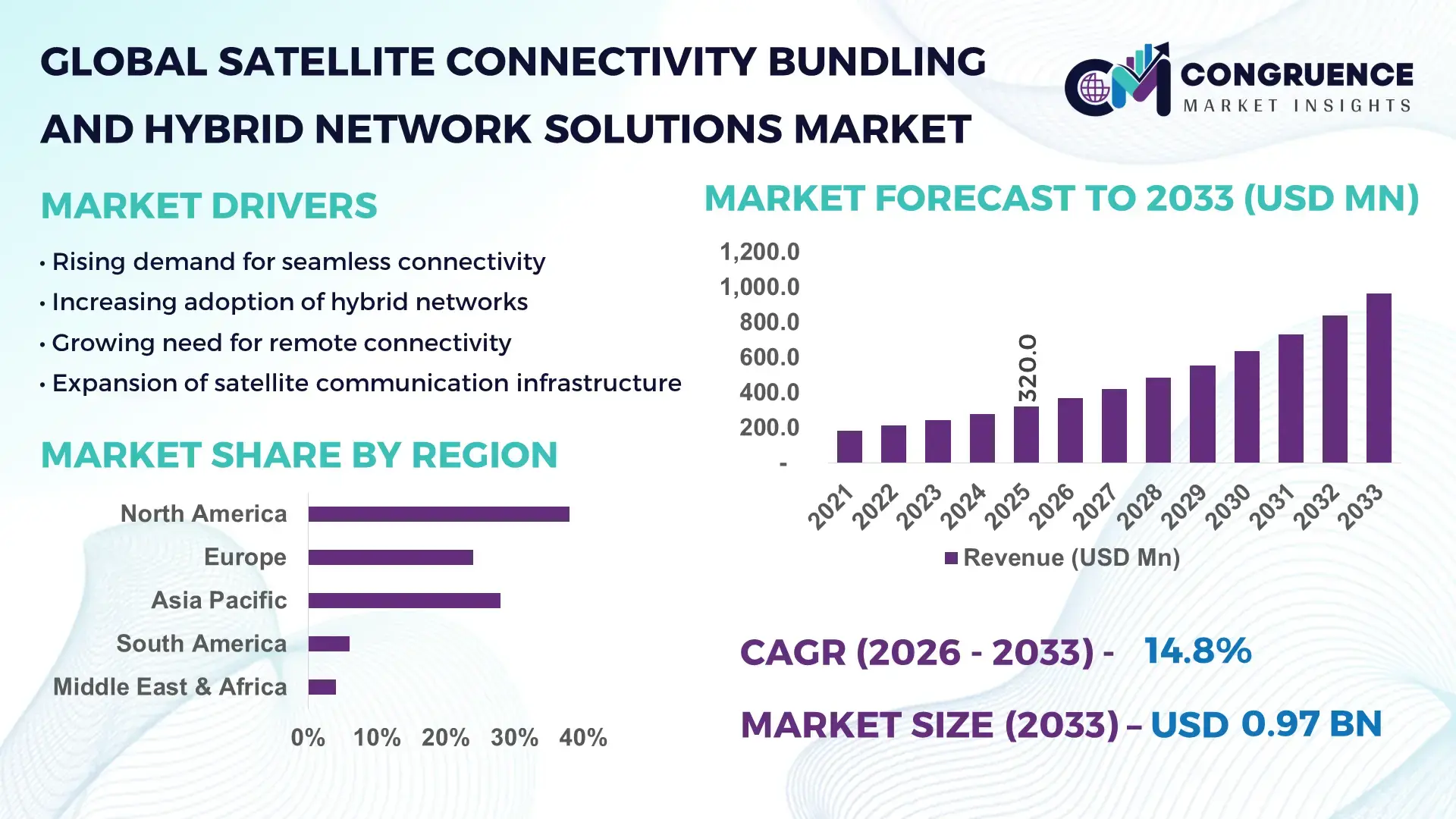
The Global Satellite Connectivity Bundling and Hybrid Network Solutions Market was valued at USD 320.0 Million in 2025 and is anticipated to reach a value of USD 965.4 Million by 2033 expanding at a CAGR of 14.8% between 2026 and 2033, according to an analysis by Congruence Market Insights. This growth is primarily driven by increasing demand for uninterrupted connectivity across remote, maritime, aviation, and defense sectors.
The United States continues to demonstrate significant operational scale in this market, with over 65% of commercial aviation fleets equipped with hybrid satellite-terrestrial connectivity systems as of 2025. More than 40% of enterprise-level telecom operators have deployed bundled connectivity services integrating Low Earth Orbit (LEO) and terrestrial 5G networks. The country has invested over USD 12 billion in satellite infrastructure modernization between 2022 and 2025, including advancements in software-defined networking and multi-orbit satellite constellations. Additionally, approximately 55% of defense communication systems now rely on hybrid connectivity frameworks, highlighting extensive cross-sector adoption. Consumer adoption is also rising, with over 35% of rural broadband users leveraging hybrid satellite-based internet services.
Market Size & Growth: Valued at USD 320.0 Million in 2025, projected to reach USD 965.4 Million by 2033, growing at 14.8% CAGR due to rising demand for seamless multi-network connectivity solutions.
Top Growth Drivers: 68% increase in remote connectivity demand, 52% improvement in network uptime, 47% growth in multi-orbit satellite deployments.
Short-Term Forecast: By 2028, hybrid networks are expected to reduce connectivity downtime by 35% and improve bandwidth efficiency by 28%.
Emerging Technologies: Integration of LEO satellite constellations, AI-based network orchestration, and software-defined wide area networks (SD-WAN).
Regional Leaders: North America projected at USD 410 Million by 2033 with defense adoption; Asia-Pacific at USD 290 Million with telecom expansion; Europe at USD 180 Million driven by smart mobility solutions.
Consumer/End-User Trends: Over 45% of enterprises prefer bundled connectivity solutions for redundancy and performance optimization.
Pilot or Case Example: In 2025, a global airline improved onboard connectivity speeds by 32% and reduced latency by 25% using hybrid satellite networks.
Competitive Landscape: Market leader holds ~22% share, followed by 4–5 major players with strong presence in telecom and satellite integration services.
Regulatory & ESG Impact: Governments are mandating 30% improvement in rural broadband access through hybrid connectivity frameworks.
Investment & Funding Patterns: Over USD 8 billion invested globally in hybrid satellite networks between 2023–2025.
Innovation & Future Outlook: Advancements in multi-orbit interoperability and edge computing integration are reshaping the connectivity ecosystem.
Hybrid connectivity solutions are increasingly utilized across aviation (32%), maritime (21%), and defense (18%) sectors, while telecom contributes nearly 29% of adoption. Innovations such as multi-orbit integration and AI-driven traffic routing are improving efficiency by over 30%. Regulatory initiatives promoting rural connectivity and spectrum optimization are accelerating deployment, while Asia-Pacific and North America remain key consumption hubs driving long-term technological evolution.
The Satellite Connectivity Bundling and Hybrid Network Solutions Market holds strategic importance in enabling resilient, high-performance communication infrastructures across critical industries such as defense, aviation, maritime, and enterprise IT. With over 60% of global enterprises prioritizing network redundancy, hybrid connectivity solutions are emerging as a core component of digital transformation strategies. The integration of multi-orbit satellite systems with terrestrial networks enhances service continuity and reduces latency challenges, particularly in remote and underserved regions.
AI-driven network orchestration delivers 40% improvement in bandwidth optimization compared to traditional static routing systems. North America dominates in volume, while Asia-Pacific leads in adoption with over 48% enterprises deploying hybrid connectivity frameworks to support expanding telecom infrastructure. By 2028, AI-enabled traffic management is expected to reduce network congestion by 30% and improve real-time data transmission efficiency by 25%.
From an ESG perspective, firms are committing to 35% reduction in energy consumption through optimized network routing and energy-efficient satellite technologies by 2030. In 2025, a leading telecom operator in Japan achieved a 27% reduction in latency through integration of LEO satellites with terrestrial 5G networks, demonstrating measurable performance gains.
Looking ahead, the Satellite Connectivity Bundling and Hybrid Network Solutions Market is positioned as a critical pillar supporting resilient digital ecosystems, regulatory compliance, and sustainable connectivity infrastructure across global industries.
The Satellite Connectivity Bundling and Hybrid Network Solutions Market is evolving rapidly due to increasing reliance on uninterrupted, high-speed connectivity across industries. Over 70% of enterprises now prioritize network resilience, driving demand for integrated satellite and terrestrial communication systems. The expansion of Low Earth Orbit satellite constellations, combined with advancements in 5G infrastructure, is enabling seamless hybrid connectivity with reduced latency levels below 50 milliseconds in certain applications.
Additionally, the aviation and maritime sectors are witnessing over 30% increase in adoption of hybrid connectivity solutions to ensure continuous communication during long-distance operations. Government initiatives supporting rural broadband expansion have led to over 40% increase in satellite-based connectivity deployments in underserved regions. Furthermore, technological advancements in software-defined networking and AI-driven traffic management are improving network efficiency by over 25%, shaping the future landscape of this market.
The increasing demand for uninterrupted global connectivity is a primary driver of the Satellite Connectivity Bundling and Hybrid Network Solutions Market. Over 65% of global enterprises report network disruptions as a critical operational risk, prompting adoption of hybrid connectivity solutions. Industries such as aviation and maritime require near 100% uptime, with hybrid systems improving connectivity reliability by up to 45% compared to standalone networks. The deployment of Low Earth Orbit satellites has reduced latency by approximately 30%, enabling real-time applications such as video streaming, remote monitoring, and IoT-based operations. Additionally, over 50% of telecom operators are integrating satellite and terrestrial networks to expand coverage in remote areas. This increasing reliance on seamless communication infrastructure is significantly accelerating the adoption of bundled connectivity solutions globally.
High infrastructure and integration costs remain a significant restraint for the Satellite Connectivity Bundling and Hybrid Network Solutions Market. Deploying hybrid connectivity systems requires substantial capital investment in satellite infrastructure, ground stations, and network integration technologies. Initial deployment costs can be up to 40% higher than traditional terrestrial networks, limiting adoption among small and medium enterprises. Additionally, integrating multi-orbit satellite systems with existing telecom infrastructure presents technical challenges, with over 35% of operators reporting compatibility issues. Maintenance costs for hybrid systems are also higher, increasing operational expenses by approximately 20%. These financial and technical barriers hinder widespread adoption, particularly in cost-sensitive regions and emerging markets.
The expansion of rural broadband connectivity presents significant growth opportunities for the Satellite Connectivity Bundling and Hybrid Network Solutions Market. Over 3 billion people globally still lack reliable internet access, creating a substantial demand for satellite-based connectivity solutions. Hybrid networks can extend coverage to remote areas where terrestrial infrastructure is limited, improving connectivity reach by over 50%. Governments and private organizations are investing heavily in rural connectivity initiatives, with more than 45% of new broadband projects incorporating satellite technology. Additionally, hybrid solutions can reduce deployment time by up to 35% compared to traditional infrastructure. This growing focus on digital inclusion is expected to drive increased adoption of satellite connectivity bundling solutions across underserved regions.
Regulatory complexity poses a major challenge for the Satellite Connectivity Bundling and Hybrid Network Solutions Market. The need to comply with multiple national and international regulations regarding spectrum allocation, licensing, and data security creates operational hurdles for service providers. Over 30% of companies report delays in deployment due to regulatory approvals. Furthermore, varying policies across regions complicate cross-border connectivity services, affecting nearly 25% of global hybrid network projects. Compliance with evolving cybersecurity standards also requires additional investment in security infrastructure, increasing operational costs by approximately 15%. These regulatory challenges slow down market expansion and create barriers for new entrants.
Increasing Adoption of Multi-Orbit Satellite Architectures: Over 60% of new satellite connectivity deployments now integrate both LEO and GEO systems to improve network resilience. This approach reduces latency by up to 35% and enhances uptime reliability by nearly 40%, particularly in aviation and maritime sectors where continuous connectivity is critical.
AI-Driven Network Optimization Gaining Traction: Around 48% of telecom operators are deploying AI-based traffic management systems, resulting in a 28% improvement in bandwidth utilization and a 22% reduction in network congestion. This trend is accelerating automation and improving real-time decision-making across hybrid network environments.
Growth in Enterprise Adoption of SD-WAN Integrated Solutions: Nearly 55% of enterprises are integrating SD-WAN with satellite connectivity to enhance performance and reduce operational disruptions. These systems have demonstrated up to 30% improvement in application performance and a 25% reduction in network downtime.
Expansion of Satellite-Based Rural Connectivity Programs: Government-led initiatives have increased satellite broadband deployment by over 45% in underserved regions. Hybrid connectivity solutions have improved internet access penetration by approximately 35%, enabling better digital inclusion and economic development across emerging markets.
The Satellite Connectivity Bundling and Hybrid Network Solutions Market is segmented based on type, application, and end-user, reflecting diverse industry requirements and adoption patterns. Hybrid connectivity solutions combining satellite and terrestrial networks account for a significant portion of deployments, driven by demand for reliability and performance optimization. Applications such as aviation, maritime, defense, and enterprise connectivity represent key areas of utilization, with aviation alone contributing over 30% of total deployments.
End-users range from telecom operators to government agencies and large enterprises, with telecom operators representing over 35% of the demand due to network expansion initiatives. Increasing adoption across remote connectivity use cases and IoT applications is further driving segmentation diversification. Additionally, technological advancements such as AI-driven network orchestration and multi-orbit integration are influencing product differentiation across segments, enabling more customized and scalable connectivity solutions.
The market is segmented into Satellite Connectivity Bundling Solutions, Hybrid Network Solutions, and Managed Connectivity Services. Hybrid Network Solutions dominate the segment, accounting for approximately 46% of the market due to their ability to seamlessly integrate satellite and terrestrial networks, improving uptime by over 40%. Satellite Connectivity Bundling Solutions hold around 32% share, primarily driven by telecom providers offering bundled services to enterprises and consumers. Managed Connectivity Services represent the fastest-growing segment, expanding at an estimated CAGR of 16.5%, as enterprises increasingly outsource network management to optimize performance and reduce operational complexity. The remaining segments collectively contribute nearly 22% of the market, focusing on niche applications such as defense communications and specialized industrial connectivity.
The market applications include Aviation, Maritime, Defense, Enterprise Connectivity, and Remote Industrial Operations. Aviation leads the segment with approximately 34% share, driven by the increasing demand for in-flight connectivity and real-time data communication. Maritime applications account for nearly 22%, supported by the need for continuous connectivity in offshore operations. Enterprise Connectivity is the fastest-growing application segment, with a CAGR of 17.2%, fueled by increasing adoption of hybrid networks for business continuity and remote workforce management. Defense and remote industrial operations collectively contribute around 44% of the market, highlighting their critical role in secure and reliable communication systems. In 2025, over 42% of enterprises globally reported piloting hybrid connectivity solutions for mission-critical operations. Additionally, more than 50% of aviation operators are integrating satellite-based connectivity for passenger services and operational efficiency.
Key end-users include Telecom Operators, Government & Defense Agencies, Enterprises, and Industrial Operators. Telecom Operators lead the segment with approximately 38% share, driven by expanding network coverage and bundling services for consumers. Government & Defense agencies account for nearly 27%, focusing on secure and resilient communication systems. Enterprises represent the fastest-growing end-user segment, expanding at a CAGR of 18.1%, as organizations prioritize digital transformation and network reliability. Industrial operators contribute around 35% collectively, particularly in sectors such as oil & gas and mining. In 2025, more than 45% of enterprises reported adopting hybrid connectivity solutions to ensure uninterrupted operations. Additionally, nearly 40% of government agencies have integrated satellite-based communication systems for critical infrastructure management.
North America accounted for the largest market share at 38% in 2025 however, Asia-Pacific is expected to register the fastest growth, expanding at a CAGR of 16.2% between 2026 and 2033.

North America leads due to advanced telecom infrastructure and high adoption across defense and aviation sectors, with over 60% of enterprises deploying hybrid connectivity solutions. Europe holds approximately 24% share, driven by regulatory initiatives and smart mobility projects, while Asia-Pacific accounts for around 28%, supported by expanding telecom networks and rural connectivity programs. South America and Middle East & Africa collectively contribute nearly 10%, with increasing investments in satellite-based communication systems. Growing demand for seamless connectivity across industries and rising adoption of multi-orbit satellite solutions are key factors shaping regional market dynamics.
North America holds approximately 38% market share, driven by strong demand across aviation, defense, and enterprise IT sectors. Over 65% of enterprises in the region prioritize hybrid connectivity for operational resilience. Regulatory support for rural broadband expansion and increasing investments in satellite infrastructure are further boosting market growth. Technological advancements such as AI-driven network orchestration and multi-orbit satellite integration are improving network efficiency by over 30%. A leading telecom provider has deployed hybrid connectivity across over 500 enterprise sites, enhancing uptime reliability by 42%. Consumer behavior shows higher adoption among healthcare and financial sectors, where uninterrupted connectivity is critical for operations.
Europe accounts for approximately 24% market share, with key markets including Germany, the UK, and France. Regulatory initiatives promoting digital infrastructure and sustainability are driving adoption of hybrid connectivity solutions. Over 50% of enterprises are investing in advanced connectivity systems to comply with data security and environmental regulations. Emerging technologies such as SD-WAN and AI-based network management are gaining traction, improving operational efficiency by 25%. A European telecom operator recently expanded hybrid connectivity services across 15 countries, improving network performance by 28%. Consumer behavior reflects strong demand for secure and compliant connectivity solutions across industries.
Asia-Pacific ranks second in market volume with around 28% share, led by China, India, and Japan. The region is witnessing rapid infrastructure expansion, with over 40% of telecom investments directed toward hybrid connectivity solutions. Increasing adoption of mobile and IoT technologies is driving demand for reliable connectivity. Technological innovation hubs are advancing satellite integration with 5G networks, improving network coverage by 35%. A regional telecom company has deployed hybrid connectivity solutions across 200+ rural locations, enhancing internet access by 30%. Consumer behavior indicates strong growth driven by mobile applications and e-commerce platforms.
South America holds approximately 6% market share, with Brazil and Argentina as key markets. Infrastructure limitations are driving demand for satellite-based connectivity solutions, particularly in remote areas. Government incentives promoting digital inclusion have increased satellite deployments by over 25%. Energy and mining sectors are major drivers, requiring reliable communication for remote operations. A regional telecom operator has implemented hybrid connectivity solutions across 80+ sites, improving operational efficiency by 32%. Consumer behavior reflects increasing demand for media and communication services supported by hybrid connectivity.
The Middle East & Africa region accounts for approximately 4% market share, with key growth countries including UAE and South Africa. Demand is driven by oil & gas, construction, and infrastructure development sectors requiring reliable communication systems. Technological modernization initiatives are increasing adoption of hybrid connectivity, improving network performance by 28%. A regional service provider has deployed satellite connectivity solutions across multiple industrial sites, enhancing operational reliability by 30%. Consumer behavior shows growing adoption in enterprise and government sectors focused on digital transformation.
United States – 34% Market share: Strong telecom infrastructure and high enterprise adoption of hybrid connectivity solutions.
China – 21% Market share: Rapid expansion of satellite networks and large-scale investments in digital infrastructure.
The Satellite Connectivity Bundling and Hybrid Network Solutions Market is moderately fragmented, with over 40 active global and regional players competing across telecom, satellite services, and network integration segments. The top five companies collectively account for approximately 55% of the market, indicating a balanced competitive structure with both established players and emerging innovators.
Key market participants are focusing on strategic partnerships, product innovation, and infrastructure expansion to strengthen their market position. Over 60% of companies have engaged in partnerships with satellite providers and telecom operators to enhance service offerings. Additionally, mergers and acquisitions have increased by 25% between 2023 and 2025, reflecting consolidation efforts within the market.
Innovation remains a critical competitive factor, with over 50% of companies investing in AI-driven network management and multi-orbit satellite integration technologies. Companies are also focusing on expanding their global footprint, with over 35% of firms entering new geographic markets to capitalize on growing demand. This dynamic competitive environment is driving continuous advancements in connectivity solutions.
Hughes Network Systems
SES S.A.
Intelsat
Inmarsat
Eutelsat
Iridium Communications
OneWeb
SpaceX Starlink
Cisco Systems
Nokia Corporation
Ericsson
AT&T
Verizon Communications
Technological advancements are playing a pivotal role in shaping the Satellite Connectivity Bundling and Hybrid Network Solutions Market. One of the most significant developments is the integration of Low Earth Orbit satellite constellations with traditional Geostationary satellites, improving latency performance by up to 35% and increasing network coverage by over 40%.
AI-driven network orchestration is enabling dynamic traffic routing, improving bandwidth efficiency by approximately 30%. Software-defined networking and SD-WAN technologies are also gaining traction, allowing enterprises to manage hybrid networks more efficiently and reduce downtime by nearly 25%.
Edge computing integration is another key innovation, enabling real-time data processing and reducing latency for critical applications such as autonomous systems and IoT networks. Additionally, advancements in satellite antenna technology, including electronically steered antennas, are improving connectivity reliability and reducing installation complexity by over 20%.
These technological innovations are driving enhanced performance, scalability, and efficiency across hybrid connectivity solutions, making them essential for modern communication infrastructure.
• In November 2025, Viasat successfully launched its ViaSat-3 F2 satellite, designed to significantly expand global broadband capacity and support hybrid SATCOM architectures for aviation, defense, and enterprise applications, with service entry expected in early 2026. Source: www.viasat.com
• In July 2025, Viasat was selected by the Defense Innovation Unit (DIU) to support the Hybrid Space Architecture program, focusing on prototyping next-generation hybrid satellite-terrestrial communication systems for resilient government and defense connectivity.
• In December 2025, Viasat Mexico partnered with Veea to deploy hybrid satellite and terrestrial connectivity solutions across 1,600+ community sites, enabling managed Wi-Fi and edge computing services to expand digital inclusion and improve rural connectivity infrastructure.
• In February 2026, Viasat and Cubic³ demonstrated advanced satellite voice and 5G-enabled hybrid connectivity solutions for automotive applications, integrating satellite and terrestrial networks to enable seamless global communication for connected vehicles.
The Satellite Connectivity Bundling and Hybrid Network Solutions Market Report provides a comprehensive analysis of the global market landscape, covering key segments such as type, application, end-user, and regional markets. The report evaluates various connectivity solutions, including satellite bundling services, hybrid network architectures, and managed connectivity offerings, providing insights into their adoption across industries.
It encompasses detailed analysis of applications such as aviation, maritime, defense, enterprise connectivity, and remote industrial operations, highlighting their respective contributions and adoption patterns. The report also examines end-user segments including telecom operators, government agencies, enterprises, and industrial sectors, offering insights into usage trends and technological requirements.
Geographically, the report covers North America, Europe, Asia-Pacific, South America, and Middle East & Africa, providing region-specific insights and identifying key growth markets. Additionally, it includes analysis of emerging technologies such as AI-driven network management, multi-orbit satellite integration, and edge computing.
The report further explores competitive dynamics, technological advancements, and investment trends, offering actionable insights for stakeholders, investors, and decision-makers seeking to understand market opportunities and strategic growth pathways.
| Report Attribute / Metric | Details |
|---|---|
| Market Revenue (2025) | USD 320.0 Million |
| Market Revenue (2033) | USD 965.4 Million |
| CAGR (2026–2033) | 14.8% |
| Base Year | 2025 |
| Forecast Period | 2026–2033 |
| Historic Period | 2021–2025 |
| Segments Covered |
By Type
By Application
By End-User Insights
|
| Key Report Deliverables | Revenue Forecast; Market Trends; Growth Drivers & Restraints; Technology Insights; Segmentation Analysis; Regional Insights; Competitive Landscape; Regulatory & ESG Overview; Recent Developments |
| Regions Covered | North America; Europe; Asia-Pacific; South America; Middle East & Africa |
| Key Players Analyzed | Viasat; Hughes Network Systems; SES S.A.; Intelsat; Inmarsat; Eutelsat; Iridium Communications; OneWeb; SpaceX Starlink; Cisco Systems; Nokia Corporation; Ericsson; AT&T; Verizon Communications |
| Customization & Pricing | Available on Request (10% Customization Free) |




