
Reports
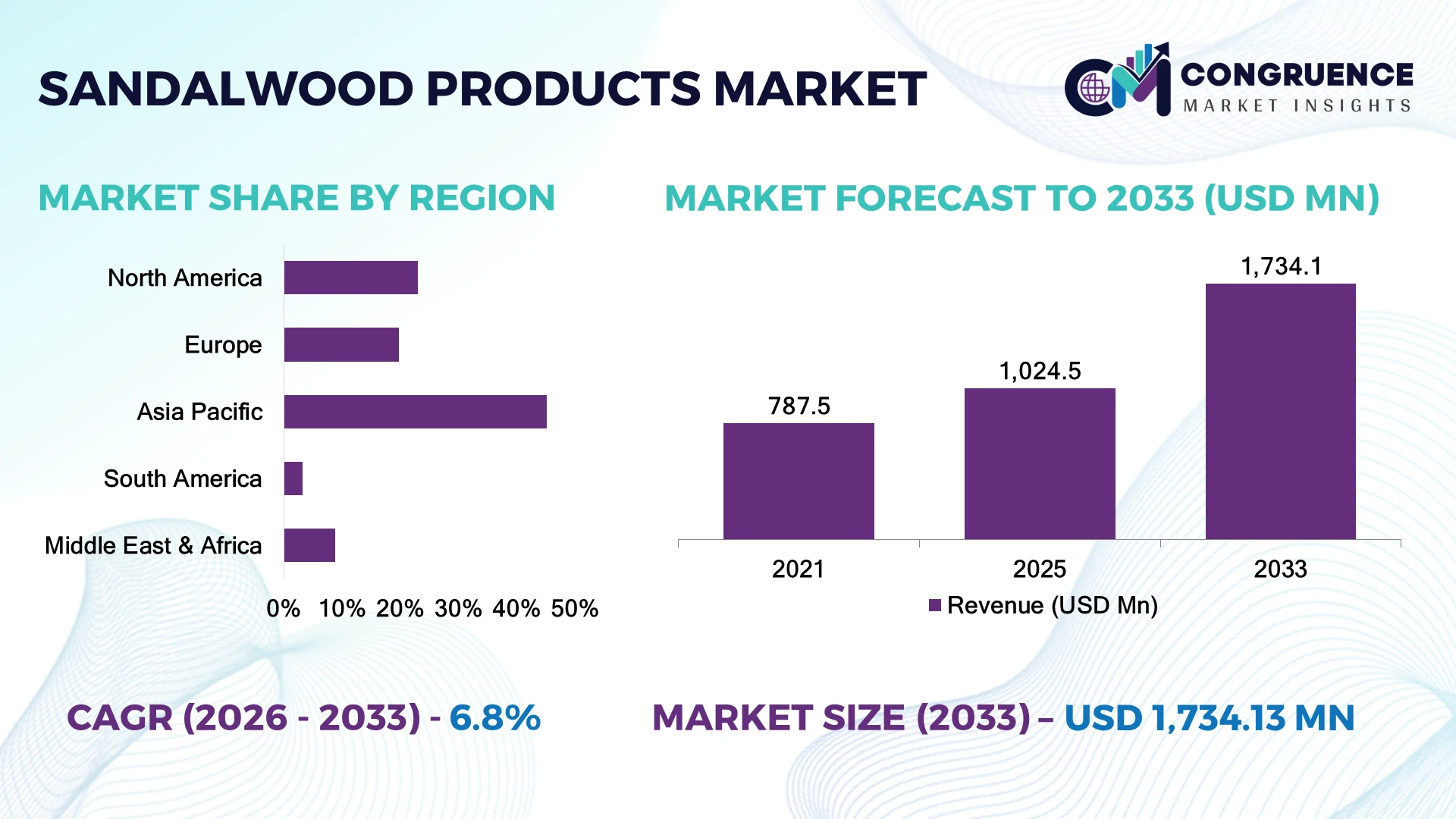
The Global Sandalwood Products Market was valued at USD 1,024.5 Million in 2025 and is anticipated to reach a value of USD 1,734.1 Million by 2033 expanding at a CAGR of 6.8% between 2026 and 2033. Growth is driven by premium fragrance, personal-care, aromatherapy, and pharmaceutical formulations increasingly prioritizing natural sandalwood oil and traceable botanical inputs.
India retains a premium position, with Indian sandalwood representing 58.6% of global sandalwood oil supply in 2025, while Western Australia manages about 6,000 hectares of sandalwood plantations and up to 2,500 tonnes of annual wild harvest. India’s traditional-use base contrasts with Australia’s plantation-led supply strategy, while 2026 regulatory scrutiny reinforces traceability across international trade.
The strategic priority is securing compliant feedstock and converting scarce sandalwood into higher-value oils, fragrances, cosmetics, and wellness products.
Market Size & Growth: USD 1,024.5 million in 2025 to USD 1,734.1 million by 2033 at 6.8% CAGR; advanced extraction and premium formulations strengthen value capture.
Top Growth Drivers: Sandalwood oil 51.8%, personal care and cosmetics 46.1%, Asia-Pacific 45.2%; premium downstream applications anchor demand.
Short-Term Forecast: By 2028, digital traceability and process automation target 2–4% higher processing efficiency and tighter batch consistency.
Emerging Technologies: Supercritical CO2 extraction, tissue culture, AI-assisted formulation, and precision plantation monitoring are improving yield control and product standardization.
Regional Leaders: Asia-Pacific USD 418.2 million, North America USD 212.5 million, Europe USD 183.4 million in 2025; APAC leads production-linked adoption.
Consumer/End-User Trends: Personal care and cosmetics account for 46.1%, reinforcing sandalwood oil integration into premium skincare, fragrance, and wellness products.
Pilot/Case Example: A 7.3-hectare Australian sandalwood trial produced 21.5 tonnes of commercial wood, validating irrigated cultivation and downstream oil production.
Competitive Landscape: Quintis leads plantation-integrated supply, alongside Santanol, RK-Essential Oils, Meena Perfumery, and Australian Botanical Products across premium oil and ingredient markets.
Regulatory & ESG Impact: Western Australia manages up to 2,500 tonnes of wild sandalwood annually under licensing and certified environmental-management frameworks, strengthening supply traceability.
Investment & Funding: A$20.8 million changed hands in 2025 for two sandalwood plantation aggregations, signaling active asset repositioning and disciplined agricultural capital allocation.
Innovation & Future Outlook: 2026–2028 competition will prioritize traceable plantations, advanced extraction, clean-label formulations, and vertically coordinated supply chains.
The Sandalwood Products Market is centered on essential oils, premium fragrances, cosmetics, incense, aromatherapy, and pharmaceutical formulations. Sandalwood oil represented 51.8% of 2025 product demand, while advanced extraction and plantation traceability strengthen supply control. Regulatory licensing and longer cultivation cycles are accelerating sourcing discipline, creating opportunities for integrated processors and premium ingredient suppliers.
Sandalwood is becoming strategically important because premium fragrance, cosmetics, wellness, and pharmaceutical manufacturers increasingly compete for traceable botanical inputs with limited natural supply. Sandalwood oil represented 51.8% of 2025 product demand, concentrating commercial value in processed, higher-margin formats rather than raw wood.
Supply-chain restructuring is accelerating as producers balance plantation-grown material with regulated wild harvesting. Western Australia manages about 6,000 hectares of sandalwood plantations, while India retains a stronger cultural and traditional-use base. Advanced extraction, particularly supercritical CO2 processing, offers tighter purity and yield control than conventional methods, supporting 2–4% processing-efficiency gains.
Through 2026–2028, companies are prioritizing plantation integration, digital traceability, extraction modernization, and formulation partnerships. Western Australian sandalwood management demonstrates how licensed harvesting, certification, and regeneration can strengthen supply resilience. The strongest competitive position will belong to companies controlling compliant feedstock while converting it efficiently into standardized oils, fragrances, cosmetics, and wellness ingredients.
Sandalwood oil represented 51.8% of product demand in 2025, while personal care and cosmetics accounted for 46.1% of application demand. Premium fragrance houses and skincare manufacturers are increasing sandalwood integration because standardized oil profiles improve formulation consistency and product differentiation. India’s established perfumery ecosystem is reinforcing downstream processing, while Australian plantation supply provides traceable feedstock. Companies are responding through plantation integration, distillation upgrades, and long-term procurement arrangements. The non-obvious shift is that value creation is moving from raw sandalwood availability toward controlled oil quality, making extraction capability and feedstock traceability more important than wood volume alone.
Sandalwood supply remains constrained by long cultivation cycles, regulated harvesting, and concentration of premium-grade feedstock. Oil already represents 51.8% of product demand, increasing pressure on consistent heartwood availability, while personal care and cosmetics absorb 46.1% of applications. Australia’s regulated harvesting framework and India’s controlled sandalwood trade create additional procurement complexity for processors. Companies face higher inventory requirements and greater working-capital exposure when securing mature material. Producers are reducing vulnerability through plantation diversification, contracted cultivation, certified sourcing, and alternative botanical formulations. The critical operational constraint is not processing capacity but maintaining predictable, compliant feedstock quality across multiple production cycles.
Technology-enabled cultivation presents an underdeveloped opportunity as producers seek more predictable sandalwood yields. Australia manages approximately 6,000 hectares of sandalwood plantations, creating a scalable base for precision irrigation, remote monitoring, and plantation analytics. Tissue-culture propagation and genetic selection can improve planting consistency, while digital traceability can reduce sourcing discrepancies by 2–4%. Companies are investing in plantation-management systems, specialized nurseries, and integrated extraction facilities. India offers additional opportunity through organized cultivation and downstream perfumery clusters. The strategic opportunity lies in linking plantation data directly with extraction planning, allowing processors to optimize harvest timing, oil quality, and inventory allocation rather than managing cultivation and manufacturing independently.
Natural sandalwood chemistry creates persistent standardization challenges because oil composition varies with species, age, geography, and heartwood characteristics. With sandalwood oil accounting for 51.8% of product demand, even 2–3% variation in key aromatic constituents can affect fragrance formulation consistency and batch acceptance. Australia’s plantation material and India’s traditional supply streams require different quality-control protocols. Companies are increasing laboratory profiling, batch traceability, and blending capabilities to stabilize finished-product specifications. The deeper challenge is scaling premium formulations without sacrificing botanical authenticity. Investment in analytical chemistry, digital batch records, and standardized extraction parameters will determine whether processors can maintain consistent quality as sourcing networks expand.
Traceability Becomes Commercial Infrastructure: Sandalwood processors are moving beyond basic origin documentation toward digitally managed batch traceability. With oil representing 51.8% of product demand, processors are linking plantation records, harvest data, extraction batches, and formulation inputs. Australia’s regulated harvesting environment is accelerating this workflow, while companies increasingly use traceability as a premium-product differentiator rather than solely a compliance requirement.
Premium Formulations Shift Product Mix: Personal care and cosmetics captured 46.1% of application demand in 2025, strengthening demand for standardized sandalwood oil, extracts, and fragrance ingredients. Manufacturers are shifting from undifferentiated raw-material sales toward refined formulations and branded ingredients. The operational change improves margin control while reducing exposure to commodity-style wood pricing, particularly among processors serving premium skincare and fragrance manufacturers.
Plantation Management Gets Data-Driven: Australian sandalwood cultivation is increasingly incorporating digital monitoring across approximately 6,000 hectares of managed plantations. Remote sensing, irrigation controls, and plantation analytics are improving visibility into tree development and resource allocation. Companies are pairing cultivation data with processing schedules, creating tighter supply planning. This integration addresses a non-obvious bottleneck: harvest timing directly influences downstream oil consistency and inventory utilization.
Regulated Supply Reshapes Procurement: Harvest licensing and sustainability requirements are pushing companies toward longer-term procurement structures rather than spot purchasing. Australia’s managed harvesting framework permits up to 2,500 tonnes of wild sandalwood annually, increasing the importance of compliant sourcing. Processors are responding through plantation partnerships, contracted supply, and diversified geographic sourcing, turning regulatory compliance into a supply-security mechanism rather than a standalone administrative requirement.
Sandalwood oil leads the global Sandalwood Products Market with approximately 51.8% share in 2025, supported by higher-value applications across fine fragrance, skincare, aromatherapy, and pharmaceutical formulations. Sandalwood wood and chips follow at about 34.2%, retaining importance as feedstock for oil extraction, incense, carving, and traditional products. Sandalwood powder accounts for nearly 14.0% and remains strategically relevant in cosmetics, herbal preparations, and ceremonial applications. Companies are prioritizing oil-processing capacity because downstream conversion captures substantially greater value than unprocessed wood sales.
The fastest-growing shift is toward premium, standardized oil and powder formats as buyers demand consistent aromatic profiles and traceable botanical origin. Natural inputs retain an authenticity advantage, while synthetic alternatives address cost-sensitive formulations. Australian plantation operators and Indian processors are therefore strengthening cultivation, extraction, quality testing, and long-term procurement. Investment is moving toward integrated processing rather than standalone raw-material trading.
Australia’s Forest Products Commission manages approximately 6,000 hectares of sandalwood plantations, reinforcing plantation-integrated supply as a strategic benchmark for commercial producers.
Personal Care & Cosmetics represents the leading application at approximately 46.2% of the Sandalwood Products Market in 2025. Its dominance reflects extensive sandalwood oil usage in premium skincare, soaps, fragrances, and botanical formulations where aromatic quality and natural positioning support product differentiation. Aromatherapy and Incense follows at roughly 28.3%, supported by wellness products, diffusers, ritual products, and premium home-fragrance formats. Pharmaceuticals account for about 16.4%, while Religious & Cultural applications contribute approximately 9.2%, maintaining concentrated demand in markets such as India.
Aromatherapy represents the strongest emerging use case as wellness brands broaden sandalwood-based formulations beyond traditional channels. Pharmaceutical applications remain more specification-intensive, requiring controlled purity and traceability. Companies are adapting through specialized grades, formulation partnerships, and expanded direct supply arrangements. The commercial implication is clear: manufacturers serving cosmetics and wellness buyers gain broader volume opportunities, while pharmaceutical suppliers compete primarily through quality assurance and regulatory readiness.
India’s AYUSH ecosystem continues supporting standardized botanical formulations, reinforcing institutional demand for authenticated plant-based ingredients and strengthening quality requirements across sandalwood processors.
Commercial users represent the leading end-user group, accounting for approximately 46% of global Sandalwood Products Market demand, as fragrance houses, cosmetics manufacturers, wellness companies, retailers, and hospitality businesses purchase sandalwood derivatives at recurring volumes. Industrial users contribute around 32%, particularly through fragrance ingredients, pharmaceutical processing, incense manufacturing, and specialized formulations. Individual consumers account for roughly 22%, supported by direct purchases of oils, powders, incense, and personal-care products.
Commercial procurement is becoming more specification-driven, while industrial buyers increasingly prioritize reliable batch quality and traceable sourcing. Individual consumption remains fragmented but benefits from e-commerce and premium wellness positioning. Companies are responding differently across these groups: commercial suppliers are expanding contract manufacturing and private-label capabilities, industrial processors are strengthening quality-control systems, and consumer brands are emphasizing packaged, authenticated products. The strategic shift favors suppliers capable of serving recurring institutional volumes without compromising botanical authenticity or documentation.
India’s regulated sandalwood trade framework places greater emphasis on licensed movement and documented sourcing, strengthening procurement discipline for commercial and industrial buyers.
Asia-Pacific accounted for the largest market share at 45.2% in 2025 moreover, Asia-Pacific is also expected to register the fastest growth, expanding at a CAGR of 8.3% between 2026 and 2033.

North America represented approximately 23.0% of the global Sandalwood Products Market in 2025, with the United States concentrating most regional demand. Premium fragrance, clean-label cosmetics, aromatherapy, and wellness formulations are driving greater use of standardized sandalwood oils and extracts. Specialty retail and online channels account for more than 55% of category volume, accelerating access to niche botanical products. U.S. formulators increasingly prioritize documented origin, purity testing, and consistent aromatic profiles as procurement requirements tighten. Companies are responding by expanding direct sourcing relationships, strengthening formulation partnerships, and developing higher-value oil grades. The key shift is from commodity-style sandalwood purchasing toward specification-led procurement, allowing suppliers with reliable traceability and formulation support to command stronger enterprise relationships.
United States Market Outlook: The United States is the principal North American market, accounting for approximately 19.9% of global demand in 2025. Its established luxury fragrance, personal-care, wellness, and specialty retail infrastructure supports premium sandalwood applications. Digital commerce is widening consumer access while formulation companies increasingly require consistent botanical specifications and transparent sourcing.
Europe accounted for approximately 19.8% of global Sandalwood Products Market demand in 2025, anchored by France, Germany, and the United Kingdom. The region’s established fragrance and cosmetics industries favor traceable, sustainably sourced sandalwood ingredients, while stringent formulation requirements increase the value of documented origin and consistent quality. France imported €303.8 million of essential oils in 2024, substantially ahead of Germany at €134 million, demonstrating the depth of the region’s botanical-ingredient infrastructure. Companies are emphasizing certified sourcing, specialized fragrance grades, and formulation partnerships to meet premium-product specifications.
France Market Outlook: France is the strategically significant European market because of its global perfumery ecosystem and substantial essential-oil procurement base. Essential-oil imports reached €303.8 million in 2024, providing established channels for sandalwood ingredients. Fragrance houses increasingly prioritize consistent aroma profiles and sustainable sourcing, creating opportunities for suppliers offering authenticated, specification-controlled sandalwood oils.
Asia-Pacific held approximately 45.2% of the global Sandalwood Products Market in 2025, supported by India’s traditional consumption base and Australia’s plantation-linked supply infrastructure. India is strengthening cultivation access, while Australia manages approximately 6,000 hectares of sandalwood plantations. Fragrance, cosmetics, traditional medicine, incense, and wellness applications create diversified demand across the region. Supply-chain integration is becoming more important as processors seek reliable heartwood for premium oils and extracts. Companies are investing in plantation management, extraction capacity, quality testing, and long-term procurement structures to reduce feedstock volatility.
India Market Outlook: India combines cultural demand with established perfumery, Ayurvedic, cosmetics, and traditional-product industries. Policy changes in 2026 allowing private sandalwood cultivation across an estimated 11,000 hectares strengthen the domestic supply base. Processors are positioned to benefit from greater cultivation participation while continuing to emphasize regulated movement, authenticated raw material, and downstream oil processing.
South America represented approximately 3.2% of global Sandalwood Products Market demand in 2025, with Brazil serving as the principal commercial market. Natural cosmetics, premium personal care, aromatherapy, and fragrance applications are creating selective demand for sandalwood oils and extracts. Brazil’s established beauty industry provides stronger commercialization infrastructure than smaller neighboring markets, while regional supply remains dependent on imported or specialized botanical ingredients. Companies are emphasizing distributor partnerships, smaller premium product portfolios, and direct relationships with beauty and wellness formulators. The strategic opportunity is concentrated in higher-value applications rather than broad commodity consumption, making product authentication, formulation support, and reliable import logistics more important than scale alone.
Brazil Market Outlook: Brazil is the strongest South American opportunity because of its large beauty and personal-care ecosystem and established consumer familiarity with natural oils. Premium skincare and fragrance channels provide an entry point for sandalwood ingredients, while e-commerce improves access to specialized products. Suppliers with localized distribution and documented botanical quality can reduce procurement friction and target higher-value formulations.
Middle East & Africa accounted for approximately 8.9% of global Sandalwood Products Market demand in 2025. Saudi Arabia, the UAE, and other Gulf markets are supported by premium perfumery, incense, luxury gifting, and traditional fragrance consumption. Sandalwood’s role as a durable base note positions it within higher-value fragrance formulations rather than purely mass-market products. Companies are strengthening specialty distribution, concentrated-oil portfolios, and relationships with regional perfumers. The region also offers an important diversification opportunity for suppliers seeking demand outside traditional Asian channels. Competitive advantage increasingly depends on authenticity, fragrance performance, concentrated formats, and reliable import logistics, particularly for premium retail and hospitality-linked fragrance programs.
Saudi Arabia Market Outlook: Saudi Arabia is strategically important because of its premium fragrance culture, luxury retail infrastructure, and established incense consumption. Sandalwood products benefit from demand for concentrated oils and prestige fragrance compositions. Suppliers with regional distribution, premium packaging, and authenticated sourcing can access higher-value buyers while avoiding direct competition with lower-priced mass-market botanical products.
Quintis, Santanol, KSDL, and specialist distillers such as Meena Perfumery and RK-Essential Oils compete across integrated supply, processing, and branded ingredients. Plantation leaders compete with Indian processors and downstream fragrance suppliers: the former prioritize feedstock control, while the latter win through formulation, distribution, and customization.
The top five manufacturers collectively control about 65% of sandalwood-oil supply, indicating concentrated premium sourcing. Competition centers on price, provenance, extraction quality, and supply reliability; certified traceability can command premium positioning, while processing optimization can reduce energy use by 12–18%.
Players are responding through plantation expansion, farmer partnerships, distribution agreements, and vertical integration. Santanol strengthened European cosmetics access through distribution, while KSDL is building domestic genetic resources. The competitive shift is toward controlled supply and authenticated quality. Long cultivation cycles and regulatory access remain major entry barriers. Winning requires secure feedstock, verified purity, scalable processing, and dependable delivery across premium fragrance and wellness channels.
Quintis
Santanol Group
Karnataka Soaps and Detergents Limited
Meena Perfumery
RK-Essential Oils Company
Naresh International
Katyani Exports
Essentially Australia
Sandalwood Forest
Jiangxi Jishui Natural Essential Oil Factory
Eden Botanicals
Plant Therapy Essential Oils
dōTERRA International
Haldin International
Technology adoption is moving from batch steam distillation toward continuous processing, digital traceability, and precision quality testing. Quintis’s continuous steam line produces four times more oil from the same steam volume, cuts water and energy requirements by 75%, and reduces A-grade distillation from nine days to two. Commercial-scale deployment demonstrates that process modernization improves throughput and unit economics for integrated producers.
Emerging technologies include tissue-culture propagation, genetic selection, remote plantation monitoring, and analytical profiling of α-santalol-rich oils. Indian sandalwood contains about 6–7% oil in heartwood versus roughly 2% for Australian S. spicatum, making species selection and controlled cultivation strategically important. IWST has supplied about 60,000 quality seedlings annually, providing a deployment base for improved planting material. These systems support tighter quality control, more predictable cultivation, and stronger product positioning.
Through 2026–2028, the disruptive advantage will come from linking plantation data with extraction, authentication, and formulation workflows. Compared with legacy manual conversion, continuous distillation delivers a documented 4x steam-productivity improvement and 75% lower water and energy requirements. Digital provenance systems will strengthen market access, while genetic-resource programs improve planting-stock consistency. Vertically integrated suppliers benefit most because they can connect cultivation, processing, testing, and customer specifications into one controlled chain.
April 2024 Santanol partnered with ECSA Chemicals to distribute Indian sandalwood products across the DACH cosmetics market. Clinical formulations used 0.1% and 0.5% sandalwood oil concentrations, expanding evidence-based skincare applications and strengthening Santanol’s access to European cosmetic formulators. Source: ecsa.ch
March 2025 Researchers at University of Agricultural Sciences Raichur evaluated commercial sandalwood plantations in Karnataka, identifying multiple-host planting and 6-by-6-meter geometry as superior approaches. Recommended density reached 554 trees per hectare, improving cultivation standardization and plantation planning for semi-arid conditions. Source: Springer Nature
October 2025 India’s Sandalwood Development Committee launched an inter-ministerial development report involving six central ministries and departments. The framework targets cultivation, processing, conservation, and trade reforms, strengthening policy coordination and creating clearer operating conditions for domestic sandalwood businesses and growers. Source: pib.gov.in
February 2026 Karnataka Soaps and Detergents Limited partnered with the Institute of Wood Science and Technology to establish India’s first sandalwood gene pool and germplasm bank. Karnataka also planned planting of 100,000 saplings, targeting better planting-stock quality and cultivation. Source: newindianexpress.com
The Sandalwood Products Market Report covers product categories including sandalwood oil, wood and chips, powder, incense, extracts, and value-added formulations. Segmentation evaluates applications across personal care and cosmetics, fine fragrance, aromatherapy, pharmaceuticals, religious and cultural uses, and other specialty applications. End-user analysis distinguishes commercial formulators, industrial processors, institutional buyers, and consumers.
Regional coverage spans North America, Europe, Asia-Pacific, South America, and Middle East & Africa, with country-level assessment of cultivation, processing, trade controls, distribution infrastructure, and premium-product adoption. Technology analysis covers advanced distillation, tissue culture, genetic selection, digital traceability, analytical authentication, and plantation monitoring. With natural sandalwood oil representing about 73.5% of the sandalwood-oil market, the report supports sourcing decisions, investment planning, expansion priorities, competitive positioning, partnership development, and product strategy through 2026–2033.
| Report Attribute/Metric | Report Details |
|---|---|
|
Market Revenue in 2025 |
USD 1,024.5 Million |
|
Market Revenue in 2033 |
USD 1,734.1 Million |
|
CAGR (2026 - 2033) |
6.8% |
|
Base Year |
2025 |
|
Forecast Period |
2026 - 2033 |
|
Historic Period |
2021 - 2025 |
|
Segments Covered |
By Type
By Application
By End-User
|
|
Key Report Deliverable |
Revenue Forecast, Growth Trends, Market Dynamics, Segmental Overview, Regional and Country-wise Analysis, Competition Landscape |
|
Region Covered |
North America, Europe, Asia-Pacific, South America, Middle East, Africa |
|
Key Players Analyzed |
Quintis, Santanol Group, Karnataka Soaps and Detergents Limited, Meena Perfumery, RK-Essential Oils Company, Naresh International, Katyani Exports, Essentially Australia, Sandalwood Forest, Jiangxi Jishui Natural Essential Oil Factory, Eden Botanicals, Plant Therapy Essential Oils, dōTERRA International, Haldin International |
|
Customization & Pricing |
Available on Request (10% Customization is Free) |




