
Reports
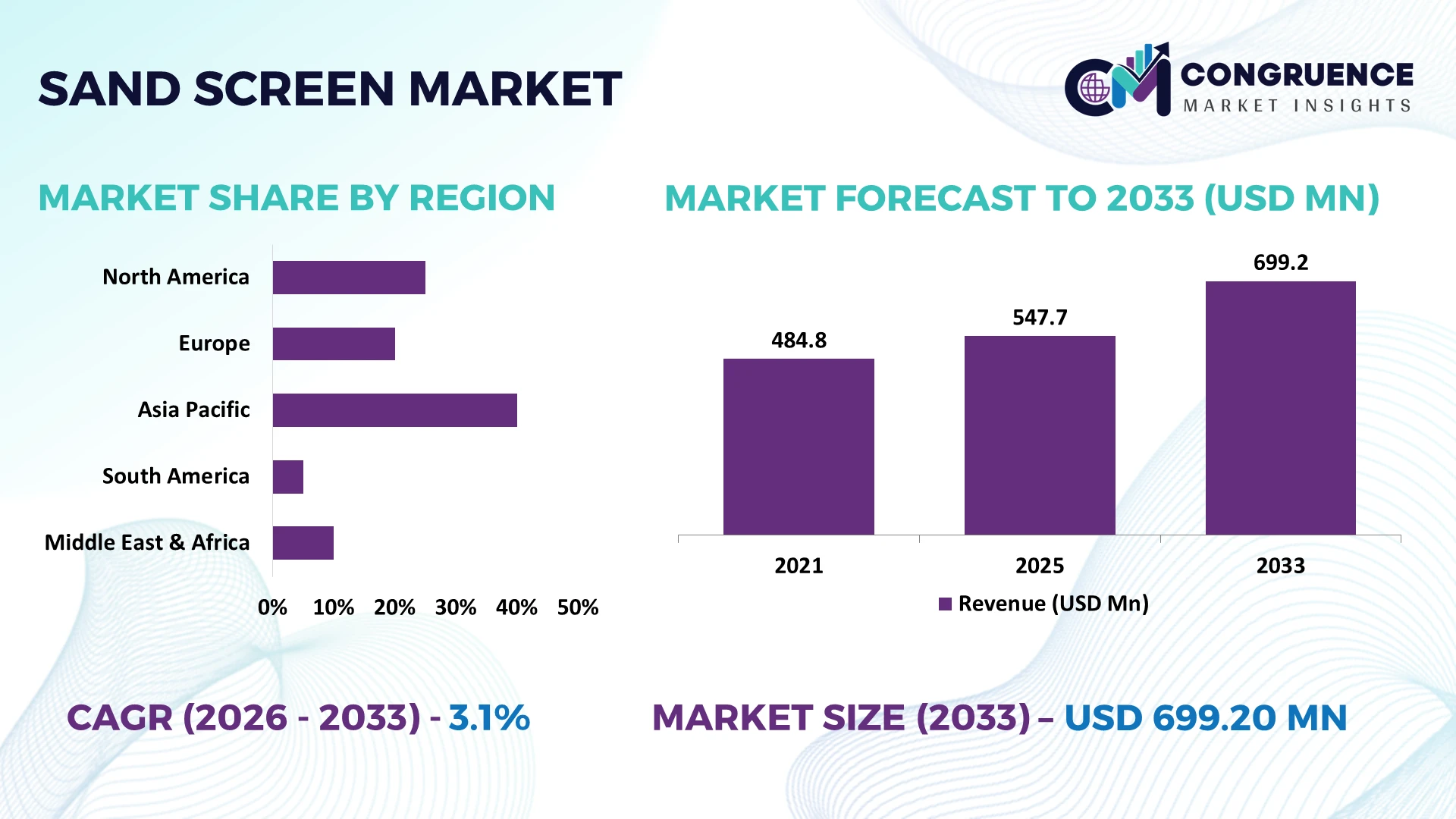
The Global Sand Screen Market was valued at USD 547.74 Million in 2025 and is anticipated to reach a value of USD 699.2 Million by 2033 expanding at a CAGR of 3.1% between 2026 and 2033. Growth is driven by rising horizontal and unconventional well completions, tighter sand-control requirements in unconsolidated reservoirs, and increased deployment of premium mesh, expandable, and inflow-control screen technologies across complex well architectures.
The United States remains the dominant country, representing about 78% of North America's sand-control market, supported by Permian, Eagle Ford, and Gulf of America activity; the Permian accounted for nearly 48% of U.S. crude production in 2025. Upstream investment remains substantial, with ExxonMobil allocating USD 24.7 billion to upstream activities in 2025, while Chevron planned nearly USD 6 billion for U.S. shale and tight assets in 2026. Stand-alone screens account for about 65% of global deployment, while advanced expandable and premium mesh configurations continue gaining adoption in higher-risk wells.
Strategic implication: suppliers should prioritize U.S. unconventional and offshore projects while differentiating through higher-flow, erosion-resistant, expandable, and application-specific screen designs.
Market Size & Growth: USD 547.74 million in 2025 to USD 699.2 million by 2033 at a 3.1% CAGR, supported by horizontal drilling and increasingly complex sand-control requirements.
Top Growth Drivers: Unconventional wells 71%; oil and gas operators 69%; stand-alone screens 65%, reflecting sustained demand for reliable downhole filtration.
Short-Term Forecast: By 2030, advanced screen deployment targets 10–15% lower intervention exposure through improved plugging resistance, erosion control, and completion reliability.
Emerging Technologies: AI-assisted screen selection, CFD-DEM modelling, premium multilayer mesh, and expandable systems are accelerating engineering precision and improving completion performance.
Regional Leaders: North America ~USD 259M, Middle East & Africa ~USD 182M, and Asia Pacific ~USD 147M by 2033, led by unconventional, offshore, and deepwater adoption.
Consumer/End-User Trends: Oil and gas operators represent about 69% of end-user demand, increasingly prioritizing lifecycle reliability, sand retention, and reduced workover frequency over initial procurement cost.
Pilot/Case Example: A 2025 Peciko Field intervention restored approximately 1.0 MMscfd of production while achieving zero surface sand, demonstrating the operational value of targeted sand-control deployment.
Competitive Landscape: North America holds roughly 37% of the market, with Halliburton, SLB, Baker Hughes, Weatherford, and regional manufacturers competing through completion reliability and customized screen architectures.
Regulatory & ESG Impact: Development projects represented about 89% of global upstream oil and gas investment in 2025, reinforcing demand for completion systems that reduce intervention frequency and operational exposure.
Investment & Funding: Global upstream investment reached approximately USD 620 billion in 2025, with North America accounting for about 36%, strengthening spending on advanced well-completion and sand-management technologies.
Innovation & Future Outlook: Next-generation screens increasingly integrate multilayer filtration, expandable architectures, erosion-resistant materials, and real-time monitoring, shifting procurement toward measurable lifecycle performance and longer well productivity.
The Sand Screen Market is increasingly shaped by high-sand unconventional reservoirs, offshore completions, mature-field redevelopment, and deeper wells where production continuity depends on precise particle retention and high flow efficiency. Premium mesh, expandable screens, autonomous inflow-control integration, and CFD-based design are gaining traction as operators target fewer interventions and longer well operating periods. Around 70% of oil and gas production wells face some level of sand-related operating challenge, strengthening the commercial case for advanced filtration and erosion-management solutions. The U.S. Permian, Middle East offshore fields, and Asian deepwater developments remain key demand areas, creating a stronger pipeline for technologically differentiated sand-control systems and setting the stage for deeper strategic analysis.
The Sand Screen Market is becoming strategically important as operators prioritize production continuity, well integrity, and lower intervention exposure across increasingly complex reservoirs. In high-sand formations, ineffective filtration can accelerate erosion, plugging, and workovers, directly affecting asset economics. The market is also shifting toward localized manufacturing and shorter supply chains as oilfield-service companies reduce exposure to cross-border component delays and prioritize regional completion inventories.
Advanced premium-mesh and expandable screens deliver approximately 10–15% higher effective flow capacity and can reduce intervention frequency by around 8–12% compared with conventional screen configurations in demanding wells. The United States remains the largest deployment center, led by Permian unconventional development, while Saudi Arabia and the UAE emphasize high-temperature, high-pressure applications and large offshore programs. Over the next 2–3 years, advanced screen adoption is positioned to increase by roughly 8–10 percentage points as operators standardize performance-based completion specifications.
Field deployments combining inflow-control devices with premium screens demonstrate how operators are moving from basic filtration toward integrated sand-management systems. Manufacturers are responding through localized production, engineering partnerships, and application-specific R&D. Competitive advantage will increasingly depend on screen reliability, deployment precision, and measurable lifecycle operating savings rather than hardware availability alone.
Increasing unconventional and high-rate well activity is strengthening demand for engineered sand-control systems. Horizontal wells now account for more than 70% of new U.S. oil wells, while high-rate completions place greater stress on filtration surfaces and erosion resistance. Premium multilayer screens can improve particle-retention consistency by approximately 10–15% versus basic configurations, reducing production interruptions. The Permian Basin remains the critical operational hub, where longer laterals and aggressive stimulation increase sand-management requirements. Manufacturers are responding with expandable screens, premium mesh geometries, and application-specific inflow-control integration. The non-obvious advantage is lifecycle optimization: operators increasingly evaluate screens by intervention avoidance and retained production rather than initial equipment cost.
Sand-screen economics remain exposed to stainless-steel, nickel-alloy, manufacturing, and specialized completion-component costs. Alloy-intensive configurations can carry 15–25% higher material costs than conventional designs, while imported components can add 5–10% to procurement lead times during logistics disruptions. U.S. operators increasingly favor domestic inventory and multi-supplier contracts to limit exposure to international shipping volatility. In Saudi Arabia and the UAE, high-temperature and corrosive environments also increase material-selection requirements, raising qualification costs. Companies are countering these pressures through supplier diversification, longer-term procurement agreements, and localized machining. The strategic constraint is not simply material pricing; inconsistent component availability can delay completion schedules and weaken service-company utilization.
Digital completion engineering creates an underpenetrated opportunity for intelligent sand-management systems combining screens, inflow-control devices, downhole monitoring, and predictive analytics. Integrated designs can improve production-flow management by approximately 8–12% while reducing unnecessary intervention exposure by 5–10% in suitable applications. The United States is advancing these systems through digitally optimized unconventional completions, while Gulf producers are applying them to complex offshore and high-temperature wells. AI-assisted CFD and particle-flow modelling are becoming more relevant for screen sizing and erosion prediction. Companies are positioning through R&D partnerships, integrated completion packages, and proprietary modelling platforms. A key opportunity lies in selling performance-based completion solutions rather than individual screens, increasing recurring engineering and service value.
Longer horizontal sections, heterogeneous formations, high-pressure environments, and variable particle-size distributions create execution challenges that conventional screen specifications cannot consistently address. Screen-selection errors can increase plugging or erosion exposure by 10–20%, while complex offshore interventions can require substantially longer service windows than standard onshore completions. U.S. unconventional operators face reservoir-to-reservoir variability, whereas Gulf producers increasingly manage high-temperature and high-pressure conditions requiring tighter qualification standards. Companies must strengthen computational modelling, laboratory qualification, field-data integration, and installation training to maintain deployment consistency. The critical long-term issue is scalability: expanding advanced screen systems without standardized digital design workflows can increase engineering complexity faster than production benefits, limiting operational consistency across large multi-well programs.
Longer Horizontal Wells Reshape Design: Permian average lateral length reached 10,867 feet in 2025, up 77% from 2015, while super-laterals above 15,000 feet reached 15% of new completions. Screen manufacturers are adapting wire geometry, erosion resistance, and deployment specifications for longer intervals, increasing demand for engineered rather than standardized systems.
Premium Filtration Gains Field Preference: Premium multilayer and high-flow screens are gaining adoption as operators manage finer formation particles and higher production velocities. Advanced configurations can deliver 10–15% higher effective flow performance, while high-flow wire-wrapped designs provide up to 2× erosion resistance. Suppliers are expanding application-specific designs instead of competing primarily on unit price.
Digital Qualification Enters Workflows: CFD-based erosion modelling, particle-flow simulation, and digital completion evaluation are moving earlier into screen-selection workflows. Computational screening can reduce physical design iterations by approximately 15–20%, while integrated monitoring improves post-completion diagnostics. Companies are pairing engineering teams with digital specialists to accelerate qualification for complex wells.
Supply Chains Shift Toward Localization: Higher steel costs and logistics uncertainty are encouraging U.S. and Gulf operators to favor regional inventories, dual sourcing, and longer procurement contracts. Upstream costs increased about 3% in 2025, while U.S. tariffs increased pressure on imported steel and aluminum. Manufacturers are responding with localized machining, buffer stock, and supplier diversification to protect completion schedules.
Wire-Wrapped Screens remain the leading type, accounting for approximately 34% of market demand because their scalable construction, high inflow capability, and compatibility with stand-alone and gravel-packed completions suit a broad range of wells. Premium Screens follow at about 25%, gaining share where fine sand, high production velocity, and erosion resistance justify higher specification. Slotted Liner Screens retain roughly 14% through lower-cost deployment in long intervals and lower-productivity formations. Companies continue optimizing wire geometry and base-pipe design to improve flow distribution without materially increasing installation complexity.
Expandable Screens represent the fastest-growing type, with adoption rising around 9–11% annually as operators address long-reach and irregular wellbore conditions. Their ability to expand against the formation improves coverage where conventional screens face placement limitations. Pre-Packed Screens retain niche demand near 10%, while Mesh Screens account for approximately 7% and remain relevant in formations requiring finer filtration. Manufacturers are prioritizing expandable architectures and premium mesh R&D, shifting investment toward applications where completion reliability offsets higher equipment costs.
Sand Control represents the leading application at approximately 31% share because uncontrolled formation sand directly threatens production equipment, flow assurance, and well integrity. Well Completion accounts for nearly 24%, supported by the integration of screens with gravel packs, inflow-control devices, and completion assemblies. Horizontal Wells are the fastest-growing application, with adoption increasing roughly 10–12% as longer laterals expose more reservoir surface and intensify inflow-management requirements. Companies are adapting screen geometry and deployment procedures for extended horizontal intervals rather than applying vertical-well specifications unchanged.
Gravel Packing remains strategically important at about 18%, particularly in unconsolidated formations, while Open-Hole Completion represents around 15% and Cased-Hole Completion approximately 12%. Open-hole systems retain advantages where formation access and lower completion complexity are priorities, whereas cased-hole designs provide greater placement control. Operators are increasingly combining sand screens with ICDs and alternate-path gravel-pack systems to improve interval coverage. The commercial shift is toward integrated completion packages that reduce intervention exposure rather than standalone filtration procurement.
Oil Producers represent the dominant end-user group at approximately 38% share, reflecting the high concentration of sand-control requirements in oil-focused unconventional and mature-field operations. Onshore Operators account for about 34%, supported by large well counts, established completion infrastructure, and faster deployment cycles. Offshore Operators are the fastest-growing end-user group, with adoption increasing approximately 9–11% as deepwater developments demand longer production intervals and stronger erosion resistance. Companies are targeting producers through standardized completion packages, while offshore suppliers emphasize qualification, reliability, and integrated engineering support.
Gas Producers represent roughly 14% of demand, while Well Service Companies and Drilling Contractors account for approximately 8% and 6%, respectively. Gas-focused buyers increasingly prioritize high-flow filtration, whereas service companies influence purchasing through completion design and field execution. Offshore operators are shifting toward premium and high-flow screen configurations, with suppliers expanding technical partnerships and regional service capabilities. The non-obvious competitive advantage is specification control: companies that secure early involvement in well-design decisions can influence screen selection before procurement becomes price-driven.
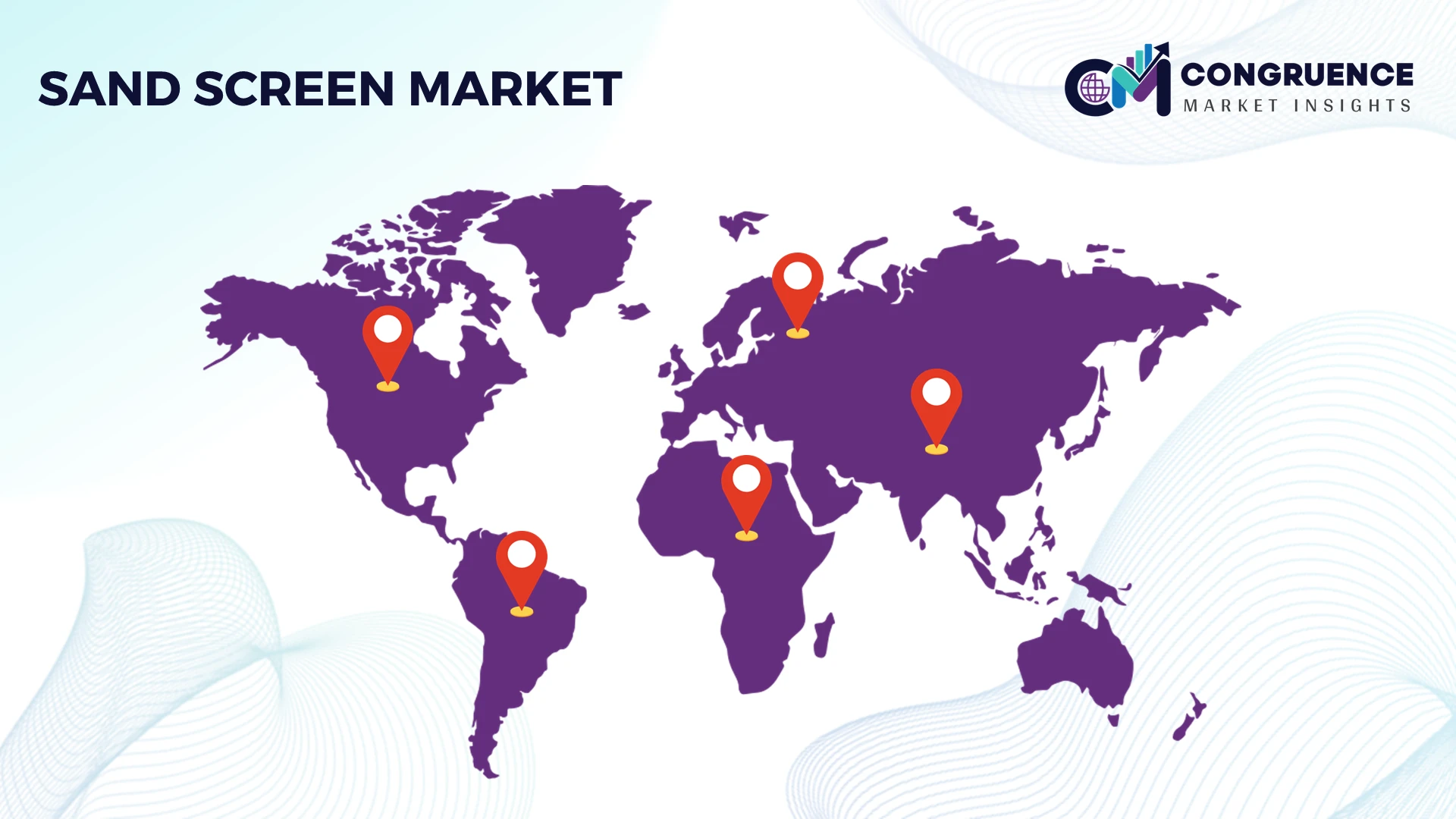
North America accounted for the largest market share at 37% in 2025 however, Asia-Pacific is expected to register the fastest growth, driven by expanding offshore development, unconventional drilling, and increasing adoption of engineered sand-control systems.
Unconventional drilling intensity strengthens premium sand-control deployment
North America remains the primary Sand Screen Market hub, supported by dense unconventional drilling activity across the Permian, Eagle Ford, Bakken, and Gulf of Mexico. The United States contributes more than 70% of regional oilfield sand-screen demand, with long horizontal wells increasing requirements for high-flow filtration, erosion resistance, and reliable deployment across extended intervals. Permian operators increasingly deploy engineered screen assemblies alongside inflow-control and gravel-pack technologies. U.S. upstream capital expenditure remains above USD 100 billion annually, sustaining equipment replacement and new-well completion demand. Manufacturers are responding through localized production, inventory expansion, digital engineering, and application-specific partnerships. The strategic shift is from standardized wire-wrapped products toward higher-value configurations that improve completion reliability, reduce intervention frequency, and support longer producing intervals.
United States Market Outlook: The United States offers the strongest combination of drilling scale, completion infrastructure, specialist service capacity, and screen manufacturing expertise. Permian horizontal development remains the principal demand center, with average lateral lengths exceeding 10,000 feet. Domestic suppliers benefit from shorter lead times, established service networks, and direct access to operators, strengthening customization and rapid field-support capabilities. Continued investment in unconventional and offshore assets supports demand for premium screens and integrated sand-management systems.
Mature assets drive selective modernization and efficiency-focused completions
Europe represents a technology-focused but comparatively selective Sand Screen Market, with demand concentrated in mature North Sea assets, offshore redevelopment, and specialized gas projects. The region emphasizes reliability, environmental compliance, and extending productive life from existing infrastructure rather than maximizing new-well volumes. Norway and the United Kingdom remain important deployment centers, with offshore operators favoring premium screens, erosion-resistant alloys, and completion designs capable of operating within constrained intervention windows. Norway's petroleum investment remains above NOK 200 billion annually, supporting subsea and brownfield activity. Operators are increasingly combining sand-control equipment with digital well monitoring and condition-based intervention planning. The key market distinction is higher specification intensity: European buyers place greater weight on lifecycle performance, certification, intervention reduction, and environmental operating efficiency than on lowest upfront equipment cost.
Norway Market Outlook: Norway is the region's most strategically significant market because of its offshore production base, advanced subsea infrastructure, and established completion-service ecosystem. More than 80% of its petroleum production comes from offshore fields, sustaining demand for reliable downhole filtration and specialized completion technologies. Operators increasingly favor premium materials, engineered screens, and digitally monitored systems where intervention costs are exceptionally high.
Offshore expansion and manufacturing depth accelerate deployment
Asia-Pacific is emerging as the fastest-expanding Sand Screen Market, supported by offshore developments in China, Southeast Asia, Australia, and India. China combines substantial domestic oilfield activity with a large manufacturing ecosystem, enabling faster sourcing of standard screen components and competitive fabrication. Indonesia and Malaysia are increasing offshore development, while Australia continues deploying sophisticated completion technologies in challenging reservoirs. China National Offshore Oil Corporation's offshore capital spending remains in the multi-billion-dollar range annually, supporting completion-equipment demand. Regional operators are also increasing localization to reduce imported-equipment exposure and procurement delays. Manufacturers are responding through regional fabrication, technical partnerships, inventory hubs, and localized engineering support. The non-obvious advantage is the combination of expanding well activity and lower manufacturing costs, allowing suppliers to scale premium designs without relying exclusively on Western production bases.
China Market Outlook: China combines large upstream operators, extensive drilling infrastructure, domestic fabrication capacity, and growing offshore development. Its manufacturing ecosystem supports shorter component lead times, localized customization, and competitive procurement for standard and premium configurations. Offshore production expansion and increasing use of advanced completion assemblies are strengthening demand for premium filtration, erosion-resistant materials, and engineered screen architectures.
Deepwater development concentrates demand around high-value wells
South America is becoming increasingly important for advanced sand-screen deployment as Brazil's offshore and pre-salt developments generate demand for high-reliability completion equipment. Brazil accounts for the overwhelming majority of regional offshore activity, with deepwater production exceeding 4 million barrels of oil equivalent per day in 2025. High-pressure reservoirs and long subsea production cycles favor premium screens, erosion-resistant materials, and integrated completion systems. Argentina's Vaca Muerta adds a second demand channel through unconventional horizontal drilling, although infrastructure and logistics remain less developed than in the United States. Operators are increasing local procurement and technical partnerships to reduce equipment lead times and strengthen field support. Suppliers with deepwater qualification, local service capability, and rapid engineering support hold an advantage as Brazil's offshore project pipeline expands.
Brazil Market Outlook: Brazil offers the strongest commercial opportunity through its deepwater and pre-salt production base. Petrobras remains the dominant operational buyer, with offshore projects requiring highly reliable completion systems capable of managing complex reservoir conditions and extended production cycles. Continued deployment of floating production infrastructure supports demand for engineered screens, premium materials, specialized installation services, and technically qualified suppliers.
Field modernization and high-rate wells support premium systems
Middle East & Africa demand is concentrated in Saudi Arabia, the UAE, Qatar, Oman, and selected African offshore developments. Saudi Arabia and the UAE are prioritizing reservoir optimization, mature-field redevelopment, and higher recovery from complex formations, creating demand for durable sand-control systems. Saudi Aramco's upstream capital allocation remains above USD 40 billion annually, supporting extensive drilling and completion activity. High-temperature and high-pressure wells increasingly require premium alloys, optimized filtration, and integrated inflow-control designs. Gulf operators are also emphasizing local manufacturing and supplier qualification to strengthen oilfield-equipment resilience. African offshore projects create additional demand for specialized screens but face longer logistics cycles and infrastructure constraints. Suppliers are therefore expanding regional service centers, stocking critical components, and forming local partnerships to secure large project contracts and improve response times.
Saudi Arabia Market Outlook: Saudi Arabia is the region's most influential market because of its exceptional production scale, extensive drilling programs, and sophisticated oilfield-service infrastructure. Large mature-field redevelopment programs require precise sand management across varied reservoir conditions, including high-rate and technically demanding wells. Local-content initiatives are encouraging suppliers to establish manufacturing, assembly, engineering, and technical-support capabilities inside the country, strengthening domestic supply resilience.
Halliburton, SLB, Baker Hughes, Weatherford, and specialist regional screen manufacturers compete across premium completion technology, customized filtration, and cost-focused supply. The top five global service players collectively command roughly 35–40% of the addressable sand-screen supply ecosystem, while regional manufacturers compete aggressively on fabrication cost, customization, and delivery speed. Premium engineered systems can command 10–20% higher pricing than conventional configurations, shifting competition toward lifecycle performance rather than equipment price alone. Global leaders are expanding through localized manufacturing, integrated completion packages, operator partnerships, and digital engineering, while regional suppliers use shorter lead times and application-specific fabrication to capture standardized applications. Vertical integration across screen design, completion engineering, and field services is strengthening customer lock-in and technical differentiation. The principal entry barrier is qualification for high-pressure, offshore, and long-horizontal applications, where failure costs are substantial. Winning suppliers need proven reliability, rapid customization, localized inventory, technical support, and integrated engineering capability rather than low pricing alone.
SLB
Halliburton
Baker Hughes
Weatherford International
Tendeka
Superior Energy Services
National Oilwell Varco
Hebei Shengkai Petroleum Machinery
Hebei Ruichang Petroleum Machinery
Shengli Oilfield Highland Petroleum Equipment
Yantai Jintai International Trade
Beijing Dongfang Yuzhu Petroleum Technology
PetroGuard
Variperm
Current sand-screen technology is shifting from conventional wire-wrapped designs toward premium multilayer mesh, erosion-resistant alloys, and formation-matched filtration. SLB’s MeshRite uses a 40% open-flow area versus up to 30% for conventional screens, improving flow capacity by roughly 33%. Baker Hughes also combines screens with autonomous inflow-control devices, improving flow management by about 1–2%. Adoption is strongest in long-horizontal, open-hole, and high-rate wells where plugging and erosion directly affect production continuity.
Emerging technologies include expandable and conformable screens, hydraulic activation, shape-memory polymer media, and automated screen-selection workflows. Weatherford’s ESS enables one-trip deployment, with a documented 54-well campaign recording zero sand-control failures; Baker Hughes’ GeoFORM can save one to three days of rig time per zone compared with conventional gravel-pack approaches. These systems reduce installation complexity by approximately 10–20% and favor suppliers capable of integrating screen design with completion engineering.
By 2026–2028, disruptive development will center on single-trip multizone completion, digital selection, real-time monitoring, and advanced materials. Halliburton’s 2026 OSTMZ system treats multiple zones in one trip, eliminating repeated deployment-tool repositioning. Competitive advantage will favor integrated-service leaders and technology specialists that combine filtration, automation, and completion intelligence to reduce rig exposure and improve well productivity.
May 2026 Halliburton launched OSTMZ, a single-trip multizone sand-control system treating multiple zones without tool repositioning or repeated surface testing. The deployment model targets lower rig exposure and higher reservoir coverage in complex completions. Source: halliburton.com
September 2026 Weatherford reported its first single-trip multizone gravel-pack lower completion in Trinidad and Tobago, reducing four runs to one and saving USD 5 million in rig time. The milestone strengthens integrated sand-control deployment economics. Source: weatherford.com
May 2025 Baker Hughes presented a conformable sand-control workflow using shape-memory polymer media and dual-action fluids at OTC. The technology targets problematic sand-producing wells while improving filter-cake removal and maintaining flow assurance. Source: onepetro.org
May 2024 Universiti Teknologi PETRONAS researchers published a comprehensive sand-screen review identifying selection, erosion, materials, and design as major performance variables. The study compared expandable, ceramic, metallic, polymer, and shape-memory materials, strengthening data-driven screen selection. Source: pmc.ncbi.nlm.nih.gov
The Sand Screen Market Report covers Wire-Wrapped Screens, Premium Screens, Expandable Screens, Pre-Packed Screens, Slotted Liner Screens, and Mesh Screens across Sand Control, Well Completion, Horizontal Wells, Gravel Packing, Open-Hole Completion, and Cased-Hole Completion applications. End-user coverage includes Oil Producers, Gas Producers, Drilling Contractors, Well Service Companies, Offshore Operators, and Onshore Operators. The analysis evaluates established configurations alongside expandable, conformable, erosion-resistant, and digitally optimized sand-control technologies.
Geographically, the report assesses North America, Europe, Asia-Pacific, South America, and Middle East & Africa, with country-level analysis of major production and deployment hubs. It evaluates technology adoption, completion complexity, supply-chain localization, manufacturing capacity, and competitive positioning. The report supports investment planning, product portfolio prioritization, regional expansion, partnership decisions, and competitive strategy by identifying deployment shifts and technology pathways influencing the market between 2026 and 2033.
| Report Attribute/Metric | Report Details |
|---|---|
Market Revenue in 2025 | USD 547.74 Million |
Market Revenue in 2033 | USD 699.2 Million |
CAGR (2026 - 2033) | 3.1% |
Base Year | 2025 |
Forecast Period | 2026 - 2033 |
Historic Period | 2021 - 2025 |
Segments Covered | By Type
By Application
By End-User
|
Key Report Deliverable | Revenue Forecast, Growth Trends, Market Dynamics, Segmental Overview, Regional and Country-wise Analysis, Competition Landscape |
Region Covered | North America, Europe, Asia-Pacific, South America, Middle East, Africa |
Key Players Analyzed | SLB, Halliburton, Baker Hughes, Weatherford International, Tendeka, Superior Energy Services, National Oilwell Varco, Hebei Shengkai Petroleum Machinery, Hebei Ruichang Petroleum Machinery, Shengli Oilfield Highland Petroleum Equipment, Yantai Jintai International Trade, Beijing Dongfang Yuzhu Petroleum Technology, PetroGuard, Variperm |
Customization & Pricing | Available on Request (10% Customization is Free) |




