
Reports
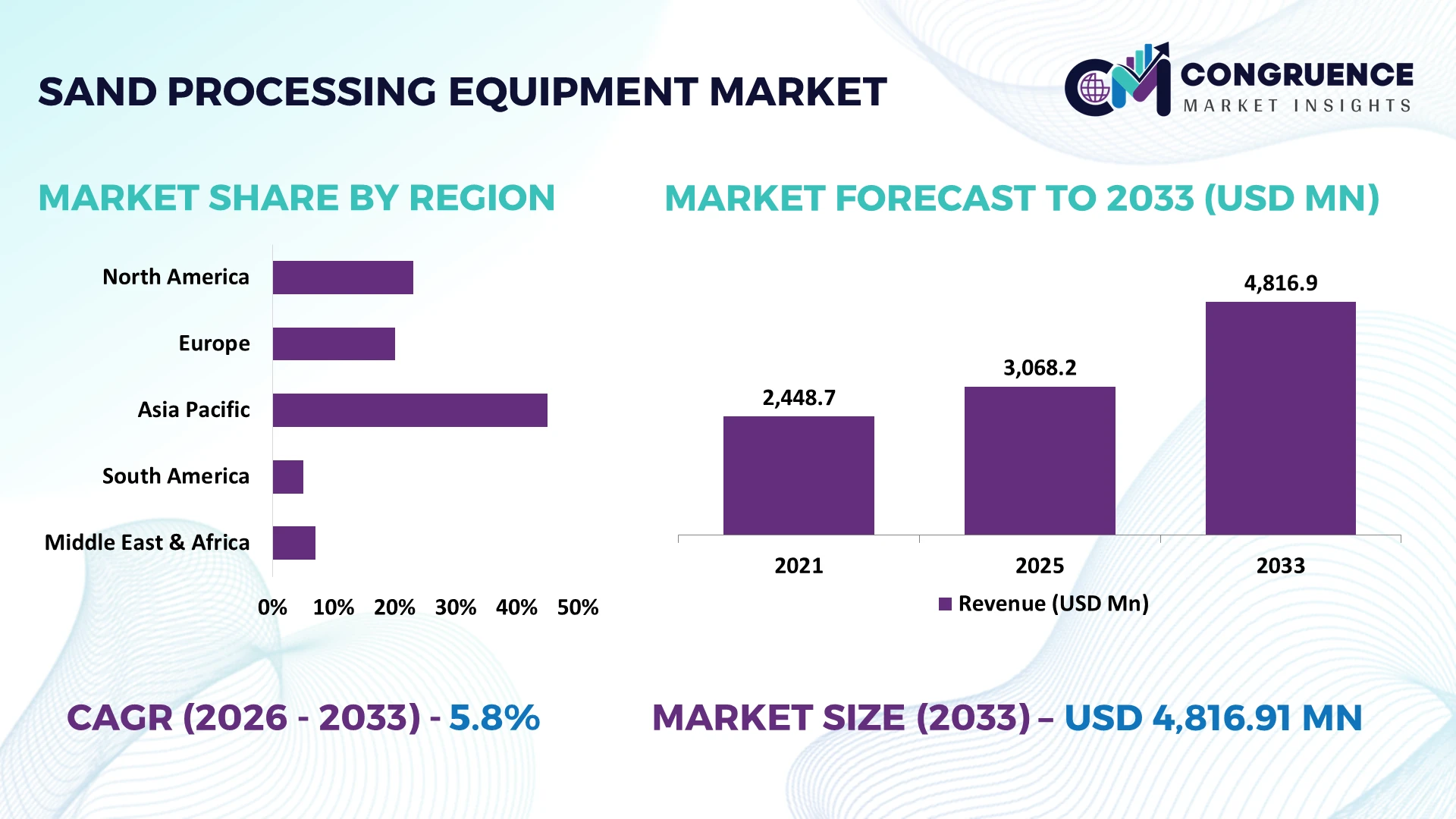
The Global Sand Processing Equipment Market was valued at USD 3068.2 Million in 2025 and is anticipated to reach a value of USD 4816.91 Million by 2033 expanding at a CAGR of 5.8% between 2026 and 2033. Growth is driven by manufactured sand substitution for constrained river sand, tighter aggregate specifications, and quarry investment in automated washing, classification, dewatering, and fines recovery systems.
China remains the dominant country in the global sand processing equipment market, supported by more than 30% of global construction aggregate consumption and extensive domestic crushing, screening, and washing capacity. Infrastructure construction, concrete production, and manufactured sand plants sustain equipment utilization, while hydrocyclones, high frequency screens, and closed loop water systems improve material recovery. India is expanding rapidly from a smaller installed base as highway development and restrictions on uncontrolled river sand extraction accelerate M sand processing investment. China maintains a substantially larger installed aggregate processing ecosystem, while India’s 100,000+ km national highway network creates significant greenfield and replacement opportunities for advanced sand washing and classification equipment.
Asia Pacific therefore represents the priority investment zone for suppliers targeting automated washing, water recycling, fines recovery, and high throughput modular sand processing systems.
Market Size & Growth: USD 3,068.2 million in 2025 is projected to reach USD 4,816.91 million by 2033 at 5.8% CAGR, supported by manufactured sand processing and automated aggregate plant investment.
Top Growth Drivers: Manufactured sand substitution, infrastructure construction, and water efficient processing lead equipment demand, while advanced recycling configurations can recover up to 90% of process water.
Short Term Forecast: By 2028, digitally optimized washing and classification lines can reduce unplanned equipment downtime by approximately 10–15% through predictive maintenance, connected monitoring, and automated process adjustments.
Emerging Technologies: AI assisted process control, sensor monitoring, variable frequency drives, and automated hydrocyclone classification are enabling real time optimization of throughput, particle size distribution, moisture levels, and energy consumption.
Regional Leaders: Asia Pacific approaches USD 2.0 billion by 2033, North America approximately USD 1.0 billion, and Europe around USD 0.9 billion, supported respectively by capacity expansion, automation, and circular aggregate processing.
End User Trends: Quarry and aggregate operators increasingly specify integrated washing and water management systems capable of recycling approximately 85–95% of process water, reducing freshwater withdrawals and settling pond requirements.
Pilot & Case Example: Modern closed circuit washing configurations deployed during 2025 demonstrated water recovery exceeding 90% in suitable aggregate applications while improving control over saleable sand fractions and reducing fine material losses.
Competitive Landscape: No single supplier controls 20% of the fragmented global market; Metso, CDE, McLanahan, Weir, and Terex compete through processing efficiency, modular equipment, aftermarket services, and water management capabilities.
Regulatory & ESG Impact: Closed loop washing systems can reduce freshwater requirements by up to 90%, directly addressing quarry permitting constraints, sediment discharge requirements, regional water scarcity, and increasingly stringent environmental operating standards.
Investment & Funding: Global infrastructure requirements measured in trillions of USD are directing capital toward quarry modernization, manufactured sand capacity, recycled aggregates, and integrated processing lines rather than standalone replacement machinery.
Innovation & Future Outlook: Next generation plants combine 3+ digital layers including connected sensors, automated controls, and predictive analytics, shifting competitive advantage from installed capacity toward specification consistency, recovery yield, and lifecycle efficiency.
The Sand Processing Equipment Market is increasingly shaped by manufactured sand plants, construction aggregates, silica processing, recycled materials, and high specification concrete applications. Equipment innovation is concentrating on modular washing trains, intelligent classification, high frequency screening, fines recovery, and compact water treatment systems. Closed loop configurations can recycle more than 90% of processing water, strengthening their value in water constrained quarry operations. Restrictions on uncontrolled river sand extraction across major Asian construction markets are simultaneously redirecting investment toward engineered sand production, establishing a strong strategic case for efficient, digitally controlled processing capacity.
Closed Loop Washing Gains Scale: Sand processors are redesigning washing circuits around water recirculation, with modern clarification and filter press configurations recovering roughly 90–95% of process water and reducing freshwater intake by 70–85%. Water restrictions affecting quarry permits are accelerating deployment. Equipment suppliers are integrating thickeners, hydrocyclones, and automated dosing controls into compact systems, lowering pond dependency and enabling operators to sustain production where water availability increasingly determines permitted capacity.
Modular Plants Replace Fixed Layouts: Quarry operators are shifting toward modular processing trains that can shorten installation schedules by approximately 25–35% and reduce site preparation requirements by 15–25% compared with conventional fixed plants. This transition is particularly visible in Indian manufactured sand projects and remote mining operations. Manufacturers are responding with containerized washing, screening, and dewatering modules that simplify capacity additions and allow processors to redeploy equipment as extraction faces change.
Sensor Control Tightens Specifications: Automated monitoring is moving from auxiliary functionality into core plant control, with connected moisture, pressure, and particle monitoring capable of reducing specification variability by 10–20% and manual intervention by around 15%. Producers supplying concrete customers increasingly require tighter gradation consistency. OEMs are embedding programmable controls, remote diagnostics, variable speed drives, and condition monitoring into crushers, screens, classifiers, and dewatering equipment to stabilize output without proportionally increasing labor.
Fines Become Saleable Feedstock: Operators are increasingly recovering material previously discharged to settling ponds, with optimized hydrocyclone and dewatering circuits capturing approximately 80–95% of usable fine sand and reducing waste volumes by 20–30%. The non-obvious shift is economic: waste management is becoming product recovery. Companies are pairing cyclones with high frequency screens and dewatering units to create additional specification grades while reducing disposal handling, tailings footprints, and lost mineral value.
Washers represent the leading type with an estimated 27% market share, reflecting their central role in removing clay, silt, organics, and unwanted fines before specification sand enters concrete, asphalt, or industrial applications. Their advantage comes from integration with screens and dewatering equipment, enabling complete wet processing lines rather than standalone separation. Crushers remain essential upstream for manufactured sand feed preparation, while screens provide mature sizing control across high throughput plants. Classifiers retain importance where precise particle separation determines finished product quality.
Hydrocyclones are the fastest-growing type as processors prioritize fine particle recovery, compact footprints, and closed circuit water management. Modern cyclone circuits can recover more than 90% of suitable fine material, while integrated dewatering can reduce final sand moisture toward 10–15% under appropriate operating conditions. Attrition scrubbers are gaining strategic relevance in silica and mineral applications requiring intensive surface cleaning. Suppliers are consequently expanding modular cyclone clusters, intelligent washers, high frequency screening, and integrated dewatering packages, shifting investment toward equipment combinations that maximize saleable yield per tonne processed.
Aggregate Processing leads applications with an estimated 31% share, supported by continuous requirements for washed, graded, specification-controlled sand across concrete, asphalt, road base, and construction aggregate operations. Large quarry installations favor integrated crushing, screening, washing, and dewatering circuits because consolidated processing improves throughput consistency. Sand Washing remains a mature high-volume application, while Sand Classification increasingly uses hydrocyclones and automated controls to maintain tighter gradation. Sand Recovery supports material conservation, and Mineral Processing requires specialized separation where mineral value justifies intensive treatment.
Manufactured Sand Production is the fastest-growing application as constraints on natural sand extraction push contractors toward engineered alternatives. Properly configured plants can convert crushed rock into controlled sand while recovering 80–95% of usable fines through optimized circuits. Fine Sand Recovery is becoming operationally critical because processors increasingly treat previously discarded particles as saleable output rather than waste. Equipment companies are scaling turnkey M sand plants, modular washing platforms, automated classification, and water recycling packages, concentrating investment where producers need repeatable particle shape, moisture control, and specification compliance.
Construction Materials represent the largest end-user group with an estimated 34% share, reflecting intensive consumption of specification sand in ready-mix concrete, precast products, mortar, and asphalt supply chains. High-volume producers require consistent particle distribution and controlled moisture, supporting integrated washing, screening, classification, and dewatering installations. Aggregates remain another established buyer group because quarry economics depend directly on saleable yield. Mining prioritizes rugged processing systems for mineral separation, while Foundries, Glass Manufacturing, and Ceramics purchase more specialized equipment where silica cleanliness and particle consistency carry higher value.
Infrastructure is the fastest-growing end-user as highway, rail, urban construction, and public works programs increase demand for locally processed aggregates and manufactured sand. India’s National Infrastructure Pipeline encompasses more than 9,000 projects, strengthening the case for scalable processing capacity near construction corridors. Suppliers are targeting infrastructure contractors and quarry partners with modular plants, application-specific configurations, lifecycle service agreements, and integrated water management. Competitive positioning is therefore moving toward complete processing ecosystems capable of supporting high utilization while maintaining specification consistency across changing feed materials.
Asia-Pacific accounted for the largest market share at 43.2% in 2025 however, Asia-Pacific is expected to register the fastest growth, expanding at a CAGR of 6.7% between 2026 and 2033.
Automation Reshapes Mature Quarry Operations
North America accounted for approximately 22.8% of the Sand Processing Equipment Market in 2025, with demand concentrated across construction aggregates, industrial sand, mining, and infrastructure rehabilitation. U.S. operators are replacing labor-intensive wet processing layouts with automated screening, hydrocyclone classification, dewatering, and water-recirculation systems. The Infrastructure Investment and Jobs Act continues to support transportation construction through USD 550 billion in new federal investment, sustaining aggregate requirements across highway and bridge programs. Canadian mineral developments provide an additional equipment channel, particularly for attrition scrubbing and classification. Mature operators increasingly prioritize retrofit-compatible modules because brownfield modernization avoids complete plant replacement. Suppliers are consequently emphasizing remote diagnostics, wear monitoring, modular washing trains, and aftermarket support, positioning lifecycle productivity and reduced water dependency ahead of basic equipment capacity.
United States Market Outlook: The United States leads regional deployment through its extensive quarry network, large construction-materials industry, and continued transportation investment. More than 4 billion metric tons of aggregates and related mineral materials are consumed annually across major applications, supporting recurring equipment replacement. Producers increasingly favor automated controls and modular processing packages that improve specification consistency without requiring extensive greenfield development.
Circular Aggregates Accelerate Plant Modernization
Europe represented approximately 19.1% of the market in 2025, with Germany, the United Kingdom, France, Italy, and Nordic countries sustaining sophisticated aggregate-processing installations. The structural shift is toward recycled construction materials and closed-loop water management rather than simple capacity expansion. EU construction and demolition waste exceeds 800 million tonnes annually, creating a substantial feedstock pool for washing, classification, and contaminant-removal equipment. Operators are integrating attrition, density separation, fine screening, and dewatering to convert variable demolition material into specification aggregates. Tight permitting and water-discharge requirements strengthen demand for clarification and sludge-management systems capable of returning over 90% of process water. Equipment manufacturers are responding with electrically driven modular plants, digital process monitoring, and recycling-focused configurations, making recovery efficiency and environmental compliance central purchasing criteria.
Germany Market Outlook: Germany combines a large construction-materials base with stringent circular-economy requirements and advanced machinery engineering. Construction and demolition activities generate more than 200 million tonnes of mineral waste annually, providing substantial secondary material for processing. German operators increasingly deploy multi-stage screening, washing, contaminant separation, and water treatment systems to raise recovered aggregate quality for higher-value construction applications.
Manufactured Sand Drives Deployment Scale
Asia-Pacific held approximately 43.2% of global demand in 2025, supported by exceptional aggregate consumption across China, India, Japan, Australia, and Southeast Asia. China provides the largest installed processing base, while India is producing stronger incremental demand as restrictions on uncontrolled river-sand extraction encourage manufactured sand capacity. Indian quarry operators are deploying vertical-shaft crushing, multi-deck screening, washing, classification, and fines-recovery lines near expanding urban and highway corridors. China’s continuing transport and urban infrastructure programs support high-throughput replacement demand, while Australian mining operations require specialized mineral-sand separation equipment. Suppliers are scaling locally manufactured modular systems and regional service networks to reduce delivery times. The competitive advantage increasingly rests on configuring complete plants that convert variable crushed feed into consistent concrete-grade sand while minimizing water consumption and unsaleable fines.
China Market Outlook: China remains the region’s largest equipment base because of its enormous cement, concrete, aggregates, and mineral-processing ecosystem. The country produces more than 2 billion tonnes of cement in a typical year, indicating the scale of downstream construction-material flows requiring aggregate inputs. Domestic equipment manufacturers compete aggressively through integrated crushing, screening, classification, automation, and high-capacity plant engineering.
Mining and Quarry Upgrades Shape Demand
South America represented approximately 6.7% of global market activity in 2025, with Brazil, Chile, Peru, and Argentina generating demand across aggregates, mining, industrial minerals, and infrastructure materials. Brazil provides the broadest construction-related equipment base, whereas Chile and Peru create technically demanding mineral-processing opportunities. Copper operations require classification, dewatering, and fine-particle management under increasingly stringent water constraints, encouraging closed-circuit configurations. Brazil’s highway concession and urban infrastructure programs are simultaneously supporting quarry modernization near major consumption corridors. Suppliers are emphasizing durable modular equipment because remote mine locations, logistics costs, and uneven service coverage can materially affect plant availability. Local assembly, distributor partnerships, standardized wear components, and remote monitoring are becoming practical responses to execution constraints, particularly where imported equipment lead times undermine rapid capacity additions.
Brazil Market Outlook: Brazil offers the strongest diversified demand base, combining major iron ore operations with large cement, concrete, and road-construction industries. Its federal highway network extends beyond 75,000 km, creating sustained aggregate requirements for rehabilitation and concessions. Equipment vendors benefit from localized parts inventories and service partnerships because geographic scale makes maintenance responsiveness an important procurement differentiator.
Megaprojects Accelerate Engineered Sand Capacity
Middle East & Africa accounted for approximately 8.2% of the market in 2025, with Saudi Arabia, the UAE, South Africa, and mineral-intensive African economies anchoring equipment deployment. Gulf construction programs are increasing requirements for specification aggregates, while desert sand’s unsuitable particle characteristics for many structural concrete applications strengthen dependence on crushed and processed material. Saudi Arabia’s giga-project pipeline is encouraging investment in high-capacity manufactured sand, screening, and washing installations near development corridors. African mining markets create a different requirement centered on hydrocyclones, attrition scrubbers, classification, and dewatering. Water scarcity makes recycling particularly valuable across both subregions. Suppliers are responding with modular plants, containerized water-treatment systems, local maintenance partnerships, and high-wear configurations designed for abrasive feed, remote operations, and limited freshwater availability.
Saudi Arabia Market Outlook: Saudi Arabia is the region’s strategic construction-processing hub, supported by Vision 2030 developments and extensive transport, tourism, housing, and urban projects. NEOM alone spans a planned development area of approximately 26,500 square kilometres. Quarry operators are therefore investing in engineered aggregate production, automated classification, and water-efficient washing systems capable of supporting large construction packages close to project sites.
Metso, CDE Group, McLanahan, Terex, and Weir compete for integrated quarry, aggregate, mining, and manufactured-sand projects, while specialized regional OEMs pressure them on price and delivery speed. The top five suppliers hold an estimated 35–40% combined share, leaving substantial demand accessible to application-focused manufacturers. CDE and McLanahan differentiate through washing, classification, fines recovery, and water-management integration; Metso, Terex, and Weir leverage broader crushing, screening, minerals-processing, and aftermarket ecosystems. Automated controls can improve plant availability by 5–10%, while closed-loop configurations recover above 90% of process water and modular designs can shorten installation schedules by roughly 25%. Competition is shifting from individual machines toward complete processing circuits, digital monitoring, lifecycle service, and guaranteed output specifications. Manufacturers are expanding service networks, modular portfolios, and application partnerships to capture brownfield upgrades. Engineering expertise, installed support infrastructure, wear-parts availability, and application testing remain substantial entry barriers. Winning requires measurable recovery performance, rapid commissioning, dependable service, and integrated process guarantees.
Metso Corporation
CDE Group
McLanahan Corporation
Terex Corporation
The Weir Group PLC
Sandvik AB
FLSmidth & Co. A/S
Haver & Boecker OHG
Superior Industries, Inc.
Matec Industries S.p.A.
Binder+Co AG
TAKRAF Group
MEKA Global
Propel Industries Private Limited
Current sand processing plants increasingly combine PLC automation, variable-frequency drives, hydrocyclones, high-frequency screens and online moisture sensing. Connected controls can improve throughput efficiency by 8–12%, while predictive condition monitoring reduces unplanned stoppages by roughly 10%. Adoption is strongest in high-volume aggregate operations, where integrated dashboards coordinate crushing, washing, classification and dewatering, giving operators tighter specification control and lower labor exposure.
Emerging systems pair machine vision, AI-assisted feed control and digitally adjustable classification with closed-loop water treatment. Early digitalized plants can cut process variability by 10–15% and improve saleable recovery by 5–8%. Compared with conventional sand screws, modern cyclone-plus-dewatering configurations deliver about 15–25% better fine-material retention in suitable feeds. Large quarry groups benefit most because incremental recovery scales rapidly across multiple production lines.
Disruptive development is shifting toward autonomous plant optimization, dry classification and sensor-linked modular equipment that adapts to changing feed characteristics without repeated manual calibration. By 2026–2028, deployment of remote diagnostics and automated set-point control should expand across new premium installations, supporting 5–10% lower operating intervention. Suppliers integrating crushers, screens, washers and water circuits into one control architecture gain a competitive advantage because customers increasingly buy guaranteed process performance, not standalone machinery alone.
September 2024 CDE and Granite Construction commissioned a 550+ tph sand and aggregate wash plant at Coyote Pit, Utah, integrating high-capacity wet processing for infrastructure materials while addressing site-specific water-management requirements and strengthening Granite’s aggregate production capability. Source: NSSGA
October 2025 Terex Washing Systems upgraded Barro Group’s Australian operation with an FM120 sand-processing unit and second dewatering screen. The installation delivered approximately 30% higher production while reducing fines losses and improving water management through integrated cyclone-based processing. Source: Terex
June 2026 Metso launched ELL Series inclined screens using variable elliptical motion for secondary and tertiary aggregate processing. The technology delivers up to 20% higher throughput within the same footprint, improving capacity utilization without requiring corresponding plant-footprint expansion. Source: Aggregate Equipment Guide
July 2026 Tyrone International partnered with Mesda Group to introduce integrated wash plants and water-management systems across Asian mining, quarrying, and recycling markets. The partnership combines two companies’ capabilities, expanding end-to-end processing access through Mesda’s established Asian manufacturing platform. Source: Tyrone International
The Sand Processing Equipment Market Report evaluates seven equipment types: Crushers, Screens, Washers, Classifiers, Hydrocyclones, Attrition Scrubbers, and Dewatering Equipment. Application coverage spans Sand Washing, Sand Classification, Sand Recovery, Fine Sand Recovery, Aggregate Processing, Manufactured Sand Production, and Mineral Processing, alongside seven defined end-user groups. Analysis tracks equipment integration, automation, fines recovery, modular deployment, digital controls, dry classification, and water-efficient processing technologies.
Geographic assessment covers North America, Europe, Asia-Pacific, South America, and Middle East & Africa, with Asia-Pacific representing approximately 43% of 2025 demand. The report evaluates established OEM positioning, regional equipment strategies, replacement cycles, processing configurations, and emerging manufactured-sand and recycling applications. Coverage through 2026–2033 supports investment prioritization, production-capacity planning, geographic expansion, supplier benchmarking, partnership decisions, and competitive positioning as purchasing shifts toward integrated processing systems delivering measurable recovery, specification, and operating-performance advantages.
| Report Attribute/Metric | Report Details |
|---|---|
Market Revenue in 2025 | USD 3068.2 Million |
Market Revenue in 2033 | USD 4816.91 Million |
CAGR (2026 - 2033) | 5.8% |
Base Year | 2025 |
Forecast Period | 2026 - 2033 |
Historic Period | 2021 - 2025 |
Segments Covered | By Type
By Application
By End-User
|
Key Report Deliverable | Revenue Forecast, Growth Trends, Market Dynamics, Segmental Overview, Regional and Country-wise Analysis, Competition Landscape |
Region Covered | North America, Europe, Asia-Pacific, South America, Middle East, Africa |
Key Players Analyzed | Metso Corporation, CDE Group, McLanahan Corporation, Terex Corporation, The Weir Group PLC, Sandvik AB, FLSmidth & Co. A/S, Haver & Boecker OHG, Superior Industries, Inc., Matec Industries S.p.A., Binder+Co AG, TAKRAF Group, MEKA Global, Propel Industries Private Limited |
Customization & Pricing | Available on Request (10% Customization is Free) |




