
Reports
The Global Salt Substitutes Market was valued at USD 1,356.2 Million in 2025 and is anticipated to reach a value of USD 2,244.5 Million by 2033 expanding at a CAGR of 6.5% between 2026 and 2033. Growth is being driven by sodium-reduction reformulation, potassium-chloride-based blends, cardiovascular-health programs, and food manufacturers replacing conventional sodium chloride without sacrificing taste.
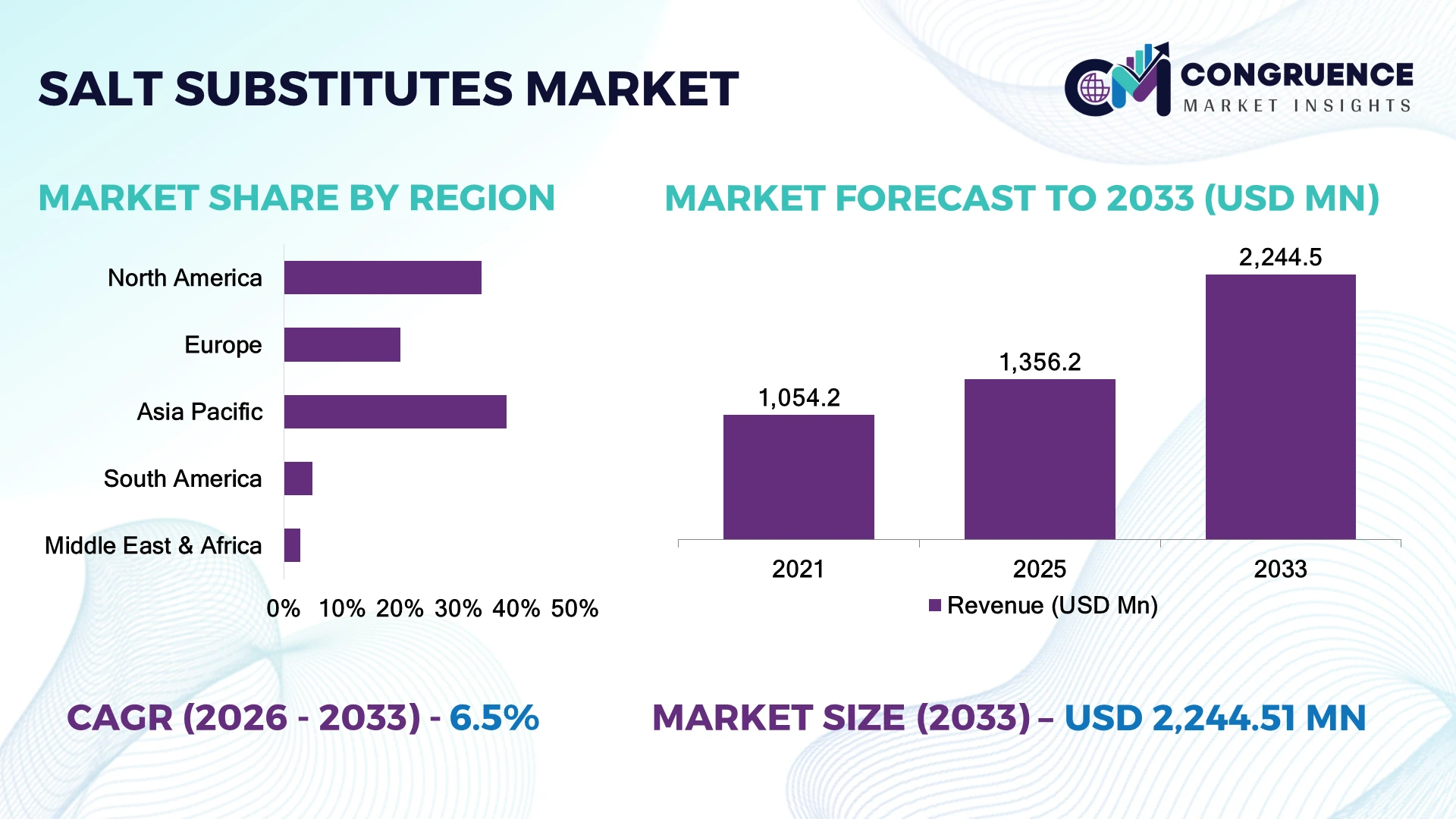
China represents the dominant manufacturing and consumption base, supported by its large processed-food industry, extensive seasoning production, and established potassium-mineral supply chain. North America has stronger premium and clinical adoption, while India is accelerating low-sodium food reformulation. Potassium-based substitutes can reduce sodium exposure by approximately 25–40% in suitable formulations, strengthening demand as WHO-backed sodium-reduction policies influence food manufacturers.
Strategically, suppliers should prioritize taste-masking technology, potassium-based formulations, and partnerships with large food processors to capture reformulation-led demand.
Market Size & Growth: USD 1,356.2 Million in 2025 to USD 2,244.5 Million by 2033 at 6.5% CAGR, driven by sodium-reduction reformulation and potassium-based alternatives.
Top Growth Drivers: Sodium reduction +8–12%, potassium-based formulations +7–10%, and processed-food reformulation +6–9%.
Short-Term Forecast: By 2028, optimized potassium blends can reduce sodium content 25–40% while maintaining acceptable sensory performance.
Emerging Technologies: Taste masking, microencapsulation, mineral blending, and AI-assisted formulation are improving flavor performance and formulation precision.
Regional Leaders: Asia-Pacific is projected near USD 900 Million, North America around USD 550 Million, and Europe approximately USD 430 Million, with regulatory-led reformulation strengthening adoption.
Consumer/End-User Trends: Health-oriented food applications are increasing low-sodium formulation penetration by approximately 6–10% annually across selected processed-food categories.
Pilot/Case Example: 2025 reformulation programs increasingly targeted 20–30% sodium reduction while retaining conventional taste profiles through potassium chloride and flavor-modulation systems.
Competitive Landscape: K+S, Morton Salt, Cargill, Corbion, and NuTek compete across mineral supply, formulation technology, food-grade ingredients, and specialty low-sodium solutions.
Regulatory & ESG Impact: Sodium-reduction programs targeting 20–30% lower sodium strengthen demand for substitutes while reducing dependence on conventional sodium chloride in reformulated foods.
Investment & Funding: Potassium-mineral and specialty-ingredient capacity expansion continues to attract investment, with producers prioritizing food-grade purification, blending, and application-development capabilities.
Innovation & Future Outlook: Next-generation blends combining potassium chloride, mineral salts, amino acids, and flavor modulators are shifting competition from commodity substitution toward performance-driven formulation platforms.
The Salt Substitutes Market is increasingly centered on potassium chloride, potassium-lactate blends, mineral formulations, yeast-derived flavor systems, and sodium-reduction solutions for processed foods, snacks, bakery products, sauces, and ready meals. Potassium-based formulations can achieve approximately 25–40% sodium reduction in suitable applications. Food manufacturers are simultaneously adjusting formulations to meet tightening sodium targets and maintain taste consistency, creating stronger demand for application-specific blending expertise.
The Salt Substitutes Market is becoming strategically important because sodium reduction is moving from a nutritional preference into a product-development requirement for major food manufacturers. Reformulation now influences ingredient procurement, sensory engineering, labeling, and regulatory compliance simultaneously. Potassium chloride is central to this transition because it can deliver substantial sodium reduction while retaining salt-like functionality, although bitterness and metallic aftertaste require formulation controls.
Technology is narrowing the performance gap between conventional salt and alternatives. Standard potassium chloride formulations can achieve roughly 25–40% sodium reduction, while encapsulation, flavor modulation, and blended mineral systems improve sensory acceptance compared with untreated potassium chloride. North America and Europe emphasize regulatory compliance and premium health positioning, while China and India offer larger-volume opportunities through processed foods, seasonings, snacks, and ready-to-eat products.
During 2026–2028, manufacturers will increasingly invest in taste-masking systems, precision blending, application laboratories, and co-development agreements with food processors. A practical opportunity lies in supplying customized formulations rather than commodity potassium chloride alone, allowing ingredient companies to address sodium targets by product category. Competitive advantage will therefore depend on sensory performance, formulation speed, food-grade consistency, and the ability to scale sodium reduction without compromising consumer acceptance.
Food manufacturers are accelerating sodium-reduction reformulation as public-health targets increasingly influence packaged-food specifications. Potassium chloride and blended mineral systems can reduce sodium content by approximately 25–40%, while flavor-modulation technologies improve sensory acceptance and enable 10–20% additional reduction in selected formulations. In the United States, major food processors are expanding reduced-sodium product lines, while China and India are increasing formulation activity across snacks, sauces, instant foods, and seasonings. Ingredient suppliers are responding with application laboratories, customized blends, and food-processing partnerships. The non-obvious commercial shift is that salt substitutes are becoming formulation platforms rather than direct salt replacements, allowing suppliers to capture higher-value business through taste optimization, mineral balancing, and category-specific performance.
Potassium chloride remains the primary technical alternative to sodium chloride, but excessive substitution can introduce bitter or metallic notes that constrain dosage. Conventional potassium chloride substitution typically becomes sensory-sensitive beyond approximately 30–40% sodium replacement, while specialized masking systems can improve acceptable substitution levels by roughly 10–20%. Cost also remains relevant because customized blends and encapsulated ingredients can carry 15–30% premiums over basic salt inputs. Manufacturers operating in India and Southeast Asia face additional formulation pressure where price-sensitive consumers prioritize familiar taste profiles. Ingredient companies are reducing exposure through potassium-lactate blends, yeast extracts, amino-acid systems, and flavor modulators. The key operational constraint is not ingredient availability but achieving sodium reduction without triggering reformulation failures, consumer rejection, or higher warranty and quality-control costs.
Next-generation salt substitutes are creating opportunities through precision blending, microencapsulation, and application-specific taste modulation. Encapsulated potassium systems can improve sensory performance while supporting approximately 30–50% sodium reduction in suitable food formulations, and optimized blends can reduce reformulation trials by roughly 15–25%. Japan and South Korea offer attractive commercialization environments because processed-food manufacturers already use sophisticated flavor and ingredient engineering. Suppliers are positioning through joint development programs with snack, bakery, sauce, and ready-meal producers rather than selling commodity mineral ingredients alone. A non-obvious opportunity lies in sodium-reduction-as-a-service: ingredient companies can combine formulation expertise, sensory testing, and regulatory support into recurring B2B partnerships. This approach increases switching costs and strengthens supplier influence over customers' product-development pipelines.
Salt-substitute performance varies significantly by food matrix, moisture level, acidity, processing temperature, and flavor intensity, making large-scale standardization difficult. A formulation optimized for snacks can require 10–20% different dosage or masking intensity when transferred to sauces or bakery products, increasing application-development workload. High-volume processors also demand tight batch consistency, with mineral concentration and particle characteristics requiring narrow specification tolerances. In China and India, rapidly expanding processed-food production adds pressure to scale customized formulations without disrupting established production lines. Companies must invest in application laboratories, sensory panels, automated dosing, and digital formulation databases to control variability. The strategic challenge is building repeatable technical platforms that preserve taste and functionality across thousands of production batches while meeting evolving sodium targets and maintaining competitive ingredient economics.
Blended Minerals Replace Straight Substitution: Food formulators are moving from pure potassium chloride toward potassium-calcium, potassium-magnesium, organic-mineral, and flavor-modulated systems. Blended approaches can support approximately 25–40% sodium reduction while improving sensory acceptance by 10–20% versus basic substitution. Ingredient suppliers are expanding application testing and customized formulations, particularly for sauces, snacks, bakery products, and ready meals where taste consistency determines commercial success.
Taste Masking Becomes Core Technology: Encapsulation, yeast-derived flavor systems, amino-acid modulation, and bitterness blockers are increasingly integrated into salt-reduction formulations. Advanced masking can increase acceptable potassium substitution by roughly 10–20% while reducing reformulation iterations by 15–25%. Manufacturers are shifting R&D budgets toward sensory engineering because the limiting factor is increasingly consumer acceptance rather than technical sodium reduction capability.
Sodium Targets Reshape Product Specs: Food companies are increasingly embedding sodium thresholds directly into procurement and new-product specifications, accelerating reformulation at the ingredient-selection stage. Selected formulations now target 20–30% sodium reductions without changing product positioning. Suppliers are responding with standardized low-sodium ingredient platforms and regulatory support, while large processors are qualifying multiple substitute systems to avoid dependence on a single formulation technology.
Application Labs Gain Strategic Value: Salt-substitute suppliers are expanding technical centers and customer co-development programs because performance differs sharply across food matrices. Pilot testing can reduce formulation-development cycles by approximately 15–25%, while digital recipe databases improve repeatability across production sites. The non-obvious shift is toward technical service as a competitive moat, with suppliers using sensory expertise and process data to secure longer-term food-manufacturer relationships.
Potassium Chloride Anchors Scale as Blended Systems Accelerate
Potassium Chloride is the leading type, accounting for approximately 45–49% of the global Salt Substitutes Market in 2025. Its dominance reflects established food-grade supply chains, compatibility with existing production processes, and comparatively straightforward substitution across processed foods. Yeast Extracts and Amino Acids remain important complementary technologies, particularly where formulators need stronger umami depth or bitterness masking. Mineral Blends are the fastest-changing category, with adoption expanding approximately 8–12% as manufacturers seek higher sodium reduction without compromising sensory performance. Companies are increasingly combining potassium chloride with flavor modulators rather than relying on one-for-one replacement.
The mature KCl segment retains a cost and scalability advantage, while blended mineral and flavor systems command greater technical value. Reformulation programs increasingly target 20–40% sodium reduction, with advanced masking systems extending acceptable substitution levels by roughly 10–20%. Investment is therefore shifting toward application laboratories, sensory testing, encapsulation, and co-development rather than commodity capacity alone. Suppliers with both mineral supply security and formulation expertise are gaining stronger negotiating leverage with food processors.
A 2025–2026 survey of 195 supermarkets across 15 Chinese cities found lower-sodium salt available in 88.9% of middle-sized and 90.9% of large supermarkets, confirming expanding retail infrastructure for potassium-enriched formulations.
Sauces and Seasonings Concentrate Reformulation Demand
Sauces & Dressings represent the leading application, accounting for approximately 34–35% of global Salt Substitutes demand in 2025. Their high sodium intensity, frequent consumption, and formulation flexibility make them a primary target for sodium reduction. Snacks are the fastest-changing application, with adoption expanding approximately 10–14% as manufacturers reformulate chips, crackers, savory snacks, and ready-to-eat products. Meat & Poultry, Bakery & Confectionery, Dairy & Frozen Foods, and soups remain important because salt contributes simultaneously to taste, preservation, texture, and processing performance.
The application shift is moving from basic replacement toward matrix-specific formulation. Sauces can accommodate mineral blends and flavor modulators relatively efficiently, whereas meat and bakery formulations require tighter control of water activity, texture, fermentation, and preservation. Selected reformulations achieve approximately 20–40% sodium reduction, while advanced masking can improve sensory acceptance by 10–20%. Companies are expanding pilot kitchens, application centers, and co-development programs with food manufacturers. This favors suppliers capable of validating performance at commercial processing conditions rather than simply supplying substitute ingredients.
WHO’s 2025 lower-sodium salt-substitute guideline specifically supports potassium-containing substitutes as part of population sodium-reduction strategies, strengthening the regulatory relevance of reformulation across processed-food applications.
Food Manufacturers Lead as Household Adoption Broadens
The Food & Beverage Industry is the leading end-user, representing approximately 65–70% of global Salt Substitutes demand. Large processors purchase substitutes in industrial volumes and require consistent mineral specifications, sensory performance, and regulatory documentation across multiple production sites. Household users account for a smaller but established share through low-sodium table-salt products, while Foodservice and Institutional buyers increasingly adopt substitutes where menu reformulation and nutrition standards influence procurement. Pharmaceutical and specialized healthcare applications remain niche but strategically relevant.
Foodservice and institutional procurement represents the faster-changing buyer group, with adoption increasing approximately 8–12% as hospitals, schools, and organized catering operations implement sodium-conscious menu programs. Industrial food manufacturers, by comparison, prioritize scalable formulations and can target 20–40% sodium reduction across selected product lines. Companies are responding with tiered pricing, private-label formulations, bulk mineral supply contracts, and technical partnerships. Household brands compete through taste, labeling, and affordability, while industrial suppliers differentiate through formulation support, batch consistency, and regulatory expertise. The strategic shift is toward long-term B2B formulation relationships rather than transactional ingredient sales.
FDA sodium-reduction targets cover 163 commercially processed, packaged, and prepared food categories, while Phase I and Phase II targets together support an approximately 20% reduction from previous sodium levels, reinforcing industrial reformulation demand.
Asia-Pacific accounted for the largest market share at 38.2% in 2025 however, Asia-Pacific is expected to register the fastest growth, expanding at a CAGR of 7.8% between 2026 and 2033.

Industrial Reformulation Converts Sodium Targets into Ingredient Demand
North America represents approximately 32–36% of global Salt Substitutes demand, supported by sophisticated packaged-food manufacturing, established ingredient distribution, and aggressive sodium-reduction reformulation. The United States remains the principal market, with processors targeting sauces, snacks, bakery products, prepared meals, and meat applications. More than 70% of U.S. dietary sodium comes from packaged, prepared, and restaurant foods, making industrial reformulation more commercially significant than household table-salt replacement. The FDA's Phase II framework covers 163 food categories and targets approximately 20% lower sodium intake relative to pre-Phase-I levels. Ingredient suppliers are therefore expanding potassium-based blends, taste-masking systems, and application laboratories. Competitive advantage increasingly depends on delivering measurable sodium reduction without compromising texture, preservation, or flavor.
U.S. Market Outlook: The United States remains the region's principal formulation and procurement hub, with large food processors actively qualifying sodium-reduction systems across multiple product categories. FDA data indicate that approximately 40% of Phase I targets were already achieved or within 10% of target levels by 2022, demonstrating tangible reformulation progress. Suppliers with validated sensory performance and scalable food-grade potassium systems are best positioned for enterprise contracts.
Regulatory Reformulation Accelerates Potassium-Based Ingredient Adoption
Europe accounts for approximately 28–31% of global Salt Substitutes demand, supported by established processed-food industries, clean-label positioning, and national sodium-reduction programs. Germany, the United Kingdom, France, and Italy provide the strongest commercial concentration across sauces, bakery, snacks, ready meals, and meat products. The region increasingly favors mineral blends and natural flavor systems that support sodium reduction while maintaining familiar sensory profiles. Potassium-based substitutes represent approximately 45–50% of regional substitute usage, while yeast-derived systems provide an important masking and umami function. The 2025 WHO lower-sodium salt-substitute guideline has strengthened institutional attention to potassium-containing alternatives and sodium reduction. Manufacturers are responding through application-specific blends, clean-label reformulation, and partnerships with ingredient specialists.
Germany Market Outlook: Germany is Europe's most strategically significant industrial market, supported by a large processed-food manufacturing base, advanced ingredient formulation capabilities, and strong retailer influence over product specifications. Food manufacturers increasingly integrate low-sodium requirements into product-development workflows rather than treating them as late-stage reformulation projects. Suppliers offering potassium-mineral systems with bitterness masking and consistent batch performance can secure deeper integration into bakery, sauces, snacks, and prepared-food production.
Food Manufacturing Scale Drives Rapid Sodium-Reduction Deployment
Asia-Pacific holds approximately 38.2% of global Salt Substitutes demand, supported by China's enormous processed-food industry and established food-science capabilities in Japan and South Korea. China, Japan, India, and South Korea account for the region's principal demand, with potassium chloride and blended mineral systems increasingly used across seasonings, sauces, snacks, and ready-to-eat foods. A 2025 Chinese retail study found lower-sodium salt available in approximately 89–91% of surveyed middle-sized and large supermarkets, demonstrating substantial channel penetration. The WHO's 2025 lower-sodium salt-substitute guideline further strengthens the policy case for potassium-based alternatives. Suppliers are expanding local blending, sensory testing, and food-manufacturer partnerships to shorten reformulation cycles and address country-specific taste profiles.
China Market Outlook: China provides the strongest manufacturing and volume platform within Asia-Pacific because its food-processing ecosystem combines large seasoning, snack, sauce, and convenience-food production with extensive ingredient distribution. Lower-sodium salt availability above 88% across surveyed supermarket formats demonstrates that alternative-salt products have moved beyond specialist channels in selected urban markets. Suppliers are increasingly localizing mineral blending and application support to serve high-volume processors efficiently.
Brazilian Food Processing Creates the Regional Commercial Base
South America remains a developing market, with Brazil accounting for the largest commercial opportunity through its extensive processed-food, meat, bakery, sauces, and seasoning industries. Demand is increasingly linked to sodium-conscious reformulation rather than standalone household salt replacement. Brazil's established food-processing infrastructure provides ingredient suppliers with scalable routes into industrial formulations, while Argentina and Chile provide additional opportunities in processed foods and health-oriented products. Potassium chloride and mineral blends remain the primary technical approaches, but taste masking is important for applications requiring higher substitution levels. Companies are strengthening local distributor networks, application support, and formulation partnerships to overcome fragmented procurement. The strategic opportunity is to enter through large food processors and seasoning manufacturers, where one validated formulation can be extended across multiple product lines.
Brazil Market Outlook: Brazil is the region's principal food-manufacturing and ingredient-processing hub, giving salt-substitute suppliers access to large-scale meat, bakery, sauces, and seasoning production. Industrial customers increasingly require formulation consistency across multiple plants, creating demand for standardized potassium blends and technical support. Suppliers with local warehousing and application laboratories can reduce formulation and replenishment lead times while supporting sodium-reduction programs across high-volume product categories.
Health-Oriented Reformulation Builds Institutional Demand
Middle East & Africa remains a smaller but strategically developing market, with Saudi Arabia, the UAE, South Africa, and Israel representing the strongest commercial centers. Demand is concentrated in processed foods, seasonings, healthcare-oriented diets, foodservice, and household low-sodium products. Saudi Arabia is particularly relevant as health-focused nutrition initiatives intersect with food-industry modernization and expanding retail infrastructure. The WHO's 2025 guideline provides an additional policy framework for lower-sodium salt substitutes, while potassium-based formulations remain the dominant technical route. Suppliers are building regional distribution, technical formulation support, and partnerships with food manufacturers and healthcare-oriented channels. The principal commercial constraint is uneven awareness and technical capability across markets, making localized education and application support important competitive tools.
Saudi Arabia Market Outlook: Saudi Arabia represents the region's most strategically significant market because food manufacturing, modern retail, healthcare programs, and nutrition initiatives are developing simultaneously. Salt-substitute demand is increasingly linked to processed foods and hypertension-oriented dietary products rather than table-salt replacement alone. Suppliers can strengthen market access through local distributors, food-manufacturer partnerships, and potassium-based formulations adapted to regional taste preferences, while technical education can accelerate adoption among institutional and commercial buyers.
Cargill, K+S, Corbion, Morton Salt, and NuTek compete as established ingredient and salt specialists, while regional potassium-chloride producers challenge them through cost and localized supply. The top five are estimated to hold approximately 42% combined share. Competition centers on formulation performance, price, mineral purity, supply reliability, and sensory consistency; potassium systems can reduce sodium 20–50%, while advanced masking improves acceptable substitution by 10–20%. Cargill combines potassium chloride, specialty salts, and application laboratories; K+S integrates mineral production with formulation support; Corbion differentiates through fermentation-derived flavor systems; and specialist suppliers target customized blends. The competitive shift is from commodity potassium chloride toward integrated sodium-reduction platforms combining minerals, flavor modulation, and technical services. Entry barriers include food-grade certification, mineral supply security, sensory validation, customer qualification, and application expertise. Winning requires reliable feedstock, scalable formulation technology, validated taste performance, rapid co-development, and established food-manufacturer relationships that convert technical capability into recurring contracts.
Cargill, Incorporated
K+S AG
Corbion N.V.
Morton Salt, Inc.
NuTek Food Science
Tate & Lyle PLC
Jungbunzlauer Suisse AG
Dr. Paul Lohmann GmbH KG
Compass Minerals
Innophos Holdings, Inc.
American Elements
Nutramax Laboratories
Prime Specialty
Foodaids
Potassium chloride remains the core technology because it integrates directly into existing food-processing systems, with selected formulations supporting 20–50% sodium reduction. Newer fine-particle, compacted, and mineral-blend systems improve dissolution, adherence, and flavor delivery. Compared with conventional granulated KCl, engineered particle systems can improve blendability and topical salt perception by approximately 10–20%. Adoption is strongest among processed-food manufacturers reformulating snacks, sauces, bakery products, and prepared meals.
Taste-masking technologies are becoming the principal differentiation layer. Fermentation-derived flavor enhancers, amino-acid modulation, encapsulation, and bitterness blockers can improve sensory acceptance by approximately 10–20% and enable higher substitution levels. Corbion benefits from integrated flavor and preservation capabilities, while Cargill combines potassium chloride with engineered salt particles and application testing. The competitive advantage increasingly shifts toward suppliers that control both mineral inputs and sensory formulation.
Between 2026 and 2028, AI-assisted formulation, high-throughput sensory screening, precision blending, and digital recipe optimization will shorten development cycles by approximately 15–25%. Compared with conventional trial-and-error reformulation, data-driven screening can reduce laboratory iterations and accelerate customer qualification. K+S and Cargill benefit from vertically integrated mineral platforms, while Corbion and specialist formulators gain through application-specific technologies. The decisive technology shift is from ingredient substitution toward validated, category-specific sodium-reduction systems.
May 2026 K+S highlighted commercial salt-reduction trials producing approximately 25% lower sodium in bread and meat products without noticeable taste changes. The work strengthens potassium-based reformulation for industrial food processors and supports broader commercialization of standardized reduced-sodium blends. Source: k-plus-s.com (K+S Aktiengesellschaft)
March 2026 Cargill reported a sodium-reduced snack prototype using Potassium Pro Ultra Fine potassium chloride, achieving 29% lower sodium at 120 mg per 28-g serving. The result demonstrates application-level sensory optimization and strengthens Cargill's positioning in precision sodium-reduction ingredients. Source: cargill.com (Cargill)
February 2026 Corbion continued commercial deployment of PuraQ Arome NA4, enabling up to 30% sodium reduction in refrigerated foods while maintaining savory flavor. The fermentation-derived system expands non-KCl formulation options and strengthens supplier differentiation across sauces, salads, ready meals, and condiments. Source: corbion.com (Corbion)
January 2026 FDA records continued recognizing potassium-chloride/sodium-chloride mixtures as salt-substitute formulations, reinforcing regulatory acceptance of potassium-based alternatives. The classification supports food manufacturers developing reduced-sodium products and provides a standardized regulatory pathway for potassium-containing substitute formulations in the U.S. Source: fda.gov (precisionFDA)
The report covers potassium chloride, mineral blends, yeast extracts, amino acids, potassium lactate, potassium-based mixtures, and emerging flavor-modulation systems. Application coverage includes sauces and dressings, snacks, meat and poultry, bakery and confectionery, dairy and frozen foods, soups, seasonings, and household table-salt alternatives. End-user analysis spans food and beverage manufacturers, foodservice operators, institutional buyers, households, and specialized nutrition applications.
Regional coverage includes North America, Europe, Asia-Pacific, South America, and Middle East & Africa, with detailed assessment of major markets including the United States, Germany, China, India, Brazil, and Saudi Arabia. Technology analysis evaluates encapsulation, bitterness masking, precision blending, engineered particle systems, fermentation-derived flavor enhancement, and digital formulation tools. The report supports investment planning, supplier selection, regional expansion, formulation strategy, competitive positioning, and product development priorities through 2026–2033.
| Report Attribute/Metric | Report Details |
|---|---|
|
Market Revenue in 2025 |
USD 1,356.2 Million |
|
Market Revenue in 2033 |
USD 2,244.5 Million |
|
CAGR (2026 - 2033) |
6.5% |
|
Base Year |
2025 |
|
Forecast Period |
2026 - 2033 |
|
Historic Period |
2021 - 2025 |
|
Segments Covered |
By Type
By Application
By End-User
|
|
Key Report Deliverable |
Revenue Forecast, Growth Trends, Market Dynamics, Segmental Overview, Regional and Country-wise Analysis, Competition Landscape |
|
Region Covered |
North America, Europe, Asia-Pacific, South America, Middle East, Africa |
|
Key Players Analyzed |
Cargill, Incorporated, K+S AG, Corbion N.V., Morton Salt, Inc., NuTek Food Science, Tate & Lyle PLC, Jungbunzlauer Suisse AG, Dr. Paul Lohmann GmbH KG, Compass Minerals, Innophos Holdings, Inc., American Elements, Nutramax Laboratories, Prime Specialty, Foodaids |
|
Customization & Pricing |
Available on Request (10% Customization is Free) |




