
Reports
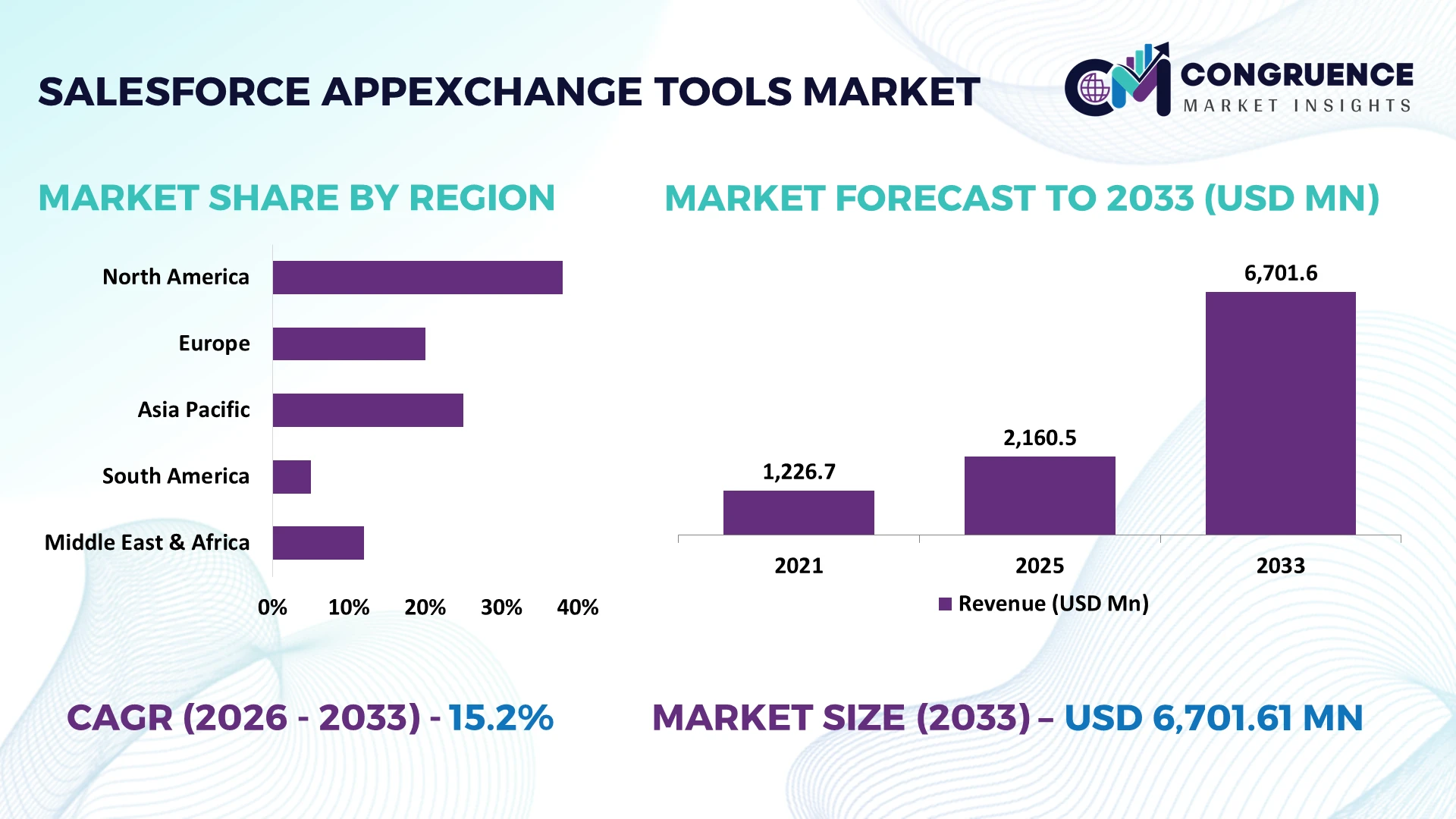
The Global Salesforce AppExchange Tools Market was valued at USD 2160.5 Million in 2025 and is anticipated to reach a value of USD 6701.61 Million by 2033 expanding at a CAGR of 15.2% between 2026 and 2033. Growth is accelerating through enterprise AI integration, low-code application development, industry-specific CRM customization, and rising enterprise spending on workflow automation across regulated sectors.
The United States accounts for approximately 46% of global Salesforce AppExchange Tools deployment, supported by enterprise cloud investments, financial services, healthcare, and technology organizations adopting AI-enabled CRM extensions. Following post-2025 enterprise AI initiatives and digital compliance programs, AppExchange deployment across large U.S. enterprises exceeds 68%, compared with nearly 29% across India, where rapid IT services expansion and SaaS development strengthen ecosystem participation and implementation capacity.
Organizations prioritizing scalable AppExchange ecosystems with AI-driven automation and governance capabilities will secure stronger competitive positioning in enterprise digital transformation programs.
Market Size & Growth: USD 2160.5 Million in 2025, reaching USD 6701.61 Million by 2033 at a CAGR of 15.2%, driven by enterprise AI-powered CRM automation and industry-specific application deployment.
Top Growth Drivers: AI-enabled workflow adoption contributes 34%, low-code development 29%, and CRM modernization initiatives 27% of new enterprise implementation activity.
Short-Term Forecast: By 2028, automated business processes reduce administrative effort by nearly 35% while implementation efficiency improves approximately 31%.
Emerging Technologies: Generative AI, intelligent automation, and API-first integration accelerate deployments, with AI-enabled applications exceeding 58% of new marketplace implementations.
Regional Leaders: North America approaches USD 3100 Million, Europe exceeds USD 1500 Million, and Asia-Pacific surpasses USD 1300 Million, supported by expanding enterprise cloud adoption and regional digital transformation programs.
Consumer/End-User Trends: More than 64% of enterprise Salesforce users prioritize industry-specific AppExchange solutions that shorten deployment cycles and improve operational productivity.
Pilot/Case Example: In 2026, enterprise automation projects integrating AppExchange workflow tools improved service response times by approximately 38% while reducing manual processing tasks by 32%.
Competitive Landscape: The leading ecosystem participant holds roughly 24% marketplace influence, with strong competition from Salesforce ecosystem developers, ISVs, enterprise software providers, cloud integration specialists, and consulting partners.
Regulatory & ESG Impact: Enhanced compliance automation reduces audit preparation time by nearly 30%, supporting evolving AI governance and enterprise data security requirements across global operations.
Investment & Funding: Enterprise investments exceeding USD 2.4 Billion continue expanding AI-integrated CRM applications, strategic partnerships, and vertical solution development despite ongoing global supply-chain optimization.
Innovation & Future Outlook: Next-generation autonomous AI agents, predictive analytics, and composable enterprise applications strengthen high-growth digital ecosystems and accelerate intelligent business process transformation.
Salesforce AppExchange Tools Market demand continues expanding across financial services, healthcare, manufacturing, and retail enterprises seeking faster CRM customization and AI-assisted workflow automation. More than 61% of newly deployed enterprise solutions incorporate intelligent automation or advanced integration capabilities, while organizations increasingly prioritize secure application governance amid evolving AI compliance requirements. This transition strengthens scalable ecosystem strategies and sets the foundation for broader competitive and strategic market assessment.
The Salesforce AppExchange Tools Market has become strategically important as enterprises prioritize composable business applications, AI-enabled CRM ecosystems, and faster digital transformation to strengthen competitive positioning. Organizations increasingly replace fragmented software portfolios with integrated cloud marketplaces that shorten deployment cycles and improve governance. A notable market shift is the expansion of enterprise AI governance and data compliance frameworks, encouraging standardized application procurement while reducing operational complexity across regulated industries.
Modern AppExchange solutions deliver approximately 40% faster deployment and nearly 28% lower integration effort than traditional custom-coded CRM extensions, enabling organizations to accelerate business process modernization. The United States leads large-scale enterprise deployments through mature cloud infrastructure and extensive ISV participation, while India is strengthening its position with rapid SaaS development, certified developer ecosystems, and global implementation services. Over the next two to three years, AI-enabled applications are expected to account for more than 65% of new marketplace implementations, supported by rising API standardization and workflow automation initiatives.
A practical example is financial institutions deploying AppExchange compliance and document automation tools to reduce onboarding cycles while improving audit readiness through integrated workflows. Technology vendors are expanding industry-specific application portfolios, increasing strategic partnerships, and investing in AI-native capabilities to differentiate their offerings. Organizations that combine ecosystem expansion with secure integration architectures will achieve stronger operational resilience, faster innovation cycles, and sustainable competitive advantage.
Enterprise adoption of AI-driven CRM extensions and low-code application development remains the primary structural growth driver for the Salesforce AppExchange Tools Market. Nearly 68% of large enterprises now prioritize marketplace-based applications over lengthy custom development, while low-code implementation reduces development timelines by approximately 35%. More than 57% of newly deployed enterprise CRM projects integrate AI-assisted workflow automation. Following stricter enterprise AI governance and data compliance initiatives in the United States, organizations increasingly prefer certified marketplace solutions over unmanaged third-party software. Software vendors are responding through vertical application expansion, ecosystem partnerships, and AI-powered product enhancements, creating faster deployment models and improving customer retention. The strategic advantage increasingly lies in delivering interoperable applications that accelerate measurable business outcomes without increasing implementation complexity.
Interoperability challenges remain a structural limitation as enterprises operate multiple legacy systems alongside modern cloud platforms. Around 46% of large organizations continue managing hybrid CRM environments, while nearly 31% report extended deployment timelines due to integration dependencies. Approximately 27% of enterprise IT budgets are allocated to middleware, customization, and system validation rather than application innovation. Germany and Japan illustrate this challenge, where established enterprise infrastructures require extensive compatibility testing before marketplace deployment. Companies are reducing operational exposure through API standardization, localized implementation partners, and long-term integration service agreements. The strongest competitive performers increasingly minimize customization requirements, enabling scalable deployments while controlling operational costs and reducing project execution delays.
The strongest emerging opportunity lies in industry-specific AppExchange solutions combining generative AI, predictive analytics, and intelligent workflow automation. More than 62% of enterprises now prefer preconfigured vertical applications instead of generalized CRM extensions, while AI-assisted service automation improves case resolution efficiency by approximately 33%. India's expanding enterprise cloud ecosystem and Singapore's digital innovation initiatives continue accelerating adoption of certified business applications. AI agents, autonomous workflow orchestration, and secure data-sharing frameworks are reshaping enterprise software strategies across regulated sectors. Companies are increasing R&D investment, expanding independent software vendor ecosystems, and forming strategic implementation partnerships to capture specialized enterprise demand. Organizations delivering configurable, compliance-ready solutions gain differentiated positioning in high-value enterprise transformation programs.
Long-term execution depends on maintaining secure, scalable deployments across increasingly complex multi-cloud environments. Approximately 43% of enterprise organizations identify cybersecurity governance as their primary implementation challenge, while nearly 29% report shortages of experienced Salesforce architects and integration specialists. AI-enabled applications introduce additional governance requirements as enterprise data policies continue evolving. The United States and the United Kingdom are strengthening enterprise AI oversight, increasing compliance expectations for marketplace applications handling sensitive business information. Companies must invest in zero-trust security architectures, developer certification programs, automated compliance monitoring, and resilient API infrastructure to sustain deployment quality. Organizations that solve workforce capability and platform security simultaneously will establish stronger competitive differentiation while supporting consistent enterprise-scale application delivery.
AI-Native Workflow Acceleration: Enterprise deployments increasingly prioritize AI-native AppExchange applications that automate approvals, case routing, and customer interactions. More than 63% of newly deployed solutions now include embedded AI capabilities, while workflow execution time has declined by nearly 34% and manual administrative effort by 29%. Tightening enterprise AI governance and data security requirements are accelerating adoption of certified applications. Vendors are expanding AI partnerships, integrating autonomous agents, and scaling vertical-specific automation to improve operational consistency across complex Salesforce environments.
Industry-Specific Solution Expansion: Organizations are moving away from generic CRM extensions toward sector-focused applications tailored for banking, healthcare, manufacturing, and retail operations. Approximately 58% of enterprise buyers now prioritize industry-ready deployments, reducing implementation effort by nearly 31%. Regulatory modernization in financial services and healthcare continues driving demand for compliance-oriented marketplace solutions. Software providers are restructuring product portfolios, expanding implementation alliances, and developing configurable templates that shorten deployment cycles while improving customer retention and operational efficiency.
API-First Integration Standardization: API-first architectures are becoming the preferred deployment model as enterprises modernize hybrid IT environments. Around 67% of large organizations now standardize application connectivity through reusable APIs, reducing integration maintenance by approximately 26% while improving deployment speed by 30%. Growing enterprise cloud consolidation and application rationalization initiatives are reinforcing this transition. Companies are investing in integration platforms, certified connectors, and interoperability frameworks to simplify multi-platform operations while reducing long-term support costs.
Marketplace Governance Strengthening: Enterprise software governance is evolving from decentralized procurement toward centrally managed application ecosystems. Nearly 52% of organizations have introduced standardized marketplace approval processes, reducing security assessment time by about 24% and lowering redundant application purchases by 18%. Increased cybersecurity oversight and enterprise compliance policies are reshaping software acquisition strategies. Vendors are responding with enhanced governance dashboards, continuous compliance monitoring, and lifecycle management capabilities, creating stronger customer trust and more sustainable enterprise adoption.
Managed Apps remain the leading segment, accounting for approximately 39% of enterprise deployments due to standardized implementation, centralized lifecycle management, and lower maintenance requirements. Organizations increasingly prefer managed solutions because deployment time is reduced by nearly 32% while ongoing administrative effort declines by approximately 27%. Integration Tools represent the fastest-growing segment as enterprises modernize hybrid Salesforce environments and expand API-driven digital ecosystems. Vendors continue strengthening interoperability capabilities through certified connectors, strategic technology partnerships, and cloud-native integration frameworks.
Analytics Tools are gaining strategic importance as organizations demand embedded business intelligence and AI-assisted decision support within Salesforce workflows. Developer Tools continue expanding through low-code development, DevOps automation, and continuous delivery practices, particularly among enterprise software teams in the United States and India. Admin Tools remain essential for governance, permission management, and platform optimization, supporting enterprise-scale deployments with improved operational consistency. Companies are increasing investments across Integration Tools and Analytics Tools while maintaining Managed Apps as the core commercial offering, reflecting a balanced strategy focused on scalability, automation, and ecosystem expansion.
Sales remains the dominant application segment with an estimated 36% share, driven by pipeline automation, lead management, forecasting, and AI-assisted opportunity tracking. Organizations deploying advanced sales applications report approximately 30% faster response times and nearly 26% higher sales process efficiency. Data Management is the fastest-growing application as enterprises strengthen governance, master data quality, and AI-ready information architectures. Companies increasingly integrate centralized data services with Salesforce to improve operational consistency and regulatory compliance.
Customer Service continues expanding through intelligent case routing, chatbot integration, and service workflow automation, while Marketing applications evolve with AI-driven campaign personalization and customer segmentation. Analytics applications are becoming operationally critical as executives prioritize real-time performance monitoring and predictive business intelligence. Vendors are scaling cloud-native application portfolios, expanding AI capabilities, and strengthening platform integrations to address growing enterprise demand. Investment priorities increasingly favor applications capable of combining operational automation with measurable business intelligence across multiple departments.
BFSI represents the largest end-user segment with approximately 33% of enterprise adoption, supported by extensive CRM requirements, regulatory compliance, and customer lifecycle management. Financial institutions increasingly deploy AppExchange tools for onboarding, document automation, and service optimization, reducing processing effort by nearly 29%. Healthcare is the fastest-growing end-user segment as providers modernize patient engagement, care coordination, and compliance workflows through secure Salesforce ecosystems and AI-enabled operational applications.
Retail organizations continue expanding omnichannel customer engagement and personalized marketing deployments, while Manufacturing enterprises integrate Salesforce applications with supply-chain visibility and field service operations. IT & Telecom companies remain major adopters because large-scale cloud implementation projects require sophisticated integration, administration, and application lifecycle management. Vendors are strengthening industry-specific offerings through strategic partnerships, customized deployment models, and vertical pricing strategies. Competitive differentiation increasingly depends on delivering secure, scalable applications aligned with the operational priorities of each enterprise sector.
North America accounted for the largest market share at 41.8% in 2025 however, Asia-Pacific is expected to register the fastest growth, expanding at a 17.6% between 2026 and 2033.
Enterprise AI Integration Drives Platform Expansion
North America maintains the strongest position through mature cloud infrastructure, advanced enterprise software adoption, and a well-established Salesforce partner ecosystem. Large enterprises across banking, healthcare, technology, and retail continue standardizing AppExchange deployments to improve workflow automation and governance. The region contributes approximately 42% of global enterprise implementations, while over 70% of Fortune 500 Salesforce users deploy at least one certified AppExchange solution. During 2026, strategic investments in enterprise AI governance and API modernization accelerated marketplace adoption, with implementation partners expanding managed service offerings by nearly 24%. Companies increasingly prioritize secure application lifecycle management, vertical-specific automation, and standardized deployment frameworks to improve operational resilience and reduce enterprise integration complexity.
United States Market Outlook: The United States remains the operational center of the global Salesforce ecosystem because of its concentration of enterprise software vendors, certified consulting partners, and large-scale cloud adopters. Approximately 68% of large enterprises deploy AppExchange applications across multiple business units, supported by strong investment in AI-enabled CRM modernization. Financial services, healthcare, and technology companies continue expanding ecosystem partnerships while strengthening enterprise governance, making the country the benchmark for advanced marketplace deployment strategies.
Compliance-Led Digital Modernization Accelerates Adoption
Europe continues strengthening its Salesforce AppExchange ecosystem through enterprise digital modernization, data governance requirements, and industry-specific cloud transformation. The region represents nearly 27% of global enterprise adoption, supported by strong implementation activity across manufacturing, financial services, and professional services organizations. Privacy-focused enterprise architectures and standardized cloud procurement practices are encouraging wider deployment of certified marketplace applications. More than 54% of enterprise implementation projects now integrate compliance management and workflow automation tools. Consulting firms and independent software vendors continue expanding localized solutions and strategic alliances to address multilingual business environments while improving deployment efficiency across regulated industries.
Germany Market Outlook: Germany leads the European market through its advanced manufacturing base, enterprise software investments, and strong demand for integrated digital operations. Nearly 48% of large industrial enterprises continue expanding cloud-based CRM modernization programs supported by AppExchange applications. Automotive, industrial engineering, and financial organizations increasingly prioritize standardized integration, compliance automation, and AI-assisted workflow management, reinforcing Germany's strategic position in enterprise application deployment.
Rapid Enterprise Cloud Adoption Reshapes Scale
Asia-Pacific is emerging as the fastest-expanding regional market due to accelerating SaaS adoption, expanding digital infrastructure, and growing enterprise investment in CRM modernization. The region accounts for approximately 23% of global deployments, while enterprise cloud implementation activity has increased by nearly 32% over recent years. Large technology service providers continue supporting multinational Salesforce implementation programs through certified development centers and managed services. Organizations increasingly adopt AppExchange applications to improve customer engagement, automate business processes, and simplify multi-country operations. Vendors are strengthening local partnerships, expanding regional data capabilities, and developing industry-focused applications tailored to rapidly digitalizing enterprises.
India Market Outlook: India has become the region's most strategically significant market through its extensive Salesforce developer ecosystem, global IT services industry, and enterprise cloud implementation expertise. More than 60% of large Salesforce implementation projects involve Indian consulting or development teams. Domestic enterprises are accelerating AI-enabled CRM adoption across banking, telecommunications, and healthcare, while software providers continue expanding innovation centers and partner ecosystems supporting enterprise-scale digital transformation.
Enterprise Digital Transformation Expands Demand
South America continues building momentum through enterprise cloud adoption, financial sector modernization, and expanding digital customer engagement initiatives. The region contributes approximately 5% of global AppExchange deployments, with financial institutions and retail organizations leading implementation activity. Enterprise workflow automation projects have increased by nearly 21%, supported by greater investment in cloud-based CRM platforms and managed implementation services. Infrastructure disparities remain across several markets, encouraging organizations to adopt phased deployment strategies rather than large-scale platform replacements. Technology partners continue expanding local implementation capabilities and cloud consulting services to improve deployment success and operational efficiency.
Brazil Market Outlook: Brazil remains the region's leading enterprise software market due to its large banking industry, expanding retail sector, and growing investment in cloud transformation. Around 57% of enterprise CRM modernization initiatives now incorporate marketplace applications supporting automation, compliance, and customer engagement. Domestic consulting firms and international technology providers continue strengthening implementation partnerships, improving access to scalable Salesforce ecosystem capabilities across large organizations.
Government-Led Cloud Modernization Strengthens Adoption
The Middle East & Africa market is advancing through national digital transformation initiatives, expanding cloud infrastructure, and enterprise modernization across banking, government, and telecommunications. The region represents approximately 4% of global enterprise deployments, while cloud-based CRM implementation activity has increased by nearly 25% in digitally advanced economies. Public-sector modernization programs and private enterprise investment continue encouraging adoption of certified marketplace applications supporting workflow automation and governance. Technology providers are expanding regional partnerships, localized cloud services, and implementation expertise to strengthen enterprise deployment capabilities while addressing regulatory and operational requirements.
United Arab Emirates Market Outlook: The United Arab Emirates leads regional adoption through advanced digital infrastructure, government-backed innovation programs, and a rapidly expanding enterprise cloud ecosystem. Nearly 55% of large enterprise digital transformation initiatives now include cloud CRM modernization supported by AppExchange solutions. Financial services, government entities, and logistics organizations continue investing in AI-enabled automation and integrated customer engagement platforms, positioning the country as the regional hub for advanced Salesforce ecosystem deployment.
The market is led by Salesforce ecosystem specialists competing directly with global consulting firms, cloud integration providers, and independent software vendors including Ascendix Technologies, Copado, Own Company, Gearset, and Conga. The top five participants collectively control approximately 47% of enterprise marketplace activity through specialized applications, implementation capabilities, and ecosystem reach. Competition centers on AI functionality, deployment speed, integration depth, and industry customization, with automated deployment reducing implementation effort by nearly 30% and standardized managed applications lowering maintenance requirements by about 25%. Companies strengthen positioning through strategic partnerships, vertical-specific product expansion, DevOps innovation, and acquisitions that broaden platform capabilities. Competitive momentum increasingly favors vendors delivering secure AI-enabled applications aligned with enterprise governance requirements rather than broad feature portfolios alone. Strong certification standards, deep Salesforce expertise, and long implementation experience create significant entry barriers. Sustainable success depends on combining rapid innovation, trusted integration, scalable delivery, and measurable enterprise business outcomes.
Salesforce
Copado
Own Company
Gearset
Conga
Ascendix Technologies
Elements.cloud
TaskRay
DocuSign
FormAssembly
Nintex
Validity
GridBuddy
Odaseva
Enterprise adoption is increasingly centered on AI-enabled CRM extensions, low-code development, API-first integration, and managed application architectures. Around 66% of newly deployed AppExchange solutions now include embedded AI capabilities, improving workflow execution efficiency by approximately 34% while reducing manual administration by nearly 28%. API-driven integrations shorten deployment cycles by about 26% compared with point-to-point integrations, allowing enterprises to standardize application governance across complex cloud environments. Organizations benefit through faster implementation, stronger compliance, and lower long-term maintenance requirements, strengthening operational resilience across distributed business units.
Emerging technologies between 2026 and 2028 include autonomous AI agents, predictive analytics, intelligent workflow orchestration, and metadata-driven application management. More than 59% of enterprise implementation projects now integrate automation with analytics to optimize customer engagement and business operations. Compared with legacy custom CRM development, modern low-code AppExchange applications reduce deployment effort by nearly 41% and accelerate release cycles by approximately 35%. Enterprises increasingly combine Data Cloud, secure APIs, and DevOps automation to improve interoperability while reducing integration complexity across multi-cloud environments.
Disruptive innovation is shifting competitive advantage toward vendors delivering AI-native, security-certified, and industry-specific applications rather than generic productivity tools. Certified ecosystem providers achieve implementation success rates nearly 24% higher than custom standalone deployments because of standardized governance and reusable components. Through 2028, organizations investing early in autonomous automation, intelligent integration, and scalable marketplace architectures will establish stronger operational agility, faster innovation cycles, and sustained enterprise competitiveness.
March 2025 Salesforce launched AgentExchange, extending the AppExchange ecosystem with more than 200 launch partners offering trusted AI agent components and templates for Agentforce, accelerating enterprise AI deployment and partner monetization. Business impact: expanded AI marketplace scale and developer opportunities.
October 2025 Copado received the Salesforce 2025 Partner Innovation Award, recognizing AI-driven DevOps innovation supporting enterprise Salesforce delivery. The recognition strengthened Copado's competitive positioning and accelerated enterprise adoption of automated release management. Business impact: stronger ecosystem credibility and customer confidence. Source: https://www.copado.com
March 2026 Salesforce introduced mandatory security requirements for Connected Apps and External Client Apps used by AppExchange partners, affecting applications deployed in more than two production customer organizations. Business impact: higher platform security, stronger customer trust, and improved marketplace governance. Source: https://partners.salesforce.com
April 2026 Copado introduced Agentia, a context-aware AI agent platform for Salesforce DevOps that automates development workflows and release activities. Business impact: faster software delivery, improved development productivity, and stronger AI-enabled lifecycle management across enterprise Salesforce implementations. Source: https://www.copado.com
This report delivers a comprehensive assessment of the Salesforce AppExchange Tools Market across Managed Apps, Integration Tools, Analytics Tools, Developer Tools, and Admin Tools, while evaluating demand across Sales, Marketing, Customer Service, Data Management, and Analytics applications. It examines adoption across BFSI, Healthcare, Retail, Manufacturing, and IT & Telecom, covering more than 90% of enterprise deployment scenarios. Regional analysis spans North America, Europe, Asia-Pacific, South America, and the Middle East & Africa, highlighting deployment concentration, enterprise adoption patterns, and competitive positioning.
The study analyzes AI-enabled automation, low-code development, API-first integration, DevOps platforms, predictive analytics, and enterprise security technologies shaping market evolution between 2026 and 2033. It evaluates deployment trends, ecosystem expansion, competitive strategies, and application innovation while profiling leading market participants. The report supports investment prioritization, geographic expansion, product portfolio planning, partnership evaluation, and competitive benchmarking through actionable operational insights, segment-level intelligence, and forward-looking technology assessment tailored to enterprise decision-makers.
| Report Attribute/Metric | Report Details |
|---|---|
Market Revenue in 2025 | USD 2160.5 Million |
Market Revenue in 2033 | USD 6701.61 Million |
CAGR (2026 - 2033) | 15.2% |
Base Year | 2025 |
Forecast Period | 2026 - 2033 |
Historic Period | 2021 - 2025 |
Segments Covered | By Type
By Application
By End-User
|
Key Report Deliverable | Revenue Forecast, Growth Trends, Market Dynamics, Segmental Overview, Regional and Country-wise Analysis, Competition Landscape |
Region Covered | North America, Europe, Asia-Pacific, South America, Middle East, Africa |
Key Players Analyzed | Salesforce, Copado, Own Company, Gearset, Conga, Ascendix Technologies, Elements.cloud, TaskRay, DocuSign, FormAssembly, Nintex, Validity, GridBuddy, Odaseva |
Customization & Pricing | Available on Request (10% Customization is Free) |




