
Reports
The Global Sales Performance Management Market was valued at USD 6920 Million in 2025 and is anticipated to reach a value of USD 13202.64 Million by 2033 expanding at a CAGR of 8.41% between 2026 and 2033. Growth is driven by AI based sales forecasting, automated incentive compensation, territory optimization, and enterprise migration from spreadsheet based commission administration toward integrated cloud sales platforms.
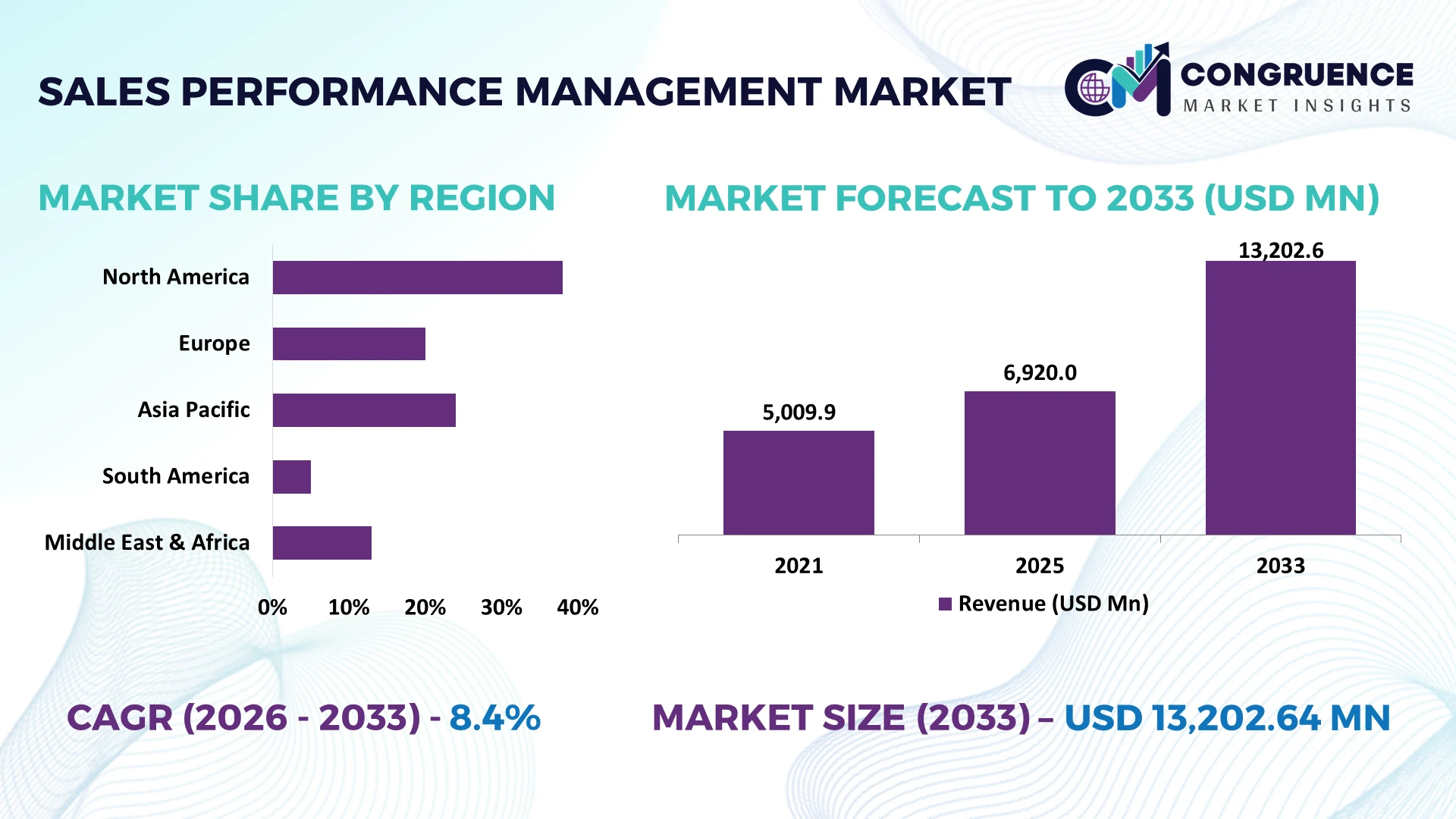
The United States represents the dominant country market, accounting for approximately 38% of global Sales Performance Management deployments, supported by large technology, financial services, healthcare, telecommunications, and professional services sales organizations. More than 70% of large US enterprises operate cloud based CRM environments, creating an established integration layer for incentive compensation, quota management, forecasting, and sales analytics. US adoption remains substantially ahead of India, where rapid SaaS expansion and digitally managed distributed sales teams are accelerating SPM implementation. Ongoing US technology investment restrictions involving China are also reinforcing enterprise focus on controlled data environments and auditable AI workflows.
For buyers and vendors, competitive advantage increasingly depends on integrating compensation, forecasting, territory planning, and AI guided seller actions within one governed data architecture.
Market Size & Growth: USD 6.92 billion in 2025 advances to USD 13.20 billion by 2033 at 8.41%, supported by AI enabled forecasting and automated compensation management.
Top Growth Drivers: Cloud migration above 70%, AI assisted selling adoption exceeding 50% among digitally mature sales organizations, and commission automation reducing manual processing by approximately 30% underpin expansion.
Short Term Forecast: By 2028, advanced SPM implementations are positioned to reduce compensation administration effort by 25% while improving quota and territory planning efficiency by approximately 20%.
Emerging Technologies: Generative AI, predictive analytics, and intelligent workflow automation increasingly connect CRM activity, quota attainment, pipeline probability, and compensation data within unified seller decision systems.
Regional Leaders: North America approaches USD 5.0 billion, Europe approximately USD 3.5 billion, and Asia Pacific roughly USD 3.0 billion by 2033 as cloud first sales operations broaden.
End User Trends: More than 60% of digitally mature enterprise sales organizations prioritize integrated analytics, forecasting, and incentive visibility instead of isolated commission management applications.
Pilot/Case Example: 2025 enterprise AI assisted sales deployments demonstrated approximately 15% improvement potential in seller productivity by reducing administrative workload and directing representatives toward higher probability opportunities.
Competitive Landscape: The leading vendor commands an estimated low double digit share, while SAP, Oracle, Salesforce, Xactly, and Varicent compete through analytics depth, ecosystem integration, compensation automation, and AI capabilities.
Regulatory & ESG Impact: GDPR exposure covering 100% of applicable EU personal data workflows increases requirements for permission controls, explainable analytics, retention governance, and auditable employee performance information.
Investment & Funding: Enterprise sales technology spending operates within a global CRM software ecosystem exceeding USD 100 billion, directing investment toward AI integration, data unification, partnerships, and workflow consolidation.
Innovation & Future Outlook: By 2030, AI driven recommendation engines will increasingly shift SPM from retrospective scorekeeping toward continuous territory, quota, incentive, pipeline, and seller action optimization.
Sales Performance Management Market demand is concentrating around incentive compensation management, quota planning, territory optimization, sales forecasting, and performance analytics as enterprises consolidate fragmented revenue operations. Generative AI and predictive scoring are turning SPM platforms into decision engines capable of recommending seller actions rather than simply reporting attainment. In digitally mature organizations, integrated sales technology environments now influence more than 60% of performance management workflows. European data governance requirements are simultaneously increasing demand for transparent, permission controlled employee analytics, positioning platform integration and governed intelligence as central themes for the market’s strategic evolution.
Sales Performance Management is becoming a strategic control layer for enterprises seeking tighter alignment between sales capacity, incentives, territories, and profitable customer acquisition. Digital adoption is shifting organizations from periodic quota reviews toward continuous performance orchestration using CRM, compensation, pipeline, and workforce data. AI assisted platforms can automate more than 60% of routine compensation calculations, while legacy spreadsheet workflows often require extensive manual validation, creating reconciliation delays and weaker visibility into seller behavior.
Deployment maturity differs sharply by country. US enterprises lead in integrated CRM, incentive compensation, and predictive forecasting, while India is scaling cloud SPM adoption through technology services, financial services, telecom, and distributed field sales operations. Modern automated compensation workflows can shorten processing cycles by roughly 30% compared with spreadsheet intensive administration. A multinational organization, for example, can connect territory assignments, quota attainment, commission calculations, and manager dashboards across thousands of representatives without maintaining separate country spreadsheets.
Through 2028, investment priorities will move toward generative AI coaching, scenario based territory planning, and unified revenue intelligence. Vendors are deepening CRM partnerships and embedding AI into compensation and forecasting workflows, while enterprises consolidate point solutions. Competitive advantage will increasingly belong to organizations that convert performance data into faster resource allocation and seller decisions.
Enterprise migration toward AI enabled revenue operations is the strongest structural driver for Sales Performance Management adoption. More than 70% of large enterprises operate cloud based CRM environments, while AI assisted sales tools can reduce routine administrative workloads by approximately 20% and improve forecasting productivity by 15%–25%. The shift accelerated as US technology and financial services companies consolidated fragmented sales applications into integrated data environments capable of linking quotas, incentives, territories, and pipeline signals. This changes SPM from compensation administration into an operational decision platform. Vendors are responding by embedding predictive analytics, generative AI coaching, and automated territory modeling into cloud suites. The strategic advantage is speed: companies connecting seller activity directly with compensation signals can reallocate territories and incentives before quarterly performance gaps become entrenched.
Data fragmentation across CRM, ERP, payroll, HR, and legacy commission systems remains a structural constraint on enterprise SPM deployment. Large organizations can operate 10 or more interconnected sales and workforce applications, while poor data quality can consume 20%–30% of analytics teams’ preparation time. Integration becomes particularly difficult for multinational businesses where compensation rules, currencies, tax treatment, and employment requirements differ by country. Germany’s stringent employee data governance environment adds another layer of control around performance information and automated decision processes. These conditions increase implementation effort and delay standardized global rollouts. Enterprises are reducing exposure through API based architectures, master data governance, phased migrations, and standardized compensation models. Vendors offering prebuilt CRM, ERP, and HCM connectors gain a deployment advantage because integration economics increasingly determine platform selection alongside functionality.
Next generation SPM platforms are creating an opportunity to optimize incentives dynamically rather than administering fixed compensation plans retrospectively. Generative AI, predictive attainment models, and scenario engines can evaluate thousands of quota, territory, and incentive combinations before deployment, while automation can reduce compensation processing effort by around 25%–30%. India presents an important expansion opportunity because digitally managed salesforces across banking, insurance, telecom, pharmaceuticals, and SaaS increasingly require scalable performance governance. Cloud based deployment also enables midmarket companies to adopt capabilities previously concentrated among multinational enterprises. Through 2028, vendors are positioning around AI generated coaching, behavioral performance signals, and real time incentive simulations. Partnerships with CRM and workforce platforms are expanding ecosystem reach. The non-obvious opportunity lies in using compensation data as predictive intelligence for retention, territory redesign, and sales capacity investment.
Scaling AI driven SPM across multinational sales organizations introduces execution risks extending beyond initial system integration. Enterprises must synchronize continuously changing CRM opportunities, payroll records, territory structures, quotas, and compensation rules while maintaining explainable recommendations. Cybersecurity is equally material because SPM platforms process sensitive employee, customer, compensation, and performance information; human involvement remains associated with more than 60% of organizational security breaches. EU AI governance requirements are also increasing scrutiny of automated systems influencing workforce decisions, requiring stronger documentation and human oversight. In complex deployments, even a 1% compensation calculation error can generate thousands of disputed transactions across large salesforces. Companies must therefore invest in identity controls, data lineage, AI validation, specialist implementation talent, and continuous model monitoring. Long term competitiveness depends on scaling intelligence without sacrificing calculation accuracy, trust, or regulatory consistency.
Agentic Workflows Enter Daily Selling: AI agents are moving from experimentation into live commercial workflows, with 54% of sales teams already using agents and another 34% expecting adoption within two years. Prospecting, quoting, commission administration, and usage tracking are increasingly automated. Companies are redesigning seller workflows around human AI collaboration, reducing research time by approximately 34% and content preparation by 36% while expanding agent deployments across customer-facing operations.
Outcome Metrics Replace Activity Tracking: Sales organizations are shifting performance measurement from call volumes and pipeline activity toward profitability, conversion, attainment, and customer outcomes. In 2025, 42% of sales professionals prioritized recurring business performance, 30% emphasized profit margin, and 28% tracked win rates. SPM vendors are responding by integrating financial and seller metrics, enabling managers to connect incentive structures with commercially meaningful outcomes rather than rewarding isolated activity indicators.
Compensation Becomes Continuously Adaptive: Annual incentive configuration is giving way to more frequent compensation adjustments as product mixes, territories, and seller responsibilities change. Automated commission engines increasingly process multi-variable plans while maintaining audit trails and approval workflows. With 51% of sales leaders reporting disconnected systems slowing AI initiatives, enterprises are restructuring compensation data architectures and consolidating CRM, payroll, and performance records to reduce disputes and accelerate plan modifications.
Manager Coaching Becomes Data Triggered: Performance coaching is shifting from scheduled reviews toward continuous interventions triggered by pipeline behavior, conversion patterns, and attainment signals. AI is already used by 87% of sales organizations, while top-performing sellers are 1.7 times more likely to use agents than struggling teams. Enterprises are embedding recommendations within manager dashboards, allowing coaching resources to concentrate on specific opportunity gaps instead of applying standardized training across entire salesforces.
Compensation Management leads the type landscape with an estimated 29% share, reflecting its mission-critical role in calculating commissions, bonuses, accelerators, thresholds, and complex multi-tier incentive structures. Large enterprises prioritize this segment because automated calculation can reduce manual compensation administration by approximately 25% while improving payment accuracy and auditability. Incentive Management remains closely aligned with compensation workflows, whereas Quota Management and Territory Management support allocation discipline by connecting seller capacity with account potential and geographic coverage.
Performance Analytics is the fastest-growing type as enterprises move beyond retrospective scorecards toward predictive attainment and behavioral intelligence. AI-enabled analytics can shorten performance diagnosis cycles by approximately 20%, encouraging vendors to embed recommendations directly within CRM and compensation environments. Sales Forecasting is increasingly connected with quota and pipeline signals rather than operating independently. Vendors are consequently investing in integrated analytics, scenario modeling, and interoperable planning modules, shifting buyer priorities from standalone administrative functionality toward platforms capable of linking compensation decisions with forward-looking commercial performance.
Commission Management represents the leading application with an estimated 27% share because payment accuracy, complex incentive structures, and payroll integration create immediate operational requirements. Automation can reduce commission-processing effort by approximately 25%–30%, making the application particularly important for US technology, financial services, and telecommunications enterprises operating large variable-pay salesforces. Target Setting and Sales Planning remain established use cases, while Performance Tracking increasingly combines attainment, pipeline movement, conversion, and productivity indicators within manager dashboards.
Sales Coaching is the fastest-growing application as AI converts performance signals into personalized recommendations and next-best actions. AI agents are expected to reduce prospect research time by 34%, giving managers additional capacity for deal strategy and capability development. Revenue Forecasting is evolving through predictive opportunity scoring, while Territory Planning increasingly incorporates account potential and workload signals instead of static geographic allocation. Companies are integrating these applications with CRM environments and scaling automated guidance, creating stronger demand for unified platforms where planning, coaching, forecasting, commissions, and performance measurement operate from synchronized commercial data.
Banking represents the leading end-user segment with an estimated 22% share, supported by large relationship-manager networks, product-specific incentive structures, regulated selling practices, and intensive performance measurement. Banks require granular controls linking targets, customer portfolios, product categories, compliance requirements, and variable compensation. Insurance follows with similarly complex agent structures, while Telecommunications and IT Services emphasize quota attainment and recurring-account performance. Retail and Manufacturing increasingly use SPM to coordinate distributed field and channel sales teams, with automated workflows capable of cutting administrative effort by approximately 20%.
IT Services is the fastest-growing end-user as cloud providers, software firms, and technology consultancies expand subscription, consumption, and partner-led selling models. Technology organizations report approximately 55% regular generative AI usage in marketing and sales, creating favorable conditions for predictive coaching and performance analytics. Healthcare and Pharmaceuticals require controlled incentive structures around specialized salesforces. Vendors are responding with industry-specific workflows, configurable compliance controls, ecosystem integrations, and modular deployment models tailored to distinct compensation and sales-governance requirements.
North America accounted for the largest market share at 41% in 2025 however, Asia-Pacific is expected to register the fastest growth, expanding at a CAGR of 10.2% between 2026 and 2033.
AI-Integrated Revenue Operations Lead Deployment
North America accounts for approximately 41% of Sales Performance Management demand, supported by mature CRM infrastructure, complex variable-compensation structures, and high enterprise software penetration. US and Canadian organizations increasingly connect SPM platforms with CRM, HCM, payroll, and revenue-intelligence environments, moving performance management closer to daily sales execution. Approximately 75% of US organizations use cloud infrastructure across multiple business functions, providing a strong foundation for SaaS-based compensation and territory platforms. Adoption is concentrated across technology, banking, insurance, telecommunications, healthcare, and professional services, where distributed salesforces require auditable incentive calculations. Enterprises are also consolidating overlapping sales applications as AI adoption increases data-consistency requirements. Vendors are responding through Salesforce ecosystem integrations, cloud migration programs, and embedded generative-AI capabilities that shorten planning cycles and improve manager visibility into attainment.
United States Market Outlook: The United States remains the region's operational center because large enterprises combine sophisticated incentive plans with established CRM ecosystems and extensive variable-pay workforces. More than 70% of large organizations operate cloud-based customer platforms, supporting integration of quota, commission, forecasting, and coaching workflows. Technology and financial-services companies are prioritizing governed AI deployment, creating strong demand for auditable performance data and configurable compensation logic.
Governed Automation Reshapes Sales Operations
Europe represents approximately 25% of global Sales Performance Management activity, with deployment concentrated in the United Kingdom, Germany, France, the Netherlands, and Nordic economies. Enterprises are modernizing compensation and performance systems while responding to GDPR requirements and expanding AI governance obligations under the EU AI Act. This regulatory environment is shifting procurement toward platforms offering explainability, role-based access, data lineage, and human oversight of automated performance decisions. Cloud adoption among EU enterprises exceeded 45%, widening the addressable base for integrated SPM deployments. Financial services, industrial technology, pharmaceuticals, telecommunications, and business services remain important adopters. Multinational employers are also standardizing incentive governance across national operations while retaining country-specific compensation rules. Platform providers are strengthening European data hosting, configurable compliance controls, and integration partnerships, making governance functionality a competitive procurement criterion rather than an administrative add-on.
Germany Market Outlook: Germany combines a large industrial sales base with rigorous employee-data governance and extensive enterprise software infrastructure. More than 45% of German enterprises use cloud computing services, enabling migration from locally maintained compensation processes toward controlled SaaS environments. Industrial manufacturers increasingly require SPM platforms capable of handling direct sales, dealer networks, export territories, and technically specialized account structures without weakening works-council and privacy controls.
Digital Salesforces Accelerate Platform Scaling
Asia-Pacific holds approximately 23% of the market, with adoption expanding across India, China, Japan, Australia, Singapore, and South Korea as enterprises digitize large direct, channel, and field-sales operations. India provides particular deployment momentum through IT services, banking, insurance, telecommunications, pharmaceuticals, and digitally enabled retail, while Japan emphasizes structured account management and enterprise-system integration. Cloud infrastructure expansion is reducing the technical barrier to centralized incentive and performance administration; public-cloud adoption now reaches a majority of large digitally mature enterprises in several major economies. Vendors are scaling local implementation partnerships, multilingual interfaces, configurable compensation engines, and CRM integrations to address heterogeneous sales structures. A distinctive regional shift is the use of SPM for channel and partner performance alongside employee compensation, reflecting the importance of distributors, resellers, agents, and ecosystem selling across high-volume Asian markets.
India Market Outlook: India offers exceptional operational scale because banks, insurers, telecom operators, pharmaceutical companies, SaaS vendors, and IT services groups manage extensive distributed salesforces. The country has more than 900 million internet users, supporting increasingly digital customer acquisition and seller workflows. SPM providers are targeting this environment with cloud-first pricing, mobile accessibility, configurable incentives, and integrations suited to direct employees, agents, partners, and field representatives.
Cloud Modernization Broadens Enterprise Adoption
South America contributes approximately 6% of global Sales Performance Management demand, led by Brazil and followed by Argentina, Chile, and Colombia. Adoption centers on banking, insurance, telecommunications, retail, technology services, and consumer-facing enterprises operating geographically dispersed sales organizations. Brazil's expanding cloud infrastructure is improving access to centralized compensation, forecasting, and performance analytics, while multinational companies are standardizing regional sales governance across multiple currencies and employment structures. More than 40% of Brazilian enterprises use paid cloud services, strengthening the technical foundation for SaaS SPM deployments. However, integration with older payroll systems, fragmented data environments, and varying local compensation practices can extend implementation cycles. Vendors are countering these limitations through modular deployments, local implementation partners, Portuguese and Spanish interfaces, and preconfigured CRM connectors that reduce integration requirements for mid-sized organizations.
Brazil Market Outlook: Brazil dominates South American deployment through its large banking, telecommunications, retail, software, and insurance sectors. The country's instant-payment ecosystem processes billions of Pix transactions monthly, illustrating the broader digitalization of commercial infrastructure. Enterprises are extending similar real-time operating expectations into sales management, strengthening demand for automated incentive calculations, mobile performance visibility, and analytics capable of coordinating extensive branch, agent, and field-sales networks.
Digital Transformation Drives Enterprise Modernization
Middle East & Africa represents approximately 5% of global Sales Performance Management activity, with deployment concentrated in the United Arab Emirates, Saudi Arabia, South Africa, and other digitally advanced commercial centers. Gulf enterprises are modernizing CRM, workforce, analytics, and cloud environments alongside national digital-transformation programs, creating infrastructure for integrated sales-performance platforms. Saudi Arabia's technology modernization under Vision 2030 and the UAE's cloud and AI investment agenda are accelerating adoption among banking, telecommunications, real estate, technology, and professional-services organizations. Cloud migration is also enabling centralized governance for salesforces operating across multiple Gulf and African markets. Vendors are responding through hyperscaler partnerships, regional data-center availability, Arabic-language capabilities, and implementation ecosystems. Outside leading hubs, uneven cloud maturity and integration capability continue to favor modular SaaS deployments over complex enterprise-wide transformations.
Saudi Arabia Market Outlook: Saudi Arabia is emerging as a strategic deployment center as Vision 2030 accelerates digitization across financial services, telecommunications, tourism, real estate, and technology. Digital payments already represent more than 70% of retail transactions, demonstrating enterprise readiness for data-driven operating models. Large employers are increasingly investing in cloud CRM, analytics, and workforce platforms that create the integration foundation required for sophisticated quota, incentive, territory, and seller-performance management.
Salesforce, SAP, Oracle, Xactly, and Varicent anchor competition, with enterprise-suite vendors challenging specialist SPM providers on ecosystem breadth while specialists compete through compensation depth, configurability, and deployment speed. The top five players collectively hold approximately 48% of the market, leaving substantial room for specialized platforms. Salesforce and Oracle leverage CRM integration, SAP exploits ERP and workforce connectivity, while Xactly and Varicent differentiate through incentive-compensation intelligence and planning. Advanced automation can reduce compensation administration by 25%–30%, while prebuilt integrations can shorten implementation cycles by roughly 20%. Competition is shifting toward generative AI, predictive attainment, embedded coaching, and unified revenue intelligence rather than standalone commission processing. Vendors are expanding through cloud partnerships, product integration, AI development, and implementation ecosystems. Complex compensation logic, enterprise-grade data integration, security requirements, and historical performance datasets create meaningful entry barriers. Winning requires accurate calculation engines, interoperable architecture, governed AI, rapid deployment, and measurable seller-productivity improvement.
Salesforce
SAP
Oracle
Xactly
Varicent
Anaplan
Performio
CaptivateIQ
Spiff
Everstage
Forma.ai
Iconixx
Zoho Corporation
Gryphon.ai
Current Sales Performance Management technology centers on cloud-native compensation engines, predictive forecasting, API integration, and embedded analytics connecting CRM, ERP, HCM, and payroll data. AI-supported forecasting and performance analytics deliver the strongest measurable value: 90% of surveyed enterprise SPM practitioners identify these use cases as AI’s leading contribution. Compared with spreadsheet-led administration, automated platforms can cut compensation-processing effort by roughly 25%, improving payout accuracy, auditability, and planning speed.
Emerging architectures combine generative AI, natural-language configuration, scenario modeling, and agentic workflows. Hybrid AI deployment is favored by 84% of enterprise practitioners, enabling packaged intelligence to be extended with company-specific data and business rules. AI agents increasingly investigate performance anomalies, model incentive changes, and recommend quota or territory actions. Specialist SPM vendors benefit competitively because proprietary compensation datasets and configurable calculation logic create stronger context than generic copilots.
From 2026 through 2028, disruptive value will shift toward autonomous sales-performance orchestration across quotas, territories, incentives, forecasting, and coaching. About 68% of practitioners expect AI’s greatest next-stage impact in planning optimization, while 14% already accept greater AI autonomy in governance decisions. Enterprises acting now can build trusted data foundations, validate models, and integrate workflows before agent-led orchestration becomes a procurement requirement for enterprise buyers.
April 2024 Salesforce launched Salesforce Spiff inside Sales Cloud after completing its acquisition, integrating incentive compensation with CRM workflows. Salesforce reported 64% of organizations struggle with correct quota setting, making unified pipeline-to-paycheck visibility important for compensation accuracy and seller motivation. Source: salesforce.com
May 2025 Xactly partnered with ServiceNow to integrate sales performance management with Sales and Order Management, connecting quote-to-order activity, earnings, incentives, and performance metrics. The integration addressed quota and incentive alignment as 15 SPM providers faced expanding cross-platform revenue-management requirements. Source: destinationcrm.com
November 2025 CaptivateIQ launched its AI-Powered Payee Experience, adding real-time explanations and personalized commission coaching. Company research found 92% of representatives consider real-time earnings visibility motivating, yet only 52% of organizations provide real-time performance tracking, exposing a significant transparency gap. Source: prnewswire.com
March 2026 Xactly’s Sales Performance AI received the Artificial Intelligence Excellence Award after deploying AI Agents for incentive workflows and proactive revenue intelligence. 2026 program recognized deployments across 36 industries and over 15 countries, validating agentic SPM’s transition into production. Source: bintelligence.com
The report evaluates Sales Performance Management across six types, seven applications, and eight end-user industries, providing a structured view of incentive administration, compensation, quota allocation, territory design, analytics, forecasting, coaching, and revenue planning. Regional coverage spans North America, Europe, Asia-Pacific, South America, and Middle East & Africa, with country-level attention to enterprise adoption, cloud maturity, regulatory requirements, and deployment concentration.
Technology coverage examines predictive analytics, generative AI, agentic automation, cloud-native calculation engines, scenario modeling, API interoperability, and CRM, ERP, HCM, and payroll integration. The analysis also tracks emerging revenue-performance orchestration, partner-led selling, real-time commission visibility, and AI-supported territory optimization. Competitive assessment covers established enterprise-suite vendors and specialist SPM platforms, enabling decision-makers to evaluate investment priorities, market-entry opportunities, partnership strategies, deployment economics, and evolving competitive requirements through 2033.
| Report Attribute/Metric | Report Details |
|---|---|
Market Revenue in 2025 | USD 6920 Million |
Market Revenue in 2033 | USD 13202.64 Million |
CAGR (2026 - 2033) | 8.41% |
Base Year | 2025 |
Forecast Period | 2026 - 2033 |
Historic Period | 2021 - 2025 |
Segments Covered | By Type
By Application
By End-User
|
Key Report Deliverable | Revenue Forecast, Growth Trends, Market Dynamics, Segmental Overview, Regional and Country-wise Analysis, Competition Landscape |
Region Covered | North America, Europe, Asia-Pacific, South America, Middle East, Africa |
Key Players Analyzed | Salesforce, SAP, Oracle, Xactly, Varicent, Anaplan, Performio, CaptivateIQ, Spiff, Everstage, Forma.ai, Iconixx, Zoho Corporation, Gryphon.ai |
Customization & Pricing | Available on Request (10% Customization is Free) |




