
Reports
The Global SaaS-based Expense Management Market was valued at USD 3263.97 Million in 2025 and is anticipated to reach a value of USD 5996.78 Million by 2033 expanding at a CAGR of 7.9% between 2026 and 2033.
Growth is being accelerated by enterprise-wide automation mandates and the shift toward AI-driven financial controls, with organizations reporting up to 28% reduction in manual processing time through cloud-based expense platforms. Between 2024 and 2026, stricter digital tax compliance frameworks and cross-border reporting requirements have pushed enterprises to adopt centralized SaaS expense systems to ensure audit readiness and policy enforcement.
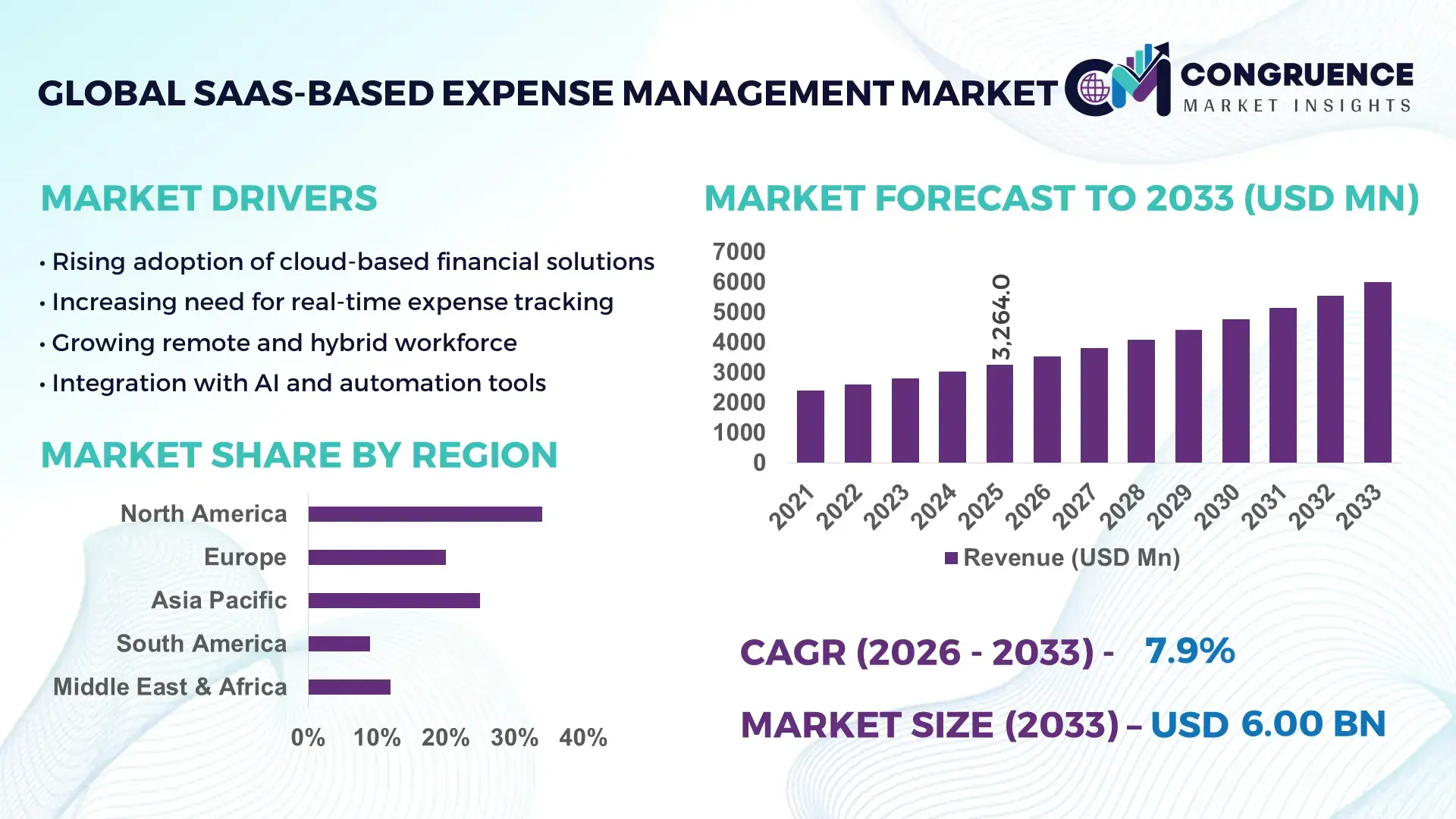
The United States leads the global SaaS-based expense management landscape, accounting for approximately 34% of total adoption, driven by high enterprise cloud penetration exceeding 70% and strong investments in fintech infrastructure. The country’s large base of multinational corporations, particularly across technology, consulting, and financial services sectors, supports high transaction volumes processed via automated expense platforms. In contrast, Western Europe contributes around 26%, supported by regulatory digitization mandates such as e-invoicing frameworks, while Asia-Pacific is expanding rapidly with over 18% share, led by India and Southeast Asia where SME cloud adoption has grown by nearly 22% year-over-year. Compared to legacy on-premise systems, SaaS solutions deliver 35–40% faster reimbursement cycles and significantly improved compliance tracking.
Strategically, vendors and enterprises prioritizing AI integration and regulatory alignment will secure stronger competitive positioning in this high-growth, compliance-driven digital finance ecosystem.
Market Size & Growth: USD 3263.97M (2025) to USD 5996.78M (2033) at 7.9% CAGR, driven by AI-enabled automation reducing processing costs by 25%.
Top Growth Drivers: Cloud adoption (↑32%), compliance digitization (↑27%), mobile workforce expansion (↑21%).
Short-Term Forecast: By 2027, reimbursement cycle time drops by 30% with automated workflows and real-time approvals.
Emerging Technologies: AI-based receipt scanning improves accuracy by 40%, alongside predictive analytics and API-led integrations.
Regional Leaders: North America (~USD 2.1B) leads with enterprise adoption; Europe (~USD 1.6B) driven by regulation; Asia-Pacific (~USD 1.3B) growing via SME digitization.
Consumer/End-User Trends: Over 62% of enterprises now use mobile-first expense reporting, improving employee compliance by 20%.
Pilot/Case Example: A 2025 enterprise rollout achieved 35% faster expense approvals and 18% reduction in policy violations.
Competitive Landscape: Top players hold ~45% market share, competing on AI automation and ERP integration capabilities.
Regulatory & ESG Impact: Digital compliance tools improve audit efficiency by 30% and reduce paper usage by over 50%.
Investment & Funding: Over USD 1.4B invested globally in fintech SaaS platforms, focusing on automation and cross-border capabilities.
Innovation & Future Outlook: Embedded finance and real-time spend analytics enhance decision accuracy by 25%.
Enterprise demand is led by IT & services (~38%), BFSI (~24%), and manufacturing (~18%), reflecting high transaction complexity and compliance intensity. AI-driven receipt capture and automated audit systems are improving processing accuracy by over 35%, while API integrations with enterprise systems are accelerating deployment efficiency. Asia-Pacific demand is rising above 20%, supported by SME digitization and regulatory e-invoicing mandates. Increasing focus on real-time spend visibility and predictive analytics is shifting organizations toward proactive financial control, strengthening long-term cost optimization strategies.
SaaS-based expense management is rapidly transforming into a core financial control layer as enterprises prioritize real-time visibility, compliance automation, and cost optimization across distributed workforces. The market is accelerating as CFOs shift from reactive expense tracking to predictive spend intelligence, with over 65% of large enterprises integrating expense platforms into broader financial ecosystems. Increasing regulatory scrutiny and cross-border transaction complexity are forcing organizations to adopt centralized, cloud-native systems that ensure audit readiness and policy enforcement at scale.
AI-driven expense automation improves processing efficiency by 40% while reducing operational costs by 25% compared to legacy on-premise systems. North America leads in transaction volume, while Asia-Pacific leads in adoption momentum with over 22% annual growth driven by SME digitization and mobile-first financial tools. Over the next 2–3 years, enterprises are targeting a 30% reduction in reimbursement cycle times and a 20% improvement in policy compliance through advanced analytics and automation. ESG alignment is emerging as a competitive advantage, with digital expense systems reducing paper usage by over 50% and strengthening sustainability reporting.
A 2025 enterprise deployment across a global consulting firm achieved 35% faster approvals and reduced expense leakage by 18%, reinforcing measurable ROI. Investment strategies are shifting toward AI integration, embedded finance, and API ecosystems, with companies allocating over 30% of fintech budgets toward intelligent automation. Organizations that prioritize integrated, data-driven expense ecosystems will secure stronger financial governance and long-term competitive differentiation.
The accelerating demand for automated financial workflows and regulatory compliance is forcing enterprises to replace fragmented legacy systems with integrated SaaS-based expense platforms. Over 68% of organizations have prioritized finance automation to reduce manual intervention, while AI-enabled tools are improving expense data accuracy by nearly 35%. A major global trigger is the expansion of digital tax frameworks and e-invoicing mandates across Europe and Asia, requiring real-time reporting and standardized documentation. This shift is driving enterprises to adopt cloud-native platforms capable of handling high transaction volumes with built-in compliance controls. In response, companies are accelerating investments in AI-driven expense solutions, expanding partnerships with ERP providers, and scaling cloud infrastructure to support global operations. The direct impact is faster processing cycles, reduced compliance risk, and improved financial visibility, enabling organizations to optimize cost structures and strengthen governance frameworks.
Despite strong adoption, data security concerns and integration complexity are constraining scalability across the SaaS-based expense management market. Approximately 42% of enterprises cite data privacy risks and cross-border data transfer regulations as major barriers, particularly in regions with strict compliance frameworks. Additionally, integration with legacy ERP systems increases implementation costs by 20–25%, creating delays in deployment and limiting ROI realization. A key real-world constraint is the fragmentation of financial infrastructure across emerging markets, where inconsistent digital ecosystems slow adoption. These limitations directly impact operational efficiency, increasing onboarding time and limiting seamless data flow across systems. To mitigate risks, companies are diversifying cloud hosting strategies, investing in advanced encryption technologies, and forming long-term partnerships with compliance-focused solution providers. This approach helps balance scalability with security while ensuring regulatory alignment across multiple jurisdictions.
The next phase of growth is being driven by AI-powered predictive analytics, embedded finance capabilities, and expansion into underserved SME segments. AI-driven expense forecasting is improving budget accuracy by over 28%, while embedded payment integrations are reducing transaction processing time by nearly 22%. A significant opportunity lies in emerging markets across Asia-Pacific and Latin America, where SME cloud adoption is increasing by over 25% annually, creating new demand for scalable, low-cost solutions. The shift toward real-time financial intelligence is also enabling proactive decision-making, allowing enterprises to identify cost anomalies and optimize spending patterns. Companies are positioning for dominance by investing in R&D for advanced analytics, expanding regional cloud infrastructure, and building ecosystem partnerships with fintech and banking platforms. This strategic alignment is unlocking new revenue streams while enhancing operational efficiency and customer retention.
Scalability, system interoperability, and user adoption remain critical challenges that are reshaping competitive dynamics in the SaaS-based expense management market. Nearly 38% of enterprises report difficulties in integrating multiple financial systems, leading to data silos and reduced process efficiency. Additionally, user resistance to new digital workflows slows adoption rates by up to 15%, particularly in large organizations with entrenched processes. A key real-world pressure is the rapid evolution of compliance standards, requiring continuous system updates and increasing operational complexity. These challenges impact long-term sustainability by limiting platform performance and delaying ROI realization. To remain competitive, companies must invest in seamless API architectures, enhance user experience design, and strengthen training frameworks to drive adoption. Strategic partnerships with technology providers and continuous innovation in platform capabilities are essential to overcome these barriers and sustain growth momentum.
AI automation adoption exceeds 65%, reducing processing time by 40% across enterprise workflows. Organizations are rapidly deploying AI-driven receipt capture and automated approval engines, with over 58% of firms integrating machine learning into expense validation processes. This shift is optimizing accuracy by 35% and minimizing manual errors. Companies are restructuring finance operations by embedding AI into core systems and expanding partnerships with analytics providers to scale intelligent automation capabilities.
Mobile-first expense reporting usage rises above 62%, improving compliance rates by 20%. The shift toward remote and hybrid workforces is forcing enterprises to deploy mobile-enabled platforms for real-time expense submissions. Over 55% of transactions are now initiated via mobile apps, reducing reporting delays by 25%. Firms are redesigning user interfaces and investing in mobile security layers to ensure seamless and compliant expense tracking, particularly in regions with increasing digital workforce mobility.
API-led integrations expand by 48%, accelerating system interoperability and real-time data flow. Enterprises are actively integrating expense platforms with ERP and payroll systems to eliminate data silos and enhance financial visibility. This trend is reducing reconciliation time by 30% and improving cross-functional coordination. In response to regulatory digitization mandates, companies are scaling API ecosystems and forming strategic alliances with enterprise software providers to ensure seamless compliance and operational efficiency.
Subscription-based pricing models increase adoption by 27%, reshaping cost structures and vendor strategies. Businesses are shifting from fixed licensing to flexible, usage-based pricing, enabling cost optimization and scalability. This model is reducing upfront investment by 22% while improving budget predictability. Vendors are restructuring offerings to include modular features and tiered pricing, targeting SMEs and mid-sized enterprises. A non-obvious shift is the bundling of expense tools with broader financial platforms, redefining competitive positioning and customer retention strategies.
The SaaS-based expense management market is structured across types, applications, and end-users, with demand concentration reflecting enterprise priorities around automation, compliance, and financial visibility. Type-based segmentation shows strong dominance of integrated expense platforms, while application-level demand is concentrated in reporting and compliance functions. End-user distribution highlights high adoption across IT-intensive and transaction-heavy industries. Over 60% of demand is driven by enterprises seeking real-time expense visibility and policy enforcement, while nearly 25% of growth is shifting toward SME adoption due to scalable SaaS pricing models. This segmentation indicates a clear transition from standalone tools to integrated financial ecosystems, forcing vendors to align product capabilities with evolving enterprise requirements and industry-specific use cases.
Travel and Expense (T&E) Management dominates the market with approximately 42% share, driven by its ability to handle high-volume employee expenses, integrate with travel booking systems, and deliver end-to-end automation. Its structural advantage lies in scalability and seamless policy enforcement, making it essential for large enterprises with distributed workforces. However, Invoice and Spend Management is the fastest-growing segment, expanding at over 24% adoption growth, as organizations prioritize centralized control over procurement and vendor payments. Compared to T&E systems, which focus on employee expenses, invoice and spend solutions offer broader financial oversight, enabling cost optimization across supply chains.
Reimbursement Management and Corporate Card Management collectively account for around 34% share, serving niche but critical functions such as employee reimbursements and real-time transaction tracking. Demand is shifting toward integrated platforms combining these capabilities, prompting companies to invest in unified expense ecosystems. Vendors are expanding product portfolios and enhancing automation features to capture this shift. Businesses prioritizing invoice and spend capabilities are gaining stronger financial control, indicating a strategic shift toward holistic expense governance.
“According to a 2025 report, Invoice and Spend Management solutions were adopted by over 48% of large enterprises, resulting in a 30% improvement in cost visibility and control, reinforcing its growing strategic importance.”
Expense Reporting leads with approximately 36% share, as it forms the foundational layer of expense management systems, enabling standardized data capture and submission processes. Its dominance is driven by widespread enterprise adoption and regulatory requirements for accurate documentation. In contrast, Audit and Analytics is the fastest-growing application, expanding at over 26%, fueled by increasing demand for real-time insights and fraud detection capabilities. While reporting focuses on data collection, analytics transforms this data into actionable intelligence, creating a clear shift from operational to strategic usage.
Expense Tracking and Policy Compliance together account for nearly 40% of demand, reflecting the importance of real-time monitoring and adherence to corporate guidelines. Budget Control, though smaller in share, is gaining traction as organizations seek proactive cost management tools. Companies are scaling analytics capabilities and integrating compliance features into core platforms to meet evolving requirements. This shift highlights the growing importance of data-driven decision-making in expense management, pushing vendors to enhance analytical depth and reporting accuracy.
“According to a 2025 report, Audit and Analytics applications were deployed across over 60,000 organizations, improving fraud detection rates by 32%, highlighting its rapid operational adoption.”
IT and Telecom leads the market with approximately 34% share, driven by high digital maturity, large-scale operations, and significant travel and operational expenses. These organizations rely heavily on automated expense systems to manage complex financial workflows and ensure compliance. BFSI follows closely, accounting for around 26%, with strong demand for audit-ready systems and regulatory compliance. However, Retail is emerging as the fastest-growing segment, expanding at over 23%, fueled by distributed operations and the need for real-time expense tracking across multiple locations.
Healthcare and Manufacturing collectively contribute nearly 30% share, with increasing adoption driven by cost control requirements and operational efficiency needs. While IT and Telecom prioritize advanced analytics and integration, Retail focuses on scalability and ease of deployment. Companies are tailoring solutions with industry-specific features, flexible pricing, and strategic partnerships to capture these segments. This shift indicates a broader expansion beyond traditional enterprise users, with growing opportunities in operationally diverse industries requiring customized expense management solutions.
“According to a 2025 report, adoption among Retail organizations increased by 23%, with over 25,000 companies implementing SaaS-based expense solutions, leading to a 28% improvement in operational cost tracking efficiency, indicating a strong shift in demand dynamics.”
North America accounted for the largest market share at 34% in 2025 however, Asia-Pacific is expected to register the fastest growth, expanding at a CAGR of 9.2% between 2026 and 2033.
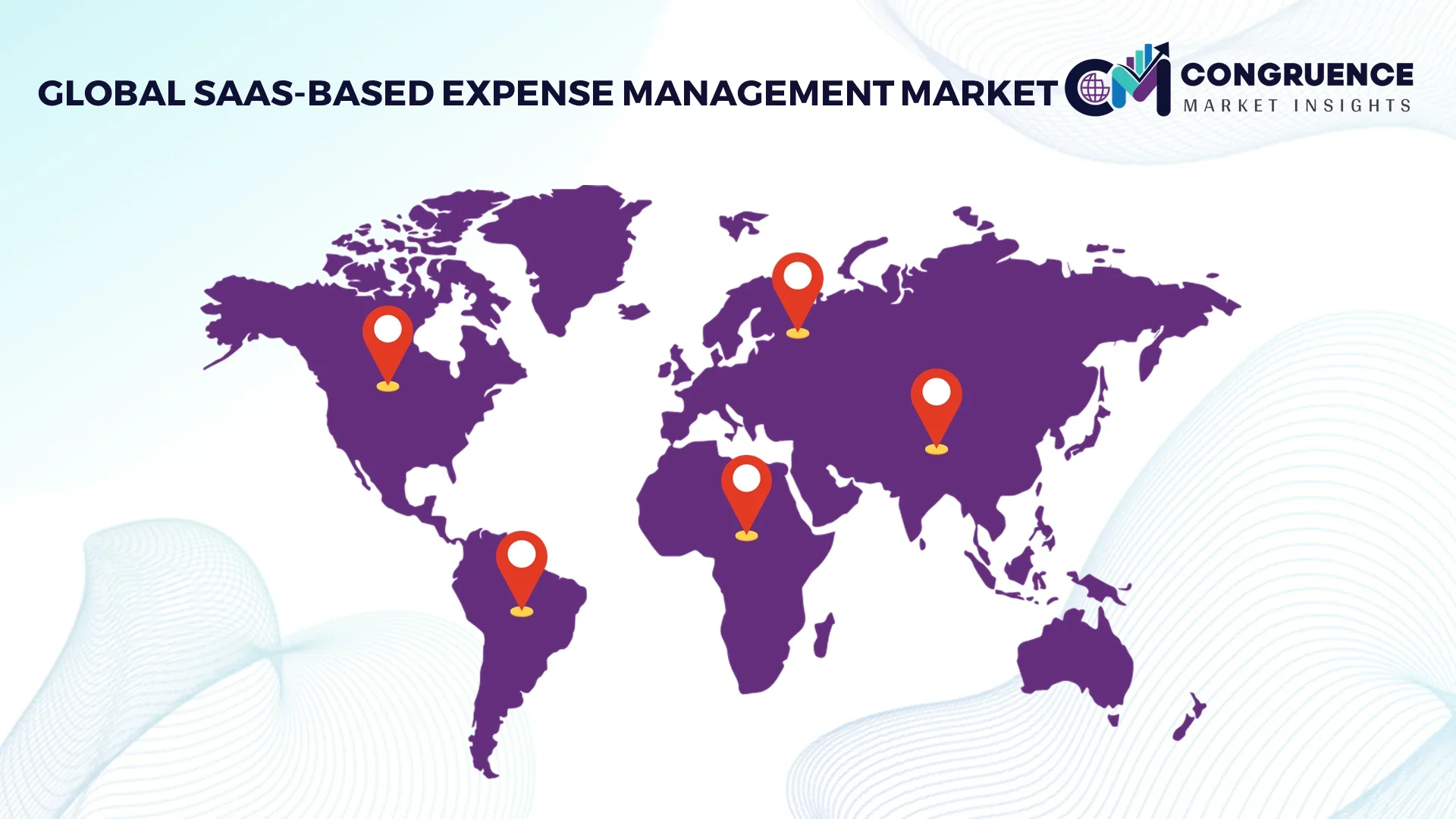
North America leads in demand concentration due to high enterprise cloud penetration exceeding 70%, while Europe holds around 26% share driven by regulatory compliance mandates and structured digital finance frameworks. Asia-Pacific, with over 18% share, is accelerating adoption through SME digitization and mobile-first financial ecosystems growing above 22% annually. A key structural shift is the global push toward e-invoicing and digital tax compliance, forcing rapid SaaS deployment across regions. Companies are increasingly prioritizing Asia-Pacific for expansion, while maintaining North America as a core revenue base and leveraging Europe for compliance-driven innovation.
What is driving enterprise-wide automation and real-time expense control adoption?
North America holds approximately 34% of global demand, driven by large-scale enterprise adoption across technology, consulting, and financial services sectors. Over 72% of enterprises have integrated SaaS expense platforms into broader ERP ecosystems, reflecting a strong shift toward unified financial management. A key structural force is increasing regulatory scrutiny around financial reporting and audit transparency, pushing companies to deploy automated compliance tools. AI-driven expense systems have improved processing efficiency by nearly 38%, while reducing manual intervention by 30%. Enterprises are prioritizing scalable, API-integrated platforms and allocating over 28% of fintech budgets toward automation. Decision-making is driven by performance optimization and compliance assurance, positioning the region as a priority for continuous innovation and high-value deployments.
How are compliance mandates and sustainability goals reshaping expense management systems?
Europe accounts for nearly 26% of the market, with strong adoption across Germany, the UK, and France driven by regulatory digitization and ESG requirements. E-invoicing mandates and tax compliance frameworks have increased SaaS adoption by over 24%, forcing enterprises to modernize financial systems. Sustainability goals are also influencing demand, with digital expense platforms reducing paper-based processes by more than 50%. Companies are deploying advanced analytics and compliance tools to meet strict reporting standards, improving audit efficiency by 30%. Enterprises prioritize accuracy, traceability, and regulatory alignment, leading to increased investment in integrated platforms. This region compels companies to innovate around compliance and sustainability, making it a critical benchmark for operational excellence.
Why is rapid digital scaling redefining expense management adoption patterns?
Asia-Pacific holds over 18% market share and is the fastest-expanding region, led by China, India, and Southeast Asia. SME cloud adoption is increasing by more than 22%, supported by mobile-first platforms and cost-effective SaaS solutions. A strong advantage lies in large-scale digital infrastructure expansion and growing fintech ecosystems. Enterprises are rapidly deploying localized expense solutions, with over 60% of transactions now processed digitally. Companies are investing in scalable cloud infrastructure and forming regional partnerships to support high-volume adoption. Cost efficiency and speed are key decision factors, with businesses prioritizing flexible, subscription-based models. This region is critical for scale-driven expansion and long-term demand growth.
How are cost constraints and digital adoption shaping enterprise expense solutions?
South America contributes approximately 9% of global demand, with Brazil and Mexico leading regional adoption. Increasing digitization across retail and financial services sectors is driving SaaS adoption, with usage growing by nearly 18% annually. However, infrastructure limitations and cost sensitivity remain key constraints, increasing deployment timelines by 15–20%. Enterprises are adopting phased implementations and localized solutions to manage costs effectively. Cloud-based expense platforms are improving operational efficiency by 25%, particularly in mid-sized enterprises. Companies are focusing on flexible pricing and regional partnerships to capture demand. This region presents a balance of growth opportunity and operational risk, requiring targeted strategies for market penetration.
What role is digital transformation playing in reshaping financial operations?
The Middle East & Africa region accounts for around 7% of the market, with demand concentrated in the UAE, Saudi Arabia, and South Africa. Sector-driven adoption across oil & gas, construction, and large infrastructure projects is accelerating demand for automated expense systems. Digital transformation initiatives have increased SaaS adoption by over 20%, supported by government-led modernization programs. Enterprises are deploying cloud-based platforms to manage complex project expenses, improving reporting efficiency by 28%. Strategic investments in fintech ecosystems and partnerships are expanding deployment capabilities. Organizations prioritize scalability and compliance, making this region an emerging hub for transformation-driven adoption.
United States – 34% market share; dominance driven by high enterprise cloud adoption and strong demand for integrated financial automation solutions
Germany – 11% market share; leadership supported by strict regulatory frameworks and advanced digital compliance infrastructure
The SaaS-based expense management market is defined by competition between global cloud leaders, specialized fintech providers, and ERP-integrated solution vendors. Key players such as SAP Concur, Expensify, Coupa Software, Zoho Expense, and Emburse compete on technology depth, integration capability, and user experience. The top five players collectively control approximately 45% of the market, with differentiation driven by AI-enabled automation, which improves processing efficiency by over 35%, and API integrations that reduce reconciliation time by nearly 30%.
Competition is intensifying as enterprise software providers integrate expense tools into broader financial ecosystems, challenging standalone platforms. Vendors are expanding through strategic partnerships, vertical integration, and regional scaling to capture SME demand. A notable shift is the bundling of expense management with procurement and payment systems, redefining value propositions. Entry barriers are rising due to high integration complexity and compliance requirements, forcing new entrants to invest heavily in technology and partnerships. Winning in this market requires delivering seamless integration, advanced analytics, and scalable solutions aligned with evolving enterprise financial strategies.
SAP Concur
Expensify
Coupa Software
Zoho Expense
Emburse
Certify (Emburse Certify)
Rydoo
Chrome River Technologies
SutiSoft
Webexpenses
Pleo
Happay
Fyle
AI-driven automation, optical character recognition (OCR), and machine learning-based anomaly detection are currently redefining expense workflows. AI-enabled receipt processing improves data extraction accuracy by over 40% while reducing manual validation costs by nearly 25%. Adoption has crossed 65% among large enterprises, with companies integrating these tools directly into ERP systems to enable real-time expense validation and compliance enforcement, significantly improving audit readiness and operational speed.
Emerging technologies such as predictive analytics and API-first architectures are accelerating integration across financial ecosystems. Predictive spend analytics improves budget forecasting accuracy by 28%, while API integrations reduce reconciliation time by 30%. Over 48% of organizations are deploying API-based expense platforms to connect finance, payroll, and procurement systems. This integration trend is enabling unified financial visibility and faster decision-making, giving enterprises a measurable operational advantage in cost control and efficiency optimization.
Compared to legacy on-premise systems, cloud-native SaaS platforms deliver 35–40% faster reimbursement cycles and reduce infrastructure costs by over 20%. Disruptive innovations such as embedded finance and real-time payment integrations are further transforming the market, enabling instant reimbursements and automated settlements. Fintech-driven vendors and ERP-integrated providers are gaining competitive advantage, particularly among SMEs and high-growth enterprises seeking scalability.
January 2026 – SAP Concur launched an AI-powered expense auditing module enhancing fraud detection accuracy by 32%, enabling enterprises to reduce compliance risks and improve audit efficiency across large-scale deployments. [AI Audit Expansion] Source: https://www.sap.com
September 2025 – Expensify introduced real-time expense approval workflows, reducing reimbursement cycle times by 28% and improving user adoption across mobile-first platforms. This shift strengthens its position in SME-focused expense solutions. [Real-Time Workflow] Source: https://www.expensify.com
March 2025 – Coupa Software expanded its expense management suite through a strategic partnership integrating payment automation, improving transaction processing speed by 35% for enterprise clients. This enhances end-to-end spend visibility. [Integrated Payments Push] Source: https://www.coupa.com
June 2024 – Zoho Expense upgraded its platform with advanced analytics dashboards, increasing reporting efficiency by 30% and enabling businesses to gain deeper financial insights for decision-making. [Analytics Upgrade] Source: https://www.zoho.com
This report delivers comprehensive coverage of the SaaS-based expense management market across key segments, including types such as Travel and Expense Management, Invoice and Spend Management, Reimbursement Management, and Corporate Card Management. It further analyzes applications including expense reporting, tracking, budget control, policy compliance, and audit analytics, alongside end-user industries such as BFSI, IT and telecom, healthcare, retail, and manufacturing. Geographic coverage spans five major regions, capturing both mature markets and high-growth emerging economies, while incorporating advanced technologies such as AI automation, predictive analytics, and API-driven integrations.
The analysis is supported by detailed segmentation across over 15 sub-categories, profiling more than 12 key companies and evaluating adoption patterns exceeding 60% in enterprise environments. It includes insights into operational efficiency gains of up to 40% through automation and highlights technology deployment trends across regions with over 50% mobile-based usage in modern expense systems. The report also captures emerging niches such as embedded finance and real-time expense analytics, which are reshaping financial workflows.
Strategically, the report enables decision-makers to identify high-impact investment areas, optimize expansion strategies, and strengthen competitive positioning. With forward-looking coverage through 2033, it provides actionable intelligence on where demand is shifting, which technologies are scaling, and how organizations can align with evolving digital finance ecosystems.
| Report Attribute/Metric | Report Details |
|---|---|
|
Market Revenue in 2025 |
USD 3263.97 Million |
|
Market Revenue in 2033 |
USD 5996.78 Million |
|
CAGR (2026 - 2033) |
7.9% |
|
Base Year |
2025 |
|
Forecast Period |
2026 - 2033 |
|
Historic Period |
2021 - 2025 |
|
Segments Covered |
By Type
By Application
By End-User
|
|
Key Report Deliverable |
Revenue Forecast, Growth Trends, Market Dynamics, Segmental Overview, Regional and Country-wise Analysis, Competition Landscape |
|
Region Covered |
North America, Europe, Asia-Pacific, South America, Middle East, Africa |
|
Key Players Analyzed |
SAP Concur, Expensify, Coupa Software, Zoho Expense, Emburse, Certify (Emburse Certify), Rydoo, Chrome River Technologies, SutiSoft, Webexpenses, Pleo, Happay, Fyle |
|
Customization & Pricing |
Available on Request (10% Customization is Free) |




