
Reports
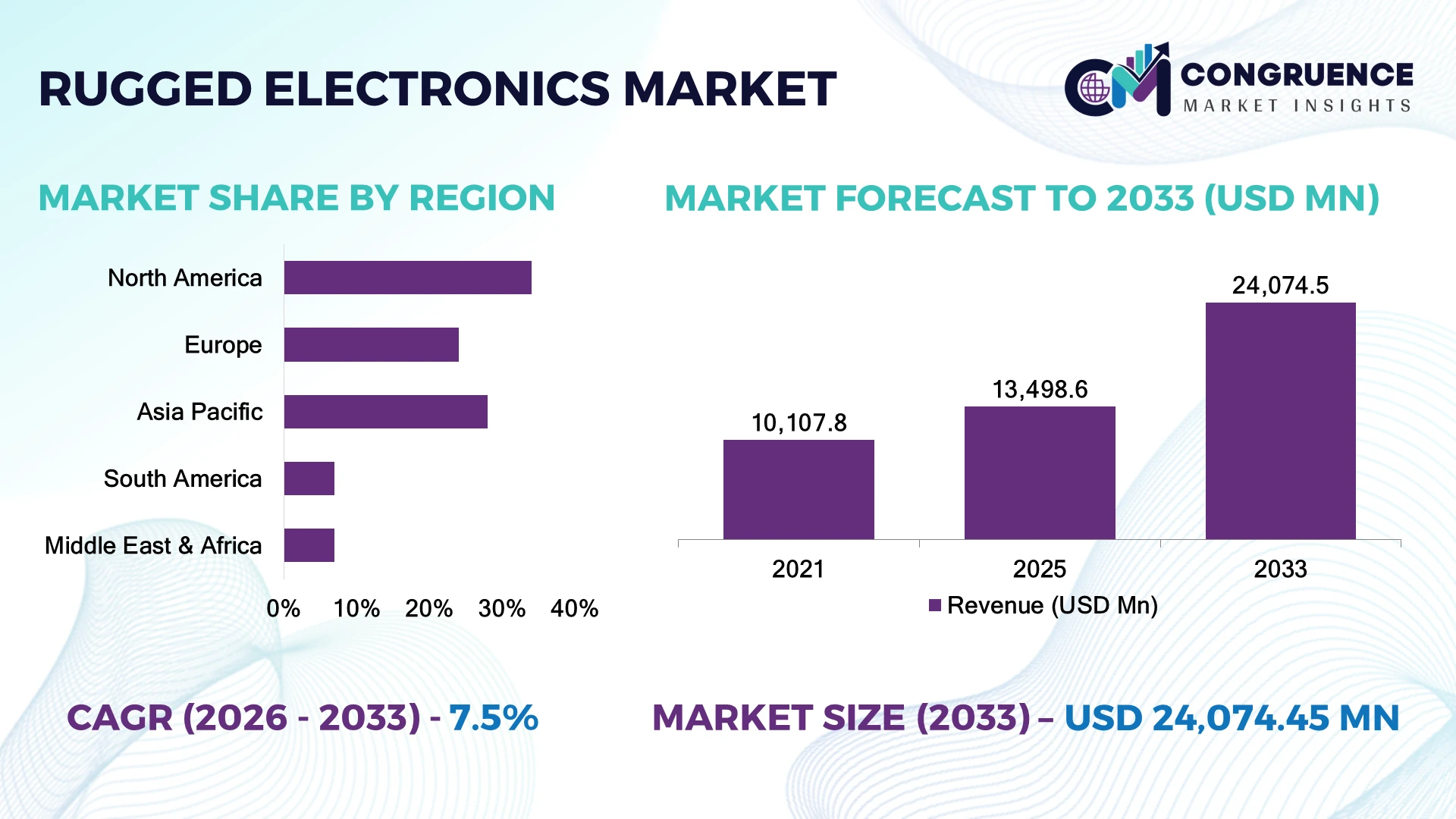
The Global Rugged Electronics Market was valued at USD 13,498.6 Million in 2025 and is anticipated to reach a value of USD 24,074.5 Million by 2033 expanding at a CAGR of 7.5% between 2026 and 2033. Growth is driven by defense modernization, industrial edge computing, and deployment of connected field equipment across utilities, transportation, mining and emergency response.
The United States remains a strategically important demand centre, supported by defense procurement and industrial digitalization. European defense investment strengthened in 2024, with European NATO allies and Canada increasing spending by 20%, reinforcing demand for secure, mission-ready electronics. Rugged laptops and tablets increasingly combine MIL-STD-810H testing, IP-rated protection, encrypted storage and high-performance processors. Compared with standard commercial devices, rugged platforms prioritize operational continuity in environments where equipment failure can interrupt safety-critical work.
Strategic implication: Suppliers should prioritize verified environmental protection, secure edge computing and long-term serviceability to win defense and industrial contracts.
Market Size & Growth: The market is valued at USD 13,498.6 million in 2025 and is projected to reach USD 24,074.5 million by 2033, supported by defense modernization and industrial digitization.
Top Growth Drivers: Defense electronics procurement, connected industrial maintenance and field mobility are the principal demand drivers; European NATO allies and Canada raised defense spending by 20% in 2024.
Short-Term Forecast: By 2028, buyers will increasingly evaluate device uptime, battery replacement time, secure connectivity and support lifecycle before standardizing rugged hardware fleets.
Emerging Technologies: Edge AI, 5G, Wi-Fi 7 and hardware-based security are shifting rugged devices from data-entry terminals toward local analytics and real-time decision support.
Regional Leaders: North America benefits from defense and industrial demand; Europe is strengthening defense readiness; Asia-Pacific combines electronics manufacturing with expanding industrial digitization.
Consumer/End-User Trends: Utilities, public safety and field-service teams prioritize glove-compatible displays, sunlight readability, hot-swappable batteries and reliable operation in harsh environments.
Pilot/Case Example: In 2025, Getac introduced rugged computers with on-device AI processing, including the B360 series, targeting field reports, diagnostics and secure offline workflows.
Competitive Landscape: Panasonic, Getac, Dell, Zebra Technologies and Durabook compete on durability, computing performance, customization and service coverage; comparable global market shares are not consistently disclosed.
Regulatory & ESG Impact: MIL-STD-810H environmental testing and IP protection ratings influence procurement, while longer service life and replaceable components can reduce premature device replacement.
Investment & Funding: European NATO allies and Canada increased defense spending by 20% in 2024, supporting a broader modernization environment for mission-critical electronics and communications.
Innovation & Future Outlook: Rugged hardware is evolving toward AI-ready, connected edge platforms that combine environmental resilience with secure processing and industry-specific interfaces.
The rugged electronics market includes computers, tablets, handheld terminals, tracking devices, displays and embedded systems designed for exposure to shock, vibration, dust, moisture and temperature extremes. Defense, utilities, manufacturing, transportation and public safety increasingly require secure computing at the point of work. In 2025, manufacturers began expanding AI-ready rugged portfolios, reflecting a shift from durability-focused hardware toward local analytics, stronger connectivity and operational decision support. The strategic priority is balancing performance with field reliability and lifecycle cost.
Rugged electronics are becoming strategically important because defense teams and industrial operators increasingly depend on real-time digital information outside controlled office environments. Equipment failure can interrupt inspections, vehicle maintenance, field repairs or mission communications. The 20% increase in defense spending by European NATO allies and Canada in 2024 reinforced procurement momentum for modernized platforms. Buyers are consequently evaluating computing performance, cybersecurity, interoperability and product lifecycle alongside environmental protection.
Technology is moving from conventional ruggedized computing toward AI-capable edge platforms. Traditional devices primarily support data capture and remote applications, whereas newer processors can run selected analytics locally, reducing dependence on continuous connectivity. Getac's 2025 AI-ready B360 and B360 Pro laptops incorporated Intel Core Ultra Series 2 processors and AI acceleration. North American and European defense applications emphasize secure mission performance, while industrial users in Asia-Pacific prioritize field service, manufacturing execution and equipment diagnostics. Both groups require dependable support and compatible software.
During 2026–2028, suppliers will compete through on-device AI, faster wireless connectivity, modular power systems and longer support lifecycles. A utility technician can use local diagnostics in a remote location where cloud access is unreliable; a defense operator requires similar resilience with stricter security controls. Manufacturers are expanding AI-ready portfolios and tailoring configurations for specialized workflows. Competitive advantage will depend on validated ruggedness, secure integration, reliable supply and measurable productivity improvements rather than processor specifications alone.
Defense modernization and industrial digitization are increasing the need for electronics that remain operational under shock, vibration, dust and temperature extremes. European NATO allies and Canada increased defense spending by 20% in 2024, strengthening the procurement environment for mission-ready computing and communications. In industrial markets, connected maintenance and field-service workflows require devices capable of accessing operational records and processing information at the worksite. AI-ready processors extend these capabilities to local diagnostics and data analysis. Manufacturers are responding with secure rugged laptops, tablets and embedded platforms, supported by application-specific configurations. The strategic advantage lies in reducing dependence on fragile consumer devices where failures create repeat visits, interrupted maintenance or operational risk.
Rugged electronics typically require reinforced enclosures, sealed connectors, impact-resistant displays and environmental validation, increasing acquisition costs relative to conventional commercial devices. Fully rugged systems also require specialized batteries, docking equipment and replacement components, creating additional inventory and maintenance burdens. Buyers must assess total fleet cost rather than comparing purchase prices alone. Specialized processors, displays and industrial connectors can create supply dependencies, while smaller procurement volumes limit purchasing leverage for some customers. Manufacturers are responding with modular designs, common accessories and longer support commitments. The key pressure point is proving that reduced failure exposure and longer service life offset the initial premium under actual operating conditions, especially for fleets deployed across remote or geographically dispersed sites.
Edge AI creates opportunities to move rugged electronics beyond data capture toward local image analysis, diagnostics and decision support. In 2025, Getac introduced rugged laptops and tablets with AI-capable processors, including a platform designed to deliver up to 48 trillion operations per second through its neural processing unit. Local processing can support selected tasks when connectivity is limited and reduce the need to transmit sensitive operational data continuously. Opportunities span vehicle inspection, manufacturing quality checks, utilities and field maintenance. Suppliers are developing application partnerships and tailored configurations that integrate AI hardware with workflow software. The non-obvious opportunity is software-led differentiation: validated field applications and secure data handling can create more durable customer relationships than hardware specifications alone.
Rugged electronics must integrate with legacy vehicle systems, industrial control platforms, secure networks and specialized peripherals without compromising reliability. Wireless connectivity can improve field productivity, but remote sites still face coverage gaps, interference and cybersecurity exposure. AI workloads add requirements for memory, processing capacity and thermal management within sealed enclosures. Devices also need operating-system support and security updates throughout long procurement cycles. Manufacturers must validate performance across environmental conditions while maintaining compatibility with customer applications. Partnerships with software vendors, network providers and system integrators are essential to address these requirements. The central challenge is delivering a consistent, secure operational platform across diverse field environments, not simply certifying a durable enclosure.
AI Moves Directly Into Field Devices — In March 2025, Getac introduced next-generation B360 and B360 Pro rugged laptops with Intel Core Ultra Series 2 processors and AI acceleration. In September 2025, it launched the F120 rugged tablet and V120 laptop with on-device AI capabilities. Local processing supports diagnostics and reporting when connectivity is limited, shifting competition toward secure edge performance as well as physical durability.
Wireless Connectivity Becomes a Core Specification — Getac's September 2025 F120 and V120 launch included Wi-Fi 7, Bluetooth 5.4 and two Thunderbolt 4 ports. These interfaces support faster data transfer and integration with field peripherals. Manufacturers are responding to demand for rugged mobile workstations that connect to modern networks while retaining compatibility with industrial and mission-specific equipment.
India Expands AI-Ready Rugged Deployment — In February 2026, Getac announced four AI-ready rugged devices for India, targeting manufacturing, automotive, pharmaceuticals, aviation and rail transportation. The lineup included devices with IP66 protection and AI processing of up to 48 TOPS on selected configurations. The expansion reflects efforts to support industrial digitization with equipment suited to monsoon exposure, remote sites and field workflows.
Defense Spending Accelerates Modernization Priorities — European NATO allies and Canada increased defense spending by 20% in 2024, strengthening the environment for mission-critical electronics procurement. Buyers are prioritizing secure computing, dependable communications and compatibility with operational systems. Suppliers are responding with AI-ready platforms, encrypted storage, environmental protection and customized interfaces designed for defense, public safety and infrastructure operations.
Rugged laptops and computers are estimated to represent approximately 36% of the rugged electronics market by type, supported by their processing capacity, keyboard-based workflows and compatibility with industrial software, diagnostic tools and defense applications. Rugged tablets are an estimated 27%, with adoption strengthening where mobile inspections, digital work orders and field reporting require touchscreen access. Rugged handheld terminals, smartphones and embedded rugged systems serve specialized needs, including barcode capture, vehicle electronics and machine-level computing. These shares are indicative analytical estimates, not audited industry statistics.
Rugged tablets are positioned for faster adoption as field teams replace paper-based inspections and deploy connected maintenance applications. AI-capable processors, 5G connectivity and hot-swappable batteries are strengthening product differentiation; selected new devices advertise neural-processing performance of up to 48 TOPS. Standard rugged laptops remain essential for complex diagnostics, while handhelds retain advantages in scanning-intensive operations. Manufacturers are investing in modular configurations, longer support lifecycles and application partnerships. Buyers should prioritize device suitability, software compatibility and fleet-level service costs rather than selecting products solely by durability rating.
Defense and military applications are estimated to account for approximately 30% of rugged electronics demand, reflecting requirements for mission-ready computing, secure communications and operation under shock, vibration and temperature extremes. Industrial manufacturing and maintenance represent an estimated 27%, supported by digital work instructions, equipment diagnostics and inspection workflows. Transportation and logistics, public safety, energy and utilities, and healthcare account for additional demand where devices must remain dependable outside conventional office settings. These shares are analytical estimates and vary according to whether embedded systems and specialized communications equipment are included.
Industrial maintenance is positioned for faster adoption as manufacturers connect frontline workers with operational data and digital service records. AI-enabled diagnostics and wireless connectivity strengthen the case for rugged devices at remote or hazardous sites, while defense procurement continues to emphasize security, interoperability and validated durability. In 2024, European NATO allies and Canada increased defense spending by 20%, reinforcing the wider modernization environment. Suppliers are tailoring hardware, security features and docking systems to each workflow. Commercial implications differ by application: defense emphasizes certification and lifecycle support, whereas industrial buyers focus on uptime, integration and workforce productivity.
Defense and aerospace organizations are estimated to represent approximately 32% of rugged electronics demand by end-user, driven by field command, maintenance, logistics and secure operational requirements. Industrial and manufacturing enterprises account for an estimated 28%, using rugged computers and tablets for inspections, machine servicing and production-floor data capture. Transportation and logistics operators, energy and utility companies, public safety agencies, and healthcare organizations form additional customer groups. These percentages are indicative estimates rather than published market shares. Large defense buyers typically prioritize security, qualification and long support periods, whereas commercial operators place greater weight on fleet cost, application integration and rapid deployment.
Industrial and logistics buyers are positioned for faster adoption as digital work orders, connected assets and AI-assisted inspection move closer to frontline operations. Device suppliers are responding with configurable hardware, barcode and RFID options, vehicle docks, secure connectivity and centralized fleet management. AI-ready systems can process selected information locally when networks are unreliable, but procurement still depends on application compatibility and measurable workflow benefits. Companies should segment sales strategies by buyer economics: defense contracts reward compliance and lifecycle assurance, while industrial fleets reward uptime and simplified support. Partnerships with software integrators and service providers can strengthen deployment outcomes and recurring customer relationships.
North America accounted for the largest market share at approximately 34% in 2025 however, Asia-Pacific is expected to register the fastest growth, expanding at an estimated CAGR of 8.6% between 2026 and 2033.

Defense Modernization and AI-Enabled Field Computing Strengthen Demand
North America holds a leading position in rugged electronics through defense procurement, industrial maintenance, public safety and transportation applications. The United States drives regional demand for rugged laptops, tablets, embedded computers and secure mobile terminals, particularly where equipment must operate under extreme environmental conditions. AI-capable processors are extending device functionality toward local diagnostics and real-time field analytics. Buyers increasingly evaluate cybersecurity, interoperability, lifecycle support and environmental validation alongside computing performance. Industrial operators prioritize reduced downtime, while defense customers emphasize secure communications and mission reliability. Manufacturers are responding with application-specific configurations, extended product support and integrated fleet-management capabilities. Competition increasingly favours suppliers that combine proven durability with secure computing and dependable service rather than offering ruggedized hardware without workflow integration.
United States Market Outlook: The United States benefits from a substantial defense procurement base, advanced industrial automation and established rugged-computing suppliers. Its defense and aerospace contractors require secure devices for field maintenance, logistics and operational coordination, while utilities and manufacturers use rugged tablets for inspections and equipment servicing. AI-ready platforms create additional opportunities for offline analytics in locations with limited connectivity. Suppliers can strengthen their position through security certifications, software compatibility, long-term component availability and specialized support for government and enterprise fleets.
Defense Reinvestment Accelerates Mission-Critical Equipment Modernization
Europe's rugged electronics demand is shaped by defense readiness, industrial automation, transportation networks and critical-infrastructure maintenance. Germany, France, the United Kingdom and the Nordic countries support demand for rugged computing, secure communications and field-service devices. The European Defence Agency reported that EU member-state defense expenditure reached €343 billion in 2024, up 19% year over year, while defense investment exceeded €100 billion. This modernization environment supports procurement of mission-ready electronics, although spending is not exclusive to rugged devices. Industrial buyers also prioritize environmental protection, interoperability and extended equipment lifecycles. Suppliers are responding with secure platforms, configurable interfaces and localized service arrangements.
Germany Market Outlook: Germany combines a strong industrial automation base with established automotive, machinery and defense manufacturing. Rugged devices support production-line maintenance, mobile diagnostics and field inspections across demanding operating environments. Its advanced manufacturing ecosystem creates opportunities for hardware integrated with industrial software, machine diagnostics and enterprise asset-management systems. Suppliers can differentiate through compatibility with existing factory networks, robust device-management tools and long-term technical support. Procurement increasingly favours solutions that preserve operational continuity while integrating with established industrial workflows.
Electronics Manufacturing and Industrial Digitization Expand Deployment
Asia-Pacific combines extensive electronics manufacturing with growing demand from logistics, utilities, transportation, mining and industrial production. China, Japan, South Korea and India offer distinct opportunities, ranging from advanced manufacturing and embedded computing to field mobility and infrastructure maintenance. India's electronics-goods production increased approximately sixfold between fiscal 2014–15 and 2024–25, reaching around ₹11.3 lakh crore, illustrating the expansion of its broader electronics ecosystem rather than rugged-device output specifically. Industrial digitalization is strengthening demand for durable tablets, handheld terminals and connected field computers. Suppliers are adapting product configurations, pricing and service coverage to local operating conditions and procurement budgets.
China Market Outlook: China offers a substantial manufacturing ecosystem for electronic components, industrial equipment and connected devices. Rugged electronics serve factory automation, logistics, mining, transportation and infrastructure maintenance, where dust, vibration and demanding shift patterns influence hardware selection. Domestic component availability supports supply-chain responsiveness, while industrial buyers increasingly require compatibility with enterprise software and connected equipment. Suppliers that balance competitive pricing with environmental validation, repairability and dependable component sourcing are better positioned to secure large fleet deployments and repeat procurement.
Mining and Remote Industrial Operations Support Specialized Demand
South America's rugged electronics demand is concentrated in mining, energy, agriculture, transportation and field-service operations. Brazil is the principal industrial market, while Chile and Peru create opportunities through mining and mineral-processing activity. Remote worksites require devices that withstand dust, vibration, temperature changes and inconsistent network coverage. Rugged tablets and handheld terminals support equipment inspections, maintenance records and logistics coordination, but investment can be constrained by import costs, financing and limited local repair capacity. Suppliers are responding through regional distribution, localized technical support and configurations suited to industry-specific applications. The strongest business case emerges when device reliability reduces repeat site visits, maintenance delays or interruptions to high-value operations.
Brazil Market Outlook: Brazil's mining and industrial sectors create demand for rugged devices used in fleet maintenance, field inspections and operational data capture. The Brazilian Mining Institute reported that the country's mining sector projected approximately US$76.9 billion in investment through 2030, providing a broader industrial investment signal rather than a direct rugged-electronics allocation. Suppliers can target mining, energy and agricultural operations with sunlight-readable displays, durable connectors and offline data capabilities. Local repair networks and readily available replacement components remain important to reducing fleet downtime and ownership costs.
Infrastructure Expansion and Industrial Diversification Drive Deployment
The Middle East and Africa market is shaped by energy operations, defense modernization, transportation infrastructure and industrial diversification. Saudi Arabia and the United Arab Emirates are important investment centres, while South Africa and other African markets generate demand through mining, utilities and logistics. Rugged computers and handheld devices support field maintenance in high-temperature, dusty and remote environments. Deployment requirements vary considerably: large Gulf enterprises often prioritize secure connectivity and integrated asset management, while mining and utility operators emphasize durability, battery life and repair access. Suppliers are expanding through regional distributors, systems integrators and service partnerships. Procurement success depends on environmental suitability, local technical support and compatibility with existing operational systems.
Saudi Arabia Market Outlook: Saudi Arabia's industrial diversification and infrastructure programmes create opportunities for rugged electronics across energy, transport, construction, logistics and public-sector operations. Field teams require equipment suited to high temperatures, dust exposure and extended outdoor shifts. Rugged tablets and mobile computers support inspections, maintenance documentation and digital work coordination across dispersed sites. Suppliers can differentiate through thermal validation, secure connectivity, Arabic-language workflow support where required, and local service coverage. Partnerships with industrial technology providers can help integrate rugged hardware into enterprise maintenance and asset-management systems.
Panasonic Connect and Getac compete in premium rugged laptops and tablets, while Dell Technologies targets enterprise fleets and Zebra Technologies specializes in frontline scanning. Advantech, Kontron, and AAEON compete in embedded industrial computing; MilDef and Leonardo DRS focus on defense-grade tactical systems. The market remains fragmented: no audited public dataset verifies a global top-five share, so any figure is estimated; an indicative range is 25–35%. Buyers weigh reliability, certifications, integration, service, and price. Connectivity and edge-AI upgrades may command 5–10% configuration premiums, while modular designs can reduce replacement costs by 10–15%; these are directional estimates, not audited averages. Getac is adding AI-capable devices, Zebra advances wireless scanning, and MilDef expands through acquisition. Competition is shifting from survivability alone toward secure, connected edge computing. Certification, qualification cycles, and defense procurement access deter entrants. Winners combine validated durability, customization, long-term support, and dependable regional supply across complex customer environments and lifecycle services.
Rugged devices are moving from conventional CPUs toward AI-capable processors, Wi-Fi 7, 5G, faster interfaces, and hot-swappable power. Neural-processing units can run diagnostics and image analysis locally, reducing cloud dependence; in suitable workloads, local inference may cut response latency by 10–30%. This is an engineering estimate, not a market-wide result.
Legacy rugged computers prioritize durability and basic connectivity; newer platforms combine MIL-STD-810H and IP66 protection with secure boot, TPM 2.0, biometrics, and modular batteries. Improved processors and storage can deliver roughly 20–40% faster performance than older generations in comparable tasks, depending on configuration. AI-ready Copilot+ devices remain an emerging premium tier, not a proven majority of installed fleets; broad adoption percentages are not publicly established. Industrial buyers integrate devices with asset-management, warehouse, fleet, and maintenance systems.
During 2026–2028, edge AI, private 5G, Wi-Fi 7, and device-management software should matter most where downtime and poor connectivity are costly. Getac and Panasonic benefit in mobile computing; Zebra gains where scanning dominates, while Advantech and Kontron serve embedded deployments. A 1–2% improvement in task completion or uptime can compound across large fleets, but must be validated in pilots. Buyers should test thermal limits, battery life, cybersecurity, and application compatibility before scaling procurement securely.
The report evaluates fully rugged, semi-rugged, and ultra-rugged devices, including laptops, tablets, handheld computers, embedded systems, displays, and mission-critical electronics. Applications span defense, public safety, manufacturing, energy, transportation, logistics, healthcare, mining, and field services. End-users include government agencies, industrial enterprises, commercial operators, and infrastructure providers.
Regional coverage spans North America, Europe, Asia-Pacific, South America, and the Middle East and Africa, assessing procurement, industrial digitization, and supply conditions. Technology coverage includes edge AI, 5G and Wi-Fi 7, modular designs, cybersecurity, and lifecycle software. The report compares global suppliers, defense integrators, and embedded-computing vendors across product differentiation, customization, channels, and qualification barriers. It supports investment screening, market entry, regional expansion, vendor selection, and competitive positioning through 2026–2033, while identifying niche opportunities in connected field service, tactical systems, and harsh-environment automation.
| Report Attribute/Metric | Report Details |
|---|---|
|
Market Revenue in 2025 |
USD 13,498.6 Million |
|
Market Revenue in 2033 |
USD 24,074.5 Million |
|
CAGR (2026 - 2033) |
7.5% |
|
Base Year |
2025 |
|
Forecast Period |
2026 - 2033 |
|
Historic Period |
2021 - 2025 |
|
Segments Covered |
By Type
By Application
By End-User
|
|
Key Report Deliverable |
Revenue Forecast, Growth Trends, Market Dynamics, Segmental Overview, Regional and Country-wise Analysis, Competition Landscape |
|
Region Covered |
North America, Europe, Asia-Pacific, South America, Middle East, Africa |
|
Key Players Analyzed |
Panasonic Connect, Getac Technology Corporation, Dell Technologies, Zebra Technologies, Advantech, Honeywell, DT Research, Crystal Group, MilDef Group, Winmate, RuggON, AAEON, Kontron, Leonardo DRS |
|
Customization & Pricing |
Available on Request (10% Customization is Free) |




