
Reports
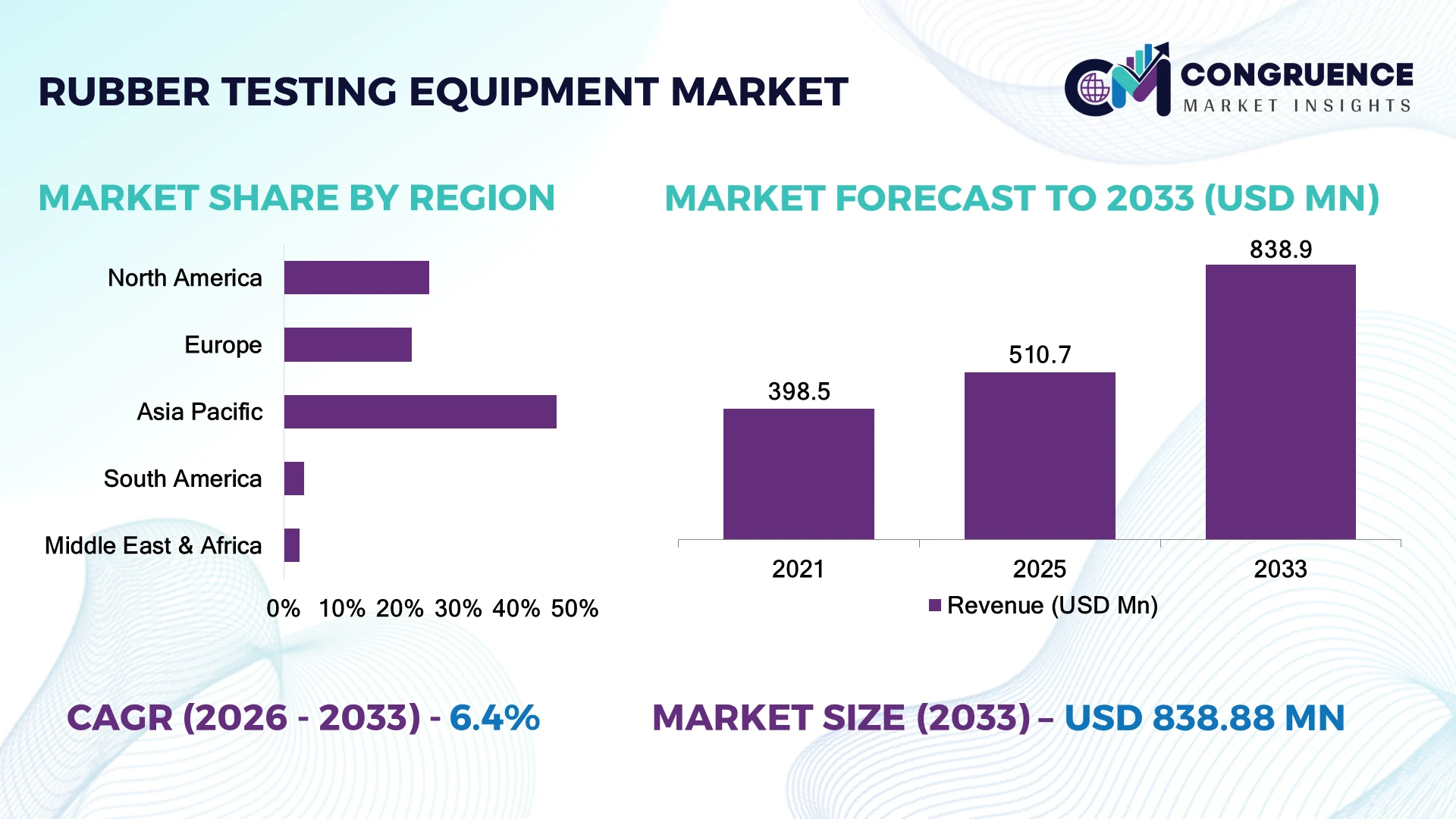
The Global Rubber Testing Equipment Market was valued at USD 510.7 Million in 2025 and is anticipated to reach a value of USD 838.9 Million by 2033 expanding at a CAGR of 6.4% between 2026 and 2033. Growth is driven by stricter material quality validation requirements across tire manufacturing, automotive components, industrial rubber products, and automated laboratory testing environments.
China accounts for approximately 38% of global rubber testing equipment manufacturing capacity, supported by its extensive tire production, industrial rubber processing, and laboratory instrumentation industries. Manufacturing capacity is nearly 2.7 times larger than Germany, while automated testing platforms improve laboratory throughput by approximately 24%. Ongoing supply-chain diversification and advanced manufacturing initiatives following global trade realignments in 2026 are accelerating investment in intelligent testing laboratories and digital quality assurance systems.
Manufacturers investing in automated testing technologies, precision measurement systems, and integrated laboratory software will strengthen long-term competitiveness across high-value industrial quality control applications.
Market Size & Growth: USD 510.7 million in 2025 reaching USD 838.9 million by 2033 at 6.4% CAGR, driven by automated quality testing and advanced material validation.
Top Growth Drivers: Tire manufacturing (+22%), automotive quality standards (+18%), laboratory automation (+16%).
Short-Term Forecast: By 2028, testing throughput improves 19% while inspection time declines 14%.
Emerging Technologies: AI-assisted analysis, robotic sample handling, and cloud-enabled laboratory management accelerate testing efficiency.
Regional Leaders: Asia-Pacific (~USD 390 million), Europe (~USD 175 million), North America (~USD 150 million), supported by industrial quality modernization.
Consumer/End-User Trends: Nearly 67% of large rubber manufacturers are adopting automated testing workflows.
Pilot/Case Example: A 2026 smart laboratory deployment reduced manual testing errors by approximately 21%.
Competitive Landscape: Top five manufacturers hold nearly 57% market share through precision instrumentation and software integration.
Regulatory & ESG Impact: Digital testing platforms reduce paper-based quality documentation by approximately 35%.
Investment & Funding: More than USD 850 million supports laboratory modernization and advanced testing infrastructure globally.
Innovation & Future Outlook: Intelligent analytics, predictive quality control, and connected laboratory ecosystems redefine competitive differentiation.
The Rubber Testing Equipment market is evolving through digital laboratory automation, precision measurement technologies, and AI-assisted quality analytics that improve repeatability and compliance. Nearly 41% of newly installed testing systems now feature integrated software platforms for centralized data management, while manufacturers continue strengthening localized service capabilities amid ongoing industrial supply-chain restructuring. These operational advancements establish the foundation for the market's strategic transformation.
Rubber Testing Equipment has become a strategic investment area as manufacturers compete on product consistency, regulatory compliance, and digital quality assurance rather than production capacity alone. Increasing automation across tire manufacturing, industrial rubber processing, and laboratory operations is reshaping purchasing priorities. Supply-chain restructuring and tighter material qualification requirements are encouraging manufacturers to modernize testing infrastructure and integrate digital inspection workflows that improve traceability across production environments.
Modern automated testing platforms process samples approximately 27% faster than conventional manually operated equipment while reducing operator intervention by nearly 20%. China continues leading large-scale deployment through its extensive manufacturing ecosystem, whereas Germany focuses on precision instrumentation, laboratory innovation, and advanced calibration technologies for high-performance industrial applications. Over the next two to three years, more than half of newly commissioned quality laboratories are expected to integrate connected testing systems with centralized quality management software.
Manufacturers are expanding intelligent testing portfolios, investing in AI-enabled analytics, and strengthening partnerships with tire producers and industrial laboratories. Automated data acquisition and predictive quality monitoring are becoming core competitive differentiators for laboratory equipment suppliers. Organizations that combine precision instrumentation, digital integration, and responsive technical support will secure stronger market positioning as rubber manufacturers prioritize higher testing accuracy, faster certification cycles, and operational efficiency across global production networks.
Automotive, tire, and industrial rubber manufacturers are rapidly modernizing quality laboratories to achieve higher testing accuracy and faster certification cycles. Nearly 69% of large tire production facilities now integrate automated testing workflows, while digital data acquisition improves laboratory productivity by approximately 23% and reduces testing variability by nearly 18%. China's expansion of intelligent manufacturing and stricter quality validation across export-oriented industries is accelerating investment in advanced rubber testing infrastructure. This operational shift is increasing demand for integrated testing platforms capable of supporting continuous production environments. Equipment manufacturers are expanding automation portfolios, strengthening software partnerships, and investing in intelligent laboratory systems. A decisive competitive advantage now depends on delivering connected testing ecosystems instead of standalone laboratory instruments.
Rubber testing equipment manufacturers continue facing supply pressure for high-precision sensors, electronic controllers, calibration modules, and specialized measurement systems. Imported precision components account for approximately 46% of critical instrument assemblies, while procurement lead times have increased by nearly 17% following continued semiconductor and industrial electronics supply adjustments. Germany's precision instrumentation sector remains exposed to elevated sourcing costs for advanced electronic components, affecting manufacturing schedules and pricing flexibility. These structural limitations delay equipment delivery, increase production costs, and compress operating margins. Companies are mitigating risks by localizing component sourcing, establishing long-term supplier agreements, standardizing hardware architectures, and redesigning systems around interchangeable electronic modules that improve procurement resilience.
AI-enabled diagnostics, cloud-connected laboratory platforms, and predictive calibration technologies are transforming the operational value of rubber testing equipment. Approximately 44% of newly specified laboratory systems now require centralized quality data management, while predictive maintenance algorithms reduce equipment downtime by nearly 21%. Japan is accelerating digital laboratory modernization through advanced manufacturing initiatives emphasizing intelligent quality assurance. Equipment suppliers are expanding software development, collaborating with industrial automation providers, and investing in integrated laboratory ecosystems. A significant strategic opportunity lies in subscription-based analytics and remote calibration services, enabling recurring customer engagement while improving testing efficiency and reducing lifecycle operating costs beyond conventional equipment sales.
Maintaining consistent testing performance across geographically distributed laboratories has become a significant execution challenge as manufacturers adopt digital quality systems. Approximately 29% of multinational rubber producers continue operating mixed generations of testing equipment, while laboratory interoperability issues increase validation time by nearly 16%. India's rapidly expanding industrial manufacturing sector is creating additional pressure for harmonized testing protocols across suppliers serving international automotive and industrial customers. Manufacturers must invest in standardized communication protocols, cybersecurity-enabled laboratory software, and globally recognized calibration frameworks. Long-term competitiveness depends on delivering interoperable testing platforms capable of maintaining consistent measurement accuracy across multiple production facilities and regulatory environments.
AI-Powered Test Interpretation: Artificial intelligence is increasingly automating rubber property analysis, reducing data interpretation time by approximately 26% while improving defect detection accuracy by nearly 18%. Growing shortages of experienced laboratory personnel are encouraging manufacturers to deploy intelligent analytics platforms and expand partnerships with industrial software providers to improve operational consistency.
Cloud Laboratory Integration: Connected laboratory ecosystems are replacing isolated testing environments, with centralized data platforms increasing by approximately 34% across large manufacturing facilities. Digital workflow integration shortens reporting cycles by nearly 20% while improving audit readiness. Equipment suppliers are embedding cloud connectivity and expanding lifecycle support services to strengthen long-term customer relationships.
Robotic Sample Handling Expands: Automated specimen preparation and robotic material handling now improve laboratory throughput by approximately 22% while reducing manual handling errors by nearly 17%. Industrial automation initiatives in China and South Korea are encouraging equipment manufacturers to integrate robotics into advanced testing platforms, improving repeatability and lowering operating costs.
Modular Testing Platforms Advance: Laboratories increasingly favor modular equipment architectures that reduce upgrade costs by approximately 15% and shorten installation time by nearly 19%. Instead of replacing complete systems, manufacturers are expanding configurable testing modules and software-driven upgrades, allowing customers to modernize laboratories incrementally while extending equipment lifecycle and protecting capital investments.
Universal Testing Machines account for approximately 36% of the global Rubber Testing Equipment market due to their ability to perform tensile, compression, elongation, and flexural testing within a single platform. Their versatility, laboratory scalability, and compatibility with digital data acquisition systems make them the preferred choice for tire manufacturers, industrial rubber producers, and research laboratories. Hardness testers remain an established segment for routine quality inspection, while rheometers and moving die rheometers continue serving advanced compound development where curing behavior and process optimization are operational priorities.
Rheometers represent the fastest-growing equipment category as manufacturers increasingly emphasize compound characterization for high-performance tires and engineered elastomers. Modern rheological analysis improves formulation accuracy by approximately 20%, while automated testing reduces operator intervention by nearly 18%. Companies are expanding intelligent rheometer portfolios, integrating AI-assisted software, and strengthening collaborations with automotive and industrial laboratories. Investment priorities continue shifting toward multifunctional testing platforms that reduce laboratory complexity while supporting precision material development and faster product qualification.
According to a 2026 assessment by ASTM International, automated rheological testing and digital universal testing platforms are becoming standard equipment across advanced rubber quality laboratories to improve repeatability and international testing compliance.
Tire manufacturing accounts for approximately 44% of global Rubber Testing Equipment demand because of continuous requirements for tensile strength, abrasion resistance, curing performance, and fatigue validation across passenger, commercial, and specialty tire production. Increasing regulatory emphasis on product consistency and vehicle safety has intensified laboratory testing frequency throughout manufacturing operations. Industrial rubber products remain a mature application segment, while research laboratories and automotive component testing continue expanding through advanced material development and product certification activities.
Research and development applications are the fastest-growing segment as manufacturers accelerate formulation innovation for electric vehicles, sustainable elastomers, and high-performance industrial products. Digital laboratory platforms improve testing throughput by approximately 22%, while automated workflows reduce validation time by nearly 17%. Equipment suppliers are strengthening software integration, expanding laboratory automation capabilities, and developing application-specific testing solutions. Demand is steadily shifting toward intelligent laboratories capable of supporting continuous product development alongside high-volume production quality assurance.
A 2025 enterprise laboratory survey by the International Organization for Standardization highlighted increasing deployment of automated material testing systems across tire and industrial rubber manufacturing to strengthen process consistency and product validation.
Tire manufacturers account for approximately 48% of global Rubber Testing Equipment purchases due to their extensive laboratory infrastructure, stringent quality standards, and continuous material validation requirements. High production volumes and frequent compound optimization create sustained demand for precision testing systems across development and manufacturing operations. Independent testing laboratories remain important buyers serving certification and third-party validation, while rubber product manufacturers continue investing in advanced testing capabilities to improve product quality and export compliance.
Research institutes represent the fastest-growing end-user group as advanced elastomer research, sustainable material development, and collaborative innovation programs expand globally. Automated laboratory systems improve testing productivity by approximately 21%, while connected quality management platforms increase operational efficiency by nearly 18%. Equipment manufacturers are targeting these organizations through customized software, collaborative research partnerships, flexible service agreements, and modular testing platforms. Competitive positioning increasingly depends on delivering integrated laboratory ecosystems tailored to evolving research and industrial testing requirements.
A 2026 laboratory equipment assessment by the International Laboratory Accreditation Cooperation highlighted accelerating investment in digitally connected testing systems among research institutes and accredited material testing laboratories to improve quality assurance and international compliance.
Asia-Pacific accounted for the largest market share at 46.8% in 2025 however, North America is expected to register the fastest growth, expanding at a CAGR of 6.9% between 2026 and 2033.
Digital Laboratory Modernization Strengthens Quality Validation
North America represents a high-value Rubber Testing Equipment market supported by advanced tire manufacturing, industrial materials research, and widespread laboratory automation. The region contributes approximately 25% of global demand, driven by increasing adoption of intelligent testing systems across automotive, aerospace, and industrial rubber manufacturing. Nearly 63% of newly commissioned material testing laboratories now incorporate integrated software platforms for centralized quality management. Equipment suppliers are expanding calibration services, AI-enabled testing capabilities, and automated sample handling technologies, while laboratory modernization initiatives improve testing productivity by approximately 18%. Enterprise demand increasingly favors connected testing ecosystems that reduce validation cycles and improve traceability throughout manufacturing operations.
United States Market Outlook: The United States leads the regional market through its extensive tire manufacturing capacity, advanced laboratory infrastructure, and strong investment in industrial quality assurance. Automotive suppliers and independent testing laboratories are accelerating deployment of intelligent material testing platforms capable of supporting digital manufacturing environments. Approximately 71% of large industrial testing facilities now utilize automated quality data acquisition, encouraging equipment manufacturers to strengthen software integration, technical support, and long-term laboratory modernization partnerships.
Precision Engineering Drives Laboratory Innovation
Europe accounts for approximately 22% of global Rubber Testing Equipment demand, supported by premium automotive manufacturing, advanced industrial testing standards, and strong emphasis on laboratory precision. Manufacturers are increasingly deploying automated testing platforms to improve repeatability, digital traceability, and regulatory compliance. Nearly 39% of newly installed laboratory systems include AI-assisted analysis and centralized calibration management. Equipment suppliers continue investing in precision instrumentation, software-driven testing workflows, and collaborative development with automotive and industrial manufacturers to improve operational efficiency and testing consistency.
Germany Market Outlook: Germany remains the region's technology leader through its precision engineering capabilities, globally recognized testing laboratories, and strong automotive manufacturing ecosystem. Industrial laboratories increasingly adopt intelligent material characterization systems that improve measurement consistency and shorten certification timelines. Automated testing technologies have enhanced laboratory productivity by approximately 19%, reinforcing Germany's position as a center for advanced rubber testing innovation.
Manufacturing Scale Accelerates Smart Testing Adoption
Asia-Pacific dominates the Rubber Testing Equipment market through its extensive tire manufacturing capacity, expanding industrial production, and rapid modernization of quality laboratories. The region accounts for approximately 46.8% of global demand, supported by increasing investment in intelligent manufacturing and export-oriented quality assurance. Automated testing infrastructure has improved laboratory throughput by nearly 23%, while connected quality management platforms continue reducing manual inspection processes. Equipment manufacturers are expanding regional production, strengthening technical service networks, and developing application-specific testing solutions for automotive and industrial customers.
China Market Outlook: China serves as the largest market due to its integrated tire manufacturing ecosystem, extensive industrial rubber production, and continuous investment in laboratory automation. Approximately 38% of global rubber testing equipment manufacturing capacity is concentrated in the country, supported by intelligent manufacturing initiatives and expanding quality assurance requirements. Domestic manufacturers continue strengthening software capabilities and precision instrumentation while increasing collaboration with automotive and industrial enterprises.
Industrial Quality Upgrades Support Equipment Demand
South America is experiencing steady demand for Rubber Testing Equipment as industrial manufacturers strengthen quality control capabilities and expand domestic production of tires and engineered rubber products. Brazil accounts for the largest regional demand through its established automotive supply chain and industrial manufacturing base. Approximately 21% of newly upgraded quality laboratories now utilize automated testing equipment, improving testing consistency and reducing manual processing requirements. Equipment suppliers are strengthening distributor partnerships, expanding calibration services, and improving regional technical support while balancing infrastructure limitations and imported equipment dependency.
Brazil Market Outlook: Brazil leads the regional market through its mature tire manufacturing sector, expanding industrial laboratories, and increasing emphasis on international product quality standards. Manufacturers continue modernizing testing facilities with advanced material characterization equipment and digital reporting capabilities. Strong collaboration between industrial producers and laboratory equipment suppliers is improving operational efficiency while supporting export-oriented manufacturing and regulatory compliance.
Industrial Diversification Expands Testing Infrastructure
The Middle East & Africa market is advancing through industrial diversification, manufacturing modernization, and increasing investment in quality assurance infrastructure. Demand for Rubber Testing Equipment is supported by expanding automotive component production, industrial rubber processing, and laboratory accreditation initiatives. Approximately 17% of newly established industrial testing laboratories now deploy automated material testing platforms to improve operational accuracy. Equipment suppliers are expanding regional service capabilities, strengthening distributor partnerships, and investing in localized calibration support to improve equipment reliability and customer responsiveness.
Saudi Arabia Market Outlook: Saudi Arabia has emerged as the region's strategic market through industrial diversification programs, expanding manufacturing capacity, and growing investment in accredited testing laboratories. Industrial operators are strengthening laboratory capabilities to support higher-value manufacturing and international product certification. Increasing deployment of digitally integrated testing systems is enhancing operational efficiency, while partnerships with global laboratory equipment providers continue accelerating technical capability development across the country's industrial sector.
Global testing specialists including Alpha Technologies, Instron, ZwickRoell, Shimadzu Corporation, and MonTech compete against regional instrumentation manufacturers focused on cost-efficient laboratory solutions. Premium automation providers challenge value-oriented equipment suppliers through software integration and precision measurement, while independent testing equipment firms compete with diversified materials testing companies on application expertise. The top five players collectively control approximately 57% of global market share. Competition centers on testing accuracy, automation, digital integration, and lifecycle service. AI-enabled laboratory platforms improve testing productivity by nearly 22%, automated specimen handling reduces operator intervention by approximately 18%, and integrated software shortens reporting cycles by around 16%. Companies are expanding calibration networks, acquiring specialist testing businesses, launching intelligent instruments, and strengthening industrial partnerships. Competitive momentum is shifting from standalone equipment toward connected laboratory ecosystems with predictive analytics. High calibration standards, software interoperability, and technical support capabilities remain significant entry barriers. Winning requires precision instrumentation, intelligent automation, rapid service response, and integrated laboratory software delivering measurable productivity improvements.
Alpha Technologies Inc.
Instron
ZwickRoell Group
Shimadzu Corporation
MonTech Werkstoffprüfmaschinen GmbH
Tinius Olsen Testing Machine Company
Gotech Testing Machines Inc.
ADMET Inc.
Qualitest International Inc.
Elastocon AB
Labthink Instruments Co., Ltd.
Haida International Equipment Co., Ltd.
Rubber Testing Equipment technology is rapidly evolving through automated rheometers, intelligent universal testing systems, and non-contact optical measurement platforms integrated with laboratory management software. Advanced digital testing systems improve testing repeatability by approximately 21%, while automated specimen handling increases laboratory throughput by nearly 19%. Around 66% of newly installed premium testing systems now include centralized software for data acquisition, compliance management, and real-time reporting. These capabilities reduce operator dependency, improve traceability, and strengthen quality assurance across tire manufacturing and industrial rubber production.
Emerging technologies include AI-assisted result interpretation, cloud-connected laboratories, predictive calibration, and digital twin-based testing workflows. Compared with conventional manually operated systems, intelligent testing platforms reduce validation time by approximately 24% while improving measurement consistency by nearly 18%. Laboratory operators adopting integrated hardware and software gain the strongest competitive advantage because automated reporting accelerates certification and minimizes operational variability across multiple production facilities.
Between 2026 and 2028, connected laboratory ecosystems, predictive diagnostics, and robotics-assisted material testing will reshape procurement priorities. Manufacturers investing in modular testing platforms, intelligent analytics, and remote equipment monitoring will strengthen operational efficiency while reducing maintenance interruptions. Early technology adoption enables faster product qualification, simplified laboratory expansion, stronger regulatory compliance, and differentiated service capabilities, positioning suppliers to secure long-term contracts with automotive, tire, and advanced materials manufacturers.
May 2024 – Alpha Technologies launched the AlphaFlex10 Tensile Tester, expanding from rheology into destructive physical-property testing with integrated enterprise software. The platform supports multiple tensile and compression test modes, improving laboratory workflow consolidation. Source: Alpha Technologies
November 2024 – Alpha Technologies opened a demonstration laboratory with Politecnico di Milano, strengthening customer access to advanced rubber testing technologies across Europe. The initiative expands hands-on validation capabilities and accelerates application development. Source: Alpha Technologies
July 2025 – Alpha Technologies acquired Metravib Material Testing, adding dynamic mechanical analysis, fatigue testing, and viscoelastic characterization capabilities to its portfolio. The acquisition broadened end-to-end polymer testing solutions and expanded global technical reach. Source: Alpha Technologies
September 2025 – Instron introduced a 100 kN tabletop universal testing system with a 40% smaller footprint than comparable floor models, enabling higher-capacity testing within space-constrained laboratories while simplifying installation using standard electrical infrastructure. Source: Instron
This report provides a comprehensive assessment of the global Rubber Testing Equipment market across major equipment types, applications, end-user industries, and regional markets. It evaluates universal testing machines, rheometers, hardness testers, abrasion testers, and specialized laboratory systems used across tire manufacturing, industrial rubber products, research laboratories, and quality assurance facilities. The study also examines automation, AI-enabled analytics, non-contact measurement technologies, cloud-connected laboratory software, and digital calibration platforms transforming material testing operations.
The analysis supports strategic planning between 2026 and 2033 through detailed evaluation of deployment patterns, technology adoption, regional manufacturing dynamics, and competitive positioning. More than 65% of advanced laboratories are transitioning toward digitally integrated testing platforms that improve traceability and operational efficiency. The report enables stakeholders to benchmark competitors, prioritize investments, optimize laboratory modernization, identify high-growth applications, evaluate technology roadmaps, and strengthen expansion strategies across global automotive, industrial, polymer, and advanced materials testing ecosystems.
| Report Attribute/Metric | Report Details |
|---|---|
|
Market Revenue in 2025 |
USD 510.7 Million |
|
Market Revenue in 2033 |
USD 838.9 Million |
|
CAGR (2026 - 2033) |
6.4% |
|
Base Year |
2025 |
|
Forecast Period |
2026 - 2033 |
|
Historic Period |
2021 - 2025 |
|
Segments Covered |
By Type
By Application
By End-User
|
|
Key Report Deliverable |
Revenue Forecast, Growth Trends, Market Dynamics, Segmental Overview, Regional and Country-wise Analysis, Competition Landscape |
|
Region Covered |
North America, Europe, Asia-Pacific, South America, Middle East, Africa |
|
Key Players Analyzed |
Alpha Technologies Inc., Instron, ZwickRoell Group, Shimadzu Corporation, MonTech Werkstoffprüfmaschinen GmbH, Tinius Olsen Testing Machine Company, Gotech Testing Machines Inc., ADMET Inc., Qualitest International Inc., Elastocon AB, Labthink Instruments Co., Ltd., Haida International Equipment Co., Ltd. |
|
Customization & Pricing |
Available on Request (10% Customization is Free) |




