
Reports
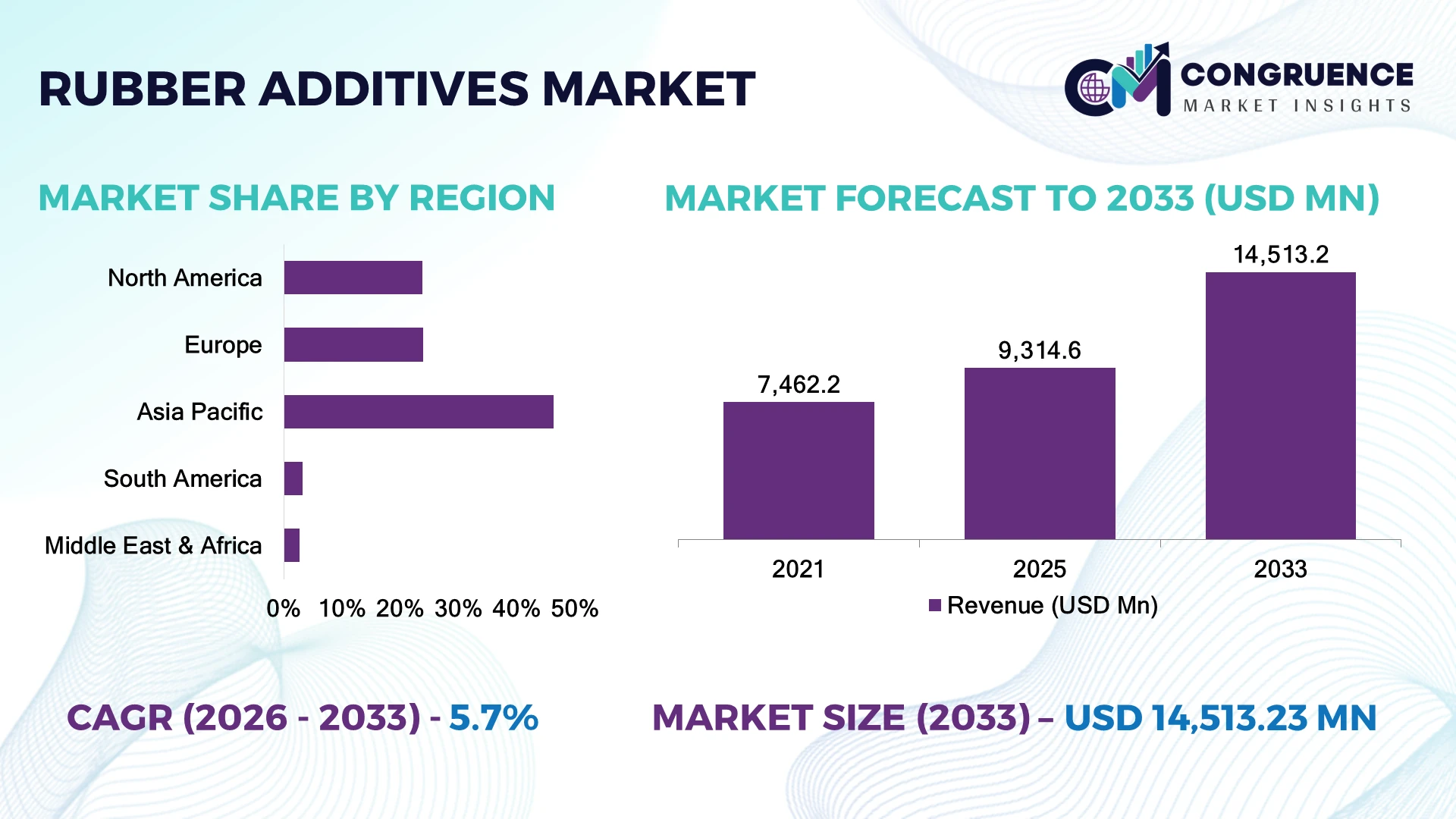
The Global Rubber Additives Market was valued at USD 9,314.6 Million in 2025 and is anticipated to reach a value of USD 14,513.2 Million by 2033 expanding at a CAGR of 5.7% between 2026 and 2033. Growth is driven by rising high-performance tire production, expanding electric vehicle manufacturing, and increasing demand for durable industrial rubber compounds with advanced processing and aging resistance.
China dominates the global Rubber Additives market with approximately 39% of worldwide production capacity, supported by integrated tire manufacturing, petrochemical infrastructure, and strong domestic automotive demand. Compared with Germany, which emphasizes specialty additive innovation, China maintains significantly larger manufacturing scale, with over 72% of major tire plants utilizing advanced additive formulations. Ongoing supply-chain diversification following global trade realignments continues accelerating domestic investment in high-value rubber chemicals and sustainable production technologies.
Manufacturers investing in specialty additives, sustainable formulations, and localized supply chains are strengthening long-term competitiveness across automotive, industrial, and advanced elastomer applications.
Market Size & Growth: USD 9,314.6 million (2025) to USD 14,513.2 million (2033) at 5.7% CAGR, supported by advanced tire manufacturing and EV demand.
Top Growth Drivers: EV tire demand (+31%), industrial rubber production (+24%), specialty elastomer adoption (+19%).
Short-Term Forecast: By 2028, processing efficiency improves 15% while material waste declines 12%.
Emerging Technologies: Nano-additives, bio-based processing aids, and AI-assisted formulation optimization improve compound performance.
Regional Leaders: Asia-Pacific, Europe, and North America lead demand through automotive expansion and advanced manufacturing.
Consumer/End-User Trends: Over 67% of premium tire manufacturers prioritize high-performance additive packages for durability and rolling resistance.
Pilot/Case Example: A 2026 smart compounding initiative reduced mixing cycle time by 18% through digital process optimization.
Competitive Landscape: Top suppliers control approximately 46% market share, competing through specialty chemistry and global manufacturing footprints.
Regulatory & ESG Impact: Low-PAH and environmentally compliant additives reduce regulated substance usage by nearly 20%.
Investment & Funding: More than USD 2.8 billion supports specialty chemical capacity expansion and sustainable additive development.
Innovation & Future Outlook: Circular rubber technologies and bio-based additive systems reshape long-term product development strategies.
The Rubber Additives market is evolving toward advanced formulations supporting high-performance tires, industrial seals, conveyor belts, and engineered elastomers. Demand is increasing for processing aids, antioxidants, antidegradants, and reinforcing additives capable of improving durability and energy efficiency. Nearly 58% of premium compound manufacturers now integrate sustainable additive technologies, while ongoing supply-chain localization strengthens production resilience and sets the foundation for broader strategic market transformation.
Rubber additives have become strategically important as manufacturers balance performance, sustainability, and regulatory compliance across automotive, industrial, construction, and consumer goods sectors. Tire producers and elastomer compounders increasingly require advanced additive packages that improve durability, wear resistance, heat stability, and processing efficiency while meeting evolving environmental standards. Supply-chain restructuring following geopolitical trade adjustments has accelerated investment in regional chemical manufacturing and specialty formulation capabilities.
Advanced polymer-compatible additive systems improve compound dispersion by approximately 23% while reducing mixing energy consumption by nearly 17% compared with conventional formulations. China leads large-scale production through integrated chemical manufacturing ecosystems, whereas Germany and Japan focus on specialty additives engineered for premium automotive and industrial applications. During the next two to three years, manufacturers are expected to accelerate adoption of low-emission antioxidants, sustainable processing aids, and digital formulation optimization to improve product consistency and operational efficiency.
Leading producers are expanding specialty additive production, strengthening raw material partnerships, and investing in bio-based chemistry research to diversify portfolios. One notable example includes tire manufacturers integrating advanced silica-compatible additive systems that enhance rolling resistance while extending tire service life. Companies capable of combining sustainable chemistry, localized production, and application-specific innovation will strengthen competitive positioning across the evolving global rubber value chain.
The transition toward high-performance tires for electric vehicles and premium passenger cars is accelerating demand for advanced rubber additives. Approximately 64% of specialty additive consumption is linked to tire manufacturing, while silica-compatible additive systems improve rolling resistance by nearly 18% and extend tire durability by approximately 14%. China continues expanding integrated tire manufacturing capacity to meet growing domestic and export demand, prompting additive suppliers to localize production and strengthen feedstock availability. The resulting increase in compound performance requirements is encouraging manufacturers to invest in next-generation antioxidants, processing aids, and antidegradants. Strategic partnerships between chemical producers and tire manufacturers are shortening product development cycles and enabling customized formulations that improve operational efficiency and product differentiation.
Rubber additive production remains highly dependent on petrochemical intermediates, exposing manufacturers to raw material price fluctuations and supply-chain disruptions. Feedstock costs account for nearly 52% of production expenses, while specialty aromatic intermediates have experienced price swings exceeding 20% during recent procurement cycles. Germany's stricter chemical compliance requirements are increasing reformulation costs for conventional additive manufacturers. These pressures reduce pricing flexibility, compress operating margins, and complicate long-term supply agreements with tire and industrial rubber producers. Companies are responding through regional sourcing strategies, backward integration, long-term procurement contracts, and increased investment in bio-based alternatives to reduce dependence on volatile petroleum-derived raw materials.
The shift toward sustainable elastomer manufacturing is creating new opportunities for bio-based processing aids, low-toxicity antioxidants, and circular rubber formulations. More than 35% of premium tire manufacturers have initiated evaluation programs for renewable additive chemistries, while advanced formulation technologies reduce volatile emissions by approximately 22% during rubber processing. Japan is expanding collaborative research on environmentally compatible rubber chemicals that maintain mechanical performance without increasing processing complexity. Manufacturers are increasing R&D investment, forming partnerships with specialty chemical innovators, and expanding pilot-scale production of renewable additives. A significant strategic opportunity lies in developing multifunctional additive packages that simultaneously improve durability, processability, and environmental compliance, reducing formulation complexity for compound producers.
Maintaining consistent performance while complying with evolving chemical regulations presents a long-term challenge for rubber additive manufacturers. Approximately 31% of product development timelines are now dedicated to regulatory testing and validation, while reformulated additive systems require nearly 25% more laboratory qualification than conventional chemistries. The European Union's evolving chemical safety framework continues increasing technical documentation and product certification requirements. Companies must invest in formulation science, toxicology assessment, digital quality management, and advanced testing infrastructure to ensure consistent global compliance. Long-term competitiveness depends on accelerating compliant product development without compromising rubber performance, processing efficiency, or customer qualification schedules.
Bio-Based Additives Gain Momentum: Rubber compounders are increasing adoption of renewable processing aids and sustainable antioxidants, reducing processing emissions by approximately 20% while improving environmental compliance. Regulatory pressure on conventional chemicals is accelerating commercialization. Manufacturers are expanding renewable feedstock sourcing and investing in green chemistry production technologies.
Silica-Compatible Formulations Expand: Premium tire producers are deploying advanced silica-compatible additive systems that improve wet grip performance and reduce rolling resistance by nearly 16%. Growing electric vehicle production is reshaping formulation priorities. Chemical suppliers are strengthening collaborative development programs with tire manufacturers to accelerate customized compound innovation.
Digital Compound Optimization Advances: AI-assisted formulation software and automated mixing controls reduce development cycles by approximately 24% while improving batch consistency by nearly 18%. The non-obvious shift is the growing use of predictive material modeling before pilot production. Companies are integrating digital laboratories with smart manufacturing systems to optimize additive selection and processing conditions.
Localized Chemical Manufacturing Rises: Supply-chain resilience initiatives are encouraging regional production of specialty rubber additives, reducing procurement lead times by approximately 21% and logistics costs by nearly 13%. Global trade realignment continues influencing investment decisions. Producers are expanding local manufacturing facilities, strengthening strategic supplier networks, and diversifying critical raw material sourcing to improve long-term operational stability.
Antidegradants account for approximately 34% of the global Rubber Additives market, making them the leading product category due to their critical role in preventing oxidation, ozone cracking, thermal degradation, and weather-induced deterioration. Their widespread use across passenger vehicle tires, industrial rubber products, and heavy-duty applications ensures consistent demand. Processing aids and accelerators remain mature segments supporting manufacturing efficiency, while vulcanization agents continue serving high-volume tire and industrial compound production with established processing reliability.
Processing aids represent the fastest-growing type as manufacturers prioritize energy-efficient mixing, improved filler dispersion, and shorter production cycles. Advanced processing technologies reduce compound mixing time by approximately 16%, while next-generation additive packages improve production consistency by nearly 19%. Specialty antioxidants and environmentally compliant stabilizers are also gaining traction as chemical regulations evolve. Leading suppliers are expanding specialty product portfolios, investing in low-emission formulations, and partnering with tire manufacturers to develop application-specific additive systems. Investment is increasingly directed toward multifunctional additives capable of improving processing efficiency while extending product durability.
According to a 2026 enterprise assessment published by the International Institute of Synthetic Rubber Producers (IISRP), advanced antidegradant and processing aid formulations are increasingly incorporated into premium tire compounds to improve service life and manufacturing consistency.
Tire manufacturing dominates the Rubber Additives market with approximately 58% market share due to its high consumption of antioxidants, accelerators, vulcanization agents, and processing aids required for performance, durability, and safety. Continuous production volumes and stringent quality requirements maintain stable additive demand across passenger, commercial, and off-road tire manufacturing. Industrial rubber goods remain a mature application supported by conveyor belts, hoses, seals, and vibration-control components, while footwear and latex products sustain specialized additive requirements through niche production environments.
Industrial rubber products represent the fastest-growing application as infrastructure expansion, mining, renewable energy, and heavy equipment manufacturing increase demand for durable elastomer components. Advanced additive systems improve abrasion resistance by approximately 18% while reducing production defects by nearly 14%. Manufacturers are integrating automated compounding, expanding specialty formulation capabilities, and strengthening customer-specific product development. Demand is shifting toward customized additive packages that simultaneously improve processability, mechanical performance, and regulatory compliance across diverse industrial applications.
A 2025 manufacturing outlook released by the European Tyre and Rubber Manufacturers' Association (ETRMA) highlighted increasing deployment of advanced additive technologies to enhance tire durability, processing efficiency, and sustainable rubber production.
The automotive industry accounts for approximately 61% of global Rubber Additives consumption owing to large-scale production of tires, seals, hoses, gaskets, belts, and vibration-control components. High production volumes, strict durability standards, and continuous product qualification create stable demand for advanced additive technologies. Industrial manufacturing remains an established buyer segment supporting machinery, mining, and heavy equipment, while construction applications maintain steady demand for engineered rubber materials exposed to harsh operating environments.
Renewable energy and electric mobility manufacturers represent the fastest-growing end-user segment as demand increases for high-performance elastomer components capable of operating under elevated thermal and mechanical conditions. Specialized additive formulations improve heat resistance by approximately 17% while extending component lifespan by nearly 21%. Suppliers are responding through customized product development, long-term technical partnerships, localized manufacturing support, and sustainable formulation strategies. Future competitive advantage increasingly depends on delivering application-specific additive systems tailored to evolving mobility, industrial automation, and energy infrastructure requirements.
A 2026 enterprise survey conducted by the Society of Rubber Industry (India) found increasing adoption of specialty rubber additives among automotive and industrial component manufacturers to improve processing efficiency, product durability, and compliance with evolving performance standards.
Asia-Pacific accounted for the largest market share at 46.3% in 2025 however, Middle East & Africa is expected to register the fastest growth, expanding at a CAGR of 6.5% between 2026 and 2033.
Advanced Tire Manufacturing Accelerates Specialty Chemical Demand
North America represents approximately 23.8% of the global Rubber Additives market, supported by advanced tire manufacturing, high-value automotive production, and expanding industrial rubber applications. Manufacturers increasingly prioritize specialty antioxidants, processing aids, and environmentally compliant formulations to improve durability and production efficiency. Nearly 63% of premium tire manufacturing facilities have integrated automated rubber compounding systems capable of handling advanced additive packages with greater process consistency. Investment continues in sustainable chemical production, digital process control, and localized raw material sourcing as companies strengthen supply resilience. Chemical suppliers are expanding application engineering capabilities and collaborating directly with OEMs to accelerate formulation development for electric vehicles and high-performance industrial components.
United States Market Outlook: The United States leads the regional market through its large automotive manufacturing base, specialty chemical industry, and advanced elastomer research ecosystem. Tire producers and industrial rubber manufacturers continue investing in low-emission additive technologies and automated compounding operations. More than 70% of large domestic tire manufacturing facilities have upgraded production systems to support advanced silica-compatible formulations, strengthening operational efficiency and product performance across premium applications.
Regulatory Compliance Drives Specialty Formulation Innovation
Europe maintains a strong position through high-value specialty chemical manufacturing, advanced automotive production, and rigorous chemical compliance standards. Approximately 24% of global specialty rubber additive consumption is associated with European industrial applications requiring premium performance and environmental compatibility. Manufacturers continue replacing conventional formulations with sustainable additive systems while expanding investment in bio-based processing technologies and advanced laboratory validation. Product differentiation increasingly depends on compliance, durability, and energy-efficient compound processing rather than production scale alone.
Germany Market Outlook: Germany serves as Europe's strategic center for high-performance rubber additives due to its integrated automotive, machinery, and specialty chemical industries. Manufacturers emphasize advanced formulation research and close collaboration with tire producers developing premium mobility solutions. Nearly 60% of newly commercialized specialty rubber compounds incorporate environmentally compliant additive technologies designed to improve durability while meeting increasingly stringent product qualification requirements.
Integrated Manufacturing Ecosystems Sustain Global Leadership
Asia-Pacific dominates global Rubber Additives production through its integrated petrochemical complexes, large tire manufacturing industry, and extensive export-oriented rubber processing infrastructure. The region accounts for approximately 46.3% of global demand, supported by expanding automotive manufacturing and industrial equipment production. More than 68% of global tire manufacturing capacity is concentrated across major Asia-Pacific production hubs, creating sustained demand for accelerators, antidegradants, and processing aids. Manufacturers continue expanding specialty additive capacity while investing in automation and environmentally compliant production technologies to strengthen export competitiveness.
China Market Outlook: China remains the world's largest Rubber Additives market due to its extensive tire manufacturing capacity, integrated petrochemical value chain, and strong domestic industrial demand. Large chemical producers continue expanding specialty additive production while improving manufacturing automation and environmental compliance. Approximately 39% of global rubber additive production capacity is concentrated in China, reinforcing its position as the primary supply hub for international tire and industrial rubber manufacturers.
Industrial Modernization Supports Stable Demand Expansion
South America continues strengthening demand through automotive assembly, mining equipment manufacturing, agricultural machinery, and infrastructure development requiring durable rubber components. Brazil and Argentina remain the primary industrial consumers of specialty rubber additives for tires, conveyor belts, and industrial hoses. Approximately 48% of new industrial rubber production projects now incorporate advanced additive formulations that improve abrasion resistance and processing efficiency. While logistics costs and raw material availability remain operational constraints, localized manufacturing partnerships are improving supply reliability and production flexibility.
Brazil Market Outlook: Brazil leads the regional market through its established tire manufacturing sector, growing agricultural equipment industry, and expanding industrial rubber processing capacity. Domestic manufacturers continue investing in modern compounding technologies and specialty additive formulations to improve export competitiveness. Advanced processing aids are increasingly adopted to reduce production variability and improve manufacturing productivity across large-scale rubber processing facilities.
Petrochemical Integration Strengthens Value Chain Development
The Middle East & Africa market is advancing through petrochemical diversification, industrial manufacturing expansion, and growing investment in downstream specialty chemical production. Countries with integrated refining and petrochemical infrastructure are increasing production of feedstocks used in rubber additive manufacturing. Approximately 36% of newly announced specialty chemical projects within the region target higher-value downstream materials supporting automotive and industrial applications. Companies are strengthening regional supply networks while expanding technical partnerships to improve product quality and manufacturing capability.
Saudi Arabia Market Outlook: Saudi Arabia is emerging as the region's leading market through its integrated petrochemical infrastructure, industrial diversification strategy, and expanding specialty chemicals sector. Investments in downstream chemical manufacturing are creating opportunities for localized production of rubber additive intermediates while reducing import dependence. Industrial development programs continue encouraging higher-value chemical production that supports domestic manufacturing and strengthens long-term competitiveness in global specialty materials markets.
LANXESS, Eastman, Flexsys, China Sunsine, and Kumho Petrochemical compete directly in premium rubber additives, while regional manufacturers challenge them through cost-efficient commodity products. The top five suppliers collectively account for approximately 47% of global market share. Competition centers on formulation performance, production integration, supply reliability, and regulatory compliance rather than price alone. Advanced processing promoters improve compound dispersion by nearly 18%, sustainable additives reduce production emissions by approximately 20%, and integrated manufacturing lowers logistics costs by around 15%. Global leaders are expanding specialty additive capacity, introducing sustainable chemistries, forming long-term partnerships with tire manufacturers, and strengthening regional production through vertical integration. Competition is shifting from volume-driven commodity chemicals toward high-value multifunctional additives supporting electric vehicles and environmentally compliant tires. Regulatory qualification, proprietary formulation expertise, and integrated feedstock access remain significant entry barriers. Winning requires differentiated chemistry, resilient supply chains, customer-specific technical support, and continuous innovation.
LANXESS AG
Eastman Chemical Company
Flexsys
China Sunsine Chemical Holdings Ltd.
Kumho Petrochemical Co., Ltd.
SI Group
Arkema S.A.
NOCIL Limited
Behn Meyer Group
Shandong Yanggu Huatai Chemical Co., Ltd.
King Industries, Inc.
PMC Group, Inc.
Emery Oleochemicals
Advanced antidegradants, silica-compatible processing promoters, and pre-dispersed rubber chemicals define current technology leadership. Modern additive systems improve filler dispersion by approximately 19% and reduce compound mixing energy by nearly 17%, while around 66% of premium tire manufacturers now utilize advanced multifunctional additive packages. Digital formulation software is increasingly integrated with automated compounding systems, enabling faster process optimization, improved batch consistency, and lower material waste across high-volume manufacturing facilities.
Emerging technologies include bio-based antioxidants, renewable processing aids, nanostructured reinforcing additives, and AI-assisted compound design. Compared with conventional processing additives, next-generation silica dispersion technologies improve rolling resistance performance by approximately 16% while shortening mixing cycles by nearly 14%. Global specialty chemical producers benefit from these innovations through premium product differentiation, whereas integrated manufacturers gain operational advantages by combining advanced chemistry with localized production and technical application support.
Between 2026 and 2028, sustainable additive chemistry, predictive formulation modeling, and digital quality control will reshape competitive positioning. Companies investing early in renewable raw materials, intelligent compound engineering, and multifunctional additive platforms will strengthen customer retention, accelerate product qualification, and improve manufacturing resilience. Immediate investment in advanced formulation technologies delivers measurable operational efficiency while supporting evolving environmental compliance and premium tire performance requirements.
March 2024 – LANXESS introduced sustainable rubber additives for tire production, including a TMQ antidegradant containing over 50% sustainable raw materials and the new Rhenocure DR/S processing technology, strengthening environmentally focused tire manufacturing. Source: LANXESS
February 2025 – LANXESS launched Vulkanox HS Scopeblue, an ISCC PLUS-certified antioxidant produced with 55% sustainable raw materials, enabling tire manufacturers to improve product sustainability without changing existing manufacturing processes. Source: LANXESS
September 2025 – LANXESS announced expansion of rubber processing promoter production at its South Carolina facility, establishing its first U.S. manufacturing site for these products to strengthen domestic supply reliability and shorten delivery times. Source: LANXESS Newsroom
March 2026 – Flexsys announced commercialization progress for its alternative to 6PPD tire additive while expanding customer qualification activities, supporting regulatory readiness and accelerating development of next-generation rubber chemical solutions. Source: Flexsys corporate announcement.
This report provides comprehensive analysis of the global Rubber Additives market across product types, applications, end-user industries, and key regional markets. It evaluates antidegradants, accelerators, processing aids, vulcanization agents, and specialty additives used across tire manufacturing, industrial rubber products, automotive components, construction, and advanced elastomer applications. The study further examines manufacturing trends, product qualification requirements, supply-chain evolution, and adoption of sustainable formulation technologies across major production hubs.
The report also assesses emerging technologies including bio-based additives, digital formulation optimization, silica-compatible processing systems, and advanced compound engineering. More than 60% of premium tire manufacturers are transitioning toward multifunctional additive formulations with improved processing and environmental performance. Strategic insights support investment planning, manufacturing expansion, product portfolio optimization, competitive benchmarking, regional market prioritization, and long-term business positioning by identifying evolving customer requirements, technology shifts, and operational opportunities expected to shape industry development between 2026 and 2033.
| Report Attribute/Metric | Report Details |
|---|---|
|
Market Revenue in 2025 |
USD 9,314.6 Million |
|
Market Revenue in 2033 |
USD 14,513.2 Million |
|
CAGR (2026 - 2033) |
5.7% |
|
Base Year |
2025 |
|
Forecast Period |
2026 - 2033 |
|
Historic Period |
2021 - 2025 |
|
Segments Covered |
By Type
By Application
By End-User
|
|
Key Report Deliverable |
Revenue Forecast, Growth Trends, Market Dynamics, Segmental Overview, Regional and Country-wise Analysis, Competition Landscape |
|
Region Covered |
North America, Europe, Asia-Pacific, South America, Middle East, Africa |
|
Key Players Analyzed |
LANXESS AG, Eastman Chemical Company, Flexsys, China Sunsine Chemical Holdings Ltd., Kumho Petrochemical Co., Ltd., SI Group, Arkema S.A., NOCIL Limited, Behn Meyer Group, Shandong Yanggu Huatai Chemical Co., Ltd., King Industries, Inc., PMC Group, Inc., Emery Oleochemicals |
|
Customization & Pricing |
Available on Request (10% Customization is Free) |




