
Reports
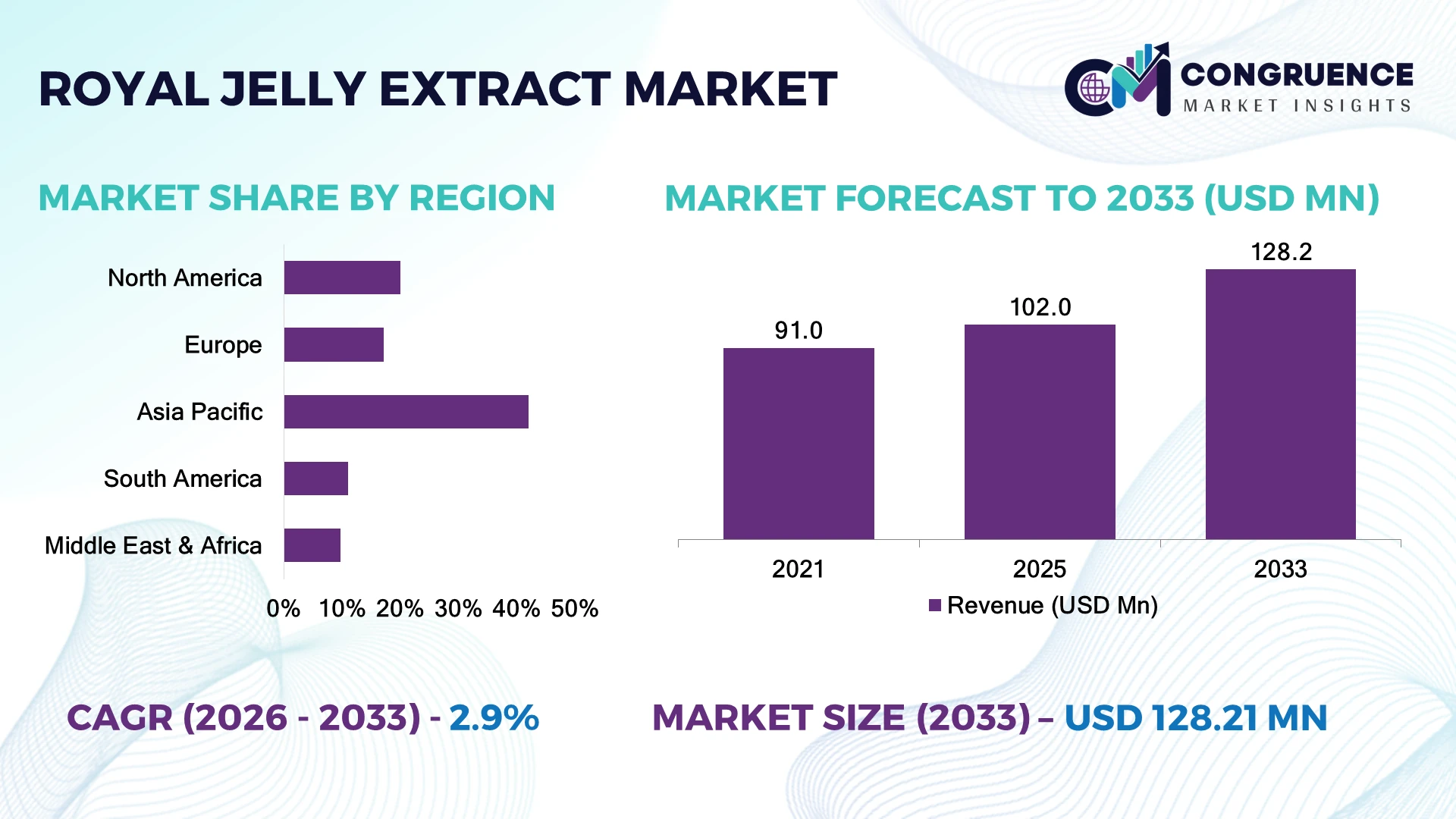
The Global Royal Jelly Extract Market was valued at USD 102.0 Million in 2025 and is anticipated to reach a value of USD 128.2 Million by 2033 expanding at a CAGR of 2.9% between 2026 and 2033. Growth is driven by wider use of standardized 10-HDA-rich royal jelly extracts in nutraceuticals, functional foods, and premium skincare, supported by microencapsulation and improved preservation technologies.
China holds the dominant position with more than 85% of global royal jelly production, supported by large-scale apiculture and export infrastructure. Japan remains a major premium-consumption market, while India produces only a small fraction of global supply. China’s production advantage exceeds India’s by more than 80 percentage points, reinforcing supply concentration.
Strategic implication, Companies should prioritize China-linked sourcing diversification, standardized extracts, and shelf-stable formulations to strengthen supply resilience and premium-market positioning.
Market Size & Growth: Market value reaches USD 128.2 Million by 2033 from USD 102.0 Million in 2025, with a 2.9% CAGR, supported by advanced extraction, stabilization, and functional-ingredient innovation.
Top Growth Drivers: Natural nutraceutical adoption 8%, clean-label cosmetics 7%, and functional-food applications 6%.
Short-Term Forecast: By 2028, stabilized and encapsulated formats are positioned to improve storage efficiency by approximately 20% and reduce cold-chain dependency by 15%.
Emerging Technologies: Spray-drying, microencapsulation, non-thermal processing, and analytical 10-HDA standardization are reshaping extract stability and formulation consistency.
Regional Leaders: Asia-Pacific is projected near USD 61 Million, Europe around USD 34 Million, and North America approximately USD 23 Million, with online nutraceutical adoption accelerating across developed markets.
Consumer/End-User Trends: Approximately 30% of premium royal jelly consumption is shifting toward convenient capsules, powders, and formulated supplements rather than fresh formats.
Pilot/Case Example: A 2025 spray-drying formulation achieved approximately 95% encapsulation efficiency, demonstrating a measurable route toward improved bioactive protection and commercial shelf stability.
Competitive Landscape: China-linked producers retain an estimated 60%+ production position, while key participants include Y.S. Eco Bee Farms, NOW Foods, Durham’s Bee Farm, and Wangs.
Regulatory & ESG Impact: Traceability, adulteration controls, and sustainable beekeeping practices are increasing compliance requirements, with quality-screening programs targeting 10-HDA consistency and contaminant control.
Investment & Funding: Industry investment is increasingly directed toward extraction, freeze-drying, encapsulation, and quality-testing infrastructure, with strategic partnerships strengthening premium ingredient supply chains.
Innovation & Future Outlook: Next-generation extracts will emphasize standardized bioactive profiles, low-temperature processing, AI-assisted quality monitoring, and sustainable packaging, shifting competition from raw supply toward formulation performance.
Royal jelly extract is gaining traction across premium nutraceuticals, functional beverages, and clean-label skincare, particularly where standardized 10-HDA content supports product differentiation. Encapsulation technologies are addressing the ingredient’s sensitivity to spoilage and cold storage, while China’s dominant production position continues to influence international procurement strategies. Approximately 85% of global production remains concentrated in China, making supply diversification increasingly important for multinational formulators.
Royal jelly extract is becoming strategically important because value is shifting from raw bee-derived material toward standardized, stable, application-ready bioactive ingredients. Nutraceutical manufacturers, cosmetic formulators, and functional-food companies are increasingly competing through purity, 10-HDA consistency, formulation stability, and traceability rather than basic ingredient availability. This shift strengthens the role of extraction technology and quality-control infrastructure in commercial differentiation.
Supply-chain restructuring is particularly important because China accounts for more than 85% of global royal jelly production. Companies sourcing exclusively from Chinese suppliers face concentration exposure, while Indian, South Korean, and Southeast Asian producers have opportunities to build secondary supply networks. Microencapsulation provides a measurable technology advantage, with optimized spray-dried formulations achieving nearly 95% encapsulation efficiency compared with conventional handling that provides substantially less protection against oxidation and degradation.
Over the next 2–3 years, manufacturers are expected to increase investment in standardized extracts, cold-chain optimization, digital traceability, and shelf-stable powder formats. A practical deployment pathway is the integration of spray-drying with 10-HDA testing for nutraceutical ingredient production, reducing formulation variability and improving logistics. Companies that combine diversified sourcing with advanced stabilization partnerships will gain stronger operational resilience and premium-market positioning.
The strongest growth driver is the transition from raw royal jelly toward standardized extracts containing measurable bioactive compounds such as 10-HDA. China contributes more than 85% of global production, creating a mature raw-material base for extract manufacturers, while premium nutraceutical and cosmetic formulations increasingly prioritize specification-controlled ingredients. Optimized spray-drying has demonstrated encapsulation efficiency approaching 95%, strengthening the commercial case for stable powder formats. This technology shift reduces deterioration during storage and improves batch consistency. Japanese and South Korean manufacturers are particularly positioned to expand high-value formulations, while Chinese processors continue investing in extraction and export-grade processing. Companies are responding through formulation partnerships, analytical testing, and encapsulation capacity, creating a strategic shift from commodity royal jelly procurement toward higher-margin standardized ingredients.
Royal jelly extract production remains constrained by biological yields, specialized beekeeping skills, and geographic concentration. China supplies more than 85% of global production, leaving international manufacturers exposed to regional disruptions, export restrictions, climate variability, and quality inconsistencies. Fresh royal jelly also requires controlled storage, while freeze-drying remains energy-intensive and can increase processing costs by more than 20% compared with simpler handling approaches. Adulteration and inconsistent 10-HDA levels further increase laboratory-testing requirements. These factors directly affect procurement margins, inventory planning, and scalability for manufacturers outside major producing hubs. Companies are mitigating exposure through multi-country sourcing, longer-term supplier contracts, batch-level authentication, and investments in stabilized powder formats. The key operational priority is reducing dependence on fresh material without compromising bioactive integrity.
The largest emerging opportunity lies in shelf-stable royal jelly extracts that can move beyond traditional fresh and refrigerated products. Microencapsulation can achieve approximately 95% encapsulation efficiency, while optimized powders can deliver more than 96% solubility, enabling broader use in functional beverages, supplement premixes, gummies, and cosmetic formulations. India, Southeast Asia, and selected European markets offer attractive expansion pathways as manufacturers develop localized nutraceutical and clean-beauty products. Non-thermal preservation, controlled-release systems, and advanced packaging are further improving ingredient stability. Companies can capture this opportunity by establishing application laboratories, partnering with beverage and cosmetics formulators, and developing standardized 10-HDA specifications. The non-obvious advantage is logistics: stable powdered extracts can reduce dependence on refrigerated distribution and open lower-cost international channels.
Long-term competitiveness depends on maintaining consistent bioactive concentration across variable bee colonies, climates, harvesting cycles, and processing facilities. Production quality can fluctuate with colony health and management conditions, while 10-HDA concentration around 2%–3% is increasingly used as a quality indicator for commercial material. China’s highly concentrated supply base adds further pressure on multinational manufacturers seeking geographic diversification. Automated quality testing, digital batch traceability, and standardized extraction protocols require additional capital and skilled technical personnel. Companies must also manage evolving food, nutraceutical, cosmetic, and labeling requirements across export markets. The strategic challenge is therefore not simply increasing extraction capacity but building repeatable quality across decentralized suppliers. Investment in laboratory infrastructure, supplier certification, and data-driven quality management will determine scalable market access.
Freeze-Dried Formats Gain Ground: Freeze-dried royal jelly extract now represents more than 55% of the type segment as manufacturers shift from refrigerated fresh material toward ambient-stable formats. Shelf-life extension of several months and easier encapsulation reduce logistics complexity by roughly 20%, while processors in China and Japan are expanding drying capacity. The non-obvious shift is that stabilization is increasingly influencing procurement decisions as strongly as raw-material availability.
Standardization Reshapes Processing: Manufacturers are increasing 10-HDA and major royal jelly protein testing, with standardized bioactive specifications increasingly targeting 90%+ batch consistency. Advanced low-temperature drying and analytical screening reduce variability by approximately 15%–20% compared with less-controlled processing. Export-oriented suppliers are investing in laboratory automation and batch traceability as stricter quality documentation requirements increase cross-border compliance pressure.
Digital Channels Accelerate Purchasing: Online purchasing is expanding as supplement brands use direct-to-consumer platforms, subscription programs, and digital product education. Digital channels are estimated to capture more than 20% of purchases in developed markets, while repeat-order programs can increase customer retention by approximately 15%. Companies are restructuring distribution around smaller, shelf-stable packs, enabling faster fulfillment and reducing dependence on specialty-store networks.
Functional Blends Broaden Demand: Royal jelly extract is increasingly combined with propolis, ginseng, botanical antioxidants, and other functional ingredients, with combination formulations accounting for roughly 25% of premium supplement launches. This transition increases formulation differentiation and supports higher-value positioning. Manufacturers are responding through co-development partnerships and application-specific blends, while South Korean and Japanese formulators are accelerating beauty-from-within and preventive-wellness products.
Royal Jelly Extract dominates the type segment with an estimated 54%–56% share, supported by longer shelf life, easier transportation, precise dosing, and compatibility with capsules and powdered formulations. Fresh Royal Jelly retains approximately 44%–46% share and remains important in premium natural products, specialist wellness channels, and applications where minimal processing is prioritized. The extract format reduces deterioration exposure and can remain stable for months under controlled ambient conditions, compared with fresh material requiring continuous refrigeration. Companies are therefore directing more processing investment toward freeze-drying, encapsulation, and standardized potency testing.
Royal Jelly Extract is also the faster-moving format, gaining roughly 2–3 percentage points of share as nutraceutical manufacturers replace difficult-to-handle fresh material with stable ingredients. Fresh Royal Jelly retains strategic relevance because of its premium positioning and perceived authenticity, but its cold-chain requirements restrict international scalability. The business implication is clear: processors with drying capacity, standardized 10-HDA specifications, and export-grade packaging are better positioned to capture multinational contracts. Companies are increasingly combining extraction with quality-control laboratories to improve batch consistency and reduce downstream formulation losses.
Dietary Supplements lead the application segment with approximately 44%–48% share, reflecting royal jelly extract’s established use in capsules, soft gels, powders, and combination wellness formulations. Medical Products account for roughly 25%–28%, while Food applications represent about 18%–20% and Others account for approximately 7%–10%. Supplement manufacturers benefit from the extract’s concentrated format and straightforward incorporation into standardized dosage systems, keeping this application commercially dominant.
Medical Products represent the faster-developing application as research activity around 10-HDA, major royal jelly proteins, antioxidant properties, and immune-related functionality expands formulation interest. Adoption is increasing by approximately 3–5 percentage points across specialized product pipelines, although regulatory requirements remain more stringent than for conventional supplements. Food applications are shifting toward functional beverages and fortified products, while Others remains focused on specialized formulations. Companies are responding with application-specific extraction grades, smaller-dose formulations, and partnerships with nutraceutical formulators. The strategic implication is that future competition increasingly depends on formulation compatibility rather than simply securing raw royal jelly supply.
Nutraceutical Manufacturers represent the leading end-user group with an estimated 45%–50% share, supported by high-volume requirements for capsules, powders, soft gels, and blended wellness products. Pharmaceutical Companies account for approximately 25%–28%, while Retail Consumers represent roughly 22%–27% through direct purchases of packaged extracts and finished supplements. Nutraceutical buyers have greater procurement scale and formulation flexibility, making them more influential in specification setting, packaging requirements, and supplier qualification.
Pharmaceutical Companies are the fastest-growing end-user group, with specialized demand increasing by approximately 4%–6% as research-driven applications focus on standardized bioactive compounds and controlled formulations. Retail Consumers continue shifting toward convenient powder and capsule formats, increasing preference for traceability and standardized potency. Companies are targeting nutraceutical manufacturers through bulk contracts and customized extracts, while pharmaceutical suppliers are investing in analytical validation and higher-grade processing. The competitive implication is that suppliers serving multiple end-user specifications gain stronger resilience than those dependent on a single channel.
Asia-Pacific accounted for the largest market share at 42.1% in 2025 however, South America is expected to register the fastest growth, expanding at a CAGR of 5.8% between 2026 and 2033.

North America represented approximately 20.0% of the global market in 2025, with the United States accounting for the majority of regional consumption through dietary supplements, functional nutrition, and premium personal-care formulations. Demand is increasingly concentrated around standardized, shelf-stable extracts rather than fresh royal jelly, improving inventory flexibility and reducing cold-chain exposure. Online supplement channels account for more than 20% of purchasing activity in developed markets, accelerating direct-to-consumer distribution and smaller-format product launches. U.S. formulators are increasing use of encapsulated and blended royal jelly ingredients to improve dosage consistency and product differentiation. Companies are responding through contract manufacturing, specialty-ingredient partnerships, and expanded analytical testing for 10-HDA and major royal jelly proteins. The strategic shift is toward higher-specification ingredients capable of meeting supplement quality, labeling, and traceability requirements.
United States Market Outlook: The United States is the principal North American demand center, supported by a mature dietary-supplement industry and extensive specialty retail and e-commerce infrastructure. More than 70% of regional demand is concentrated in the country, creating an attractive market for standardized capsules, powders, and functional blends. Manufacturers are prioritizing convenient formats, third-party testing, transparent sourcing, and contract partnerships to strengthen consumer confidence and accelerate product commercialization.
Europe accounted for approximately 17.2% of the global market in 2025, supported by Germany, France, the United Kingdom, and other established wellness markets. Regulatory scrutiny around food supplements, cosmetic ingredients, labeling, and contaminant controls is pushing suppliers toward documented sourcing and tighter batch specifications. Premium formulations increasingly emphasize traceability, clean-label positioning, and sustainable beekeeping practices. Germany and France together represent more than 40% of regional demand, creating concentrated opportunities for compliant suppliers. Manufacturers are investing in laboratory verification, standardized 10-HDA testing, and low-temperature processing to protect bioactive compounds. The region’s higher compliance burden increases market-entry costs by an estimated 10%–15% for smaller suppliers but creates an advantage for established processors with certification and quality-management infrastructure. Companies are therefore favoring qualified supplier networks and long-term procurement agreements over spot purchasing.
Germany Market Outlook: Germany is the strategic European demand center because of its large nutraceutical and natural-health product ecosystem. More than 25% of European royal jelly extract demand is concentrated in Germany, supported by established pharmacy, health-food, and online distribution channels. Manufacturers are increasingly emphasizing documented origin, analytical purity, and environmentally responsible sourcing, strengthening demand for standardized extracts from professionally managed processing facilities.
Asia-Pacific held the largest position with approximately 42.1% of the global market in 2025, supported overwhelmingly by China’s production scale and strong consumption in Japan and South Korea. China produces more than 90% of global royal jelly output, creating a highly integrated supply ecosystem spanning selective beekeeping, harvesting, processing, freeze-drying, and export distribution. Japan remains a major premium-consumption market, while South Korea continues expanding functional-food and beauty applications. Production systems using selectively bred high-yield bee strains can generate more than 10 times the royal jelly output of conventional lines, strengthening processing economics. Companies are expanding standardized extraction, drying, packaging, and analytical capabilities close to major apiculture hubs. The key operational advantage is vertical integration: producers can coordinate biological production with processing specifications, reducing procurement friction and improving batch availability for international buyers.
China Market Outlook: China is the dominant global production center, supplying more than 90% of worldwide royal jelly output. Zhejiang and other established apiculture areas benefit from specialized high-yield bee strains, migratory beekeeping, and processing expertise. High-yield colonies can produce more than 10 kg of royal jelly annually under optimized management. Chinese companies are increasingly moving beyond raw exports toward standardized extracts, freeze-dried ingredients, and higher-value formulations.
South America represented approximately 11.0% of the global market in 2025, with Brazil and Argentina providing the strongest commercial platforms through established beekeeping, food-processing, and natural-product industries. Brazil is particularly important because its large agricultural base supports extensive pollination networks and diversified apiculture. However, specialized royal jelly processing remains less developed than in China, creating dependence on imported standardized extracts for higher-value formulations. Premium nutraceutical and beauty products are increasing their share of urban consumption, while e-commerce is improving access to imported formulations by approximately 15%–20% in major markets. Companies are responding through distributor partnerships, localized packaging, and selective investment in extraction and drying capacity. The strategic opportunity is not simply expanding raw production but developing local processing infrastructure capable of converting domestic apiculture into standardized, export-ready ingredients.
Brazil Market Outlook: Brazil is the most strategically significant South American market because of its extensive beekeeping base, large consumer economy, and established natural-product manufacturing ecosystem. The country accounts for more than 50% of regional apiculture activity, providing a substantial foundation for royal jelly commercialization. Manufacturers are increasingly targeting premium supplements and cosmetics while building partnerships with beekeepers to improve traceability, processing consistency, and domestic availability.
Middle East & Africa accounted for approximately 9.7% of the global market in 2025, with demand concentrated in the UAE, Saudi Arabia, South Africa, and other affluent urban centers. The region remains heavily dependent on imported royal jelly ingredients because specialized extraction and controlled-storage infrastructure is limited compared with Asian production hubs. Premium wellness retail, pharmacy chains, and cross-border e-commerce are expanding access to standardized capsules and powders, while shelf-stable formats reduce dependence on refrigerated logistics. UAE and Saudi Arabia together account for more than 45% of regional premium-product demand. Companies are responding through distributor agreements, localized warehousing, and partnerships with international nutraceutical brands. The operational priority is shifting from simple import distribution toward regional formulation and packaging, which can shorten replenishment cycles by approximately 15%–20% and improve product availability.
UAE Market Outlook: The UAE is the leading Middle Eastern commercial hub because of its advanced logistics infrastructure, high-income consumer base, and strong re-export capabilities. More than 30% of premium royal jelly products entering the Gulf are distributed through UAE-based channels, supporting regional access to imported nutraceutical ingredients. Companies are using Dubai-based warehousing, e-commerce, and specialized distributors to shorten delivery cycles and develop premium wellness portfolios.
Yamada Bee Company, Robis, NOW Foods, Healthy Care, and Chinese extract processors compete across premium standardized extracts, finished nutraceuticals, and cost-efficient bulk supply. The top five players are estimated to control about 28% combined share, indicating a fragmented structure. Competition centers on formulation technology, traceability, pricing, and supply security, with standardized extracts commanding 10%–20% premiums. Leading suppliers invest in freeze-drying, 10-HDA testing, vertical sourcing, and specialty partnerships, while regional processors compete through lower costs and faster customization. Yamada Bee emphasizes R&D-led differentiation, Robis focuses on integrated manufacturing and product breadth, and Chinese processors leverage production scale. The competitive shift is moving from raw-material access toward verified potency, stabilized formats, and application-specific formulations. Entry barriers include specialized apiculture relationships, quality-control infrastructure, regulatory documentation, and bioactive consistency. Winning requires reliable sourcing, standardized 10-HDA specifications, scalable processing, differentiated formulations, and strong downstream partnerships that convert biological variability into commercially consistent products.
Yamada Bee Company, Inc.
Robis, S.L.
NOW Foods
Healthy Care Australia
Natural Factors
Solgar
Swanson Health Products
Durham’s Bee Farm
Manuka Health
BeeAlive
STE Pharmaceuticals
Henan Mingshengfeng Biotechnology Co., Ltd.
Freeze-drying remains the core stabilization technology, replacing conventional refrigerated handling where export logistics demand longer shelf life. Compared with fresh storage, lyophilization substantially reduces moisture exposure and enables ambient distribution, while standardized 10-HDA testing improves batch consistency by an estimated 10%–15%. More than half of commercial premium products increasingly use dried or stabilized formats. Chinese processors benefit from scale, while Japanese and European formulators gain through precision specification and premium positioning.
Microencapsulation is emerging as the most commercially relevant formulation upgrade, protecting sensitive proteins, fatty acids, and antioxidants during processing and storage. Optimized encapsulation can improve active retention by roughly 15%–20% versus conventional powder handling, while reducing formulation losses. Adoption is concentrated among nutraceutical, functional-food, and beauty manufacturers developing powders, gummies, beverages, and controlled-release formats. Companies integrating encapsulation with automated particle-size and moisture monitoring gain stronger manufacturing consistency and broader formulation flexibility.
From 2026–2028, enzymatic treatment, sustained-release systems, advanced polymer delivery, and digital quality analytics will push royal jelly beyond conventional supplements. Yamada Bee-backed research has demonstrated more than tenfold improvement in 10-HDA skin penetration through polymer-based formulations. The competitive advantage will shift toward companies combining extraction, analytical validation, delivery technology, and application-specific R&D rather than competing on raw ingredient price alone. Acting now secures formulation know-how and supplier integration.
February 2026 — Yamada Bee Company began test sales of royal jelly and propolis products in Kyiv, with sales scheduled through April. The initiative targets Ukrainian market entry and future local production, strengthening regional expansion and value-added processing. Source: JICA
January 2024 — Robis launched two organic royal jelly products, Ecodefensas and Ecosenior, using organically farmed inputs and 30-day dosage formats. The launch strengthens sustainable positioning and expands specialized formulations for immunity and senior wellness. Source: ROBIS
April 2024 — The Better Health Company’s GO Royal Jelly + Vitamin E received Australian medicine registration, incorporating lyophilized royal jelly. The registration provides a regulated commercialization pathway and strengthens positioning within Australia’s therapeutic-product framework. Source: Therapeutic Goods Administration
February 2025 — Yamada Bee Company researchers reported a fermentation approach enriching royal jelly-derived 10HDAA for functional-food applications. The work targets enhanced bioactive functionality and supports development of differentiated, science-led royal jelly formulations. Source: PubMed
The Royal Jelly Extract Market report covers the industry across Type, Application, End-User, and geography, evaluating fresh and stabilized formats alongside Dietary Supplements, Medical Products, Food, and other applications. End-user analysis includes Nutraceutical Manufacturers, Pharmaceutical Companies, and Retail Consumers, with detailed assessment across North America, Europe, Asia-Pacific, South America, and Middle East & Africa.
The scope also evaluates freeze-drying, microencapsulation, 10-HDA standardization, enzymatic processing, sustainable sourcing, and advanced delivery technologies shaping product development. Regional analysis identifies China, Japan, the United States, Germany, Brazil, and the UAE as strategically relevant country markets. Competitive assessment covers approximately 12 major companies and examines sourcing, formulation, processing, partnerships, and commercialization strategies. The report supports investment planning, market-entry decisions, supplier diversification, product positioning, capacity expansion, and competitive strategy through 2026–2033.
| Report Attribute / Metric | Details |
|---|---|
| Market Revenue (2025) | USD 102.0 Million |
| Market Revenue (2033) | USD 128.2 Million |
| CAGR (2026–2033) | 2.9% |
| Base Year | 2025 |
| Forecast Period | 2026–2033 |
| Historic Period | 2021–2025 |
| Segments Covered |
By Type
By Application
By End-User
|
| Key Deliverables | Revenue Forecast; Market Trends; Growth Drivers & Restraints; Technology Insights; Segmentation Analysis; Regional Insights; Competitive Landscape; Regulatory & ESG Overview; Recent Developments |
| Regions Covered | North America; Europe; Asia-Pacific; South America; Middle East & Africa |
| Companies Profiled | Yamada Bee Company, Inc.; Robis, S.L.; NOW Foods; Healthy Care Australia; Natural Factors; Solgar; Swanson Health Products; Durham’s Bee Farm; Manuka Health; BeeAlive; STE Pharmaceuticals; Henan Mingshengfeng Biotechnology Co., Ltd. |
| Customization & Pricing | Available on Request (10% Customization Free) |




