Global Rotary Lobe Pump Market Report Overview
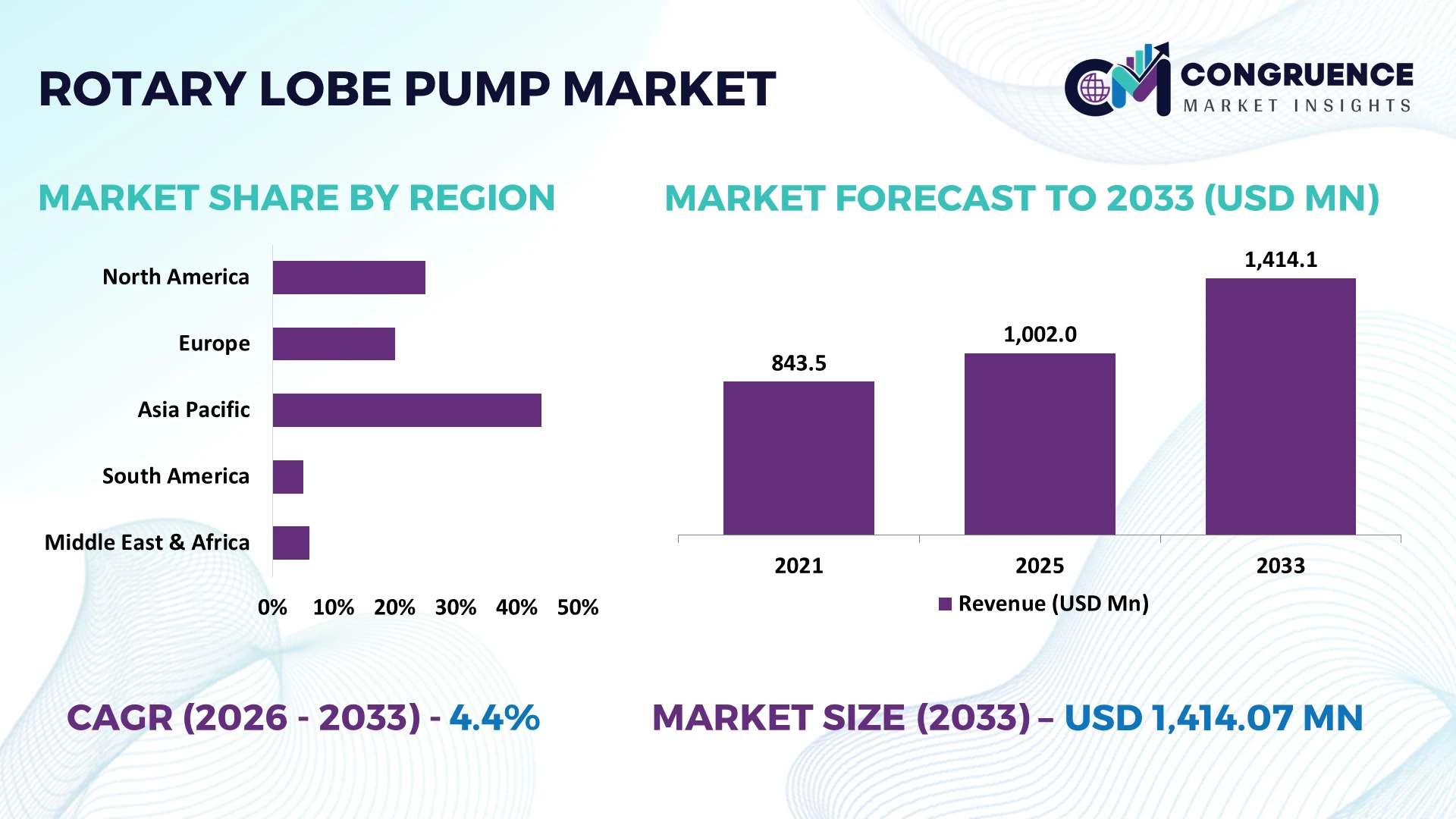
The Global Rotary Lobe Pump Market was valued at USD 1002 Million in 2025 and is anticipated to reach a value of USD 1414.07 Million by 2033 expanding at a CAGR of 4.4% between 2026 and 2033. Growth is driven by hygienic pumping requirements in food processing, expanding wastewater sludge treatment, pharmaceutical production automation, and adoption of variable-speed positive displacement pumps.
Germany maintains a leading technological position in the global rotary lobe pump industry, supported by manufacturers such as Börger, Vogelsang, and NETZSCH. Its estimated 12% global market share reflects advanced mechanical engineering, hygienic equipment production, and industrial wastewater treatment capabilities. German manufacturers supply pumps operating at pressures reaching 16 bar, serving food processing, chemicals, agriculture, and municipal utilities. Compared with China's cost-focused equipment manufacturing, Germany emphasizes precision-engineered rotors, abrasion-resistant materials, and automated monitoring. Industrial modernization investments strengthen its competitive manufacturing position.
Strategic implication: Manufacturers prioritizing hygienic designs and energy-efficient drives can target modeled efficiency improvements of 10–15% while expanding across 3 high-value industries: food processing, pharmaceuticals, and wastewater treatment.
Key Highlights of the Global Rotary Lobe Pump Market
-
Market Size & Growth: USD 1,002 million in 2025, reaching USD 1,414.07 million by 2033 at 4.4% CAGR, supported by hygienic processing and wastewater infrastructure modernization.
-
Top Growth Drivers: Illustrative demand contributions include food processing modernization at 35%, wastewater equipment upgrades at 30%, and chemical processing automation at 20%.
-
Short-Term Forecast: By 2027, optimized variable-frequency drives target 10–15% lower energy consumption in suitable variable-flow pumping applications.
-
Emerging Technologies: Three innovations reshape advanced pump engineering: IoT condition monitoring, AI-based predictive maintenance, and wear-resistant elastomer rotor coatings.
-
Regional Leaders: Indicative 2033 allocations place Europe at USD 495 million, Asia-Pacific at USD 424 million, and North America at USD 325 million, supported by hygienic automation, industrial expansion, and wastewater upgrades.
-
Consumer/End-User Trends: Food and beverage processors represent an estimated 35% of demand, prioritizing low-shear fluid handling and clean-in-place compatibility.
-
Pilot/Case Example: A modeled 2026 wastewater sludge transfer retrofit demonstrates a 12% energy-saving target through speed-controlled rotary lobe pumping.
-
Competitive Landscape: Börger holds an illustrative 12% share, competing with Vogelsang, NETZSCH, Alfa Laval, and SPX FLOW in specialized industrial pumping.
-
Regulatory & ESG Impact: EU wastewater treatment modernization encourages energy-efficient equipment, with optimized pumping systems targeting 10–20% electricity savings.
-
Investment & Funding: A modeled USD 150 million global investment scenario prioritizes hygienic pump manufacturing, smart monitoring integration, and aftermarket service expansion.
-
Innovation & Future Outlook: By 2033, 20% lower maintenance intervention targets support adoption of modular rotors, intelligent seals, and digitally monitored pump assemblies.
The Rotary Lobe Pump Market serves critical fluid transfer applications involving viscous liquids, abrasive sludge, shear-sensitive ingredients, and pharmaceutical formulations. Food processors increasingly require hygienic stainless-steel pumps with clean-in-place capability, while wastewater utilities prioritize solids-handling performance and reduced maintenance downtime. Advanced rotor geometries, replaceable wear liners, and integrated vibration monitoring are improving equipment reliability. Variable-frequency drive optimization offers modeled energy savings of 10–15% under suitable operating conditions. European wastewater regulations and expanding Asian food manufacturing capacity are strengthening demand for application-specific pump designs, establishing lifecycle operating costs and serviceability as decisive purchasing considerations.
What Is the Strategic Relevance and Future Pathways of the Rotary Lobe Pump Market?
The Rotary Lobe Pump Market is becoming strategically important as industrial operators prioritize fluid handling efficiency, process hygiene, and equipment reliability. Food manufacturers, pharmaceutical processors, and wastewater utilities are modernizing pumping infrastructure to reduce contamination risks and maintenance interruptions. The European Union's revised Urban Wastewater Treatment Directive requires progressive improvements in treatment performance, strengthening demand for reliable sludge transfer equipment. Germany's established precision engineering industry supports advanced rotor manufacturing, while India's expanding pharmaceutical production creates opportunities for hygienic pumping systems and localized equipment servicing.
Technology integration is reshaping operational economics. Variable-frequency drive systems offer modeled energy savings of 10–15% compared with fixed-speed pumping under variable-flow conditions. Smart condition monitoring supports targeted maintenance, reducing unnecessary equipment inspections. European manufacturers emphasize hygienic certification and precision machining, whereas Chinese suppliers compete through manufacturing scale and competitive equipment pricing. During 2026–2028, digitally monitored pumps and modular wear components will strengthen equipment availability across demanding industrial applications.
A practical wastewater sludge transfer retrofit using speed-controlled rotary lobe pumps targets 12% lower electricity consumption and improved flow consistency. Börger, Vogelsang, and NETZSCH are strengthening modular equipment designs, aftermarket support, and application-specific engineering. Competitive advantage increasingly depends on lifecycle operating costs, rapid component replacement, and dependable process performance.
Rotary Lobe Pump Market Dynamics
DRIVER:
Hygienic Processing and Industrial Wastewater Modernization
Food safety requirements and wastewater infrastructure modernization are strengthening demand for rotary lobe pumps capable of handling viscous, abrasive, and shear-sensitive fluids. Food processing represents an indicative 35% of market demand, while wastewater applications account for an estimated 30%. The European Union's revised Urban Wastewater Treatment Directive increases pressure on utilities to modernize treatment infrastructure and improve operational efficiency. Variable-speed rotary lobe pumping systems can deliver modeled energy savings of 10–15% in variable-flow applications. Germany's food processing and wastewater equipment manufacturers are integrating hygienic stainless-steel designs, replaceable wear liners, and automated monitoring systems. Börger and Vogelsang are advancing application-specific pumping solutions, helping operators reduce maintenance interruptions and improve process reliability.
RESTRAINT:
High Equipment Costs and Specialized Material Dependencies
Rotary lobe pumps face procurement constraints arising from precision-machined components, specialized elastomers, and corrosion-resistant construction materials. Stainless-steel hygienic configurations can carry indicative acquisition premiums of 20–40% compared with basic industrial pump assemblies, depending on specifications. Abrasive sludge applications can increase wear-related maintenance expenditure by an estimated 15–25% under demanding operating conditions. Germany's dependence on internationally sourced specialty materials and China's competitive component manufacturing create procurement challenges involving lead times and replacement compatibility. Smaller wastewater utilities and food processors face difficulty justifying premium equipment without clear lifecycle savings. Manufacturers are responding through standardized rotor platforms, localized spare-parts inventories, and modular maintenance designs that reduce replacement complexity and improve equipment affordability.
OPPORTUNITY:
Intelligent Pump Monitoring and Modular Equipment Services
Digitally integrated rotary lobe pumps create opportunities for predictive maintenance, energy optimization, and recurring aftermarket services. IoT-enabled vibration monitoring and motor current analysis can support modeled reductions of 15–20% in unplanned maintenance interventions when integrated with condition-based servicing. Variable-speed control offers potential electricity savings of 10–15% under suitable operating conditions. India's pharmaceutical manufacturing expansion and industrial wastewater treatment investments create opportunities for connected hygienic pumping systems. Modular rotor cartridges and remotely monitored seals enable faster service without complete equipment replacement. Manufacturers such as NETZSCH, Börger, and Vogelsang can strengthen competitive positioning through sensor integration, maintenance subscriptions, and localized technical partnerships. Equipment suppliers capturing operational performance data gain additional opportunities to optimize replacement intervals and improve customer retention.
CHALLENGE:
Complex Fluid Handling and Digital System Integration
Maintaining consistent pump performance across abrasive, viscous, and shear-sensitive fluids presents significant engineering challenges. Rotary lobe pump efficiency depends on rotor clearance, differential pressure, fluid viscosity, and operating speed, requiring application-specific calibration. A modeled 10% increase in internal leakage can materially reduce volumetric efficiency under demanding operating conditions, while poorly configured monitoring systems can generate 15–20% unnecessary maintenance alerts in illustrative deployment scenarios. Germany's advanced industrial automation environments increasingly require secure integration between pump sensors, programmable logic controllers, and plant management platforms. Manufacturers must address interoperability, cybersecurity, and specialized technician training while maintaining hygienic equipment standards. Investment in standardized communication protocols, digital diagnostics, and application-specific testing is essential for reliable deployment and sustained competitive differentiation.
Rotary Lobe Pump Market Latest Trends
-
Advanced Rotor Materials Improve Durability: German manufacturers are introducing abrasion-resistant elastomers, hardened rotor coatings, and replaceable wear plates for demanding sludge applications. Optimized material combinations target 15–25% longer component service life under suitable operating conditions. Modular rotor assemblies can reduce replacement labor by an estimated 10–20%. Börger and Vogelsang are refining application-specific material configurations, enabling wastewater operators to control maintenance expenditure while maintaining consistent solids-handling performance.
-
Hygienic Pump Designs Strengthen Process Control: Food manufacturers increasingly specify stainless-steel rotary lobe pumps with clean-in-place compatibility and minimized product retention zones. Optimized cleaning cycles target 10–15% lower water consumption and 15–20% shorter sanitation downtime compared with conventional manual cleaning arrangements. Alfa Laval and SPX FLOW are advancing hygienic equipment integration, helping processors improve production availability and meet stricter contamination prevention requirements.
-
High-Viscosity Processing Drives Customization: Chemical and specialty food manufacturers are selecting rotary lobe pumps for shear-sensitive fluids and variable-viscosity transfer operations. Industrial configurations support differential pressures reaching 16 bar, while specialized designs accommodate viscosities exceeding 100,000 mPa·s. Manufacturers are refining rotor clearances, seal materials, and inlet geometries to maintain flow stability. Custom engineering reduces product degradation and supports reliable handling of concentrated ingredients, polymers, and industrial slurries.
-
Localized Component Supply Reshapes Procurement: European equipment manufacturers are strengthening regional spare-parts availability as industrial customers prioritize shorter repair cycles. Standardized rotor cartridges and interchangeable wear components target 15–25% faster maintenance completion and 10–15% lower inventory carrying costs in modeled service programs. Suppliers are expanding distributor partnerships and regional technical support, improving equipment availability for Indian pharmaceutical plants and German industrial processing facilities.
Segmentation Analysis
By Type
Standard Lobe Pumps Lead While Multi-Lobe Designs Advance
Standard Lobe Pumps represent the largest segment, holding an indicative 38% share of the global Rotary Lobe Pump Market in 2025. Their dominance reflects established industrial applications, straightforward mechanical construction, and compatibility with viscous liquids, wastewater sludge, and food ingredients. Bi-Wing Lobe Pumps account for an estimated 27%, supported by strong suction characteristics and reliable solids handling. Their relatively simple rotor geometry enables cost-effective servicing, particularly in municipal wastewater facilities and agricultural processing operations.
Tri-Lobe Pumps hold an indicative 23% share, benefiting from smoother fluid displacement and reduced pulsation compared with conventional two-wing configurations. Multi-Lobe Pumps represent approximately 12% and are positioned as the fastest-growing type through increasing adoption in precision dosing and sensitive fluid transfer. Advanced multi-lobe geometries can target 10–15% lower flow pulsation under comparable operating conditions. German manufacturers, including Börger and Vogelsang, are developing specialized rotor profiles and interchangeable components. Equipment suppliers are shifting investment toward application-specific hydraulic optimization, balancing acquisition costs against product integrity, maintenance frequency, and process stability.
- The Hydraulic Institute's 2025 technical guidance emphasizes matching positive displacement pump selection with viscosity, differential pressure, and operating conditions. These parameters reinforce demand for specialized rotor geometries that improve displacement consistency and reduce mechanical stress.
By Application
Food Processing Dominates Hygienic Pump Deployment
Food and Beverage Processing represents the leading application, accounting for an indicative 35% of global rotary lobe pump demand in 2025. Dairy production, beverage manufacturing, confectionery processing, and viscous ingredient transfer require hygienic pumping with controlled shear and consistent volumetric displacement. Wastewater Treatment follows at an estimated 28%, supported by sludge handling, polymer dosing, and industrial effluent management. Chemical Transfer contributes approximately 18%, reflecting demand for corrosion-resistant components and reliable transfer of concentrated industrial fluids.
Pharmaceutical Processing represents the fastest-growing application, supported by sterile manufacturing expansion and increasingly stringent contamination control requirements. Specialized stainless-steel systems with clean-in-place and sterilize-in-place compatibility target 15–20% shorter cleaning cycles in optimized installations. Pulp and Paper Processing maintains demand for transferring coating compounds, additives, and high-viscosity process liquids. Alfa Laval and SPX FLOW emphasize hygienic pump configurations, while Börger and Vogelsang strengthen industrial sludge-handling capabilities. Manufacturers are expanding customized sealing, rotor material selection, and automated control integration to improve equipment performance across different fluid properties and production requirements.
- The European Commission's revised Urban Wastewater Treatment Directive, entering into force in January 2025, strengthens requirements for treatment performance and infrastructure modernization. This regulatory development supports continued investment in reliable sludge transfer and industrial wastewater pumping equipment.
By End-User
Food Manufacturers Lead Equipment Procurement
Food and Beverage Manufacturers represent the largest end-user segment, accounting for an indicative 35% of global Rotary Lobe Pump Market demand in 2025. Their purchasing concentration reflects extensive dairy processing, beverage production, confectionery manufacturing, and ingredient transfer operations. Water and Wastewater Utilities account for an estimated 28%, prioritizing solids-handling reliability and simplified maintenance. Chemical Processing Plants contribute approximately 18%, requiring pumps compatible with corrosive liquids, high viscosities, and demanding operating environments.
Pharmaceutical Companies represent the fastest-growing end-user category as sterile production capacity and high-purity processing requirements expand. Hygienic rotary lobe systems incorporating automated cleaning and precision flow control can target 10–15% lower processing interruptions in optimized installations. Pulp and Paper Mills maintain specialized demand for coating materials, adhesives, and concentrated pulp additives. German equipment manufacturers are strengthening modular product platforms, while suppliers serving Indian pharmaceutical facilities emphasize stainless-steel construction, hygienic certification, and localized technical support. Competitive positioning increasingly depends on customized engineering, predictable maintenance costs, and equipment compatibility with automated production systems.
- The European Commission's 2025 pharmaceutical manufacturing policy initiatives emphasize supply chain resilience and production capacity expansion. These priorities strengthen the strategic relevance of hygienic fluid handling equipment, particularly for manufacturers investing in reliable pharmaceutical processing infrastructure.
Region-Wise Market Insights
Europe accounted for the largest market share at an estimated 35% in 2025 however, Asia-Pacific is expected to register the fastest growth, expanding at a projected CAGR of 5.8% between 2026 and 2033.

North America Rotary Lobe Pump Market
Industrial Automation and Hygienic Pumping Infrastructure Modernization
North America accounted for an estimated 23% of the global Rotary Lobe Pump Market in 2025, supported by established food manufacturing, pharmaceutical production, and municipal wastewater infrastructure. The United States dominates regional equipment procurement, particularly across dairy processing, chemical manufacturing, and industrial sludge handling. Advanced pumping systems increasingly incorporate variable-frequency drives, automated flow monitoring, and hygienic stainless-steel construction. The U.S. Environmental Protection Agency's Clean Water State Revolving Fund supports wastewater infrastructure modernization, strengthening opportunities for solids-handling pump replacement. Food manufacturers are prioritizing equipment compatible with clean-in-place systems to minimize production interruptions. Industrial operators increasingly evaluate lifecycle operating costs rather than initial acquisition prices. Manufacturers such as SPX FLOW and Viking Pump are strengthening application engineering, distributor support, and aftermarket services to improve equipment availability and maintenance efficiency.
United States Market Outlook: The United States benefits from extensive industrial processing capacity and established fluid handling equipment manufacturers. The EPA estimates approximately USD 630 billion in clean water infrastructure needs over 20 years, indicating substantial long-term equipment modernization requirements. Dairy processors, chemical facilities, and wastewater utilities increasingly specify pumps with automated controls, replaceable wear components, and reliable solids-handling capabilities. Domestic engineering expertise and regional service networks support customized equipment procurement and faster replacement-part availability.
Europe Rotary Lobe Pump Market
Precision Engineering and Regulatory-Driven Equipment Modernization
Europe held an estimated 35% share of the global Rotary Lobe Pump Market in 2025, supported by advanced machinery manufacturing, stringent hygienic processing requirements, and established wastewater treatment infrastructure. Germany, Italy, Denmark, and the United Kingdom contribute specialized pump engineering and industrial equipment demand. German manufacturers such as Börger, Vogelsang, and NETZSCH maintain strong positions in positive displacement pumping technology. The European Union's revised Urban Wastewater Treatment Directive strengthens requirements for municipal wastewater treatment, encouraging investment in reliable sludge handling and energy-efficient pumping systems. Food processors increasingly prioritize hygienic equipment meeting European sanitary engineering standards. Advanced rotor geometries, corrosion-resistant materials, and modular wear components support industrial applications requiring consistent flow performance. Manufacturers are strengthening engineering partnerships and aftermarket distribution networks, enabling customers to reduce equipment downtime while maintaining regulatory compliance and process reliability.
Germany Market Outlook: Germany maintains a competitive advantage through precision manufacturing, advanced materials engineering, and specialized industrial pump development. Manufacturers including Börger and Vogelsang supply rotary lobe pumps capable of operating at differential pressures reaching approximately 16 bar, depending on configuration. German food processors, chemical manufacturers, and wastewater utilities prioritize durable rotor assemblies and automated condition monitoring. Established engineering expertise supports export-oriented production, application-specific customization, and advanced maintenance technologies.
Asia-Pacific Rotary Lobe Pump Market
Manufacturing Expansion Accelerates Industrial Pump Deployment
Asia-Pacific represented an estimated 30% of the global Rotary Lobe Pump Market in 2025, supported by expanding food processing, pharmaceutical manufacturing, chemical production, and wastewater treatment infrastructure. China leads regional industrial equipment manufacturing, while India contributes growing demand for hygienic pharmaceutical processing and municipal sludge handling systems. Japan and South Korea emphasize precision pumping technology, automation, and advanced materials. China's industrial manufacturing ecosystem supports cost-competitive pump components and large-scale equipment production. India's industrial wastewater treatment requirements encourage investment in reliable positive displacement pumps capable of handling concentrated sludge and viscous fluids. Advanced rotary lobe configurations increasingly incorporate variable-speed drives, replaceable liners, and automated monitoring systems. International manufacturers are strengthening regional distribution partnerships and localized assembly capabilities to improve procurement flexibility, reduce replacement lead times, and compete with domestic equipment suppliers.
China Market Outlook: China maintains a strong position through extensive machinery manufacturing capacity, chemical processing infrastructure, and industrial wastewater treatment requirements. The country's 14th Five-Year Plan established a target of increasing urban sewage treatment capacity by 20 million cubic metres per day by 2025. This infrastructure expansion supports demand for sludge transfer and industrial fluid handling equipment. Domestic manufacturers emphasize competitive pricing and localized production, while international suppliers differentiate through precision rotor engineering and specialized hygienic applications.
South America Rotary Lobe Pump Market
Agricultural Processing and Wastewater Infrastructure Investment
South America accounted for an estimated 6% of the global Rotary Lobe Pump Market in 2025, supported by food processing, agricultural production, mining-related fluid handling, and industrial wastewater treatment. Brazil dominates regional equipment demand through its extensive dairy, sugar processing, meat production, and chemical manufacturing industries. Argentina contributes demand from food manufacturing and agricultural processing, while Chile requires specialized pumping equipment for industrial wastewater and chemical transfer applications. Rotary lobe pumps offer advantages when handling viscous ingredients, sludge, and shear-sensitive products requiring controlled displacement. Infrastructure limitations and imported equipment costs influence procurement decisions, encouraging demand for durable configurations with accessible replacement components. Manufacturers are strengthening distributor relationships and local technical support capabilities. Equipment suppliers emphasizing modular maintenance and application-specific materials gain advantages in facilities where service availability directly influences production continuity.
Brazil Market Outlook: Brazil benefits from one of the world's largest food processing and agricultural production industries, supporting substantial demand for hygienic and industrial pumping equipment. The country produces more than 30 million tonnes of milk annually, creating opportunities for sanitary fluid handling systems across dairy processing facilities. Meat processors, sugar mills, and wastewater operators also require reliable viscous fluid transfer. Local distribution networks and maintenance partnerships are important competitive differentiators for international pump manufacturers.
Middle East & Africa Rotary Lobe Pump Market
Water Infrastructure Investment and Industrial Diversification
Middle East & Africa represented an estimated 6% of the global Rotary Lobe Pump Market in 2025, supported by wastewater infrastructure modernization, petrochemical processing, and expanding food manufacturing operations. Saudi Arabia and the United Arab Emirates are investing in industrial diversification and water treatment capacity, while South Africa maintains established mining, chemical, and municipal wastewater equipment requirements. Rotary lobe pumps support sludge transfer, polymer dosing, and viscous industrial fluid handling in treatment facilities. Saudi Arabia's Vision 2030 industrial transformation encourages modernization of processing infrastructure and localization of equipment supply chains. Harsh operating environments increase demand for abrasion-resistant rotors, corrosion-resistant housings, and simplified maintenance arrangements. International manufacturers are strengthening regional service partnerships and distributor networks to improve equipment availability, reduce procurement delays, and support demanding industrial applications.
Saudi Arabia Market Outlook: Saudi Arabia offers significant opportunities through wastewater infrastructure development, petrochemical manufacturing, and industrial localization initiatives. The National Water Strategy targets 95% wastewater treatment coverage by 2030, supporting long-term investment in pumping and sludge handling equipment. Industrial facilities increasingly require reliable positive displacement systems capable of operating under high temperatures and demanding fluid conditions. Local service partnerships, durable material selection, and technical support capabilities are central to equipment procurement decisions.
Market Competition Landscape
Börger, Vogelsang, NETZSCH, Alfa Laval, and SPX FLOW compete through specialized rotor engineering, hygienic certification, and industrial service capabilities, while regional manufacturers emphasize competitive pricing and localized distribution. The leading five suppliers hold an indicative combined 45% market share, reflecting specialized equipment portfolios and fragmented application demand. European manufacturers differentiate through precision machining, abrasion-resistant components, and modular maintenance systems. Optimized variable-speed configurations target 10–15% energy savings, while advanced wear materials offer modeled 15–25% longer component service life. Alfa Laval and SPX FLOW emphasize hygienic processing integration; Börger and Vogelsang strengthen wastewater and solids-handling applications. Suppliers increasingly invest in digital diagnostics, interchangeable rotor assemblies, and regional aftermarket partnerships. Precision manufacturing requirements, hygienic validation, and specialized material costs restrict new entrants. Procurement is shifting toward lifecycle performance rather than equipment pricing alone. Competitive success requires application-specific engineering, dependable replacement parts, efficient servicing, and measurable operating cost advantages across demanding industrial environments.
Companies Profiled in the Rotary Lobe Pump Market Report
Technology Insights for the Rotary Lobe Pump Market
Current rotary lobe pump technologies emphasize precision rotor geometry, hygienic stainless steel construction, and variable frequency drives. Optimized speed control targets 10–15% lower electricity consumption than conventional fixed speed operation under variable flow conditions. Clean in place configurations reduce manual cleaning requirements, while replaceable wear liners simplify maintenance. Industrial adoption is concentrated in dairy processing, pharmaceutical manufacturing, and wastewater sludge transfer. German manufacturers benefit from combining corrosion resistant materials with standardized rotor assemblies, improving serviceability and equipment availability across demanding production environments.
Emerging technologies integrate vibration sensors, motor current monitoring, and intelligent seal diagnostics. Predictive maintenance systems target 15–20% fewer unplanned interventions in modeled industrial deployments. Advanced elastomer coatings and hardened rotor surfaces offer estimated 15–25% longer service life under comparable abrasive conditions. Compared with conventional periodic inspections, connected monitoring identifies deterioration earlier, reducing unexpected production interruptions. Equipment suppliers gain competitive advantages through integrated diagnostics and application specific maintenance services.
During 2026–2028, disruptive developments will emphasize digital twins, automated flow optimization, and modular hygienic pump platforms. Illustrative deployment targets include 10% faster maintenance completion through standardized replacement cartridges. Manufacturers integrating real time diagnostics with plant automation systems strengthen equipment reliability, customer retention, and lifecycle performance, making early technology investment strategically important.
Recent Developments in the Global Rotary Lobe Pump Market
-
October 2026: Alfa Laval introduced MaxiLobe and MaxiLobe UltraPure rotary lobe pumps, delivering at least 5% higher flow than equivalent SRU models under specified conditions. Improved volumetric efficiency and hygienic construction strengthen processing capacity without extensive piping modifications. Source: alfalaval.com
-
September 2026: NETZSCH showcased its TORNADO T1 Generation F XXLB rotary lobe pump at WEFTEC 2026. The larger configuration expands wastewater pumping capability, supporting higher duty requirements and more flexible installation arrangements for industrial sludge transfer operations. Source: fluidhandlingmag.com
-
April 2025: Roper Pump Company launched the Rockworx pump, accommodating solids measuring up to 3/8 inch. Its simplified rotor timing mechanism eliminates conventional setup complexity, reducing maintenance requirements and improving compatibility with existing industrial pumping installations and equipment systems. Source: roperpumps.com
-
July 2024: Börger supplied standardized rotary lobe pumps to a sugar refinery processing mixtures containing 50–55% solids. The installation improved handling of highly viscous materials while simplifying spare parts management, reducing maintenance complexity and supporting continuous industrial processing operations. Source: controlengeurope.com
Scope of the Rotary Lobe Pump Market Report
The Rotary Lobe Pump Market Report evaluates industrial pumping technologies, equipment procurement, manufacturing capabilities, and competitive developments between 2026 and 2033. Type segmentation covers Standard Lobe Pumps, Bi-Wing Lobe Pumps, Tri-Lobe Pumps, and Multi-Lobe Pumps. Application analysis examines Food and Beverage Processing, Pharmaceutical Processing, Chemical Transfer, Wastewater Treatment, and Pulp and Paper Processing. End-user coverage includes manufacturers, pharmaceutical companies, chemical processing plants, wastewater utilities, and paper mills. Standard Lobe Pumps represent an indicative 38% market share, establishing a benchmark for evaluating specialized configurations.
Regional analysis covers North America, Europe, Asia-Pacific, South America, and Middle East & Africa. Technology assessment addresses precision rotor geometries, hygienic construction, intelligent monitoring, and modular maintenance systems. The report supports manufacturing investment, supplier selection, distribution expansion, competitive benchmarking, and lifecycle cost optimization across established and emerging industrial applications.
Rotary Lobe Pump Market Report Summary
| Report Attribute/Metric | Report Details |
|---|
Market Revenue in 2025 | USD 1002 Million |
Market Revenue in 2033 | USD 1414.07 Million |
CAGR (2026 - 2033) | 4.4% |
Base Year | 2025 |
Forecast Period | 2026 - 2033 |
Historic Period | 2021 - 2025 |
Segments Covered | By TypeBy ApplicationFood and Beverage Processing Pharmaceutical Processing Pulp and Paper Processing
By End-UserFood and Beverage Manufacturers Chemical Processing Plants Water and Wastewater Utilities
|
Key Report Deliverable | Revenue Forecast, Growth Trends, Market Dynamics, Segmental Overview, Regional and Country-wise Analysis, Competition Landscape |
Region Covered | North America, Europe, Asia-Pacific, South America, Middle East, Africa |
Key Players Analyzed | Börger GmbH, Vogelsang GmbH & Co. KG, NETZSCH Pumpen & Systeme GmbH, Alfa Laval AB, SPX FLOW, Inc., Viking Pump, Inc., Xylem Inc., INOXPA S.A.U., GEA Group AG, Tuthill Corporation, Verder Group, SEEPEX GmbH, Fristam Pumpen KG, Wright Flow Technologies |
Customization & Pricing | Available on Request (10% Customization is Free) |