
Reports
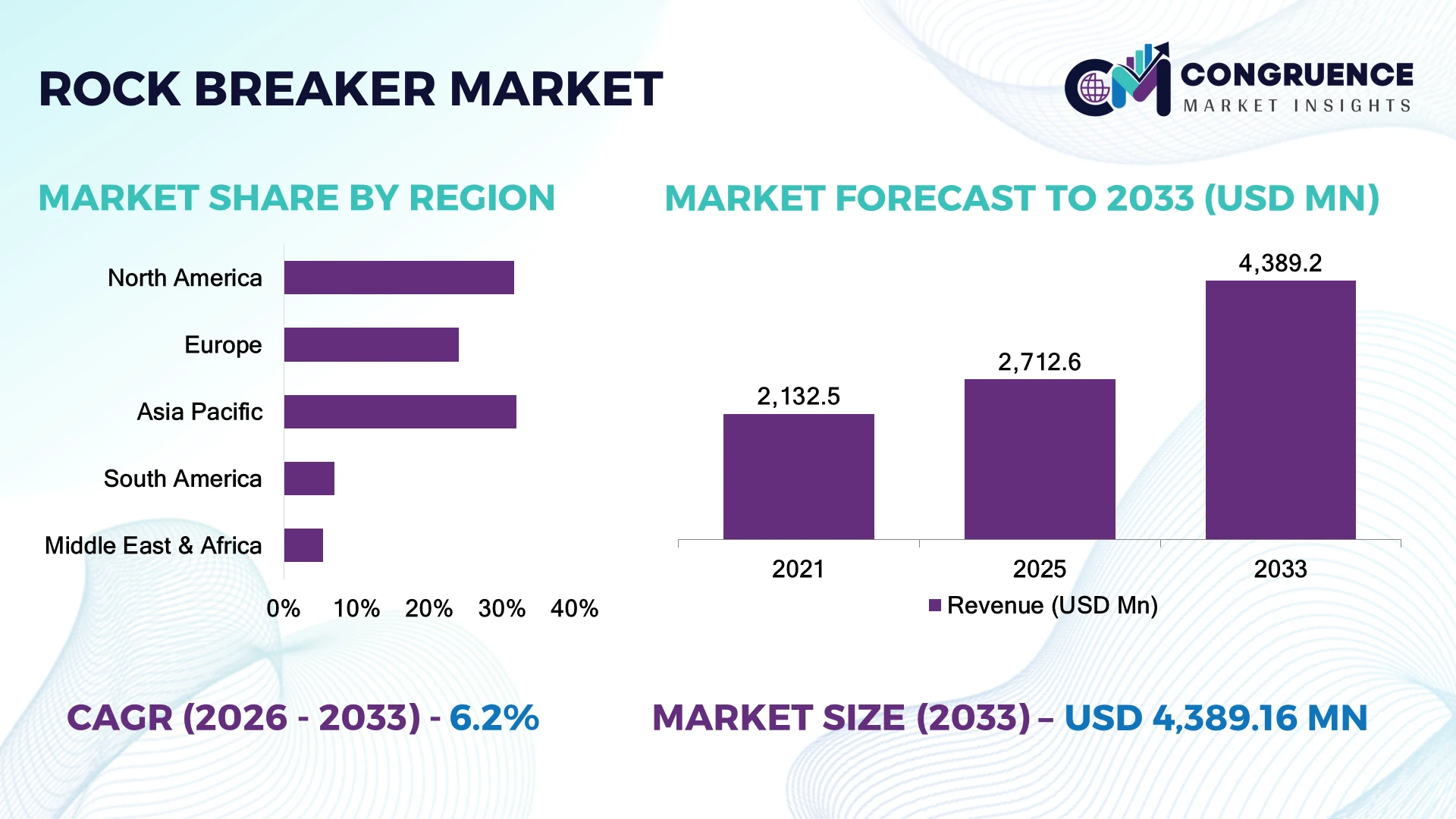
The Global Rock Breaker Market was valued at USD 2,712.6 Million in 2025 and is anticipated to reach a value of USD 4,389.2 Million by 2033 expanding at a CAGR of 6.2% between 2026 and 2033. Growth is driven by quarry expansion, road and tunnel construction, mining overburden removal, and replacement of conventional drilling-and-blasting operations with hydraulic impact systems.
China represents approximately 30% of global rock breaker demand, supported by large-scale mining, aggregate production, tunneling, and infrastructure programs, while India accounts for roughly 9–11% as road, metro, quarry, and construction activity expands. Hydraulic breakers increasingly deliver 15–25% higher productivity than older mechanical methods on suitable applications, while advanced auto-greasing and impact-energy controls are reducing maintenance intervention by 10–15%. China's extensive excavator manufacturing base also strengthens attachment availability and localization.
The strategic priority is to secure high-productivity breaker platforms with lower downtime, machine compatibility, and lifecycle operating costs.
Market Size & Growth: USD 2,712.6 million in 2025 to USD 4,389.2 million by 2033 at 6.2% CAGR, supported by quarrying, tunneling, and hydraulic attachment adoption.
Top Growth Drivers: Quarry expansion 7–9%, infrastructure excavation 6–8%, and mining overburden applications 5–7%.
Short-Term Forecast: By 2028, advanced hydraulic breakers can deliver 10–15% higher operating productivity while reducing maintenance downtime 8–12%.
Emerging Technologies: Auto-greasing, variable impact-energy control, telematics, and vibration-monitoring systems are increasing breaker uptime and machine protection.
Regional Leaders: Asia-Pacific approaches USD 1.9 billion, Europe USD 0.9 billion, and North America USD 0.8 billion by 2033, with attachment utilization increasing across excavator fleets.
Consumer/End-User Trends: Contractors and quarry operators increasingly deploy hydraulic breakers across 25–35% of suitable excavation and secondary-breaking tasks.
Pilot/Case Example: 2026 quarry modernization programs using automated lubrication and impact monitoring target 10–15% fewer maintenance interventions and improved daily equipment availability.
Competitive Landscape: Epiroc holds an estimated 12–14% share, competing with Sandvik, Komatsu, Caterpillar, Furukawa Rock Drill, and Soosan through performance and attachment portfolios.
Regulatory & ESG Impact: Reduced reliance on blasting in suitable applications can lower localized vibration, dust, and permitting requirements, while optimized hydraulics reduce fuel consumption approximately 5–10%.
Investment & Funding: More than USD 1.0 billion in equipment manufacturing, quarry modernization, infrastructure, and mining-capacity investment is supporting attachment replacement and fleet expansion.
Innovation & Future Outlook: Smart breakers, remote diagnostics, high-strength components, and excavator-integrated controls are shifting purchasing toward lifecycle productivity rather than upfront equipment price.
The Rock Breaker Market spans hydraulic breakers, pneumatic breakers, and specialized impact attachments used in construction, quarrying, mining, demolition, and tunneling. Hydraulic systems dominate modern excavator-mounted applications, with advanced models improving productivity by approximately 15–25% on suitable rock conditions. Demand is shifting toward intelligent breakers with automatic lubrication, impact-energy adjustment, and telematics as contractors seek lower downtime amid tighter equipment-utilization targets.
Rock breakers are becoming strategically important as contractors and quarry operators prioritize faster excavation, predictable equipment utilization, and reduced dependence on drilling-and-blasting workflows. Infrastructure modernization in India, China, the Middle East, and North America is increasing demand for attachment systems that can operate across fragmented work sites without requiring dedicated blasting infrastructure. This is particularly relevant for urban tunneling, road widening, utility excavation, and quarry operations near populated areas.
Technology is reshaping productivity economics. Modern hydraulic breakers with optimized impact-energy control and automatic lubrication can improve effective productivity by approximately 10–15% and reduce maintenance intervention by 8–12% compared with older manually serviced systems. Asia-Pacific remains the largest deployment base because of construction and quarrying scale, while Europe places greater emphasis on noise, vibration, emissions, and equipment efficiency. Over the next 2–3 years, telematics-enabled breakers and machine-control integration are expected to become increasingly common in larger contractor fleets.
Companies are therefore prioritizing modular breaker ranges, excavator compatibility, predictive maintenance, and localized service networks. Manufacturers are also strengthening dealer partnerships to reduce spare-parts lead times and improve field support. Competitive advantage will increasingly depend on maximizing productive impact hours rather than simply increasing nominal breaker power, making lifecycle efficiency, durability, and digital diagnostics central to purchasing decisions.
Urban road expansion, metro construction, tunneling, quarrying, and utility excavation are increasing demand for high-output hydraulic breakers, particularly in India, China, Saudi Arabia, and the U.S. Infrastructure excavation applications are expanding approximately 6–8% annually, while quarry operators increasingly target 10–15% higher equipment utilization. Modern hydraulic breakers can deliver 15–25% greater effective productivity than older configurations under suitable rock conditions. The shift toward mechanized excavation in constrained urban projects is also reducing reliance on blasting. Manufacturers are responding with higher-energy breaker ranges, excavator-specific attachments, and stronger dealer networks. The strategic advantage is increasingly determined by productive impact hours and uptime rather than maximum nominal impact energy alone.
Rock breaker profitability remains exposed to steel, alloy, hydraulic-component, and wear-part costs, with critical components accounting for roughly 45–60% of manufacturing expenditure. Abrasion-sensitive tools and bushings can represent 10–20% of annual operating costs in intensive quarry applications, while imported hydraulic components can create 5–10% procurement-cost volatility. India and Southeast Asian contractors also face longer replacement-part lead times when specialized components are sourced internationally. These pressures increase total ownership costs and encourage fleet operators to extend component life rather than simply purchase higher-powered units. Manufacturers are localizing wear-part production, expanding regional inventories, and using hardened alloys and improved heat treatment to reduce replacement frequency by approximately 10–15%.
Connected breakers create an underdeveloped opportunity to convert attachment performance into measurable fleet intelligence. Telematics-enabled systems can track impact hours, hydraulic pressure, temperature, and maintenance intervals, potentially reducing unplanned service intervention by 10–15% and improving attachment utilization by 5–10%. Japan and South Korea are strong technology-development markets, while India offers substantial adoption potential as contractors digitize mixed excavator fleets. Automatic lubrication and impact-energy adjustment further support controlled operation across varying rock conditions. Manufacturers are positioning through sensor integration, machine-control partnerships, and cloud-based diagnostics. The non-obvious opportunity lies in predictive wear management: knowing remaining tool life can improve parts planning and prevent productivity losses caused by unexpected breaker downtime.
Breaker manufacturers face increasing pressure to maintain impact performance under abrasive rock, extended duty cycles, and mixed excavator fleets. In intensive quarry applications, wear components can require replacement 15–25% more frequently than in general construction, while poorly matched hydraulic flow can reduce effective output by 10–20%. Skilled technicians are also needed to diagnose accumulator, valve, piston, and hydraulic-system problems, creating service constraints in remote mining and quarry locations. Companies are addressing these challenges through remote diagnostics, modular component design, dealer training, and application-specific breaker sizing. Long-term competitiveness will depend on balancing higher impact energy with structural durability, because excessive energy without matched tool and carrier specifications accelerates wear and increases lifecycle costs.
Smart Breaker Monitoring Expands: Connected hydraulic breakers are moving toward real-time impact-hour, pressure, temperature, and service monitoring. Telematics can improve attachment utilization by 5–10% and reduce unplanned maintenance intervention by 10–15%. Contractors are integrating breaker data with excavator fleet-management platforms, shifting purchasing decisions toward measurable uptime rather than headline impact energy.
Automatic Lubrication Gains Traction: Automatic greasing systems are increasingly specified for high-cycle quarry and demolition applications, reducing manual lubrication requirements by approximately 30–50% and limiting operator-related maintenance variation. Manufacturers are integrating centralized lubrication with service alerts, particularly for fleets operating multiple shifts. This reduces routine intervention and improves consistency where labor availability is constrained.
Low-Noise Urban Breaking Rises: Construction activity around hospitals, residential districts, and dense commercial corridors is increasing demand for vibration- and noise-managed breakers. Low-noise configurations can reduce perceived operating disturbance by approximately 10–20% depending on application and site conditions. Japanese and European contractors are prioritizing enclosed housings, optimized impact profiles, and controlled operating modes for regulated urban projects.
Wear Parts Become Strategic: Rising component costs are pushing contractors toward longer-life moils, chisels, bushings, and hardened working tools. Advanced wear materials can extend component service intervals by approximately 10–20%, while predictive replacement planning can reduce emergency parts requirements by 5–10%. Manufacturers are strengthening regional inventories and offering application-specific tooling packages to protect uptime and aftermarket revenue.
Hydraulic rock breakers account for approximately 78–82% of global demand, reflecting their compatibility with excavators, high impact energy, controllable operating cycles, and suitability across construction, quarrying, demolition, and mining. Their ability to use existing excavator hydraulic systems reduces the need for dedicated carrier equipment and supports faster attachment deployment. Pneumatic breakers hold roughly 10–13%, retaining relevance in underground work, confined excavation, and applications where compressed-air systems are already available. Mechanical and other specialized breakers represent the balance and remain important for niche, low-duty, or highly application-specific requirements.
Hydraulic systems are also the fastest-evolving category, with smart lubrication, variable impact control, telematics, and improved wear components increasing productive operating time by approximately 5–10%. Manufacturers are expanding carrier-compatible product ranges and strengthening aftermarket networks. The business implication is clear: investment is shifting toward electronically monitored hydraulic platforms and longer-life tooling rather than simply higher impact ratings.
U.S. crushed-stone production reached approximately 1.5 billion tons in 2025 across about 3,500 quarries, demonstrating the scale of aggregate operations requiring mechanized rock-breaking and excavation equipment.
Construction and infrastructure excavation represents approximately 38–42% of global rock breaker demand, making it the largest application due to widespread use in road construction, foundation work, utility excavation, metro projects, and urban redevelopment. Quarrying follows at roughly 25–29%, supported by secondary breaking and aggregate processing, while mining contributes around 17–21%. Demolition and tunneling collectively represent approximately 12–16%, with highly specialized requirements for controlled impact, vibration management, and confined-space operation.
Quarrying and tunneling are among the fastest-changing applications as operators seek greater equipment utilization and reduced drilling-and-blasting dependence. Advanced breakers can improve productive breaking efficiency by roughly 10–15% in suitable operating conditions, while automated lubrication reduces routine intervention. In the U.S., construction aggregates remain heavily linked to infrastructure activity: 72% of crushed stone consumption in 2025 was used as construction aggregate, primarily for road construction and maintenance. Manufacturers are therefore tailoring breaker energy, tooling, and carrier compatibility to specific rock conditions rather than pursuing one-size-fits-all product strategies.
U.S. highway construction spending during the first nine months of 2024 was 8% higher than the corresponding period in 2023, reinforcing infrastructure excavation as a significant equipment-utilization driver.
Construction contractors represent approximately 42–46% of global rock breaker purchases, reflecting their large excavator fleets and broad exposure to road, building, utility, and infrastructure projects. Quarry operators account for around 22–26%, while mining companies contribute approximately 16–20%. Demolition specialists and government infrastructure agencies comprise the remaining demand. Contractors prioritize carrier compatibility, acquisition cost, rental availability, and service coverage, whereas quarry and mining operators place greater emphasis on impact productivity, wear life, and uptime.
Quarry and mining operators are the fastest-growing high-intensity buyer groups, with multi-shift operations placing substantially greater emphasis on component durability and predictive maintenance. Heavy users can account for 60–70% higher annual breaker operating hours than general construction fleets, making aftermarket tooling a critical purchasing criterion. Manufacturers are responding with application-specific breakers, regional parts inventories, dealer service agreements, and fleet-management integration. The strategic opportunity is therefore shifting toward lifecycle contracts and attachment-as-a-service models, particularly where customers seek predictable maintenance expenditure rather than outright ownership.
U.S. construction aggregates were produced by 1,322 companies operating 3,531 crushed-stone quarries in 2023, illustrating the highly distributed contractor, quarry, and aggregate operating base served by breaker manufacturers.
North America accounted for the largest market share at 31.6% in 2025 however, Asia-Pacific is expected to register the fastest growth, expanding at a CAGR of 7.1% between 2026 and 2033.

Infrastructure rehabilitation sustains high-value breaker demand
North America represents approximately 31.6% of global rock breaker demand, supported by highway rehabilitation, commercial construction, quarrying, mining, utility replacement, and large-scale civil engineering. The U.S. accounts for the majority of regional consumption, with Canada adding significant mining and aggregate demand. Hydraulic breakers dominate new attachment deployments, while telematics-enabled models are gaining traction among large contractors seeking higher equipment utilization. Infrastructure spending under the U.S. Infrastructure Investment and Jobs Act continues to support excavation-intensive projects, particularly road, bridge, utility, and transit construction. Contractors increasingly favor breakers with automatic lubrication and carrier-matching controls, which can reduce maintenance intervention by 10–15%. Manufacturers are strengthening dealer inventories and rental partnerships to shorten attachment availability and parts lead times.
U.S. Market Outlook: The U.S. remains the largest national market, supported by approximately 1.5 billion tons of annual crushed-stone production and thousands of quarrying operations. Demand is concentrated around highway construction, aggregate production, commercial development, demolition, and utility excavation. Larger contractors increasingly use telematics and application-specific tooling to improve breaker utilization, while rental channels broaden access to advanced hydraulic attachments without full ownership costs.
Urban excavation favors controlled-impact technologies
Europe accounts for approximately 24% of global rock breaker demand, with Germany, France, the United Kingdom, Italy, and the Nordic countries forming important equipment and construction markets. Urban redevelopment, tunneling, rail modernization, quarrying, and demolition support consistent breaker utilization. Noise and vibration constraints are increasing interest in low-noise housings, controlled impact profiles, and electrically optimized excavators. Advanced hydraulic breakers can reduce maintenance intervention by approximately 8–12% through automatic lubrication and condition monitoring. Manufacturers are emphasizing durable wear components, lower hydraulic consumption, and digital service diagnostics to meet stricter project specifications. Dealer-led service networks remain strategically important because contractors prioritize rapid replacement-part availability for high-utilization fleets.
Germany Market Outlook: Germany combines strong construction-equipment manufacturing capabilities with extensive quarrying, demolition, tunneling, and infrastructure activity. Industrial clusters around Bavaria and North Rhine-Westphalia support sophisticated attachment demand, while urban construction increasingly requires controlled-impact equipment. Large contractors are adopting connected breaker monitoring and automated lubrication to improve availability, with advanced systems targeting approximately 5–10% higher productive utilization.
Construction scale and manufacturing depth accelerate adoption
Asia-Pacific represents approximately 32% of global rock breaker demand and is the largest deployment base, led by China, India, Japan, South Korea, and Australia. China alone contributes roughly 30% of global demand, supported by construction, quarrying, mining, and extensive excavator production. India is rapidly expanding attachment use across highways, metros, urban infrastructure, and quarrying. Local manufacturing enables competitive pricing and shorter replacement-part lead times, while Japanese and Korean suppliers emphasize hydraulic precision and durability. Advanced breakers with automatic lubrication, impact adjustment, and telematics are gaining adoption among larger fleets. Manufacturers are expanding localized production, dealer networks, and excavator compatibility to capture high-volume infrastructure and quarry applications.
China Market Outlook: China remains the region's dominant market because of its large excavator fleet, extensive aggregate industry, mining activity, and established attachment manufacturing base. Domestic manufacturers provide cost-competitive hydraulic breakers across compact through heavy excavator classes. Automated lubrication and intelligent impact controls are increasingly incorporated into premium models, while localized component sourcing can reduce replacement-part lead times by approximately 15–25%.
Mining and aggregates anchor high-intensity equipment demand
South America contributes approximately 7% of global rock breaker demand, with Brazil accounting for more than half of regional consumption. Mining, quarrying, road construction, hydropower projects, and urban infrastructure generate concentrated demand for medium- and heavy-duty hydraulic breakers. Brazil's iron ore, aggregate, and construction industries require attachments capable of sustained operation under abrasive conditions, making wear-tool durability a major purchasing criterion. Breaker utilization in mining and quarrying can exceed general construction duty cycles by 30–50%, increasing demand for reinforced housings, heavy-duty tools, and regional parts inventories. Manufacturers are strengthening dealer coverage and service partnerships around major mining and construction corridors to reduce downtime caused by long-distance component logistics.
Brazil Market Outlook: Brazil is the region's principal market, supported by extensive mining, aggregate production, road construction, and urban development. Mining corridors in Minas Gerais and Pará generate substantial heavy-equipment utilization, while São Paulo and other metropolitan areas support construction and demolition demand. Contractors increasingly prioritize breaker durability and aftermarket support, with application-specific tooling helping extend service intervals by approximately 10–20% in demanding operations.
Mega-project construction and mining modernization reshape demand
The Middle East & Africa accounts for approximately 5.4% of global rock breaker demand, with Saudi Arabia, the UAE, South Africa, and Egypt representing key consumption centers. Saudi infrastructure and urban-development programs are increasing demand for breakers in excavation, road building, tunneling, utilities, and large-scale site preparation. South Africa adds significant mining and quarrying requirements, particularly for heavy-duty attachments. High ambient temperatures, abrasive materials, and remote project locations increase emphasis on hydraulic cooling, reinforced components, and field-service availability. Manufacturers are expanding distributor networks and stocking wear parts closer to major construction and mining hubs. Premium breaker adoption is strengthening as contractors prioritize uptime over initial purchase price.
Saudi Arabia Market Outlook: Saudi Arabia is emerging as a strategically important breaker market through large-scale urban, tourism, transport, and infrastructure development associated with national economic diversification programs. Excavation-intensive projects require medium- and heavy-duty hydraulic attachments across extensive construction sites. Contractors increasingly favor high-productivity breakers with automated lubrication and service monitoring, while localized dealer support can reduce equipment and replacement-part response times by approximately 15–20%.
Epiroc, Sandvik, Caterpillar, Komatsu, and Furukawa compete with Soosan, NPK, and regional Asian manufacturers across premium hydraulic breakers, OEM-integrated attachments, and cost-focused alternatives. The top five players hold approximately 25% combined market share, leaving room for regional suppliers. Competition centers on attachment compatibility, impact efficiency, durability, service coverage, and price; advanced systems can improve productive utilization 5–10% and reduce maintenance intervention 8–15%, while localized parts networks can cut downtime 10–20%. Epiroc and Furukawa are refreshing breaker portfolios, Caterpillar and Komatsu leverage excavator ecosystems, while Asian producers compete through lower acquisition costs and customization. The market is shifting toward intelligent breakers featuring automatic lubrication, impact control, asset tracking, and predictive maintenance. Entry barriers include metallurgical expertise, hydraulic-system validation, dealer networks, tooling ecosystems, and application testing. Competitive pressure is strongest where contractors compare lifecycle cost rather than purchase price. Winning requires carrier integration, durable wear systems, responsive aftermarket support, and productivity gains.
Epiroc
Sandvik
Caterpillar
Komatsu
Furukawa Rock Drill
Soosan Heavy Industries
NPK Construction Equipment
Volvo Construction Equipment
JCB
Daemo Engineering
Everdigm
Okada Aiyon
Rock breakers are moving from conventional fixed-impact hydraulic systems toward electronically controlled platforms combining automatic lubrication, blank-fire protection, impact adjustment, vibration isolation, and attachment tracking. These functions can improve productive utilization by 5–10% and reduce maintenance intervention by 8–15%. Adoption is strongest among large quarry, demolition, and infrastructure fleets where downtime carries high equipment costs.
Three-dimensional hydraulic modeling and hybrid accumulator designs are improving energy transfer while reducing internal hydraulic losses. Epiroc’s latest breaker architecture demonstrates the shift toward lighter assemblies and serviceable wear components; compared with older manually maintained designs, optimized systems can reduce service time approximately 10–20%. Smart stroke control is also emerging, automatically matching impact behavior to material conditions and reducing unnecessary energy consumption by roughly 5–10%.
From 2026–2028, telematics, predictive wear analytics, machine-control integration, and low-noise breaker architectures will gain importance. Asset tracking can improve attachment visibility and utilization by 5–10%, while predictive maintenance can reduce unscheduled downtime 10–15%. OEMs with excavator ecosystems, such as Caterpillar, Komatsu, and Volvo, benefit from integrated machine-attachment compatibility, while specialist manufacturers differentiate through breaker expertise and aftermarket support. The competitive priority is shifting from impact power alone toward connected, application-specific productivity, supported by workflows and parts planning across contractor fleets.
April 2026 Epiroc launched EC 122 hydraulic breaker, 80 kg lighter than its predecessor for 15–24-ton carriers. Smart wear inserts and EnergyRecovery improve serviceability and handling, reducing lifecycle burden for quarrying, demolition, excavation, and utility contractors for operators. Source: epiroc.com
December 2025 Furukawa Rock Drill announced the FHB hydraulic-breaker series, launching seven models from January 2026. SMART STROKE SYSTEM automatically adjusts piston stroke to material conditions, improving breaking efficiency and reducing machine load for construction and quarry customers. Source: furukawakk.co.jp
March 2025 Volvo CE introduced HB01 and HB02 hydraulic breakers for compact excavators, including electric models. The HB01 weighs 79 kg, enabling low-noise breaking in confined urban sites and indoor projects while expanding attachment utility for compact-equipment fleets. Source: volvoce.com
July 2025 Epiroc HB 4100 breakers entered a German demolition project on 40-tonne-class excavators, demonstrating heavy-breaker deployment for time-constrained concrete and steel work. The application strengthened blast-free demolition capability and highlighted high-impact attachments for specialized contractors in Germany. Source: gminsights.com
The Rock Breaker Market Report covers hydraulic, pneumatic, and specialized mechanical breakers across construction excavation, quarrying, mining, demolition, tunneling, roadwork, and utility projects. End-user analysis includes construction contractors, quarry operators, mining companies, demolition specialists, and infrastructure agencies, with assessment of heavy-duty, compact, low-noise, and blast-free breaking applications. Hydraulic breakers represent approximately 78–82% of overall demand, establishing the core technology base.
Regional coverage spans North America, Europe, Asia-Pacific, South America, and Middle East & Africa, supported by country-level analysis of major equipment and construction hubs. Technology assessment includes automatic lubrication, smart stroke control, telematics, asset tracking, vibration reduction, advanced wear materials, and predictive maintenance. The report evaluates approximately 10–14 major companies, competitive positioning, adoption patterns, aftermarket opportunities, and deployment economics to support investment planning, geographic expansion, product development, partnerships, and competitive strategy through 2026–2033.
| Report Attribute/Metric | Report Details |
|---|---|
|
Market Revenue in 2025 |
USD 2,712.6 Million |
|
Market Revenue in 2033 |
USD 4,389.2 Million |
|
CAGR (2026 - 2033) |
6.2% |
|
Base Year |
2025 |
|
Forecast Period |
2026 - 2033 |
|
Historic Period |
2021 - 2025 |
|
Segments Covered |
By Type
By Application
By End-User
|
|
Key Report Deliverable |
Revenue Forecast, Growth Trends, Market Dynamics, Segmental Overview, Regional and Country-wise Analysis, Competition Landscape |
|
Region Covered |
North America, Europe, Asia-Pacific, South America, Middle East, Africa |
|
Key Players Analyzed |
Epiroc, Sandvik, Caterpillar, Komatsu, Furukawa Rock Drill, Soosan Heavy Industries, NPK Construction Equipment, Volvo Construction Equipment, JCB, Daemo Engineering, Everdigm, Okada Aiyon |
|
Customization & Pricing |
Available on Request (10% Customization is Free) |




