
Reports
The Global Robotic Tips Market was valued at USD 501.3 Million in 2025 and is anticipated to reach a value of USD 1,028.6 Million by 2033 expanding at a CAGR of 9.4% between 2026 and 2033. Growth is driven by automated welding, higher robotic utilization in EV and automotive production, and replacement demand for precision tips engineered for longer operating cycles.
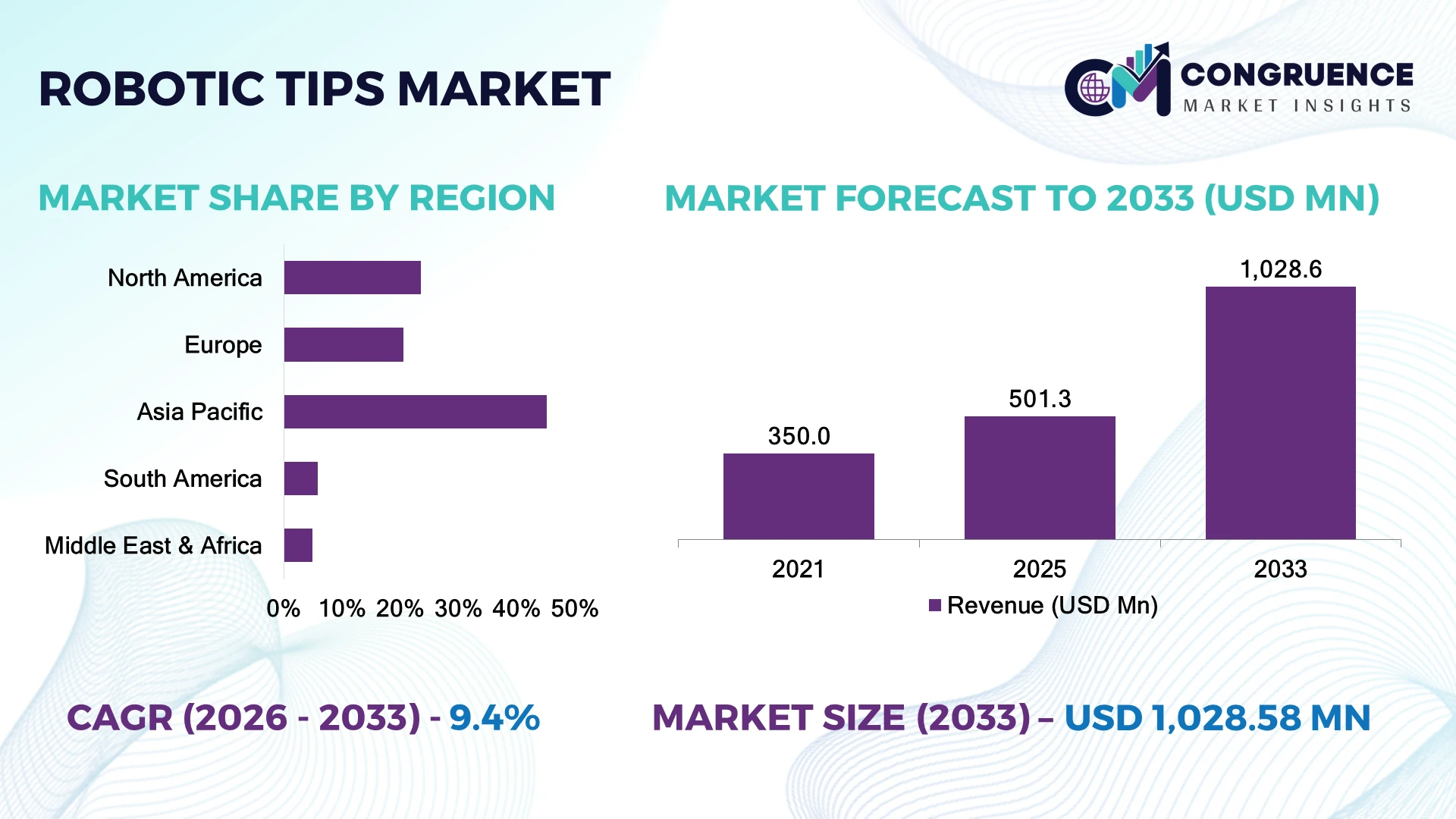
China is the dominant country market, accounting for approximately 30–33% of global robotic tips demand, supported by automotive, electronics, machinery, and battery manufacturing. The U.S. follows with roughly 18–21%, while Germany remains a technology-intensive market with automotive automation penetration above 40% in major production environments. China's EV and battery manufacturing expansion continues reshaping component sourcing in 2026, increasing demand for high-durability robotic tips.
Strategic implication: suppliers with wear-resistant materials, faster replacement cycles, and localized supply chains are positioned to capture automation-led procurement.
Market Size & Growth: USD 501.3 million in 2025 to USD 1,028.6 million by 2033 at 9.4% CAGR, driven by robotic welding and automated production.
Top Growth Drivers: Automotive automation 35%, EV manufacturing 24%, electronics and precision assembly 18%.
Short-Term Forecast: By 2028, advanced robotic tips can reduce replacement frequency 10–15% and improve production uptime 3–6%.
Emerging Technologies: AI-controlled welding, wear-resistant alloys, sensor-enabled tips, and automated tip-changing systems are reshaping robotic consumables.
Regional Leaders: Asia-Pacific is projected near USD 430 million by 2033, Europe USD 250 million, and North America USD 220 million, supported by expanding robotic-cell deployment.
Consumer/End-User Trends: Automotive and transportation applications account for approximately 45–50% of demand, with EV production accelerating high-cycle tip requirements.
Pilot/Case Example: 2026 automated welding-cell deployments increasingly target 5–10% higher equipment utilization through predictive replacement and automated tip servicing.
Competitive Landscape: Leading suppliers collectively control an estimated 25–30% of the market, with major competition across established welding-component manufacturers and specialized robotic consumable suppliers.
Regulatory & ESG Impact: Automated processes can reduce material waste by approximately 5–10% through controlled deposition, optimized replacement, and improved process consistency.
Investment & Funding: Supplier investment is shifting toward localized manufacturing, advanced metallurgy, automated tip-changing systems, and partnerships with robotic-cell integrators.
Innovation & Future Outlook: By 2028, predictive wear monitoring, digitally managed consumables, and quick-change robotic tips will shift competition toward lifecycle performance rather than unit price.
The Robotic Tips Market is expanding around automotive welding, EV battery manufacturing, metal fabrication, and electronics assembly, where precision and repeatability are critical. High-cycle applications increasingly prioritize tips delivering 10–15% longer service intervals. In 2026, manufacturers are also localizing consumable supply chains to reduce exposure to logistics disruption and component lead-time volatility, strengthening the shift toward performance-engineered robotic tips.
The Robotic Tips Market is becoming strategically important because robotic-cell productivity increasingly depends on consumable consistency rather than robot hardware alone. Automotive, EV, and metal-fabrication manufacturers are pushing toward higher utilization, tighter weld tolerances, and fewer unplanned interventions. This is shifting procurement from low-cost replacement tips toward engineered components optimized for cycle life, thermal stability, and dimensional consistency.
Advanced wear-resistant robotic tips can extend usable operating intervals by approximately 10–15% compared with conventional consumables, while automated tip-changing systems reduce manual intervention and associated cell stoppages by roughly 15–25%. Asia-Pacific remains the largest deployment environment because of automotive, electronics, and battery manufacturing scale, whereas Germany and the U.S. emphasize high-precision automation and digitally integrated production cells.
Over the next 2–3 years, predictive wear monitoring and automated replacement are expected to become increasingly integrated into robotic welding platforms. A practical deployment model combines robotic controllers, tip-condition monitoring, and automated servicing to reduce maintenance interruptions. Companies are consequently expanding metallurgy R&D, partnering with robotic integrators, and localizing production near major manufacturing clusters. Competitive advantage will increasingly depend on measurable lifecycle savings, rapid supply availability, and compatibility with advanced robotic production cells.
Rapid expansion of automated welding in EV, automotive, and battery manufacturing is increasing demand for durable robotic tips capable of sustaining high-cycle production. Automotive applications account for approximately 45–50% of robotic tip demand, while EV-related production contributes around 20–25% of incremental requirements. Chinese battery and vehicle plants are also increasing robotic-cell utilization, placing greater emphasis on consistent electrode geometry and thermal performance. Advanced tip materials can extend service intervals by approximately 10–15%, reducing unplanned cell interruptions. Suppliers are responding with copper-alloy optimization, wear-resistant coatings, automated tip-dressing compatibility, and direct partnerships with welding-cell integrators. The strategic shift is toward lifecycle productivity, making tip durability a measurable component of robotic-cell economics rather than a low-value consumable decision.
Robotic tips remain exposed to volatility in copper and specialized alloy inputs, with raw materials representing approximately 45–60% of manufacturing cost for conventional electrode components. Material-price fluctuations can increase procurement costs by 8–15%, particularly for suppliers dependent on imported copper alloys. Automotive plants operating thousands of welding cycles daily also require frequent tip replacement, making consumable expenditure operationally visible. China-based manufacturers benefit from established metal-processing ecosystems, while European and North American suppliers face greater pressure to secure localized inputs. Companies are responding through copper-alloy optimization, recycled material streams, dual sourcing, and longer-term metal contracts. The key restraint is not simply material cost: inconsistent alloy availability can disrupt standardized tip performance across multi-plant robotic production environments.
Sensor-enabled robotic welding creates an opportunity to transform robotic tips from replacement consumables into monitored production assets. Tip-condition monitoring and automated dressing can improve usable electrode life by approximately 10–20% while reducing unnecessary replacements by 8–15%. German and Japanese automotive plants are increasingly integrating welding-cell data with manufacturing execution and predictive-maintenance systems. Suppliers can capitalize by developing RFID identification, wear analytics, automated inspection, and digitally managed replacement schedules. The most valuable opportunity is aftermarket intelligence: tip-performance data can identify abnormal electrode wear caused by welding parameters, material changes, or fixture alignment. Manufacturers are therefore investing in software partnerships and integrated tooling platforms that create recurring service relationships beyond conventional component sales.
Increasing robotic-cell speeds are placing greater thermal and mechanical stress on electrode tips, creating consistency challenges across high-volume production environments. High-utilization automotive cells can perform thousands of spot welds per shift, while electrode geometry variations of even 5–10% can affect contact conditions, current distribution, and dressing intervals. EV battery structures introduce additional pressure because lightweight materials and coated steels require tightly controlled welding parameters. Plants operating multiple robotic lines must also maintain consistent consumable specifications across suppliers and locations. Manufacturers are addressing this through automated tip dressing, tighter dimensional tolerances, metallurgical testing, and digital process monitoring. The long-term competitive challenge is achieving identical tip performance across high-speed cells without increasing maintenance frequency or material consumption.
Automated Dressing Becomes Standard: Automotive welding cells are increasingly integrating automated electrode dressing to stabilize tip geometry and extend usable life by approximately 10–20%. Dressing systems can reduce manual intervention by 15–25% and support more consistent weld quality across high-cycle operations. European and Japanese manufacturers are prioritizing automated maintenance within robotic-cell specifications, while tip suppliers are optimizing electrode geometry specifically for automated dressing equipment.
Multi-Material Welding Changes Design: EV production is increasing use of galvanized steels, advanced high-strength steels, aluminum components, and coated materials, raising demand for application-specific robotic tips. Specialized geometries can improve electrode service life by approximately 8–15% in demanding applications. Suppliers are developing differentiated copper alloys and surface treatments rather than universal tip designs, shifting competition toward material engineering and application-specific qualification.
Local Supply Chains Gain Priority: Automotive manufacturers are reducing exposure to long-distance consumable supply disruptions by qualifying regional robotic-tip suppliers and maintaining dual-source programs. Localized sourcing can shorten replenishment lead times by approximately 20–30% and reduce inventory buffers by 10–15%. India's expanding automotive and EV manufacturing ecosystem is encouraging domestic electrode machining and alloy-processing capacity, while global suppliers establish closer distribution and technical-support networks.
Digital Consumable Tracking Expands: Robotic production plants are increasingly tracking electrode usage, dressing cycles, replacement intervals, and weld counts digitally. Connected monitoring can improve consumable-utilization visibility by approximately 15–25% and reduce premature replacement by 8–12%. The non-obvious shift is that tip data is becoming a process-quality indicator: suppliers are integrating identification and performance analytics into welding platforms to support predictive servicing and plant-level benchmarking.
Copper-chromium-zirconium (CuCrZr) robotic tips represent the leading type, accounting for approximately 48–52% of demand because they combine high electrical conductivity, thermal resistance, hardness, and compatibility with high-volume spot-welding cells. Standard copper tips retain roughly 25–30% share, particularly in cost-sensitive and lower-duty applications, while tungsten and specialized alloy tips account for approximately 15–20%. CuCrZr is favored in automotive body welding because its performance remains stable across repeated thermal cycles, reducing premature geometry degradation.
Advanced coated and application-specific tips represent the fastest-growing type, expanding from a smaller installed base as EV production introduces galvanized steels, high-strength materials, and tighter welding tolerances. These designs can extend service intervals by approximately 10–15% and reduce replacement frequency by 8–12%. Suppliers are increasing metallurgy R&D, developing application-specific geometries, and partnering with robotic-cell integrators. Investment is consequently shifting toward higher-performance consumables where lifecycle cost outweighs the initial unit-price advantage.
The International Federation of Robotics reported that China installed 57,200 industrial robots in automotive manufacturing in 2024, while automotive accounted for 45% of global automotive robot installations, reinforcing the importance of high-cycle welding consumables in the world's largest automated production base.
Automotive welding is the leading application, representing approximately 45–50% of global robotic tips demand because robotic spot welding is deeply embedded in body-in-white, chassis, and structural assembly. Electronics and precision assembly account for roughly 18–22%, while metal fabrication and machinery contribute approximately 15–20%. Automotive plants consume tips at significantly higher cycle rates than lower-volume fabrication operations, making electrode durability, dressing compatibility, and dimensional consistency commercially critical.
EV and battery-related welding represent the fastest-growing application within the market, driven by new vehicle platforms, battery-pack production, and increased automation of structural joining. These applications are generating demand for specialized tip geometries and alloy formulations, with application-specific designs capable of improving usable tip life by approximately 8–15%. Aerospace and specialized industrial fabrication remain smaller but technically demanding niches. Suppliers are responding with dedicated product lines, qualification programs, and direct integration with welding-equipment manufacturers. The commercial shift is toward performance-based consumables tailored to material combinations rather than universal robotic tips.
In 2025, the International Federation of Robotics reported that U.S. automotive manufacturers installed 13,700 industrial robots in 2024, representing a 10.7% year-on-year increase and confirming continued automation intensity in the principal robotic-welding application.
Automotive OEMs represent the leading end-user group, accounting for approximately 40–45% of global robotic tips consumption because their manufacturing plants operate large robotic welding fleets with high electrode-cycle intensity. Tier-1 automotive suppliers contribute approximately 25–30%, while metal fabricators and general industrial manufacturers account for roughly 20–25%. OEM procurement emphasizes repeatability, validated welding performance, supply continuity, and total consumable cost rather than the lowest unit price. Large plants also create significant recurring replacement demand because robotic cells operate continuously across multiple production shifts.
Tier-1 suppliers are the fastest-growing end-user group as EV platforms expand outsourced component production and suppliers automate body, chassis, battery, and structural-part manufacturing. Their adoption is increasingly linked to flexible robotic cells capable of handling multiple vehicle programs, creating demand for standardized tips and rapid-change tooling. Companies are responding through direct technical partnerships, regional stocking, customized electrode geometry, and volume contracts. Suppliers serving OEMs benefit from scale, while those targeting Tier-1 manufacturers gain opportunities through faster customization and application engineering. Future competitive positioning will depend increasingly on combining product performance with localized technical support and dependable replenishment.
The International Federation of Robotics reported that the United States automotive industry reached 13,500 industrial robot installations in 2025, remaining the country's largest industrial-robot customer despite a 1% year-on-year decline, underscoring the sustained scale of OEM-led automation.
Asia-Pacific accounted for the largest market share at 45.2% in 2025 however, Asia-Pacific is expected to register the fastest growth, expanding at a CAGR of 10.1% between 2026 and 2033.

Automotive reshoring strengthens high-cycle robotic welding demand
North America accounted for approximately 23.5% of the global Robotic Tips Market in 2025, with demand concentrated in U.S. automotive, aerospace, heavy equipment, and metal-fabrication facilities. Automotive manufacturing remains the principal consumption base, while reshoring and plant modernization are increasing requirements for durable spot-welding consumables. The U.S. automotive industry installed approximately 13,500 industrial robots in 2025, reinforcing the installed base requiring recurring electrode replacement and dressing. Suppliers are increasingly combining robotic tips with automated dressing compatibility, regional inventory, and application engineering. Mexico is also strengthening the regional supply chain through automotive assembly and component manufacturing. The commercial shift is toward shorter replenishment cycles and application-specific electrode geometries rather than standardized low-cost tips.
United States Market Outlook: The United States represents the region's dominant market, supported by large automotive OEM and Tier-1 manufacturing clusters across Michigan, Ohio, Tennessee, Kentucky, and the southern states. Automotive applications account for approximately 45–50% of regional robotic-tip consumption. Rising automation intensity is increasing demand for CuCrZr electrodes, automated dressing-compatible geometries, and localized technical support.
Precision manufacturing drives premium electrode adoption
Europe represented approximately 20.6% of global Robotic Tips Market demand in 2025, supported by automotive, machinery, aerospace, and advanced metal-processing industries. Germany, Italy, France, Spain, and Central European manufacturing hubs account for substantial consumption, with automotive welding remaining the primary application. Approximately 40–45% of European robotic-tip demand is linked to automotive and transportation production. Manufacturers are increasingly prioritizing electrode durability, dimensional consistency, and material efficiency as energy and labor costs remain elevated. Suppliers are responding through advanced copper alloys, automated dressing compatibility, localized distribution, and direct OEM qualification. Europe's competitive advantage lies less in production volume than in high-value, tightly controlled robotic welding environments requiring application-specific consumables.
Germany Market Outlook: Germany is Europe's most strategically significant market because of its concentration of automotive OEMs, Tier-1 suppliers, machinery producers, and robotic-system integrators. Automotive manufacturing accounts for a substantial share of domestic robotic welding activity, creating recurring demand for high-performance electrode tips. Suppliers benefit from proximity to major industrial clusters and increasingly collaborate with automation integrators on application-specific tip geometry and process optimization.
China-led automation scale reshapes consumable demand
Asia-Pacific accounted for approximately 45.2% of global demand in 2025, led by China, Japan, South Korea, and increasingly India. China alone represents approximately 30–33% of global robotic-tip consumption because of its extensive automotive, EV, electronics, machinery, and battery manufacturing base. The region's industrial robot installations create a large recurring consumables market, particularly for high-cycle spot welding. India is strengthening its position through automotive and EV manufacturing expansion, while Japan and South Korea emphasize precision automation. Suppliers are increasing local production, regional warehousing, and direct partnerships with welding-equipment and robotic-cell manufacturers. The scale advantage increasingly favors suppliers capable of supporting both high-volume standard tips and application-specific products.
China Market Outlook: China remains the dominant country market, supported by its extensive EV, automotive, battery, electronics, and machinery manufacturing ecosystems. Automotive manufacturers installed more than 57,000 industrial robots in 2024, creating substantial recurring requirements for robotic welding consumables. Domestic electrode producers benefit from integrated copper-alloy processing, machining capacity, and proximity to major vehicle-production clusters, strengthening their ability to compete on both price and replenishment speed.
Automotive production anchors selective automation investment
South America represented approximately 5.8% of global Robotic Tips Market demand in 2025, with Brazil accounting for the majority of regional consumption through automotive, machinery, metal fabrication, and industrial equipment manufacturing. Robotic welding remains concentrated in larger production facilities, while smaller fabricators continue using more labor-intensive processes. Automotive applications represent approximately 45–50% of regional robotic-tip demand. Brazil's established vehicle-production ecosystem supports recurring requirements for spot-welding electrodes, dressing equipment, and replacement components. Suppliers are prioritizing local distributors, technical support, and inventory availability because imported consumables can face longer replenishment cycles. The market opportunity is therefore concentrated in high-utilization plants where electrode lifecycle performance directly affects production economics.
Brazil Market Outlook: Brazil is the region's primary market, supported by established automotive manufacturing clusters in São Paulo, Paraná, Minas Gerais, and Bahia. Automotive and transportation manufacturing generate approximately half of regional robotic-tip consumption. Suppliers with domestic distribution and technical-service capabilities can reduce replenishment lead times and provide application-specific electrode qualification, strengthening competitiveness against imported standardized products.
Industrial diversification creates new automation demand
Middle East & Africa accounted for approximately 5.0% of global Robotic Tips Market demand in 2025, with consumption concentrated in Saudi Arabia, the United Arab Emirates, South Africa, and selected North African manufacturing hubs. Automotive assembly, metal fabrication, industrial equipment, construction machinery, and energy-sector manufacturing are expanding the addressable automation base. Approximately 25–30% of regional robotic-tip demand is associated with automotive and transportation-related production, while heavy fabrication represents an important secondary application. Saudi Arabia's industrial diversification programs and the UAE's advanced manufacturing investments are encouraging automated production-cell deployment. Suppliers are responding through distributor partnerships, regional inventories, and application engineering. The principal opportunity is supplying high-utilization industrial cells where automation reduces dependence on skilled manual welding labor.
Saudi Arabia Market Outlook: Saudi Arabia is emerging as the region's most strategically significant market through industrial diversification, automotive localization, and advanced manufacturing investments. New manufacturing facilities increasingly incorporate automated welding and material handling, creating demand for durable consumables and localized technical support. Suppliers able to establish regional inventory and partnerships with system integrators can address shorter maintenance cycles while supporting the country's expanding industrial automation base.
OBARA and Kyokuto compete with specialized electrode manufacturers such as Pahwa MetalTech and WPI, while welding-system suppliers including Dengensha and ARO compete through integrated guns, dressers, changers, and consumables. The top five players are estimated to hold 28–34% combined share, leaving substantial room for regional specialists. Competition centers on metallurgy, tip life, customization, and supply reliability: advanced CuCrZr and coated tips can extend service intervals 10–15%, automated changing can cut replacement downtime 15–25%, and localized stocking can shorten replenishment 20–30%. Japanese suppliers leverage OEM qualification and integrated equipment portfolios; Indian and Chinese producers compete through customization, rapid machining, and cost. Current competition is shifting from standalone tip supply toward integrated electrode-management ecosystems, including automated dressing, sensing, and replacement. Entry barriers include automotive validation, dimensional consistency, metallurgical expertise, and established robotic-cell compatibility. Winning requires proven tip life, fast customization, regional inventory, and integration with automated maintenance systems across major automotive plants.
OBARA Corporation
Kyokuto Co., Ltd.
Dengensha America Corporation
ARO Welding Technologies
Pahwa MetalTech
WPI Taiwan
AMADA WELD TECH
CenterLine (Windsor) Limited
T. J. Snow Company
GYS
Fronius International
TECNA S.p.A.
Nanjing XY Industry Equipment
Suzhou Suradasz Welding Consumables
Robotic tip technology is shifting from conventional copper consumables toward CuCrZr, alumina-dispersion copper and coated electrodes engineered for high-cycle spot welding. CuCrZr represents the dominant advanced-material choice, delivering roughly 8–15% longer usable tip life than standard copper in demanding cells. Automated tip dressing is increasingly integrated with robotic guns, reducing manual intervention by 15–25% and stabilizing electrode geometry across production shifts.
Digital inspection is becoming the next differentiator. Laser scanning, machine vision, weld-current feedback, and tip-condition algorithms enable automated assessment before quality degradation spreads across a cell. Laser inspection has demonstrated 95% measurement-evaluation success, while connected monitoring can reduce premature replacement by 8–12%. Automated tip changers compress servicing time, with some systems completing replacement in under 30 seconds. These technologies benefit automotive plants where downtime translates into production losses.
From 2026–2028, integration will move toward closed-loop electrode management linking robot controllers, welding timers, dressers, sensors, and maintenance software. Compared with manual inspection and scheduled replacement, automated condition-based servicing can improve maintenance efficiency by 15–25%. Japanese and European integrated suppliers gain through OEM qualification, while Indian and Chinese specialists gain through customization and localized supply. Competitive advantage will shift toward lifecycle performance, data interoperability, and replenishment rather than lowest unit price.
April 2024 Obara Corporation received U.S. Patent 11,945,041 for integrated electrode maintenance using a cap extractor and dispenser. The design enables tip replacement without stopping robot movement, improving maintenance repeatability and supporting higher welding-cell availability across major automotive production. Source: patents.justia.com
July 2024 Doben Limited filed technology for integrated electrode maintenance in robotic welding cells, combining dressing, extraction, and dispensing. The system is designed to perform servicing during robot handling cycles, reducing production interruption and strengthening automated consumable management. Source: patents.justia.com
January 2025 Trebuľa-led research demonstrated automated laser inspection of welding-electrode condition with a 95% measurement-evaluation success rate. The system uses up to 1,000 profiles per scan cycle, supporting predictive maintenance and reducing dependence on manual electrode inspection. Source: springer.com
January 2026 Dongfeng Motor Group and Dongfeng Nissan Passenger Vehicle filed a patent for simultaneous feeding of upper and lower electrode caps. The automated design addresses filling inefficiency and supports faster robotic tip replacement in automotive welding operations. Source: patsnap.com
The Robotic Tips Market Report covers electrode tips and caps used across robotic resistance-welding environments, with segmentation by CuCrZr, conventional copper, coated, and specialized alloy configurations. Application coverage includes automotive body-in-white, EV and battery manufacturing, metal fabrication, electronics, appliances, and machinery, while end-user analysis evaluates automotive OEMs, Tier-1 suppliers, contract manufacturers, and industrial fabricators. Regional analysis spans North America, Europe, Asia-Pacific, South America, and Middle East & Africa.
The report assesses electrode metallurgy, automated tip dressing, sensing, laser inspection, tip-changing systems, predictive maintenance, and digitally integrated welding cells. Automotive applications represent approximately 45–50% of demand, while Asia-Pacific accounts for roughly 45% of global consumption. The analysis supports investment planning, supplier selection, regional expansion, OEM partnerships, technology prioritization, and competitive positioning through 2026–2033, including opportunities in EV welding, advanced materials, and automated electrode-management systems.
| Report Attribute/Metric | Report Details |
|---|---|
|
Market Revenue in 2025 |
USD 501.3 Million |
|
Market Revenue in 2033 |
USD 1,028.6 Million |
|
CAGR (2026 - 2033) |
9.4% |
|
Base Year |
2025 |
|
Forecast Period |
2026 - 2033 |
|
Historic Period |
2021 - 2025 |
|
Segments Covered |
By Type
By Application
By End-User
|
|
Key Report Deliverable |
Revenue Forecast, Growth Trends, Market Dynamics, Segmental Overview, Regional and Country-wise Analysis, Competition Landscape |
|
Region Covered |
North America, Europe, Asia-Pacific, South America, Middle East, Africa |
|
Key Players Analyzed |
OBARA Corporation, Kyokuto Co., Ltd., Dengensha America Corporation, ARO Welding Technologies, Pahwa MetalTech, WPI Taiwan, AMADA WELD TECH, CenterLine (Windsor) Limited, T. J. Snow Company, GYS, Fronius International, TECNA S.p.A., Nanjing XY Industry Equipment, Suzhou Suradasz Welding Consumables |
|
Customization & Pricing |
Available on Request (10% Customization is Free) |




