Global Robotic Floor Scrubber Market Report Overview
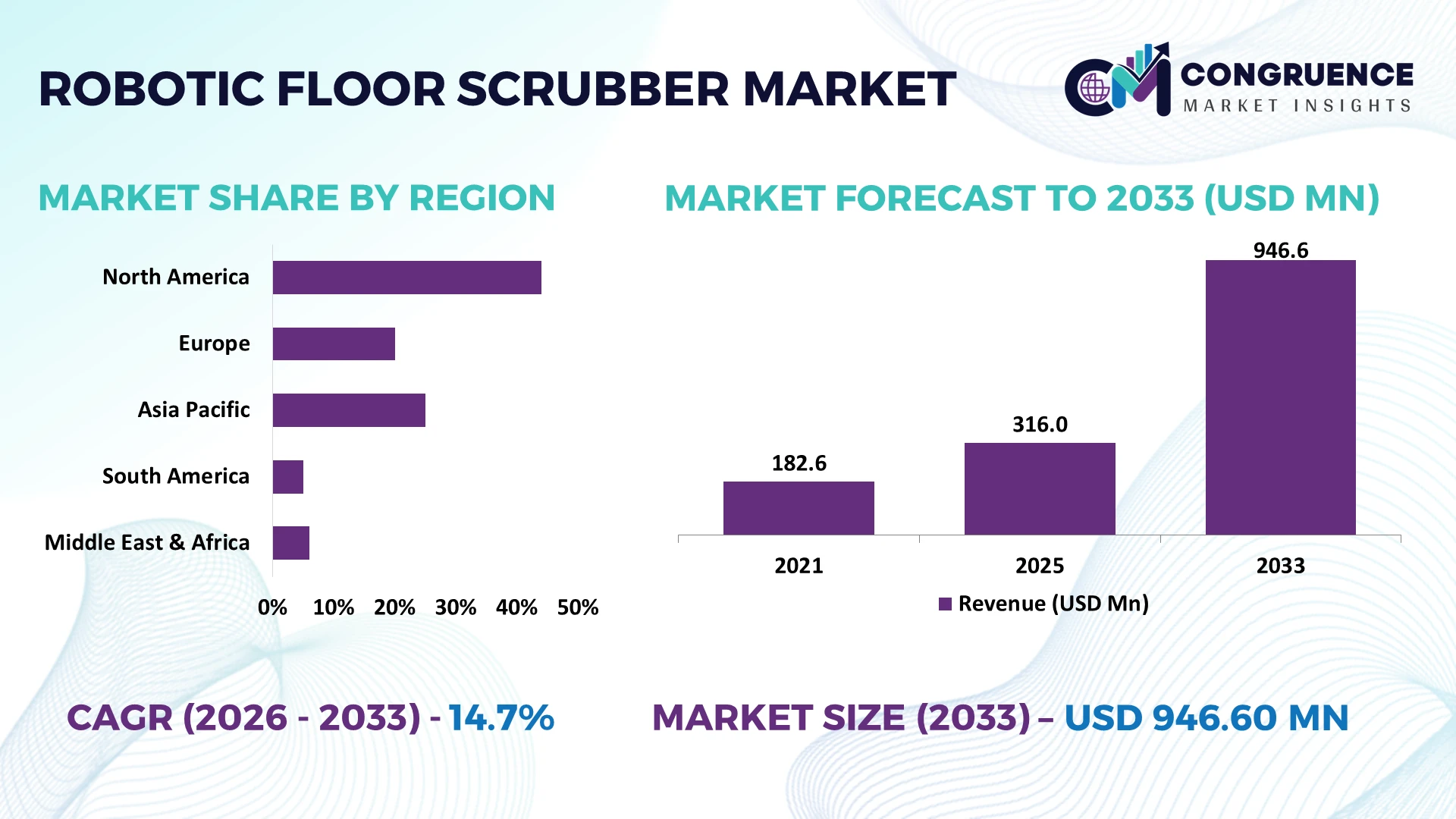
The Global Robotic Floor Scrubber Market was valued at USD 316 Million in 2025 and is anticipated to reach a value of USD 946.6 Million by 2033 expanding at a CAGR of 14.7% between 2026 and 2033. Growth is driven by commercial cleaning labor shortages, autonomous navigation technology, warehouse automation, and increasing adoption of robotic cleaning equipment across large facilities.
The United States represents a leading market for robotic floor scrubbers, supported by extensive commercial infrastructure and rising investment in autonomous facility management. The country employed approximately 2.4 million janitors and building cleaners in 2024, while the median annual wage exceeded USD 35,000. In comparison, Japan faces greater demographic pressure, with approximately 29% of its population aged 65 or older, compared with roughly 18% in the United States. These structural differences influence autonomous cleaning adoption across warehouses, hospitals, airports, and retail facilities.
Strategically, manufacturers should prioritize autonomous fleet management, labor productivity, and service-based deployment models to capture enterprise cleaning contracts.
Key Highlights of the Global Robotic Floor Scrubber Market
-
Market Size & Growth: USD 316 million in 2025, reaching USD 946.6 million by 2033 at 14.7% CAGR, driven by autonomous cleaning adoption.
-
Top Growth Drivers: Approximately 29% elderly population in Japan, 18% in the United States, and 100% autonomous route execution after configuration.
-
Short-Term Forecast: By 2028, modeled market expansion reaches approximately 51% above 2025, strengthening demand for automated facility cleaning equipment.
-
Emerging Technologies: Three priorities include AI obstacle recognition, LiDAR-based SLAM navigation, and cloud-connected robotic fleet management.
-
Regional Leaders: North America, Europe, and Asia-Pacific concentrate commercial automation demand; warehouse robotics and healthcare cleaning drive equipment deployment.
-
Consumer/End-User Trends: Enterprise buyers prioritize 24-hour cleaning availability, scheduled autonomous routes, and documented task completion.
-
Pilot/Case Example: In 2024, autonomous cleaning deployments increasingly incorporated 2 operating modes: supervised mapping and autonomous route execution.
-
Competitive Landscape: Tennant, Nilfisk, Kärcher, Gausium, and Avidbots compete through navigation reliability, cleaning performance, and service coverage.
-
Regulatory & ESG Impact: Automated water dosing and recovery systems support controlled cleaning operations, while 2026 procurement emphasizes measurable water efficiency.
-
Investment & Funding: Commercial cleaning automation investment increasingly targets 3 capabilities: robotics hardware, fleet software, and recurring maintenance services.
-
Innovation & Future Outlook: By 2033, AI navigation, autonomous docking, and multi-robot coordination will reshape large-scale facility cleaning operations.
The robotic floor scrubber market is transitioning from standalone autonomous cleaning machines toward connected facility maintenance platforms. Warehouses, hospitals, airports, shopping centers, and manufacturing plants increasingly evaluate equipment through cleaning coverage, labor allocation, and operating reliability. AI-assisted obstacle detection, LiDAR navigation, and automated docking improve operational flexibility across dynamic environments. Japan's approximately 29% elderly population highlights the structural labor pressures accelerating interest in autonomous maintenance technologies. In 2026, suppliers are emphasizing fleet management software, cleaning performance documentation, and subscription-based equipment access. These developments are shifting competitive differentiation toward lifecycle service capabilities and measurable facility productivity, establishing the foundation for strategic investment decisions.
What Is the Strategic Relevance and Future Pathways of the Robotic Floor Scrubber Market?
Robotic floor scrubbers are becoming strategic facility management assets as commercial operators shift from labor-intensive cleaning contracts toward autonomous equipment supported by digital performance monitoring. Japan's population aged 65 and above represents approximately 29% of residents, compared with roughly 18% in the United States, highlighting contrasting workforce pressures. Manufacturers including Tennant, Gausium, and Avidbots are responding through autonomous navigation, fleet management platforms, and service-based deployment models that improve equipment accessibility.
LiDAR-enabled simultaneous localization and mapping allows robotic scrubbers to navigate predefined cleaning routes while adapting to obstacles. Compared with manually operated scrubbers, autonomous systems can release operator time for other maintenance activities during scheduled cleaning cycles. In an illustrative eight-hour shift, automating four hours of routine scrubbing reallocates 50% of the operator's scheduled time, excluding supervision and servicing. North American buyers emphasize labor productivity, while European facilities increasingly evaluate equipment efficiency and operational documentation.
Between 2026 and 2028, investment priorities will shift toward autonomous docking, predictive maintenance, and centralized fleet orchestration. A distribution center operating three robotic scrubbers can coordinate cleaning schedules across separate zones while monitoring task completion remotely. Suppliers are strengthening software capabilities and distributor partnerships to improve deployment reliability. Competitive advantage increasingly depends on verified cleaning productivity, service responsiveness, and integration with enterprise facility management systems.
Robotic Floor Scrubber Market Dynamics
DRIVER:
Commercial Cleaning Workforce Constraints and Automation
Labor availability is accelerating robotic floor scrubber procurement across commercial facilities requiring predictable cleaning coverage. Japan's population aged 65 and above accounts for approximately 29%, compared with 18% in the United States, creating an 11-percentage-point demographic difference. This structural pressure strengthens the business case for autonomous equipment in airports, hospitals, and distribution centers. Robotic scrubbers perform programmed routes while personnel manage inspections, replenishment, and specialized cleaning. An eight-hour operational schedule with four autonomous cleaning hours theoretically releases 50% of the assigned operator's shift for alternative duties, before supervisory requirements. Tennant, Gausium, and Avidbots are expanding autonomous navigation capabilities and fleet management services to capture productivity-focused enterprise procurement.
RESTRAINT:
Equipment Acquisition Costs and Infrastructure Compatibility
Robotic floor scrubber adoption faces structural limitations from equipment acquisition costs, facility layout requirements, and dependence on specialized replacement components. A facility operating one eight-hour cleaning shift has a maximum scheduled equipment utilization of 33.3% across a 24-hour day, restricting capital productivity unless additional cleaning windows are available. Increasing operation to two shifts raises theoretical utilization to 66.7%, but requires charging coordination, maintenance planning, and accessible cleaning areas. Narrow passages, uneven surfaces, and changing warehouse layouts complicate autonomous route coverage. Battery packs, sensors, and electronic controllers also create supplier dependencies. Manufacturers are responding through leasing arrangements, modular servicing, local distributor inventories, and adaptable mapping software to reduce procurement barriers.
OPPORTUNITY:
Robotics-as-a-Service and Connected Cleaning Operations
Robotics-as-a-Service creates an opportunity to expand autonomous floor scrubber deployment among facilities reluctant to purchase equipment outright. Subscription arrangements convert ownership requirements into contracted operating services, allowing buyers to evaluate cleaning performance against defined service levels. A warehouse running two four-hour autonomous cleaning cycles achieves eight scheduled operating hours daily, equivalent to 33.3% of available calendar time. Adding a third cycle increases scheduled utilization to 50%, provided charging and maintenance requirements permit. Between 2026 and 2028, autonomous docking, cloud-based reporting, and predictive maintenance will strengthen recurring service models. Gausium, Avidbots, and established cleaning equipment suppliers are developing connected product ecosystems. The strategic opportunity lies in monetizing verified cleaning outcomes rather than equipment ownership alone.
CHALLENGE:
Autonomous Navigation Reliability and Fleet Integration
Long-term robotic floor scrubber scalability depends on reliable navigation across dynamic commercial environments and integration with enterprise operating systems. A facility deploying five robots across ten cleaning zones must coordinate equipment availability, route assignments, and maintenance without disrupting pedestrian or material-handling traffic. Even 95% route completion leaves 5% of scheduled coverage requiring investigation or manual intervention. Raising completion to 98% reduces that unresolved portion by 60%, illustrating the operational value of incremental reliability improvements. These percentages represent an illustrative performance scenario rather than reported industry benchmarks. Manufacturers must improve obstacle classification, cybersecurity controls, software interoperability, and remote diagnostics. Competitive differentiation increasingly depends on consistent fleet performance under changing facility conditions, not autonomous navigation capability alone.
Robotic Floor Scrubber Market Latest Trends
-
AI Navigation Improves Cleaning Precision: Manufacturers are combining LiDAR, 3D cameras, and simultaneous localization and mapping to improve autonomous movement through changing facilities. Dual-sensor configurations provide two complementary environmental inputs, while 360-degree sensing supports surrounding obstacle awareness. Gausium and Avidbots are refining navigation software to improve route continuity, reducing operator intervention during scheduled cleaning operations.
-
Automated Docking Changes Equipment Utilization: Self-charging stations, automated water replenishment, and wastewater discharge are reducing dependence on manual servicing. In an illustrative 24-hour facility schedule, increasing productive cleaning from six to eight hours represents a 33.3% utilization improvement. Equipment manufacturers are integrating multifunctional docking stations to extend unattended operation and improve deployment economics across large commercial properties.
-
Digital Cleaning Records Strengthen Contract Accountability: Facility operators increasingly require measurable evidence of completed cleaning tasks. Connected scrubbers record route coverage, operating duration, and cleaning exceptions through centralized dashboards. In a hypothetical 100-zone facility, improving verified coverage from 90% to 98% reduces unresolved zones by 80%. Suppliers are expanding fleet analytics and automated reporting capabilities to support performance-based cleaning contracts.
-
Water Management Becomes Equipment Differentiator: Robotic scrubbers increasingly combine controlled solution dispensing, wastewater recovery, and programmable cleaning intensity. A modeled reduction from 100 liters to 80 liters per cleaning cycle represents 20% lower water consumption. Tennant and Nilfisk emphasize efficient cleaning technologies, while equipment developers refine dosing controls to reduce consumable waste and improve operating consistency.
Segmentation Analysis
By Type
Robotic Floor Scrubbers Lead Automation-Focused Equipment Demand
Robotic Floor Scrubbers represent the leading type within the automation-focused market, supported by autonomous navigation, programmable cleaning schedules, and integrated fleet monitoring. An indicative 2025 distribution assigns approximately 55% to Robotic Floor Scrubbers, 25% to Walk-Behind Floor Scrubbers, and 20% to Ride-On Floor Scrubbers. Robotic models benefit from automated route execution and centralized operating data, making them attractive for facilities with repeatable cleaning requirements. Their adoption is concentrated in environments where equipment can operate across predictable floor layouts with limited supervision. Manufacturers including Gausium, Avidbots, and Tennant are investing in improved obstacle detection, automated docking, and fleet connectivity.
Robotic Floor Scrubbers also represent the fastest-expanding type as commercial operators modernize cleaning operations. Walk-Behind Floor Scrubbers remain important for smaller facilities, irregular spaces, and applications requiring direct operator control. Ride-On Floor Scrubbers serve extensive floor areas where manual driving remains operationally practical. Suppliers are differentiating equipment through navigation capabilities, service accessibility, and deployment flexibility. Investment priorities increasingly favor autonomous systems capable of maintaining consistent coverage while reducing repetitive operator involvement.
- The International Federation of Robotics reported nearly 200,000 professional service robots sold worldwide in 2024, representing 9% annual growth. This broader automation trend supports manufacturer investment in autonomous commercial cleaning equipment and scalable deployment technologies.
By Application
Floor Cleaning Dominates Autonomous Scrubber Deployment
Floor Cleaning represents the largest application within the Robotic Floor Scrubber Market, supported by recurring maintenance requirements across commercial buildings, healthcare environments, and industrial facilities. An indicative 2025 segmentation assigns approximately 40% to Floor Cleaning, 15% to Spill and Stain Removal, 25% to Large-Area Maintenance, and 20% to Routine Facility Cleaning. Floor Cleaning benefits from repeatable routes, programmable scrubbing intensity, and standardized operating procedures. Manufacturers prioritize navigation consistency, solution dispensing, and wastewater recovery to support predictable cleaning performance. These capabilities strengthen equipment utilization across facilities requiring scheduled maintenance throughout operating hours.
Large-Area Maintenance represents the fastest-expanding application as warehouses, logistics facilities, and extensive commercial properties adopt autonomous equipment. Routine Facility Cleaning remains important for daily maintenance programs requiring documented task completion. Spill and Stain Removal presents specialized requirements because unexpected contamination demands targeted intervention and appropriate surface treatment. Manufacturers are improving sensor-assisted navigation, configurable cleaning modes, and centralized task scheduling. Competitive differentiation increasingly depends on matching machine capabilities to floor conditions, traffic patterns, and required cleaning frequency.
- The International Federation of Robotics identified transportation and logistics among the largest professional service robotics applications in its 2025 reporting. This demonstrates established enterprise acceptance of autonomous mobile equipment, supporting operational integration of robotic cleaning systems in large facilities.
By End-User
Commercial Facilities Lead Enterprise Cleaning Automation
Commercial Facilities represent the leading end-user segment within the Robotic Floor Scrubber Market, supported by recurring cleaning requirements across office buildings, institutional properties, and managed commercial spaces. An indicative 2025 distribution assigns approximately 30% to Commercial Facilities, 20% to Industrial and Manufacturing Facilities, 12% to Healthcare Facilities, 13% to Retail and Shopping Centers, 18% to Warehouses and Distribution Centers, and 7% to Transportation Hubs. Commercial Facilities benefit from standardized floor layouts, scheduled cleaning windows, and centralized property management. Equipment suppliers are targeting these buyers through fleet monitoring, service contracts, and installation support. Industrial and Manufacturing Facilities prioritize durable equipment capable of operating around production activity.
Warehouses and Distribution Centers represent the fastest-expanding end-user segment as logistics operators automate maintenance across extensive indoor environments. Healthcare Facilities emphasize cleaning consistency and controlled operating procedures, while Retail and Shopping Centers require navigation around changing pedestrian traffic. Transportation Hubs demand equipment suited to extended operating schedules. Manufacturers are developing application-specific configurations, flexible procurement arrangements, and distributor partnerships to address differing operational requirements. Competitive positioning depends on measurable cleaning coverage, reliable servicing, and compatibility with existing facility workflows.
- The International Federation of Robotics reported approximately 200,000 professional service robot sales worldwide in 2024, with 9% growth. This demonstrates expanding commercial robotics deployment and strengthens the case for autonomous cleaning equipment across operationally intensive facilities.
Region-Wise Market Insights
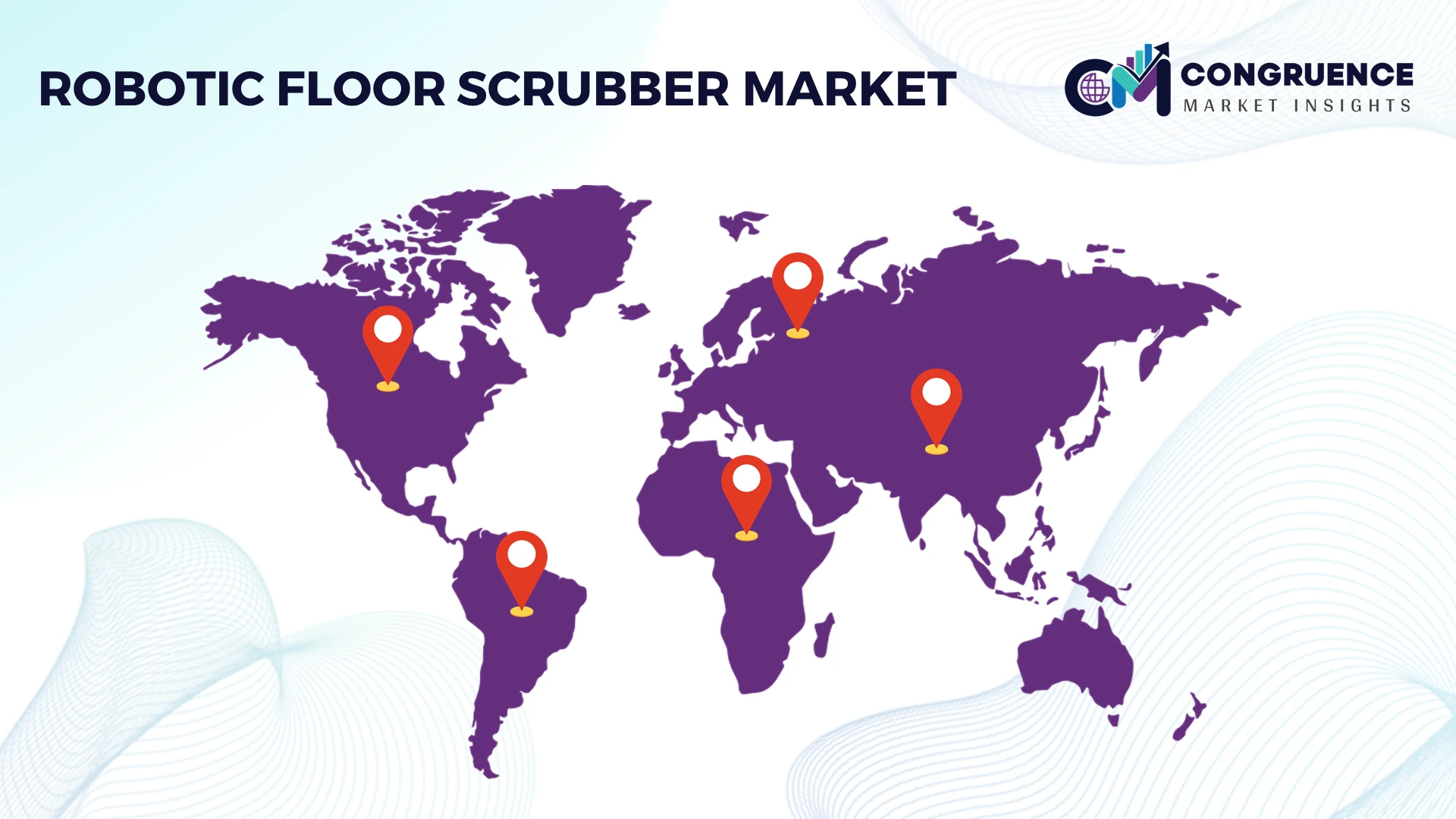
North America accounted for the largest market share at an estimated 36% in 2025 however, Asia-Pacific is expected to register the fastest growth, expanding at a CAGR of an estimated 17.8% between 2026 and 2033.
North America Robotic Floor Scrubber Market
Enterprise Cleaning Automation and Fleet Management Integration
North America accounted for an estimated 36% of the global Robotic Floor Scrubber Market in 2025, supported by established commercial cleaning infrastructure, extensive logistics facilities, and enterprise investment in autonomous maintenance equipment. The United States dominates regional procurement, while Canada contributes demand from institutional properties, transportation facilities, and commercial building operators. Robotic scrubber deployment is increasingly connected with fleet management software, allowing facilities to monitor cleaning coverage, operating hours, and equipment availability. Manufacturers including Tennant and Avidbots compete through autonomous navigation, service networks, and enterprise deployment capabilities. Large distribution centers provide favorable operating environments because predictable floor layouts support repeatable cleaning routes. Buyers increasingly evaluate equipment using completed cleaning coverage rather than machine operating time alone. Suppliers are expanding software functionality, maintenance partnerships, and automated servicing capabilities to strengthen long-term customer retention.
United States Market Outlook: The United States provides substantial demand through commercial property management, manufacturing, and warehouse operations. Approximately 2.4 million janitors and building cleaners were employed nationally in 2024, illustrating the scale of labor-intensive facility maintenance. Minnesota-based Tennant strengthens domestic equipment availability through established manufacturing and distribution operations. Enterprise buyers prioritize labor allocation, equipment uptime, and centralized reporting when evaluating autonomous scrubber investments.
Europe Robotic Floor Scrubber Market
Sustainable Cleaning Equipment and Service-Based Procurement
Europe represented an estimated 28% of global robotic floor scrubber demand in 2025, supported by commercial building modernization, industrial cleaning requirements, and established equipment distribution networks. Germany, France, the United Kingdom, and Italy contribute substantial procurement activity across manufacturing facilities, airports, hospitals, and managed properties. European buyers increasingly emphasize equipment energy efficiency, water consumption, and lifecycle maintenance alongside autonomous cleaning performance. Manufacturers including Kärcher and Nilfisk compete through integrated cleaning portfolios, distributor relationships, and service accessibility. The European Union's Machinery Regulation, scheduled to apply from January 2027, adds an important compliance consideration for autonomous equipment manufacturers. Suppliers are refining safety systems, operating documentation, and digital monitoring capabilities to address evolving requirements. Competitive differentiation increasingly depends on combining reliable navigation with documented equipment performance and efficient consumable management.
Germany Market Outlook: Germany's industrial base and established cleaning equipment manufacturing sector support demand for advanced robotic scrubbers. Kärcher maintains a significant domestic presence, while commercial cleaning contractors and industrial facilities evaluate autonomous equipment for repetitive maintenance tasks. Germany recorded approximately 429,000 industrial robot installations in operational stock during 2023, demonstrating broad industrial automation maturity. This supports familiarity with automated equipment management and maintenance practices.
Asia-Pacific Robotic Floor Scrubber Market
Manufacturing Scale and Autonomous Cleaning Technology Development
Asia-Pacific held an estimated 27% of the global Robotic Floor Scrubber Market in 2025, supported by China's robotics manufacturing ecosystem, Japan's labor constraints, and expanding commercial infrastructure across India and Southeast Asia. Chinese manufacturers benefit from established electronics supply chains, sensor production, and autonomous mobile robot development capabilities. Japan emphasizes labor-saving equipment for hospitals, commercial properties, and transportation facilities. Approximately 29% of Japan's population is aged 65 or older, reinforcing interest in technologies that reduce repetitive maintenance workloads. Gausium and other regional developers compete through navigation software, compact equipment configurations, and automated docking technologies. Industrial expansion in India creates additional opportunities for warehouse and manufacturing facility cleaning. Suppliers are strengthening regional distribution, localized technical support, and product configurations suited to varying floor conditions and operating budgets.
China Market Outlook: China combines autonomous robotics development with large-scale manufacturing capabilities for electronic components, batteries, and sensing systems. The country accounted for approximately 54% of global industrial robot installations in 2023, illustrating its extensive automation ecosystem. Shanghai-based Gausium develops autonomous cleaning equipment for international commercial applications. Domestic component availability and software development capabilities support product customization, manufacturing scalability, and export-oriented competition.
South America Robotic Floor Scrubber Market
Commercial Property Modernization and Distributor-Led Equipment Adoption
South America accounted for an estimated 5% of global robotic floor scrubber demand in 2025, with Brazil representing the principal market for commercial cleaning automation. Demand is concentrated in shopping centers, industrial properties, logistics facilities, and large institutional buildings. Brazilian facility operators increasingly evaluate robotic scrubbers where repetitive floor maintenance can be scheduled during predictable operating periods. Equipment procurement remains sensitive to import costs, financing conditions, and the availability of specialized maintenance services. International manufacturers generally depend on regional distributors and cleaning equipment integrators to support installation and after-sales requirements. Brazil's population exceeds 200 million, supporting extensive commercial and institutional infrastructure across major metropolitan areas. Suppliers are targeting facilities with sufficiently large cleaning areas to justify autonomous deployment while emphasizing flexible financing, technician training, and locally available replacement components.
Brazil Market Outlook: São Paulo represents an important commercial and logistics center for robotic cleaning equipment deployment. Brazil's industrial and retail infrastructure creates opportunities for autonomous maintenance in distribution facilities, shopping complexes, and manufacturing plants. The country's standard import tax and indirect taxation structure influences equipment acquisition economics. Suppliers benefit from local distribution agreements, Portuguese-language interfaces, and maintenance arrangements that reduce equipment downtime.
Middle East & Africa Robotic Floor Scrubber Market
Large-Scale Infrastructure Projects and Automated Facility Maintenance
The Middle East & Africa represented an estimated 4% of the global Robotic Floor Scrubber Market in 2025, supported by commercial infrastructure investment, airport development, hospitality facilities, and industrial modernization. The United Arab Emirates and Saudi Arabia account for important procurement opportunities, particularly within large commercial properties and newly developed facilities. Autonomous scrubbers offer operational advantages where extensive indoor floor areas require scheduled cleaning outside peak visitor periods. Saudi Arabia's Vision 2030 infrastructure agenda and the UAE's investment in advanced commercial facilities provide relevant deployment contexts. Equipment suppliers compete through distributor partnerships, remote monitoring capabilities, and maintenance accessibility. Regional operating conditions also influence equipment selection, particularly dust exposure, floor material variation, and high pedestrian traffic. Manufacturers are prioritizing durable components, configurable cleaning modes, and local technical support arrangements.
Saudi Arabia Market Outlook: Saudi Arabia's infrastructure development pipeline creates opportunities for autonomous floor cleaning across airports, commercial complexes, hospitals, and hospitality properties. The country's Vision 2030 program supports economic diversification and major construction investment. Riyadh and Jeddah represent important commercial deployment centers. Suppliers targeting Saudi facilities emphasize large-area cleaning coverage, reliable navigation, service availability, and integration with professional facility management operations.
Market Competition Landscape
The Robotic Floor Scrubber Market features competition between established cleaning equipment manufacturers and specialized autonomous robotics developers. Tennant, Nilfisk, Kärcher, Gausium, and Avidbots compete through navigation reliability, cleaning performance, service coverage, and fleet software. An illustrative market model assigns these five participants approximately 62% combined share, although verified company sales shares are unavailable. Robotic models represent an estimated 55% of the defined type segmentation, supporting investment in autonomous navigation and software integration. Walk-behind equipment accounts for 25%, while ride-on systems represent 20%, reflecting continued demand for operator-controlled alternatives. Established manufacturers leverage distribution networks and maintenance capabilities, whereas robotics specialists emphasize AI navigation, automated docking, and cloud analytics. Partnerships with facility management companies accelerate deployment and recurring service opportunities. Entry barriers include reliable obstacle avoidance, technical servicing, and enterprise integration. Competitive leadership requires measurable cleaning productivity, dependable equipment uptime, and scalable after-sales support across international commercial facilities and institutional customers.
Companies Profiled in the Robotic Floor Scrubber Market Report
-
Tennant Company
-
Nilfisk A/S
-
Alfred Kärcher SE & Co. KG
-
Gausium
-
Avidbots Corp.
-
LionsBot International Pte. Ltd.
-
SoftBank Robotics Group Corp.
-
Gaussian Robotics
-
Hako GmbH
-
ICE Cobotics
-
Pudu Robotics
-
Adlatus Robotics GmbH
Technology Insights for the Robotic Floor Scrubber Market
Current robotic floor scrubbers combine LiDAR navigation, simultaneous localization and mapping, obstacle detection, and programmable cleaning routes. Autonomous systems increasingly integrate solution dispensing, wastewater recovery, and cloud monitoring. An illustrative equipment model assigns robotic scrubbers 55% of the defined type mix, reflecting automation focused procurement rather than verified industry adoption. Compared with conventional operator controlled equipment, autonomous navigation enables cleaning without continuous steering. In an eight hour shift, four autonomous operating hours theoretically release 50% of scheduled operator time, excluding supervision and maintenance.
Emerging technologies include artificial intelligence vision, automated docking, and predictive fleet diagnostics. Multisensor navigation combines laser ranging with camera recognition, improving environmental interpretation across changing floor layouts. Automated charging and water management reduce manual servicing between cleaning cycles. Increasing productive operation from six to eight hours represents a modeled 33.3% utilization improvement. Manufacturers integrating robotics hardware with service software gain advantages through recurring maintenance relationships and measurable cleaning performance.
Between 2026 and 2028, development will prioritize autonomous refilling, coordinated fleet scheduling, and adaptive cleaning intensity. Facilities deploying three robots can allocate separate zones and consolidate performance reporting. Suppliers offering reliable navigation, remote diagnostics, and responsive maintenance will secure stronger enterprise positioning as cleaning operations become increasingly data driven.
Recent Developments in the Global Robotic Floor Scrubber Market
-
February 2024: Tennant Company expanded its exclusive technology partnership with Brain Corp, investing USD 32 million in autonomous cleaning innovation. The agreement strengthens AI navigation development and supports deployment across a fleet already exceeding 6,500 Tennant cleaning robots. Source: investors.tennantco.com
-
April 2024: LionsBot opened a robotic cleaning manufacturing facility in Singapore, providing annual production capacity of 4,000 robots per shift. The expansion increased manufacturing capacity fivefold, strengthening international supply capabilities and supporting commercial cleaning equipment exports. Source: lionsbot.com
-
August 2025: Gausium documented deployment of its Scrubber 50 at Guangzhou Metro's Caihong Bridge Station, covering infrastructure exceeding 86,000 square meters. The installation combines autonomous scrubbing, automated charging, and water management, demonstrating robotic cleaning integration within transportation operations. Source: gausium.com
-
October 2025: Gausium presented its Mira robotic scrubber alongside Gausium Leaves cleaning technology through the ISSA Innovative Leaders Program. Mira navigates aisles measuring 26 inches wide, expanding autonomous cleaning suitability for constrained retail and commercial environments. Source: issa.com
Scope of the Robotic Floor Scrubber Market Report
The Robotic Floor Scrubber Market Report evaluates equipment demand, deployment economics, and competitive developments between 2026 and 2033. Type coverage includes Walk-Behind Floor Scrubbers, Ride-On Floor Scrubbers, and Robotic Floor Scrubbers. Applications comprise Floor Cleaning, Spill and Stain Removal, Large-Area Maintenance, and Routine Facility Cleaning. End-user analysis examines Commercial Facilities, Industrial and Manufacturing Facilities, Healthcare Facilities, Retail and Shopping Centers, Warehouses and Distribution Centers, and Transportation Hubs. An illustrative segmentation model assigns Robotic Floor Scrubbers 55% of the defined equipment mix.
Geographic coverage includes North America, Europe, Asia-Pacific, South America, and the Middle East & Africa. Technology assessment addresses LiDAR navigation, AI obstacle detection, automated docking, water recycling, and fleet analytics. The report supports investment planning, international expansion, product differentiation, and service strategy development through operational productivity and deployment analysis.
Robotic Floor Scrubber Market Report Summary
| Report Attribute/Metric | Report Details |
|---|
Market Revenue in 2025 | USD 316 Million |
Market Revenue in 2033 | USD 946.6 Million |
CAGR (2026 - 2033) | 14.7% |
Base Year | 2025 |
Forecast Period | 2026 - 2033 |
Historic Period | 2021 - 2025 |
Segments Covered | By TypeWalk-Behind Floor Scrubbers
By ApplicationRoutine Facility Cleaning
By End-UserIndustrial and Manufacturing Facilities Retail and Shopping Centers Warehouses and Distribution Centers
|
Key Report Deliverable | Revenue Forecast, Growth Trends, Market Dynamics, Segmental Overview, Regional and Country-wise Analysis, Competition Landscape |
Region Covered | North America, Europe, Asia-Pacific, South America, Middle East, Africa |
Key Players Analyzed | Tennant Company, Nilfisk A/S, Alfred Kärcher SE & Co. KG, Gausium, Avidbots Corp., LionsBot International Pte. Ltd., SoftBank Robotics Group Corp., Gaussian Robotics, Hako GmbH, ICE Cobotics, Pudu Robotics, Adlatus Robotics GmbH |
Customization & Pricing | Available on Request (10% Customization is Free) |