
Reports
The Global Road Transport Refrigeration Equipment Market was valued at USD 3670 Million in 2025 and is anticipated to reach a value of USD 5805.42 Million by 2033 expanding at a CAGR of 5.9% between 2026 and 2033. Growth is driven by refrigerated food distribution, pharmaceutical cold-chain compliance, fleet electrification, tighter transport-emission rules, and telematics-based temperature monitoring across long-haul and last-mile logistics.
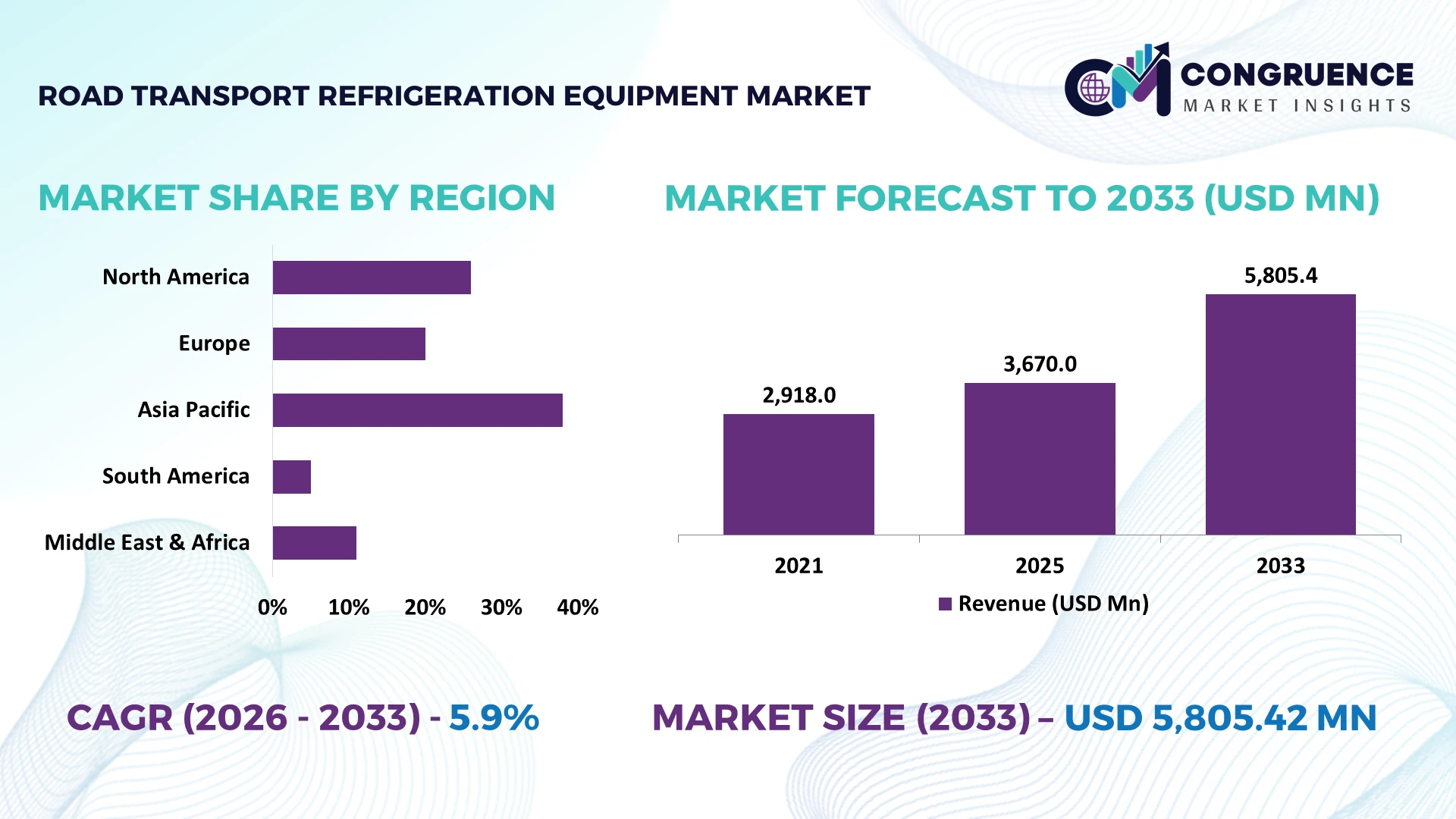
The United States remains the dominant country market, supported by its large refrigerated trucking fleet, food distribution network, and pharmaceutical logistics base. North America accounts for roughly 45–47% of global road transport refrigeration equipment demand, while more than 180 Thermo King dealer locations are being prepared for electrified refrigeration servicing. Electric units now deliver up to 40% greater cooling capacity than previous-generation systems. Compared with the United States, India remains earlier in electrified transport refrigeration adoption but is accelerating as Carrier introduced Pulsor eCool in 2025, cutting box pre-cooling time by up to 31%. U.S.-China supply-chain realignment and tighter European transport-emission standards are also pushing OEMs toward localized components, electric compressors, and alternative refrigerants.
Strategically, suppliers should prioritize electrified refrigeration, telematics, local service coverage, and temperature-assurance capabilities as fleet operators shift purchasing decisions from equipment cost toward lifecycle efficiency and regulatory compliance.
Market Size & Growth: USD 3.67 billion in 2025 advances toward USD 5.81 billion by 2033 at 5.9%, driven by cold-chain electrification and temperature-sensitive logistics expansion.
Top Growth Drivers: Electrification readiness above 35 U.S. dealer sites, 31% faster pre-cooling, and nearly 40% higher cooling capacity underpin equipment replacement.
Short-Term Forecast: By 2028, advanced electric refrigeration and predictive controls are positioned to lower fleet refrigeration energy consumption by approximately 15–20%.
Emerging Technologies: Battery-electric TRUs, axle-powered generation, variable-speed compressors, IoT telematics, and AI-assisted temperature analytics are redefining refrigerated transport architectures.
Regional Leaders: By 2033, North America approaches USD 2.71 billion, Europe roughly USD 1.39 billion, and Asia-Pacific approximately USD 1.22 billion, led increasingly by electrified deployments.
Consumer/End-User Trends: Food and beverage applications account for roughly 60% of equipment utilization, while pharmaceutical logistics is raising requirements for continuous temperature traceability.
Pilot/Case Example: In 2025, Carrier's Pulsor eCool deployment demonstrated up to 31% faster cargo-box pre-cooling from 30°C to -18°C.
Competitive Landscape: Thermo King commands an estimated 25–30% organized-market position, competing with Carrier Transicold, Daikin, Mitsubishi Heavy Industries, and SONGZ.
Regulatory & ESG Impact: Electrified refrigeration eliminates 100% of direct diesel-engine emissions at the refrigeration unit, supporting stricter urban low-emission and noise requirements.
Investment & Funding: Trane Technologies committed more than USD 100 million to its Thermo King all-electric evolve portfolio, accelerating truck, trailer, and cold-chain electrification.
Innovation & Future Outlook: Carrier now offers electric solutions across 100% of its vehicle ranges, signaling a decisive move from standalone diesel TRUs toward connected electric refrigeration platforms.
The Road Transport Refrigeration Equipment Market is increasingly shaped by food distribution, pharmaceuticals, grocery delivery, and temperature-sensitive last-mile logistics. Electric transport refrigeration units are gaining prominence as next-generation systems deliver up to 40% higher cooling capacity, while telematics and predictive controls improve cargo visibility. Tightening urban-emission rules and fleet electrification are now making refrigeration architecture a strategic cold-chain investment decision.
Road transport refrigeration equipment is becoming strategically important as food, pharmaceutical, and grocery logistics shift toward stricter temperature assurance, fleet electrification, and real-time cold-chain visibility. Regulatory pressure on transport emissions is accelerating replacement of diesel-powered refrigeration units with electric architectures, while logistics operators increasingly treat refrigeration performance as a fleet-efficiency and compliance issue rather than a standalone equipment purchase.
New-generation electric units materially improve operating performance. Carrier’s Pulsor eCool can cut cargo-box pre-cooling time by up to 31% and deliver around 32% total energy savings versus competing conventional configurations, while newer electric units provide nearly 40% higher cooling capacity than predecessor designs. The United States leads in fleet scale and connected cold-chain deployment, whereas India is emerging rapidly through urban delivery electrification and localized cold-chain investment.
A practical deployment involves electric light-commercial vehicles using refrigeration systems powered directly from the vehicle’s high-voltage battery, eliminating separate engine-driven compressors. Over the next 2–3 years, telematics, variable-speed compressors, predictive diagnostics, and zero-emission TRUs will gain procurement priority. Carrier, Thermo King, and other OEMs are expanding electric portfolios and service networks. Competitive advantage will increasingly depend on lifecycle efficiency, temperature precision, digital visibility, and compatibility with electrified fleets.
Electrification is the strongest structural driver as refrigerated fleets move away from auxiliary diesel engines toward battery-powered and direct-drive systems. Carrier’s Pulsor eCool delivers up to 32% energy savings, reduces pre-cooling time by 31%, and maintains temperature control within approximately ±1°C. In India, its 2025 launch directly addressed growing electric light-commercial vehicle deployment and urban cold-chain requirements. This transition lowers fuel dependence, simplifies mechanical architecture, and improves temperature stability during stop-start delivery cycles. Thermo King and Carrier are responding by expanding electric truck and trailer refrigeration portfolios, integrating variable-speed compressors, and strengthening dealer electrification capabilities. The strategic shift is clear: fleet operators increasingly evaluate refrigeration units by total vehicle energy use, not isolated cooling performance.
High upfront equipment costs, charging limitations, and powertrain integration requirements continue to restrict electric refrigeration adoption outside mature fleet ecosystems. Electric transport refrigeration units can reduce energy use by about 20–32%, yet refrigerated fleets must simultaneously fund batteries, charging hardware, power electronics, and vehicle conversion. In India, urban fleets operating frequent-stop routes can spend up to 90% of driving time at low engine speeds, exposing weaknesses in conventional compressor-driven systems but also increasing electrical load requirements when fleets electrify. Operators in secondary logistics hubs face additional service and charging constraints. OEMs are mitigating these barriers through plug-and-play direct-drive systems, dealer training, modular electronics, and localized servicing. The key limitation is no longer cooling capability alone; it is the availability of fleet-grade electrical infrastructure that supports dependable daily operations.
Digital cold-chain management creates a high-value opportunity beyond equipment sales. Telematics, IoT sensors, geofencing, remote diagnostics, and predictive maintenance increasingly allow operators to track temperature excursions, compressor performance, fuel or battery use, and door-opening events in real time. Advanced systems can support 15–20% maintenance-efficiency improvements, while electric platforms delivering roughly 32% energy savings create additional lifecycle value. India, the United States, and high-density European logistics corridors are especially attractive for digitally managed food and pharmaceutical fleets. Carrier and Thermo King are expanding connected platforms alongside electrified hardware, creating recurring software and service income. The non-obvious opportunity lies in converting refrigeration units into data assets that support compliance auditing, route optimization, asset utilization, and automated maintenance scheduling across large distributed fleets.
The long-term execution challenge is maintaining refrigeration performance without compromising electric vehicle range, payload, or charging schedules. Modern refrigeration units can consume a meaningful share of onboard energy, while vehicle-mounted systems must maintain cargo temperatures from around +30°C ambient conditions down to sub-zero setpoints. Carrier’s Pulsor eCool operates across a 215–750V range and weighs about 99 kg, illustrating the engineering complexity involved in balancing voltage compatibility, cooling output, weight, and vehicle integration. Urban logistics operators also require near-continuous cooling during frequent door openings and congestion. Manufacturers must therefore improve insulation, compressor efficiency, energy management software, and vehicle-to-TRU communication. Companies that cannot optimize refrigeration and propulsion as one integrated energy system will face weaker fleet economics and inconsistent deployment performance.
Van Refrigeration Gets Lighter: Urban cold-chain fleets are shifting toward compact electric units optimized for payload-sensitive vans. Thermo King’s 2025 E-Series generation delivers up to 20% lower energy consumption, 50% more heating capacity, and 32% lower unit weight. Manufacturers are redesigning compressors, controllers, and housings to reduce battery draw while preserving cargo capacity, improving last-mile operating economics.
Trailer Systems Become Self-Powered: Refrigerated trailers are increasingly adopting axle-generation and regenerative architectures that reduce dependence on tractor power. Carrier’s Vector eCool can generate up to 160 kWh peak power and stores energy in a 45-kWh battery. OEMs are expanding axle-powered platforms and intelligent energy management, helping fleets decouple refrigeration consumption from propulsion and improve zero-emission route flexibility.
Retrofit Electrification Gains Commercial Traction: Fleet operators are converting existing diesel refrigeration assets rather than replacing complete trailers. Carrier’s [R]eCool enables 100% electric refrigeration operation and can typically be installed in under one day without chassis modification. This workflow lowers asset-transition disruption and extends trailer life. Suppliers are partnering with bodybuilders and service networks to scale retrofit-compatible electrification across established fleets.
Telematics Shifts Toward Asset Intelligence: Factory-installed connectivity is becoming standard rather than optional. More than 200,000 Thermo King Precedent units operate on North American roads, while new units include 24 months of telematics connectivity. Fleets are using real-time temperature, location, diagnostics, and utilization data to reduce manual checks. OEMs are embedding analytics platforms to strengthen uptime, compliance, and service-contract retention.
Trailer Refrigeration Units lead the type segmentation with an estimated 34–38% share, reflecting their importance in long-haul frozen, chilled, meat, dairy, and pharmaceutical distribution. Their dominance comes from high payload capacity, single- and multi-temperature flexibility, extensive highway utilization, and compatibility with large national fleets. Truck Refrigeration Units account for roughly 24–28% and remain critical for regional distribution where maneuverability and frequent deliveries matter. Transport Refrigeration Units serve as the broader integrated equipment category spanning multiple vehicle formats.
Van Refrigeration Units are the fastest-growing type as grocery, foodservice, healthcare, and e-commerce logistics shift toward smaller urban delivery vehicles. New electric van units can cut energy consumption by approximately 20% and unit weight by 32%, improving payload economics. Container Refrigeration Units retain strategic relevance for intermodal road movements requiring standardized temperature control. Manufacturers are reallocating engineering resources toward electric van systems, self-powered trailers, regenerative axles, and multi-temperature platforms as investment shifts toward flexible zero-emission fleet architectures.
Frozen Food Transport accounts for an estimated 32–36% of application demand because cargo requires continuous low-temperature performance across long-distance distribution, warehousing interfaces, and retail replenishment. Chilled Food Transport follows with roughly 25–29%, supported by ready meals, beverages, processed foods, and fresh proteins requiring tighter but less energy-intensive temperature bands. Dairy Product Transport remains highly standardized because temperature excursions directly affect shelf life and product quality.
Pharmaceutical Transport is the fastest-growing application as biologics, vaccines, specialty medicines, and temperature-sensitive healthcare products demand continuous monitoring, auditability, and precise thermal control. Many vaccine products require traditional storage around 2°C to 8°C, increasing demand for telematics, calibrated sensors, backup power, and multi-zone refrigeration. Fresh Produce Transport remains operationally significant as rapid post-harvest cooling determines quality retention. Equipment manufacturers are therefore scaling precision controllers, remote temperature logging, multi-temperature evaporators, and compliance-oriented fleet platforms, moving investment from basic refrigeration capacity toward documented temperature integrity.
Food & Beverage leads end-user demand with an estimated 42–46% share because processors, distributors, restaurants, and institutional buyers depend on daily temperature-controlled movement of frozen and chilled products. Cold Chain Providers represent approximately 20–24%, operating mixed fleets across multiple customers and therefore prioritizing utilization, multi-temperature flexibility, telematics, and lifecycle service. Meat & Seafood remains equipment-intensive because product deterioration accelerates rapidly when controlled temperatures are disrupted.
Pharmaceutical Logistics is the fastest-growing buyer group as regulatory traceability and high-value biologics increase requirements for calibrated sensors, continuous data recording, and redundant cooling. Retail & Grocery is also shifting rapidly toward smaller refrigerated trucks and vans as omnichannel fulfillment expands store-to-home delivery. Manufacturers are targeting these customers with electric LCV units, multi-zone platforms, service contracts, and cloud-connected monitoring. Competitive advantage increasingly depends on matching refrigeration architecture to route density, cargo criticality, and compliance requirements rather than selling standardized units across every customer category.
North America accounted for the largest market share at 46% in 2025 however, Asia-Pacific is expected to register the fastest growth, expanding at a CAGR of 7.2% between 2026 and 2033.
Fleet Modernization Shifts Toward Electric TRUs
North America represents approximately 46% of global road transport refrigeration equipment demand, supported by dense refrigerated trucking networks, large grocery distribution systems, pharmaceutical logistics, and established equipment replacement cycles. The United States dominates deployment, with more than 200,000 Thermo King Precedent trailer units operating across North American roads. Fleet investment is shifting toward electric refrigeration, factory-installed telematics, remote diagnostics, and lower-emission refrigerants as California and other jurisdictions tighten transport refrigeration requirements. Thermo King is preparing more than 180 dealer locations for electrification support, strengthening charging, servicing, and technician capabilities. Large food distributors increasingly evaluate refrigeration alongside tractor electrification and route energy consumption. This favors suppliers offering integrated hardware, connectivity, nationwide servicing, and retrofit pathways rather than conventional diesel-only refrigeration platforms.
United States Market Outlook: The United States combines high refrigerated-trailer density with sophisticated food, grocery, healthcare, and restaurant distribution networks. California's zero-emission transport refrigeration requirements are particularly influential in fleet procurement. Large operators increasingly specify telematics-enabled equipment capable of continuous cargo monitoring, predictive servicing, and electric operation, making nationwide dealer coverage and rapid parts availability decisive competitive advantages.
Decarbonization Accelerates Trailer Electrification
Europe accounts for approximately 24% of global demand, with Germany, France, the United Kingdom, Italy, Spain, and the Netherlands supporting intensive temperature-controlled road networks. Regulatory pressure is reshaping equipment specifications as fleet operators address vehicle decarbonization, urban noise restrictions, refrigerant transition, and food-temperature compliance simultaneously. Electric trailer systems are moving beyond demonstration deployments: axle-powered configurations can generate up to 160 kWh of peak energy and combine regenerative generation with approximately 45-kWh battery storage. Germany and the Netherlands provide important testing environments because dense logistics corridors support predictable routes and charging access. Carrier, Thermo King, and specialized technology providers are increasing electric refrigeration deployments, telematics integration, and retrofit offerings. The competitive shift favors equipment that decouples refrigeration energy from diesel propulsion while preserving long-haul temperature integrity and trailer utilization.
Germany Market Outlook: Germany's position as Europe's largest road-freight economy provides a strong base for advanced refrigeration adoption across food manufacturing, supermarkets, pharmaceuticals, and cross-border logistics. Its extensive motorway network exceeds 13,000 kilometers. Fleet operators increasingly prioritize low-emission TRUs, multi-temperature flexibility, digital temperature documentation, and equipment compatible with battery-electric tractor strategies.
Cold-Chain Expansion Meets Vehicle Electrification
Asia-Pacific represents approximately 21% of global demand, with China, India, Japan, South Korea, and Australia combining expanding cold-chain infrastructure with increasingly localized refrigeration equipment production. China offers the largest operating scale through grocery distribution, food processing, fresh produce, and pharmaceutical logistics, while India presents substantial underpenetrated demand. India's cold-chain modernization is increasingly intersecting with electric light-commercial vehicles; new refrigeration platforms can reduce pre-cooling time by 31% and deliver approximately 32% energy savings. Chinese suppliers compete aggressively through localized compressors, heat exchangers, controllers, and vehicle integration, putting pricing pressure on international OEMs. Meanwhile, Japanese manufacturers retain strengths in compact, efficient truck refrigeration. Global suppliers are expanding local engineering, dealer coverage, and electric-product portfolios to capture demand without importing complete high-cost systems.
China Market Outlook: China combines the world's largest commercial-vehicle manufacturing ecosystem with rapidly expanding fresh-food e-commerce and urban distribution. New-energy commercial vehicles are increasingly entering temperature-controlled applications, encouraging domestic suppliers to integrate electric compressors and connected controllers. China's manufacturing depth in batteries, power electronics, and thermal-management components provides a structural cost advantage for next-generation refrigerated vehicles.
Food Exports Sustain Refrigerated Fleet Investment
South America accounts for approximately 5% of global demand, led by Brazil, Argentina, Chile, and Colombia. Meat, poultry, dairy, seafood, fruit, and processed-food distribution creates substantial temperature-controlled transport requirements, particularly along export-oriented agricultural corridors. Brazil remains the operational center because its highway-dependent logistics system handles roughly 60% of domestic freight movement by road. Refrigeration fleets consequently require durable equipment capable of operating across long distances, high ambient temperatures, and uneven service availability. Currency volatility and dependence on imported compressors, electronics, and specialized components constrain replacement economics, encouraging longer equipment lifecycles. OEMs and distributors are responding by expanding remanufacturing, preventive maintenance, local parts inventories, and simplified control architectures. Suppliers able to localize service and component sourcing gain an advantage over import-dependent premium platforms.
Brazil Market Outlook: Brazil combines large meat and poultry production with an extensive supermarket and foodservice distribution network, making temperature-controlled trucking strategically important. Road freight dominates domestic cargo movement, while export supply chains require reliable first-mile refrigeration. Fleet buyers emphasize fuel efficiency, ruggedized compressors, rapid servicing, and multi-temperature configurations suited to long-distance distribution between production centers and coastal markets.
Food Security Investment Expands Cold Chains
Middle East & Africa represents approximately 4% of global demand, with the UAE, Saudi Arabia, South Africa, Egypt, and Morocco providing the strongest organized cold-chain activity. High ambient temperatures and dependence on imported food make refrigeration reliability operationally critical across Gulf distribution networks. Saudi Arabia imports a substantial proportion of its food requirements while investing heavily in logistics infrastructure under Vision 2030, increasing requirements for refrigerated trucks, distribution centers, and digitally monitored cold chains. The UAE's re-export and pharmaceutical logistics position additionally supports high-specification temperature-controlled equipment. Africa remains fragmented by road quality, electricity reliability, and servicing constraints, favoring robust diesel and hybrid architectures. Equipment suppliers are strengthening distributor partnerships, technician training, telematics support, and high-ambient cooling packages rather than relying solely on standardized global platforms.
Saudi Arabia Market Outlook: Saudi Arabia offers the strongest strategic momentum through food-security investment, pharmaceutical distribution, grocery modernization, and logistics-hub development. Extreme summer temperatures exceeding 45°C place exceptional loads on refrigeration systems. Fleet operators therefore prioritize high-capacity compressors, thermal insulation, remote temperature monitoring, preventive maintenance, and equipment engineered specifically for sustained high-ambient operation.
Thermo King, Carrier Transicold, Daikin, Mitsubishi Heavy Industries, and SONGZ compete across truck, trailer, van, and electric refrigeration platforms, with global OEMs challenged by Asian cost-focused suppliers. The top five hold approximately 65–70% of organized demand, reflecting strong technology, dealer, and installed-base advantages. Competition increasingly centers on lifecycle efficiency: advanced electric systems deliver roughly 20–32% lower energy consumption, while newer platforms provide up to 40% higher cooling capacity. Thermo King and Carrier leverage telematics, electrification, and extensive service networks; Daikin and Mitsubishi emphasize compressor efficiency and integrated thermal engineering; SONGZ competes through localized manufacturing and pricing. OEMs are expanding electric portfolios, axle-generation partnerships, retrofit solutions, and connected maintenance platforms. The competitive shift is moving from diesel hardware toward integrated energy and data management. Certification, vehicle integration expertise, service coverage, and compressor technology remain entry barriers. Winning requires efficient electrification, reliable temperature control, scalable servicing, and fleet-level digital integration.
Thermo King
Carrier Transicold
Daikin Industries
Mitsubishi Heavy Industries
SONGZ Automobile Air Conditioning
DENSO Corporation
Webasto Group
Zanotti
Kingtec Group
Hwasung Thermo
Subros Limited
Zhengzhou Corun Tech
Guchen Thermo
Hubbard Products
Current road transport refrigeration technology centers on variable-speed electric compressors, inverter drives, telematics, multi-temperature control, and low-GWP refrigerants. Battery-electric units eliminate auxiliary diesel engines, while intelligent frequency conversion improves temperature stability and reduces unnecessary compressor cycling. New systems achieve around 21% lower annual energy consumption than conventional refrigeration trucks, while connected monitoring supports 10–20% fewer unscheduled service interventions. Adoption is strongest across grocery, pharmaceutical, and urban delivery fleets.
Emerging architectures integrate vehicle batteries, heat pumps, regenerative axles, predictive diagnostics, and cloud fleet platforms. Mitsubishi’s EV-integrated configuration demonstrates 42% lower annual energy costs and 46% lower carbon emissions versus conventional refrigeration trucks. Compared with legacy engine-driven units, direct electric systems maintain cooling independently of engine speed, improving stop-start route performance. Fleet operators and OEMs with integrated vehicle-energy management benefit through lower operating costs, improved payload utilization, and stronger regulatory readiness.
Disruptive development is moving toward modular electric refrigeration, AI-assisted thermal management, digital twins, and automated compliance reporting. From 2026–2028, compact modular units will accelerate deployment across electric vans and medium-duty trucks; newer designs already cut refrigeration-unit weight by 55%. Suppliers investing now in interoperable controls, cybersecurity, battery optimization, and service analytics will secure stronger fleet partnerships and recurring digital-service advantages globally.
August 2026 Mitsubishi Heavy Industries launched TEU electric transport refrigeration units in Europe, using modular architecture that reduces unit weight 55% versus conventional sub-engine units. The design improves EV installation flexibility while preserving high-capacity cooling for large refrigerated trucks. Source: mhi.com
March 2026 Thermo King launched E-Volution into serial production for 7.5–26-tonne trucks, with an independent lifecycle assessment showing up to 45% lower CO₂ emissions than diesel alternatives. The platform expands practical electric refrigeration deployment across BEV and conventional fleets. Source: thermoking.com
September 2025 Carrier Transicold introduced Pulsor eCool in India, delivering up to 32% total energy savings and 31% faster pre-cooling versus competitor offerings. The launch strengthens electric cold-chain capability for high-frequency, temperature-sensitive urban light-commercial vehicle operations nationwide. Source: motorindiaonline.in
January 2025 Mitsubishi Heavy Industries and Isuzu’s ELF EV–TEJ35AM combination received Japan’s Energy Conservation Grand Prize recognition after demonstrating 21.3% lower annual energy consumption and 46.1% lower CO₂ emissions, validating integrated EV refrigeration economics for commercial fleets. Source: mhi.com
The Road Transport Refrigeration Equipment Market Report covers Transport Refrigeration Units, Truck Refrigeration Units, Trailer Refrigeration Units, Van Refrigeration Units, and Container Refrigeration Units across frozen food, chilled food, pharmaceutical, dairy, and fresh produce transportation. Trailer units represent approximately 34–38% of type demand, while food and beverage operators account for roughly 42–46% of end-user deployment.
Geographic coverage spans North America, Europe, Asia-Pacific, South America, and Middle East & Africa, with detailed assessment of electrification, inverter compressors, regenerative axles, telematics, heat pumps, predictive diagnostics, and multi-temperature systems. The report also evaluates pharmaceutical logistics, last-mile electric refrigeration, retrofit electrification, and connected cold-chain niches. Competitive benchmarking and deployment analysis support investment planning, geographic expansion, technology partnerships, product positioning, and fleet-transition strategies through 2026–2033.
| Report Attribute/Metric | Report Details |
|---|---|
Market Revenue in 2025 | USD 3670 Million |
Market Revenue in 2033 | USD 5805.42 Million |
CAGR (2026 - 2033) | 5.9% |
Base Year | 2025 |
Forecast Period | 2026 - 2033 |
Historic Period | 2021 - 2025 |
Segments Covered | By Type
By Application
By End-User
|
Key Report Deliverable | Revenue Forecast, Growth Trends, Market Dynamics, Segmental Overview, Regional and Country-wise Analysis, Competition Landscape |
Region Covered | North America, Europe, Asia-Pacific, South America, Middle East, Africa |
Key Players Analyzed | Thermo King, Carrier Transicold, Daikin Industries, Mitsubishi Heavy Industries, SONGZ Automobile Air Conditioning, DENSO Corporation, Webasto Group, Zanotti, Kingtec Group, Hwasung Thermo, Subros Limited, Zhengzhou Corun Tech, Guchen Thermo, Hubbard Products |
Customization & Pricing | Available on Request (10% Customization is Free) |




