
Reports
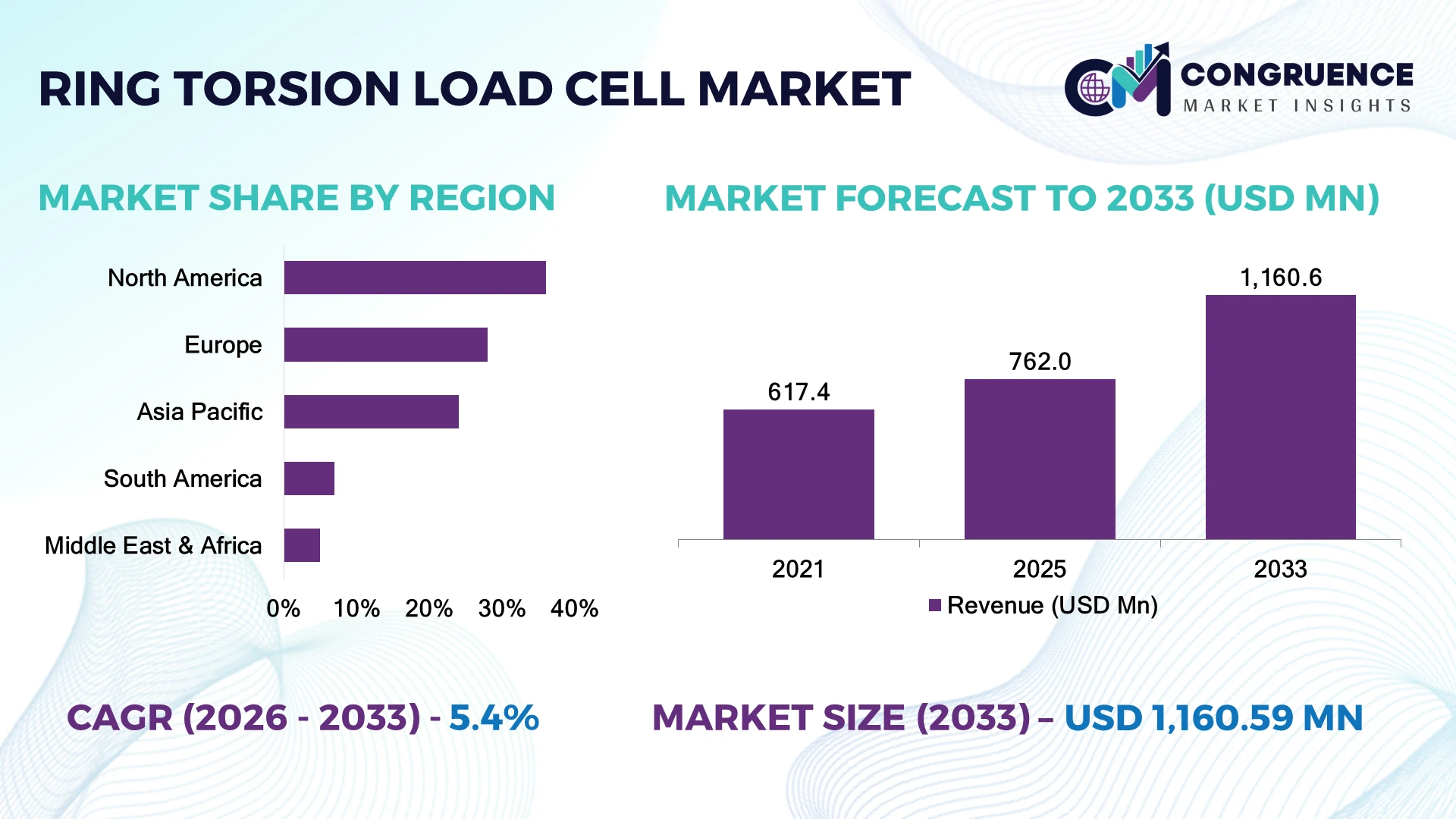
The Global Ring-torsion Load Cell Market was valued at USD 762.0 Million in 2025 and is anticipated to reach a value of USD 1,160.6 Million by 2033 expanding at a CAGR of 5.4% between 2026 and 2033. Growth is being driven by increasing deployment of precision force-measurement systems across industrial automation, aerospace testing, heavy machinery calibration, and smart manufacturing environments requiring accuracy levels above 0.03%.
The United States dominates the global market with an estimated 31% share, supported by advanced manufacturing, aerospace, defense, and process industries that account for over 42% of high-precision load cell deployments. More than 65% of large industrial testing facilities in the country utilize digital force-monitoring systems integrated with Industry 4.0 platforms. In comparison, Germany holds approximately 9% share, driven by automotive engineering and industrial automation investments. Ongoing infrastructure modernization and supply-chain reshoring initiatives further strengthen U.S. leadership in precision sensing technologies.
Strategically, manufacturers that align product portfolios with automation-driven calibration, predictive maintenance, and digital monitoring requirements are positioned to secure stronger long-term industrial contracts.
Market Size & Growth: USD 762.0 Million in 2025, reaching USD 1,160.6 Million by 2033 at 5.4% CAGR, driven by industrial automation and precision measurement demand.
Top Growth Drivers: Automation adoption (+28%), smart factory integration (+24%), and aerospace testing investments (+19%) accelerate deployment.
Short-Term Forecast: By 2028, calibration efficiency is projected to improve by 18% through digital sensing and remote diagnostics.
Emerging Technologies: AI-enabled monitoring, wireless load sensing, and advanced strain-gauge materials improve operational accuracy and uptime.
Regional Leaders: North America (~USD 360 Million), Europe (~USD 270 Million), and Asia-Pacific (~USD 310 Million by 2033) benefit from automation-led adoption.
Consumer/End-User Trends: Over 58% of industrial operators prioritize real-time force monitoring for predictive maintenance programs.
Pilot/Case Example: A 2024 aerospace testing upgrade reduced measurement deviations by 22% through advanced ring-torsion sensor deployment.
Competitive Landscape: HBM, Flintec, Vishay Precision Group, FUTEK, and MinebeaMitsumi collectively account for nearly 40% of global activity.
Regulatory & ESG Impact: Digital calibration systems cut testing waste by approximately 15% while supporting quality-compliance requirements.
Investment & Funding: More than USD 420 Million has been directed toward sensor manufacturing expansion and automation partnerships since 2023.
Innovation & Future Outlook: Smart load cells with edge analytics and cloud connectivity are reshaping high-growth industrial measurement ecosystems.
Ring-torsion load cells are gaining traction in aerospace qualification testing, automated manufacturing lines, industrial weighing systems, and structural load monitoring applications. Recent innovations include wireless telemetry-enabled sensors, digital calibration platforms, and high-temperature-resistant strain-gauge assemblies. More than 35% of newly installed industrial force-measurement systems now support remote diagnostics. Ongoing supply-chain localization initiatives are also encouraging regional manufacturing expansion, setting the stage for broader strategic adoption across advanced industrial environments.
Ring-torsion load cells are becoming strategically important as manufacturers prioritize precision measurement, digital quality assurance, and automated process control. The market is increasingly tied to industrial transformation initiatives where real-time force monitoring improves production consistency, equipment reliability, and regulatory compliance. Supply-chain restructuring across North America and Europe is also encouraging investment in localized sensor manufacturing and calibration infrastructure.
Technology differentiation is becoming a key competitive factor. Modern digital ring-torsion load cells deliver up to 25% faster calibration cycles and reduce measurement drift by nearly 20% compared with legacy analog systems. The United States continues to lead large-scale industrial deployments, while Germany and Japan focus on high-precision engineering applications with tighter integration into automated production environments. Over 60% of new industrial sensing projects now specify digital connectivity requirements for operational visibility and predictive maintenance.
A practical example can be seen in aerospace testing facilities adopting network-connected load monitoring systems to improve asset utilization and traceability. Companies are expanding R&D programs, forming sensor-integration partnerships, and increasing localized production capabilities. Over the next two to three years, adoption of intelligent monitoring platforms is expected to rise significantly, making precision sensing a critical source of operational advantage, stronger quality control, and long-term competitive positioning.
The accelerating adoption of industrial automation is creating sustained demand for high-accuracy ring-torsion load cells. More than 62% of new smart manufacturing projects incorporate force-monitoring systems for process optimization, while automated production facilities report up to 18% lower quality-control deviations when advanced load sensing is deployed. Aerospace and defense testing programs have increased precision measurement investments by approximately 20% over the past three years. The shift toward Industry 4.0 architectures is driving integration of digital load cells with industrial IoT platforms. In response, manufacturers are expanding production capacity, developing wireless-enabled sensing solutions, and establishing partnerships with automation providers. A key strategic insight is that load-cell suppliers offering software-enabled diagnostics increasingly secure higher-value contracts than hardware-only competitors.
The market faces structural pressure from rising costs of strain gauges, specialty alloys, and precision electronic components. Sensor-grade material prices have fluctuated by 12–18% in recent years, while lead times for certain electronic modules remain 20–30% above pre-disruption levels. Germany and Japan continue to dominate portions of the precision sensing supply chain, creating dependency risks for manufacturers in other countries. These constraints increase production costs, reduce pricing flexibility, and complicate large-scale deployment schedules. To mitigate exposure, companies are diversifying supplier networks, localizing assembly operations, and securing long-term procurement agreements. A notable operational insight is that firms with multi-country sourcing strategies experience significantly lower production disruptions than single-source manufacturers.
A significant opportunity lies in the convergence of intelligent sensing, predictive maintenance, and digital asset management platforms. More than 55% of industrial operators are increasing investment in condition-monitoring technologies, while connected sensors can reduce unplanned equipment downtime by approximately 25%. China’s smart manufacturing initiatives and India's industrial modernization programs are creating new deployment opportunities across production facilities and infrastructure projects. Emerging technologies such as edge analytics, cloud-based calibration management, and wireless telemetry are expanding the functional value of ring-torsion load cells. Companies are increasing R&D expenditure, forming software partnerships, and developing integrated sensing ecosystems. A non-obvious opportunity is the growing demand for data-driven compliance reporting, where measurement systems become operational intelligence assets rather than standalone hardware.
The primary long-term challenge is integrating advanced load-cell systems into increasingly complex industrial environments. Nearly 40% of industrial facilities report difficulties connecting legacy equipment with modern digital monitoring platforms, while specialized calibration and sensing expertise remains limited in several manufacturing hubs. Cybersecurity requirements for connected industrial devices have increased substantially, adding new validation and compliance burdens. These issues can delay deployment, increase lifecycle costs, and reduce the consistency of measurement performance across multi-site operations. Companies are addressing the challenge through workforce training programs, software-standardization initiatives, and collaboration with industrial automation partners. A critical strategic insight is that future competitiveness will depend not only on sensor accuracy but also on seamless interoperability across broader industrial data ecosystems.
Digital Calibration Becoming Standard Industrial operators are accelerating migration toward digital calibration platforms, with nearly 58% of newly deployed load measurement systems now featuring digital signal processing and remote diagnostics. Calibration cycle times have declined by approximately 20%, while maintenance-related downtime has fallen by 15%. Growing quality-compliance requirements and workforce shortages are encouraging enterprises to automate validation workflows. Manufacturers are responding by integrating cloud-connected monitoring capabilities and expanding software partnerships to support lifecycle management.
Compact Sensor Designs Expanding Ultra-thin and space-efficient ring-torsion load cells are gaining traction across medical devices, automated equipment, and intelligent weighing systems. Compact sensor deployments increased by roughly 24% during the past two years, while equipment footprint reductions of up to 18% are being achieved in precision applications. Miniaturization trends in Japan and Germany are accelerating demand. Companies are scaling advanced manufacturing processes and investing in high-performance materials to improve sensitivity without increasing component size.
Localized Production Networks Strengthen Supply-chain resilience has become a major operational priority following component sourcing disruptions and extended lead times. More than 35% of sensor manufacturers have expanded regional assembly operations, while average procurement risk exposure has declined by nearly 12% through supplier diversification. U.S. and European industrial firms are increasingly prioritizing localized sourcing strategies. Companies are restructuring procurement networks, securing multi-year supply agreements, and increasing inventory visibility to improve delivery consistency.
Industrial IoT Integration Accelerates Connected sensing architectures are transforming force-measurement workflows, with over 60% of large industrial facilities integrating load-cell data into broader operational platforms. Real-time monitoring improves asset utilization by approximately 17% and reduces unplanned maintenance events by nearly 14%. A less obvious shift is the growing use of force data for production analytics rather than standalone measurement. Suppliers are embedding wireless communication modules, analytics software, and predictive maintenance capabilities into next-generation sensing solutions.
Conventional Load Cells remain the leading segment, accounting for approximately 68% of global demand. Their dominance is supported by proven reliability, high-load handling capability, broad industrial acceptance, and straightforward integration into weighing systems, manufacturing equipment, and structural testing applications. Heavy industrial facilities continue to prioritize conventional designs because they deliver stable performance under demanding operating conditions. More than 70% of large-scale industrial weighing installations still utilize conventional ring-torsion architectures due to established calibration procedures and lower replacement complexity.
Ultra-thin Load Cells represent the fastest-growing segment, supported by increasing adoption in medical equipment, compact automation systems, and advanced electronic weighing applications. Demand for compact force-measurement solutions has increased by nearly 24% over the past two years as manufacturers focus on space optimization and intelligent equipment design. While conventional products remain central to industrial deployments, investment priorities are gradually shifting toward miniaturized and digitally enabled configurations. Sensor manufacturers are expanding specialized product portfolios, increasing R&D activity, and collaborating with automation providers to capture emerging demand across precision-focused applications. This transition is influencing product development strategies and creating differentiation opportunities for technology-focused suppliers.
Industrial applications lead the market with an estimated 50% share, reflecting extensive deployment across manufacturing, material handling, process control, packaging systems, and industrial weighing infrastructure. Demand remains concentrated in sectors requiring continuous force measurement, equipment protection, and quality assurance. More than 60% of new smart-factory projects incorporate advanced load-monitoring capabilities to improve process consistency and reduce operational variability. Industrial users continue to prioritize durable sensing platforms capable of supporting automated production environments.
Medical applications are the fastest-growing segment as healthcare equipment manufacturers increasingly integrate high-precision load measurement into diagnostic systems, patient monitoring devices, and intelligent weighing solutions. Adoption within medical environments has increased by approximately 22% over recent years due to rising accuracy requirements and digital device integration. Retail and transportation applications continue to expand steadily through automated checkout systems, logistics monitoring, and smart inventory management. Companies are responding through deployment expansion, product customization, and integration with digital monitoring platforms. The strongest demand momentum is increasingly linked to applications where measurement accuracy directly influences operational efficiency and compliance outcomes.
Manufacturing remains the dominant end-user segment, representing approximately 46% of market demand due to extensive utilization across production lines, testing facilities, material handling operations, and quality-control environments. Industrial manufacturers increasingly depend on force-measurement systems to improve process accuracy, reduce waste, and support predictive maintenance initiatives. Nearly 62% of large manufacturing facilities now integrate load-monitoring data into broader operational management systems, reinforcing the segment’s leadership position.
Healthcare is emerging as the fastest-growing end-user category as hospitals, medical device manufacturers, and diagnostic equipment providers expand deployment of precision sensing technologies. Healthcare-related demand has increased by roughly 20% in recent years as digital medical devices require greater measurement accuracy and reliability. Transportation, retail, and other commercial users continue to adopt ring-torsion load cells for logistics optimization, automated weighing, and inventory management applications. Suppliers are targeting these segments through customized solutions, strategic partnerships, and application-specific product development. Future demand is gradually shifting toward end users seeking intelligent sensing ecosystems rather than standalone measurement hardware, creating new competitive opportunities across specialized industries.
North America accounted for the largest market share at 36% in 2025 however, Asia-Pacific is expected to register the fastest growth, expanding at a CAGR of 6.3% between 2026 and 2033.

North America maintains a leading position in the Ring-torsion Load Cell Market due to its concentration of advanced manufacturing facilities, aerospace testing centers, defense programs, and industrial automation deployments. The region accounts for approximately 36% of global demand, supported by widespread adoption of digital sensing technologies across production, calibration, and structural testing applications. More than 65% of large-scale industrial facilities have integrated force-monitoring systems into automated quality-control workflows. Manufacturing reshoring initiatives and supply-chain localization efforts are also increasing investment in domestic sensing infrastructure. A notable market development is the expansion of smart factory projects incorporating real-time load monitoring, improving process consistency and equipment utilization. Companies continue to prioritize software-integrated load cells, predictive maintenance capabilities, and advanced calibration platforms to strengthen operational efficiency and compliance performance.
United States Market Outlook: The United States serves as the region’s primary demand center due to its extensive aerospace, defense, automotive, and industrial manufacturing base. The country accounts for nearly 85% of North American deployment activity, supported by strong investment in industrial automation and precision engineering. More than 60% of advanced testing facilities utilize digitally connected force-measurement systems, while increasing adoption of Industry 4.0 platforms continues to drive integration of intelligent load-monitoring solutions across production environments.
Europe represents approximately 28% of global market activity, supported by its strong industrial engineering ecosystem and advanced manufacturing capabilities. Demand remains concentrated in automotive production, industrial automation, renewable energy equipment, and precision testing operations. The region continues to benefit from modernization initiatives aimed at improving manufacturing efficiency and operational traceability. Nearly 58% of newly deployed industrial sensing systems are integrated with digital monitoring architectures to support performance optimization and compliance requirements. Investment in smart manufacturing technologies and advanced calibration infrastructure remains a key market driver. Companies are increasingly deploying intelligent force-measurement systems capable of supporting connected production environments while reducing maintenance complexity and improving process accuracy.
Germany Market Outlook: Germany remains the most influential market in Europe due to its leadership in industrial automation, precision engineering, and advanced manufacturing. The country hosts a significant concentration of automotive production facilities and industrial equipment manufacturers that require high-accuracy force measurement. Approximately 45% of new automation projects in key manufacturing sectors include advanced sensing and monitoring capabilities. Continued investment in factory digitization and intelligent production systems reinforces Germany’s strategic position within the regional market landscape.
Asia-Pacific accounts for approximately 24% of global market demand and represents the fastest-evolving regional landscape. Large-scale manufacturing activity, infrastructure development, electronics production, and industrial automation investments continue to strengthen adoption. More than 50% of newly installed production equipment across major manufacturing hubs now incorporates advanced sensing technologies to improve process control and operational visibility. Export-oriented industries are increasingly implementing precision measurement solutions to meet quality standards and improve productivity. Growing investment in industrial digitalization and intelligent manufacturing ecosystems is creating sustained deployment opportunities. Companies are expanding local production capacity, strengthening distribution networks, and introducing cost-optimized solutions tailored to high-volume industrial environments.
China Market Outlook: China remains the region’s largest market due to its extensive manufacturing footprint and ongoing industrial modernization initiatives. The country accounts for more than 40% of Asia-Pacific industrial sensor deployments across automotive, electronics, machinery, and logistics sectors. Large-scale smart manufacturing programs continue to accelerate adoption of advanced force-measurement technologies. Strong domestic production capabilities, expanding automation investments, and increasing emphasis on industrial efficiency position China as a critical growth engine for the market.
South America represents approximately 7% of global market activity, with demand concentrated in mining, industrial processing, logistics, and infrastructure-related operations. The region is witnessing gradual adoption of advanced force-measurement systems as enterprises seek greater operational efficiency and equipment reliability. Nearly 30% of recent industrial modernization projects have included upgraded sensing and monitoring capabilities to improve process control. Mining operations remain a particularly important deployment area due to the need for precise load management and equipment monitoring. While infrastructure constraints and uneven technology adoption continue to limit large-scale implementation, increasing investment in industrial productivity initiatives is supporting market development. Companies are focusing on localized service capabilities and strategic partnerships to strengthen market penetration.
Brazil Market Outlook: Brazil is the dominant market within South America due to its large industrial base, mining sector, and manufacturing activity. The country accounts for roughly half of regional deployment activity across industrial weighing, material handling, and process-control applications. Expanding logistics infrastructure and industrial modernization programs are increasing demand for advanced measurement systems. Strong activity in mining and heavy industry continues to create opportunities for precision sensing technologies that improve operational reliability and asset performance.
The Middle East & Africa accounts for approximately 5% of global market demand, supported by infrastructure expansion, industrial diversification programs, and modernization of energy-related operations. Demand is increasingly linked to industrial projects requiring reliable force-monitoring and equipment calibration capabilities. More than 25% of newly commissioned industrial facilities in key markets now incorporate advanced measurement technologies as part of broader automation strategies. Investments in logistics hubs, manufacturing zones, and industrial infrastructure are creating new deployment opportunities. Although adoption levels remain lower than in mature markets, strategic industrial development programs continue to strengthen demand. Companies are expanding regional partnerships and technical support capabilities to improve market accessibility and deployment efficiency.
Saudi Arabia Market Outlook: Saudi Arabia represents the most strategically significant market in the region due to its large-scale industrial diversification initiatives and infrastructure investments. Industrial development projects continue to increase demand for advanced monitoring and measurement technologies across manufacturing, logistics, and energy sectors. More than 35% of newly developed industrial facilities incorporate digital monitoring systems to support operational efficiency objectives. Strong government-backed modernization programs and expanding industrial capacity position the country as a key regional market for advanced force-measurement solutions.
The Ring-torsion Load Cell Market is characterized by competition between global precision-sensor leaders such as HBM, Flintec, Vishay Precision Group, FUTEK Advanced Sensor Technology, and MinebeaMitsumi, and regional manufacturers focused on cost-efficient industrial sensing solutions. The top five players collectively account for approximately 42% of global market activity, creating a moderately consolidated competitive structure. Global leaders compete through measurement accuracy, digital integration, and calibration capabilities, while regional suppliers compete on pricing and delivery flexibility. Accuracy improvements exceeding 15%, calibration efficiency gains of 20%, and lead-time reductions of 12% increasingly influence purchasing decisions. Companies are strengthening positions through automation investments, localized manufacturing, strategic partnerships, and software-enabled monitoring platforms. Competition is shifting toward intelligent sensing ecosystems as customers prioritize predictive maintenance and real-time analytics over standalone hardware. Certification requirements, precision engineering expertise, and calibration infrastructure remain significant entry barriers. Winning in this market requires superior measurement reliability, digital connectivity, rapid customization, and resilient supply-chain execution.
Flintec
Vishay Precision Group
FUTEK Advanced Sensor Technology
MinebeaMitsumi
Interface Inc.
Honeywell International Inc.
TE Connectivity
Keli Sensing Technology
A&D Company Limited
Yamato Scale Co., Ltd.
Thames Side Sensors Ltd.
Zemic Europe
PCB Piezotronics
Current technology development is centered on digital signal processing, advanced strain-gauge architectures, and integrated calibration software. More than 60% of newly deployed industrial force-measurement systems incorporate digital communication protocols for real-time monitoring and diagnostics. These systems improve measurement stability by approximately 18% while reducing calibration intervention requirements by nearly 15%. Manufacturers increasingly integrate sensing data into plant-level automation platforms to improve operational visibility and asset utilization.
Emerging technologies include wireless telemetry, edge analytics, and cloud-connected monitoring platforms. Adoption of connected sensing solutions has surpassed 35% within advanced manufacturing environments, supporting faster fault detection and reducing maintenance-related disruptions by nearly 20%. Compared with conventional analog load cells, intelligent digital systems deliver up to 25% faster calibration workflows and enhanced traceability. Companies operating in aerospace, automation, and precision manufacturing gain the greatest competitive advantage from these capabilities.
Disruptive innovation is increasingly focused on AI-assisted diagnostics, self-monitoring sensors, and predictive maintenance integration. Between 2026 and 2028, deployment of intelligent sensing platforms is expected to expand significantly as industrial operators prioritize automation and data-driven decision-making. Organizations acting early benefit from improved equipment reliability, lower lifecycle costs, stronger compliance performance, and differentiated operational capabilities within increasingly digital industrial environments.
February 2025 – Flintec launched the PC4 single-point load cell designed for precision weighing applications. The product supports capacities from 20 kg to 100 kg and targets food processing, packaging, and pharmaceutical operations, strengthening Flintec’s presence in high-accuracy industrial measurement systems. Source: flintec.com
March 2025 – Flintec introduced the SSB7 beam load cell for onboard vehicle weighing applications. Available in 8-ton and 12-ton variants, the solution enhances fleet weight monitoring, regulatory compliance, and operational efficiency for transportation and waste-management operators. Source: flintec.com News
May 2025 – Flintec opened a new strain-gauge manufacturing facility in Sri Lanka featuring a 2,500 sqm production footprint and a 400 sqm ISO 6 clean room. The expansion strengthens vertical integration, production control, and future manufacturing scalability. Source: flintec.com Facility Announcement
October 2024 – Vishay Precision Group released its inaugural sustainability report while advancing operational efficiency initiatives across measurement and sensing businesses. The program supports long-term manufacturing optimization and reinforces sustainability integration across global operations and customer-focused engineering activities. Source: vpgsensors.com
The report provides comprehensive analysis of the global Ring-torsion Load Cell Market across product categories, application areas, end-user industries, and regional markets. Coverage includes conventional and ultra-thin load cell technologies, along with deployment across industrial, medical, retail, transportation, and specialized operational environments. The study evaluates demand distribution patterns, technology adoption trends, deployment intensity, and competitive positioning across North America, Europe, Asia-Pacific, South America, and the Middle East & Africa.
The report further examines digital sensing platforms, wireless monitoring technologies, intelligent calibration systems, and automation-driven measurement solutions shaping future industry direction. More than 60% of emerging deployments are linked to connected monitoring architectures, highlighting the importance of digital integration. Strategic insights support investment prioritization, product development planning, expansion initiatives, competitive benchmarking, partnership evaluation, and market-entry decisions. The analysis also assesses evolving enterprise requirements, deployment trends, and technology adoption pathways expected to influence market dynamics between 2026 and 2033
| Report Attribute / Metric | Details |
|---|---|
| Market Revenue (2025) | USD 762.0 Million |
| Market Revenue (2033) | USD 1,160.6 Million |
| CAGR (2026–2033) | 5.4% |
| Base Year | 2025 |
| Forecast Period | 2026–2033 |
| Historic Period | 2021–2025 |
| Segments Covered |
By Type
By Application
By End-User
|
| Key Deliverables | Revenue Forecast; Market Trends; Growth Drivers & Restraints; Technology Insights; Segmentation Analysis; Regional Insights; Competitive Landscape; Regulatory & ESG Overview; Recent Developments |
| Regions Covered | North America; Europe; Asia-Pacific; South America; Middle East & Africa |
| Companies Profiled | HBM; Flintec; Vishay Precision Group; FUTEK Advanced Sensor Technology; MinebeaMitsumi; Interface Inc.; Honeywell International Inc.; TE Connectivity; Keli Sensing Technology; A&D Company Limited; Yamato Scale Co., Ltd.; Thames Side Sensors Ltd.; Zemic Europe; PCB Piezotronics |
| Customization & Pricing | Available on Request (10% Customization Free) |




