
Reports
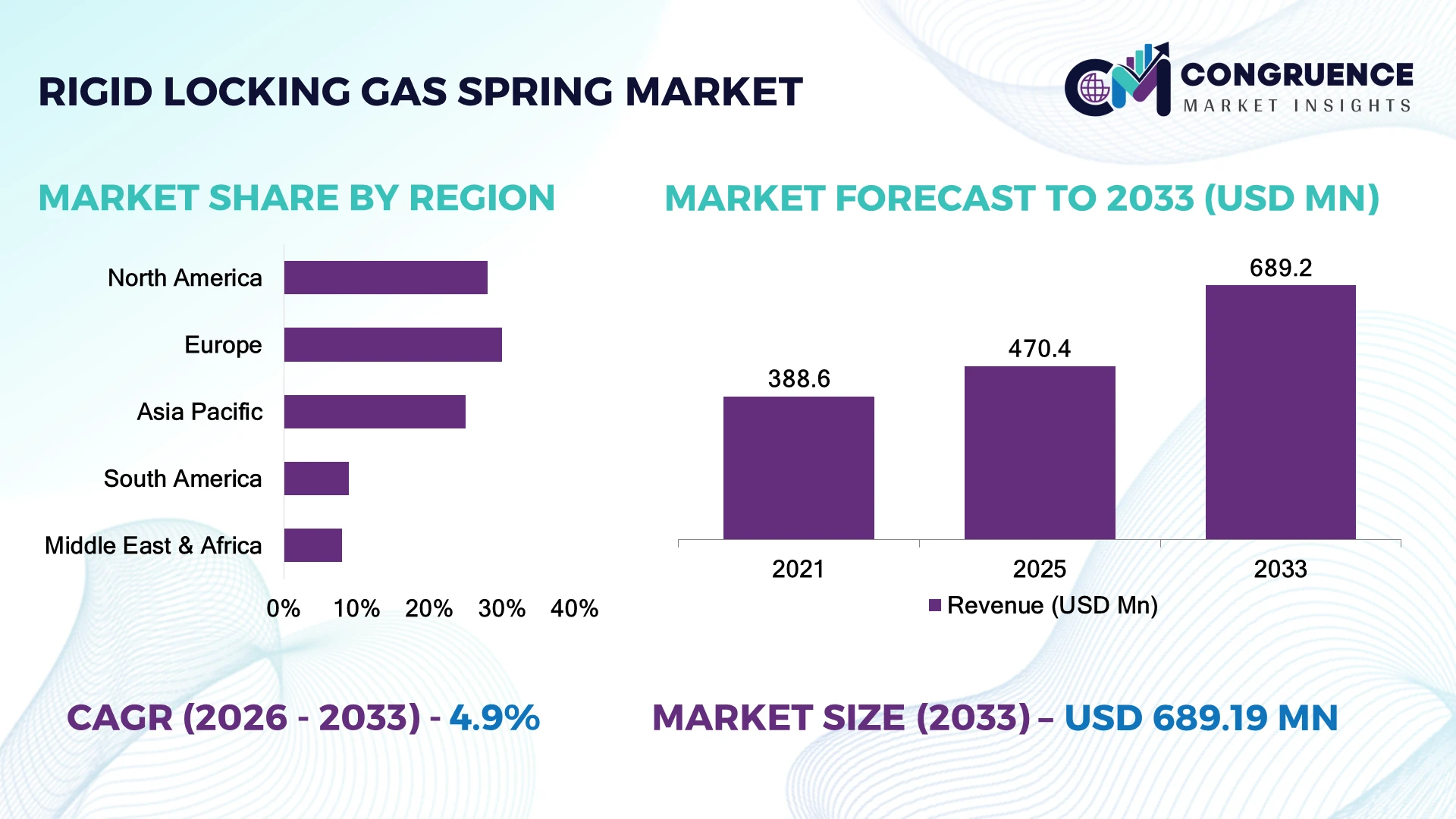
The Global Rigid Locking Gas Spring Market was valued at USD 470.4 Million in 2025 and is anticipated to reach a value of USD 689.2 Million by 2033 expanding at a CAGR of 4.89% between 2026 and 2033. Growth is driven by rising adoption of adjustable seating systems, industrial automation equipment, and lightweight ergonomic mechanisms across automotive, healthcare, and aerospace applications.
Germany leads the global market with nearly 24% share supported by advanced automotive manufacturing, over USD 15 billion annual industrial automation investments, and increasing deployment of precision mechanical components. China follows with more than 20% share, benefiting from large-scale machinery production and smart factory expansion under Industry 4.0 initiatives. Germany’s engineering-intensive adoption remains higher than China’s cost-focused manufacturing integration, creating a competitive technology gap of approximately 15% in advanced component utilization.
Companies are prioritizing localized production, material innovation, and automation partnerships to strengthen long-term market positioning.
Market Size & Growth: USD 470.4 Million in 2025 expanding to USD 689.2 Million by 2033 at 4.89% CAGR, driven by automation-enabled industrial equipment upgrades.
Top Growth Drivers: Industrial automation adoption 35%, ergonomic equipment demand 28%, automotive lightweighting initiatives 22%.
Short-Term Forecast: By 2028, advanced gas spring systems reduce installation time by 20% and improve operational efficiency by 15%.
Emerging Technologies: AI-enabled manufacturing, automated quality inspection, and advanced alloy materials are reshaping precision gas spring production.
Regional Leaders: Asia Pacific reaches approximately USD 280 Million by 2033 through smart manufacturing; Europe approaches USD 210 Million through premium engineering adoption; North America exceeds USD 150 Million through healthcare and automotive integration.
Consumer/End-User Trends: Over 45% of industrial buyers prioritize adjustable and maintenance-efficient mechanical solutions for workplace and equipment upgrades.
Pilot/Case Example: In 2024, European automotive assembly upgrades using automated positioning systems achieved nearly 18% productivity improvement through optimized locking mechanisms.
Competitive Landscape: Leading manufacturers hold nearly 40% combined share, with key players including Stabilus, Suspa, Bansbach Easylift, Industrial Gas Springs, and Lesjöfors.
Regulatory & ESG Impact: Lightweight component adoption supports up to 12% material efficiency improvements and aligns with global manufacturing sustainability targets.
Investment & Funding: More than USD 500 Million in industrial automation expansion projects globally is accelerating partnerships and component innovation.
Innovation & Future Outlook: Next-generation locking mechanisms, smart sensors, and connected industrial components are shifting competition toward intelligent motion-control solutions.
Rigid Locking Gas Springs are gaining importance across automotive interiors, medical equipment, industrial machinery, and ergonomic furniture due to improved load control and operational safety. Around 30% of new industrial equipment designs increasingly integrate advanced positioning components, while manufacturers are adopting corrosion-resistant materials and compact designs. Supply-chain restructuring after global logistics disruptions has encouraged localized production hubs in Europe and Asia, creating opportunities for suppliers offering reliable, customized solutions and faster delivery capabilities.
The Rigid Locking Gas Spring Market is becoming strategically important as manufacturers across automotive, healthcare, and industrial equipment sectors prioritize precision movement, operator safety, and compact mechanical designs. The shift toward localized supply chains after disruptions in global manufacturing networks is encouraging companies to establish regional production capabilities and strengthen supplier partnerships.
Advanced locking gas springs now integrate improved sealing technologies and lightweight materials, delivering approximately 15–20% longer service life and reducing maintenance requirements compared with conventional mechanical supports. European manufacturers emphasize high-precision engineering, while Asian producers focus on scalable manufacturing and cost optimization, creating different competitive pathways across markets.
In automotive seating, medical equipment, and industrial workstations, deployment of adjustable locking mechanisms is increasing as companies seek ergonomic improvements and productivity gains. Manufacturers are investing in automated production lines, digital quality monitoring, and strategic collaborations to improve reliability and customization capabilities. Over the next 2–3 years, competitive advantage will depend on faster innovation cycles, regional manufacturing flexibility, and the ability to deliver energy-efficient, durable motion-control solutions for evolving industrial applications.
Industrial automation and ergonomic equipment modernization are major drivers accelerating rigid locking gas spring adoption. Manufacturing facilities in Germany, Japan, and China are increasing investment in automated machinery, where precise positioning components improve operational consistency. Approximately 35% of demand growth is linked to automation equipment upgrades, while automotive applications represent nearly 30% of industrial usage. The expansion of smart factories under Industry 4.0 initiatives is increasing demand for reliable mechanical control systems. Companies are responding by expanding precision manufacturing capacity, developing customized locking solutions, and forming partnerships with automation equipment suppliers to improve performance and reduce downtime.
Raw material price volatility and specialized component manufacturing requirements remain key limitations for market scalability. Steel and alloy cost fluctuations of 10–15% have affected production planning, while dependence on precision machining capabilities creates supplier concentration risks. Small and medium manufacturers in countries such as India and Southeast Asian markets face challenges accessing advanced production technologies compared with established European suppliers. Companies are reducing exposure through supplier diversification, regional sourcing strategies, and long-term material contracts. The strategic priority is shifting toward resilient supply networks that maintain quality standards while controlling production costs.
Integration of sensors, digital monitoring, and advanced materials creates new opportunities for next-generation rigid locking gas springs. Smart industrial equipment adoption is increasing, with approximately 25% of new machinery platforms incorporating connected monitoring capabilities. Emerging markets including India, Vietnam, and Mexico are expanding manufacturing infrastructure, creating demand for efficient positioning systems. Lightweight composite materials can improve component efficiency by nearly 15%, supporting broader adoption in automotive and aerospace applications. Companies are investing in R&D programs, automation partnerships, and localized manufacturing centers to capture demand from digitally enabled industrial ecosystems.
The market faces execution challenges related to product standardization, system integration, and evolving industrial requirements. Approximately 20% of industrial equipment manufacturers report difficulties integrating customized mechanical components into existing platforms. Differences in regional engineering standards across Europe, North America, and Asia increase development complexity and testing requirements. Workforce shortages in precision manufacturing further pressure production scalability. Companies must address these barriers through advanced simulation tools, workforce training programs, standardized product platforms, and stronger collaboration with equipment manufacturers to ensure consistent deployment performance and long-term competitiveness.
Smart Manufacturing Integration: Industrial producers are integrating automated machining, digital inspection, and predictive quality systems, with nearly 30% of component manufacturers adopting smart production workflows. This shift reduces defect rates by around 15% and enables faster customization. Companies in Germany and Japan are expanding automation partnerships to improve precision output and shorten manufacturing cycles.
Lightweight Material Transition: Automotive and aerospace suppliers are increasing adoption of aluminum alloys and advanced composites, achieving approximately 12–18% weight reduction compared with traditional steel-based components. Rising vehicle efficiency standards and material optimization programs are accelerating this transition. Manufacturers are restructuring product portfolios toward corrosion-resistant and lightweight locking gas spring designs.
Localized Supply Chain Expansion: Global supply disruptions have encouraged companies to establish regional sourcing networks, with nearly 25% of industrial component suppliers increasing local production capacity since 2024. Enterprises in India, China, and Mexico are developing supplier ecosystems to reduce delivery delays and improve inventory control. Manufacturers are responding through regional facilities and strategic supplier agreements.
Ergonomic Equipment Modernization: Workplace safety requirements and labor shortages are increasing demand for adjustable mechanical systems, with more than 40% of new industrial workstation designs incorporating ergonomic positioning solutions. Healthcare and manufacturing sectors are upgrading equipment to improve operator efficiency. Companies are investing in customized gas spring solutions to support evolving workplace design standards.
Rigid locking gas springs with fixed locking mechanisms represent the leading segment, accounting for approximately 55% of market adoption due to their reliability, load stability, and suitability for industrial equipment applications. Their strong integration across automotive seating, medical devices, and machinery platforms supports continued dominance. Adjustable locking variants are the fastest-growing type, expanding as manufacturers seek flexible positioning solutions that improve operational efficiency by nearly 20% in specialized equipment environments.
Traditional non-adjustable systems maintain relevance in cost-sensitive applications, particularly in furniture and basic industrial products, while advanced locking configurations are gaining investment attention. Approximately 35% of manufacturers are increasing focus on customized locking technologies to address application-specific requirements. Companies are expanding product development programs, improving sealing technologies, and forming partnerships with equipment manufacturers to capture demand from high-performance industrial applications.
Industrial machinery applications dominate the rigid locking gas spring market with nearly 45% share, driven by demand for controlled movement, operator safety, and equipment adjustment capabilities. Manufacturing systems, automation equipment, and assembly platforms increasingly use these components to improve workflow efficiency. Automotive applications represent the fastest-growing segment, supported by rising integration of adjustable seating, interior systems, and lightweight mechanical solutions, with adoption increasing by approximately 25% across new vehicle platforms.
Healthcare equipment and furniture applications continue expanding through ergonomic upgrades and accessibility-focused designs. Around 30% of new medical workstation and patient-support equipment incorporates advanced positioning mechanisms. Companies are adapting through application-specific engineering, automation integration, and expanded customization services. Growing manufacturing investments in China and India are further increasing demand for reliable motion-control components across industrial facilities.
The manufacturing sector leads end-user adoption with approximately 50% market share due to extensive deployment in machinery, automotive production lines, and industrial workstations. High operational intensity and demand for precision movement systems continue driving purchases. Healthcare is the fastest-growing end-user segment, supported by increasing modernization of medical equipment and ergonomic requirements, with adoption expanding by nearly 22% in advanced care facilities.
Automotive, aerospace, and commercial furniture users continue contributing to market diversification through specialized applications. Around 30% of enterprise buyers are shifting toward customized gas spring solutions rather than standardized components to improve equipment performance and lifecycle value. Companies are strengthening relationships with OEMs, expanding application engineering teams, and introducing modular product ranges to serve different industrial requirements.
Europe accounted for the largest market share at 30% in 2025 however, Asia-Pacific is expected to register the fastest growth, expanding at a CAGR of 5.6% between 2026 and 2033.

North America accounted for approximately 28% of the global rigid locking gas spring market in 2025, supported by strong automotive, aerospace, healthcare equipment, and industrial machinery applications. The United States remains the primary contributor due to its advanced manufacturing infrastructure and high adoption of automated production systems. Around 35% of new industrial equipment upgrades in the region incorporate adjustable positioning components to improve workflow efficiency and operator safety. Rising reshoring activities and supply-chain localization initiatives are encouraging domestic production and supplier partnerships. Companies are investing in automated manufacturing, precision engineering capabilities, and customized product development to support demand from high-performance industrial applications.
United States Market Outlook: The United States represents the leading North American market due to its extensive automotive, aerospace, and industrial automation ecosystem. Nearly 40% of industrial modernization projects emphasize ergonomic improvements and precision motion-control solutions. Manufacturers are expanding domestic supply networks, adopting advanced quality systems, and collaborating with equipment producers to improve reliability, customization, and delivery performance.
Europe accounted for the largest share of the global rigid locking gas spring market at approximately 30% in 2025, driven by Germany’s automotive manufacturing strength, industrial automation expertise, and precision component ecosystem. Germany, Italy, and France represent the major deployment centers across automotive seating, machinery, healthcare equipment, and industrial systems. More than 40% of European industrial equipment manufacturers are integrating advanced positioning components to improve operational efficiency and equipment flexibility. Sustainability regulations and Industry 4.0 adoption are encouraging lightweight designs and automated production processes. Companies are expanding engineering capabilities, strengthening regional manufacturing networks, and developing application-specific locking gas spring solutions for premium industrial applications.
Germany Market Outlook: Germany leads the European market due to its strong automotive production base, machinery exports, and advanced engineering capabilities. The country contributes nearly 35% of Europe’s rigid locking gas spring demand, supported by extensive OEM networks and industrial automation adoption. Manufacturers are increasing investments in smart factory technologies and precision component production to maintain technological leadership.
Asia-Pacific represents approximately 25% of the global rigid locking gas spring market in 2025 and is expected to record the fastest expansion due to manufacturing growth, industrial automation adoption, and infrastructure modernization. China, Japan, South Korea, and India are the key contributors, with China accounting for a significant portion of regional demand through automotive production and machinery manufacturing. Over 30% of new manufacturing facilities across major industrial hubs are incorporating automated equipment requiring advanced positioning components. Increasing export manufacturing, supply-chain diversification, and local production expansion are strengthening regional demand. Companies are establishing manufacturing facilities, improving supplier ecosystems, and introducing cost-efficient product designs to address growing industrial requirements.
China Market Outlook: China remains the largest Asia-Pacific contributor due to its extensive manufacturing ecosystem and high-volume industrial production. The country accounts for more than 45% of regional machinery output, supporting strong demand for rigid locking gas springs. Manufacturers are enhancing automation capabilities, expanding domestic component production, and forming partnerships with industrial equipment suppliers to improve competitiveness.
South America contributes approximately 9% of the global rigid locking gas spring market, with demand concentrated in Brazil and Argentina across automotive, agricultural machinery, and industrial equipment sectors. Brazil represents the largest regional market due to its manufacturing infrastructure and industrial equipment usage. Nearly 20% of modernization initiatives within manufacturing facilities involve upgrades to mechanical positioning and support systems. However, dependence on imported precision components and limited local production capabilities continue influencing adoption patterns. Companies are responding by developing regional distribution networks, improving technical support services, and forming partnerships with equipment manufacturers to increase availability and address application-specific requirements.
Brazil Market Outlook: Brazil remains the dominant South American market due to its automotive manufacturing, agricultural machinery, and industrial processing sectors. Around 25% of machinery improvement programs focus on increasing operational efficiency through upgraded mechanical components. Suppliers are strengthening local partnerships and expanding service capabilities to support long-term adoption.
Middle East & Africa represents nearly 8% of global rigid locking gas spring demand, with adoption driven by infrastructure development, healthcare modernization, and industrial diversification projects. Saudi Arabia, the UAE, and South Africa are the primary markets, supported by investments in manufacturing facilities, industrial equipment, and advanced infrastructure systems. Approximately 15% of regional industrial investments are linked to automation and modernization initiatives requiring reliable mechanical components. Growing focus on local manufacturing capabilities and technology adoption is encouraging suppliers to establish regional partnerships. Companies are expanding distribution channels, providing customized engineering solutions, and developing project-based supply models to support emerging industrial applications.
Saudi Arabia Market Outlook: Saudi Arabia is the key Middle East market due to industrial diversification programs, infrastructure expansion, and manufacturing development initiatives. New industrial facilities are increasingly adopting automated equipment solutions, creating demand for precision mechanical components. Suppliers are establishing regional collaborations and service networks to support project execution and strengthen long-term market presence.
The Rigid Locking Gas Spring Market features competition between global motion-control leaders such as Stabilus, Suspa, Bansbach Easylift, and ACE Controls against regional manufacturers focused on cost efficiency and customization. The top five players collectively account for approximately 40% of market share, creating a moderately consolidated structure. Competition is based on precision engineering, product reliability, pricing, customization capability, and supply-chain responsiveness. Premium manufacturers invest 20–30% of development efforts toward advanced motion-control solutions, while regional suppliers compete through shorter lead times and lower production costs. Companies are expanding through automation partnerships, localized manufacturing, and application-specific product development. The market is shifting toward integrated solutions, with smart components and customized locking systems gaining importance over traditional standardized products. High tooling requirements, engineering expertise, and OEM qualification processes create entry barriers. Winning requires combining technology leadership, flexible production, and strong industrial partnerships.
Suspa GmbH
Bansbach Easylift GmbH
ACE Controls Inc.
HAHN Gasfedern GmbH
Lesjöfors AB
DICTATOR Technik GmbH
Camloc Motion Control Ltd.
Barnes Group Inc.
Vapsint Srl
Industrial Gas Springs Ltd.
Wan Der Ful Co., Ltd.
Changzhou Lige Gas Spring Co., Ltd.
Rigid locking gas spring technology is evolving from conventional mechanical designs toward advanced motion-control systems using improved sealing materials, corrosion-resistant alloys, and precision manufacturing processes. Modern gas springs achieve approximately 15% longer operating life compared with older designs through improved damping control and material optimization. Around 30% of industrial equipment manufacturers are prioritizing customized motion components to improve equipment flexibility and reliability.
Smart integration is becoming a competitive differentiator as manufacturers combine sensors, automation controls, and digital monitoring capabilities with mechanical support systems. Compared with traditional manual adjustment solutions, automated positioning technologies improve operational efficiency by nearly 20% and reduce adjustment time by approximately 25%. Leading suppliers are targeting automotive, healthcare, and industrial automation customers through connected component development.
Between 2026 and 2028, advanced materials, compact actuator integration, and digitally enabled maintenance solutions will influence product strategies. Global technology leaders benefit through premium positioning, while cost-focused manufacturers are adopting scalable production methods to compete. Companies acting early on automation compatibility and customized engineering will gain stronger customer retention and application expansion opportunities.
July 2025 Stabilus introduced the Industrial POWERISE IPR35 Smart with integrated motor control, expanding automated positioning capabilities for industrial applications. The compact solution enables controlled lifting and positioning functions without external control units, improving system integration flexibility. Source: stabilus.com
June 2025 Lesjöfors launched its NitroSpring gas spring range through its global webshop expansion strategy. The product delivers forces up to 8,000N and features compact designs up to 50% smaller than traditional alternatives, improving installation flexibility across industrial applications. Source: lesjofors.com
September 2025 Stabilus expanded its Stabilus4Automation portfolio by combining automation solutions from Stabilus, ACE, Destaco, Fabreeka, and Hahn Gasfedern. The integrated offering strengthens industrial automation positioning across automotive, pharmaceutical, and manufacturing sectors through broader solution coverage. Source: group.stabilus.com
February 2025 Lesjöfors expanded its global manufacturing footprint through the acquisition of International Industrial Springs in India. The acquisition added six production plants in Mumbai and strengthened access to engineering, energy, and industrial customers. Source: lesjofors.com
The Rigid Locking Gas Spring Market Report provides comprehensive coverage across product types, applications, end-user industries, and major geographic markets. The study evaluates locking mechanism categories, industrial machinery applications, automotive systems, healthcare equipment, furniture solutions, and emerging niche deployment areas. Regional analysis covers North America, Europe, Asia-Pacific, South America, and Middle East & Africa with country-level insights on manufacturing capabilities, adoption patterns, and industrial investments.
The report examines technology trends including advanced materials, automation integration, precision manufacturing, and customized motion-control solutions. It analyzes competitive positioning of major manufacturers, supply-chain developments, strategic partnerships, and innovation priorities. The report supports investment planning, market entry strategies, expansion decisions, and competitive benchmarking by identifying high-potential applications, evolving customer requirements, and future industry direction through 2033.
| Report Attribute / Metric | Details |
|---|---|
| Market Revenue (2025) | USD 470.4 Million |
| Market Revenue (2033) | USD 689.2 Million |
| CAGR (2026–2033) | 4.89% |
| Base Year | 2025 |
| Forecast Period | 2026–2033 |
| Historic Period | 2021–2025 |
| Segments Covered |
By Type
By Application
By End-User
|
| Key Deliverables | Revenue Forecast; Market Trends; Growth Drivers & Restraints; Technology Insights; Segmentation Analysis; Regional Insights; Competitive Landscape; Regulatory & ESG Overview; Recent Developments |
| Regions Covered | North America; Europe; Asia-Pacific; South America; Middle East & Africa |
| Companies Profiled | Stabilus SE; Suspa GmbH; Bansbach Easylift GmbH; ACE Controls Inc.; HAHN Gasfedern GmbH; Lesjöfors AB; DICTATOR Technik GmbH; Camloc Motion Control Ltd.; Barnes Group Inc.; Vapsint Srl; Industrial Gas Springs Ltd.; Wan Der Ful Co., Ltd.; Changzhou Lige Gas Spring Co., Ltd. |
| Customization & Pricing | Available on Request (10% Customization Free) |




