
Reports
The Global Rigid Food Packaging Market was valued at USD 335563.5 Million in 2025 and is anticipated to reach a value of USD 484560.6 Million by 2033 expanding at a CAGR of 4.7% between 2026 and 2033. Growth is driven by lightweighting, recyclable mono-material conversion, automated filling lines, recycled-content integration, and rising requirements for high-barrier packaging across ready meals, dairy, meat, bakery, and processed foods.
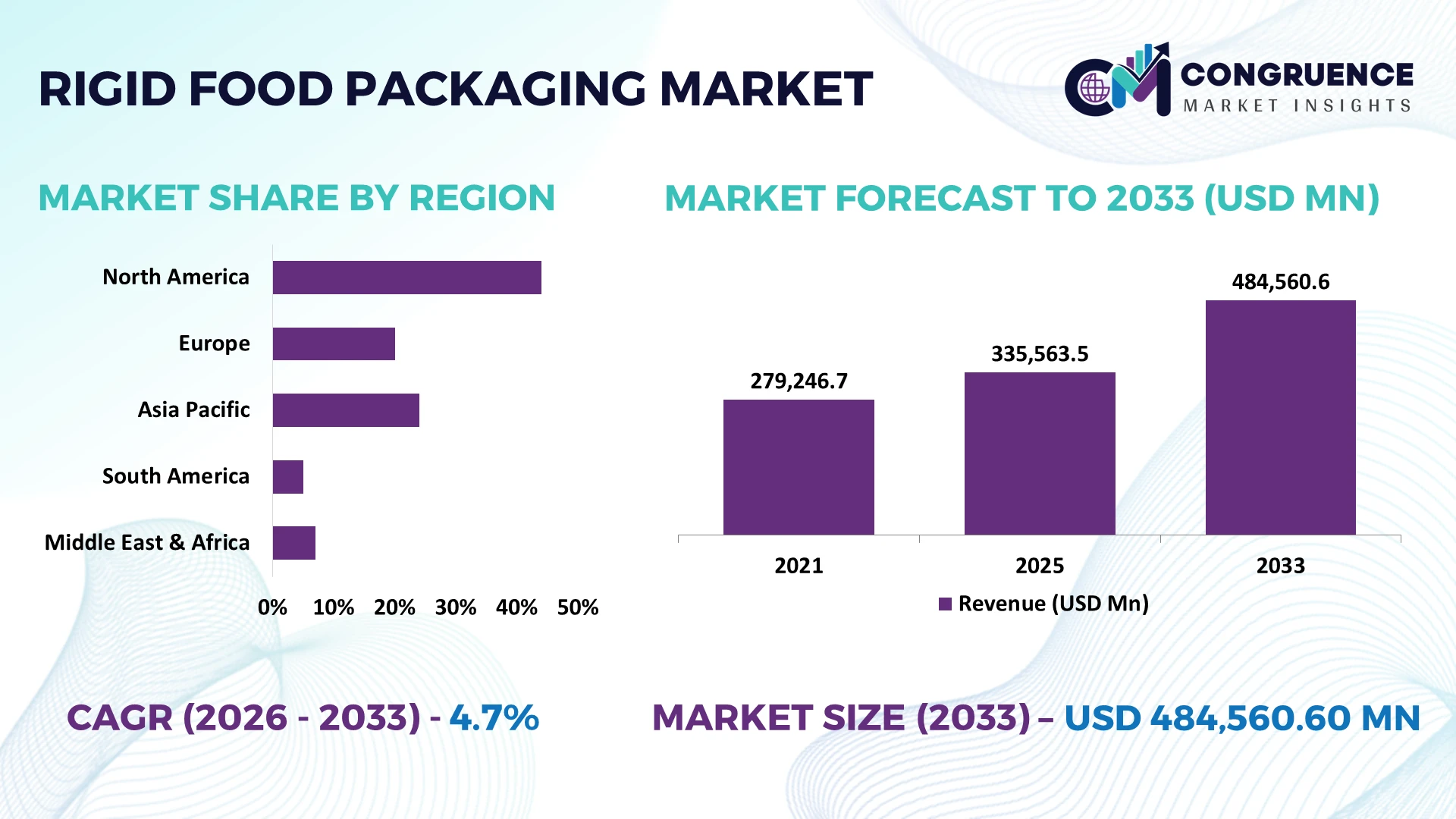
China remains the dominant rigid food packaging production base, supported by its large food-processing sector, polymer-conversion capacity, and automated packaging infrastructure. Asia Pacific accounts for approximately 40% of global demand, compared with around 27% for North America, while India is accelerating capacity investments in food processing and recyclable packaging. EU PPWR implementation in 2026 is further accelerating material redesign and recycling compliance.
Strategically, suppliers with scalable recycled-material capacity and automation-ready formats are best positioned to capture high-growth food-packaging contracts.
Market Size & Growth: USD 335563.5 Million in 2025 is projected to reach USD 484560.6 Million by 2033 at a 4.7% CAGR, supported by lightweighting and recyclable formats.
Top Growth Drivers: Lightweighting contributes approximately 30%, recyclable-material conversion 25%, and convenience-food expansion 20% to key demand momentum.
Short-Term Forecast: By 2028, automated inspection and robotic handling can reduce packaging-line labor requirements by approximately 10–15%.
Emerging Technologies: AI-enabled inspection, robotic packaging, advanced barrier coatings, and recycled PET/PP formulations are reshaping rigid food packaging.
Regional Leaders: Asia Pacific is projected at roughly USD 194 billion by 2033, North America near USD 131 billion, and Europe around USD 116 billion, led by recycling and convenience-format adoption.
Consumer Trends: Convenience-oriented rigid trays, tubs, and containers represent approximately 60% of usage across major prepared-food applications, strengthening demand for resealable and portion-controlled formats.
Pilot & Automation: Automated vision inspection can deliver defect-detection accuracy above 95%, improving quality control while reducing manual inspection dependency.
Competitive Landscape: Amcor, Berry Global, Sonoco, Sealed Air, and Silgan Holdings remain leading participants, while the fragmented structure keeps individual-company share generally below 10%.
Regulatory & ESG Impact: EU PPWR requirements taking effect in 2026 are accelerating recyclable-design adoption and increasing pressure for measurable recycled-content integration.
Investment & Expansion: More than USD 1 billion in recent capacity, recycling, and material-development commitments across the packaging sector is shifting investment toward circular polymers and advanced conversion.
Innovation & Future Outlook: AI-driven material optimization, chemical recycling, high-barrier mono-materials, and digital traceability are shifting competition from packaging volume toward recyclability, performance, and total lifecycle cost.
The Rigid Food Packaging Market is gaining traction across dairy, ready meals, meat, bakery, processed foods, and convenience products where barrier protection and structural strength are critical. Recyclable PET and PP formats are expanding, while lightweighting initiatives target 5–15% material reduction. In 2026, EU PPWR compliance is accelerating packaging redesign and supplier qualification, strengthening the strategic focus on recyclable, traceable, and automation-compatible formats.
Rigid food packaging is becoming strategically important because packaging performance increasingly influences shelf life, food waste, automation compatibility, regulatory compliance, and brand economics. Lightweighting programs are reducing material use by roughly 5–15% while maintaining structural performance, making material engineering a direct lever for margin protection. Supply-chain restructuring and 2026 packaging regulations are also pushing producers toward recyclable, traceable, and locally sourced packaging inputs.
Technology adoption is widening the gap between legacy and automated operations. Machine-vision inspection and robotic handling can improve line productivity by approximately 10–20% while reducing manual quality checks, particularly in high-volume food-processing plants. China retains the largest manufacturing scale, while Japan and Germany emphasize precision automation and high-barrier materials. India is expanding modern food-processing infrastructure, creating opportunities for standardized trays, tubs, and containers.
Over the next 2–3 years, recycled-content integration, automated inspection, and mono-material conversion are expected to become increasingly common across large food-packaging facilities. For example, automated tray-forming and vision-inspection systems can support faster changeovers and tighter defect control. Companies are therefore prioritizing recycling partnerships, localized resin sourcing, and automation upgrades. Competitive advantage will increasingly depend on combining material efficiency, regulatory readiness, and production reliability.
Automation and recyclable-format conversion are accelerating rigid food packaging investment as processors seek higher throughput with lower material intensity. Lightweighting programs typically deliver 5–15% material savings, while automated inspection and robotic handling can improve production efficiency by 10–20%. In China, large food-processing clusters are integrating automated thermoforming, filling, and vision-inspection systems to support high-volume operations. Meanwhile, EU regulatory changes in 2026 are strengthening demand for recyclable packaging architectures. Companies are responding through recycled PET and PP development, automation upgrades, and partnerships with resin suppliers. The non-obvious advantage is greater production consistency: standardized automated formats reduce quality variation while simultaneously improving material utilization and supporting compliance-driven redesign.
Polymer price volatility remains a structural constraint because rigid packaging manufacturers depend heavily on PET, PP, HDPE, and specialty barrier materials. Resin-cost movements of 10–20% can materially affect packaging conversion economics, particularly for high-volume food processors operating under fixed-price contracts. Imported specialty polymers also expose manufacturers in India and Southeast Asia to freight disruptions and currency fluctuations. Recycled resin availability creates an additional constraint, with food-grade recycled material requiring stringent sorting, decontamination, and certification. Companies are responding through multi-supplier contracts, localized procurement, recycled-material partnerships, and greater use of alternative polymer structures. The strategic pressure is shifting from simply securing resin volume toward maintaining predictable material quality and cost across production cycles.
Smart lightweighting and circular-material engineering offer significant opportunities beyond conventional packaging-volume expansion. Advanced design tools can reduce polymer consumption by approximately 5–15%, while recycled-content integration can lower dependence on virgin resin by 20–30% in suitable formats. India, Indonesia, and Vietnam present attractive opportunities as food-processing infrastructure modernizes and organized retail expands. AI-assisted material modeling and digital simulation are enabling manufacturers to optimize wall thickness, rigidity, barrier performance, and recyclability before commercial tooling. Companies are increasing R&D investment, forming recycling partnerships, and establishing regional conversion capacity. A key opportunity lies in designing packaging simultaneously for automated filling and end-of-life recovery, allowing suppliers to sell measurable operational efficiency rather than packaging units alone.
Scaling circular rigid food packaging remains an execution challenge because recycling infrastructure, food-grade resin availability, and standardized collection systems remain uneven across major markets. Recycled-content requirements can increase material qualification and processing complexity by 10–20%, while inconsistent feedstock quality can create yield losses during conversion. India faces collection and sorting fragmentation outside major urban centers, whereas Germany has more mature recovery infrastructure but stricter material and documentation requirements. Companies must therefore invest in closed-loop procurement, advanced sorting partnerships, digital material traceability, and flexible processing equipment. The critical long-term issue is interoperability between packaging design and recovery infrastructure; suppliers that optimize products without considering downstream recycling compatibility risk higher qualification costs and weaker customer adoption.
Mono-Material Conversion Accelerates: Food-packaging converters are replacing complex multilayer structures with recyclable PP and PET formats, targeting 10–20% lower material complexity and faster sorting. EU 2026 regulatory pressure is accelerating redesign, while manufacturers are expanding mono-material tooling and recycled-resin partnerships to protect compliance and customer access.
Automation Targets Labor Gaps: Packaging plants are increasing robotic palletizing, machine vision, and automated changeovers as workforce shortages intensify. PMMI reports that 88% of surveyed snack-food companies planned machinery purchases through 2027, with 57% of planned purchases replacing equipment typically 20–30 years old.
India Capacity Becomes Localized: Indian processors and converters are investing in localized packaging machinery, resin sourcing, and flexible production systems. PMMI identifies automation, sustainability-ready machinery, and localization as key 2025 investment patterns, reducing dependence on imported equipment and improving format-change responsiveness.
Traceability Enters Packaging Workflows: Digital production monitoring, embedded sensors, and machine-level data are moving quality control beyond end-of-line inspection. Predictive maintenance and remote OEM support are gaining traction as manufacturers address workforce gaps, reducing unplanned downtime and improving consistency across high-speed packaging operations.
Rigid Plastic Packaging is the leading type, estimated at approximately 48% of demand, supported by lightweight construction, scalable thermoforming and injection molding, barrier performance, and compatibility with automated filling. Metal Packaging follows with roughly 21%, retaining strength in shelf-stable foods where oxygen and light protection are critical. Glass Packaging accounts for about 18%, concentrated in premium, dairy, sauces, and products where inertness and reusable-packaging positioning strengthen brand value. Paperboard Packaging represents approximately 13% and is gaining relevance where recyclable fiber-based structures can replace selected rigid plastic applications.
Paperboard is the fastest-shifting segment, with adoption increasing around 6–8% in targeted food formats as converters improve moisture and grease resistance. Companies are prioritizing mono-material plastics, lightweight glass, high-recycled-content metal, and coated paperboard according to application-specific performance requirements. India’s rigid plastic market illustrates the scale advantage: bottles and jars represented 35.31% of rigid plastic packaging in 2025, while trays and containers are expanding faster as ready-to-eat formats gain traction.
Bottles & Jars represent the leading application at approximately 39% of rigid food packaging demand, reflecting extensive deployment across dairy, sauces, condiments, edible oils, and processed foods. Their established filling infrastructure, standardized closures, and efficient logistics create a strong installed-base advantage. Cans account for roughly 24%, while Trays & Containers hold around 22% and are gaining importance as prepared meals and portion-controlled food formats expand. Cartons contribute approximately 15%, retaining relevance where lightweight distribution and fiber-based structures provide cost advantages.
Trays & Containers are the fastest-growing application, with adoption expanding approximately 7–9% in high-volume prepared-food operations. India’s rigid plastic market recorded bottles and jars at 35.31% share in 2025, while trays and containers are projected to expand at 6.71% annually through 2031, demonstrating the operational shift toward portioning, heat resistance, and automated sealing. Companies are therefore expanding thermoforming capacity, integrating automated sealing, and developing barrier-enhanced trays to secure ready-meal and chilled-food contracts.
Food Processing is the dominant end-user, estimated at approximately 38% of rigid food packaging demand, because high-volume processors require standardized containers, trays, jars, and cans across multiple product categories. Beverage Manufacturers account for about 22%, while Dairy & Frozen Foods contribute nearly 17%. Bakery & Confectionery represents approximately 13%, and Meat & Seafood accounts for around 10%, with the latter requiring stronger barrier performance and controlled-atmosphere compatibility.
Dairy & Frozen Foods represent the fastest-shifting demand group, with advanced rigid formats gaining approximately 6–8% adoption as cold-chain infrastructure and convenience-food production expand. Food processors are prioritizing lightweight trays, high-barrier containers, recyclable PET/PP, and automated sealing to improve throughput and reduce material consumption. Beverage manufacturers are simultaneously strengthening local can and bottle capacity in India, where packaging supply disruptions in 2026 pushed glass-bottle prices up by approximately 20%, demonstrating the operational value of diversified sourcing and localized capacity. Companies are responding through supplier diversification, long-term material contracts, and regional production partnerships.
Asia-Pacific accounted for the largest market share at approximately 40% in 2025 however, South America is expected to register the fastest growth, supported by expanding food-processing capacity and modernization of packaging infrastructure.
Automation and high-performance formats reshape mature capacity
North America maintains a strong position in rigid food packaging, supported by large-scale food processors, established recycling infrastructure, and highly automated packaging plants. The United States concentrates most regional production and deployment, particularly across dairy, processed foods, meat, and ready-meal operations. Automated inspection, robotic palletizing, and high-speed thermoforming are increasingly integrated into replacement projects, with packaging-line automation capable of improving throughput by approximately 10–20%. Recycled PET and polypropylene adoption is also strengthening as brand owners pursue material-efficiency targets. Canada contributes through food-processing and sustainable packaging investments, while Mexico benefits from nearshoring and proximity to U.S. manufacturing networks. Companies are prioritizing equipment modernization, localized resin sourcing, and long-term supplier agreements to reduce operational disruption and improve production flexibility.
United States Market Outlook: The United States remains the region's primary manufacturing and technology center, with sophisticated food-processing infrastructure and extensive automated packaging deployment. Large processors increasingly integrate machine vision and robotic handling into high-volume facilities, while recycled-content procurement and lightweighting programs support cost and compliance objectives.
Regulatory redesign accelerates circular packaging investment
Europe is undergoing a structural packaging redesign driven by recycling requirements, extended producer responsibility, and increasingly automated food-processing operations. Germany, Italy, France, and the United Kingdom represent major manufacturing and consumption centers, with rigid packaging concentrated across dairy, processed foods, bakery, and prepared meals. EU packaging-policy implementation in 2026 is accelerating mono-material conversion, recycled-content integration, and design-for-recycling programs. Lightweighting initiatives can reduce material consumption by approximately 5–15%, improving both logistics efficiency and environmental performance. European converters are investing in advanced sorting compatibility, high-barrier recyclable structures, and digital quality-control systems. Companies are also strengthening recycling partnerships and regional material procurement to reduce exposure to virgin-polymer volatility while maintaining food-contact performance.
Germany Market Outlook: Germany combines advanced food-processing infrastructure with strong recycling and industrial automation capabilities. Packaging manufacturers increasingly deploy robotic handling, automated inspection, and recyclable-material systems across high-volume facilities. Its engineering ecosystem supports precision thermoforming and material optimization, enabling suppliers to address increasingly stringent packaging-design and circularity requirements.
Manufacturing scale drives automated packaging expansion
Asia-Pacific represents the largest demand and production base, supported by extensive food-processing capacity, expanding organized retail, and rapid packaging-line modernization. China remains the principal manufacturing hub, while Japan and South Korea emphasize precision automation and advanced barrier technologies. India is rapidly expanding food-processing infrastructure and domestic packaging conversion capacity, strengthening demand for bottles, jars, trays, containers, and cans. Regional manufacturers are increasingly integrating automated filling, sealing, vision inspection, and robotic material handling, with automation improving throughput by approximately 10–20% in suitable high-volume operations. Export-oriented production in China and Southeast Asia also supports economies of scale. Companies are responding through localized resin sourcing, new conversion capacity, equipment partnerships, and recycled-material development to reduce supply-chain exposure.
China Market Outlook: China holds the strongest industrial position through extensive polymer-conversion capacity, food-processing clusters, and integrated manufacturing infrastructure. Large converters increasingly combine automated thermoforming and injection molding with digital inspection systems. Its mature supplier ecosystem supports shorter procurement cycles and large-volume production, giving domestic manufacturers a significant cost and scale advantage.
Food-processing modernization strengthens regional demand
South America is led by Brazil, where large-scale meat, dairy, beverage, processed-food, and agricultural industries generate substantial demand for rigid containers, trays, cans, and jars. Modernization of food-processing facilities is increasing requirements for standardized packaging compatible with automated filling and sealing. Brazil also benefits from a broad domestic polymer-conversion base, although imported machinery and specialty materials remain exposed to currency and logistics volatility. Automated packaging systems can improve throughput by approximately 10–15% while reducing manual handling requirements. Argentina and Chile provide additional demand through food exports and organized retail development. Companies are responding with localized production, equipment upgrades, and supplier diversification. The key operational advantage increasingly lies in integrating packaging capacity directly with food-processing and cold-chain infrastructure.
Brazil Market Outlook: Brazil is the region's principal industrial and food-processing market, supported by extensive meat, dairy, agricultural, and processed-food production. Its large domestic consumer base supports high-volume packaging deployment, while local converters are investing in automated forming, filling, and sealing equipment to improve consistency and reduce dependence on imported finished packaging.
Food-security investment accelerates packaging localization
Middle East & Africa is experiencing increasing rigid food packaging investment alongside food-security programs, local manufacturing initiatives, and modernization of processing infrastructure. Saudi Arabia and the United Arab Emirates are developing advanced food-processing and logistics facilities, while South Africa provides the region's strongest established packaging-conversion base. Automated packaging adoption remains below mature markets, creating opportunities for equipment modernization and high-throughput container production. New processing facilities increasingly specify packaging systems capable of supporting 10–15% higher throughput than manually intensive operations. Companies are establishing local conversion capacity, forming technology partnerships, and diversifying polymer procurement to reduce import dependency. The non-obvious opportunity is integration between food-processing, warehousing, and packaging facilities, which can reduce transportation movements and improve supply continuity.
Saudi Arabia Market Outlook: Saudi Arabia is becoming a strategic packaging hub through food-security investments, modern processing facilities, and logistics infrastructure development. Domestic manufacturers are expanding rigid-container conversion and automated packaging capabilities to support local food production. Integration with large food-processing projects provides suppliers opportunities to establish long-term contracts and localized technical-service networks.
The Rigid Food Packaging Market features global packaging leaders including Amcor, Berry Global, Sonoco, Sealed Air, and Silgan Holdings competing with regional converters and specialized material suppliers. The top five players collectively hold an estimated 20–25% share, reflecting a fragmented structure. Competition centers on material efficiency, recycled-content capability, supply reliability, automation compatibility, and customization, with lightweighting reducing material use by 5–15% and automated systems improving throughput by 10–20%. Global leaders are expanding recycling capabilities and integrating vertically across material conversion, while regional players compete through shorter lead times and localized production. Partnerships between converters, resin suppliers, recyclers, and food manufacturers are becoming more important as regulatory requirements tighten. Entry barriers remain significant because food-contact certification, tooling investment, quality consistency, and established processor relationships require substantial capital and technical expertise. Winning requires scalable conversion, reliable material access, regulatory readiness, and application-specific innovation.
Amcor plc
Berry Global Group, Inc.
Sonoco Products Company
Sealed Air Corporation
Silgan Holdings Inc.
Pactiv Evergreen Inc.
Winpak Ltd.
Crown Holdings, Inc.
Ardagh Group S.A.
Tetra Laval International S.A.
Plastipak Holdings, Inc.
ALPLA Group
Huhtamaki Oyj
Greif, Inc.
Current rigid food packaging technology is centered on automated thermoforming, injection molding, machine vision, high-barrier coatings, and lightweight PET/PP structures. Compared with older manual inspection and changeover systems, integrated automation can improve throughput by 10–20% and reduce material use by 5–15%. Adoption is strongest in high-volume plants, where automated inspection and robotic handling directly improve consistency, labor utilization, and line availability.
Emerging systems combine AI-enabled defect detection, digital production monitoring, recycled-resin processing, and advanced barrier engineering. AI-assisted inspection can reduce manual quality-control workload by roughly 15–25%, while recycled-content processing increasingly supports PCR levels of 30–100% in selected rigid formats. Large converters benefit most because scale enables faster validation, lower unit costs, and standardized technology deployment across multiple facilities and customers.
Disruptive development through 2026–2028 will center on closed-loop recycling, digital traceability, AI material optimization, and high-barrier mono-material structures. Companies integrating recycling with conversion gain stronger feedstock control, while processors adopting connected lines gain faster changeovers and predictive maintenance. Technology investment now matters because regulatory redesign, labor constraints, and customer sustainability requirements are simultaneously compressing the window for legacy equipment replacement and accelerating competitive differentiation. By 2028, connected packaging lines are expected to become standard across leading multinational food-processing facilities globally.
June 2025 Coveris launched BarrierFresh MAP trays using board and EVOH barrier film, reducing plastic by 90% while delivering a 21-day shelf life. The format targets meat, fish and poultry processors, supporting material reduction without sacrificing protection. Source: (Packaging Europe)
January 2025 PMMI reported 88% of surveyed snack-food manufacturers planned machinery purchases through 2027, while 57% of purchases would replace equipment typically 20–30 years old. The shift strengthens demand for automated rigid-packaging lines prioritizing throughput and changeover efficiency. Source: (PMMI)
December 2024 Sonoco introduced an all-paper snack can in North America using 100% recycled fiber and a recyclable paper bottom. The rigid format replaces traditional metal bottoms, helping snack brands reduce plastic use and potentially lower extended-producer-responsibility costs. Source: (Sonoco Products Company)
March 2026 Amcor added a production line at its Lugo di Vicenza facility for high-barrier recycle-ready films, including HeatFlex retort applications. The expansion supports large-scale food packaging production, combining recyclable structures with high-temperature performance and regulatory readiness. Source: (amcor.com)
The Rigid Food Packaging Market Report evaluates four core types—Rigid Plastic Packaging, Metal Packaging, Glass Packaging, and Paperboard Packaging—across Bottles & Jars, Trays & Containers, Cans, and Cartons. End-user coverage includes Food Processing, Beverage Manufacturers, Dairy & Frozen Foods, Bakery & Confectionery, and Meat & Seafood, enabling comparison of demand concentration, deployment intensity, and purchasing priorities across applications.
The report covers North America, Europe, Asia-Pacific, South America, and Middle East & Africa, with country-level analysis focused on major production and consumption centers. Technology coverage includes automation, machine vision, lightweighting, recycled-content processing, advanced barrier materials, mono-material structures, and digital traceability. Segment-level adoption indicators, capacity patterns, competitive positioning, and technology deployment support investment planning, manufacturing expansion, supplier selection, partnership strategy, and competitive positioning from 2026 through 2033.
| Report Attribute/Metric | Report Details |
|---|---|
Market Revenue in 2025 | USD 335563.5 Million |
Market Revenue in 2033 | USD 484560.6 Million |
CAGR (2026 - 2033) | 4.7% |
Base Year | 2025 |
Forecast Period | 2026 - 2033 |
Historic Period | 2021 - 2025 |
Segments Covered | By Type
By Application
By End-User
|
Key Report Deliverable | Revenue Forecast, Growth Trends, Market Dynamics, Segmental Overview, Regional and Country-wise Analysis, Competition Landscape |
Region Covered | North America, Europe, Asia-Pacific, South America, Middle East, Africa |
Key Players Analyzed | Amcor plc, Berry Global Group, Inc., Sonoco Products Company, Sealed Air Corporation, Silgan Holdings Inc., Pactiv Evergreen Inc., Winpak Ltd., Crown Holdings, Inc., Ardagh Group S.A., Tetra Laval International S.A., Plastipak Holdings, Inc., ALPLA Group, Huhtamaki Oyj, Greif, Inc. |
Customization & Pricing | Available on Request (10% Customization is Free) |




