
Reports
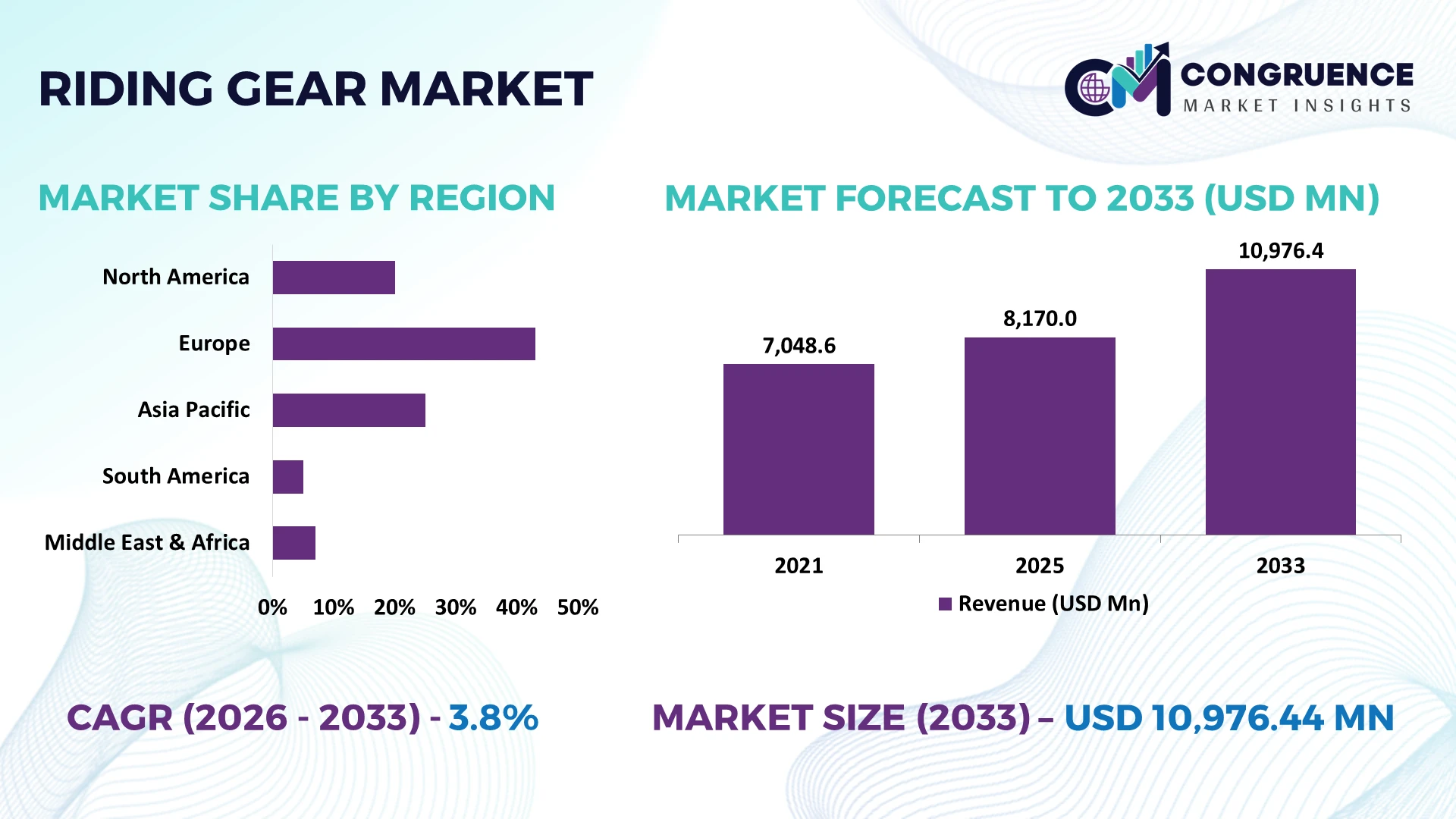
The Global Riding Gear Market was valued at USD 8170 Million in 2025 and is anticipated to reach a value of USD 10976.44 Million by 2033 expanding at a CAGR of 3.76% between 2026 and 2033. Growth is being driven by rising powered-two-wheeler ownership, stricter helmet and protective-equipment enforcement, premiumization of motorcycle apparel, and adoption of impact-resistant composites, smart helmets, and connected rider-safety systems.
India represents a dominant demand center, supported by more than 20 million annual two-wheeler sales and a large commuter-rider base, while helmet compliance and premium protective-equipment penetration continue expanding. Domestic manufacturing investments under Make in India are strengthening helmet, textile, and accessory supply chains. Compared with mature European markets, India offers substantially higher unit-volume potential, while Europe leads adoption of certified premium protective gear.
The strategic priority is to combine localized high-volume production with certified, technology-led premium products as safety regulation and rider awareness reshape purchasing decisions.
Market Size & Growth: USD 8.17 billion in 2025 is projected to reach USD 10.98 billion by 2033 at 3.76% CAGR, supported by expanding motorcycle ownership and premium protective-equipment adoption.
Top Growth Drivers: Two-wheeler fleet expansion contributes roughly 35% of demand momentum, safety awareness 30%, and premium protective apparel and helmet upgrades approximately 20%.
Short-Term Forecast: By 2027, wider use of lightweight composites and automated manufacturing is positioned to reduce selected component weight by 10–15% while improving production consistency.
Emerging Technologies: Smart helmets, Bluetooth communication, integrated cameras, airbag jackets, and advanced composite shells are accelerating, with premium connected products achieving 15–25% higher functionality than conventional alternatives.
Regional Leaders: Asia-Pacific leads volume demand, Europe dominates premium certified gear, and North America maintains strong recreational motorcycle spending; collectively, these three regions represent more than 80% of global riding-gear consumption.
Consumer/End-User Trends: Approximately 60% of younger premium riders increasingly prioritize ventilation, lightweight construction, connectivity, and certified impact protection alongside styling when upgrading helmets and protective apparel.
Pilot/Case Example: In 2025, advanced motorcycle airbag systems demonstrated millisecond-scale deployment, with leading electronically controlled products activating in roughly 25–50 milliseconds to improve upper-body impact protection.
Competitive Landscape: Fragmentation remains high, with the leading manufacturer holding an estimated single-digit global share; Alpinestars, Dainese, Shoei, Arai, and Fox Racing compete through safety certification, materials, branding, and motorsport positioning.
Regulatory & ESG Impact: UNECE Regulation No. 22.06 has raised motorcycle-helmet testing requirements across participating markets, pushing manufacturers toward broader impact testing and accelerating replacement of older ECE 22.05-certified product portfolios.
Investment & Funding: Manufacturers are directing multi-million-dollar investments toward automated molding, advanced textiles, localized Asian production, and direct-to-consumer channels as geopolitical supply-chain diversification reduces dependence on concentrated sourcing locations.
Innovation & Future Outlook: Next-generation riding gear is shifting toward connected helmets, wearable airbags, recyclable materials, and sensor-enabled protection, with advanced products targeting 10–20% weight reductions while maintaining or improving certified protection.
Riding gear demand is increasingly concentrated around certified helmets, protective jackets, gloves, boots, and connected safety equipment. Lightweight composites, wearable airbags, moisture-management fabrics, and Bluetooth-enabled helmets are reshaping premium products, with advanced materials delivering roughly 10–20% weight savings. Stricter helmet standards and supply-chain localization are accelerating product redesign, establishing technology, certification, and manufacturing agility as the next strategic battleground.
Riding gear is becoming strategically important as motorcycle safety shifts from basic compliance toward engineered protection, connected functionality, and premium rider experience. UNECE 22.06 helmet requirements have accelerated portfolio redesign around rotational-impact testing and broader certification, while manufacturers are restructuring sourcing toward India, Vietnam, and other Asian production hubs. This shift favors companies controlling materials, certification, and localized manufacturing.
Technology is widening competitive differentiation. Carbon-composite helmet shells can deliver roughly 15–25% weight reduction versus conventional thermoplastic designs, improving comfort without sacrificing protection, while electronic airbag systems can deploy within approximately 25–50 milliseconds. India provides exceptional unit scale through annual two-wheeler sales exceeding 20 million, whereas Italy, Germany, Japan, and the United States support stronger penetration of premium helmets, technical apparel, and wearable protection.
Through 2026–2028, connected helmets, airbag garments, lightweight composites, and recycled technical fabrics will gain greater premium-category penetration. Practical deployments already combine inertial sensors with electronically triggered motorcycle airbags for real-time crash detection. Manufacturers are increasing R&D, certification capabilities, localized assembly, and technology partnerships. Competitive advantage will increasingly depend on converting safety engineering into lightweight, connected, certifiable products at scalable cost.
Stricter safety standards are converting riding gear from discretionary equipment into a technology-led protection category. UNECE 22.06 introduces more demanding helmet testing than ECE 22.05, including additional impact locations and rotational-impact assessment, accelerating replacement cycles across compliant markets. India, where annual two-wheeler sales exceed 20 million units, provides substantial scale as certified helmet usage expands alongside premium motorcycles. Advanced shells can reduce helmet weight by approximately 15–25%, while electronic airbag garments activate within roughly 25–50 milliseconds. This combination of regulation and measurable protection improvement supports higher-value product mixes. Manufacturers are responding with composite-shell investment, expanded testing laboratories, CE-certified armor, and sensor-integrated apparel. The strategic advantage increasingly belongs to brands capable of delivering certification, comfort, and advanced protection without pushing products beyond mass-market affordability.
Advanced riding equipment remains constrained by material costs, fragmented certification requirements, and uneven consumer willingness to pay. Carbon-fiber helmet shells can cost substantially more to manufacture than injection-molded thermoplastic alternatives, while premium airbag jackets frequently command price premiums exceeding 50% over conventional protective garments. In India and other high-volume motorcycle markets, price sensitivity remains pronounced because commuter motorcycles dominate ownership, limiting rapid migration toward high-specification equipment. Separate certification, tooling, testing, and labeling requirements across export destinations further increase SKU complexity and working-capital requirements. Supply exposure to specialized fibers, electronic sensors, and technical fabrics also creates procurement risk. Manufacturers are countering these pressures through localized molding, modular armor platforms, dual sourcing, and longer supplier agreements. Operationally, standardizing components across multiple certified product families offers a stronger margin lever than simply raising retail prices.
Connected safety systems create a higher-value opportunity beyond conventional helmets and apparel. Bluetooth communication, crash detection, navigation displays, integrated cameras, and electronically controlled airbags are transforming riding gear into an active safety platform. Advanced composite structures can lower product weight by approximately 15–25%, while electronic airbags operating within 25–50 milliseconds create measurable differentiation from passive padding. India’s expanding premium motorcycle segment and Southeast Asia’s enormous two-wheeler population provide attractive markets for products positioned between basic equipment and European-priced premium gear. By 2028, modular electronics and shared sensor architectures can reduce development duplication across helmet and garment families by an estimated 10–15%. Companies are increasing R&D in wearable sensors, smart textiles, recyclable materials, and smartphone integration while partnering with electronics specialists. The overlooked opportunity is recurring digital services built around emergency alerts, diagnostics, and rider connectivity.
The long-term challenge is maintaining protection reliability as riding gear becomes electronically complex. Smart helmets and airbag garments introduce batteries, sensors, firmware, wireless modules, and crash-detection algorithms into products traditionally designed around passive mechanical protection. Electronic airbags must interpret an accident and deploy within approximately 25–50 milliseconds, leaving minimal tolerance for sensor or software errors. Battery degradation of even 15–20% over extended use can also affect connected-feature availability, while increasingly sophisticated electronics complicate repairability and lifecycle management. Hot, humid operating conditions in India intensify thermal, sweat, and sealing requirements compared with temperate-market deployment. Manufacturers must therefore invest in environmental validation, redundant sensing, software testing, replaceable electronics, and specialist service networks. Competitive durability will depend on treating connected riding gear as a safety-critical system rather than simply adding consumer electronics to protective equipment.
Smart Helmet Ecosystem Expansion Connected helmets are moving beyond communication tools into integrated safety platforms. Bluetooth-enabled models now account for an estimated 18–22% of premium helmet sales, while camera-equipped units have increased adoption by nearly 15% over the past two years. Smartphone integration, navigation overlays, and emergency-alert functions are becoming standard. Manufacturers are expanding electronics partnerships and modular designs to shorten product-development cycles and improve upgradeability. The shift is improving rider engagement while creating recurring accessory and software revenue opportunities.
Advanced Protective Materials Adoption Lightweight composites, multi-density impact liners, and engineered abrasion-resistant textiles are replacing conventional constructions across premium product lines. Carbon-composite shells deliver approximately 15–25% weight reductions, while advanced textile jackets improve ventilation efficiency by nearly 20%. Regulatory upgrades and consumer demand for comfort are accelerating deployment. Companies are increasing investment in technical fabrics, automated cutting systems, and material-engineering partnerships to improve production precision and reduce material waste.
Localized Manufacturing Supply Shift Supply-chain diversification is reshaping sourcing and production strategies. Manufacturers have reduced dependence on single-country procurement models, with localized sourcing programs improving lead-time reliability by roughly 10–15%. India and Vietnam continue attracting production expansion for helmets, gloves, and apparel. Automation in molding and assembly processes is improving throughput by approximately 12%. Companies are restructuring supplier networks and expanding regional manufacturing footprints to strengthen resilience against logistics disruptions and input-cost volatility.
Premium Touring Gear Growth Adventure and touring-focused equipment is gaining momentum as long-distance riding communities expand. Premium touring jackets and modular helmets are recording adoption increases of approximately 12–18%, supported by growing motorcycle tourism and organized riding events. Riders increasingly prioritize weather protection, integrated communication, and modular storage systems. Manufacturers are responding through specialized touring product lines, rider-community partnerships, and accessory ecosystems that increase customer retention while strengthening premium-category positioning.
Textile Jackets represent the leading segment, accounting for approximately 32–35% of total riding gear demand. Their dominance stems from versatility, weather adaptability, lower maintenance requirements, and compatibility with modern protective inserts. Manufacturers increasingly favor textile-based platforms because they support modular armor integration and lightweight construction while reducing production complexity. Premium textile designs now improve airflow efficiency by nearly 15–20% compared with older heavy-duty constructions, making them attractive across commuter, touring, and adventure applications.
Riding Boots are emerging as the fastest-growing type, supported by rising safety awareness and increasing adoption among touring and adventure riders. Demand for reinforced ankle protection and waterproof performance is expanding at a faster pace than traditional apparel categories. Leather Jackets remain important in premium and heritage segments, while Riding Gloves continue benefiting from mandatory safety practices and touchscreen-compatible innovations. Riding Pants are gaining relevance through abrasion-resistant fabrics and ergonomic designs. Manufacturers are increasing investments in technical textiles, lightweight armor systems, and modular product ecosystems, shifting competitive focus from basic protection toward comfort, certification, and all-weather performance.
Motorcycle Riding dominates the market with an estimated 50–55% share, supported by daily commuting, urban mobility, and recreational usage. Demand concentration remains strongest in countries with large two-wheeler fleets, where helmets, gloves, jackets, and protective accessories are purchased as recurring safety necessities. Product replacement cycles are shortening as certified protection standards and rider awareness improve. Manufacturers are expanding distribution through dealerships, specialty retailers, and direct-to-consumer channels to capture higher replacement demand.
Adventure Riding is the fastest-growing application segment as riders increasingly seek multi-terrain experiences and long-distance travel. Adoption of premium adventure gear has increased by approximately 12–18%, supported by demand for modular helmets, weatherproof apparel, and integrated communication systems. Touring remains a strong premium category, while Off-Road Riding continues driving demand for lightweight impact protection. Racing contributes high-value innovation that eventually filters into mainstream products. Companies are developing application-specific product portfolios, expanding rider-community partnerships, and investing in performance-focused materials to strengthen category specialization and customer loyalty.
Recreational Riders represent the dominant end-user group, accounting for approximately 58–62% of overall demand. This segment benefits from the largest active rider population and frequent replacement purchases across helmets, jackets, gloves, and boots. Increasing participation in weekend riding, touring groups, and motorcycle clubs is strengthening premium-product adoption. Manufacturers target this group through lifestyle branding, rider-community engagement, and differentiated product tiers that balance safety, comfort, and affordability.
Motorcycle Training Schools are emerging as the fastest-growing end-user segment. Safety-focused training programs and licensing requirements are increasing demand for standardized protective equipment, creating recurring procurement opportunities. Professional Racers remain influential despite lower volume because they drive technology validation and premium-brand visibility. Motorcycle Tour Operators continue investing in fleet-based protective equipment for customers, while Motorcycle Dealerships increasingly bundle riding gear with motorcycle purchases. Companies are responding through training partnerships, institutional pricing programs, and customized safety packages designed to improve retention and expand long-term customer ecosystems.
Asia-Pacific accounted for the largest market share at 38% in 2025 however, Asia-Pacific is expected to register the fastest growth, expanding at a CAGR of 4.6% between 2026 and 2033.
Premium Protection and Recreational Riding Shift
North America accounts for approximately 24% of global riding gear demand, with the United States concentrating most premium helmet, touring apparel, boots, and technical protection purchases. Large-displacement motorcycles and recreational riding support higher spending per rider than commuter-oriented markets. Bluetooth-integrated helmets, electronically triggered airbags, and multi-season textile systems are moving deeper into specialist retail channels. The United States recorded more than 550,000 new on-road motorcycle sales in recent annual industry reporting, sustaining replacement demand for protective equipment. Canada adds a smaller but technically mature customer base, particularly for weather-resistant touring equipment. Manufacturers are strengthening direct-to-consumer distribution, dealership partnerships, and application-specific collections. Premiumization rather than fleet expansion defines the regional opportunity, making brand credibility, certification, fit customization, and technology integration central to competitive positioning.
United States Market Outlook: The United States dominates North American demand through its extensive dealership infrastructure, established motorcycle culture, motorsport participation, and large installed motorcycle base. More than 8 million registered motorcycles create recurring replacement opportunities across helmets, jackets, gloves, and boots. Suppliers are increasingly pairing premium protection with connected communications and touring-oriented product ecosystems.
Certification Reshapes Premium Product Portfolios
Europe represents approximately 27% of global demand and remains the strongest center for certified premium motorcycle protection. UNECE 22.06 has accelerated helmet portfolio renewal through expanded impact locations, rotational testing, and stricter homologation requirements, while CE standards influence jackets, trousers, gloves, boots, and protective armor. Italy, Germany, France, Spain, and the United Kingdom concentrate premium motorcycle apparel consumption and specialist distribution. European manufacturers increasingly combine composite shells, electronically controlled airbags, abrasion-resistant textiles, and recyclable materials to differentiate products beyond styling. Production is also becoming more digitally controlled through automated cutting and precision molding, supporting lower material waste and consistent certification performance. The operational shift favors established brands capable of absorbing testing and product-development costs while maintaining frequent model updates across multiple national retail networks.
Italy Market Outlook: Italy combines premium motorcycle manufacturing, motorsport engineering, and globally recognized protective-equipment expertise. The country provides a technology base for leather suits, racing boots, airbag garments, and advanced armor systems. Italian brands increasingly transfer racing-derived protection into touring and road products, allowing high-performance innovation to reach substantially larger recreational rider populations.
Two-Wheeler Scale Accelerates Product Localization
Asia-Pacific leads the market with approximately 38% share, underpinned by enormous motorcycle populations in India, China, Indonesia, Vietnam, Thailand, and Japan. India alone records annual two-wheeler sales above 20 million units, creating exceptional scale for helmets and entry-to-mid-range protective products. Japan contributes advanced helmet engineering and premium manufacturing, while Southeast Asian markets generate high replacement volumes through intensive daily motorcycle utilization. Manufacturing localization is strengthening as brands source shells, textiles, gloves, and protective components closer to end markets, reducing logistics exposure and improving price competitiveness. Automated molding, laser cutting, moisture-resistant fabrics, and lighter protective inserts are entering higher-volume production. The key structural change is gradual conversion of riders from helmet-only purchasing toward multi-product safety kits, giving manufacturers opportunities to extend average basket size without relying exclusively on premium motorcycle ownership.
India Market Outlook: India provides the strongest volume opportunity through more than 20 million annual two-wheeler sales and an extensive domestic manufacturing ecosystem. BIS helmet requirements reinforce formalized product demand, while premium motorcycles are expanding the addressable market for jackets, gloves, boots, and certified armor. Local manufacturing gives suppliers a decisive cost and distribution advantage.
Urban Motorcycling Strengthens Protection Demand
South America contributes approximately 7% of global riding gear demand, with Brazil representing the principal operational market. Motorcycles increasingly support commuting, delivery services, and mobility in congested metropolitan areas, creating intensive equipment utilization and faster replacement cycles. Brazil has a motorcycle fleet exceeding 30 million units, providing substantial demand for helmets, gloves, rain protection, and abrasion-resistant apparel. Colombia and Argentina add concentrated urban motorcycle populations, although purchasing power constrains penetration of premium electronic protection. Distribution remains fragmented outside major cities, making dealer coverage and affordable certified products strategically important. Suppliers are expanding local distribution partnerships and introducing modular product ranges that allow riders to upgrade protection incrementally. The strongest operational opportunity lies in combining durable commuter-oriented equipment with scalable pricing rather than transferring high-cost European product architectures unchanged into price-sensitive markets.
Brazil Market Outlook: Brazil anchors South American riding gear consumption through its large motorcycle fleet, domestic two-wheeler production, delivery economy, and extensive dealership network. Annual motorcycle registrations have moved beyond 1.5 million units, reinforcing replacement demand. Manufacturers targeting Brazil increasingly prioritize ventilation, rain resistance, accessible pricing, and locally available replacement components suited to intensive daily riding.
Premium Mobility Meets Practical Protection Needs
Middle East & Africa represents approximately 4% of global demand, but purchasing patterns vary sharply between premium Gulf markets and high-utilization African motorcycle economies. The UAE and Saudi Arabia support premium superbike, touring, motorsport, and leisure-riding categories, encouraging demand for composite helmets and technical apparel. Kenya, Nigeria, Tanzania, and other African markets depend more heavily on motorcycles for commercial mobility, increasing requirements for durable, affordable protective equipment. Extreme heat creates a distinct design requirement: ventilation, moisture control, and lightweight construction directly influence adoption. Gulf investments in motorsport venues and tourism are also strengthening specialist distribution. Manufacturers are therefore separating premium and utility strategies, using authorized dealership networks in Gulf states while emphasizing durable, price-accessible helmets and apparel through African distributors.
United Arab Emirates Market Outlook: The UAE offers a concentrated premium market supported by high disposable income, superbike ownership, motorsport infrastructure, and organized riding communities. Dubai and Abu Dhabi provide strong specialist-retail coverage, while year-round heat encourages technical mesh apparel and ventilated helmets. Premium suppliers benefit from demand for internationally certified, technology-rich equipment and branded accessories.
The Riding Gear Market pits premium specialists Alpinestars, Dainese, Shoei, Arai, and REV’IT! against value-focused regional manufacturers and digitally native protective-equipment brands. The top five players collectively hold an estimated 28–32% share, reflecting fragmented demand across helmets, apparel, boots, gloves, and racing protection. Premium brands compete through certification, motorsport validation, materials engineering, and fit, while Asian producers emphasize manufacturing scale and price accessibility. Carbon-composite construction delivers roughly 15–25% weight savings over conventional thermoplastic shells, while advanced textile platforms improve ventilation by approximately 15–20%. Competition is shifting toward electronically controlled airbags, connected helmets, modular armor, and direct-to-consumer distribution. Leading suppliers are expanding localized production, rider partnerships, proprietary safety technologies, and vertically integrated testing capabilities. Certification expenditure, brand trust, specialist distribution, and product-liability exposure remain significant entry barriers. Winning requires combining verified protection, ergonomic performance, rapid product refreshes, scalable sourcing, and disciplined pricing across premium and volume categories.
Alpinestars
Dainese
Shoei
Arai Helmet
REV’IT!
AGV
HJC Helmets
Schuberth
Bell Helmets
Fox Racing
Rukka
Furygan
LS2 Helmets
Richa
Current riding-gear technology is concentrating on lighter impact protection, connected helmets, and electronically controlled airbags. Carbon-composite helmet shells reduce weight by roughly 15–25% versus conventional thermoplastic designs, improving comfort without sacrificing certified protection. Electronic airbags now deploy in about 25–50 milliseconds, while Bluetooth-enabled helmets are moving beyond communication into navigation, emergency alerts, and ride-data integration. Premium brands benefit most because certification and electronics justify stronger differentiation.
Emerging systems combine inertial sensors, smartphone connectivity, modular armor, moisture-managed textiles, and replaceable inflators. Advanced technical fabrics can improve airflow by around 15–20% over older heavy constructions, while user-serviceable airbag canisters reduce post-deployment servicing time and associated downtime. Adoption is strongest across premium touring, racing, and adventure categories, where connected protection is increasingly integrated rather than sold as standalone accessories. This improves product attachment rates and supports broader ecosystem strategies.
Disruptive development is shifting toward augmented-reality helmet displays, predictive crash algorithms, recyclable impact materials, and embedded diagnostics. By 2026–2028, connected protection should penetrate roughly 20–25% of premium product portfolios, while modular electronics can cut redesign effort by about 10–15%. Companies acting now gain faster certification cycles, stronger rider-data ecosystems, and defensible technology-led positioning. Integration also enables coordinated helmet, apparel, and motorcycle functions across platforms.
April 2026 Alpinestars expanded into India through ReiseMoto, introducing premium riding gear including the Halo Drystar Jacket at ₹52,500. The move strengthened local availability, dealership reach, and access to protective technologies for India’s growing premium motorcycle customer base. Source: bikedekho.com
November 2025 Shoei and EyeLights unveiled the GT-Air 3 Smart at EICMA, integrating third-generation augmented-reality HUD technology. The system claims over 32% faster reaction times and offers five colors, strengthening Shoei’s position in connected premium touring helmets globally. Source: eicma.it
March 2025 Alpinestars advanced wearable protection with the Tech-Air 5 Plasma, weighing 1,530 grams and more than 25% less than the Tech-Air 5. Three riding algorithms broadened street, race, and off-road usability while improving comfort and product versatility. Source: ultimatemotorcycling.com
November 2025 Arai presented its 2026 helmet collection at EICMA while marking 75 years of protection-focused manufacturing. The portfolio refresh reinforced Arai’s handcrafted premium positioning and expanded design choice ahead of 2026, supporting dealer engagement and replacement-cycle demand. Source: araihelmet.eu
The Riding Gear Market report evaluates demand across Leather Jackets, Textile Jackets, Riding Pants, Riding Gloves, and Riding Boots, with application coverage spanning Motorcycle Riding, Off-Road Riding, Racing, Touring, and Adventure Riding. End-user analysis includes Professional Racers, Recreational Riders, Motorcycle Tour Operators, Motorcycle Training Schools, and Motorcycle Dealerships. Regional coverage extends across North America, Europe, Asia-Pacific, South America, and Middle East & Africa, with country-level attention to major production and consumption hubs.
The report tracks smart helmets, electronic airbag systems, advanced composites, abrasion-resistant textiles, modular armor, connected safety platforms, and emerging augmented-reality interfaces. It also examines premiumization, localized manufacturing, regulatory certification, and distribution shifts. Quantitative indicators include segment shares, adoption patterns, product deployment, and competitive participation, helping companies assess investment priorities, expansion opportunities, partnership strategies, technology positioning, and market direction between 2026 and 2033.
| Report Attribute/Metric | Report Details |
|---|---|
Market Revenue in 2025 | USD 8170 Million |
Market Revenue in 2033 | USD 10976.44 Million |
CAGR (2026 - 2033) | 3.76% |
Base Year | 2025 |
Forecast Period | 2026 - 2033 |
Historic Period | 2021 - 2025 |
Segments Covered | By Type
By Application
By End-User
|
Key Report Deliverable | Revenue Forecast, Growth Trends, Market Dynamics, Segmental Overview, Regional and Country-wise Analysis, Competition Landscape |
Region Covered | North America, Europe, Asia-Pacific, South America, Middle East, Africa |
Key Players Analyzed | Alpinestars, Dainese, Shoei, Arai Helmet, REV’IT!, AGV, HJC Helmets, Schuberth, Bell Helmets, Fox Racing, Rukka, Furygan, LS2 Helmets, Richa |
Customization & Pricing | Available on Request (10% Customization is Free) |




