
Reports
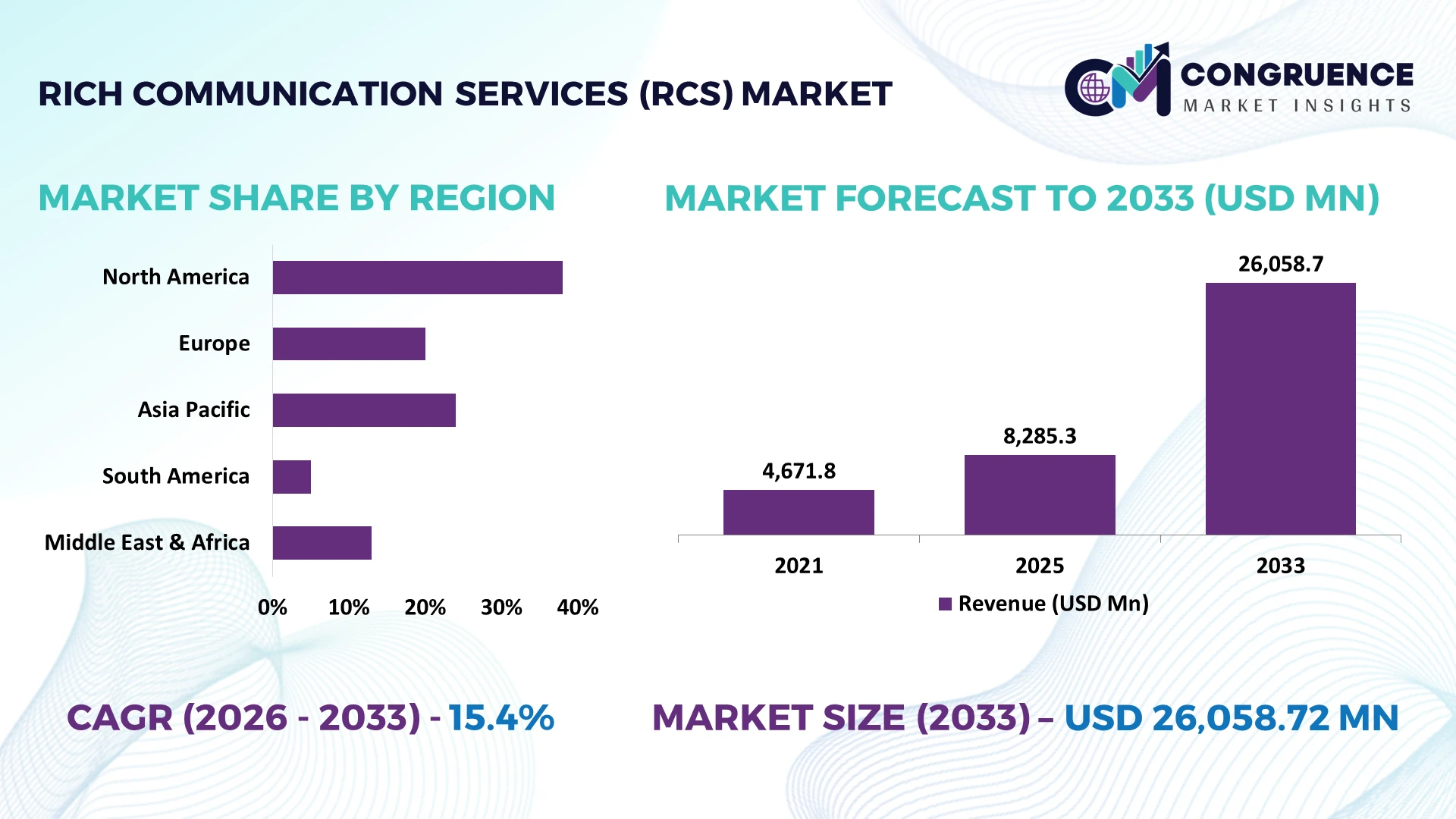
The Global Rich Communication Services (RCS) Market was valued at USD 8285.27 Million in 2025 and is anticipated to reach a value of USD 26058.72 Million by 2033 expanding at a CAGR of 15.4% between 2026 and 2033. RCS growth is being driven by Apple iOS interoperability, verified business messaging, migration of authentication traffic from SMS, and enterprise deployment of conversational commerce through native mobile inboxes.
The United States represents the dominant country opportunity, accounting for roughly 87% of North American RCS activity by value in recent market benchmarks, while domestic RCS traffic has exceeded 1 billion messages daily. Apple’s iOS 18 rollout materially widened addressable reach, with U.S. RCS availability expanding from approximately 64 million to 121 million users. Retail, BFSI, telecom, travel, and e commerce are leading commercial deployment. By comparison, India recorded 108% year over year growth in RCS interactions during H1 2026, with finance and fintech generating about 80% of traffic.
The strategic priority is shifting from basic network enablement toward verified enterprise onboarding, cross platform interoperability, conversational monetization, and scalable RCS Business Messaging infrastructure.
Market Size & Growth: USD 8,285.27 million in 2025 is projected to reach USD 26,058.72 million by 2033 at 15.4% CAGR, reinforced by SMS to verified RCS migration.
Top Growth Drivers: iOS interoperability, cloud deployment at approximately 66%, and large enterprise adoption near 70% are accelerating commercial RCS scaling.
Short Term Forecast: By 2027, global RCS Business Messaging traffic is expected to exceed 200 billion messages versus 70 billion in 2025, nearly tripling enterprise traffic.
Emerging Technologies: AI conversational agents, Universal Profile 3.0 and interoperable end to end encryption are moving RCS toward automated, authenticated two way customer journeys.
Regional Leaders: North America holds approximately 38% share, Europe about 27%, and Asia Pacific 26%, implying 2025 values near USD 3.15 billion, USD 2.24 billion and USD 2.15 billion respectively.
Consumer & End User Trends: A2P communication captures approximately 61% of activity in current industry benchmarks as enterprises prioritize transactional alerts, authentication, promotions and conversational commerce.
Pilot & Case Example: In 2025, Bandhan AMC deployed RCS customer engagement and recorded a 10% improvement in investor conversions, demonstrating measurable financial services commercialization.
Competitive Landscape: Google holds an estimated 19% share in one industry benchmark, competing with Verizon, AT&T, Vodafone and Telefónica across platforms, networks and enterprise messaging infrastructure.
Regulatory & ESG Impact: RCS fraud losses are projected to rise from USD 300 million in 2025 to USD 1.3 billion by 2030, making verification, encryption and anti fraud controls investment priorities.
Investment & Funding: No audited standalone global RCS investment total is publicly consolidated; however, the USD 1.2 billion operator RCS Business Messaging revenue pool recorded for 2025 is accelerating carrier, CPaaS and enterprise platform investment.
Innovation & Future Outlook: Business RCS traffic is projected to exceed 485 billion messages by 2030, up 286% from 125 billion in 2026, shifting competition toward authentication, conversational commerce and AI assisted service.
Rich Communication Services adoption is concentrating around banking authentication, retail promotions, customer support, travel notifications and mobile commerce, where verified senders and interactive actions strengthen native messaging workflows. Cloud deployment already represents roughly two thirds of industry activity, while AI agents increasingly automate two way conversations inside RCS sessions. Universal Profile 3.0 and cross platform end to end encryption are strengthening security architecture as operators address rising messaging fraud. Meanwhile, rapid U.S. and Indian deployment is moving competitive focus from network availability toward enterprise onboarding, monetization and measurable conversational engagement.
Rich Communication Services is becoming strategically important because mobile messaging is shifting from fragmented SMS channels toward verified, interactive communications embedded directly within native messaging applications. Apple’s adoption of RCS in iOS 18 removed a major interoperability barrier, expanding U.S. RCS reach from roughly 64 million to more than 120 million users. Operators, CPaaS providers, and enterprises are consequently redirecting investment toward Universal Profile infrastructure, verified sender ecosystems, and conversational commerce rather than maintaining SMS as the primary engagement layer.
RCS also changes messaging economics and operational performance. Interactive product cards, suggested actions, authentication, and two way responses can consolidate workflows that previously required SMS plus mobile web pages; enterprise deployments have recorded conversion improvements around 10% over conventional messaging journeys. India is developing around high volume banking, fintech, retail, and authentication traffic, while the United States benefits from rapidly expanding cross platform iOS and Android compatibility. Over 2026–2028, rising device coverage should move investment priorities from network activation toward monetization and automation.
Bandhan AMC’s RCS deployment, which delivered a reported 10% improvement in investor conversions, demonstrates the operational case. Enterprises are integrating RCS with CRM, AI agents, and customer data platforms, while carriers strengthen aggregator partnerships. Competitive advantage will increasingly depend on verified reach, measurable engagement, automation depth, and control of enterprise messaging relationships.
Cross platform accessibility is the strongest structural catalyst for RCS adoption. Apple’s RCS support expanded the reachable U.S. user base from approximately 64 million to above 120 million, an increase approaching 90%, while Android already provides extensive native RCS coverage. In India, RCS interactions increased approximately 108% year over year during the first half of 2026, with finance and fintech contributing close to 80% of traffic. The shift from Android centric deployment toward interoperable iOS and Android messaging gives banks, retailers, airlines, and telecom operators larger addressable audiences without requiring separate applications. Google, mobile operators, and CPaaS providers are consequently investing in Universal Profile compatibility, verified business identities, API integration, and enterprise onboarding to convert expanded handset reach into recurring business messaging traffic.
RCS commercialization remains constrained by inconsistent operator pricing, country specific availability, and fragmented enterprise onboarding. While cloud deployment represents approximately 66% of current RCS infrastructure activity, business messaging still depends on operator agreements, aggregator connectivity, and handset level support that differ across markets. Even with U.S. addressable reach exceeding 120 million users following iOS integration, enterprises cannot assume 100% campaign deliverability because carrier activation and device configurations remain uneven. India adds another pressure point: enterprises accustomed to low cost SMS and WhatsApp messaging require clear incremental returns before reallocating high volume traffic. CPaaS providers are reducing exposure through multi channel fallback routing, direct operator partnerships, standardized APIs, and dynamic channel selection. The strategic constraint is therefore not message functionality but predictable unit economics and universal termination.
The next opportunity lies in transforming RCS from notification delivery into an AI enabled transaction channel. Business RCS traffic is projected to rise from roughly 125 billion messages in 2026 to more than 485 billion by 2030, representing an increase above 280% and creating substantial scope for automated service journeys. India is particularly attractive because finance and fintech already generate approximately 80% of domestic RCS interactions, providing a foundation for loan servicing, payment reminders, authentication, investment communications, and personalized offers. AI agents integrated with rich cards, suggested replies, payments, and CRM data can resolve customer intent without redirecting users into separate applications. Google, carriers, CPaaS vendors, and enterprise software providers are expanding conversational AI partnerships and API ecosystems. The non obvious opportunity is capturing transaction completion, not simply increasing messaging volume.
Long term RCS competitiveness depends on preventing richer messaging capabilities from creating richer fraud surfaces. Industry forecasts indicate RCS related fraud losses could increase from roughly USD 300 million in 2025 to USD 1.3 billion by 2030, more than quadrupling as business traffic expands. This pressure becomes operationally significant when banks and fintech companies account for around 80% of RCS interactions in high growth markets such as India, where impersonation can directly affect payment and authentication workflows. Universal Profile 3.0 advances end to end encryption and security functionality, but enterprises must still coordinate identity verification, consent management, fraud analytics, carrier controls, and AI driven anomaly detection across messaging ecosystems. Operators and platform providers therefore need sustained investment in verified sender governance and shared threat intelligence; trusted identity will become as strategically important as network reach.
Branded Messaging Gains Visual Depth Enterprises are replacing text-heavy campaigns with carousels, high-resolution media, suggested actions, and embedded product discovery. Rich-media RCS campaigns have recorded engagement rates above 50% in selected deployments, while interactive formats can deliver 3–5 times higher engagement than conventional SMS. Retailers and consumer brands are restructuring campaign production around mobile-native creative assets, allowing fewer redirects to external webpages. Messaging providers are responding by scaling template management, analytics, and rich-media orchestration tools that shorten campaign creation cycles.
RCS Becomes a Search Surface Google has started testing sponsored RCS Business Messages within conversational search experiences, connecting high-intent discovery directly with branded messaging. Search-led interactions can reduce customer journey steps by 20–30% compared with flows requiring separate search, website, and messaging sessions. This transition makes message inventory part of performance marketing infrastructure rather than a standalone communications channel. Agencies, CPaaS vendors, and brands are adapting attribution models and campaign workflows to measure search-to-conversation conversion alongside clicks.
Zero Tap Verification Expands Device-aware verification is reducing dependence on manually entered one-time passwords. RCS authentication workflows can remove 1–2 user actions from conventional OTP journeys and shorten verification completion by roughly 20–40% where supported. The operational shift is particularly relevant for digital onboarding and account recovery, where abandoned authentication directly affects conversion. Identity platforms are integrating silent verification, fallback logic, and risk scoring into messaging APIs, enabling enterprises to reserve visible messages for higher-value customer interactions.
Messaging Analytics Become Outcome Based Enterprise measurement is moving beyond delivery and read receipts toward purchases, completed forms, booked services, and resolved interactions. Rich messaging campaigns can produce response rates above 30% in targeted deployments, versus low-single-digit interaction levels for basic promotional SMS. Companies are connecting RCS event data with CRM and marketing automation platforms, enabling audience suppression, journey optimization, and closed-loop attribution. The non-obvious shift is budget accountability: messaging teams increasingly compete for performance-marketing expenditure rather than traditional telecom communications budgets.
Application-to-Person represents the leading type with an estimated 44% market share, reflecting its central role in automated alerts, transactional communication, service updates, and enterprise-generated customer interactions. Its advantage comes from API scalability, high-volume orchestration, and direct integration with CRM and customer engagement platforms. Person-to-Person remains a mature traffic category supported by native handset messaging, while Business-to-Business serves narrower workflow communication requirements. Rich Media is gaining strategic importance as enterprises incorporate images, carousels, video, and interactive controls into commercial conversations.
Verified Messaging is the fastest-growing type as organizations prioritize authenticated identities and recognizable brand profiles in customer communications. Adoption is strengthening as impersonation raises the commercial value of trusted sender indicators. Verified business communication can improve interaction rates by approximately 15–25% in selected deployments. Platform providers are concentrating investment on verification APIs, brand registration, rich-media composition, and enterprise campaign controls, shifting product development toward differentiated message experiences rather than undifferentiated traffic volume.
Marketing represents the leading application with an estimated 31% share, supported by product discovery, promotional journeys, personalized offers, and measurable campaign interactions. RCS enables marketers to combine branded content, multimedia, buttons, and response capture within one native conversation, reducing dependence on landing-page handoffs. Notifications remain a mature high-volume application, while Customer Support and Customer Engagement increasingly incorporate structured menus and asynchronous conversations. Appointment Booking is gaining relevance in healthcare and service businesses because confirmation, rescheduling, and reminders can be consolidated within one messaging workflow.
Payments represent the fastest-growing application as commerce journeys move closer to the messaging interface. Integrated checkout and payment-link workflows can remove 2–3 stages from conventional mobile purchase paths, while selected conversational campaigns have delivered conversion improvements above 10%. Authentication remains operationally important for account access and transaction confirmation, but payment-oriented deployment extends RCS from communication into transaction completion. Banks, retailers, payment providers, and CPaaS platforms are prioritizing commerce APIs, catalog integration, transaction tracking, and automated post-purchase communication as investment shifts toward measurable transaction outcomes.
Retail represents the leading end-user with an estimated 28% share, driven by frequent promotional cycles, product launches, loyalty communication, order updates, and store-to-digital customer journeys. Large retailers can deploy RCS across millions of opted-in customers without requiring proprietary application usage, supporting campaign scale and measurable interactions. E-Commerce follows closely because product recommendations, delivery communication, and abandoned-cart recovery align naturally with conversational interfaces. Banking maintains substantial adoption for regulated customer communication, while Telecommunications uses RCS for subscriber servicing and account-related engagement.
Healthcare is emerging as the fastest-growing end-user as providers digitize appointment management, prescription communication, preventive-care reminders, and patient service workflows. Automated messaging can reduce missed appointments by approximately 20–30% in digital reminder programs, creating a direct capacity-utilization benefit. Travel & Hospitality increasingly applies rich messaging to itinerary management, Automotive to ownership communication, and Government to citizen notifications. Providers are responding with sector-specific templates, consent controls, workflow integrations, and enterprise partnerships, allowing product portfolios and pricing structures to reflect distinct industry requirements.
North America accounted for the largest market share at 38% in 2025 however, Asia-Pacific is expected to register the fastest growth, expanding at a CAGR of 18.1% between 2026 and 2033.
Carrier Monetization Moves Beyond Connectivity
North America’s RCS ecosystem is moving toward commercial orchestration as operators integrate messaging APIs, enterprise identity services, campaign management, and network intelligence. The United States and Canada benefit from extensive 5G infrastructure and mature CPaaS adoption, enabling businesses to embed RCS within contact centers, loyalty platforms, and customer-data environments. U.S. wireless networks covered more than 330 million people with 5G by 2025, providing the connectivity foundation for media-intensive messaging at national scale. Canadian operators are simultaneously expanding enterprise messaging capabilities around banking, retail, transportation, and subscriber management. The operational priority is now reducing fragmentation between carrier networks and enterprise software stacks. Operators and communication-platform vendors are strengthening direct connectivity, API standardization, and managed onboarding, improving deployment speed for brands running high-volume customer journeys.
United States Market Outlook: U.S. enterprises benefit from sophisticated CRM, cloud communications, digital advertising, and mobile commerce infrastructure. Smartphone penetration exceeds 90% among adults under 50, creating a highly addressable base for native messaging services. Investment is increasingly directed toward campaign orchestration, customer-data integration, measurement, and carrier-grade business messaging rather than basic messaging enablement.
Privacy Governance Reshapes Enterprise Deployment
Europe’s RCS environment is increasingly defined by consent architecture, data governance, and operator coordination rather than pure subscriber acquisition. GDPR requirements make auditable opt-in management, data minimization, retention controls, and customer identity governance central to enterprise deployments. More than 90% of EU households had internet access by 2025, while extensive 4G and expanding 5G availability support multimedia customer communications across major economies. Operators in Spain, France, Germany, Italy, and the United Kingdom are increasingly aligning RCS with enterprise communications portfolios serving financial services, mobility, utilities, and retail. A structural advantage is Europe’s established carrier relationships with large regulated enterprises; the constraint is maintaining consistent customer experiences across national operator environments. Messaging vendors are responding with localized compliance controls, centralized campaign governance, and multi-country API management.
Germany Market Outlook: Germany offers a strong enterprise base across banking, insurance, automotive, logistics, and industrial services, where controlled customer communications carry significant operational value. With smartphone usage exceeding 80% of the population, providers can address substantial mobile audiences while differentiating through German-language automation, privacy-by-design workflows, consent records, and integration with established enterprise service platforms.
Mobile-First Scale Reshapes Messaging Economics
Asia-Pacific combines enormous mobile subscriber density with highly varied operator structures, creating favorable economics for large-scale RCS deployment. China, Japan, South Korea, India, and several Southeast Asian markets have extensive mobile-first customer bases, but deployment models differ substantially between carrier-led and platform-led ecosystems. China exceeded 1 billion 5G mobile subscriptions during 2025, strengthening infrastructure capacity for richer media delivery, while Japan and South Korea provide advanced network environments for interactive enterprise communications. High message volumes allow service providers to spread platform and integration costs across much larger traffic bases than smaller national markets. Operators, aggregators, and technology vendors are consequently prioritizing localized interfaces, domestic enterprise integrations, multilingual automation, and high-throughput messaging infrastructure instead of applying one standardized commercial model across the region.
China Market Outlook: China’s advantage comes from network scale and enterprise digitization rather than dependence on conventional SMS migration. The country operates more than 4 million 5G base stations, supporting high-capacity mobile services nationwide. RCS suppliers targeting China must align with domestic carrier ecosystems, local data requirements, Chinese-language conversational interfaces, and established digital-service behaviors to build defensible enterprise deployments.
Operator Consolidation Supports Commercial Rollout
South America is developing around concentrated mobile operator networks and enterprises seeking richer communications without requiring customers to install additional applications. Brazil accounts for the largest addressable national mobile base, while Argentina, Colombia, Chile, and Peru provide secondary deployment pools for banking, retail, airlines, utilities, and delivery services. Brazil has more than 260 million active mobile accesses, giving messaging platforms substantial scale for enterprise campaigns and service communication. The regional constraint is uneven network quality and differing enterprise digitization levels outside major urban centers, which makes fallback routing operationally important. Messaging providers are therefore combining RCS with SMS and other channels through unified APIs rather than pursuing isolated deployments. Carrier relationships and local enterprise sales capabilities remain decisive for converting mobile reach into commercially sustainable traffic.
Brazil Market Outlook: Brazil combines high smartphone usage with mature digital banking, instant payments, e-commerce, and mobile-led customer servicing. PIX processes billions of transactions monthly, demonstrating consumer familiarity with real-time digital interactions. RCS providers can capitalize by integrating conversational messaging with financial notifications, merchant communications, delivery workflows, and customer-service platforms while maintaining resilient fallback capabilities.
Digital Infrastructure Investment Opens New Channels
Middle East & Africa presents a two-speed RCS environment. Gulf markets provide advanced mobile infrastructure and enterprise digitization, while many African countries remain dependent on heterogeneous handset, network, and data-access conditions. The UAE and Saudi Arabia have achieved near-universal 4G coverage and extensive 5G availability, supporting sophisticated mobile service delivery for airlines, banks, government agencies, tourism operators, and retailers. Across Africa, expanding smartphone ownership creates a longer-term enterprise messaging base, but affordability and network consistency continue to influence channel selection. The operational opportunity therefore differs by country: Gulf deployments emphasize premium digital experiences and government modernization, while African deployments require channel resilience and efficient message routing. Vendors are developing operator partnerships, localized platforms, and hybrid messaging architectures tailored to these contrasting infrastructure conditions.
Saudi Arabia Market Outlook: Saudi Arabia offers strong deployment conditions through Vision 2030 digitization, expanding 5G infrastructure, and large-scale transformation across banking, tourism, aviation, government, and retail. Internet penetration exceeds 99%, giving enterprises an unusually connected customer base. Providers are positioning around Arabic-language customer journeys, enterprise automation, and integration with rapidly modernizing digital-service infrastructure.
Google competes with carrier groups including Vodafone and Deutsche Telekom for control of RCS infrastructure, standards implementation, and enterprise access, while Infobip, Sinch, and Twilio compete for business messaging orchestration and customer relationships. The top five participants collectively represent an estimated 45% of market activity, leaving substantial traffic distributed across operators, aggregators, and communication-platform providers. Competition increasingly centers on API reliability, direct carrier connectivity, sender onboarding, analytics, and international coverage. Direct network relationships can reduce routing layers by 20–30%, while automated campaign tooling can shorten enterprise deployment cycles by approximately 25%. Platform specialists are expanding operator partnerships and omnichannel capabilities; carriers are strengthening API exposure and enterprise sales integration. The competitive shift favors providers controlling both network reach and software orchestration rather than standalone message termination. Carrier certification, country-specific compliance, and integration depth create significant entry barriers. Winning requires broad termination coverage, enterprise-grade APIs, rapid onboarding, measurable campaign performance, and dependable cross-network execution.
Google LLC
Vodafone Group Plc
Deutsche Telekom AG
Telefónica, S.A.
Orange S.A.
AT&T Inc.
Verizon Communications Inc.
Twilio Inc.
Sinch AB
Infobip Ltd.
Route Mobile Limited
Tata Communications Limited
Mavenir Systems, Inc.
Gupshup Inc.
Current RCS architecture is shifting toward messaging hubs, API orchestration, and carrier-aware routing that unify rich cards, suggested actions, verified identities, and delivery analytics. API-based provisioning can reduce manual launch workflows by about 25%, while automated capability detection can lower unnecessary SMS fallback traffic by roughly 15%. Enterprises benefit from faster campaign activation, channel governance and fewer integration layers across mobile operators.
Emerging technology centers on Messaging Layer Security, AI-assisted conversation design, and network APIs. Universal Profile 3.0 introduces interoperable end-to-end encryption across provider implementations, while AI-driven intent classification can improve automated routing accuracy by 20–30% compared with rules-based decision trees. Integration with CRM, CDP, contact-center, and identity systems is expanding, allowing customer context to move into messaging workflows. CPaaS providers with carrier connectivity gain the operational advantage.
Disruptive development through 2026–2028 will combine RCS with agentic AI, network-based identity, and transaction orchestration. Compared with legacy SMS journeys requiring external webpages, interactive RCS workflows can remove 2–3 customer steps and improve completion efficiency by 20%. Enterprises adopting APIs can deploy commerce, service, and authentication journeys without rebuilding messaging infrastructure. Competitive differentiation will increasingly depend on secure automation, interoperability, and measurable workflow execution, making integration readiness an immediate investment priority.
September 2024 Apple released iOS 18 with RCS support, enabling richer media, delivery receipts, read receipts and improved cross-platform group messaging on iPhone. The shift removed a major device ecosystem barrier and significantly expanded interoperable messaging beyond Android.
August 2025 Apple partnered with Reliance Jio to enable RCS on iPhones in India, giving Jio’s roughly 500 million subscribers access to high-resolution, data-based messaging. The rollout substantially broadened addressable enterprise reach across India’s mobile-first digital customer ecosystem.
March 2025 GSMA published Universal Profile 3.0, defining interoperable end-to-end encryption for RCS messages, files and user content using Messaging Layer Security. The specification strengthened cross-provider privacy architecture and established a standardized security foundation for future commercial deployments.
July 2026 Infobip reported 169.3% year-over-year global RCS traffic growth, alongside 14,000 successful agent launches and 7,300 brands submitting registration requests. The scale-up demonstrated accelerating enterprise commercialization and strengthened operator demand for scalable standardized onboarding infrastructure.
The report evaluates RCS across Person-to-Person, Application-to-Person, Business-to-Business, Rich Media, and Verified Messaging, alongside Customer Support, Marketing, Authentication, Appointment Booking, Payments, Notifications, and Customer Engagement applications. End-user coverage spans Retail, Banking, Healthcare, Travel & Hospitality, Telecommunications, E-Commerce, Automotive, and Government. Geographic assessment covers North America, Europe, Asia-Pacific, South America, and Middle East & Africa, capturing differences in operator readiness, enterprise deployment, mobile infrastructure, and commercial messaging maturity.
Technology coverage examines API orchestration, carrier-aware routing, Messaging Layer Security, AI-assisted conversations, identity integration, network APIs, and transaction-enabled messaging. The report also assesses competitive positioning across operators, CPaaS providers, technology platforms, and enterprise messaging specialists. Between 2026 and 2033, analysis tracks interoperability, deployment economics, enterprise onboarding, security architecture, ecosystem partnerships, and emerging conversational workflows, supporting investment allocation, country expansion, platform selection, partnership strategy, and long-term product positioning.
| Report Attribute/Metric | Report Details |
|---|---|
Market Revenue in 2025 | USD 8285.27 Million |
Market Revenue in 2033 | USD 26058.72 Million |
CAGR (2026 - 2033) | 15.4% |
Base Year | 2025 |
Forecast Period | 2026 - 2033 |
Historic Period | 2021 - 2025 |
Segments Covered | By Type
By Application
By End-User
|
Key Report Deliverable | Revenue Forecast, Growth Trends, Market Dynamics, Segmental Overview, Regional and Country-wise Analysis, Competition Landscape |
Region Covered | North America, Europe, Asia-Pacific, South America, Middle East, Africa |
Key Players Analyzed | Google LLC, Vodafone Group Plc, Deutsche Telekom AG, Telefónica, S.A., Orange S.A., AT&T Inc., Verizon Communications Inc., Twilio Inc., Sinch AB, Infobip Ltd., Route Mobile Limited, Tata Communications Limited, Mavenir Systems, Inc., Gupshup Inc. |
Customization & Pricing | Available on Request (10% Customization is Free) |




