
Reports
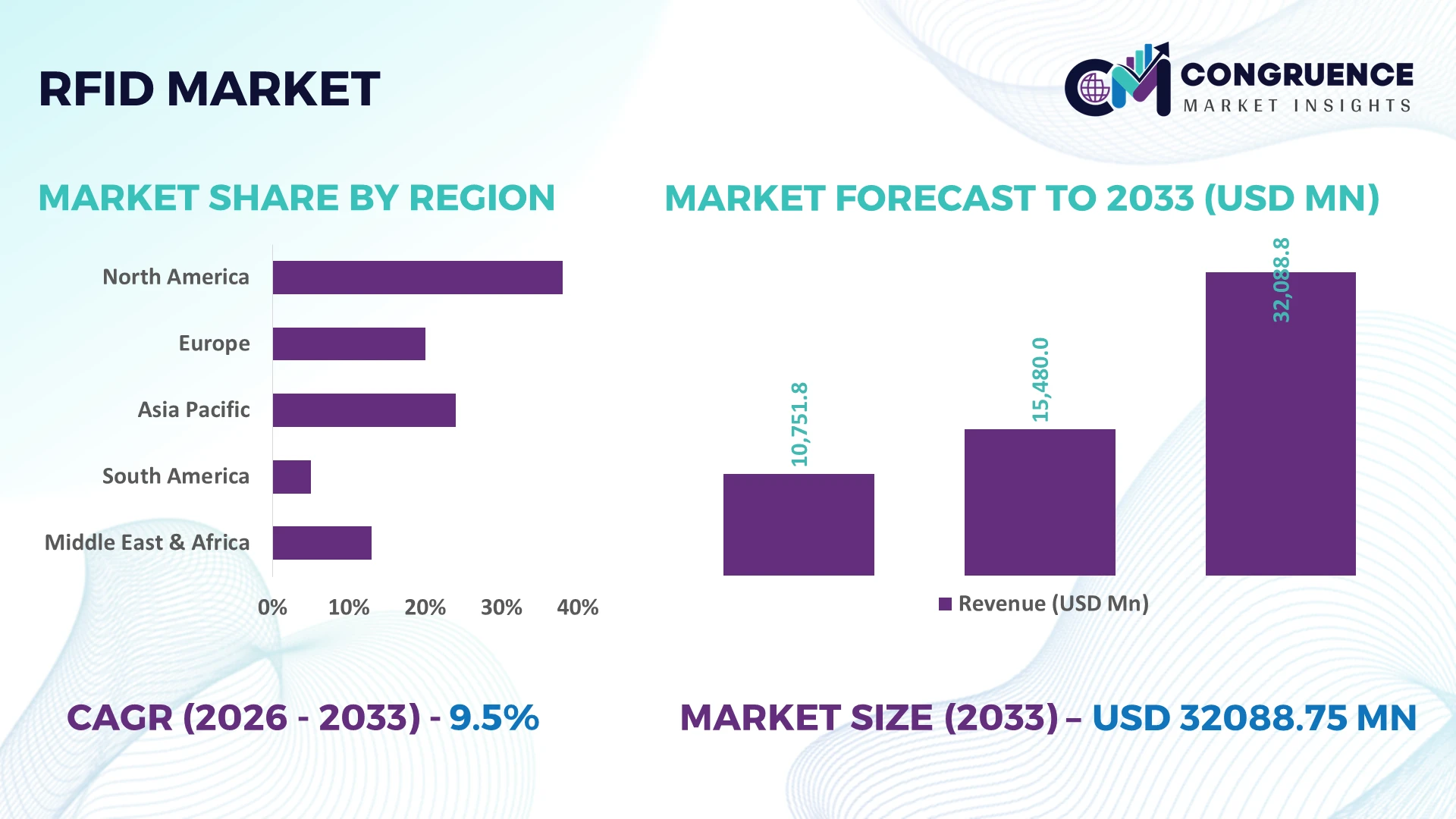
The Global RFID Market was valued at USD 15480 Million in 2025 and is anticipated to reach a value of USD 32088.75 Million by 2033 expanding at a CAGR of 9.54% between 2026 and 2033. Growth is driven by large-scale RFID deployment across retail inventory automation, logistics traceability, industrial asset management, healthcare tracking, and smart manufacturing supported by AI-enabled analytics and expanding IoT infrastructure.
The United States leads the global RFID market with an estimated 31% share, supported by more than 4,000 large-scale warehouse automation projects, strong defense logistics programs, and widespread retail item-level tagging. Compared with Germany, where Industry 4.0 accelerates factory adoption, the U.S. benefits from higher enterprise-scale investments and stronger cloud integration. Continued supply-chain diversification following Red Sea shipping disruptions has further accelerated RFID deployment across critical distribution networks.
Businesses prioritizing digital traceability, operational visibility, and automated inventory intelligence should position RFID as a core technology investment for long-term supply chain resilience and productivity gains.
Market Size & Growth: USD 15480 Million (2025) to USD 32088.75 Million (2033) at 9.54% CAGR, driven by retail automation, industrial digitization, and connected supply chains.
Top Growth Drivers: Retail tagging (+38%), warehouse automation (+35%), healthcare asset tracking (+29%) remain the three strongest growth contributors.
Short-Term Forecast: By 2028, inventory accuracy exceeds 98% while manual stock-counting time declines by nearly 45% across advanced deployments.
Emerging Technologies: AI analytics, IoT-enabled RFID platforms, and edge computing improve asset visibility, predictive tracking, and operational intelligence.
Regional Leaders: North America leads above USD 10 billion, Asia-Pacific exceeds USD 9 billion, Europe approaches USD 7 billion with expanding industrial adoption.
Consumer/End-User Trends: More than 70% of leading retailers continue expanding item-level RFID for faster checkout and omnichannel inventory visibility.
Pilot/Case Example: 2026 distribution modernization project improved inventory visibility by 32% and reduced order fulfillment time by 26%.
Competitive Landscape: Top five companies collectively control nearly 42% of the global market through innovation, manufacturing scale, and enterprise partnerships.
Regulatory & ESG Impact: Digital product traceability improves compliance while reducing inventory waste by approximately 18% across regulated industries.
Investment & Funding: More than USD 3 billion supports manufacturing expansion, smart logistics infrastructure, and strategic technology partnerships amid global supply-chain diversification.
Innovation & Future Outlook: Battery-free sensors, printable RFID, and cloud-native platforms accelerate intelligent tracking across high-growth industrial ecosystems.
RFID adoption continues expanding across retail, healthcare, manufacturing, transportation, and pharmaceutical operations as organizations prioritize real-time asset intelligence and automated traceability. AI-powered RFID platforms, battery-free sensor innovations, and cloud-based lifecycle management improve operational efficiency, with deployment accuracy exceeding 98% in advanced facilities. Strengthening product traceability regulations and resilient supply-chain strategies are accelerating enterprise investments, setting the foundation for the strategic market discussion.
RFID has become a strategic technology for enterprises seeking resilient supply chains, real-time asset visibility, and data-driven operations. Competitive advantage increasingly depends on automated identification systems that reduce manual intervention while improving inventory precision. Supply-chain restructuring since global logistics disruptions and expanding digital product traceability requirements are accelerating enterprise-wide RFID integration across retail, healthcare, manufacturing, transportation, and defense operations, making intelligent tracking a core operational capability rather than a standalone identification solution.
Compared with conventional barcode systems, RFID enables simultaneous reading of hundreds of tagged items without direct line-of-sight, improving inventory accuracy to above 98% while reducing stock-counting labor by nearly 40%. The United States leads large-scale retail and logistics deployments, whereas China is expanding high-volume manufacturing capacity and smart factory integration through extensive industrial automation programs. Over the next two to three years, enterprise item-level tagging is expected to exceed 75% across major retail chains, while warehouse automation projects continue integrating RFID with AI-driven analytics and industrial IoT platforms.
Manufacturers, logistics providers, and retailers are expanding partnerships with software vendors and semiconductor suppliers to develop cloud-connected RFID ecosystems capable of predictive asset monitoring. For example, automated distribution centers now combine RFID portals with robotics to reduce shipment verification time by over 30%, improving throughput and labor utilization. Companies that prioritize interoperable platforms, scalable infrastructure, and intelligent data management will strengthen competitive positioning while establishing long-term operational resilience.
Enterprise demand for automated inventory management and end-to-end supply-chain visibility remains the primary catalyst for RFID adoption. More than 72% of large retailers continue expanding item-level tagging, while automated warehouses report inventory accuracy above 98% and labor savings approaching 40%. Growing digital product traceability requirements across the United States and pharmaceutical serialization initiatives are accelerating deployment beyond traditional retail applications. The result is faster inventory reconciliation, reduced stock losses, and stronger compliance performance. Leading companies are increasing investments in AI-enabled RFID software, expanding manufacturing capacity, and forming technology partnerships to deliver integrated tracking platforms. Organizations combining RFID with predictive analytics gain measurable operational intelligence that extends beyond inventory management into enterprise-wide decision support.
High implementation costs and fragmented technology environments continue limiting broader RFID deployment, particularly among mid-sized enterprises. Initial infrastructure, system integration, and tag deployment can represent nearly 20–30% of digital transformation budgets for large facilities. Approximately 35% of organizations still encounter interoperability challenges between legacy enterprise resource planning platforms and modern RFID architectures. Semiconductor supply fluctuations and electronic component sourcing pressures also affect deployment schedules and procurement planning. Companies are mitigating these constraints through phased implementation strategies, localized manufacturing, long-term procurement contracts, and standardized platform architectures. Organizations that reduce integration complexity achieve faster operational returns while minimizing disruption across existing logistics and production environments.
The strongest opportunity lies in combining RFID with AI, industrial IoT, digital twins, and edge computing to create intelligent operational ecosystems. Smart factories deploying connected RFID infrastructure have improved asset utilization by nearly 25%, while predictive maintenance programs reduce equipment downtime by approximately 18%. Japan continues expanding intelligent manufacturing initiatives, creating opportunities for highly specialized industrial tracking applications. Companies are accelerating R&D investments in battery-free sensors, cloud-native asset management platforms, and recyclable RFID materials that support sustainability objectives. A less explored opportunity is integrating RFID-generated operational data into enterprise digital twin environments, enabling continuous process optimization rather than simply tracking physical assets.
Long-term competitiveness depends on securely scaling RFID infrastructure across increasingly complex enterprise ecosystems. As connected devices expand, nearly 45% of industrial organizations identify cybersecurity and data governance as major deployment priorities. Multi-site operations also face integration challenges when synchronizing RFID data across cloud platforms, robotics, warehouse management systems, and industrial automation networks. Germany's advanced manufacturing sector illustrates the growing need for standardized interoperability as production facilities become more digitally connected. Companies must strengthen cybersecurity architectures, expand workforce expertise, and invest in interoperable software frameworks while collaborating with technology partners. Organizations that establish secure, scalable RFID ecosystems will achieve more consistent deployment outcomes and stronger operational resilience across global operations.
AI-Driven Inventory Intelligence: Retailers and logistics operators are integrating RFID with AI-based inventory analytics to improve stock visibility and automate replenishment. Inventory accuracy now exceeds 98% in advanced facilities, while manual auditing declines by nearly 40% and order processing speeds improve by around 28%. Persistent labor shortages and omnichannel fulfillment requirements are accelerating deployment. Companies are expanding cloud-native RFID platforms and strengthening software partnerships to transform raw tag data into predictive operational intelligence rather than simple inventory records.
Item-Level Traceability Expansion: Digital product traceability requirements across pharmaceuticals, food distribution, and consumer goods are accelerating item-level RFID adoption. More than 70% of large retailers continue expanding tagged product portfolios, while product authentication errors decline by approximately 25%. Regulatory compliance and counterfeit prevention are driving implementation beyond traditional warehouse operations. Companies are redesigning packaging workflows, integrating RFID during production, and collaborating with packaging suppliers to improve traceability without disrupting manufacturing throughput.
Smart Factory RFID Integration: Manufacturers are embedding RFID into automated production environments where connected readers exchange real-time information with robotics and industrial IoT platforms. Production downtime has decreased by nearly 18%, asset utilization has improved by approximately 24%, and work-in-process visibility continues expanding. Germany and Japan are leading factory modernization initiatives. Equipment suppliers are developing interoperable RFID architectures that simplify machine communication and enable predictive maintenance across complex manufacturing operations.
Sustainable Tag Innovation: Enterprises are increasing investment in recyclable materials, printable RFID technology, and lower-energy reader infrastructure to reduce operational waste. New-generation tag designs reduce material usage by nearly 20%, while deployment costs decline by around 15% through manufacturing optimization. Sustainability targets and electronic waste reduction initiatives are reshaping procurement decisions. Companies are restructuring supplier networks, expanding environmentally responsible product portfolios, and commercializing lightweight RFID solutions for large-volume retail and logistics deployments.
Passive RFID remains the dominant segment because of its low deployment cost, maintenance-free operation, and scalability across retail, logistics, and healthcare environments. It accounts for approximately 62% of enterprise deployments, supported by affordable tag production and seamless integration with warehouse automation systems. RFID Tags remain strategically important as deployment volumes expand, while RFID Readers continue evolving with enhanced edge computing capabilities and cloud connectivity. Companies are increasing manufacturing capacity and launching interoperable reader platforms to support enterprise-scale digital tracking initiatives.
Semi-Passive RFID is emerging as the fastest-growing type, particularly in environmental monitoring and pharmaceutical logistics where extended sensing capability delivers higher operational value. Active RFID continues serving high-value asset tracking, mining, and industrial equipment management despite higher infrastructure costs. Around 30% of industrial projects now combine multiple RFID technologies within unified platforms, reflecting a shift toward hybrid deployments that balance performance with operational efficiency. Vendors are expanding strategic partnerships and product portfolios to address specialized enterprise requirements while strengthening ecosystem compatibility.
Inventory Management represents the largest application segment as retailers, manufacturers, and distributors prioritize real-time stock visibility and automated replenishment. Advanced RFID deployments improve inventory accuracy beyond 98% while reducing manual counting effort by nearly 40%, strengthening operational productivity. Supply Chain applications are the fastest-growing segment as enterprises modernize logistics networks, improve shipment traceability, and reduce verification delays. Organizations are integrating RFID with warehouse management software, AI analytics, and automated material handling systems to enhance operational resilience.
Retail Management continues expanding through omnichannel fulfillment and self-checkout initiatives, while Asset Tracking remains essential for healthcare equipment, industrial tools, and enterprise facilities. Access Control maintains stable demand across government infrastructure and corporate campuses through secure identity management solutions. Nearly 35% of new enterprise deployments now integrate multiple RFID applications within unified digital platforms, encouraging vendors to develop scalable software ecosystems and industry-specific solutions that improve operational flexibility and long-term customer retention.
Retail remains the dominant end-user because of extensive item-level tagging, omnichannel fulfillment, and automated inventory operations across large store networks. More than 70% of leading retailers continue expanding RFID deployment to improve product availability and reduce stock losses. Transportation & Logistics is the fastest-growing end-user segment as warehouse automation, shipment visibility, and freight tracking become operational priorities. Solution providers are strengthening partnerships with logistics operators while introducing scalable subscription-based deployment models to accelerate enterprise adoption.
Manufacturing continues expanding RFID use within smart factories for production tracking and asset visibility, while Healthcare increasingly deploys RFID for medical equipment management and pharmaceutical traceability. Government agencies maintain investment in secure identification and infrastructure monitoring, and Automotive manufacturers integrate RFID into production sequencing and component tracking. Approximately 45% of enterprise buyers now prioritize platforms capable of supporting multiple operational environments, encouraging vendors to deliver customizable ecosystems, stronger interoperability, and industry-focused implementation services.
North America accounted for the largest market share at 36.2% in 2025 however, Asia-Pacific is expected to register the fastest growth, expanding at a CAGR of 11.2% between 2026 and 2033.

Enterprise Digital Traceability Driving Large-Scale Deployment
North America maintains the leading position through extensive RFID adoption across retail, healthcare, logistics, aerospace, and defense. The region represents approximately 36.2% of global deployments, supported by advanced warehouse automation, cloud-integrated inventory platforms, and widespread item-level tagging. More than 70% of major retail chains continue expanding RFID-enabled inventory systems to improve fulfillment efficiency and reduce stock discrepancies. Enterprise investments increasingly focus on AI-integrated RFID platforms capable of delivering predictive inventory intelligence and real-time operational visibility. Strong semiconductor capability, mature enterprise infrastructure, and ongoing logistics modernization continue reinforcing North America's competitive position in enterprise-scale RFID implementation.
United States Market Outlook: The United States leads regional demand through extensive enterprise digitalization, advanced logistics infrastructure, and large-scale retail automation. Thousands of distribution centers operate RFID-enabled inventory systems supporting omnichannel commerce, while healthcare providers continue expanding asset tracking across hospital networks. More than 75% of large retailers utilize RFID for inventory optimization and fulfillment operations. Technology vendors are strengthening software ecosystems, expanding cloud integration capabilities, and collaborating with automation providers to improve operational scalability across manufacturing, transportation, and defense sectors.
Industrial Modernization Strengthens Smart Manufacturing
Europe continues strengthening RFID deployment through Industry 4.0 modernization, digital product traceability, and sustainable manufacturing initiatives. The region contributes approximately 27% of global market activity, supported by advanced automotive production, pharmaceutical compliance, and intelligent logistics infrastructure. Manufacturing facilities increasingly integrate RFID with industrial automation to improve production visibility and reduce operational bottlenecks. Cross-border supply-chain digitization and expanding warehouse modernization programs are encouraging broader enterprise deployment. Companies continue investing in interoperable identification technologies that improve product authentication, operational transparency, and lifecycle management while supporting environmental reporting requirements.
Germany Market Outlook: Germany remains Europe's most influential RFID market because of its advanced manufacturing ecosystem, industrial automation expertise, and strong engineering capabilities. Smart factory operators increasingly integrate RFID into production sequencing, asset management, and predictive maintenance environments. Around 40% of large industrial manufacturers continue expanding intelligent factory investments, encouraging technology providers to develop interoperable RFID platforms compatible with robotics, industrial IoT, and digital production management systems.
Manufacturing Scale Accelerates Enterprise Adoption
Asia-Pacific represents the fastest-expanding RFID landscape due to large-scale manufacturing, electronics production, logistics modernization, and digital infrastructure investment. The region contributes nearly 31% of global deployments while rapidly increasing production capacity for RFID tags, readers, and integrated semiconductor components. Manufacturing clusters continue embedding RFID into factory automation, warehouse operations, and export logistics. Government-backed industrial modernization initiatives and expanding e-commerce fulfillment infrastructure are accelerating enterprise implementation. Companies are increasing regional manufacturing capacity, strengthening technology partnerships, and localizing production to support growing domestic and export demand.
China Market Outlook: China dominates regional manufacturing through extensive electronics production, large-scale industrial automation, and highly integrated supply-chain infrastructure. RFID deployment continues expanding across manufacturing, retail, transportation, and public infrastructure projects. More than 60% of global electronics manufacturing capacity supports downstream RFID component production, allowing domestic suppliers to improve production efficiency and shorten delivery cycles. Enterprises continue investing in AI-enabled smart factories and intelligent logistics platforms to strengthen export competitiveness.
Logistics Modernization Expands Commercial Demand
South America is steadily increasing RFID adoption as retailers, logistics providers, and industrial operators modernize supply-chain infrastructure. The region accounts for approximately 4.8% of global market activity, supported by expanding warehouse automation and transportation digitization initiatives. Distribution centers increasingly deploy RFID to improve shipment verification and inventory accuracy while reducing manual processing requirements. Infrastructure limitations and uneven digital maturity remain operational constraints, yet enterprise investment continues advancing through phased implementation strategies and technology partnerships focused on scalable logistics modernization.
Brazil Market Outlook: Brazil leads the regional RFID market through its large retail sector, expanding logistics infrastructure, and growing manufacturing base. Distribution companies continue implementing automated inventory systems to support e-commerce fulfillment and nationwide product movement. Nearly 45% of major logistics operators have accelerated warehouse digitalization initiatives, encouraging solution providers to expand implementation services, enterprise software integration, and localized technology support for industrial customers.
Infrastructure Investment Supports Digital Transformation
The Middle East & Africa market is advancing through infrastructure modernization, logistics corridor development, healthcare digitization, and smart city initiatives. The region contributes approximately 3% of global RFID deployment while steadily expanding enterprise adoption across transportation, government services, and industrial operations. Large infrastructure programs increasingly integrate intelligent identification technologies to improve operational visibility and asset utilization. Companies are strengthening regional partnerships, expanding implementation capabilities, and introducing industry-specific RFID solutions that align with national digital transformation strategies and long-term infrastructure investment priorities.
United Arab Emirates Market Outlook: The United Arab Emirates remains the region's strategic RFID hub because of advanced logistics infrastructure, smart government initiatives, and internationally connected trade operations. Ports, airports, and free economic zones continue integrating RFID-enabled tracking systems to improve cargo visibility and customs efficiency. More than 50% of major logistics facilities have accelerated digital warehouse modernization, encouraging technology providers to expand cloud-integrated RFID platforms and intelligent supply-chain management solutions.
The RFID market is led by Avery Dennison, Zebra Technologies, Impinj, HID Global, and NXP Semiconductors, competing directly with regional hardware manufacturers and low-cost tag suppliers across retail, logistics, healthcare, and industrial automation. The top five players collectively account for approximately 48% of global market activity, while specialized software vendors compete through platform integration rather than hardware scale. Competition centers on reader performance, chip innovation, software interoperability, and deployment speed, with cloud-enabled RFID platforms improving operational efficiency by nearly 30% and AI-supported inventory analytics increasing inventory accuracy above 98%. Global leaders strengthen positions through manufacturing expansion, ecosystem partnerships, and vertically integrated hardware-software portfolios, whereas regional suppliers compete through pricing advantages of 15–20% and localized customization. The competitive landscape is shifting toward intelligent data platforms rather than standalone identification hardware, increasing pressure on vendors lacking software capabilities. High certification requirements, enterprise integration complexity, and semiconductor design expertise remain significant entry barriers. Winning requires scalable ecosystems, reliable supply chains, continuous innovation, and enterprise-grade interoperability.
Avery Dennison Corporation
Zebra Technologies Corporation
Impinj, Inc.
NXP Semiconductors N.V.
HID Global Corporation
Alien Technology LLC
CAEN RFID S.r.l.
Checkpoint Systems, Inc.
SML Group Limited
Honeywell International Inc.
GAO RFID Inc.
Invengo Information Technology Co., Ltd.
Jadak LLC
Xerafy Pte. Ltd.
Current RFID innovation is centered on AI-enabled analytics, cloud-native device management, industrial IoT connectivity, and edge computing. More than 65% of large enterprise deployments now integrate RFID with warehouse management or enterprise resource planning platforms, enabling continuous asset visibility. Edge-enabled readers reduce response latency by approximately 25%, while AI-driven inventory analytics improve demand forecasting accuracy by nearly 20%. Retail, healthcare, and logistics operators benefit from automated exception detection, predictive replenishment, and faster inventory reconciliation, creating measurable operational advantages over isolated identification systems.
Emerging technologies include battery-free sensing, printable RFID, digital twin integration, and ultra-low-power chip architectures. Compared with traditional barcode environments, enterprise RFID deployments improve inventory accuracy from roughly 85% to above 98% while reducing manual verification effort by nearly 40%. Manufacturers and logistics providers gain the greatest competitive advantage because connected RFID platforms generate operational intelligence instead of simple identification records. Companies are integrating RFID data with robotics, autonomous mobile systems, and predictive maintenance platforms to improve factory and warehouse efficiency.
Between 2026 and 2028, intelligent RFID ecosystems will increasingly combine AI, machine vision, and real-time location technologies into unified operational platforms. Deployment across automated distribution centers is expected to exceed 75% among leading global retailers and logistics providers. Vendors investing in interoperable software, advanced semiconductor design, and cloud-based analytics will strengthen competitive differentiation, while enterprises adopting integrated RFID ecosystems early will achieve faster decision-making, lower operating costs, stronger supply-chain resilience, and more scalable digital operations.
June 2025 Avery Dennison introduced the industry's first RFID label recognized for compatibility with the PET recycling stream, enabling recyclable smart labeling solutions. The innovation achieved recognition for 100% PET recycling compatibility, strengthening sustainable packaging adoption and supporting brand compliance with circular economy initiatives. Source: averydennison.com
November 2025 Impinj expanded its Gen2X RAIN RFID platform by adding support to the M770 and M780 endpoint IC families, with more than 35 Gen2X-enabled tag inlays already available. The enhancement improved enterprise read reliability and accelerated deployment across logistics, manufacturing, healthcare, and retail operations. Source: impinj.com
February 2026 Avery Dennison launched the AD IdentiFresh RFID inlay series for fresh food retail, leveraging Impinj M800 integrated circuits to improve read performance in high-moisture environments. The solution delivers faster inventory visibility while reducing operational waste across bakery, meat, produce, and deli supply chains. Source: averydennison.com
January 2026 Impinj and EM Microelectronic announced a Gen2X licensing agreement, expanding interoperability for next-generation RAIN RFID technology. The partnership strengthens ecosystem standardization, enabling broader enterprise adoption and improving compatibility across industrial RFID solutions through shared Gen2X innovation. Source: impinj.com
The report delivers comprehensive analysis of the RFID market across Passive RFID, Active RFID, Semi-Passive RFID, RFID Tags, and RFID Readers, with detailed evaluation of Inventory Management, Asset Tracking, Access Control, Supply Chain, and Retail Management applications. It assesses demand across Retail, Healthcare, Manufacturing, Transportation & Logistics, Government, and Automotive while providing strategic insights into deployment trends, enterprise adoption, and technology integration. More than 60% of enterprise implementations now combine RFID with cloud platforms, AI, or industrial IoT, highlighting the market's ongoing digital transformation.
The study covers North America, Europe, Asia-Pacific, South America, and the Middle East & Africa, examining regional deployment patterns, industrial ecosystems, and competitive positioning between 2026 and 2033. It evaluates technology innovation, investment priorities, supply-chain modernization, and evolving enterprise requirements while identifying niche opportunities in smart manufacturing, pharmaceutical traceability, sustainable RFID materials, and intelligent logistics. The report supports expansion planning, product strategy, competitive benchmarking, partnership evaluation, and long-term investment decision-making through actionable business intelligence and operational market assessment.
| Report Attribute/Metric | Report Details |
|---|---|
Market Revenue in 2025 | USD 15480 Million |
Market Revenue in 2033 | USD 32088.75 Million |
CAGR (2026 - 2033) | 9.54% |
Base Year | 2025 |
Forecast Period | 2026 - 2033 |
Historic Period | 2021 - 2025 |
Segments Covered | By Type
By Application
By End-User
|
Key Report Deliverable | Revenue Forecast, Growth Trends, Market Dynamics, Segmental Overview, Regional and Country-wise Analysis, Competition Landscape |
Region Covered | North America, Europe, Asia-Pacific, South America, Middle East, Africa |
Key Players Analyzed | Avery Dennison Corporation, Zebra Technologies Corporation, Impinj, Inc., NXP Semiconductors N.V., HID Global Corporation, Alien Technology LLC, CAEN RFID S.r.l., Checkpoint Systems, Inc., SML Group Limited, Honeywell International Inc., GAO RFID Inc., Invengo Information Technology Co., Ltd., Jadak LLC, Xerafy Pte. Ltd. |
Customization & Pricing | Available on Request (10% Customization is Free) |




