
Reports
The Global Revolving Doors Market was valued at USD 924 Million in 2025 and is anticipated to reach a value of USD 1216.73 Million by 2033 expanding at a CAGR of 3.5% between 2026 and 2033. Growth is driven by commercial-building modernization, automated entrance integration, tighter building-energy performance requirements, and demand for controlled pedestrian access across airports, hotels, offices, hospitals, and high-security facilities.
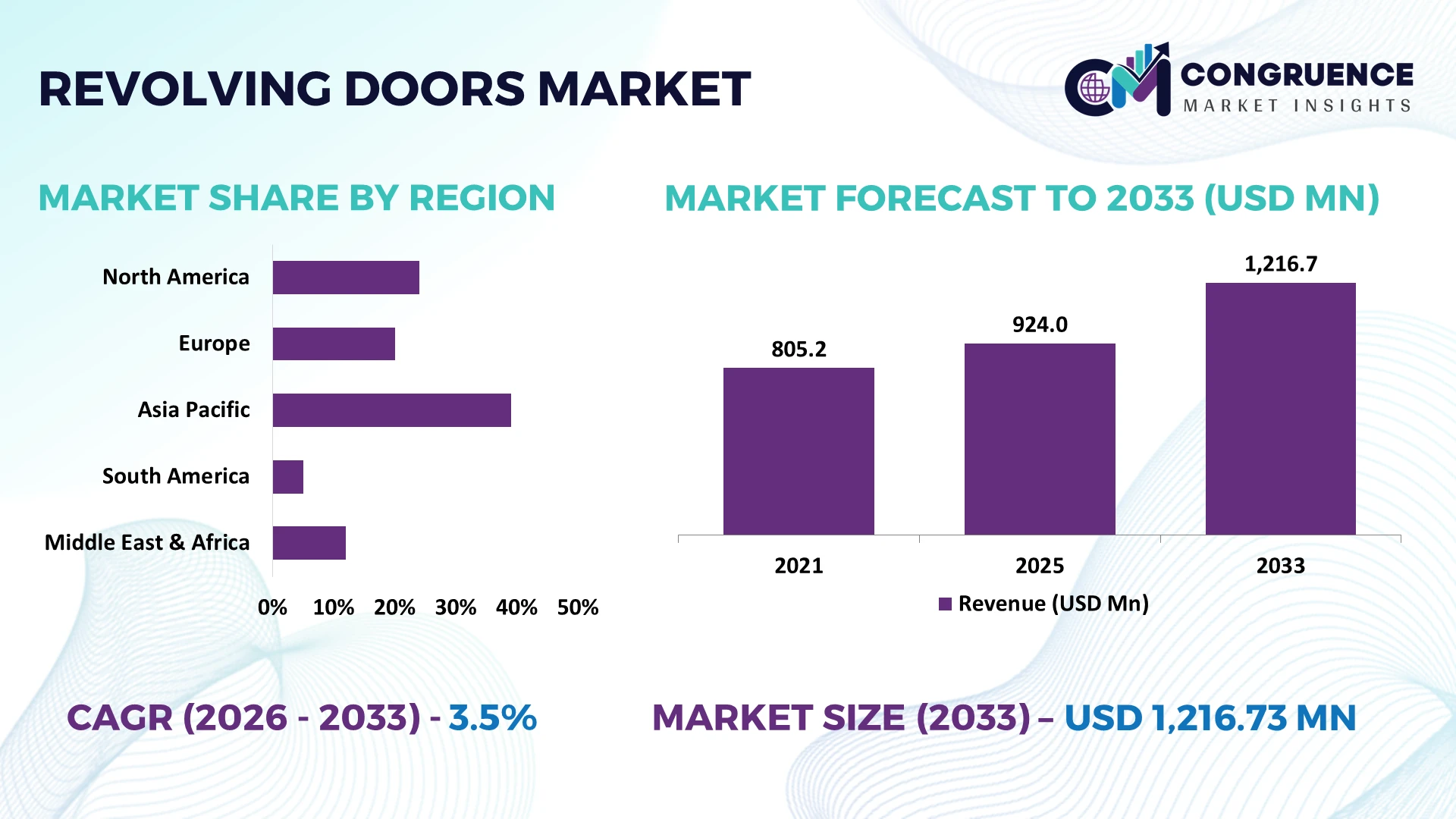
The United States remains the strongest country-level demand center within North America, supported by large commercial-property inventories, airport modernization, and smart-building retrofits. North America represented roughly 22% of global revolving-door demand in 2025, while the wider U.S. automatic-door industry exceeded USD 1.1 billion. Automatic systems account for about 67% of revolving-door installations globally, reflecting accelerated sensor, access-control, and building-management integration. Compared with the United States, India represents a faster-expanding infrastructure opportunity, with its revolving doors market reaching about USD 157 million in 2025 as airport, hospitality, and office construction accelerates. Meanwhile, ongoing U.S. and European building-security upgrades are increasing demand for biometric, anti-tailgating, and remotely monitored entrance systems.
Strategically, suppliers should prioritize automated, energy-efficient and security-integrated revolving door platforms for North American retrofits while building distribution and installation capacity across Asia’s rapidly expanding commercial infrastructure pipeline.
Market Size & Growth: USD 924 million in 2025 is projected to reach USD 1,216.73 million by 2033 at 3.5%, supported by automated entrance upgrades and commercial-building modernization.
Top Growth Drivers: Automation penetration near 67%, commercial applications around 80%, and entrance energy-loss reductions reaching 55% are strengthening replacement and new-installation economics.
Short-Term Forecast: By 2028, advanced sensor controls and predictive maintenance are positioned to reduce unplanned entrance-system downtime by approximately 15–20% across high-traffic commercial facilities.
Emerging Technologies: AI-assisted traffic sensing, biometric authentication, IoT condition monitoring, anti-tailgating detection, and intelligent variable-speed controls are reshaping advanced revolving door specifications.
Regional Leaders: By 2033, North America represents approximately USD 271 million, Asia about USD 231 million, and Europe nearly USD 185 million under current regional demand patterns and automation-led adoption.
Consumer/End-User Trends: Commercial facilities represent roughly 80% of established revolving-door demand, with airports, hotels, office towers, hospitals, and retail complexes prioritizing contactless automated entrances.
Pilot/Case Example: A Boon Edam installation reduced entrance energy loss by 55% and cut draft penetration from approximately 7 meters to just 0.6 meters.
Competitive Landscape: ASSA ABLOY holds an estimated 18% global presence, followed by Boon Edam at about 15%, alongside dormakaba, GEZE, Horton Automatics, and TORMAX.
Regulatory & ESG Impact: Energy-efficient entrance systems can reduce door-related heat and cooling leakage substantially, while accessibility, pedestrian-safety, and building-code compliance increasingly influence procurement specifications.
Investment & Funding: ASSA ABLOY generated more than USD 14 billion in 2024 group sales and continues acquisition-led expansion, reinforcing consolidation across automated entrance and access-control portfolios.
Innovation & Future Outlook: Automatic hardware already represents roughly 67% of revolving-door hardware demand, accelerating the strategic shift toward connected entrances combining access control, analytics, energy management, and predictive servicing.
The Revolving Doors Market is increasingly concentrated around airports, premium hotels, corporate offices, healthcare buildings, retail centers, and secure government facilities. Automatic configurations represent roughly 67% of established demand, while sensor-controlled movement, biometric access, IoT monitoring, and energy-efficient sealing are becoming core product differentiators. Commercial-building retrofits and tighter energy-management priorities are now moving revolving doors from architectural features toward integrated smart-building infrastructure.
Revolving doors are becoming strategically important as building owners combine entrance automation, energy management, physical security, and pedestrian-flow control within a single infrastructure layer. Automatic configurations account for roughly 67% of established demand, while modernization of airports, hospitals, hotels, and corporate campuses is shifting procurement from mechanical entrances toward sensor-driven systems connected with access-control and building-management platforms.
Compared with conventional swing-door entrances, well-designed revolving systems can reduce air infiltration and entrance-related energy losses by more than 50% in high-traffic buildings, improving HVAC efficiency while maintaining continuous pedestrian movement. The United States emphasizes retrofit automation and security integration, whereas China and India are deploying systems alongside newer airport, metro, commercial, and hospitality infrastructure. Over the next 2–3 years, contactless sensors, biometric authentication, remote diagnostics, and predictive servicing will gain greater specification weight.
A practical airport deployment combines automatic speed adjustment with access monitoring to manage passenger surges without continuously exposing conditioned interiors. Manufacturers are consequently investing in intelligent controllers, localized installation networks, digital service capabilities, and access-control partnerships. Competitive advantage will increasingly depend on delivering connected entrance ecosystems rather than standalone mechanical doors.
Building automation is the strongest structural driver, with automatic hardware representing approximately 67% of revolving-door demand and commercial facilities accounting for around 80% of installations. Modern revolving entrances can cut entrance-related energy leakage by more than 50% compared with continuously opening conventional door arrangements, strengthening their value in high-traffic properties. U.S. airport modernization and commercial-building retrofits are simultaneously increasing requirements for touchless activation, access control, and centralized facility monitoring. This shift converts entrance systems from architectural hardware into connected building assets. Manufacturers including ASSA ABLOY, Boon Edam, dormakaba, and GEZE are responding with sensor upgrades, intelligent controllers, service networks, and integrated security platforms. The strategic advantage increasingly lies in controlling both entrance hardware and its recurring digital-service layer.
High initial equipment and integration requirements remain a structural limitation, particularly when existing buildings require floor reconstruction, electrical upgrades, safety sensors, or access-control modifications. Automatic systems represent roughly 67% of demand, yet commercial applications account for nearly 80%, demonstrating that adoption remains concentrated where traffic volumes justify higher lifecycle economics. Complex revolving-door installations can require substantially greater capital expenditure than standard swing or sliding entrances, while customized security configurations increase project engineering requirements by 15–25%. In India, fragmented installation and maintenance capabilities outside major commercial hubs further constrain standardized deployment. Suppliers are reducing exposure through modular designs, standardized components, local service partnerships, and retrofit-compatible control packages. Lifecycle maintenance economics, rather than equipment price alone, increasingly determines procurement competitiveness.
The strongest opportunity lies in transforming revolving doors into data-generating smart-building endpoints. With automatic configurations already representing about 67% of demand and commercial buildings contributing roughly 80% of installations, a substantial installed base can support IoT sensors, occupancy analytics, predictive maintenance, biometric access, and adaptive speed control. Remote diagnostics can reduce technician interventions and support maintenance-efficiency improvements of approximately 15–20% in intensively used entrance systems. Singapore, the UAE, and India provide attractive deployment environments as airports, premium offices, hotels, and mixed-use developments increasingly specify integrated building-management technologies. Manufacturers are investing in connected controllers, cloud-based servicing, cybersecurity capabilities, and access-control partnerships. The non-obvious opportunity is recurring software and maintenance income built around installed entrance hardware rather than relying solely on replacement cycles.
Long-term competitiveness depends on reliably integrating mechanical assemblies with sensors, biometric readers, fire-safety systems, building-management platforms, and cybersecurity controls. Automatic configurations already represent approximately 67% of market demand, while high-traffic commercial applications approach 80%, increasing the operational consequences of system downtime. Connected entrances can involve 15–20% more electronic and control-system complexity than conventional automated configurations as remote diagnostics and intelligent access functions expand. U.S. airports and high-security corporate facilities also require entrance systems to coordinate accessibility, emergency egress, anti-tailgating, and identity-management requirements without disrupting pedestrian throughput. Manufacturers must therefore strengthen software engineering, installer training, cybersecurity testing, and remote support infrastructure. Hardware durability alone no longer secures differentiation; consistent interoperability throughout the building lifecycle is becoming the decisive competitive challenge.
Retrofit Projects Shift Toward Controls: Commercial owners are increasingly retaining durable revolving-door structures while replacing controllers, presence sensors, drives, and safety systems. Renovation and hotel-conversion projects rose 9% and 10% by rooms in 2025, strengthening retrofit workflows. Manufacturers are expanding modular control packages and technician networks to shorten modernization cycles and reduce full-door replacement requirements.
Security Specifications Move Upstream: Revolving-door procurement is shifting from architectural specification toward integrated security planning, particularly at corporate headquarters, data-sensitive facilities, and transport terminals. Automatic configurations represent roughly 67% of established demand, while commercial applications approach 80%. Vendors are integrating anti-tailgating detection, credential readers, occupancy sensing, and emergency-release functions earlier in project design.
Airport Throughput Reshapes Entrance Engineering: Global airports handled approximately 9.8 billion passengers in 2025, 3.6% above 2024 and 7.3% above 2019, intensifying peak-flow requirements. Operators increasingly specify variable-speed controls and multidirectional sensors to manage surges. Entrance manufacturers are coordinating with airport integrators to balance pedestrian throughput, accessibility, security zoning, and conditioned-air retention.
Premium Hospitality Drives Design Customization: The global hotel pipeline reached 15,922 projects in late 2025, while luxury projects increased 8% and upper-upscale projects 9%. Entrance procurement is consequently moving toward larger diameters, frameless glazing, premium finishes, quieter drives, and concealed sensors. Manufacturers are strengthening architect partnerships and configurable platforms, turning entrance aesthetics into a higher-value specification differentiator.
Automatic Revolving Doors lead the type segmentation with an estimated 55–60% share, supported by high pedestrian throughput, sensor-based safety, accessibility, and straightforward integration with building-management and access-control platforms. Their dominance is strongest across airports, hotels, office towers, hospitals, and premium retail properties where continuous operation is operationally critical. Manual Revolving Doors retain approximately 18–22% share, primarily because of lower electrical complexity and lifecycle servicing requirements in moderate-traffic buildings. Three-Wing Doors remain important where wider compartment dimensions improve luggage and accessibility movement.
Semi-Automatic Doors are the fastest-advancing type as property owners seek assisted operation without adopting fully powered architectures. Four-Wing Doors remain relevant for high-frequency pedestrian separation and compact entrance footprints, particularly in mature commercial properties. Connected controllers and predictive diagnostics are strengthening automatic systems further, prompting manufacturers to prioritize modular drives, retrofit-compatible automation, improved sensors, and configurable three- and four-wing platforms. Investment is therefore shifting from mechanical differentiation toward intelligent motion control and lifecycle serviceability.
Building Entrances account for an estimated 42–46% of application demand because revolving systems simultaneously support controlled pedestrian movement, architectural differentiation, weather separation, and continuous access. Their established position is strongest across commercial towers, hotels, institutional buildings, and transportation properties. Pedestrian Traffic applications represent roughly 18–22%, supported by installations where continuous bidirectional movement must be accommodated without repeated door-opening cycles. Climate Control remains strategically relevant in properties exposed to large indoor-outdoor temperature differentials because revolving compartments restrict direct air exchange.
Energy Conservation is emerging as the fastest-growing application as facility operators increasingly connect entrance performance with HVAC optimization and building-efficiency targets. Security Access is also becoming more technically sophisticated through biometric readers, anti-tailgating controls, credential authentication, and occupancy sensing. Manufacturers are consequently expanding intelligent controllers and configurable security packages while coordinating revolving doors with centralized building platforms. This shifts purchasing decisions from entrance hardware cost toward measurable building performance, access integrity, pedestrian throughput, and whole-life operating efficiency.
Commercial Buildings lead end-user demand with an estimated 35–40% share, reflecting the concentration of revolving doors in office towers, corporate campuses, mixed-use developments, and institutional properties requiring controlled high-frequency access. Hotels represent approximately 20–24%, where entrance aesthetics, acoustic performance, climate separation, and luggage movement shape specifications. Retail Facilities remain a mature buyer group, emphasizing shopper throughput and transparent architectural designs, while Hospitals increasingly prioritize touchless operation, accessibility, and dependable safety sensing.
Airports represent the fastest-growing operationally intensive end-user segment as passenger volumes pressure terminals to improve throughput without weakening security or environmental control. Global airport passenger traffic reached approximately 9.8 billion in 2025, 3.6% above 2024, reinforcing terminal modernization requirements. Manufacturers are responding with larger-capacity revolving entrances, variable-speed drives, redundant sensors, emergency breakout functionality, and partnerships with access-control integrators. Competitive positioning increasingly depends on customized systems for each facility type rather than standardized revolving-door packages.
North America accounted for the largest market share at approximately 29% in 2025 however, Asia-Pacific is expected to register the fastest growth, expanding at a CAGR of approximately 4.6% between 2026 and 2033.

Retrofit Automation Strengthens Installed-Base Advantage
North America accounts for approximately 29% of global revolving door demand, supported by a large installed base across office towers, airports, healthcare campuses, hotels, universities, and institutional buildings. U.S. airport passenger traffic exceeded 900 million enplanements in 2024, sustaining intensive entrance-system utilization and replacement requirements. Retrofit activity increasingly centers on upgrading controllers, presence sensors, safety systems, access credentials, and remote diagnostics without replacing durable structural assemblies. Automatic configurations dominate new premium commercial specifications as property operators prioritize pedestrian throughput, security zoning, and conditioned-air retention. Canada adds demand through Toronto, Vancouver, and Montreal commercial modernization, while U.S. suppliers increasingly bundle installation and maintenance contracts. The operational shift favors manufacturers with extensive technician coverage, backward-compatible automation packages, and integrated access-control capabilities rather than hardware-only suppliers.
United States Market Outlook: The United States anchors regional demand through its concentration of large airports, corporate campuses, hospitals, convention facilities, and high-rise commercial properties. Atlanta airport handled more than 108 million passengers in 2024, illustrating the throughput intensity confronting major facilities. U.S. procurement increasingly emphasizes anti-tailgating controls, ADA-compatible operation, intelligent safety sensing, and lifecycle service availability.
Energy Performance Reshapes Entrance Specifications
Europe represents approximately 25% of global demand, with Germany, the United Kingdom, France, and the Netherlands forming important automated-entrance markets. Building decarbonization policies are strengthening the business case for revolving entrances because continuous compartment separation restricts uncontrolled outdoor-air infiltration compared with repeatedly opened conventional doors. The EU's revised Energy Performance of Buildings Directive establishes a pathway toward a zero-emission building stock by 2050, pushing owners toward integrated envelope and HVAC efficiency upgrades. Airports, railway hubs, premium hotels, hospitals, and corporate properties are simultaneously adopting intelligent safety sensors and digital access management. European manufacturers benefit from established engineering and installation ecosystems, while renovation activity favors modular automation over structural replacement. Competitive differentiation increasingly rests on energy performance, accessibility compliance, quiet operation, architectural customization, and serviceability across aging commercial-building portfolios.
Germany Market Outlook: Germany combines strong automatic-door engineering capabilities with stringent building-efficiency requirements and a substantial non-residential property base. Frankfurt Airport processed approximately 61.6 million passengers in 2024, supporting intensive entrance infrastructure requirements. German suppliers are well positioned around precision drives, safety sensors, control electronics, energy-conscious building design, and integration with sophisticated facility-management systems.
Infrastructure Scale Accelerates Automated Deployment
Asia-Pacific holds approximately 24% of global revolving door demand and is gaining strategic weight through airport construction, metro-linked commercial development, hospitality expansion, and premium office investment. China provides the largest deployment base, while India, Singapore, Japan, South Korea, and Australia contribute increasingly sophisticated automated-entrance specifications. China handled more than 700 million civil-aviation passenger trips in 2024, creating substantial terminal access and pedestrian-management requirements. India is simultaneously expanding airport capacity and urban commercial infrastructure, increasing opportunities for automatic three-wing and four-wing configurations. Local manufacturing provides cost advantages in frames, glass assemblies, drives, and control components, while premium projects continue emphasizing international safety and access standards. Suppliers are localizing assembly, strengthening distributor networks, and adapting intelligent controls to different building-management ecosystems, making service scalability increasingly important.
China Market Outlook: China combines infrastructure scale, domestic manufacturing depth, and a rapidly modernizing commercial property base. Its civil aviation system operated more than 260 certified transport airports by 2024, creating a substantial addressable installation environment. Domestic manufacturers compete aggressively on customization and pricing, while premium developments increasingly demand intelligent sensors, facial-access integration, energy management, and higher reliability.
Commercial Modernization Concentrates Urban Demand
South America represents approximately 9% of global revolving door demand, with installations concentrated in Brazil, Argentina, Chile, and Colombia. São Paulo, Santiago, Bogotá, and Buenos Aires generate the strongest requirements through office complexes, shopping centers, hotels, hospitals, and transportation infrastructure. Brazil's commercial aviation system handled more than 118 million passengers in 2024, sustaining demand for durable automated entrances across major terminals. However, imported drives, sensors, control electronics, and specialized components expose projects to currency movements and extended procurement cycles. Consequently, buyers frequently prioritize maintainability and component availability alongside architectural design. Suppliers are strengthening local distributor relationships, technician networks, and spare-parts inventories while offering modular modernization packages. The region therefore rewards vendors that combine international automation technology with localized servicing and procurement resilience.
Brazil Market Outlook: Brazil provides South America's deepest addressable base through São Paulo's commercial-property concentration and its extensive airport network. São Paulo/Guarulhos Airport handled more than 43 million passengers in 2024, creating high-duty entrance requirements. Building operators increasingly value automated revolving systems that combine traffic handling, climate separation, safety sensing, and locally accessible maintenance support.
Megaproject Investment Elevates Premium Entrances
Middle East & Africa accounts for approximately 13% of global demand, led by the UAE, Saudi Arabia, Qatar, and selected South African commercial hubs. Gulf investment in airports, luxury hospitality, mixed-use districts, healthcare facilities, and premium offices creates an unusually specification-intensive market for large-diameter automatic revolving doors. Dubai International handled 92.3 million passengers in 2024, demonstrating the extreme pedestrian volumes influencing terminal entrance engineering. Saudi Vision 2030 developments are additionally expanding opportunities across tourism and transportation infrastructure. Harsh outdoor temperatures strengthen the operational value of entrance configurations that restrict conditioned-air loss. Suppliers are responding through project partnerships, architectural customization, local technical support, and integration with biometric security systems. Africa remains more selective, with deployments concentrated in premium commercial and institutional developments where lifecycle support can be secured.
United Arab Emirates Market Outlook: The UAE combines high international passenger volumes, premium construction standards, and rapid smart-building adoption. Dubai's hospitality inventory exceeds 150,000 hotel rooms, supporting specialized entrance requirements across luxury properties. Developers increasingly specify sensor-driven doors integrating access control, climate separation, premium finishes, remote monitoring, and high-throughput operation as part of broader intelligent-building strategies.
ASSA ABLOY, Boon Edam, dormakaba, GEZE, and TORMAX compete across premium automatic revolving-door projects, while regional manufacturers pressure established brands on price and customization. The top five players collectively represent approximately 50–55% of organized global demand, creating a moderately concentrated competitive structure. Technology increasingly outweighs basic hardware pricing: automatic configurations represent about 67% of demand, while connected controls can improve maintenance efficiency by 15–20% and advanced revolving entrances can reduce air infiltration by over 50%. ASSA ABLOY and dormakaba leverage broad access-control ecosystems; Boon Edam differentiates through security entrances; GEZE and TORMAX emphasize intelligent automation and engineering flexibility. Competition is shifting toward integrated sensors, biometrics, predictive diagnostics, and lifecycle servicing, encouraging partnerships and portfolio consolidation. Certification requirements, installer expertise, safety engineering, and dependable spare-parts networks remain substantial entry barriers. Winning requires combining reliable mechanics with digital integration, localized service capacity, architectural customization, and demonstrable whole-building operating efficiency.
ASSA ABLOY
Boon Edam
dormakaba
GEZE GmbH
TORMAX
Horton Automatics
Grupsa
Manusa
Deutschtec GmbH
Portalp
KBB Automatic Door Group
Royal Boon Edam International
ERREKA
Record UK
Current revolving-door technology centers on brushless DC drives, adaptive speed control, safety sensors, and BACnet-enabled building-management integration. Advanced automatic systems reduce power consumption by about 30% versus earlier drive architectures, while high-capacity models handle roughly 44–89 people per minute. Adoption is strongest in airports, offices, hotels, and hospitals, where automatic operation improves throughput, climate separation, and lifecycle serviceability.
Emerging systems combine facial authentication, iris recognition, anti-tailgating analytics, remote diagnostics, and predictive maintenance. Compared with legacy mechanical revolving doors, connected platforms can improve maintenance efficiency by 15–20% through condition monitoring and earlier fault detection. Smart-assist technology also bridges manual and automatic operation, lowering energy use while improving accessibility. Manufacturers with established access-control ecosystems gain the strongest competitive advantage because they can bundle doors, credentials, sensors, software, and service contracts. This integration directly lowers ownership costs and strengthens enterprise procurement justification significantly.
Disruptive development is shifting toward AI-based occupancy sensing, digital twins, edge analytics, and cybersecurity-hardened entrance controllers. Between 2026 and 2028, connected revolving doors will increasingly operate as smart-building endpoints rather than standalone hardware, with premium commercial projects prioritizing interoperable security and energy data. Suppliers acting now can capture retrofit demand, recurring service income, and specification influence before platform standards consolidate.
August 2026 ASSA ABLOY agreed to acquire Gunnebo Entrance Control, adding security revolving doors and approximately 670 employees across manufacturing sites in Europe, the United States, and Asia, strengthening secure pedestrian-access capabilities and accelerating portfolio consolidation globally today. Source: assaabloy.com
September 2025 Boon Edam showcased its Tourlock 180 security revolving door with Alcatraz Rock X facial authentication at GSX 2025, enabling touchless identity verification plus tailgate detection and strengthening deployment relevance across high-security corporate and critical-infrastructure entrances worldwide. Source: securitytoday.com
March 2024 GEZE presented its Revo.PRIME revolving door at Fensterbau Frontale with a 1,000 Nm brushless DC motor and significantly reduced energy consumption, advancing plug-and-play commissioning and building-management connectivity for hotels, offices, and administrative buildings globally today. Source: geze.com
March 2024 dormakaba showcased the Alvarado Security Revolving Door at ISC West, delivering throughput up to 44 people per minute while preventing tailgating and piggybacking, strengthening unmanned secure-access deployment across universities, government facilities, laboratories, and data centers globally. Source: securityinfowatch.com
The Revolving Doors Market Report evaluates Manual Revolving Doors, Automatic Revolving Doors, Semi-Automatic Doors, Three-Wing Doors, and Four-Wing Doors across Building Entrances, Security Access, Climate Control, Pedestrian Traffic, and Energy Conservation applications. End-user coverage spans Commercial Buildings, Hotels, Airports, Hospitals, and Retail Facilities, with automatic configurations representing roughly 55–60% of type demand and commercial buildings contributing about 35–40% of end-user deployment.
Regional analysis covers North America, Europe, Asia-Pacific, South America, and Middle East & Africa, alongside country-level infrastructure, modernization, and adoption patterns. The report assesses sensor automation, biometric access, BACnet integration, predictive maintenance, smart-assist systems, and high-capacity entrance technologies. It also examines retrofit opportunities, secure-access niches, service models, competitive positioning, and supplier strategies, helping decision-makers prioritize investment, expansion, partnerships, technology development, and market-entry pathways between 2026 and 2033.
| Report Attribute/Metric | Report Details |
|---|---|
Market Revenue in 2025 | USD 924 Million |
Market Revenue in 2033 | USD 1216.73 Million |
CAGR (2026 - 2033) | 3.5% |
Base Year | 2025 |
Forecast Period | 2026 - 2033 |
Historic Period | 2021 - 2025 |
Segments Covered | By Type
By Application
By End-User
|
Key Report Deliverable | Revenue Forecast, Growth Trends, Market Dynamics, Segmental Overview, Regional and Country-wise Analysis, Competition Landscape |
Region Covered | North America, Europe, Asia-Pacific, South America, Middle East, Africa |
Key Players Analyzed | ASSA ABLOY, Boon Edam, dormakaba, GEZE GmbH, TORMAX, Horton Automatics, Grupsa, Manusa, Deutschtec GmbH, Portalp, KBB Automatic Door Group, Royal Boon Edam International, ERREKA, Record UK |
Customization & Pricing | Available on Request (10% Customization is Free) |




