
Reports
The Global Retail Cloud Market was valued at USD 27084.58 Million in 2025 and is anticipated to reach a value of USD 66582.91 Million by 2033 expanding at a CAGR of 11.9% between 2026 and 2033. Growth is driven by enterprise-wide migration to cloud-native retail platforms, AI-powered inventory optimization, omnichannel commerce integration, and scalable edge-enabled store operations that improve operational efficiency and customer experience.
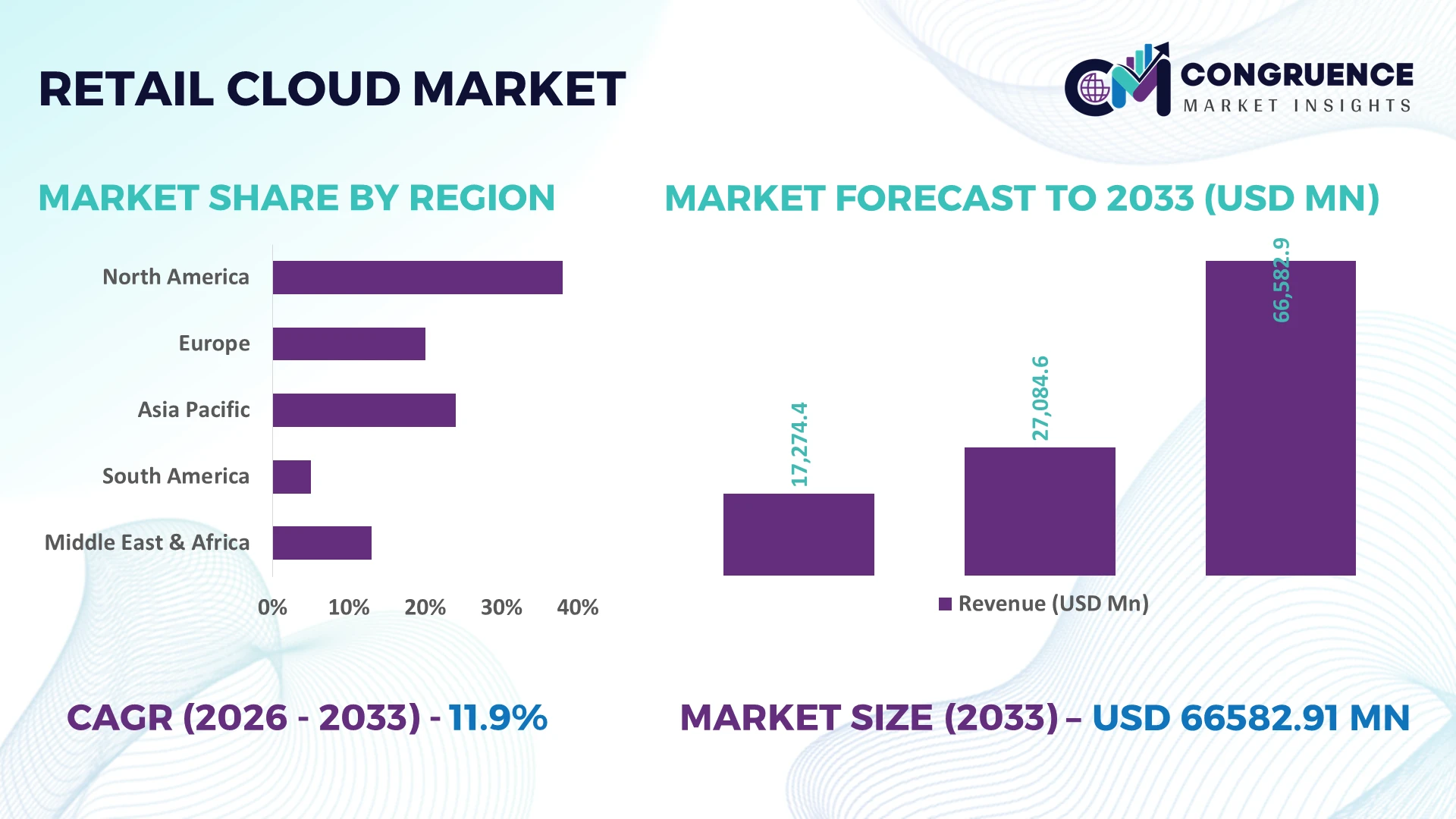
The United States dominates the global Retail Cloud Market with approximately 37% market share, supported by multi-billion-dollar digital modernization investments across grocery, fashion, and large-format retail chains, while over 72% of large retailers operate cloud-first commerce platforms. China follows with rapid deployment across digital retail ecosystems, benefiting from strong mobile commerce adoption and smart logistics expansion despite evolving global trade and tariff dynamics in 2026. This competitive landscape accelerates innovation, platform scalability, and cross-border retail transformation.
Organizations investing in secure, AI-enabled retail cloud ecosystems gain stronger operational resilience, faster deployment cycles, and greater competitive differentiation across global markets.
Market Size & Growth: USD 27,084.58 million (2025) to USD 66,582.91 million (2033) at 11.9% CAGR, driven by AI-enabled omnichannel retail transformation.
Top Growth Drivers: AI adoption exceeds 60%, cloud POS deployment grows 45%, and omnichannel fulfillment expands over 40% globally.
Short-Term Forecast: By 2028, retailers reduce infrastructure costs by 28% while improving order processing efficiency by 35%.
Emerging Technologies: Generative AI, edge computing, and predictive analytics accelerate automated merchandising and real-time inventory visibility.
Regional Leaders: North America surpasses USD 24 billion, Asia-Pacific exceeds USD 21 billion, and Europe approaches USD 15 billion through digital retail expansion.
Consumer/End-User Trends: More than 70% of digital shoppers expect unified online and in-store experiences supported by cloud platforms.
Pilot/Case Example: In 2026, AI-based cloud inventory deployment improved stock accuracy by 32% and reduced replenishment delays by 25%.
Competitive Landscape: Top providers collectively control nearly 55% market share, with Microsoft, Amazon Web Services, Google Cloud, Oracle, and SAP leading enterprise deployments.
Regulatory & ESG Impact: Cloud optimization lowers data-center energy consumption by nearly 20% while strengthening compliance with evolving digital governance requirements.
Investment & Funding: Global investments exceed USD 12 billion, fueled by strategic partnerships, platform expansion, and regional cloud infrastructure upgrades.
Innovation & Future Outlook: Autonomous retail operations, AI agents, and unified commerce platforms strengthen resilient supply chains and next-generation customer engagement.
Retail Cloud Market demand continues to expand across omnichannel commerce, cloud-based POS, digital payment ecosystems, merchandising analytics, and retail workforce management. AI-powered demand forecasting and intelligent inventory orchestration now improve forecasting accuracy by nearly 30%, while resilient cloud architectures support evolving compliance requirements and supply-chain visibility. These developments strengthen enterprise scalability and establish the foundation for the strategic market analysis that follows.
Retail cloud platforms have become a strategic foundation for retailers seeking higher operational agility, faster decision-making, and resilient omnichannel execution. Infrastructure modernization, AI-enabled merchandising, and supply-chain restructuring are accelerating cloud adoption as retailers standardize data across stores, warehouses, and digital channels. In 2026, stricter digital compliance requirements and expanding cross-border retail operations are reinforcing investments in scalable cloud ecosystems capable of supporting real-time inventory, pricing, and customer engagement.
Compared with traditional on-premise retail systems, cloud-native platforms reduce deployment time by nearly 45% and lower infrastructure maintenance costs by approximately 30% through automated software updates and elastic computing resources. The United States leads enterprise-scale cloud deployments across national retail chains, while India records faster implementation among mid-sized retailers driven by digital payment expansion and unified commerce strategies. Over the next two to three years, AI-assisted demand forecasting is expected to exceed 65% adoption among large retail organizations, strengthening inventory accuracy and fulfillment performance.
A global supermarket operator deploying cloud-based inventory synchronization across thousands of outlets demonstrates how centralized retail platforms improve replenishment efficiency and reduce stock imbalances. Retail technology providers are expanding AI partnerships, regional cloud infrastructure, and industry-specific solutions to strengthen enterprise competitiveness. Organizations that integrate secure, intelligent retail cloud architectures with operational transformation will establish stronger market positioning and long-term digital resilience.
Enterprise retailers are accelerating migration toward cloud-native commerce platforms to unify inventory, customer data, and store operations across physical and digital channels. More than 70% of large retailers now prioritize unified commerce initiatives, while AI-assisted inventory optimization improves forecast accuracy by approximately 30% and reduces stockouts by nearly 25%. The continued expansion of digital payment ecosystems and fulfillment automation in the United States is reinforcing cloud infrastructure investments. Technology providers are responding through industry-specific cloud platforms, strategic AI partnerships, and edge computing deployments that shorten implementation cycles. The resulting operational visibility enables retailers to optimize pricing, replenishment, and customer engagement while improving enterprise-wide decision speed.
Many retailers continue operating fragmented POS, ERP, and warehouse systems that complicate cloud migration and data synchronization. Approximately 48% of mid-sized retailers face interoperability challenges, while migration projects can extend implementation timelines by 20–30% when legacy applications require customization. Data sovereignty requirements in countries including Germany further increase compliance complexity for multinational retailers. Companies are reducing these constraints through phased modernization, localized cloud hosting, API-based integration frameworks, and multi-vendor technology strategies. Organizations that simplify application architecture before migration achieve more predictable deployment schedules and lower long-term operational costs than businesses relying on fragmented legacy environments.
AI-driven automation, edge computing, and retail-specific analytics platforms are creating new opportunities beyond traditional cloud hosting. Smart inventory orchestration can reduce excess inventory by approximately 18%, while AI-powered pricing engines improve promotional effectiveness by nearly 22%. India's expanding digital commerce ecosystem and nationwide retail digitization initiatives create attractive deployment opportunities for scalable cloud platforms. Technology providers are increasing investment in industry-focused AI models, retail application ecosystems, and strategic alliances with payment and logistics providers. Retailers integrating predictive analytics with real-time edge processing gain measurable improvements in store productivity and localized customer experience without significantly increasing infrastructure complexity.
Long-term competitiveness depends on securely managing increasingly complex multi-cloud environments supporting millions of daily retail transactions. More than 60% of enterprise retailers operate hybrid cloud architectures, while cybersecurity incidents targeting retail organizations continue increasing alongside digital commerce expansion. Shortages of cloud security specialists in advanced retail markets such as Japan and the United States further complicate secure deployment and governance. Companies must strengthen zero-trust security frameworks, workforce development, continuous monitoring, and cloud-native application design to maintain operational consistency. Retailers that successfully balance scalability, cybersecurity, and regulatory compliance will achieve stronger customer trust and sustainable competitive differentiation.
AI-Powered Store Intelligence: Retailers are embedding generative AI into merchandising, inventory planning, and customer engagement workflows, with AI-assisted assortment decisions increasing by nearly 40% and demand forecast accuracy improving by around 30%. Labor shortages and rising fulfillment expectations are accelerating deployment, while technology providers scale industry-specific AI models and automation partnerships that shorten planning cycles and improve shelf availability.
Hybrid Cloud Operational Expansion: Enterprise retailers are shifting critical retail applications toward hybrid cloud architectures, with more than 60% of large chains operating mixed cloud environments and application portability improving deployment flexibility by nearly 35%. Data governance requirements and infrastructure modernization are driving this transition, prompting vendors to strengthen interoperability frameworks, containerized applications, and unified management platforms for consistent multi-location operations.
Edge Computing Gains Momentum: Store-level edge computing adoption is increasing as retailers process transactions and inventory data closer to operations, reducing application response times by approximately 45% and network dependency by nearly 25%. Large retailers in the United States are expanding edge-enabled stores alongside cloud synchronization, allowing companies to improve checkout continuity, real-time pricing, and localized analytics despite network disruptions.
Composable Commerce Platform Adoption: Retail organizations are replacing monolithic software with modular cloud commerce architectures, enabling deployment cycles that are nearly 40% faster while reducing application customization costs by approximately 20%. Continuous digital commerce innovation and evolving customer expectations encourage vendors to expand API ecosystems, strategic technology alliances, and low-code development capabilities, enabling retailers to introduce new digital services without disrupting existing operations.
SaaS remains the leading Retail Cloud Market segment because it enables rapid deployment, predictable subscription costs, and seamless integration with retail operations including POS, merchandising, and customer engagement. Approximately 52% of enterprise retail cloud implementations rely primarily on SaaS platforms due to lower maintenance requirements and continuous feature updates. Private Cloud is emerging as the fastest-growing type as large retailers prioritize data sovereignty, cybersecurity, and operational control for sensitive customer and payment information. Meanwhile, PaaS strengthens application development capabilities, IaaS supports scalable infrastructure modernization, and Public Cloud continues serving cost-sensitive retailers seeking flexible expansion.
Investment priorities increasingly favor integrated cloud ecosystems rather than isolated infrastructure deployments. Nearly 58% of enterprise retailers now combine multiple cloud service models to optimize performance, security, and operational resilience. Technology providers are expanding retail-specific SaaS portfolios, strengthening Private Cloud security capabilities, and enhancing PaaS developer ecosystems through strategic partnerships and AI integration, enabling retailers to modernize operations while maintaining business continuity.
Inventory Management represents the largest application segment because retailers depend on real-time stock visibility, automated replenishment, and synchronized warehouse operations to reduce inventory imbalance. Cloud-enabled inventory systems improve stock accuracy by approximately 30% while reducing replenishment delays by nearly 25%. Analytics is the fastest-growing application as AI-driven forecasting and customer intelligence become central to merchandising decisions. E-commerce platforms continue expanding through unified commerce deployment, Customer Management solutions strengthen personalized engagement, and Supply Chain applications improve logistics coordination across distributed fulfillment networks.
Retailers increasingly integrate multiple cloud applications into unified operational environments rather than deploying standalone solutions. Nearly 65% of large retail organizations now connect inventory, analytics, and customer management platforms through centralized cloud architectures. Technology vendors respond by expanding API connectivity, workflow automation, and predictive intelligence capabilities, enabling retailers to improve operational efficiency while supporting increasingly complex omnichannel fulfillment requirements.
Supermarkets account for the largest Retail Cloud Market demand because high transaction volumes, complex inventory management, and distributed store networks require centralized cloud operations. More than 68% of large supermarket chains utilize integrated cloud platforms supporting merchandising, pricing, and replenishment workflows. E-commerce Retailers represent the fastest-growing end-user segment as digital fulfillment, AI-driven personalization, and automated order orchestration become competitive priorities. Specialty Stores continue adopting targeted cloud applications for customer engagement, while Department Stores and Convenience Stores expand cloud investments to modernize legacy retail infrastructure and improve operational consistency.
Technology providers increasingly tailor solutions according to retail operating models instead of offering standardized platforms. Nearly 55% of enterprise deployments now include industry-specific configurations supporting supermarket operations, digital commerce, or specialty retail requirements. Vendors are strengthening ecosystem partnerships, flexible pricing structures, and modular deployment strategies to address evolving customer requirements while improving scalability across diverse retail environments.
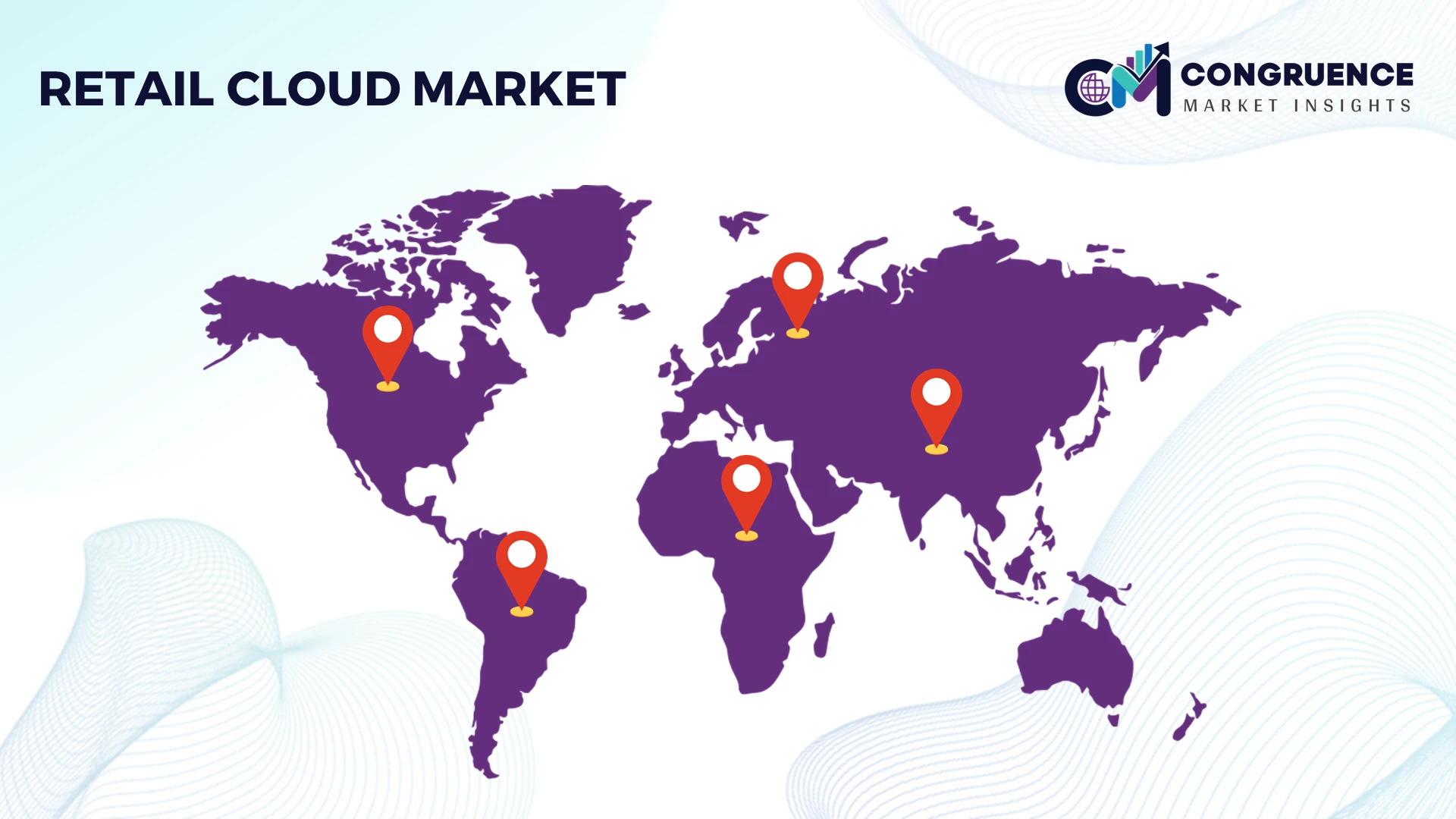
North America accounted for the largest market share at 38.4% in 2025 however, Asia-Pacific is expected to register the fastest growth, expanding at a 13.8% CAGR between 2026 and 2033.
AI-Driven Enterprise Retail Modernization
North America maintains the highest concentration of enterprise retail cloud deployments through widespread adoption among supermarket chains, department stores, and digital commerce operators. The region contributes approximately 38.4% of global market activity, supported by mature hyperscale cloud infrastructure and advanced retail technology ecosystems. More than 70% of large retailers operate unified cloud commerce platforms integrating inventory, fulfillment, and customer analytics. Ongoing investments in edge computing, AI-enabled merchandising, and automated fulfillment continue improving operational responsiveness. Strategic partnerships between cloud providers and national retailers are accelerating deployment of industry-specific applications while strengthening cybersecurity, compliance, and scalable omnichannel operations.
United States Market Outlook: The United States remains the regional technology leader because of its large enterprise retail base, advanced cloud infrastructure, and strong investment in AI-driven commerce platforms. More than 72% of major retail chains have adopted cloud-native retail management environments supporting synchronized store, warehouse, and online operations. Retailers continue expanding predictive analytics, intelligent pricing, and automated replenishment while collaborating with cloud platform providers to improve resilience, deployment speed, and customer experience across nationwide operations.
Compliance-Centered Digital Retail Transformation
Europe continues strengthening retail cloud adoption through digital modernization, cybersecurity initiatives, and data governance requirements that encourage enterprise cloud migration. The region accounts for nearly 27% of global deployments, with retailers prioritizing secure hybrid cloud architectures and integrated commerce platforms. More than 60% of large retailers are modernizing legacy retail applications to improve operational visibility and customer engagement. Sustainable data center expansion and energy-efficient cloud infrastructure further support enterprise transformation. Technology providers increasingly deliver compliance-focused cloud solutions tailored to evolving digital regulations and multinational retail operations.
Germany Market Outlook: Germany leads the European market through its advanced retail infrastructure, enterprise software adoption, and strong industrial digitalization ecosystem. Large retailers continue integrating AI-powered merchandising and cloud-based supply-chain orchestration across national distribution networks. More than 65% of enterprise retail modernization projects emphasize secure hybrid cloud environments, allowing organizations to improve operational transparency while meeting stringent digital governance and cybersecurity requirements.
Large-Scale Digital Commerce Expansion
Asia-Pacific is emerging as the fastest-expanding Retail Cloud Market due to rapid retail digitization, expanding mobile commerce ecosystems, and accelerated enterprise cloud deployment. The region represents approximately 25% of global market activity while recording the highest pace of cloud implementation across retail enterprises. More than 68% of large digital retailers are investing in AI-enabled commerce platforms supporting real-time customer engagement and fulfillment optimization. Strong hyperscale cloud investments, expanding payment ecosystems, and logistics modernization continue strengthening enterprise cloud adoption across both developed and emerging economies.
China Market Outlook: China remains the largest regional market because of its extensive digital retail ecosystem, advanced logistics infrastructure, and strong cloud technology adoption. Large retail enterprises increasingly deploy AI-enabled cloud platforms supporting intelligent inventory management, personalized commerce, and automated fulfillment. More than 75% of leading digital retailers utilize integrated cloud ecosystems, enabling faster product launches, scalable operations, and efficient coordination across nationwide retail and distribution networks.
Digital Commerce Infrastructure Accelerates Adoption
South America is steadily expanding retail cloud implementation as retailers modernize operational systems to improve digital commerce and inventory visibility. The region contributes approximately 6% of global market activity, supported by growing enterprise investment in cloud-based retail applications and payment technologies. Cloud deployments among organized retail businesses have increased by nearly 22% over recent years, strengthening omnichannel capabilities despite uneven digital infrastructure across markets. Retail technology providers continue expanding local partnerships and managed cloud services to improve accessibility while addressing connectivity and operational efficiency challenges.
Brazil Market Outlook: Brazil leads regional adoption through its large organized retail sector, expanding digital payment ecosystem, and increasing enterprise cloud investments. National retailers continue replacing legacy retail software with scalable cloud platforms supporting customer analytics, inventory synchronization, and omnichannel fulfillment. Retail technology partnerships and expanding cloud infrastructure enable businesses to improve operational flexibility while supporting growing online and physical retail integration across the country.
Retail Infrastructure Modernization Gains Momentum
The Middle East & Africa Retail Cloud Market continues advancing through digital transformation initiatives, expanding cloud infrastructure, and smart retail investments. The region represents approximately 3.6% of global market activity while increasing enterprise adoption of cloud-enabled commerce platforms across organized retail. More than 40% of large retail modernization projects now incorporate cloud-based inventory and customer management capabilities. Government-backed digital economy programs and new hyperscale data center investments continue improving enterprise deployment readiness and long-term operational resilience.
United Arab Emirates Market Outlook: The United Arab Emirates leads regional development through advanced digital infrastructure, supportive regulatory frameworks, and strong investment in cloud-enabled retail transformation. Enterprise retailers increasingly deploy AI-driven retail platforms integrated with payment systems, logistics, and customer engagement solutions. National digital economy initiatives and expanding hyperscale cloud capacity continue strengthening the country's position as a strategic retail technology hub serving both domestic and international retail operations.
The Retail Cloud Market is led by Microsoft, Amazon Web Services, Google Cloud, Oracle, and SAP, collectively controlling approximately 54% of global market activity. Competition primarily pits global hyperscale cloud providers against regional cloud specialists and enterprise retail software vendors, while niche platform innovators compete through industry-specific capabilities rather than pricing alone. Technology leadership, deployment speed, AI integration, cybersecurity, and retail workflow customization define competitive differentiation. AI-enabled merchandising platforms improve inventory accuracy by nearly 30%, while automated cloud deployment reduces implementation time by approximately 40%, creating measurable operational advantages. Leading providers strengthen market positions through strategic partnerships with retailers, regional cloud infrastructure expansion, vertical integration of analytics, and acquisitions that broaden commerce ecosystems. Competitive momentum is shifting toward unified retail platforms combining AI, edge computing, and real-time data orchestration instead of standalone cloud infrastructure. Entry pressure remains high because enterprise retailers demand proven scalability, regulatory compliance, and seamless integration with legacy retail applications. Winning requires secure, retail-specific cloud ecosystems delivering rapid deployment, continuous innovation, and enterprise-grade operational resilience.
Microsoft
Amazon Web Services
Google Cloud
Oracle
SAP
Salesforce
IBM
Alibaba Cloud
VMware
Fujitsu
Huawei Cloud
Rackspace Technology
Retail cloud technology is rapidly evolving from centralized infrastructure toward intelligent, autonomous commerce ecosystems. Generative AI, predictive analytics, edge computing, and cloud-native microservices are becoming standard enterprise capabilities. More than 65% of large retailers are integrating AI into merchandising and inventory planning, while predictive analytics improves forecast accuracy by nearly 30%. API-driven integration platforms enable real-time synchronization across stores, warehouses, payment systems, and digital commerce channels, reducing operational latency and strengthening enterprise decision-making.
Compared with traditional on-premise retail software, cloud-native architectures shorten deployment cycles by approximately 45% and reduce infrastructure maintenance costs by nearly 30% through automated updates and elastic resource allocation. Retailers operating complex omnichannel environments gain the greatest competitive advantage because cloud platforms support continuous scalability without disrupting daily operations. Edge computing further improves transaction response times by roughly 40%, enabling localized processing and uninterrupted store performance during network interruptions.
Between 2026 and 2028, autonomous retail operations, AI agents, digital twins, and industry-specific cloud platforms will reshape enterprise technology strategies. Adoption of intelligent workflow automation is expected to exceed 70% among large retail organizations, supporting faster replenishment, dynamic pricing, and personalized customer engagement. Organizations investing early in integrated AI-enabled retail cloud ecosystems will strengthen operational resilience, accelerate innovation cycles, and achieve sustainable competitive differentiation as digital commerce complexity continues increasing.
January 2026: Oracle introduced Oracle Retail Supply Chain Collaboration at NRF 2026, adding AI-driven supplier collaboration and compliance capabilities that improve forecast accuracy while strengthening retail supply-chain visibility. The platform integrates directly with Oracle Retail Merchandising Foundation Cloud Service, enhancing operational resilience. Source: Oracle
February 2026: Microsoft expanded its strategic partnership with Wesfarmers to deploy Azure AI, Microsoft Cloud, and Copilot technologies across retail operations serving brands including Bunnings and Kmart, supporting approximately 118,000 employees through enterprise-wide AI and cloud transformation. Business impact includes faster operational decision-making and workforce productivity. Source: E-commerce News Australia
January 2025: SAP launched SAP S/4HANA Cloud Public Edition for retail, fashion, and vertical businesses, integrating merchandising, procurement, and finance into a unified cloud platform. The solution centralizes 100% of core retail operational workflows, accelerating enterprise modernization and improving data consistency across retail organizations. Source: CIO Dive
January 2026: SAP unveiled its AI-native Retail Intelligence platform featuring generative AI-powered planning, inventory forecasting, and operational analytics. The solution unifies customer, supplier, sales, and inventory data, reducing manual planning activities while improving enterprise-wide retail execution and decision quality. Source: TechTarget
This report provides comprehensive analysis of the Retail Cloud Market across SaaS, PaaS, IaaS, Public Cloud, and Private Cloud deployments, evaluating operational adoption patterns, enterprise implementation strategies, and technology evolution between 2026 and 2033. The assessment covers Inventory Management, Customer Management, E-commerce, Supply Chain, and Analytics applications, alongside demand across Supermarkets, E-commerce Retailers, Specialty Stores, Department Stores, and Convenience Stores. More than 60% of enterprise deployments emphasize integrated cloud ecosystems combining AI, automation, and real-time retail intelligence.
Regional analysis spans North America, Europe, Asia-Pacific, South America, and the Middle East & Africa, highlighting country-level deployment trends, infrastructure readiness, and digital transformation priorities. The report evaluates competitive positioning, cloud modernization strategies, AI integration, edge computing, cybersecurity, and enterprise partnerships while examining adoption patterns, investment priorities, and operational benchmarks. It delivers actionable insights supporting expansion planning, technology selection, competitive differentiation, portfolio optimization, and long-term strategic decision-making across the evolving retail cloud ecosystem.
| Report Attribute/Metric | Report Details |
|---|---|
Market Revenue in 2025 | USD 27084.58 Million |
Market Revenue in 2033 | USD 66582.91 Million |
CAGR (2026 - 2033) | 11.9% |
Base Year | 2025 |
Forecast Period | 2026 - 2033 |
Historic Period | 2021 - 2025 |
Segments Covered | By Type
By Application
By End-User
|
Key Report Deliverable | Revenue Forecast, Growth Trends, Market Dynamics, Segmental Overview, Regional and Country-wise Analysis, Competition Landscape |
Region Covered | North America, Europe, Asia-Pacific, South America, Middle East, Africa |
Key Players Analyzed | Microsoft, Amazon Web Services, Google Cloud, Oracle, SAP, Salesforce, IBM, Alibaba Cloud, VMware, Fujitsu, Huawei Cloud, Rackspace Technology |
Customization & Pricing | Available on Request (10% Customization is Free) |




