
Reports
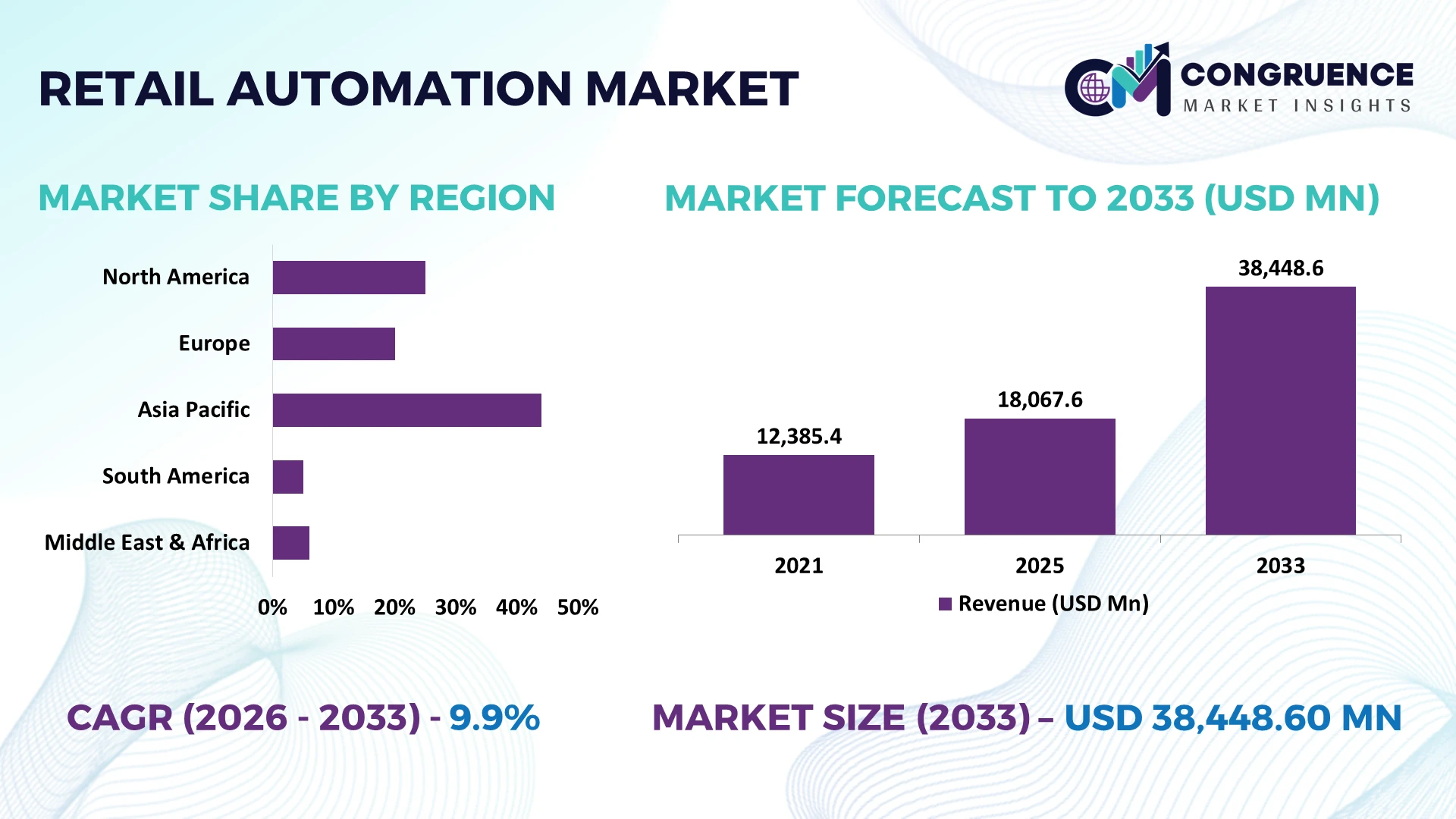
The Global Retail Automation Market was valued at USD 18067.56 Million in 2025 and is anticipated to reach a value of USD 38448.6 Million by 2033 expanding at a CAGR of 9.9% between 2026 and 2033. Growth is driven by AI-powered checkout systems, electronic shelf labels, automated inventory replenishment, and robotics integration across omnichannel retail operations.
The United States remains a leading retail automation market, supported by its extensive supermarket infrastructure, advanced payment networks, and technology investments. The US Census Bureau reported that e-commerce represented approximately 16.4% of total US retail sales in 2025, reinforcing investment in automated fulfillment and inventory synchronization. Walmart operates more than 4,600 US stores, creating substantial deployment opportunities for intelligent inventory systems and automated distribution. Compared with India, where UPI processed more than 20 billion monthly transactions during 2025, US retail automation emphasizes integrated store operations and fulfillment productivity.
Retailers prioritizing interoperable automation platforms, real-time inventory visibility, and scalable checkout infrastructure are positioned to secure stronger operating margins and improve omnichannel execution.
Market Size & Growth: Valued at USD 18067.56 Million in 2025, projected to USD 38448.6 Million by 2033 at 9.9% CAGR, driven by labor cost inflation and omnichannel fulfillment complexity.
Top Growth Drivers: Labor cost pressure at 35% of operational expense, warehouse automation order intake growth of 7% year-over-year, and AI agent deployment by over two-thirds of retailers .
Short-Term Forecast: By 2027, AI-driven route optimization and predictive analytics reduce logistics operational costs by 15–20% as retailers shift from reactive to predictive orchestration .
Emerging Technologies: AI-native handheld devices with AMOLED displays, vision-based shelf calibration systems, and robotics hub orchestration layers replacing point-to-point WMS integrations .
Regional Leaders: North America at USD 11.85 billion and 42% share, Europe at USD 9.11 billion with Germany leading, and Asia-Pacific at USD 7.27 billion expanding at the highest regional growth rate .
Consumer/End-User Trends: Supermarkets and hypermarkets command 31.13% of end-user share; POS systems hold 44.89% of component revenue as self-checkout adoption expands .
Pilot/Case Example: Zebra Technologies completed the USD 1.3 billion acquisition of Elo Touch Solutions in October 2025, expanding addressable market by approximately USD 8 billion and enabling end-to-end retail automation spanning mobile computing, checkout scanning, and customer-facing touchpoints .
Competitive Landscape: NCR Voyix, Honeywell, Zebra Technologies, Diebold Nixdorf, and Datalogic lead; Amazon, Walmart, Alibaba, Oracle, and SAP compete across software and platform capabilities .
Regulatory & ESG Impact: Self-checkout regulations emerging in at least nine US states; Rhode Island enacted staffing ratio requirements effective January 2027 mandating one staffed checkout for every three self-checkout stations .
Investment & Funding: Zebra Technologies completed USD 1.3 billion Elo Touch Solutions acquisition; retailers increasingly prioritize supplier diversification and modular procurement to reduce tariff and supply chain exposure .
Innovation & Future Outlook: Agentic AI managing purchases autonomously with one third of US consumers open to AI-assisted transactions; humanoid robotics entering warehouse dexterity applications .
Retail automation adoption is expanding across grocery chains, fashion retailers, pharmacies, and high-volume distribution networks, where transaction speed and merchandise availability determine profitability. Computer vision checkout, RFID-enabled product identification, and AI-based demand forecasting are replacing disconnected store management processes. Amazon's Just Walk Out technology demonstrates how sensor fusion and automated payment processing support cashierless transactions, while electronic shelf labels enable centralized price updates across thousands of products. India's UPI ecosystem, processing more than 20 billion monthly transactions in 2025, illustrates the expanding digital infrastructure supporting connected retail operations. These developments establish the strategic importance of scalable, data-integrated retail automation investments.
Retail automation is becoming a strategic priority as retailers restructure store operations around labor productivity, inventory precision, and digitally connected fulfillment. The transition from standalone point-of-sale terminals toward integrated commerce infrastructure is changing technology procurement and competitive differentiation. Walmart's investment in automated distribution demonstrates how large retailers are shifting capital toward robotic handling, predictive replenishment, and centralized inventory orchestration. These investments strengthen merchandise availability while reducing dependence on repetitive manual processes.
Technology modernization delivers measurable operational advantages. RFID-based inventory systems can achieve accuracy exceeding 95% in appropriately managed deployments, compared with substantially lower accuracy under conventional manual stocktaking. The United States leads large-scale fulfillment automation, while China emphasizes mobile payments, intelligent vending, and digitally integrated convenience formats. Germany prioritizes electronic shelf labels and automated warehouse systems. These differences encourage technology providers to develop modular architectures suited to individual retail operating environments.
Between 2026 and 2028, computer vision, edge computing, and AI-driven inventory optimization will increasingly converge within unified retail platforms. Retailers are expanding partnerships with robotics manufacturers, cloud infrastructure providers, and payment technology specialists to improve deployment economics. Automated micro-fulfillment centers offer a practical pathway for processing online grocery orders closer to consumers, reducing picking distances and supporting faster delivery. Competitive advantage will increasingly depend on converting connected store data into reliable operational decisions rather than merely installing additional automation equipment.
Retailers are accelerating checkout automation to improve transaction throughput, labor allocation, and store productivity. A 2026 retail study covering 39 companies found that self-checkout accounted for approximately 54% of transactions in stores offering the technology, demonstrating substantial consumer acceptance. In the United States, Walmart's automated supply-chain network served approximately 65% of its stores in 2026, highlighting enterprise-scale infrastructure modernization. The shift toward integrated store and distribution operations is encouraging retailers to deploy computer vision, intelligent point-of-sale systems, and automated merchandise handling. Technology providers are responding through robotics partnerships, cloud-based retail platforms, and modular checkout solutions. The strategic advantage lies in coordinating customer transactions with inventory replenishment rather than optimizing individual processes independently.
Retail automation investments face immediate financial constraints from hardware acquisition, infrastructure retrofitting, maintenance requirements, and transaction-related shrinkage. A 2026 study of self-checkout deployments identified an average 22% increase in retail losses during the first year following implementation. Comparative analysis also recorded an average 0.42 percentage-point difference in losses between stores with and without self-checkout systems. These findings expose profitability pressures for supermarket operators expanding unattended payment infrastructure. In the United Kingdom, retailers are strengthening checkout supervision, transaction verification, and exception monitoring to protect margins. Vendors are responding with computer vision loss detection, flexible equipment leasing, and integrated payment security. Deployment economics increasingly depend on controlling shrinkage alongside labor savings.
Next-generation retail automation opportunities are expanding through compact fulfillment robotics, predictive assortment planning, and software-defined store operations. India's expanding digital commerce infrastructure offers a substantial deployment opportunity, supported by UPI's growing transaction penetration and organized retail modernization. Automated fulfillment platforms capable of handling 80% of standardized inventory workflows demonstrate the potential for concentrating robotic investment on high-frequency merchandise. Emerging edge AI architectures also support localized product recognition and real-time replenishment without continuous cloud processing. Technology developers are pursuing partnerships with grocery chains, logistics operators, and payment infrastructure providers. Between 2026 and 2028, modular automation subscriptions and shared fulfillment infrastructure will create attractive entry points for mid-sized retailers seeking enterprise-grade capabilities.
Scaling retail automation across heterogeneous store networks requires reliable robotic manipulation, workforce coordination, and uninterrupted transaction processing. Walmart's Brooksville automation operations illustrate this complexity, with approximately 80% of inventory processing automated while the remaining 20% requires human intervention for difficult merchandise categories. Across its broader network, more than 50% of e-commerce volume is supported by partially automated systems, emphasizing the continued importance of hybrid operations. Irregular packaging, equipment maintenance, and robotic handling limitations create operational inconsistencies during expansion. Retailers must strengthen equipment interoperability, develop specialized technical capabilities, and establish predictive maintenance programs. Long-term competitiveness depends on achieving consistent automation performance across diverse merchandise profiles without compromising fulfillment reliability.
Point-of-Sale Systems constitute the leading retail automation type, supported by their essential role in payment authorization, transaction recording, and store management integration. Established deployments across supermarkets, pharmacies, and specialty retail chains create sustained demand for software upgrades and connected payment terminals. Self-Checkout Systems represent another significant category, with a 2026 retail study covering 39 companies reporting that self-checkout accounted for approximately 54% of transactions in stores offering the technology. Electronic Shelf Labels are expanding through large-scale deployments, while Smart Vending Machines support unattended transactions in airports, workplaces, and convenience locations.
Retail Robots represent a rapidly developing category as computer vision, robotic manipulation, and autonomous navigation improve commercial deployment capabilities. Automated Storage Systems optimize merchandise density and retrieval, while Automated Guided Vehicles support structured warehouse transport operations. Amazon's robotic network surpassed 1 million deployed units in 2025, demonstrating the scale of automation within retail fulfillment infrastructure. Manufacturers are strengthening partnerships with software developers and distribution operators to deliver integrated solutions. Investment priorities increasingly favor interoperable systems that connect store transactions with inventory execution and automated merchandise movement.
Inventory Management represents a leading retail automation application because merchandise accuracy directly influences replenishment decisions, working capital efficiency, and product availability. Zebra Technologies' 2025 Global Shopper Study found that 84% of retail decision-makers faced significant pressure to synchronize inventory across sales channels. Checkout Automation remains an established application, supported by transaction processing requirements and customer demand for convenient payment experiences. Price Management increasingly incorporates centrally controlled pricing software, while Shelf Monitoring uses computer vision to detect availability gaps and misplaced merchandise. Customer Service applications integrate intelligent assistance, automated inquiries, and personalized shopping support.
Loss Prevention is becoming a rapidly advancing application as retailers confront fraudulent transactions and merchandise shrinkage. The National Retail Federation's 2025 research found that 9% of merchandise returns were fraudulent, creating demand for automated verification and exception monitoring. Order Fulfillment is also expanding through robotic picking and coordinated warehouse execution. Technology providers are combining transaction analytics, merchandise identification, and intelligent surveillance within unified operating platforms. Retailers increasingly prioritize systems that protect profitability while maintaining customer convenience and improving operational responsiveness.
Supermarkets and Hypermarkets represent the leading end-user category, supported by high transaction volumes, extensive merchandise assortments, and complex replenishment requirements. Large grocery operators deploy integrated checkout systems, automated pricing platforms, and inventory monitoring technologies across hundreds or thousands of locations. Walmart operates more than 4,600 stores in the United States, illustrating the deployment scale available to major retail enterprises. Convenience Stores increasingly adopt compact unattended checkout solutions, while Specialty Stores prioritize merchandise identification and customer engagement. Department Stores emphasize cross-channel inventory coordination, and Shopping Malls invest in shared digital services and customer-facing automation infrastructure.
E-commerce Retailers represent a rapidly advancing end-user category because rising order complexity increases the importance of robotic fulfillment and automated merchandise sorting. Pharmacies are strengthening automated dispensing and product traceability to support regulated inventory handling. Zebra Technologies' 2025 findings showed that 89% of retail associates believed artificial intelligence would improve productivity, reinforcing enterprise interest in workforce-supporting technologies. Automation suppliers are developing sector-specific platforms, flexible subscription models, and integrated service partnerships. Competitive differentiation increasingly depends on aligning deployment economics with merchandise characteristics, operating scale, and customer transaction requirements.
North America accounted for the largest market share at approximately 35% in 2025 however, Asia-Pacific is expected to register the fastest growth, expanding at a CAGR of approximately 12.5% between 2026 and 2033.
Enterprise Retail Modernization and Intelligent Store Infrastructure
North America maintains a leading position in retail automation, supported by extensive supermarket networks, advanced payment infrastructure, and large-scale investment in automated distribution. The United States dominates regional deployment, while Canada contributes through connected retail systems and warehouse modernization. Enterprise retailers increasingly integrate cloud-based point-of-sale platforms, intelligent inventory management, and automated merchandise handling. Amazon's deployment of more than 1 million robots globally by 2025 illustrates the scale of automation investment among US-headquartered retail enterprises. Grocery operators are also expanding electronic shelf labels and computer vision systems to improve pricing execution and merchandise visibility. Retail technology providers, including NCR Voyix, Zebra Technologies, and Honeywell, are strengthening software integration and operational analytics capabilities. Competitive differentiation increasingly depends on connecting transaction processing, inventory records, and fulfillment execution within unified enterprise infrastructure.
United States Market Outlook: The United States benefits from established retail technology ecosystems, extensive distribution infrastructure, and strong enterprise software adoption. Walmart's US network exceeds 4,600 stores, providing substantial opportunities for standardized automation deployment. Major retailers are investing in intelligent checkout, automated returns processing, and predictive inventory systems to improve operational consistency across geographically dispersed locations.
Digital Pricing Modernization and Regulatory-Led Technology Integration
Europe represents an established retail automation market, supported by organized grocery networks, advanced industrial automation capabilities, and stringent operational compliance requirements. Germany, France, and the United Kingdom are important deployment centers for electronic shelf labels, automated storage systems, and integrated retail software. European retailers increasingly prioritize digital price management to improve promotional accuracy and reduce manual merchandising workloads. Carrefour has expanded electronic shelf label adoption across selected retail formats, while industrial technology providers are developing connected store infrastructure. The EU AI Act introduces additional governance requirements for applicable artificial intelligence systems, influencing procurement decisions involving customer analytics and automated monitoring. Retailers are responding through privacy-conscious software architectures, centralized technology governance, and interoperable equipment platforms. Energy-efficient refrigeration monitoring and automated inventory coordination also support operating cost control and resource optimization.
Germany Market Outlook: Germany combines strong industrial automation expertise with an extensive organized retail network. Schwarz Group, Aldi, and REWE operate large-scale grocery infrastructure that supports advanced logistics and store technology integration. Germany's Industry 4.0 ecosystem encourages cooperation between equipment manufacturers, software developers, and retailers, strengthening opportunities for robotic handling, automated warehousing, and connected merchandise management.
Digital Commerce Integration and Large-Scale Automation Manufacturing
Asia-Pacific is emerging as the fastest-expanding retail automation region, supported by China's intelligent retail infrastructure, Japan's robotics expertise, and India's digital payment ecosystem. China maintains substantial manufacturing capacity for barcode scanners, self-service terminals, RFID equipment, and automated material handling systems. Japan's retail operators are adopting unattended checkout and robotic merchandise handling to address workforce constraints. India's UPI infrastructure processed more than 20 billion transactions in a single month during 2025, demonstrating the scale of digital payment adoption. South Korea contributes through smart convenience stores, automated kiosks, and advanced semiconductor technologies. Retail technology manufacturers are expanding local production, software integration, and distribution partnerships to improve equipment availability. The region's competitive advantage increasingly reflects the combination of electronics manufacturing capacity, mobile commerce penetration, and flexible automation deployment models.
China Market Outlook: China benefits from integrated electronics manufacturing clusters in Shenzhen, Dongguan, and Suzhou, supporting domestic production of intelligent payment terminals, sensors, and retail robotics. Alibaba's Freshippo retail ecosystem demonstrates the integration of physical stores, digital ordering, and technology-enabled fulfillment. Chinese manufacturers are strengthening computer vision capabilities and automated merchandise identification while expanding equipment exports to international retail operators.
Digital Payment Expansion and Organized Retail Modernization
South America's retail automation landscape is increasingly influenced by electronic payment adoption, supermarket modernization, and investment in connected commerce infrastructure. Brazil represents the principal deployment center, supported by established retail chains and a rapidly expanding instant payment ecosystem. Argentina, Chile, and Colombia contribute through self-service checkout installations, digital inventory systems, and automated payment acceptance. Brazil's Pix network processed more than 63 billion transactions during 2024, illustrating the transaction infrastructure available for connected retail applications. Retailers are integrating payment terminals with merchandise management software to improve transaction reconciliation and store-level visibility. However, imported equipment costs, fragmented legacy systems, and uneven connectivity continue to influence implementation economics. Technology suppliers are responding through local distribution partnerships, cloud-based deployment models, and equipment configurations adapted to regional operating conditions.
Brazil Market Outlook: Brazil benefits from an extensive organized grocery sector, established banking infrastructure, and widespread adoption of instant payments. Carrefour Brasil, Assaí Atacadista, and Grupo Mateus provide substantial enterprise deployment opportunities. The Central Bank's Pix infrastructure supports interoperable digital transactions, encouraging retailers to modernize payment acceptance, integrate customer purchasing records, and reduce dependence on conventional transaction-processing arrangements.
Smart Retail Investment and Commercial Infrastructure Transformation
The Middle East & Africa retail automation market is shaped by commercial infrastructure investment, modern shopping centers, and expanding digital payment networks. The United Arab Emirates and Saudi Arabia lead major retail technology deployments, supported by supermarket expansion, tourism infrastructure, and national digital transformation initiatives. Saudi Arabia's Vision 2030 program encourages modernization across commercial services, logistics, and technology infrastructure. In Africa, South Africa maintains an established organized retail ecosystem, while Kenya advances digital commerce through mobile payment integration. Retail operators are introducing self-service kiosks, intelligent checkout terminals, and automated stock management to improve transaction efficiency. Technology vendors are strengthening regional partnerships with systems integrators and payment service providers. Deployment strategies increasingly emphasize scalable cloud infrastructure, multilingual customer interfaces, and reliable equipment servicing across geographically dispersed commercial locations.
Saudi Arabia Market Outlook: Saudi Arabia is a strategically important retail automation market because of its expanding modern retail infrastructure and government-supported digital transformation. Saudi Payments reported that electronic payments accounted for 79% of retail consumer payments in 2024. Retail operators, including Panda Retail Company and Abdullah Al Othaim Markets, are positioned to benefit from integrated checkout technologies, automated inventory management, and connected store operations.
NCR Voyix, Honeywell, Zebra Technologies, Diebold Nixdorf, and Datalogic anchor the retail automation market, with the top five players commanding approximately 35–40% of worldwide revenue through POS hardware, self-checkout systems, and mobile computing platforms. Competition bifurcates between established hardware incumbents competing on installed-base retention and technology innovators including Amazon, Walmart, and Alibaba that deploy proprietary automation for competitive advantage rather than commercial resale. The basis of competition is shifting from hardware specifications toward software integration and AI capability: 92% of operations executives reported technology investments failed to meet expectations, with integration complexity cited as the primary barrier. Players compete through consolidation—Zebra's USD 1.3 billion Elo Touch Solutions acquisition expanded its addressable market by USD 8 billion—and vertical integration of hardware, software, and services. Entry barriers center on multi-site deployment scale and retail workflow expertise.
NCR Voyix
Honeywell International
Zebra Technologies
Diebold Nixdorf
Datalogic
Toshiba Global Commerce Solutions
Fujitsu
Epson
Oracle
SAP
Amazon
Walmart
Alibaba Group
Posiflex Technology
Current retail automation technologies combine cloud-connected point-of-sale systems, RFID inventory tracking, and electronic shelf labels to improve transaction accuracy and merchandise visibility. RFID-enabled stocktaking can achieve inventory accuracy exceeding 95% in optimized deployments, compared with approximately 70–80% under conventional manual processes. Walmart's electronic shelf label expansion across approximately 2,300 US stores demonstrates enterprise-scale adoption. Centralized price management reduces repetitive shelf maintenance, allowing employees to concentrate on replenishment and customer service while improving promotional consistency across retail locations.
Emerging technologies include computer vision checkout, autonomous mobile robots, and edge-based artificial intelligence for merchandise recognition. Amazon's DeepFleet system targets a 10% improvement in robotic fleet travel efficiency through coordinated movement optimization. Computer vision platforms integrate camera analytics with transaction records to identify scanning irregularities and improve loss detection. Retailers adopting unified software architectures gain advantages over competitors operating disconnected checkout, inventory, and fulfillment systems, particularly where transaction volumes and merchandise complexity are high.
Between 2026 and 2028, robotic manipulation, predictive replenishment, and intelligent store orchestration will reshape retail technology investment. AI-driven workflow optimization will increasingly connect warehouse execution with physical store operations. Modular deployment platforms will help mid-sized retailers access advanced automation without extensive infrastructure replacement. Competitive advantage will depend on interoperability, deployment reliability, and measurable productivity improvements across retail networks.
October 2024: NCR Voyix deployed its software-first virtualization platform for Speedy Stop, decoupling POS software from Verifone hardware across Texas convenience stores. The deployment eliminates full hardware replacement costs while enabling cloud-based remote issue resolution and future application integration. Source: ncr.com
October 2025: Honeywell launched its CT70 handheld computer with Qualcomm Dragonwing Q-6690 processor, 5G, and Wi-Fi 7 for retail and logistics frontline workers. The device integrates agentic AI for inventory search and product identification, reducing errors and accelerating customer service workflows. Source: honeywell.com
November 2025: Datalogic launched the Joya Smart family, the industry's first self-shopping devices with integrated AI computer vision validating scanned items. The system reduces incorrect transactions at self-checkout from 3% to under 1% while cutting manual staff interventions by 15% in pilot stores. Source: datalogic.com
November 2025: Diebold Nixdorf expanded its partnership with ROSSMANN to support the drugstore chain's Swiss market entry, providing POS systems and self-checkout technology through its eServices portal. The collaboration builds on support for over 2,350 German stores, creating a blueprint for European expansion. Source: nasdaq.com
The Retail Automation Market Report examines industry developments between 2026 and 2033, covering seven technology types: Point-of-Sale Systems, Self-Checkout Systems, Automated Storage Systems, Electronic Shelf Labels, Smart Vending Machines, Retail Robots, and Automated Guided Vehicles. Application analysis evaluates Inventory Management, Checkout Automation, Price Management, Customer Service, Shelf Monitoring, Order Fulfillment, and Loss Prevention. End-user coverage includes Supermarkets and Hypermarkets, Convenience Stores, Specialty Stores, Department Stores, E-commerce Retailers, Pharmacies, and Shopping Malls.
Regional assessment covers North America, Europe, Asia-Pacific, South America, and Middle East & Africa, examining deployment concentration, digital infrastructure, and enterprise investment priorities. Technology coverage includes RFID, computer vision, autonomous robotics, and AI-driven retail operations. The report evaluates competitive positioning, emerging unattended retail formats, equipment interoperability, and automation procurement strategies, supporting investment allocation, geographic expansion, technology partnerships, and long-term operational planning.
| Report Attribute/Metric | Report Details |
|---|---|
Market Revenue in 2025 | USD 18067.56 Million |
Market Revenue in 2033 | USD 38448.6 Million |
CAGR (2026 - 2033) | 9.9% |
Base Year | 2025 |
Forecast Period | 2026 - 2033 |
Historic Period | 2021 - 2025 |
Segments Covered | By Type
By Application
By End-User
|
Key Report Deliverable | Revenue Forecast, Growth Trends, Market Dynamics, Segmental Overview, Regional and Country-wise Analysis, Competition Landscape |
Region Covered | North America, Europe, Asia-Pacific, South America, Middle East, Africa |
Key Players Analyzed | NCR Voyix, Honeywell International, Zebra Technologies, Diebold Nixdorf, Datalogic, Toshiba Global Commerce Solutions, Fujitsu, Epson, Oracle, SAP, Amazon, Walmart, Alibaba Group, Posiflex Technology |
Customization & Pricing | Available on Request (10% Customization is Free) |




