
Reports
The Global Residential HVAC Market was valued at USD 17600 Million in 2025 and is anticipated to reach a value of USD 25983.41 Million by 2033 expanding at a CAGR of 4.99% between 2026 and 2033. Growth is driven by heat-pump replacement, stricter building-efficiency standards, inverter-based cooling adoption, and rising electrification of residential heating.
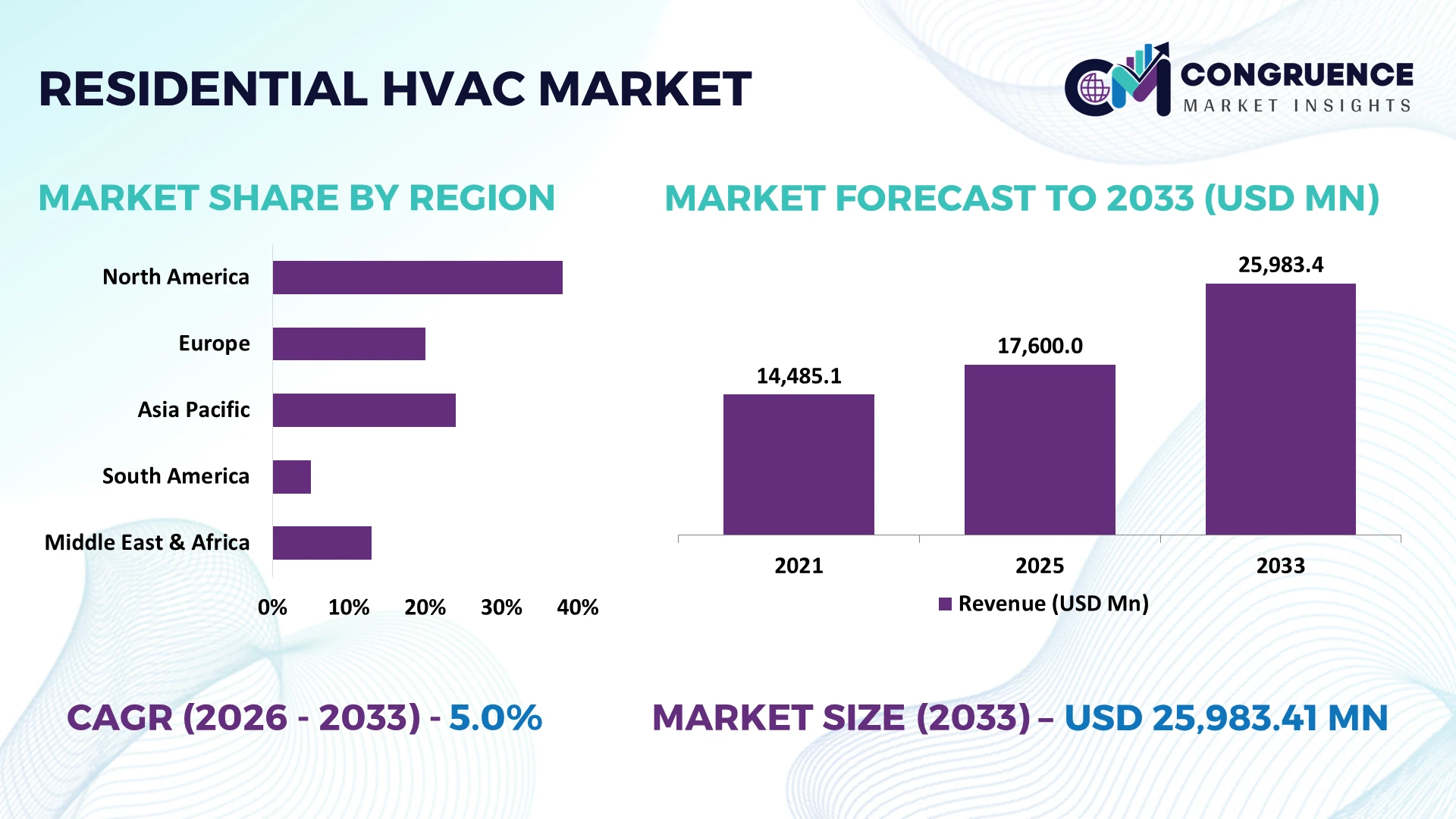
The United States remains a dominant residential HVAC market, with air-conditioning penetration exceeding 90% of households and heat-pump installations accelerating as electrification policies reshape residential heating. China combines the world’s largest HVAC manufacturing capacity with rapid inverter and variable-speed system adoption, while the U.S. emphasizes replacement and high-efficiency retrofits. The Russia-Ukraine energy disruption has reinforced efficiency-focused heating decisions across Europe, where heat-pump deployment is expanding. North American replacement demand remains structurally stronger than new-build demand, supporting premium-system adoption.
Strategically, manufacturers should prioritize high-efficiency heat pumps, inverter platforms, and retrofit-ready systems in mature markets while expanding affordable efficient technologies across high-growth Asian markets.
Market Size & Growth: USD 17.60 billion in 2025 to USD 25.98 billion by 2033 at 4.99% CAGR, driven by heat-pump electrification and replacement cycles.
Top Growth Drivers: Heat-pump adoption 15%, inverter penetration 12%, energy-efficiency retrofits 10%.
Short-Term Forecast: By 2028, inverter-based residential systems are positioned to reduce household cooling energy consumption by approximately 15% versus conventional fixed-speed units.
Emerging Technologies: AI-enabled controls, variable-speed compressors, low-GWP refrigerants, and connected thermostats are shifting HVAC toward predictive, automated energy management.
Regional Leaders: North America is projected near USD 7.5 billion, Europe near USD 5.8 billion, and Asia Pacific near USD 8.9 billion, supported respectively by replacement, heat-pump, and inverter adoption.
Consumer/End-User Trends: More than 60% of new high-efficiency residential HVAC purchases increasingly prioritize energy ratings, operating cost, and smart-control compatibility.
Pilot/Case Example: U.S. heat-pump deployments during 2023–2024 demonstrated double-digit household heating-efficiency improvements compared with conventional electric resistance heating.
Competitive Landscape: North America represents roughly 34% of global market value, with Carrier, Daikin, Trane Technologies, Johnson Controls, and Lennox maintaining major competitive positions.
Regulatory & ESG Impact: Low-GWP refrigerant transitions are accelerating product redesign, with next-generation refrigerants targeting substantially lower global-warming potential than legacy HFC systems.
Investment & Funding: Global HVAC manufacturers are directing billions of dollars toward heat pumps, refrigerant transitions, manufacturing expansion, and connected-control platforms as supply chains regionalize.
Innovation & Future Outlook: Next-generation systems will integrate AI optimization, thermal storage, advanced compressors, and low-GWP refrigerants, shifting competition from equipment capacity toward lifecycle energy performance.
The Residential HVAC Market is seeing strongest demand from heat-pump replacement, inverter air conditioners, smart thermostats, ductless mini-splits, and high-efficiency retrofit systems. Variable-speed compressors and AI-assisted controls are improving load matching, with advanced systems targeting roughly 10–20% lower energy consumption than conventional fixed-speed equipment. Europe’s heat-pump expansion and North American refrigerant-transition requirements are accelerating product redesign, while Asia-Pacific manufacturers continue scaling inverter production. Supply-chain localization for compressors, electronics, and refrigerants is becoming increasingly important as manufacturers seek greater resilience and shorter equipment lead times, setting the foundation for the market’s strategic technology shift.
Residential HVAC is becoming strategically important as equipment efficiency, refrigerant regulation, electrification, and connected controls increasingly determine product competitiveness and household operating costs. Inverter-driven systems can reduce electricity consumption by roughly 15–30% versus fixed-speed units under comparable loads, strengthening the business case for premium equipment and replacement-led sales. The United States is prioritizing heat-pump retrofits and refrigerant transition, while China combines large-scale manufacturing with rapid inverter-air-conditioner deployment. Over the next 2–3 years, manufacturers with efficient compressor platforms and software-enabled controls are positioned to capture higher-value replacement demand.
Supply-chain restructuring is simultaneously changing investment priorities. Compressor electronics, refrigerants, power semiconductors, and control components are receiving greater localization attention after recent global logistics disruptions. In India, Japan, and Southeast Asia, manufacturers are expanding production and supplier networks to support rising residential cooling requirements. Connected HVAC systems are also shifting service models from periodic maintenance toward condition-based monitoring, potentially reducing avoidable service interventions by approximately 10–15%.
A practical deployment pathway is the integration of heat pumps with smart thermostats and variable-speed compressors in residential retrofit programs. Companies are responding through localized manufacturing, technology partnerships, and R&D focused on low-GWP refrigerants and predictive controls. Competitive advantage increasingly depends on combining equipment efficiency, component resilience, digital service capability, and regulatory readiness into one scalable platform.
Heat-pump electrification and inverter adoption are reshaping residential HVAC purchasing, particularly in the United States, Japan, and parts of Europe. Inverter compressors can deliver approximately 15–30% lower electricity consumption than fixed-speed systems under variable loads, while heat pumps can provide substantially higher heating efficiency than resistance systems. Refrigerant-transition requirements are accelerating replacement of legacy equipment and forcing manufacturers to redesign product platforms. U.S. manufacturers are therefore increasing heat-pump capacity, upgrading compressor technology, and forming component partnerships. The non-obvious advantage is portfolio standardization: modular inverter and heat-pump platforms allow companies to serve multiple efficiency classes while reducing engineering duplication and accelerating regulatory compliance.
HVAC manufacturers face persistent exposure to compressor, copper, electronic-control, and refrigerant cost volatility. Copper and critical component price movements can materially affect equipment input costs, while refrigerant transitions require redesigned systems and new servicing capabilities. In some markets, advanced heat-pump equipment carries installation costs roughly 20–40% above conventional replacement systems, slowing adoption where household financing is limited. China-based supply chains remain particularly important for compressors, electronics, and finished air-conditioning equipment, creating concentration exposure during logistics disruptions. Companies are reducing this pressure through dual sourcing, localized assembly, longer supplier contracts, and alternative component architectures. The key operational constraint is not equipment availability alone but maintaining margin discipline while upgrading product specifications.
AI-assisted controls, variable-speed compressors, thermal sensors, and connected thermostats create opportunities beyond equipment sales. Smart control optimization can target approximately 10–20% reductions in avoidable residential energy consumption, while predictive diagnostics can lower unnecessary service interventions by around 10–15%. India offers a particularly important deployment opportunity as rising cooling intensity intersects with expanding inverter-air-conditioner adoption and building-efficiency initiatives. Japanese and European manufacturers are advancing integrated heat-pump, controls, and energy-management platforms rather than selling standalone equipment. Companies can capture higher-value recurring revenue through connected-service subscriptions, installer ecosystems, and utility partnerships. The strategic opportunity lies in controlling the residential energy-management layer, not simply increasing installed equipment volume.
Connected HVAC deployment introduces execution challenges involving interoperability, cybersecurity, installer capability, and fragmented residential infrastructure. As smart equipment penetration rises, manufacturers must support multiple communication protocols while protecting connected controls and household energy data. Installation quality remains decisive: poorly commissioned systems can reduce real-world efficiency by an estimated 10–20%, undermining the performance claims of advanced equipment. The United States faces a growing requirement for technicians trained in heat-pump and low-GWP refrigerant systems, while emerging markets often have fragmented installer networks. Companies therefore need certified technician programs, standardized commissioning tools, secure software architectures, and partnerships with utilities and building-service providers. Long-term competitiveness will depend on delivering consistent field performance, not merely advanced hardware.
Low-GWP Refrigerant Transition: U.S. manufacturers shifted residential heat-pump production to A2L refrigerants in 2025, while heat-pump sales fell about 13% amid refrigerant shortages and slower housing construction. Companies are redesigning equipment, expanding technician training, and tightening refrigerant procurement to protect production continuity.
Cooling Demand Rebalancing: India sold a record 14 million air conditioners in 2024, while fewer than 20% of households owned an AC, highlighting substantial first-time adoption potential. Manufacturers are expanding inverter production, local assembly, and distribution networks to capture urban replacement and new-installation demand.
Localized Supply Networks: More than 70% of heat-pump sales in major markets were domestically sourced in 2024, while China represented about 35% of global manufacturing capacity. OEMs are increasing local assembly, dual sourcing, and compressor partnerships to reduce exposure to cross-border component disruptions.
Grid-Responsive HVAC Controls: Heat pumps represented 2–16% of annual peak electricity demand across major markets in 2024. Connected thermostats, thermal storage, and automated load shifting are moving HVAC toward grid-responsive operation, enabling utilities and manufacturers to manage peak loads while improving equipment utilization.
Air Conditioners remain the leading type, accounting for approximately 35% of residential HVAC demand, supported by established installation networks, high replacement volumes, and scalable split-system manufacturing. Heat Pumps represent the fastest-shifting category, with adoption accelerating as electrification policies and dual heating-cooling functionality improve their economic value. Furnaces retain strong relevance in colder U.S. and Canadian housing, while Boilers remain important in hydronic-heating applications. Ventilation Systems and Smart HVAC Systems hold smaller shares but are gaining strategic relevance through indoor-air-quality monitoring, connected controls, and automated energy management. Manufacturers are increasing investment in inverter compressors, low-GWP refrigerants, and integrated controls, with premium systems increasingly differentiated by lifecycle efficiency rather than cooling capacity.
Germany illustrates the segment transition: heat-pump sales increased 55% during the first half of 2025 and exceeded gas-boiler sales for the first time. China follows a different pathway, with reversible air conditioners representing about half of its heat-pump market. This contrast is pushing manufacturers toward country-specific product portfolios and localized technology strategies.
Space Cooling remains the dominant application, representing approximately 50–55% of residential HVAC demand as rising cooling intensity and replacement requirements sustain equipment utilization. Energy Management is the fastest-emerging application as connected thermostats, variable-speed compressors, occupancy sensors, and automated controls increasingly optimize household electricity consumption. Ventilation, Air Quality Control, and Humidity Control are gaining importance in premium housing, while Space Heating remains critical across colder U.S., Canadian, European, and Japanese markets. Manufacturers are integrating sensors and control software directly into HVAC platforms, shifting differentiation toward system-level efficiency and operational visibility.
India demonstrates the scale of unmet cooling demand: fewer than 20% of households had air conditioning in 2024, yet cooling contributed approximately 60 GW to peak electricity demand, with AC sales reaching 14 million units. This combination is encouraging manufacturers to pair efficient cooling equipment with smart controls and utility-compatible load management.
Single-Family Homes represent approximately 70% of residential HVAC demand, reflecting their large installed base, frequent replacement requirements, and direct homeowner purchasing decisions. Multi-Family Homes are experiencing faster structural adoption as developers prioritize centralized systems, standardized equipment, and building-level energy management. Apartments and Condominiums increasingly require compact, zoned solutions with limited installation disruption, while Residential Complexes and Housing Developments are incorporating HVAC specifications during initial project design. Manufacturers are responding with packaged heat-pump configurations, centralized controls, financing programs, and developer partnerships designed around portfolio-scale deployment rather than individual equipment sales.
The United States provides a mature replacement-led model, with around 90% of households using air conditioning and more than 20% relying on heat pumps for space heating. India presents a contrasting first-installation opportunity, with fewer than 20% of households equipped with air conditioning. Companies are therefore emphasizing contractor networks and replacement programs in the United States while targeting developers, urban housing projects, and localized distribution in India.
North America accounted for the largest market share at 37.55% in 2025 however, Asia-Pacific is expected to register the fastest growth, expanding at a CAGR of 6.82% between 2026 and 2033.

Replacement demand and electrification reshape equipment priorities
North America remains the largest residential HVAC market, supported by a substantial installed base, high cooling penetration, and accelerated replacement activity. The United States accounts for most regional demand, with around 90% of households using air conditioning and more than 20% relying on heat pumps for space heating. A major operational shift is the transition to A2L refrigerants, requiring equipment redesign, technician certification, and inventory restructuring. Heat pumps have outsold gas boilers in the United States for four consecutive years despite a 13% sales decline in 2025. Manufacturers are therefore prioritizing reversible systems, domestic component sourcing, and contractor partnerships to capture replacement demand while managing refrigerant-transition costs.
United States Market Outlook: The United States combines the region’s deepest installed base with advanced HVAC manufacturing, contractor infrastructure, and utility-supported electrification. Around two-thirds of U.S. homes already have conditions enabling cooling-equipment replacement with reversible heat pumps, creating a substantial retrofit pathway without complete building-system reconstruction.
Heat-pump deployment strengthens energy-security positioning
Europe is undergoing a structural shift from fossil-fuel heating toward heat pumps, driven by energy-security requirements, efficiency regulation, and building modernization. The region accounts for more than 20% of global heat-pump sales, while sales across 12 European countries increased 11% in the first half of 2026. Germany, France, and the Nordic markets remain important deployment centers for hydronic and air-source systems. The Russia-Ukraine energy disruption and subsequent gas-supply concerns strengthened the strategic value of electrified heating. Manufacturers are expanding heat-pump portfolios, local production, installer networks, and partnerships with utilities and building-service providers. The main commercial constraint remains installation cost and uneven electricity-to-gas price economics across countries.
Germany Market Outlook: Germany is a leading European deployment market, with heat-pump sales rising 55% during the first half of 2025. Its industrial base, heating-system replacement requirements, and building-efficiency programs are supporting demand for high-efficiency hydronic heat pumps and integrated residential energy systems.
Manufacturing scale meets rapidly expanding cooling intensity
Asia-Pacific combines the largest residential cooling base with exceptional manufacturing depth, making it the principal production and deployment center for HVAC equipment. China accounts for roughly 35% of global heat-pump manufacturing capacity, while its vertically integrated supply chain gives manufacturers significant cost advantages. India is becoming an important demand frontier as low household AC penetration intersects with rising temperatures and urban housing development. Japan and South Korea contribute advanced compressor, inverter, and heat-pump technologies. Companies are expanding local production, electronics integration, and component ecosystems while adapting equipment to different climate and housing conditions. The region’s strategic advantage is the combination of manufacturing scale and rapidly expanding first-time equipment adoption.
China Market Outlook: China leads residential HVAC manufacturing through integrated compressor, electronics, and equipment supply chains. Its heat-pump manufacturing base represents about 35% of global capacity, while highly competitive production enables equipment costs substantially below those of several competing manufacturing locations.
Urban cooling adoption drives selective market expansion
South America remains a smaller but increasingly relevant residential HVAC market, with Brazil accounting for the largest demand concentration because of its population scale, warm climate, and expanding urban housing base. Residential cooling dominates purchasing requirements, while heat-pump adoption remains comparatively limited outside selected higher-income and new-build applications. Brazil’s domestic manufacturing and distribution ecosystem provides a stronger platform than several neighboring markets, although imported components remain important for advanced compressors and controls. Manufacturers are emphasizing inverter air conditioners, localized assembly, financing partnerships, and broader retail coverage. The key operational opportunity lies in improving energy efficiency without pushing equipment costs beyond household affordability, particularly as electricity expenses increasingly influence replacement decisions.
Brazil Market Outlook: Brazil provides the region’s strongest combination of residential scale, appliance manufacturing, retail distribution, and tropical cooling demand. Local production and established HVAC service networks allow manufacturers to expand inverter-based systems while improving energy performance in densely populated urban housing markets.
Extreme cooling loads accelerate efficiency-led modernization
The Middle East & Africa market is shaped by extreme cooling requirements, rapid urban development, and infrastructure-intensive housing projects. Saudi Arabia, the United Arab Emirates, and South Africa represent important demand centers with differing climate and deployment profiles. Gulf residential developments increasingly specify centralized cooling, high-efficiency chillers, smart controls, and building-management integration. Inverter adoption and low-GWP refrigerant technologies are gaining importance as electricity consumption and sustainability requirements receive greater attention. Manufacturers are responding through project partnerships, localized service networks, and high-temperature equipment engineering. The non-obvious opportunity is lifecycle optimization: reducing HVAC energy consumption in large residential developments can materially improve operating economics even when upfront equipment costs remain higher.
Saudi Arabia Market Outlook: Saudi Arabia has strong strategic relevance because residential cooling is essential for year-round comfort and large-scale housing development is expanding equipment deployment. Manufacturers are positioning through high-ambient-temperature systems, centralized controls, local service partnerships, and efficiency-focused project specifications.
The Residential HVAC market is contested by global OEMs including Carrier, Daikin, Trane Technologies, Johnson Controls, and LG Electronics, alongside regional manufacturers competing primarily on cost, localized distribution, and climate-specific engineering. The top five players collectively account for approximately 35–40% of global shipments, leaving substantial room for regional challengers and specialized technology providers. Competition increasingly centers on inverter efficiency, refrigerant transition readiness, supply-chain control, and connected-service capability. Advanced systems can deliver roughly 15–30% lower electricity consumption than fixed-speed equipment, while China’s vertically integrated manufacturing base achieves production costs estimated 35–50% below several competing locations. Leading companies are expanding localized factories, securing compressor partnerships, integrating controls, and strengthening installer ecosystems. The competitive shift is moving from equipment capacity toward platform integration and component security. High entry barriers include manufacturing scale, certification, distribution reach, and technician networks. Winning requires cost-efficient production combined with differentiated efficiency, reliable supply, and strong field-service execution.
Carrier Global Corporation
Daikin Industries Ltd.
Trane Technologies plc
Johnson Controls International plc
LG Electronics Inc.
Panasonic Holdings Corporation
Mitsubishi Electric Corporation
Haier Smart Home Co., Ltd.
Samsung Electronics Co., Ltd.
Lennox International Inc.
Rheem Manufacturing Company
Bosch Home Comfort Group
Midea Group Co., Ltd.
Fujitsu General Limited
Variable-speed inverter compressors, smart thermostats, and connected sensors are the current technology base, with inverter systems typically delivering 15–30% lower electricity use than fixed-speed equipment under variable loads. Connected controls are moving beyond basic scheduling toward automated load management, while low-GWP refrigerants are becoming standard in new U.S. equipment. Trane’s 2025 R-454B portfolio reduces refrigerant global-warming potential by 78%, making regulatory compliance a direct product-differentiation lever.
Emerging systems combine AI-assisted diagnostics, occupancy sensing, thermal storage, and variable-capacity operation. Smart controls can reduce avoidable HVAC energy consumption by roughly 10–20%, while predictive monitoring can lower unnecessary service interventions by approximately 10–15%. Carrier’s Opti-V supports up to nine indoor units from one outdoor unit and reaches SEER2 ratings of 29.7, demonstrating how zoning and high-efficiency architecture are converging. Global OEMs with established controls ecosystems benefit most from this integration.
From 2026–2028, cold-climate heat pumps, natural refrigerants, grid-responsive controls, and integrated home-energy platforms will shape product differentiation. Trane’s field-tested cold-climate system achieved 15–20% average energy-bill savings, demonstrating the commercial value of advanced controls and variable-speed operation. Manufacturers that combine efficient hardware, software intelligence, and refrigerant readiness will gain stronger positioning as replacement cycles accelerate.
June 2025 Carrier relaunched its geothermal heat-pump portfolio, with systems delivering 33–65% annual heating and cooling cost savings versus traditional HVAC. The expansion strengthens its premium electrification portfolio and creates differentiated options for retrofit-focused residential customers. Source: carrier.com
April 2025 Trane introduced a redesigned residential HVAC portfolio using R-454B refrigerant with 78% lower global-warming potential than traditional refrigerants. Variable-speed models operating from 25–100% capacity strengthen efficiency positioning while supporting the U.S. refrigerant transition. Source: trane.com
November 2024 Daikin and Copeland announced a U.S. joint venture to introduce inverter swing rotary compressor technology for residential HVAC. The venture planned operation by the first half of 2025, strengthening domestic supply and accelerating inverter adoption. Source: daikin.com
May 2024 Daikin committed to developing a pathway toward one million heat-pump solutions in California by 2030 and expanding local distribution and training centers. The initiative aligns manufacturing capacity with California’s six-million-unit deployment target. Source: daikin.com
The Residential HVAC Market Report covers Air Conditioners, Heat Pumps, Furnaces, Boilers, Ventilation Systems, and Smart HVAC Systems across Space Cooling, Space Heating, Ventilation, Air Quality Control, Humidity Control, and Energy Management applications. End-user analysis includes Single-Family Homes, Multi-Family Homes, Apartments, Condominiums, Residential Complexes, and Housing Developments.
The report evaluates North America, Europe, Asia-Pacific, South America, and Middle East & Africa, with country-level analysis emphasizing manufacturing capacity, adoption patterns, infrastructure, regulatory transitions, and deployment intensity. Technology coverage includes inverter compressors, connected controls, AI-enabled monitoring, low-GWP and natural refrigerants, cold-climate heat pumps, and integrated energy-management platforms. The analysis supports investment planning, geographic expansion, product portfolio decisions, competitive positioning, supply-chain localization, and technology prioritization across 2026–2033.
| Report Attribute/Metric | Report Details |
|---|---|
Market Revenue in 2025 | USD 17600 Million |
Market Revenue in 2033 | USD 25983.41 Million |
CAGR (2026 - 2033) | 4.99% |
Base Year | 2025 |
Forecast Period | 2026 - 2033 |
Historic Period | 2021 - 2025 |
Segments Covered | By Type
By Application
By End-User
|
Key Report Deliverable | Revenue Forecast, Growth Trends, Market Dynamics, Segmental Overview, Regional and Country-wise Analysis, Competition Landscape |
Region Covered | North America, Europe, Asia-Pacific, South America, Middle East, Africa |
Key Players Analyzed | Carrier Global Corporation, Daikin Industries Ltd., Trane Technologies plc, Johnson Controls International plc, LG Electronics Inc., Panasonic Holdings Corporation, Mitsubishi Electric Corporation, Haier Smart Home Co., Ltd., Samsung Electronics Co., Ltd., Lennox International Inc., Rheem Manufacturing Company, Bosch Home Comfort Group, Midea Group Co., Ltd., Fujitsu General Limited |
Customization & Pricing | Available on Request (10% Customization is Free) |




