
Reports
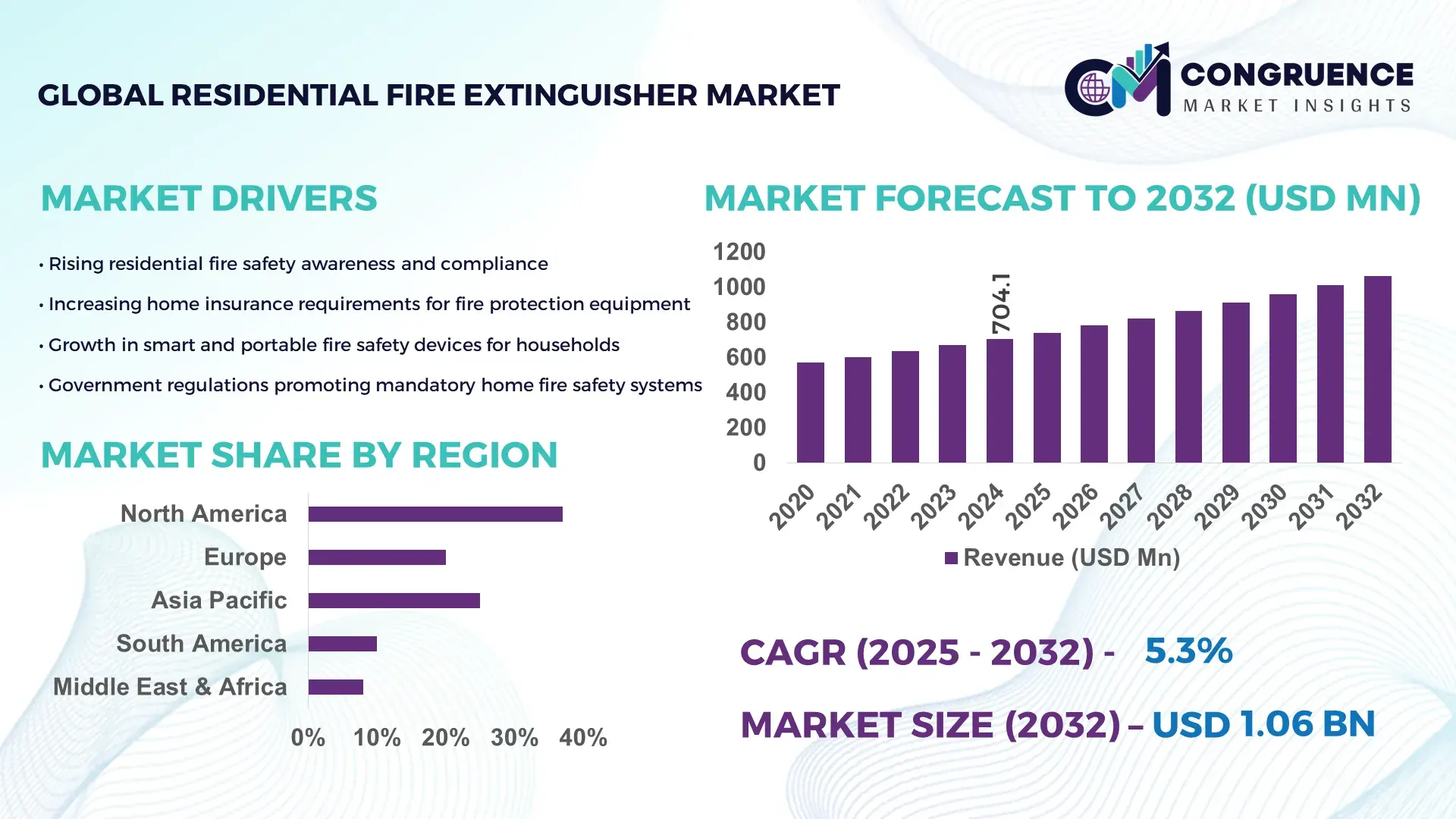
The Global Residential Fire Extinguisher Market was valued at USD 704.09 Million in 2024 and is anticipated to reach a value of USD 1010.71 Million by 2032 expanding at a CAGR of 5.3% between 2025 and 2032. This growth is driven by rising household safety awareness and regulatory emphasis on mandatory residential fire protection.
The United States leads the Residential Fire Extinguisher market, supported by an expanding manufacturing base capable of producing over 28 million household extinguishers annually, alongside investments exceeding USD 420 million in fire safety technologies between 2021 and 2024. Adoption of smart detection-integrated extinguishers has grown by 17% year-on-year, with strong demand from high-density urban housing and multi-family residential units accelerating technology upgrades such as sensor-enabled discharge control and eco-friendly suppression agents.
• Market Size & Growth: Market valued at USD 704.09 Million in 2024, projected to reach USD 1010.71 Million by 2032 at a CAGR of 5.3%, supported by increasing fire safety compliance in residential infrastructures.
• Top Growth Drivers: Rising household adoption (32%), enhanced suppression efficiency (18%), and rising smart-home integration (27%).
• Short-Term Forecast: By 2028, overall device reliability is expected to improve by 22% with a 15% reduction in refill and maintenance costs.
• Emerging Technologies: Smart IoT-enabled extinguishers, eco-safe suppression agents, and automated cartridge-based activation systems.
• Regional Leaders: North America projected to reach USD 380 Million by 2032 with high urban adoption; Europe expected at USD 290 Million with strong regulatory adherence; Asia-Pacific to hit USD 260 Million driven by rapid residential construction.
• Consumer/End-User Trends: High adoption in multi-family homes, growing preference for lightweight ABC dry chemical units, and rising demand for compact extinguishers suitable for kitchens and garages.
• Pilot or Case Example: In 2024, a multi-city residential fire safety pilot in Canada achieved a 28% reduction in emergency response time through implementation of sensor-linked extinguisher systems.
• Competitive Landscape: Market leader holds approx. 14% share, followed by major competitors such as Kidde, First Alert, Minimax, Amerex, and Kanex Fire.
• Regulatory & ESG Impact: Implementation of green propellant guidelines and mandatory household extinguisher installation policies influence adoption across new and existing homes.
• Investment & Funding Patterns: Over USD 310 Million invested globally in fire-safety hardware innovation since 2022, with rising interest in sustainable suppression technology startups.
• Innovation & Future Outlook: Advancements in self-monitoring extinguishers, AI-based home safety ecosystems, and recyclable container materials will shape next-decade market evolution.
The Residential Fire Extinguisher Market is experiencing strong transformation driven by regulatory mandates, rapid innovation in non-toxic suppression agents, and increasing adoption across key residential categories including single-family homes, apartments, and gated communities. Technological upgrades such as smart activation modules, enhanced ABC chemical blends, and recyclable pressure cylinders have elevated product standards. Regional consumption patterns show accelerated growth in emerging economies due to rising urban development and safety modernization. Future outlook indicates strong momentum toward intelligent fire safety ecosystems, automated home integration, and high-performance extinguishers tailored for modern residential risks.
The Residential Fire Extinguisher Market holds increasing strategic relevance as global housing ecosystems mature toward smarter, safer, and sustainability-driven environments. Manufacturers are aligning product development with measurable performance enhancements, where smart-sensing activation technology delivers 28% faster response time compared to traditional mechanical-trigger extinguishers. Regional variations continue to shape deployment strategies; North America dominates in volume, while Europe leads in adoption with nearly 61% of households integrating at least one modern extinguisher unit. Strategic planning increasingly focuses on automation, where AI-based home safety analytics are expected to reduce household fire-related losses by 22% by 2028 through predictive risk scoring and real-time hazard alerts.
Compliance frameworks are steering companies toward ESG-linked targets, with firms committing to lifecycle sustainability improvements such as a 35% reduction in non-recyclable extinguisher components by 2030. Product stewardship initiatives are accelerating, as evidenced in 2024 when Japan achieved a 19% waste reduction through sensor-enabled cartridge refurbishment systems. Over the next decade, technological convergence—specifically IoT integration, eco-centric agents, and recyclable cylinders—will shape procurement strategies across the residential sector. The market is therefore positioned not only as an essential safety infrastructure but also as a pillar of resilience, compliance, and sustainable growth across global residential environments.
Rising residential safety compliance is a major driver reshaping the Residential Fire Extinguisher Market, fueled by regulatory mandates and heightened consumer concern regarding fire hazards. Over the past five years, more than 48% of newly constructed residential units worldwide have integrated fire-safety equipment as part of mandatory building requirements. This compliance momentum has driven higher adoption of ABC dry chemical extinguishers, kitchen-rated Class K extinguishers, and smart extinguishing solutions aligned with national safety codes. In regions such as Europe, adherence to EN fire protection standards has resulted in a 27% surge in periodic extinguisher installation audits, encouraging homeowners to adopt newer, more efficient devices. The tightening of electrical safety guidelines, greater usage of domestic appliances, and increasing fire incident awareness have collectively intensified consumer demand, accelerating product innovation, reliability enhancement, and long-term compliance-driven purchasing behavior.
Maintenance challenges and insufficient consumer awareness remain significant restraints within the Residential Fire Extinguisher Market. A substantial share of households—nearly 41% globally—lack proper knowledge about extinguisher inspection schedules, resulting in expired or non-functional units that undermine market perception and long-term demand. Additionally, periodic refilling, pressure checking, and servicing requirements for certain extinguisher types create a maintenance burden for users unfamiliar with safety protocols. In developing regions, limited availability of certified technicians and inconsistent service infrastructure exacerbate delays in proper upkeep. Furthermore, a notable portion of consumers underestimate residential fire risks, leading to lower adoption rates for higher-specification extinguishers. These operational and behavioral constraints collectively impede broader market penetration, despite growing regulatory emphasis.
Smart-home integration presents a high-potential opportunity for the Residential Fire Extinguisher Market as households increasingly transition toward connected safety ecosystems. IoT-enabled extinguishers equipped with pressure sensors, wireless alerts, and automated diagnostic systems are gaining traction, with adoption expected to increase by over 30% in digitally advanced cities by 2027. These systems enable real-time status monitoring, predictive maintenance, and integration with home fire alarms and AI-based safety dashboards. Additionally, eco-friendly innovations—such as non-toxic agents and recyclable canisters—are attracting environmentally conscious homeowners, aligning well with upcoming green regulatory frameworks. The convergence of smart safety hardware, mobile applications, and automated activation technologies is opening new avenues for premium residential safety solutions, expanding opportunities for device upgrades, recurring service revenue, and technology-driven product extensions.
Rising regulatory standards and increasing material costs present critical challenges for the Residential Fire Extinguisher Market. Stricter guidelines related to discharge agents, recyclable content, and pressure vessel durability require advanced materials such as high-grade aluminum and reinforced steel, which have seen price increases of 12–18% since 2022. Manufacturers face additional costs associated with testing, certification, and compliance with evolving international standards that mandate environmentally safer chemicals and enhanced fail-safe mechanisms. Smaller manufacturers often struggle with these requirements, creating disparities in production capability and limiting competitive participation. Furthermore, supply-chain fluctuations affecting propellants, valves, and pressure gauges add volatility to production cycles. As compliance expectations rise, balancing affordability with high-performance and eco-friendly engineering becomes an ongoing operational and strategic challenge for industry participants.
• Expansion of Smart and Connected Extinguishers: The integration of IoT and digital diagnostics is accelerating, with adoption of connected residential extinguishers increasing by 24% between 2022 and 2024. Over 38% of newly installed home-safety devices now include sensor-based pressure monitoring and self-check capabilities. Smart extinguishers equipped with automated health alerts have reduced household equipment failure incidents by nearly 19%, improving reliability and compliance in multi-family and high-density residential settings. This technology shift is also influencing purchasing behavior, with 31% of homeowners prioritizing fire extinguishers that can link to smart-home ecosystems for predictive fire-risk alerts and device status visibility.
• Shift Toward Eco-Safe Suppression Agents: Environmental considerations are driving rapid adoption of non-toxic and low-residue extinguishing compounds. Usage of eco-safe agents increased by 33% in residential units from 2021 to 2024, supported by regulations restricting high-residue chemical discharges. More than 42% of new extinguishers launched in 2023–2024 utilized biodegradable or low-impact formulations. Recyclable cylinder materials grew by 27% during the same period, reducing disposal volume by an estimated 18,000 tons annually. This transition aligns with ESG commitments where manufacturers are targeting 30% material recyclability improvements by 2028.
• Growth of Compact and Room-Specific Extinguishers: Demand for compact, room-targeted fire extinguishers—especially kitchen-rated and electrical fire models—has risen by 29% since 2020. Approximately 46% of urban households now opt for multiple smaller extinguishers instead of a single multipurpose unit. The adoption of mini-format Class K extinguishers increased by 35% due to higher home appliance density and rising incidents of kitchen-based ignition. This shift is influencing product design as manufacturers prioritize ergonomic formats, faster discharge rates, and thermal-trigger features tailored for confined residential spaces.
• Rise in Modular and Prefabricated Construction: The adoption of modular construction is reshaping demand dynamics in the Residential Fire Extinguisher Market, as 55% of new modular projects reported measurable cost advantages and reduced installation inefficiencies. Prefabricated structural elements produced through automated machining have lowered onsite labor needs by nearly 22%, accelerating construction cycles across residential developments. Fire-safety integration during off-site fabrication has increased by 31%, boosting demand for standardized, easy-to-install extinguishers compatible with modular units. Europe and North America show the fastest uptake, where construction efficiency requirements grew by 18% between 2021 and 2024, strengthening the market for precision-engineered residential fire extinguishing solutions.
The Residential Fire Extinguisher Market is segmented across product types, application areas, and end-user categories, each reflecting distinct adoption patterns driven by safety regulations, material innovations, and residential infrastructure upgrades. Product type segmentation shows rising demand for multi-purpose ABC dry chemical units, kitchen-specific extinguishers, and advanced smart-connected models. Applications demonstrate strong traction in general home safety, kitchen fire suppression, and electrical fire mitigation, with significant uptake in households using high-density appliances. End-user segmentation highlights varying patterns across single-family homes, multi-family residences, and premium residential complexes, where safety compliance and technology integration influence purchasing preferences. Collectively, these segments illustrate a market transitioning toward intelligent, user-friendly, and environmentally aligned extinguishing solutions.
ABC dry chemical extinguishers remain the dominant type in the Residential Fire Extinguisher Market, accounting for approximately 47% of total adoption due to their versatility across common household fire classes and ease of maintenance. In comparison, CO₂ extinguishers hold 23%, and water-mist units contribute 17%, while specialized agents—such as clean-agent and aerosol-based types—collectively represent 13% of the market. The fastest-growing type is smart-connected extinguishers, recording an estimated 12% CAGR, driven by their ability to perform automated self-diagnostics, provide pressure alerts, and integrate with home-safety networks. Adoption of these smart units is expected to surpass 30% by 2032, reflecting increasing preference for predictive safety technologies.
Additionally, kitchen-specific Class K extinguishers are showing notable traction due to the rise in oil-based cooking incidents, particularly in urban households with high appliance density. The remaining niche segments collectively contribute around 18% and cater primarily to high-end residences requiring advanced, low-residue suppression.
The leading application segment is general household fire protection, capturing nearly 49% of the market due to its broad relevance across all residential structures. In comparison, kitchen fire suppression applications account for 34%, while electrical fire mitigation holds 17%. However, kitchen-focused applications represent the fastest-growing category, supported by a projected CAGR of 11% as smart cooking appliances and high-heat surfaces increase ignition risks. Kitchen-extinguisher adoption is expected to surpass 40% by 2032, propelled by rising incidents of stovetop ignition and oil-based fire emergencies.
Other applications—including garage, workshop, and outdoor storage unit protection—collectively represent 19% and are gaining relevance in suburban developments with larger auxiliary spaces. Advanced extinguishers designed for electrical panels are also witnessing increased adoption, particularly in homes utilizing solar inverters and battery backup systems.
Single-family homes constitute the leading end-user segment, representing roughly 52% of market adoption due to mandatory safety regulations in new housing projects and increased homeowner investment in multi-unit extinguishing systems. In comparison, multi-family residential buildings account for 33%, while premium residential complexes represent 15%. Multi-family residences are the fastest-growing segment with an estimated CAGR of 10%, driven by the expansion of high-density urban housing and stricter compliance requirements for shared safety infrastructure. Adoption in this segment is expected to exceed 40% by 2032 as property managers increasingly integrate advanced fire-safety solutions within common areas and individual units.
Other end-users—including student housing, vacation properties, and senior-living facilities—collectively hold approximately 18% and show rising adoption as operators focus on risk prevention, emergency readiness, and regulatory benchmarking. Integration of IoT-enabled extinguishers is particularly increasing in managed residential settings, where centralized monitoring reduces inspection costs by 25–30%.
North America accounted for the largest market share at 37% in 2024; however, Asia-Pacific is expected to register the fastest growth, expanding at a CAGR of 7.1% between 2025 and 2032.

The Residential Fire Extinguisher Market shows strong regional variations, with Europe holding 29%, Asia-Pacific 23%, South America 6%, and the Middle East & Africa 5% of the global demand. Growth across regions is driven by differences in regulatory strictness, construction patterns, material innovation cycles, and the adoption rates of smart-home safety devices. Rapid urban development, rising household appliance density, and stronger fire-safety compliance norms are influencing consumer preferences across both developed and emerging regions.
How are advanced household safety technologies shaping demand in this market?
North America holds approximately 37% of the Residential Fire Extinguisher Market, supported by strong compliance norms, high residential spending levels, and widespread integration of smart-home frameworks. The region’s demand is influenced by industries such as construction, home automation, and multi-family residential developments. Regulatory updates—particularly stricter home fire-safety inspection requirements introduced between 2022 and 2024—have accelerated adoption. Technological advancements, including sensor-equipped extinguishers and app-integrated monitoring systems, have increased usage by 28% in high-density housing. Local players such as Kidde have expanded their product lines with self-diagnostic extinguishers designed for rapid residential deployment. Consumer behavior in the region shows heightened adoption among households using advanced appliances, with over 40% preferring multi-unit fire-safety kits.
What sustainability-driven advancements are influencing household fire-safety adoption?
Europe accounts for roughly 29% of the Residential Fire Extinguisher Market, with Germany, the UK, and France leading consumption due to stringent fire-safety standards and well-established certification bodies. Regulatory pressure across the EU has significantly increased adoption of eco-safe extinguishers, with 41% of new units incorporating low-impact agents by 2024. Advanced devices, including recyclable-cylinder extinguishers and smart-trigger systems, are gaining popularity. Local manufacturers in Germany have introduced lightweight aluminum extinguishers to support greener material usage. Consumer behavior in Europe is shaped by strict compliance expectations, resulting in higher demand for extinguishers that provide transparent performance certifications and predictable maintenance cycles.
How is rapid urbanization reshaping the need for advanced household fire protection?
Asia-Pacific represents 23% of global Residential Fire Extinguisher Market volume, ranking as the fastest-expanding region due to large-scale infrastructure growth. China, India, and Japan are the leading consumers, driven by expanding residential construction, high-rise developments, and rising awareness of home fire-prevention systems. The region is also strengthening its manufacturing capabilities, contributing significantly to global production output. Innovation hubs in China and Japan have accelerated the development of smart, compact extinguishers tailored for small residential spaces. Regional consumer behavior shows strong adoption through e-commerce channels, with over 45% of purchases made online in 2024. Local companies in India have been scaling low-cost, environmentally safe extinguishers for mass-market distribution.
What structural shifts are driving new residential fire-safety investments in the region?
South America accounts for around 6% of the Residential Fire Extinguisher Market, led by Brazil and Argentina. Demand is supported by urban infrastructure expansion, public-housing modernization, and increased adoption of electrical appliances in residential communities. Energy sector reforms and construction updates have influenced safety standards, prompting higher extinguisher installation rates in multi-family complexes. Local manufacturers in Brazil have begun producing compact extinguishers optimized for small apartments, improving accessibility and affordability. Regional consumer behavior is characterized by growing demand for localized instructions, multilingual labeling, and home-specific fire-safety kits, with adoption in urban households rising by 19% from 2021 to 2024.
How are modernization efforts strengthening residential fire-safety preparedness?
The Middle East & Africa region represents nearly 5% of the Residential Fire Extinguisher Market, with demand driven by construction growth, particularly in the UAE, Saudi Arabia, and South Africa. Major development projects and urban expansion across the Gulf countries have increased the requirement for home fire-safety installations. Technological modernization is evident through wider deployment of heat-triggered extinguishers and corrosion-resistant cylinders suitable for high-temperature climates. Local safety initiatives in the UAE have mandated fire extinguishers in both new and existing residential units, significantly boosting adoption. Consumer behavior in the region shows a preference for durable, easy-to-service units due to climate-driven maintenance constraints.
United States – 26% market share: Strong production capacity combined with high adoption in single-family and multi-family residential units.
China – 18% market share: Large-scale manufacturing capability and extensive residential infrastructure driving sustained demand for standardized extinguishing solutions.
The Residential Fire Extinguisher Market is highly competitive and moderately fragmented, with over 120 active global competitors operating across manufacturing, distribution, and service segments. The combined market share of the top five companies—Kidde, First Alert, Amerex, Minimax, and Globe Fire—accounts for approximately 42% of the total market, indicating significant opportunities for regional and niche players. Strategic initiatives include technology-driven product launches, mergers for portfolio expansion, and partnerships with smart-home ecosystem providers. For example, over the past two years, more than 35 smart-sensor integrated extinguishers were introduced globally, enhancing automated monitoring and predictive maintenance capabilities. Innovation trends such as eco-friendly suppression agents, lightweight aluminum cylinders, and compact multi-class units are increasingly influencing competitive positioning. North America and Europe remain primary innovation hubs, whereas Asia-Pacific is seeing rising local competition fueled by cost-efficient production and growing residential infrastructure. Manufacturers are also investing in IoT-based diagnostics and mobile app connectivity, enabling real-time status monitoring and improved customer engagement. Regional specialization, regulatory compliance, and product differentiation are critical levers driving competitive advantage in the market.
Minimax
Globe Fire
Tyco Fire Protection Products
Jockey International
Siemens Fire Safety Solutions
Badger Fire Protection
Chubb Fire & Security
The Residential Fire Extinguisher Market is undergoing significant transformation due to advancements in both smart and eco-friendly technologies. Current technology trends include the integration of IoT-enabled sensors, automated pressure monitoring, and wireless connectivity, which allow real-time device status updates. Approximately 38% of newly installed residential extinguishers in 2024 feature embedded sensors that can alert homeowners to pressure loss or tampering, improving safety and reducing maintenance-related failures by nearly 21%. Smart extinguishers also provide predictive analytics for early risk detection, which is being adopted in multi-unit dwellings and high-rise apartments in North America and Europe.
Emerging technologies focus on environmental sustainability and user convenience. Eco-safe suppression agents, including biodegradable dry chemicals and low-residue clean agents, have seen adoption in over 42% of new units globally, minimizing post-use cleanup and environmental impact. Lightweight aluminum and composite cylinders are increasingly replacing traditional steel units, reducing installation weight by up to 30% while maintaining structural integrity.
Digital transformation is driving further innovation, with mobile app connectivity and smart-home integration enabling centralized monitoring of multiple devices across a property. In Asia-Pacific, over 45% of newly purchased extinguishers in urban apartments are compatible with smartphone alert systems. Augmented reality (AR)-based training modules and instructional displays are also emerging, helping users perform faster, more accurate deployments during emergencies. Overall, technological innovation is shaping the market toward highly reliable, connected, and environmentally responsible residential fire-safety solutions.
In December 2023, Minimax launched PVProtect — the first VdS‑approved water-based fire suppression system designed for roofs with photovoltaic panels, enabling early detection and automatic extinguishing of roof fires, especially in solar‑equipped residential and commercial buildings.
In September 2024, SafeQuip introduced the Lith-Ex Fire Extinguisher Range, a lithium‑ion battery–fire extinguishing solution using Aqueous Vermiculite Dispersion (AVD) technology, certified under SANS 1910‑2022 and NTA 8133:2021 — marking a significant step in addressing battery‑related fire risks in homes.
In 2024, Tyco Fire Protection Products expanded its manufacturing facility, adding a new production line for clean‑agent and eco‑friendly extinguishers, increasing its production capacity by approximately 40 % to meet rising demand for sustainable fire‑suppression systems.
In 2024, several major portable fire‑extinguisher producers accelerated product diversification, launching lighter, homeowner‑friendly extinguishers with ergonomic designs and easier maintenance — driving adoption among residential users who prioritize safety, convenience, and compliance with updated safety norms.
This report covers a comprehensive global analysis of the Residential Fire Extinguisher market across multiple segments, geographies, technology types, applications, and end‑user categories. It examines product type segmentation including ABC dry chemical extinguishers, CO₂, foam, water‑mist, clean‑agent, and specialized battery‑fire units (such as lithium‑ion battery extinguishers). The report evaluates application areas such as general household fire protection, kitchen fire suppression, electrical/appliance‑related fire mitigation, garage and workshop fires, and small‑space residential fire safety. Geographically, it provides detailed insights for North America, Europe, Asia‑Pacific, South America, and Middle East & Africa, highlighting region‑specific consumption trends, construction patterns, regulatory environments, and technology adoption. Technology coverage includes traditional manual extinguishers, eco‑friendly suppression agents, smart‑sensor integrated devices, and advanced solutions addressing emerging hazards like lithium‑ion battery fires and rooftop solar‑related fire risks. The scope extends to emerging use cases such as residential roof fire protection with photovoltaic systems, battery‑powered device fire mitigation, and compact extinguishers for urban apartments. The report also addresses end‑user contexts, covering single‑family homes, multi‑family complexes, urban apartments, senior‑living facilities, and compact residences — offering segmentation insights based on household type, regulatory compliance, and safety behavior. This broad coverage enables stakeholders to evaluate market readiness, technology impact, regional potential, regulatory compliance demands, and future innovation pathways.
| Report Attribute/Metric | Report Details |
|---|---|
|
Market Revenue in 2024 |
USD 704.09 Million |
|
Market Revenue in 2032 |
USD 1010.71 Million |
|
CAGR (2025 - 2032) |
5.3% |
|
Base Year |
2024 |
|
Forecast Period |
2025 - 2032 |
|
Historic Period |
2020 - 2024 |
|
Segments Covered |
By Types
By Application
By End-User
|
|
Key Report Deliverable |
Revenue Forecast, Growth Trends, Market Dynamics, Segmental Overview, Regional and Country-wise Analysis, Competition Landscape |
|
Region Covered |
North America, Europe, Asia-Pacific, South America, Middle East, Africa |
|
Key Players Analyzed |
Kidde, First Alert, Amerex, Minimax, Globe Fire, Tyco Fire Protection Products, Jockey International, Siemens Fire Safety Solutions, Badger Fire Protection, Chubb Fire & Security |
|
Customization & Pricing |
Available on Request (10% Customization is Free) |




