
Reports
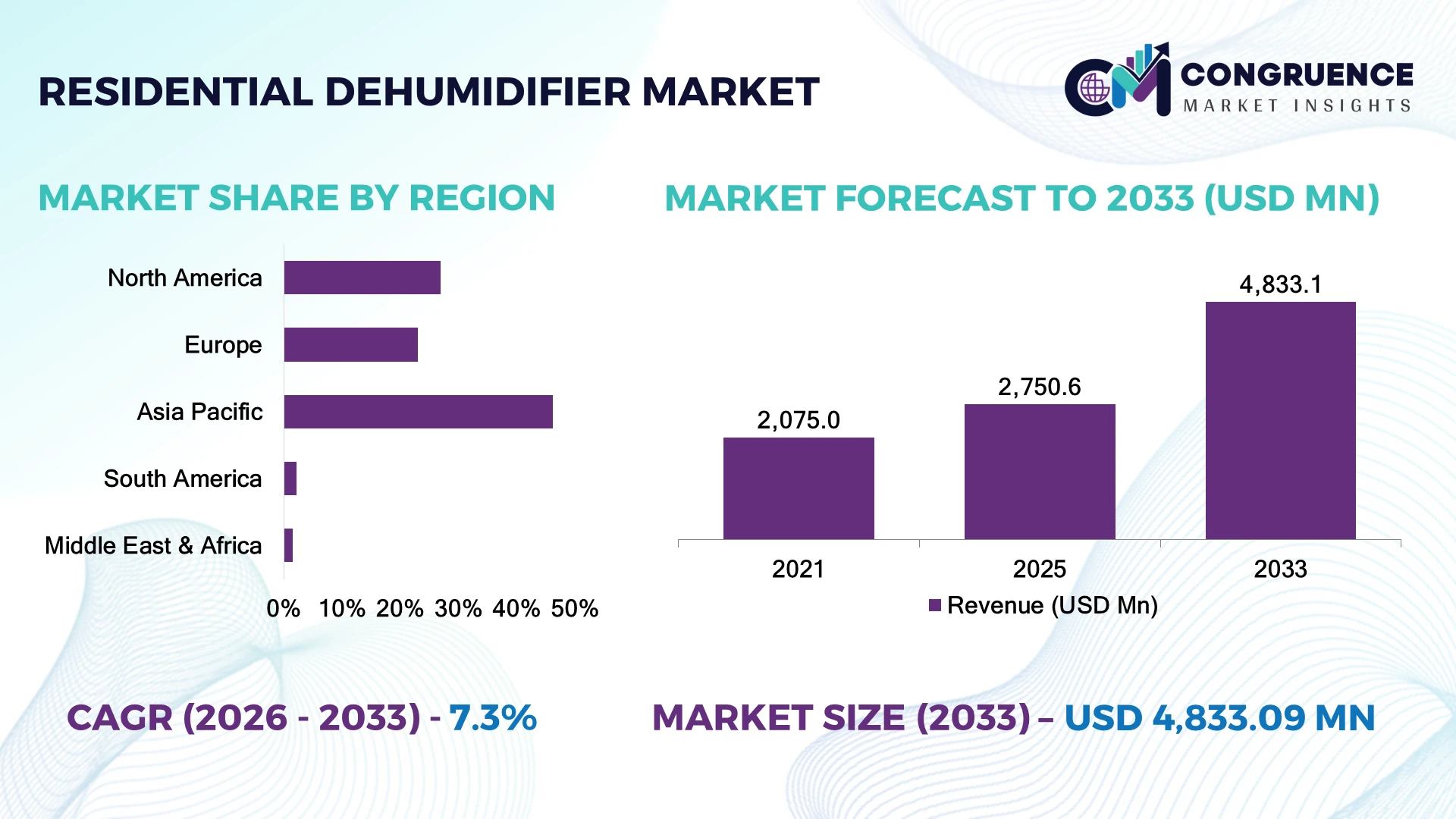
The Global Residential Dehumidifier Market was valued at USD 2,750.6 Million in 2025 and is anticipated to reach a value of USD 4,833.1 Million by 2033 expanding at a CAGR of 7.3% between 2026 and 2033. Growth is driven by rising humidity-related indoor air quality concerns, stricter residential energy-efficiency standards, smart home integration, and increasing renovation of moisture-prone housing.
China accounts for approximately 41% of global residential dehumidifier manufacturing capacity, supported by its mature home appliance ecosystem, compressor production, and electronics supply chain. Production capacity is nearly 2.9 times higher than Vietnam, while smart Wi-Fi-enabled models represent approximately 38% of new residential shipments. Ongoing supply-chain diversification and tariff-driven manufacturing realignment in 2026 are encouraging broader regional production while strengthening appliance innovation and export resilience.
Manufacturers combining energy-efficient technologies, connected home capabilities, and diversified manufacturing footprints will secure stronger long-term market positioning.
Market Size & Growth: USD 2,750.6 million in 2025 reaching USD 4,833.1 million by 2033 at 7.3% CAGR, driven by indoor air quality and smart appliance adoption.
Top Growth Drivers: Smart home integration (+27%), humidity-related health awareness (+24%), energy-efficient appliance upgrades (+22%).
Short-Term Forecast: By 2028, energy consumption declines 16% while moisture removal efficiency improves 18%.
Emerging Technologies: AI humidity control, IoT connectivity, and inverter compressor technology improve residential performance.
Regional Leaders: Asia-Pacific (~USD 2.3 billion), North America (~USD 1.1 billion), Europe (~USD 850 million), supported by smart appliance penetration.
Consumer/End-User Trends: Nearly 59% of premium buyers prefer connected dehumidifiers with mobile app control.
Pilot/Case Example: A 2026 residential smart-home program reduced indoor humidity fluctuations by approximately 21%.
Competitive Landscape: Top five manufacturers control nearly 56% market share through appliance innovation and manufacturing scale.
Regulatory & ESG Impact: High-efficiency appliances lower household electricity use by approximately 14%.
Investment & Funding: More than USD 2.1 billion supports factory expansion, automation, and smart appliance development.
Innovation & Future Outlook: Low-GWP refrigerants, predictive controls, and integrated air-quality management define next-generation residential solutions.
The Residential Dehumidifier market is rapidly shifting toward connected, energy-efficient appliances with intelligent humidity sensing, inverter compressors, and integrated indoor air quality management. Approximately 44% of newly introduced premium models now feature AI-assisted humidity optimization and remote monitoring. Manufacturing diversification following global supply-chain adjustments is accelerating product localization, preparing the market for the strategic transformation discussed below.
The Residential Dehumidifier market has become strategically important as housing modernization, indoor air quality standards, and smart home adoption reshape appliance purchasing priorities. Manufacturers are restructuring supply chains, expanding regional assembly capacity, and integrating connected technologies to improve resilience and reduce delivery risks. Competitive advantage increasingly depends on delivering energy-efficient appliances that combine environmental performance with intelligent home automation.
Modern inverter-based dehumidifiers consume approximately 24% less electricity than conventional fixed-speed systems while improving moisture removal efficiency by nearly 19% under variable humidity conditions. China maintains leadership in manufacturing scale and component sourcing, whereas South Korea and Japan continue differentiating through premium compressor technology and advanced smart appliance integration. During the next two to three years, more than half of premium residential dehumidifier launches are expected to feature AI-enabled humidity optimization and seamless smart home compatibility.
Manufacturers are strengthening partnerships with smart home ecosystem providers, investing in environmentally friendly refrigerants, and expanding localized production to improve supply continuity. Residential developers increasingly specify connected humidity management systems in new housing projects, particularly in high-humidity urban environments. Companies that combine digital connectivity, energy-efficient engineering, and resilient manufacturing strategies will establish durable competitive advantages as intelligent indoor climate management becomes a defining feature of modern residential living.
Residential demand is accelerating as homeowners increasingly prioritize indoor air quality, mold prevention, and moisture control in energy-efficient homes. Approximately 63% of premium residential appliance purchases now consider humidity management as a key buying criterion, while connected humidity control reduces indoor moisture fluctuations by nearly 23% and improves appliance efficiency by approximately 17%. The United States continues strengthening residential energy-efficiency programs and healthy building initiatives, encouraging wider adoption of intelligent dehumidification systems. This transition is prompting manufacturers to expand inverter compressor production, integrate smart home connectivity, and invest in AI-enabled humidity optimization. A notable strategic shift is the repositioning of dehumidifiers from seasonal appliances to year-round indoor climate management solutions.
Manufacturers continue facing structural cost pressures from compressors, electronic control modules, and environmentally compliant refrigerants. Nearly 38% of manufacturing expenses are associated with compressors and cooling components, while advanced low-GWP refrigerants increase production costs by approximately 15%. China remains the primary sourcing hub for critical appliance components, creating procurement challenges during periods of trade policy adjustments and logistics disruptions. These factors compress operating margins and limit price competitiveness in entry-level product categories. Companies are mitigating risks through supplier diversification, localized assembly operations, long-term procurement agreements, and redesigning products with standardized electronic platforms to improve manufacturing flexibility.
Integration with intelligent home ecosystems is creating new value opportunities beyond conventional humidity control. Approximately 46% of premium residential appliances introduced in 2026 support smart home platforms, while AI-driven humidity optimization lowers electricity consumption by nearly 18%. South Korea is advancing connected appliance ecosystems where dehumidifiers communicate with air conditioners, air purifiers, and home energy management systems. Manufacturers are investing in cloud-based device management, expanding software partnerships, and developing subscription-based maintenance services. An emerging strategic opportunity lies in predictive indoor climate management that automatically adjusts humidity based on weather forecasts, occupancy patterns, and household energy demand.
As residential dehumidifiers become digitally connected, manufacturers face growing challenges associated with software compatibility, cybersecurity, and long-term platform support. Approximately 34% of consumers prioritize compatibility with existing smart home ecosystems, while firmware management increases lifecycle support requirements by nearly 19%. Japan's connected appliance sector continues emphasizing secure communication protocols and standardized interoperability across household devices. Inconsistent software integration affects customer satisfaction, increases technical support costs, and complicates multi-brand deployments. Companies must strengthen embedded cybersecurity, invest in universal communication standards, and collaborate with smart home platform providers to maintain long-term competitiveness in connected appliance ecosystems.
Inverter Technology Becomes Standard: Inverter-driven residential dehumidifiers have increased new premium product adoption by approximately 36%, while reducing household electricity consumption by nearly 18%. Rising residential energy-efficiency standards are encouraging manufacturers to automate compressor production, optimize component sourcing, and accelerate replacement of conventional fixed-speed technologies.
Connected Appliances Expand Rapidly: Wi-Fi-enabled dehumidifiers now account for approximately 42% of premium residential launches, while mobile application usage has increased by nearly 27%. Growing smart home adoption is driving appliance manufacturers to establish software partnerships and integrate humidity management into broader connected home ecosystems for centralized device control.
Low-GWP Refrigerant Transition: Environmental regulations are accelerating adoption of low-global-warming-potential refrigerants, with approximately 31% of newly introduced residential models utilizing next-generation refrigerant platforms. Manufacturers are redesigning cooling systems, restructuring supplier relationships, and expanding compliant production capacity to strengthen regulatory readiness and export competitiveness.
Compact Multifunction Designs Rise: Space-efficient residential models combining dehumidification, air purification, and intelligent air quality sensing have improved shelf-space efficiency by approximately 16% while increasing consumer preference by nearly 22%. Appliance companies are investing in modular product platforms and flexible manufacturing lines to respond quickly to changing urban housing requirements and premium lifestyle preferences.
Compressor-based residential dehumidifiers account for approximately 68% of the global market due to their superior moisture extraction capacity, energy-efficient performance in warm climates, and suitability for medium to large residential spaces. Their proven durability and compatibility with smart control systems continue to make them the preferred choice for permanent household installations. Thermoelectric (Peltier) dehumidifiers remain relevant for compact rooms, wardrobes, and low-noise applications, while desiccant dehumidifiers retain strategic importance in colder climates where compressor efficiency declines.
Desiccant dehumidifiers represent the fastest-growing segment as consumers increasingly seek year-round humidity control in colder regions and energy-efficient winter operation. Advanced desiccant systems improve low-temperature moisture removal by approximately 28%, while smart compressor models now account for nearly 44% of premium residential product launches. Manufacturers are investing in quieter compressors, eco-friendly refrigerants, hybrid dehumidification technologies, and intelligent humidity optimization. Investment priorities are steadily shifting toward premium, connected, and climate-adaptive product portfolios capable of serving diverse residential environments.
A 2026 assessment published by the Association of Home Appliance Manufacturers indicated that high-capacity compressor-based dehumidifiers remained the preferred residential solution across North America due to superior moisture removal performance and whole-home deployment capability.
Basement moisture control represents approximately 36% of residential dehumidifier demand, reflecting persistent humidity challenges in below-grade living spaces and storage areas. Continuous operation prevents mold growth, structural deterioration, and indoor air quality degradation, making this application the largest purchasing category. Whole-house humidity management continues gaining momentum through integrated HVAC solutions, while bedroom and living room applications are expanding alongside rising consumer awareness of healthy indoor environments and smart home adoption.
Whole-house humidity control is the fastest-growing application as homeowners increasingly integrate intelligent climate management across multiple rooms. Approximately 33% of newly installed premium residential HVAC systems now incorporate centralized humidity management, while connected monitoring improves indoor comfort consistency by nearly 21%. Manufacturers are expanding smart ecosystem compatibility, developing integrated control platforms, and strengthening partnerships with HVAC solution providers. Demand is shifting from standalone room appliances toward comprehensive residential humidity management solutions that enhance comfort, energy efficiency, and long-term property protection.
A 2025 residential housing technology survey conducted by the National Association of Home Builders reported increasing homeowner preference for integrated humidity control systems in newly constructed energy-efficient homes, particularly in moisture-prone climate zones.
Individual homeowners account for approximately 72% of residential dehumidifier purchases, driven by renovation activity, indoor air quality improvement, and long-term property maintenance. This segment benefits from broad product availability across retail and e-commerce channels, with consumers increasingly selecting connected appliances featuring automatic humidity control and energy-saving operation. Residential landlords remain an important buyer group for rental property maintenance, while vacation homeowners increasingly adopt portable units to prevent seasonal moisture damage during extended vacancy periods.
Residential property developers represent the fastest-growing end-user segment as humidity management becomes an increasingly valued feature in premium housing developments and smart residential communities. Approximately 29% of newly marketed premium housing projects now incorporate integrated indoor climate management features, while developer demand for connected appliances has increased by nearly 18%. Manufacturers are strengthening builder partnerships, offering customized installation packages, and expanding after-sales service networks to secure long-term procurement agreements and strengthen competitive positioning.
A 2026 enterprise assessment by the National Association of Home Builders found that residential developers increasingly specify smart humidity management systems as part of premium indoor environmental quality packages to improve buyer value perception and long-term building performance.
Asia-Pacific accounted for the largest market share at 46.2% in 2025 however, North America is expected to register the fastest growth, expanding at a CAGR of 7.8% between 2026 and 2033.
Smart Home Integration Accelerates Premium Appliance Adoption
North America is strengthening its position through widespread smart home deployment, increasing demand for energy-efficient appliances, and growing consumer focus on indoor air quality. The region represents approximately 27% of global Residential Dehumidifier demand, with high adoption concentrated across humid coastal states and newly constructed energy-efficient homes. Nearly 58% of premium residential dehumidifier sales now include Wi-Fi connectivity and intelligent humidity management. Manufacturers continue expanding localized assembly, strengthening retail partnerships, and introducing Energy Star-certified product portfolios that improve operational efficiency while reducing household energy consumption.
United States Market Outlook: The United States remains the largest national market owing to its mature residential appliance sector, advanced smart home ecosystem, and continuous housing renovation activity. Demand is particularly strong across the Southeast and Gulf Coast, where elevated humidity supports year-round appliance utilization. Approximately 61% of premium residential dehumidifier purchases include connected features such as mobile application control and automatic humidity optimization, encouraging manufacturers to prioritize software integration and after-sales digital services.
Energy-Efficient Housing Modernization Supports Demand
Europe accounts for approximately 23% of global Residential Dehumidifier consumption, supported by stringent appliance efficiency regulations, sustainable housing upgrades, and increasing renovation of moisture-prone residential buildings. Demand is expanding across Northern and Western Europe, where humidity control contributes to building preservation and healthier indoor environments. Nearly 36% of recently introduced residential models utilize low-GWP refrigerants and advanced inverter technology. Appliance manufacturers are investing in environmentally compliant production and expanding partnerships with home improvement retailers to strengthen market penetration.
Germany Market Outlook: Germany leads regional adoption through its advanced appliance manufacturing ecosystem, energy-efficient housing initiatives, and strong consumer preference for premium household technologies. Residential renovation projects increasingly integrate intelligent humidity management systems that complement modern ventilation solutions. Approximately 29% of newly upgraded energy-efficient homes incorporate advanced indoor climate management appliances, supporting sustained demand for premium residential dehumidifiers with connected monitoring capabilities.
Manufacturing Leadership and Urban Housing Expansion
Asia-Pacific dominates the Residential Dehumidifier market through its extensive manufacturing capacity, growing middle-class consumer base, and rapid urban residential development. The region contributes approximately 46.2% of global demand while accounting for more than half of worldwide residential dehumidifier production. Around 65% of exported residential units originate from manufacturing clusters in East Asia, supported by integrated compressor, electronics, and appliance supply chains. Manufacturers continue expanding automated production facilities and regional distribution networks to improve export competitiveness and product availability.
China Market Outlook: China serves as both the world's largest manufacturing hub and one of the fastest-expanding domestic consumer markets for residential dehumidifiers. Strong vertical integration across compressors, motors, electronic controls, and appliance assembly provides significant production efficiency. Approximately 41% of global residential dehumidifier manufacturing capacity is concentrated in China, enabling manufacturers to accelerate smart appliance innovation while maintaining large-scale export capability and rapid product commercialization.
Urban Residential Upgrades Expand Market Penetration
South America is experiencing steady demand growth as urban housing improvements, rising consumer awareness of indoor air quality, and expanding appliance retail networks improve product accessibility. Brazil represents the largest share of regional demand, supported by humid climatic conditions and increasing middle-income household appliance purchases. Approximately 18% of premium residential appliance retailers have expanded their connected home product portfolios during the past two years. Manufacturers continue strengthening regional distribution partnerships while balancing import dependency and localized assembly initiatives to improve supply continuity.
Brazil Market Outlook: Brazil remains the region's largest residential dehumidifier market due to extensive urban housing, humid climatic conditions, and expanding consumer investment in home comfort appliances. National retailers are increasing availability of energy-efficient and smart-connected dehumidifiers across major metropolitan areas. Continued expansion of e-commerce appliance channels is improving market penetration and enabling manufacturers to reach underserved residential consumers with premium humidity control solutions.
Infrastructure Modernization Supports Premium Appliance Demand
The Middle East & Africa Residential Dehumidifier market is advancing through premium residential construction, expanding smart home adoption, and modernization of high-end housing developments. Gulf countries account for the majority of regional premium appliance demand, particularly where humidity control enhances indoor comfort and building durability. Approximately 22% of newly completed luxury residential developments now integrate connected indoor climate management technologies. Manufacturers are strengthening regional distribution partnerships and expanding premium product availability to serve increasingly technology-oriented residential customers.
Saudi Arabia Market Outlook: Saudi Arabia leads regional market development through sustained residential construction activity, smart city initiatives, and rising adoption of intelligent home technologies. Large-scale housing developments increasingly prioritize integrated indoor environmental management as part of premium residential specifications. Growing deployment of connected household appliances is encouraging manufacturers to establish stronger distribution networks, localized service infrastructure, and premium product offerings tailored to modern residential living.
Global appliance leaders Midea, LG Electronics, Panasonic, Whirlpool Corporation, and Danby compete directly with premium climate-control specialists such as Meaco and Aprilaire, while regional OEM manufacturers challenge through aggressive pricing and localized distribution. The top five companies collectively command approximately 54% of global market share. Competition centers on energy efficiency, smart connectivity, manufacturing scale, and supply-chain responsiveness rather than price alone. Inverter technologies reduce electricity consumption by nearly 20%, Wi-Fi-enabled models improve user engagement by approximately 28%, and automated manufacturing lowers production costs by around 14%. Companies are expanding regional assembly, strengthening retailer partnerships, introducing AI-enabled humidity control, and vertically integrating compressor and electronic component production. Competitive momentum is shifting toward connected, environmentally compliant appliances using low-GWP refrigerants and intelligent sensing technologies. Compliance costs, compressor sourcing, and brand credibility remain significant entry barriers. Winning requires scalable manufacturing, differentiated smart technologies, resilient supply networks, and premium after-sales service capabilities.
Midea Group
LG Electronics
Panasonic Corporation
Whirlpool Corporation
Danby Appliances
Meaco
AprilAire
Honeywell
TCL Electronics
Sharp Corporation
De'Longhi S.p.A.
Ebac Ltd.
Residential dehumidifier technology is rapidly advancing through inverter compressors, intelligent humidity sensors, Wi-Fi connectivity, and AI-enabled environmental control. Approximately 62% of premium residential models now incorporate connected monitoring platforms, while inverter compressors improve energy efficiency by nearly 21% compared with conventional fixed-speed systems. Variable-speed airflow management further enhances moisture extraction consistency by approximately 16%, allowing appliances to maintain stable indoor humidity with lower operating noise. These technologies improve user comfort while reducing household energy consumption and supporting premium product differentiation.
Emerging technologies include predictive humidity algorithms, low-GWP refrigerant platforms, occupancy-aware operation, and integration with smart home ecosystems. Compared with traditional compressor designs, AI-assisted humidity optimization improves operational efficiency by approximately 18% while reducing unnecessary compressor cycling by nearly 24%. Premium manufacturers benefit most because connected ecosystems strengthen customer retention, enable software updates, and create opportunities for value-added digital services that differentiate products beyond hardware performance.
Between 2026 and 2028, integrated indoor climate management platforms will become increasingly common as residential appliances communicate with HVAC systems, air purifiers, and home energy management software. Manufacturers investing in embedded intelligence, sustainable refrigerants, and localized automated manufacturing will strengthen competitive positioning. Early adoption enables lower operating costs, stronger regulatory compliance, improved customer experience, and greater resilience against increasing competition in intelligent residential appliance markets.
February 2025 – Midea America unveiled its "Midea Makes the WOW!" initiative, highlighting expanded smart home appliance innovation across the U.S. market and accelerating deployment of connected residential climate-control products. The strategy reinforces premium consumer positioning. Source: Midea
April 2025 – Danby Appliances acquired Coldex, expanding its Canadian appliance manufacturing and distribution capabilities while strengthening product availability across institutional and residential channels. The transaction broadened operational scale and improved domestic supply flexibility. Source: Danby
May 2025 – Midea completed the integration of Teka Group, combining manufacturing capabilities, appliance portfolios, and international distribution networks to accelerate global market penetration and product innovation across residential appliances. Source: Midea Global
January 2025 – Meaco secured two Expert Reviews "Product of the Year 2025" awards for its dehumidifier and fan portfolio, reinforcing premium product recognition and strengthening competitive positioning in energy-efficient residential air treatment. Source: Expert Reviews via Meaco.
The report provides comprehensive analysis of the Residential Dehumidifier market across major product types, residential applications, end-user groups, and key geographic regions. It evaluates compressor, thermoelectric, and desiccant technologies while assessing demand across basements, whole-house humidity management, bedrooms, living spaces, and other residential environments. The study also examines smart connectivity, inverter compressors, AI-enabled humidity control, low-GWP refrigerants, and integrated home climate management technologies influencing purchasing decisions and product development.
The analysis covers Asia-Pacific, North America, Europe, South America, and the Middle East & Africa, evaluating manufacturing concentration, deployment patterns, technology adoption, and competitive positioning. More than 60% of premium residential models now incorporate intelligent humidity management or connected home functionality, reflecting accelerating digital transformation. The report supports investment planning, product portfolio optimization, expansion strategies, competitive benchmarking, and long-term business positioning between 2026 and 2033 by identifying evolving consumer preferences, technology priorities, regional manufacturing trends, and emerging opportunities across the global residential dehumidifier industry.
| Report Attribute/Metric | Report Details |
|---|---|
|
Market Revenue in 2025 |
USD 2,750.6 Million |
|
Market Revenue in 2033 |
USD 4,833.1 Million |
|
CAGR (2026 - 2033) |
7.3% |
|
Base Year |
2025 |
|
Forecast Period |
2026 - 2033 |
|
Historic Period |
2021 - 2025 |
|
Segments Covered |
By Type
By Application
By End-User
|
|
Key Report Deliverable |
Revenue Forecast, Growth Trends, Market Dynamics, Segmental Overview, Regional and Country-wise Analysis, Competition Landscape |
|
Region Covered |
North America, Europe, Asia-Pacific, South America, Middle East, Africa |
|
Key Players Analyzed |
Midea Group, LG Electronics, Panasonic Corporation, Whirlpool Corporation, Danby Appliances, Meaco, AprilAire, Honeywell, TCL Electronics, Sharp Corporation, De'Longhi S.p.A., Ebac Ltd. |
|
Customization & Pricing |
Available on Request (10% Customization is Free) |




