Global Residential Construction Market Report Overview
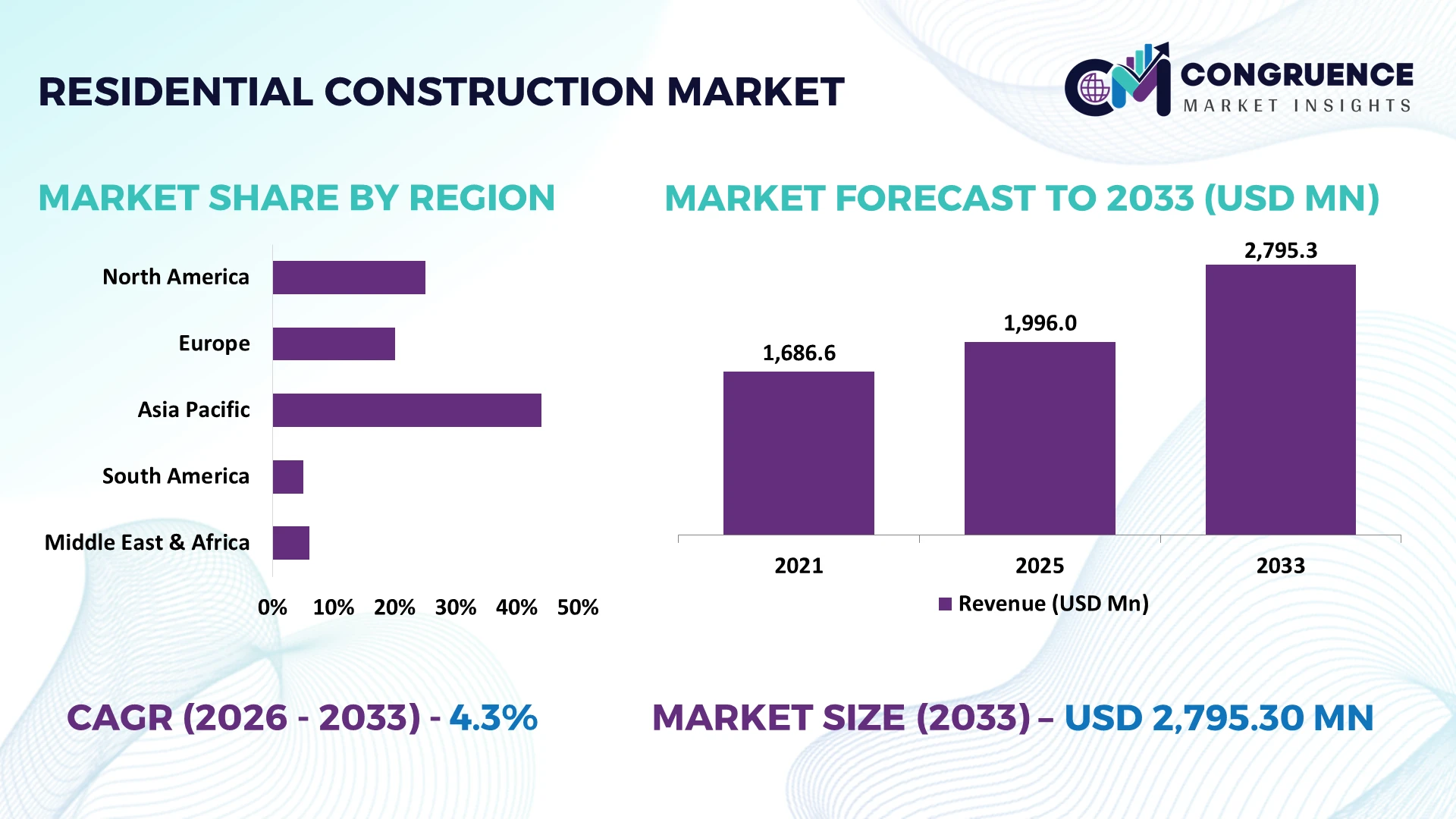
The Global Residential Construction Market was valued at USD 1995.99 Million in 2025 and is anticipated to reach a value of USD 2795.3 Million by 2033 expanding at a CAGR of 4.3% between 2026 and 2033. Growth is driven by government-backed affordable housing programs, urban household formation, prefabricated building adoption, and investments in energy-efficient residential infrastructure.
China maintains a dominant position in global residential construction activity, supported by extensive urban housing infrastructure and established construction material supply chains. The country accounted for approximately 29% of global construction output in 2023, reflecting its substantial industrial capacity. China's property sector restructuring is shifting investment toward affordable housing, urban village redevelopment, and completion of unfinished projects. Compared with India, where the Pradhan Mantri Awas Yojana Urban 2.0 targets 10 million additional urban households, China's residential sector operates at greater established scale. Prefabrication and digital construction technologies support modernization across both markets.
Strategically, developers adopting industrialized construction methods can target 15–25% shorter project schedules and 10–15% lower material waste, strengthening housing delivery efficiency and project competitiveness.
Key Highlights of the Global Residential Construction Market
-
Market Size & Growth: USD 1,995.99 million in 2025, reaching USD 2,795.3 million by 2033 at 4.3% CAGR, supported by affordable housing investment and modular construction.
-
Top Growth Drivers: Illustrative project scenarios identify 20% faster prefabricated delivery, 15% material waste reduction, and 10% procurement efficiency improvement.
-
Short-Term Forecast: By 2027, digitally coordinated residential projects target 15% shorter construction schedules and 10% lower rework requirements.
-
Emerging Technologies: BIM, AI-assisted scheduling, and 3D concrete printing support 3 major pathways toward advanced residential construction productivity.
-
Regional Leaders: Indicative 2033 allocations place Asia-Pacific at USD 1,146 million, North America at USD 783 million, and Europe at USD 587 million, supported by prefabrication, digital project management, and energy-efficient building adoption.
-
Consumer/End-User Trends: Energy-efficient residential designs target 20–30% lower operational energy consumption through improved insulation, ventilation, and building systems.
-
Pilot/Case Example: India's 2024 PMAY-U 2.0 initiative targets housing assistance for 10 million urban households, supporting organized residential development.
-
Competitive Landscape: No single global leader dominates; an indicative top-developer share below 5% reflects fragmentation among D.R. Horton, Lennar, PulteGroup, Sekisui House, and Vanke.
-
Regulatory & ESG Impact: The EU's revised Energy Performance of Buildings Directive targets zero-emission standards for all new buildings from 2030.
-
Investment & Funding: India's PMAY-U 2.0 framework outlines approximately USD 120 billion in total investment, strengthening affordable housing delivery and construction partnerships.
-
Innovation & Future Outlook: Modular housing, digital twins, and low-carbon concrete support modeled 15–25% construction efficiency improvements through 2028.
Residential construction activity increasingly concentrates on affordable housing, urban redevelopment, and energy-efficient residential buildings. Developers are integrating building information modeling, prefabricated structural components, and automated project scheduling to improve construction productivity. Modular construction projects can target 15–25% shorter delivery schedules compared with conventional site-intensive methods, depending on design and project complexity. India's housing initiatives and Europe's tightening building energy requirements are influencing construction specifications and procurement decisions. Emerging opportunities include factory-manufactured housing components, low-carbon materials, and digitally coordinated subcontractor networks. These structural changes are reshaping investment priorities and establishing the foundation for strategic market assessment.
What Is the Strategic Relevance and Future Pathways of the Residential Construction Market?
Residential construction is becoming strategically important as housing affordability pressures, urban redevelopment, and energy efficiency regulations reshape developer investment priorities. India's Pradhan Mantri Awas Yojana Urban 2.0 targets housing assistance for 10 million urban households, creating opportunities for standardized construction systems and organized material procurement. Meanwhile, China's property sector restructuring is redirecting development priorities toward affordable housing and unfinished project completion. Developers increasingly prioritize predictable construction schedules, capital efficiency, and localized building material supply chains to protect project viability.
Industrialized construction technologies are changing residential project economics. Prefabricated building systems can deliver modeled 15–25% shorter construction schedules compared with conventional site-intensive methods, while building information modeling targets 10–15% reductions in coordination-related rework. China benefits from established prefabrication capacity, whereas India emphasizes scalable affordable housing delivery and Europe prioritizes energy-efficient construction. During 2026–2028, developers are expected to increase modular component procurement, digital project coordination, and low-carbon material adoption across selected housing projects.
A practical deployment involves using factory-manufactured wall panels and digitally coordinated installation schedules in multifamily housing developments. Companies including Sekisui House and Lennar are investing in construction standardization and technology-enabled building processes. Competitive advantage increasingly depends on delivering compliant housing faster while maintaining predictable quality, procurement costs, and project execution.
Residential Construction Market Dynamics
DRIVER:
Affordable Housing Expansion and Industrialized Construction Adoption
Government-backed housing programs and urban population concentration are accelerating organized residential construction activity. India's PMAY-U 2.0 targets assistance for 10 million urban households, encouraging developers to expand standardized housing delivery capabilities. Industrialized construction methods can achieve modeled 15–25% shorter project schedules, while prefabricated components target 10–15% lower material wastage compared with conventional construction. These improvements support tighter project financing cycles and more predictable housing delivery. Developers are responding through partnerships with precast concrete manufacturers, modular building suppliers, and digital construction technology providers. India's expanding metropolitan housing corridors create opportunities for repeatable building designs and centralized procurement. The strategic advantage lies in reducing construction variability across multiple developments rather than relying exclusively on lower labor costs.
RESTRAINT:
Construction Material Volatility and Housing Affordability Constraints
Residential construction faces structural pressure from fluctuating cement, steel, timber, and transportation costs, alongside elevated housing financing expenses. In the United States, mortgage affordability constraints influence homebuyer purchasing decisions and developer inventory strategies. Illustrative project sensitivity analysis indicates that a 10% increase in major material costs can raise total construction expenditure by approximately 4–6%, depending on procurement composition. Financing costs increasing by 15% can further compress project margins and delay construction starts. Import-dependent markets face additional exposure to shipping disruptions and currency fluctuations. Developers are responding through fixed-price supply agreements, localized material sourcing, and phased land development. Maintaining procurement flexibility is becoming critical because material price exposure directly affects project feasibility before construction begins.
OPPORTUNITY:
Modular Housing and Energy-Efficient Residential Development
Factory-manufactured housing components and advanced building energy systems offer substantial opportunities to improve residential construction productivity. India's affordable housing programs create demand for standardized structural modules, while Europe's revised Energy Performance of Buildings Directive establishes zero-emission requirements for new buildings from 2030. Modular construction can target 20–30% reductions in on-site labor requirements, while high-performance insulation and efficient building systems can lower operational energy consumption by 20–25% in suitable designs. Developers are expanding partnerships with prefabrication manufacturers, building automation suppliers, and low-carbon material producers. During 2026–2028, digitally configured housing designs and standardized component platforms will support scalable deployment. The strongest opportunity lies in combining factory production with energy-efficient specifications to reduce lifetime housing costs.
CHALLENGE:
Skilled Workforce Shortages and Digital Construction Integration
Residential construction companies face execution challenges from skilled labor shortages, fragmented subcontractor networks, and inconsistent adoption of digital project management systems. In the United States, shortages of qualified electricians, carpenters, and mechanical installation specialists complicate residential development schedules. Illustrative project scenarios indicate that workforce availability constraints can extend completion timelines by 10–20%, while poorly coordinated digital workflows can generate 5–10% additional rework during complex installations. Integrating building information modeling with site execution also requires standardized data exchange and workforce training. Developers must invest in vocational partnerships, digital construction capabilities, and prefabricated installation systems. Long-term competitiveness depends on maintaining consistent construction quality across geographically distributed projects while reducing dependence on specialized on-site labor.
Residential Construction Market Latest Trends
-
Digital Permitting Reshapes Project Approval Workflows: Residential developers increasingly adopt electronic permit submissions, automated compliance checks, and integrated municipal approval systems. In modeled implementations, digital permitting targets 20–30% faster document processing and 15% fewer incomplete submissions. United States municipalities are expanding electronic plan review capabilities, prompting builders to standardize architectural documentation and coordinate regulatory approvals earlier, reducing preconstruction uncertainty and improving development pipeline visibility.
-
Build-to-Rent Communities Attract Institutional Capital: Institutional investors are expanding professionally managed rental housing portfolios, particularly across major United States metropolitan areas. Purpose-built rental developments increasingly incorporate 100–300 residential units, with standardized maintenance specifications targeting 10–15% lower operating administration costs. Developers are restructuring land acquisition and construction partnerships to accommodate long-term ownership strategies, creating more predictable project pipelines and reducing dependence on individual homebuyer transactions.
-
Material Traceability Strengthens Procurement Oversight: Residential builders are introducing digital material passports, supplier verification systems, and standardized product documentation to improve construction transparency. European building product regulations are encouraging stronger material performance records and lifecycle traceability. Digitized procurement workflows target 15–20% faster supplier documentation reviews and 10% fewer material specification discrepancies. Construction companies are expanding supplier data integration, improving compliance coordination and reducing delays caused by incomplete product certifications.
-
Mortgage Affordability Changes Housing Product Mix: Elevated financing costs are encouraging United States homebuilders to prioritize smaller floor plans, financing incentives, and standardized construction specifications. Illustrative development scenarios indicate that 10–15% reductions in average floor area can improve affordability while lowering material requirements by 8–12%. D.R. Horton and Lennar are adjusting product configurations and purchasing strategies, strengthening inventory turnover and supporting demand among payment-sensitive first-time homebuyers.
Segmentation Analysis
By Type
Single-Family Homes Lead Residential Construction Activity
Single-Family Homes represent the leading segment, accounting for an estimated 42% of the global residential construction market, supported by established homeownership preferences, suburban development, and extensive private housing investment. The United States maintains substantial single-family construction activity, with developers prioritizing standardized layouts, efficient land utilization, and repeatable building specifications. Companies including D.R. Horton, Lennar, and PulteGroup are adjusting floor plans and construction processes to address affordability constraints. Multi-Family Homes account for an indicative 25% share, benefiting from rental housing development and institutional investment in professionally managed residential communities.
Apartments and Condominiums represent the fastest-growing type, with an estimated 23% market share, driven by urban land constraints, higher-density development, and demand for centrally located housing. China, India, and major European cities demonstrate increasing emphasis on vertical residential construction and shared infrastructure. Townhouses maintain approximately 10% share, offering intermediate-density housing solutions between detached homes and large apartment developments. Developers are expanding mixed-density portfolios, prefabricated component procurement, and standardized residential designs to improve construction economics and address diverse household affordability requirements.
- The U.S. Census Bureau reported approximately 1.36 million privately owned housing starts in 2025, with single-family construction representing the majority. This reinforces the segment's importance while highlighting opportunities for higher-density residential development.
By Application
New Housing Construction Dominates Development Investment
New Housing Construction accounts for an estimated 48% of global residential construction activity, supported by household formation, urban expansion, and planned residential infrastructure development. China, India, and the United States represent important markets for new housing delivery, although project structures differ significantly across these countries. Developers increasingly prioritize standardized designs, construction scheduling efficiency, and integrated material procurement to control development expenditure. Housing Renovation and Remodeling represents approximately 27% of market activity, supported by aging housing inventories, property modernization, and changing household requirements. Contractors are expanding renovation services incorporating building system upgrades, structural improvements, and digital project coordination.
Affordable Housing Development represents the fastest-growing application, accounting for an indicative 18% share, driven by government housing programs and growing affordability pressures. India's PMAY-U 2.0 targets assistance for 10 million urban households, supporting organized residential construction and standardized housing delivery. Luxury Housing Development maintains approximately 7% share, concentrated in premium urban locations and high-value residential communities. Construction companies are expanding affordable housing partnerships, specialized renovation capabilities, and differentiated residential offerings to balance project profitability with changing housing demand.
- India's Ministry of Housing and Urban Affairs identifies PMAY-U 2.0 as a major affordable housing initiative targeting 10 million urban households. The program supports demand for organized construction delivery, standardized building components, and coordinated project implementation.
By End-User
Individual Homeowners Lead Residential Construction Demand
Individual Homeowners represent the largest end-user segment, accounting for an estimated 38% of global residential construction demand, reflecting direct housing purchases, self-managed construction, and residential renovation expenditure. Homeownership preferences remain important across the United States, India, and several European markets, although financing conditions influence purchasing decisions. Real Estate Developers represent approximately 30% of demand, supported by organized housing communities, apartment projects, and large-scale residential development pipelines. Developers increasingly emphasize standardized construction specifications, centralized procurement, and coordinated subcontractor management to improve project delivery efficiency and manage capital exposure.
Government Housing Agencies represent the fastest-growing end-user segment, supported by affordable housing initiatives and publicly coordinated residential infrastructure investment. India's PMAY-U 2.0 illustrates the increasing role of government-supported housing delivery. Housing Associations maintain important positions in European residential development, particularly through regulated rental housing and community housing programs. Institutional Investors are expanding exposure to professionally managed rental properties and long-term residential assets. Construction companies are developing specialized procurement agreements, flexible project financing structures, and tailored housing delivery models to address differing buyer requirements and strengthen project pipeline stability.
- The National Association of Home Builders' 2025 housing market analysis highlights affordability pressures and changing buyer preferences in the United States. These conditions reinforce demand for smaller homes, standardized designs, and financing-sensitive residential development strategies.
Region-Wise Market Insights
Asia-Pacific accounted for the largest market share at an estimated 41% in 2025 however, Middle East & Africa is expected to register the fastest growth, expanding at a CAGR of an estimated 6.2% between 2026 and 2033.

North America Residential Construction Market
Housing Affordability Reshapes Construction and Development Strategies
North America accounts for an estimated 28% of the global residential construction market, supported by established homebuilding companies, suburban housing demand, and institutional rental property investment. The United States dominates regional construction activity, while Canada contributes through urban housing development and multifamily residential projects. Elevated mortgage financing costs are encouraging developers to prioritize smaller homes, standardized floor plans, and construction efficiency. The United States recorded approximately 1.36 million privately owned housing starts in 2025, demonstrating substantial residential development activity. Major builders, including D.R. Horton, Lennar, and PulteGroup, are adjusting housing portfolios and expanding digital construction management capabilities. Build-to-rent communities are attracting institutional investors seeking professionally managed housing assets. Developers implementing standardized procurement and coordinated subcontractor scheduling target 10–15% reductions in construction-related administrative inefficiencies, supporting project execution and affordability.
United States Market Outlook: The United States maintains a strong residential construction ecosystem supported by established homebuilders, mortgage financing institutions, and extensive building material distribution networks. Texas, Florida, and North Carolina represent important development centers because of population movement and housing construction activity. Single-family housing remains a major construction category, while developers increasingly emphasize smaller floor plans and standardized specifications. Digital project coordination targets 15% faster construction documentation processing.
Europe Residential Construction Market
Energy Performance Regulations Accelerate Housing Modernization
Europe represents an estimated 21% of the global residential construction market, with Germany, France, the United Kingdom, and Spain contributing substantial development activity. Housing construction priorities increasingly reflect energy performance requirements, aging residential infrastructure, and urban affordability constraints. The European Union's revised Energy Performance of Buildings Directive establishes zero-emission requirements for new buildings from 2030, influencing architectural specifications and construction material selection. Germany emphasizes energy-efficient residential development, while the United Kingdom prioritizes housing supply expansion and planning system modernization. Developers are increasing investment in high-performance insulation, heat pump integration, and digitally coordinated building designs. Residential projects incorporating advanced thermal envelopes can target 20–30% reductions in operational energy consumption compared with conventional building configurations. Prefabricated construction components are also supporting standardized quality control and reduced on-site installation requirements.
Germany Market Outlook: Germany maintains a technologically advanced residential construction industry supported by engineering expertise, established building product manufacturers, and stringent energy efficiency requirements. Housing developers increasingly integrate prefabricated components, advanced insulation, and low-carbon construction materials. Government-supported energy renovation initiatives encourage modernization of existing housing stock. Industrialized building processes target 15–20% shorter installation schedules in suitable residential projects, strengthening construction productivity despite skilled labor constraints.
Asia-Pacific Residential Construction Market
Large-Scale Housing Development and Industrialized Building Systems
Asia-Pacific dominates the global residential construction market with an estimated 41% share, supported by extensive housing infrastructure, urban population concentration, and established construction material manufacturing capacity. China remains a major residential construction center, although property sector restructuring has redirected investment toward affordable housing, urban redevelopment, and unfinished project completion. India is expanding organized housing development through government-backed programs, while Japan emphasizes prefabricated construction and technologically advanced residential building systems. India's PMAY-U 2.0 targets housing assistance for 10 million urban households, strengthening demand for standardized construction solutions. China maintains extensive precast concrete manufacturing capabilities, supporting industrialized housing delivery. Developers are increasing investment in building information modeling, modular construction components, and centralized procurement. Illustrative prefabricated housing projects target 15–25% shorter construction schedules, improving project delivery predictability and material utilization.
China Market Outlook: China maintains substantial residential construction capacity through established building material supply chains, large construction enterprises, and advanced prefabrication manufacturing infrastructure. Government initiatives addressing unfinished housing projects and urban village redevelopment are reshaping development priorities. Major cities, including Shanghai, Shenzhen, and Beijing, remain important residential modernization centers. Industrialized construction systems target 10–15% reductions in material wastage, supporting greater resource efficiency and standardized housing quality.
South America Residential Construction Market
Affordable Housing Programs Support Organized Residential Development
South America accounts for an estimated 6% of global residential construction activity, with Brazil representing the largest regional market. Government housing initiatives, metropolitan population concentration, and residential infrastructure modernization support construction demand across Brazil, Chile, Colombia, and Argentina. Brazil's Minha Casa, Minha Vida program remains an important driver of affordable housing development, encouraging standardized construction practices and partnerships between developers and financial institutions. São Paulo and other metropolitan centers demonstrate demand for apartment construction and higher-density residential communities. Developers increasingly adopt precast concrete systems, digital project coordination, and centralized material procurement to manage construction costs. Illustrative implementation scenarios indicate that standardized housing components can reduce construction schedules by 10–20%. However, financing constraints, construction material inflation, and infrastructure limitations continue to influence project feasibility and development timelines.
Brazil Market Outlook: Brazil leads South American residential construction through its established homebuilding industry, extensive cement production capacity, and government-supported housing programs. São Paulo, Rio de Janeiro, and Belo Horizonte represent important residential development centers. Minha Casa, Minha Vida encourages affordable housing delivery through coordinated financing and developer participation. Companies increasingly utilize standardized building specifications, targeting 10–15% improvements in procurement efficiency across repetitive residential projects.
Middle East & Africa Residential Construction Market
Urban Development Investment and Housing Infrastructure Expansion
The Middle East & Africa represents an estimated 4% of global residential construction activity, supported by urban expansion, government housing initiatives, and large-scale infrastructure investment. Saudi Arabia and the United Arab Emirates lead premium residential development and master-planned housing projects, while South Africa, Egypt, and Kenya demonstrate demand for affordable urban housing. Saudi Vision 2030 supports housing development and construction sector modernization, encouraging private developer participation and advanced building technologies. Egypt's New Administrative Capital and associated urban development programs illustrate continued investment in planned residential infrastructure. Construction companies increasingly integrate precast concrete systems, digital design coordination, and industrialized building components. Suitable modular housing deployments target 15–25% faster construction schedules. Infrastructure availability, financing accessibility, and skilled workforce capacity remain important determinants of project delivery performance.
Saudi Arabia Market Outlook: Saudi Arabia represents a strategically important residential construction market through Vision 2030, expanding urban infrastructure, and government-supported homeownership initiatives. Riyadh and Jeddah concentrate major housing development activity, while NEOM incorporates advanced construction technologies into planned urban environments. Saudi Arabia's Vision 2030 targets 70% homeownership by 2030, encouraging developers to expand residential delivery capacity and strengthen partnerships with building material manufacturers.
Market Competition Landscape
The residential construction market remains fragmented, with D.R. Horton, Lennar, PulteGroup, Sekisui House, and China Vanke competing against regional developers and specialized modular housing providers. Their combined global market share is estimated below 5%, reflecting localized land ownership, regulatory differences, and fragmented project delivery. American homebuilders emphasize standardized designs and purchasing scale, while Japanese developers differentiate through industrialized construction and quality control. Chinese companies prioritize urban redevelopment and high-density housing delivery. Prefabricated building systems target 15–25% shorter schedules, while centralized procurement supports modeled 10–15% material purchasing efficiencies. Developers are expanding supplier partnerships, digital construction platforms, and factory-manufactured components to strengthen operational control. Rising land acquisition costs, skilled labor shortages, and financing constraints create substantial entry barriers. Competition increasingly favors integrated development models over conventional subcontractor coordination. Winning requires reliable land pipelines, disciplined procurement, efficient construction execution, and housing products aligned with affordability requirements.
Companies Profiled in the Residential Construction Market Report
Technology Insights for the Residential Construction Market
Current residential construction technologies emphasize building information modeling, prefabricated structural components, and automated project scheduling. BIM integrates architectural, structural, and mechanical designs, targeting 10–15% reductions in coordination rework. Factory-manufactured panels support 15–25% shorter installation schedules than conventional site-built assemblies under comparable project conditions. Adoption is strongest among large developers managing repetitive housing designs, where standardized components improve procurement accuracy, installation consistency, and subcontractor coordination across multiple developments without increasing supervisory requirements or construction complexity.
Emerging technologies include AI-assisted construction planning, robotic surveying, and digitally connected material procurement. Predictive scheduling targets 10–20% fewer avoidable delays, while automated surveying improves measurement productivity by an estimated 15%. Digital twins connect design specifications with construction progress, enabling earlier identification of installation conflicts. Developers in Japan, China, and the United States are expanding technology partnerships to strengthen workforce productivity and construction quality across increasingly complex residential projects.
Disruptive innovations include 3D concrete printing, autonomous construction equipment, and low-carbon building materials. During 2026–2028, suitable printed structural applications target 20–30% lower formwork requirements, while optimized concrete formulations can reduce embodied emissions by 15–25%. Industrialized builders gain competitive advantages through repeatable production, reduced material handling, and faster delivery. Investment priorities increasingly favor integrated design-to-manufacturing platforms over isolated construction technologies.
Recent Developments in the Global Residential Construction Market
-
April 2024: Sekisui House completed its acquisition of M.D.C. Holdings, expanding American homebuilding operations across 16 states with approximately 15,000 annual housing units. The transaction strengthened geographic coverage, construction technology integration, and standardized residential development capabilities. Source: sekisuihouse.co.jp
-
May 2024: Lennar and ICON advanced the Wolf Ranch development in Texas, with 95 homes reportedly printed using robotic concrete construction technology. The 100-home project demonstrated industrialized residential production, reducing dependence on conventional wall construction methods. Source: constructionbriefing.com
-
October 2024: Barratt Redrow received final UK competition clearance following Barratt's acquisition of Redrow, with integration targeting at least £90 million in cost synergies. The consolidation strengthened purchasing scale, operational coordination, and residential development capacity across Britain. Source: gov.uk
-
October 2025: D.R. Horton reported 84,863 home closings during fiscal 2025, reflecting a 5% annual decline amid affordability pressures. The company's operational performance highlighted changing housing demand, encouraging disciplined inventory management, product adjustments, and construction investment allocation. Source: drhorton.com
Scope of the Residential Construction Market Report
The Residential Construction Market Report examines housing development structures, construction technologies, and investment priorities between 2026 and 2033. Segmentation covers Single-Family Homes, Multi-Family Homes, Apartments and Condominiums, and Townhouses. Application analysis evaluates New Housing Construction, Housing Renovation and Remodeling, Affordable Housing Development, and Luxury Housing Development. End-user coverage includes Individual Homeowners, Real Estate Developers, Housing Associations, Government Housing Agencies, and Institutional Investors. Indicative segmentation assigns Single-Family Homes a 42% market share.
Regional assessment covers North America, Europe, Asia-Pacific, South America, and Middle East & Africa, emphasizing construction activity, housing policies, and infrastructure investment. Technology analysis addresses BIM, modular construction, robotic automation, and energy-efficient building systems. Competitive evaluation examines major developers, procurement strategies, and construction partnerships, supporting geographic expansion, investment planning, and long-term competitive positioning.
Residential Construction Market Report Summary
| Report Attribute/Metric | Report Details |
|---|
Market Revenue in 2025 | USD 1995.99 Million |
Market Revenue in 2033 | USD 2795.3 Million |
CAGR (2026 - 2033) | 4.3% |
Base Year | 2025 |
Forecast Period | 2026 - 2033 |
Historic Period | 2021 - 2025 |
Segments Covered | By TypeApartments and Condominiums
By ApplicationHousing Renovation and Remodeling Affordable Housing Development Luxury Housing Development
By End-UserGovernment Housing Agencies
|
Key Report Deliverable | Revenue Forecast, Growth Trends, Market Dynamics, Segmental Overview, Regional and Country-wise Analysis, Competition Landscape |
Region Covered | North America, Europe, Asia-Pacific, South America, Middle East, Africa |
Key Players Analyzed | D.R. Horton, Inc., Lennar Corporation, PulteGroup, Inc., NVR, Inc., Toll Brothers, Inc., KB Home, Sekisui House, Ltd., Daiwa House Industry Co., Ltd., China Vanke Co., Ltd., China Overseas Land & Investment Ltd., Barratt Redrow plc, Taylor Wimpey plc, Persimmon plc, Grupo Vinte S.A. |
Customization & Pricing | Available on Request (10% Customization is Free) |





