
Reports
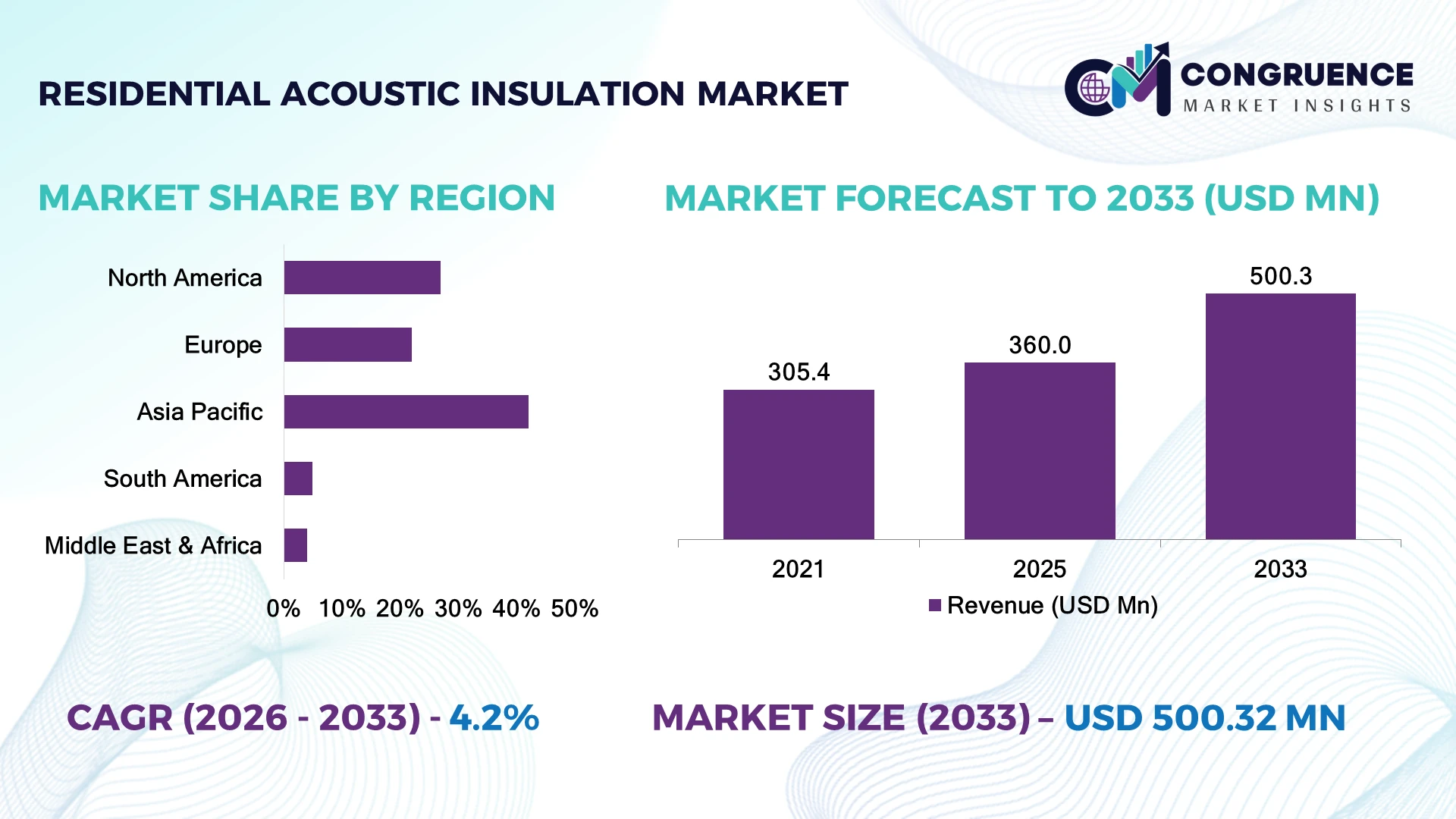
The Global Residential Acoustic Insulation Market was valued at USD 360.0 Million in 2025 and is anticipated to reach a value of USD 500.3 Million by 2033 expanding at a CAGR of 4.2% between 2026 and 2033. Growth is driven by stricter urban noise regulations, rising adoption of recycled acoustic materials, and increased soundproofing requirements in high-density housing projects.
China dominates residential acoustic insulation adoption, accounting for nearly 35% of global installations, supported by urban redevelopment programs and large-scale residential construction. The country’s building sector has integrated advanced mineral wool and polymer-based insulation across more than 60% of newly developed premium housing projects. The United States follows with strong renovation demand, while Germany emphasizes energy-efficient acoustic solutions under EU building standards. China’s residential construction capacity remains over 2 times larger than the U.S. housing improvement market, creating a significant manufacturing and deployment advantage.
Companies prioritizing localized production and sustainable material innovation will gain stronger competitive positioning.
Market Size & Growth: The market reaches USD 360.0 Million in 2025 and USD 500.3 Million by 2033 at a 4.2% CAGR, driven by advanced soundproof panels and urban noise-control regulations.
Top Growth Drivers: Urban housing expansion (35%), renovation activity (28%), and sustainable insulation adoption (22%) are the leading growth contributors.
Short-Term Forecast: By 2028, smart acoustic materials are expected to improve installation efficiency by 20% and reduce material waste by 15%.
Emerging Technologies: AI-based acoustic simulation, automated installation systems, recycled fiber insulation, and nano-enhanced sound barriers are reshaping product development.
Regional Leaders: Asia-Pacific approaches USD 210 Million with high-rise adoption; North America reaches USD 150 Million through remodeling; Europe nears USD 100 Million through green building compliance.
Consumer/End-User Trends: More than 45% of premium residential buyers prioritize acoustic comfort features, especially in urban apartments and mixed-use developments.
Pilot/Case Example: In 2024, European housing projects using advanced mineral wool systems achieved approximately 30% lower indoor noise transmission levels.
Competitive Landscape: Leading manufacturers hold around 40% combined market influence, with key players including Saint-Gobain, ROCKWOOL, Knauf Insulation, Owens Corning, and Kingspan.
Regulatory & ESG Impact: Green building policies have increased demand for recyclable insulation materials by nearly 25% across major construction markets.
Investment & Funding: Over USD 1 Billion in insulation manufacturing expansion and material innovation investments are supporting capacity upgrades and regional supply-chain localization.
Innovation & Future Outlook: Next-generation bio-based fibers, modular acoustic systems, and digitally optimized building designs are driving the shift toward high-performance residential insulation.
Residential acoustic insulation solutions are gaining importance across apartments, luxury housing, and renovation projects as developers focus on occupant comfort, regulatory compliance, and sustainable construction. Recent innovations include lightweight composite panels and recycled acoustic fibers, with adoption of environmentally certified insulation materials increasing by approximately 25%. Supply-chain restructuring in Europe and Asia is encouraging manufacturers to establish localized production hubs, improving material availability and reducing logistics constraints. The market is transitioning toward smarter, thinner, and more efficient acoustic systems that balance performance with space optimization.
Residential acoustic insulation is becoming strategically important as urban density, housing modernization, and occupant wellness standards reshape construction priorities. Developers are increasingly integrating acoustic performance into building designs alongside energy efficiency and sustainability requirements. Regulatory changes in cities such as London, Singapore, and Tokyo are accelerating adoption of certified sound-control materials, while manufacturers are restructuring supply chains to secure mineral fibers, polymers, and recycled inputs.
Advanced acoustic composites are improving installation outcomes compared with traditional insulation systems. Lightweight engineered panels reduce installation time by approximately 25% and require less structural modification than conventional heavy insulation assemblies. Germany and Japan are advancing high-performance acoustic technologies through precision manufacturing, while India and Southeast Asian markets are expanding deployment through affordable housing initiatives.
Companies are increasing investment in automated production, strategic partnerships, and localized manufacturing facilities to improve cost control and delivery reliability. For example, modular residential developers are adopting factory-produced acoustic wall systems to reduce onsite installation complexity. Competitive advantage will increasingly depend on material innovation, regional manufacturing strength, and the ability to deliver sustainable acoustic solutions at scale.
Rising urban density and stricter sound-control standards are strengthening demand for residential acoustic insulation. Countries including China, Germany, and Japan are expanding noise-performance requirements in residential developments, with compliance-driven projects representing nearly 40% of premium housing applications. Recycled fiber and mineral wool technologies are gaining traction due to improved sound absorption and environmental performance. The European Union’s green building initiatives are encouraging developers to integrate acoustic materials alongside energy-efficient designs. Manufacturers are responding through production expansion, partnerships with construction firms, and development of lightweight composite insulation systems. Companies investing in locally manufactured acoustic products are improving supply reliability while reducing exposure to raw material volatility.
Fluctuating prices of mineral fibers, polymers, and specialty acoustic materials continue to pressure manufacturing economics. Raw material costs have increased by approximately 15–20% in some markets due to energy price volatility and transportation disruptions. Smaller construction suppliers face margin challenges because premium acoustic products require higher upfront investment compared with conventional materials. Countries dependent on imported insulation components experience longer procurement cycles and inventory pressure. Manufacturers are reducing exposure through regional sourcing agreements, recycled material integration, and supplier diversification strategies. The ability to maintain consistent pricing while delivering high acoustic performance remains a critical operational challenge for industry participants.
Growing adoption of green construction practices creates opportunities for bio-based fibers, recycled acoustic panels, and digitally optimized insulation solutions. Sustainable insulation materials are experiencing increasing acceptance, with environmentally certified products gaining more than 25% higher preference among premium residential developers. Smart building platforms using acoustic monitoring sensors are creating new opportunities for performance-based insulation services. India, Vietnam, and Brazil are emerging as attractive markets due to expanding urban housing programs and infrastructure modernization. Companies are investing in R&D partnerships and advanced manufacturing technologies to develop thinner, higher-performance insulation products. The next competitive advantage will come from combining acoustic efficiency with sustainability credentials and digital building integration.
Deployment consistency remains challenging due to varying building structures, installation practices, and regional construction standards. Approximately 30% of acoustic performance issues are linked to improper installation rather than material limitations. Skilled labor shortages in markets such as the United States and Australia increase project execution complexity and quality-control requirements. Additionally, inconsistent testing standards across countries create difficulties for manufacturers seeking global product certification. Companies must address these barriers through installer training programs, standardized modular solutions, and digital quality-monitoring tools. Long-term competitiveness will depend on reducing installation variability while ensuring reliable acoustic performance across diverse residential environments.
Recycled Material Integration Rising: Manufacturers are accelerating adoption of recycled wool, PET fibers, and bio-based acoustic materials, with sustainable insulation usage increasing by nearly 25% in premium residential projects. Germany and the Netherlands are tightening green construction requirements, pushing suppliers to redesign product portfolios. Companies are expanding circular material partnerships to reduce raw material dependency and improve ESG compliance.
Prefabricated Systems Gaining Momentum: Modular acoustic wall panels and factory-produced insulation assemblies are improving installation workflows, reducing onsite labor requirements by around 20% and shortening project timelines by 15%. Japan and Singapore are increasing prefabricated housing adoption due to skilled labor constraints. Builders and insulation firms are investing in automated manufacturing lines and contractor integration programs.
Digital Acoustic Design Adoption: Building developers are increasingly using AI-based acoustic simulation and digital modeling tools, improving design accuracy by approximately 30% before construction begins. Enterprise construction firms in the United States are integrating predictive acoustic analysis into planning workflows. Manufacturers are partnering with software providers to deliver customized insulation specifications and reduce redesign costs.
Localized Supply Chains Expanding: Raw material disruptions and transportation pressures are encouraging regional manufacturing investments, with local sourcing strategies improving delivery reliability by nearly 20%. China, India, and the United States are expanding domestic insulation production capacity to reduce import exposure. Companies are restructuring procurement networks and forming regional supplier alliances to strengthen operational resilience.
Mineral wool remains the leading type in the Residential Acoustic Insulation Market, accounting for approximately 45% of total adoption due to superior sound absorption, fire resistance, and compatibility with modern building codes. Its widespread use in apartments, luxury housing, and renovation projects is supported by established manufacturing networks across Germany, China, and the United States. Fiberglass insulation follows with nearly 30% share, benefiting from lower installation costs and broad contractor familiarity. Recycled acoustic panels and polymer-based insulation represent the fastest-growing categories, expanding as developers prioritize lightweight solutions and sustainable materials. These emerging types are gaining adoption rates of more than 20% annually in premium residential projects due to easier installation and improved environmental credentials. Companies are increasing investment in advanced composites, hybrid insulation designs, and localized production facilities to capture evolving demand.
Wall insulation represents the leading application segment with approximately 50% market share, driven by its critical role in reducing airborne noise transmission between apartments, homes, and shared residential spaces. High-density housing projects in China, India, and urban U.S. markets are prioritizing wall acoustic systems to meet occupant comfort expectations. Ceiling and floor insulation applications collectively contribute around 35% share, supported by demand from multi-story residential developments. Home theater rooms, recording spaces, and specialized acoustic environments are emerging as the fastest-growing applications, with adoption increasing by nearly 25% among premium residential buyers. Developers are integrating customized acoustic solutions into luxury housing packages and smart-home ecosystems. Companies are responding through modular product development, installation partnerships, and application-specific acoustic engineering services.
Residential developers and construction companies represent the dominant end-user group, accounting for approximately 55% of market demand due to large-scale apartment projects, urban housing expansion, and regulatory compliance requirements. Large developers in China, the United States, and India are integrating acoustic insulation as a standard feature in premium and mid-income housing projects. Individual homeowners contribute nearly 25% of demand, primarily through renovation and home improvement activities. The fastest-growing end-user segment is luxury residential and smart-home developers, where acoustic comfort is becoming a key differentiation factor. Adoption among premium housing projects has increased by more than 30% as buyers prioritize privacy and wellness features. Manufacturers are strengthening partnerships with developers, architects, and construction firms while introducing customized solutions for different building categories. This shift is creating opportunities for companies offering integrated acoustic design support rather than standalone materials.
Asia-Pacific accounted for the largest market share at 42% in 2025 however, North America is expected to register the fastest growth, expanding at a CAGR of 4.8% between 2026 and 2033.

North America represented approximately 27% of the global Residential Acoustic Insulation Market in 2025, supported by strong renovation activity, advanced residential construction practices, and increasing adoption of high-performance acoustic materials. The United States remains the primary contributor due to large-scale housing upgrades and multi-family residential developments. More than 50% of premium residential projects in major metropolitan areas incorporate enhanced sound-control solutions as builders focus on occupant comfort and compliance. Manufacturers are strengthening domestic production networks, expanding contractor partnerships, and investing in lightweight insulation technologies to improve installation efficiency and reduce dependency on imported materials.
United States Market Outlook: The United States leads regional demand due to its extensive residential renovation ecosystem and advanced construction standards. The country accounts for more than 80% of North American acoustic insulation consumption, with strong adoption across apartments, luxury housing, and remodeling projects. Companies are increasing investment in recycled insulation materials, digital acoustic modeling, and contractor-focused solutions to improve project performance.
Europe accounted for nearly 22% of the global Residential Acoustic Insulation Market in 2025, driven by strict building performance regulations, sustainable construction initiatives, and widespread adoption of certified insulation systems. Germany, France, and the United Kingdom represent major demand centers due to advanced housing standards and renovation programs. More than 35% of new residential developments in Western Europe integrate acoustic insulation as part of energy-efficient building designs. Manufacturers are expanding recycled material production and improving manufacturing efficiency to meet environmental requirements. The region’s focus on low-carbon construction is accelerating the transition toward high-performance mineral wool, fiberglass, and bio-based acoustic solutions.
Germany Market Outlook: Germany remains Europe’s leading market due to its advanced construction regulations, strong insulation manufacturing base, and focus on sustainable buildings. Nearly 60% of energy-efficient residential projects incorporate certified insulation technologies. Companies are prioritizing circular material development and automated production systems to improve sustainability performance and maintain competitiveness.
Asia-Pacific dominated the Residential Acoustic Insulation Market with approximately 42% share in 2025, supported by rapid urbanization, large residential construction pipelines, and strong manufacturing capabilities. China, Japan, and India are the primary contributors, with China maintaining the largest production base for insulation materials. More than 50% of premium urban housing projects in major Chinese cities integrate advanced acoustic solutions to improve living standards. India is witnessing increasing adoption through smart city developments and affordable housing initiatives. Manufacturers are expanding production capacity, establishing regional supply chains, and introducing cost-effective acoustic products to serve diverse residential applications.
China Market Outlook: China holds the strongest position in Asia-Pacific due to its extensive residential construction capacity and domestic manufacturing ecosystem. The country contributes more than 60% of regional insulation production capacity and continues investing in urban redevelopment projects. Companies are focusing on automated manufacturing, sustainable materials, and localized supply networks to support high-volume demand.
South America accounted for approximately 5% of the global Residential Acoustic Insulation Market in 2025, with Brazil and Argentina representing the largest demand contributors. Growth is supported by increasing residential modernization, premium apartment development, and rising awareness of indoor comfort standards. Brazil represents more than 60% of regional demand due to its large urban housing sector and construction activity. However, reliance on imported insulation materials creates supply-chain pressure and affects pricing consistency. Companies are responding by strengthening distribution networks, developing regional partnerships, and introducing products suited for local construction requirements.
Brazil Market Outlook: Brazil remains the key South American market due to its large housing base and metropolitan construction activity. More than 70% of residential development is concentrated in major urban areas, creating demand for improved acoustic performance. Manufacturers are expanding local partnerships and adapting product solutions for residential renovation and new construction projects.
Middle East & Africa represented approximately 4% of the global Residential Acoustic Insulation Market in 2025, supported by luxury residential projects, urban transformation programs, and increasing demand for premium building materials. The United Arab Emirates, Saudi Arabia, and South Africa are the leading contributors. Large-scale developments linked to Saudi Arabia’s Vision 2030 and urban expansion projects across Gulf countries are increasing demand for advanced acoustic solutions. More than 50% of premium residential developments in Dubai incorporate enhanced building performance features, including sound-control systems. Companies are expanding regional partnerships and improving supply availability to serve high-value construction projects.
United Arab Emirates Market Outlook: The United Arab Emirates is the leading Middle East market due to luxury residential construction, smart building adoption, and strong infrastructure investment. Dubai’s premium housing sector increasingly integrates advanced acoustic materials as part of high-quality building specifications. Companies are partnering with developers to deliver customized insulation systems for modern residential projects.
The Residential Acoustic Insulation Market features competition between global insulation leaders, regional manufacturers, and specialized acoustic solution providers. Major players such as Saint-Gobain, ROCKWOOL, Knauf Insulation, Owens Corning, and Kingspan compete through material innovation, distribution strength, and sustainability-focused products. The top five companies collectively account for approximately 45% of market participation, reflecting a moderately consolidated structure. Competition is driven by product performance, pricing efficiency, supply reliability, and customization capabilities, with premium acoustic solutions achieving 20–30% higher adoption in luxury residential projects. Companies are expanding manufacturing capacity, forming construction partnerships, and integrating recycled materials to strengthen market positioning. The competitive landscape is shifting toward sustainable materials, localized supply chains, and digitally optimized acoustic design. High certification requirements, manufacturing expertise, and contractor networks create entry barriers. Winning players will require scalable production, advanced material technology, and strong regional partnerships to outperform established competitors.
ROCKWOOL International A/S
Knauf Insulation
Owens Corning
Kingspan Group
BASF SE
Armacell International S.A.
Johns Manville
Sika AG
Fletcher Building Limited
Trelleborg AB
K-FLEX
Paroc Group
Recticel Insulation
Advanced acoustic insulation technologies are shifting toward recycled fibers, bio-based materials, and lightweight composite structures. Mineral wool and fiberglass remain widely deployed, while recycled PET and natural fiber systems are gaining adoption in sustainable housing projects. New-generation materials improve sound absorption performance by approximately 15–25% compared with conventional insulation products. Companies benefit through improved environmental compliance, reduced material dependency, and stronger positioning in green construction markets.
Digital acoustic modeling, artificial intelligence-based simulation, and smart building integration are becoming important design tools. AI-assisted acoustic planning can reduce design errors by nearly 30% and improve installation efficiency by approximately 20%. Construction firms and insulation manufacturers are adopting these technologies to deliver customized solutions faster while minimizing project modifications. Premium residential developers are increasingly integrating digital acoustic analysis before construction begins.
Between 2026 and 2028, modular acoustic panels, automated manufacturing, and recyclable insulation systems will drive competitive differentiation. Prefabricated acoustic assemblies can reduce installation time by around 25% compared with traditional onsite methods. Companies investing in automation, material innovation, and digital workflows will gain advantages through faster deployment, improved quality control, and stronger customer value.
August 2025 – Saint-Gobain announced the construction of its 7th float glass line and 5th mineral wool insulation line in Chennai, India, strengthening local manufacturing capabilities for insulation products. The expansion adds a new insulation production line to support growing construction demand and regional supply resilience. Business impact: enhanced manufacturing capacity and improved market responsiveness in South Asia. Source: www.saint-gobain.co.in
February 2025 – ROCKWOOL announced the expansion of its Marshall County operations in the United States with a new production line incorporating proprietary WR-Tech™ and CR-Tech™ technologies. The investment increases production capability while enhancing water repellency and corrosion resistance performance. Business impact: stronger supply availability and differentiated product offerings for insulation markets. Source: www.rockwool.com
May 2026 – ROCKWOOL signed an agreement to acquire Ravago’s stone wool factory in Hungary, adding annual production capacity of approximately 40,000 tonnes. The acquisition strengthens the company’s manufacturing footprint in Central and Eastern Europe. Business impact: improved regional supply coverage and stronger operational control across growing insulation markets. Source: www.rockwool.com
August 2024 – ROCKWOOL announced a new stone wool insulation manufacturing facility in Cheyyar, Tamil Nadu, India. The company committed an investment of ₹550 crore and expects the site to create more than 150 jobs, with operations planned from 2026. Business impact: expanded production capacity, localized supply chains, and improved service for the Indian construction and insulation market.
The Residential Acoustic Insulation Market Report covers comprehensive analysis across major material types, including mineral wool, fiberglass, foam-based insulation, recycled acoustic materials, and advanced composite solutions. The study evaluates applications such as wall insulation, floor insulation, ceiling insulation, and specialized residential acoustic environments. End-user coverage includes residential developers, construction companies, renovation contractors, and individual homeowners across North America, Europe, Asia-Pacific, South America, and Middle East & Africa.
The report provides strategic insights into technology adoption, sustainable material trends, supply-chain developments, competitive positioning, and emerging market opportunities. It analyzes deployment patterns, regional manufacturing capabilities, innovation strategies, and company participation across the value chain. The research supports investment decisions, expansion planning, product development strategies, and competitive positioning by identifying key demand shifts and future market direction through 2033.
| Report Attribute / Metric | Details |
|---|---|
| Market Revenue (2025) | USD 360.0 Million |
| Market Revenue (2033) | USD 500.3 Million |
| CAGR (2026–2033) | 4.2% |
| Base Year | 2025 |
| Forecast Period | 2026–2033 |
| Historic Period | 2021–2025 |
| Segments Covered |
By Type
By Application
By End-User
|
| Key Deliverables | Revenue Forecast; Market Trends; Growth Drivers & Restraints; Technology Insights; Segmentation Analysis; Regional Insights; Competitive Landscape; Regulatory & ESG Overview; Recent Developments |
| Regions Covered | North America; Europe; Asia-Pacific; South America; Middle East & Africa |
| Companies Profiled | Saint-Gobain; ROCKWOOL International A/S; Knauf Insulation; Owens Corning; Kingspan Group; BASF SE; Armacell International S.A.; Johns Manville; Sika AG; Fletcher Building Limited; Trelleborg AB; K-FLEX; Paroc Group; Recticel Insulation |
| Customization & Pricing | Available on Request (10% Customization Free) |




