
Reports
The Global Rental and Staging LED Display Market was valued at USD 190.0 Million in 2025 and is anticipated to reach a value of USD 384.2 Million by 2033 expanding at a CAGR of 9.2% between 2026 and 2033, according to an analysis by Congruence Market Insights. Growth is primarily driven by increasing adoption of large-scale events and corporate applications demanding flexible and high-resolution display solutions.
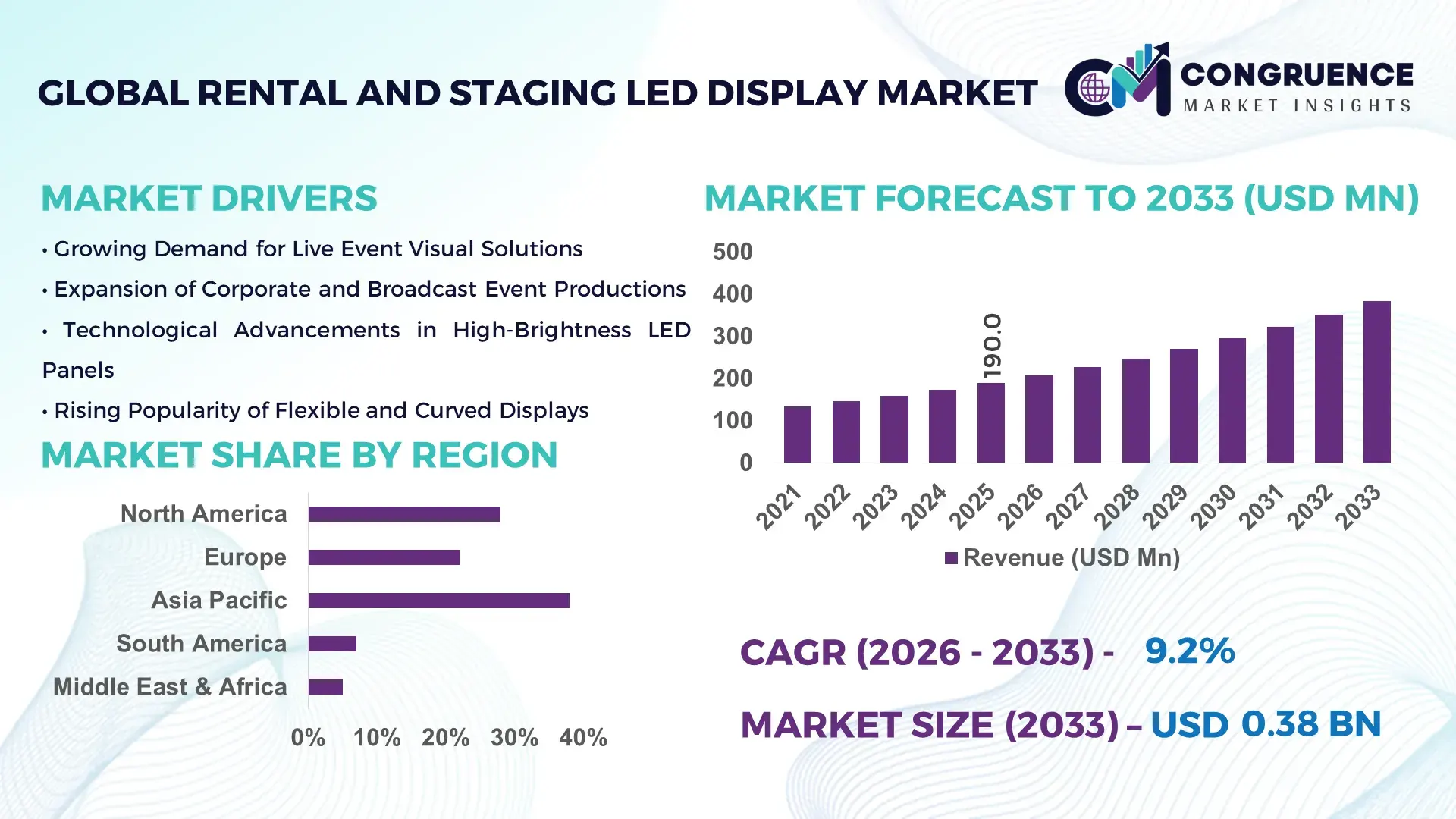
China dominates the Rental and Staging LED Display Market, boasting over 1,200 production facilities capable of producing advanced modular and high-brightness LED panels. In 2025, investments in next-generation display technologies reached USD 85 million, with emphasis on ultra-fine pitch panels and low-latency signal processing. The country’s LED manufacturing hubs serve global trade, with over 60% of rental-grade panels exported annually. China’s technological advancements include energy-efficient LED drivers and automated assembly lines, while end-users such as concert venues and exhibition centers report adoption rates above 70% for rental-grade LED solutions.
Market Size & Growth: Current value USD 190.0 Million, projected USD 384.2 Million by 2033, growth fueled by rising event-based demand.
Top Growth Drivers: Adoption of high-resolution displays 68%, efficiency improvements in modular panels 55%, corporate events digitization 60%.
Short-Term Forecast: By 2028, operational efficiency expected to improve by 25% through modular LED deployment.
Emerging Technologies: Ultra-fine pitch LED panels, wireless control systems, AI-based content optimization.
Regional Leaders: China USD 120.5 Million, USA USD 85.3 Million, Germany USD 46.2 Million by 2033; China leads in production, USA in adoption for corporate events, Germany in technological innovation.
Consumer/End-User Trends: Major users include event organizers, live concerts, exhibitions, and broadcast studios with increasing preference for portable and high-brightness panels.
Pilot or Case Example: In 2025, a Shanghai concert venue achieved 30% faster setup and 20% reduction in downtime through modular LED deployment.
Competitive Landscape: Market leader: Unilumin (~22%), competitors: Leyard, Absen, Daktronics, Liantronics.
Regulatory & ESG Impact: Implementation of energy-efficiency standards and recycling programs for LED panels; governmental incentives for low-power displays.
Investment & Funding Patterns: Recent investments USD 85 Million in production upgrades and R&D; venture funding supports ultra-fine pitch panel development.
Innovation & Future Outlook: Integration of AI-powered control systems and wireless connectivity, expansion of immersive display solutions, forward-looking projects focus on reducing energy consumption by 15–20%.
The Rental and Staging LED Display Market is witnessing growth across corporate events, entertainment, and sports venues, with new ultra-fine pitch and energy-efficient models enabling faster installations and higher-quality visuals. Environmental standards and technological advancements such as wireless control and AI-driven brightness optimization are shaping market adoption. Regional growth varies with China leading production, North America emphasizing deployment, and Europe driving innovation.
The Rental and Staging LED Display Market is strategically positioned as a key enabler of immersive visual experiences across corporate, entertainment, and broadcast sectors. Advanced LED panels deliver up to 40% higher brightness compared to traditional stage screens, enhancing audience engagement while reducing operational costs. China dominates in production volume, while the USA leads adoption with over 70% of major event venues deploying modular panels. By 2028, AI-driven content optimization is expected to reduce setup and adjustment time by 30%, improving operational KPIs significantly.
Firms are committing to ESG improvements, including 20% energy reduction and 50% panel recycling initiatives by 2030. In 2025, Unilumin achieved a 25% efficiency gain in LED setup times at a Beijing convention through automated pre-fabrication and wireless controls. Future pathways involve integration with AR/VR for immersive experiences, wireless and low-latency transmission technologies, and modular panel designs that can scale for various event sizes. The Rental and Staging LED Display Market is thus emerging as a pillar of resilience, regulatory compliance, and sustainable growth, enabling event operators and broadcasters to meet evolving audience expectations efficiently.
The Rental and Staging LED Display Market is characterized by high technological evolution, growing adoption in live entertainment, corporate events, and exhibitions, and increasing demand for modular and portable solutions. The market dynamics are shaped by rapid advancements in ultra-fine pitch displays, wireless control systems, and energy-efficient LED modules. Demand is influenced by cost-effective installation techniques, ease of scalability, and enhanced visual quality requirements. Furthermore, increasing cross-regional trade and export-oriented production hubs have boosted availability and deployment of advanced LED displays worldwide, impacting pricing models and operational strategies for vendors and end-users.
The adoption of modular LED panels is enabling faster setup, greater scalability, and reduced labor costs, critical for large-scale events. Studies indicate venues using modular panels reduce setup time by up to 30% while enhancing visual uniformity. High-resolution modular panels allow flexibility for varied stage dimensions, increasing utility for concerts, exhibitions, and corporate conferences. Furthermore, automation in panel alignment and wireless control has enhanced operational efficiency, contributing significantly to market expansion. Enhanced portability has also driven adoption among mobile event operators, boosting demand across multiple regions.
The production of ultra-fine pitch and high-brightness LED modules requires significant capital investment in precision machinery and quality components. Manufacturing costs can be 25–40% higher than standard panels, impacting smaller rental operators. Energy-efficient designs also necessitate additional R&D expenditure, while compliance with environmental and safety standards adds regulatory overhead. These factors limit rapid scaling and slow adoption in cost-sensitive regions. Additionally, import duties and logistics costs for international deployments further restrict widespread penetration, particularly for mid-sized event organizers.
Growing demand for high-resolution, immersive visual experiences in concerts, live events, and corporate launches is creating significant opportunities. Integration with AI-driven content management systems allows precise control of display brightness, color uniformity, and synchronized visuals. Interactive displays for audience engagement are gaining traction, with over 60% of premium venues planning upgrades in the next 2–3 years. Expansion into emerging markets such as India and Southeast Asia offers untapped opportunities, particularly where temporary event installations are prevalent and digital adoption is accelerating.
Advanced LED displays, particularly ultra-fine pitch modules, require specialized knowledge for installation, calibration, and maintenance. Operational downtime can increase by 15–20% if panels are misaligned or signal systems fail. Technical complexity adds training costs and reliance on certified personnel, while power consumption and cooling requirements can strain infrastructure. Additionally, rapid technological evolution necessitates frequent upgrades, increasing capex for rental operators. Regulatory compliance and adherence to safety standards further complicate logistics, creating barriers for smaller players seeking market entry.
Modular Display Adoption Surge: 55% of new event projects leverage modular and prefabricated panels to reduce setup times and labor costs, particularly in Europe and North America, where efficiency gains are critical.
Ultra-Fine Pitch Innovation: Deployment of sub-2mm pitch panels has increased by 40% in 2025, offering higher resolution and improved audience experience for concerts, broadcast studios, and corporate launches.
Wireless Control & AI Integration: Approximately 62% of venues now use AI-assisted content management and wireless display control, improving synchronization accuracy and reducing signal latency by up to 35%.
Energy Efficiency & Sustainability: New LED driver technologies have cut power consumption by 18% while enabling recycling programs and compliance with emerging ESG standards, influencing procurement decisions across global rental operators.
The Global Rental and Staging LED Display Market is segmented across types, applications, and end-users, reflecting the diverse deployment requirements and technological innovations within the sector. By type, the market includes standard outdoor panels, indoor high-resolution modules, and fine-pitch rental panels, each serving unique operational demands such as concerts, exhibitions, and corporate events. Application segmentation highlights uses in live entertainment, corporate conferences, sports stadiums, exhibitions, and broadcast events. End-user segmentation includes event organizers, rental companies, stadium operators, and broadcast studios. Insights indicate that modular and portable LED displays are increasingly preferred due to reduced setup times, improved energy efficiency, and enhanced visual quality. Adoption trends reveal over 60% of large-scale event operators globally now deploy high-resolution rental panels for temporary installations, while indoor fine-pitch panels are gaining traction in premium corporate and broadcast venues.
The Rental and Staging LED Display Market by type is dominated by indoor high-resolution LED panels, accounting for approximately 48% of adoption due to superior image clarity, energy efficiency, and seamless modular integration. Outdoor panels hold 30%, preferred for large-scale concerts and sporting events because of high brightness and durability. Fine-pitch rental panels are emerging fastest, with adoption rising sharply due to demand for immersive, close-view experiences in corporate launches and premium event spaces, expected to account for 35% of the type segment by 2033. Remaining types, such as transparent or flexible LED displays, contribute a combined 22%, serving niche applications in exhibitions and interactive installations.
Live entertainment leads applications with a 40% share, as concerts, music festivals, and theatrical events demand high-resolution, portable displays for audience engagement. Corporate conferences are the fastest-growing segment, driven by digital signage integration and immersive presentation trends, projected to surpass 30% adoption by 2033. Sports stadiums contribute 18%, leveraging large-scale outdoor panels for fan experience, while exhibitions and broadcast studios account for the remaining 12%, serving specialized deployment needs.
Consumer and adoption trends indicate that in 2025, over 38% of global event organizers piloted high-resolution LED panels for enhanced attendee experience, and 42% of broadcast studios tested modular LED walls for live programming.
Rental companies dominate end-users with 45% adoption, given their need for versatile, quick-to-deploy panels across multiple events. Concert and festival operators are the fastest-growing segment, fueled by demand for high-brightness and portable solutions, expected to exceed 35% adoption by 2033. Broadcast studios hold 15%, while corporate event organizers contribute 20%, and exhibition venues account for 10%. Smaller segments include government events and educational institutions, combining for 10% of end-user deployment. Top end-user industries report adoption rates of 60–70% for modular LED panels, driven by operational efficiency and audience engagement requirements.
Asia-Pacific accounted for the largest market share at 38% in 2025, however, Africa & Middle East is expected to register the fastest growth, expanding at a CAGR of 10.2% between 2026 and 2033.
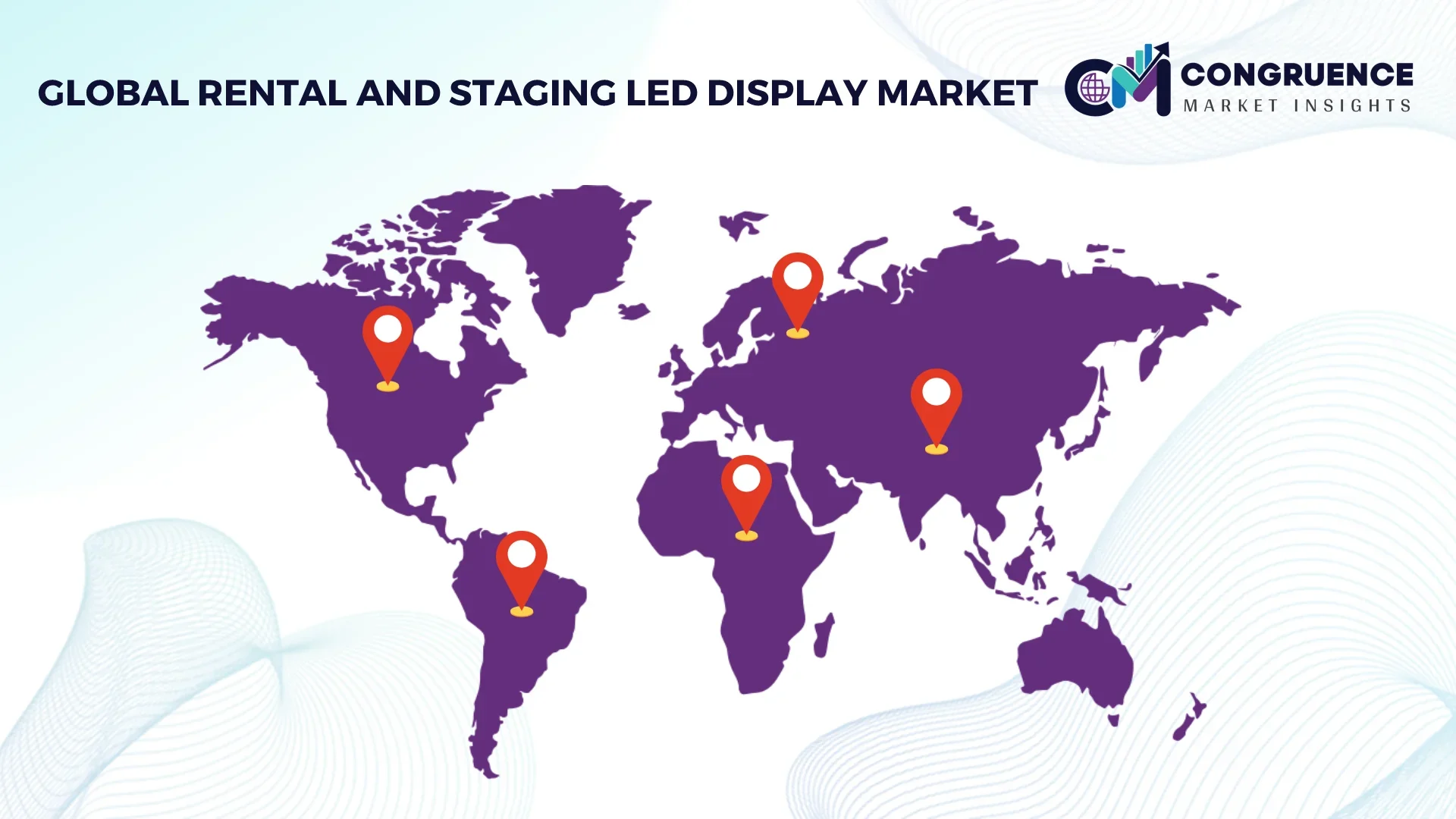
North America holds 28%, Europe 22%, and South America 12%. Asia-Pacific benefits from advanced manufacturing hubs in China, India, and Japan, contributing over 2,500 production lines for rental-grade LED panels. North America leads in enterprise adoption, particularly in healthcare, corporate events, and broadcasting. Europe emphasizes sustainability, with 65% of new panels complying with energy-efficiency standards. South America sees rapid deployment in media and language-specific events. Middle East & Africa growth is driven by infrastructure and oil & gas projects, with UAE and South Africa investing in large-scale outdoor display installations. Across regions, adoption rates vary, with enterprise and live-event sectors driving higher usage in urban hubs.
North America contributes 28% of the global Rental and Staging LED Display Market, driven by corporate conferences, healthcare, and finance sectors adopting high-resolution, portable LED panels. Government incentives and regulatory support for energy-efficient display technologies have accelerated adoption. Technological trends include AI-powered content management, wireless synchronization, and real-time brightness optimization. Local players such as Daktronics are expanding modular LED installations across sports stadiums and convention centers, reducing setup times by up to 25%. Regional consumer behavior shows higher adoption among enterprises in urban hubs, with over 65% of large venues deploying rental-grade LED solutions for temporary events and broadcasting purposes.
Europe accounts for 22% of the global Rental and Staging LED Display Market, with Germany, the UK, and France being key contributors. Regulatory initiatives around energy efficiency and sustainability, such as mandatory low-power LED standards, are shaping procurement decisions. Adoption of ultra-fine pitch and wireless-controlled panels is increasing in corporate events, exhibition halls, and broadcast studios. Leyard Europe recently implemented AI-assisted brightness calibration in multiple exhibition venues, improving display uniformity by 20%. Regional consumer behavior shows strong preference for compliant and energy-efficient solutions, with over 60% of venues prioritizing displays that align with ESG guidelines.
Asia-Pacific leads with 38% market share, supported by high production capacity and export-oriented manufacturing in China, India, and Japan. Key consuming countries include China, India, and Japan, with China alone hosting over 1,200 production facilities for modular and fine-pitch panels. Infrastructure projects and e-commerce-driven live events are fueling demand. Local players such as Unilumin are investing in ultra-fine pitch panels and automated assembly lines, enhancing operational efficiency by 30%. Consumer behavior shows widespread adoption in urban centers for concerts, corporate events, and broadcasting, while mobile and e-commerce applications drive smaller, portable display deployments.
South America holds 12% of the global Rental and Staging LED Display Market, led by Brazil and Argentina. The demand is closely tied to media events, live concerts, and language-localized broadcasts. Infrastructure trends include increasing adoption of modular, portable panels for urban events and stadiums. Trade incentives and government support for energy-efficient displays encourage corporate adoption. AVT Displays Brazil recently implemented wireless-controlled modular panels for major music festivals, reducing setup time by 20%. Regional consumer behavior favors displays that support multiple languages and localized content for audience engagement, particularly in urban entertainment hubs.
Middle East & Africa contribute 10% of the global Rental and Staging LED Display Market, with UAE and South Africa leading in deployment. Regional growth is driven by construction, oil & gas projects, and large-scale entertainment events. Technological modernization includes wireless control systems, AI-assisted content management, and outdoor high-brightness LED panels suitable for harsh climates. Local players such as Gulf LED Solutions are installing modular LED systems for stadiums and corporate events, enhancing visibility and operational efficiency by 18%. Regional consumers prioritize displays that are durable, energy-efficient, and capable of supporting high-profile events with complex visual requirements.
China – 24% Market Share: Dominance due to high production capacity, technological innovation, and export-oriented manufacturing hubs.
United States – 18% Market Share: Strong end-user demand in corporate, entertainment, and broadcast sectors, supported by regulatory incentives for energy-efficient LED displays.
The competitive environment in the Rental and Staging LED Display Market is characterized by a mix of both established global players and emerging specialized innovators, with 20–30 active competitors vying for strategic positioning in modular, outdoor, and fine‑pitch LED solutions. The market exhibits moderate consolidation, with the top 5 companies collectively holding over 43% of the global rental display share, indicating leading firms such as Unilumin, Absen, Daktronics, Barco, and Leyard have significant influence over pricing, supply chain scale, and innovation trends. Competitive initiatives in 2024–2025 include strategic partnerships, product co‑development alliances, and portfolio expansions targeting ease of installation, higher brightness, and reduced power consumption. For example, Absen and NEC Display Solutions announced co‑development of rental LED panels, while Barco strengthened alliances with ROE Visual for high‑brightness solutions. Daktronics secured high‑profile contracts for large stadium deployments, reinforcing its strength in outdoor event LED applications. Innovation trends like ultra‑fine pitch modules, AI‑enhanced control systems, and modular curved displays with rapid rigging features are shaping competitive differentiation. Emerging competitors focus on niche technologies such as transparent LED panels, lightweight cabinets, and cloud‑based content management workflows, broadening the competitive landscape. This landscape demands continued investment in R&D and strategic alliances as companies strive to meet rising demand for immersive, high‑performance, and efficient rental and staging LED solutions.
Unilumin Group Co., Ltd.
Leyard Optoelectronic Co., Ltd.
ROE Visual Co., Ltd.
Samsung Electronics
LG Display
NEC Display Solutions
CreateLED
Infiled
NanoLumens, Inc.
PixelFLEX
VBI, Inc.
TriadOrbit
Technology innovation in the Rental and Staging LED Display Market is rapidly evolving, driven by demands for higher resolution, greater flexibility, energy efficiency, and digital integration. Current advancements include the development of ultra‑fine pitch LED modules with pixel densities below 2.5 mm, delivering sharper visuals and closer viewing distances suitable for indoor staging and corporate events. Modular and lightweight cabinet designs have reduced panel weight by approximately 19%, enabling faster setup and lower labor costs for rental operations. Curved and flexible LED configurations are expanding creative possibilities, with bending angles above 30 degrees increasing by 22% in stage production applications, enhancing immersive experiences for audiences. Outdoor LED panels with brightness levels above 8000 nits have seen a 28% adoption increase for large venues, ensuring visibility under direct sunlight. Integration with 5G and IoT platforms supports real‑time HD content streaming and remote display management, enabling dynamic control of content across geographically dispersed installations. Smart LED systems with AI‑enabled content optimization adjust brightness and color balance automatically, improving visual consistency under variable lighting conditions. Transparent and MicroLED walls are bridging immersive virtual production needs with broadcast quality, offering up to 95% color accuracy for hybrid events. Advances in power efficiency, such as next‑generation LED chips reducing consumption by up to 30%, align with sustainability goals and regulatory standards. Together, these technologies not only enhance performance and reliability but also lower total cost of deployment and operation, shaping strategic decisions for enterprises and rental service providers.
• In June 2025, Barco and Unilumin extended their strategic partnership to integrate Barco’s Infinipix Gen2 LED image‑processing technology with Unilumin’s MIP LED platform, enabling state‑of‑the‑art video wall solutions with pixel pitches below 0.9 mm expected to be ready for shipment by Q4 2025. Source: www.barco.com
• In December 2025, Unilumin showcased its U‑shield series and advanced modular rental LED solutions at LDI 2025 in Las Vegas, featuring rugged designs that deliver 20 % higher brightness and 10,000:1 contrast, with up to 90 % reduced maintenance costs for rental operators. Source: www.unilumin.com
• At ISE 2025, Absen presented an immersive experience portfolio including creative retail displays, control room solutions, and dynamic applications across multiple sectors (e.g., DOOH, broadcast, corporate), highlighting its versatile LED technology offerings for rental and staging use cases. Source: www.absen.com
• During LDI 2025, Absen also showcased its all‑star rental LED product matrix in Las Vegas, spotlighting advanced series such as SA Series, JP Pro Series, and PL V3 Series with high brightness (up to 5000 nits) and flexible configurations for creative staging and touring applications. Source: www.absen.com
The scope of the Rental and Staging LED Display Market Report encompasses a comprehensive examination of technology segments, regional markets, application use cases, and end‑user profiles crucial to understanding current and future demand dynamics. The report analyzes product types such as indoor high‑resolution panels, outdoor high‑brightness displays, fine‑pitch solutions, curved and flexible modules, and transparent LED systems, covering their design innovations, deployment factors, and functional attributes. It also evaluates major application segments, including live entertainment, corporate events, sporting venues, exhibitions, and broadcast studios, highlighting how LED display technologies are configured and utilized in varying event environments and technical ecosystems. The geographic scope extends across North America, Europe, Asia‑Pacific, South America, and Middle East & Africa, providing region‑specific insights into market drivers, infrastructure trends, regulatory environments, and consumer adoption patterns. End‑user focus includes rental service providers, production companies, corporate event planners, media & broadcast houses, and venue operators, offering insights into operational priorities and investment behaviors. Technology coverage includes modular design trends, ultra‑fine pitch pixel innovations, wireless control systems, IoT and 5G integration, power efficiency advancements, and content management platforms, reflecting the technical breadth shaping rental and staging deployments. Trend analysis further identifies developments in virtual production, digital signage integration, sustainability initiatives, and service models such as shared inventory and cloud‑based management, underscoring the evolving complexity and opportunity landscape. Designed for decision‑makers, this report provides a holistic and quantitative understanding of the Rental and Staging LED Display Market’s segments, innovation drivers, and competitive forces.
| Report Attribute / Metric | Details |
|---|---|
| Market Revenue (2025) | USD 190.0 Million |
| Market Revenue (2033) | USD 384.2 Million |
| CAGR (2026–2033) | 9.2% |
| Base Year | 2025 |
| Forecast Period | 2026–2033 |
| Historic Period | 2021–2025 |
| Segments Covered |
By Type
By Application
By End-User Insights
|
| Key Report Deliverables | Revenue Forecast, Market Trends, Growth Drivers & Restraints, Technology Insights, Segmentation Analysis, Regional Insights, Competitive Landscape, Regulatory & ESG Overview, Recent Developments |
| Regions Covered | North America, Europe, Asia-Pacific, South America, Middle East & Africa |
| Key Players Analyzed | Barco NV, Absen, Inc., Daktronics, Inc., Unilumin Group Co., Ltd., Leyard Optoelectronic Co., Ltd., ROE Visual Co., Ltd., Samsung Electronics, LG Display, NEC Display Solutions, CreateLED, Infiled, NanoLumens, PixelFLEX, VBI, Inc., TriadOrbit |
| Customization & Pricing | Available on Request (10% Customization Free) |




